09 Apr 2018

Coinbase hires Rachael Horwitz as its first VP of comms

As Coinbase slowly earns the opportunity to begin thinking about taking a breath after the insane growth of the past few months, it’s thinking more about what all it has to say.

The cryptocurrency exchange startup has hired Spark Capital partner Rachael Horwitz as its first VP of communications.

Horwitz led marketing and communications work for Spark Capital and served as an advisor to some of the firm’s portfolio companies, one of which was Coinbase . Previous to that, she was the director of technology communications at Facebook.

As an industry, blockchain tech has had a bit of a PR problem. Its proponents have promised the moon, but scandals and scams have left the impression that it’s all still a bit of a wild west. For the more legitimate startups like Coinbase, that presents its own challenges — but also plenty of opportunities. Horwitz tells TechCrunch she is particularly excited about tackling public education of blockchain and ensuring that regular consumers know about it, but also that the Silicon Valley tech community is aware of its promise.

“Over the past year especially, it’s really been a blockbuster year in the cryptocurrency space, so now the opportunity is really how do you keep that momentum going and how do you capitalize on that, and I think there’s so much to do in education especially,” Horwitz told TechCrunch in an interview.

Horwitz is Coinbase’s third female executive hire made in recent months. Tina Bhatnagar (previously of Twitter) is the company’s VP of operations and technology, and Emilie Choi (formerly of LinkedIn) is VP of business development. Horwitz has previously taken part in events to promote female representation in the cryptocurrency space, not only in leadership roles at startups, but as investors.

“The mission is to create a more open financial system for the world. I think it goes without saying that you can’t do that without making sure that everyone has an equal opportunity to participate in this new system.”

Horwitz begins her position at Coinbase today.

09 Apr 2018

Gov officials conclude SpaceX not at fault for Zuma satellite separation failure, report says

In turns out, SpaceX was indeed not responsible for the loss of a top secret government satellite that fell back to earth and was destroyed following a Falcon 9 rocket launch earlier this year, a report in the Wall Street Journal today states.

The Zuma satellite’s purpose was highly classified, but the fate of the project which was rumored to cost $3.5 billion to develop was covered in a high profile fashion because it was intimately tied to a live-streamed SpaceX launch. Sources familiar with two separate federal and industry investigations tell the Journal that the blame for the failure rests with the failure of a payload adapter modified by top military contractor Northrop Grumman which also built the Zuma satellite itself.

The payload adapter device struggled to operate in zero gravity conditions, the report details:

The device, purchased from a subcontractor, was significantly modified and then successfully tested three times on the ground by Northrop Grumman, according to one person familiar with the process. But upon reaching orbit, this person said, the adapter didn’t uncouple the satellite from the rocket in zero-gravity conditions.

Sensors on board failed to immediately report what happened, this person said, so officials tracking the launch weren’t aware of the major malfunction until the satellite was dragged back into the atmosphere by the returning second stage. The satellite ultimately broke free but by then had dropped to an altitude that was too low for a rescue.

In the aftermath of the successful Falcon 9 launch, word emerged that the Zuma satellite separation had been far less successful, but because of the project’s classified nature there was no official word to be found. Given the often tenuous nature of SpaceX’s history with public perception of its rocket safety, the company did later publicly note that the Falcon 9 “did everything correctly,” insinuating that the fault did not lie with its tech.

Reports soon emerged that the failure was likely not the fault of SpaceX, and it seems that after investigations, the government has concluded the same.


09 Apr 2018

Facebook shut down Russian APT28 trolls before the 2016 U.S. election

The most interesting part of Mark Zuckerberg’s prepared testimony for congress that was released today shows that Facebook has been fighting Russian election interferences since before the 2016 U.S. presidential race. Facebook shut down accounts related to Russian GRU military intelligence-linked group APT28, also known as Fancy Bear, which had created an organization called DCLeaks run by fake personas to seed stolen information to journalists.

Wired detailed the methods of the “Advanced Persistent Threat 28” group in January 2017. APT28 uses zero-day exploits, malware-equipped spearfishing emails, publicly known but unfixed vulnerabilities in computer systems, and malicious iFrames embedded in hacked websites to steal people’s files. The group has been connecte to attacks on NATO, French television station TV5Monde, and the World Anti-Doping Agency.

The Washington Post reported in September 2017 that Facebook had detected the APT28 accounts in June 2016 and reported their activity to the FBI, but didn’t detail that Facebook had fought back directly by shutting down their accounts. Facebook had not previously confirmed this story.

Here’s Zuckerberg’s full explanation of the situation:

“Elections have always been especially sensitive times for our security team, and the 2016 U.S. presidential election was no exception. Our security team has been aware of traditional Russian cyber threats — like hacking and malware — for years. Leading up to Election Day in November 2016, we detected and dealt with several threats with ties to Russia. This included activity by a group called APT28, that the U.S. government has publicly linked to Russian military intelligence services. But while our primary focus was on traditional threats, we also saw some new behavior in the summer of 2016 when APT28-related accounts, under the banner of DC Leaks, created fake personas that were used to seed stolen information to journalists. We shut these accounts down for violating our policies.”

The Post reported that APT28 were known for stealing data and military plans from political targets, leading Facebook’s security team to assume it was planning traiditional espionage rather than a more public-facing disinformation campaign to skew the election. But they did share their findings with the FBI. Later when Facebook discovered APT28 had created the the Guccifer 2.0 hacker persona and DCLeaks Facebook to deliver stolen emails and documents to journalists, Facebook contacted the FBI again.

Now Zuckerberg’s testimony indicates Facebook didn’t just hand off responsibility to the FBI, but worked to combat the trolls on its own.

This information could give Facebook and Zuckerberg a better defense as he’s questioned by the U.S. Senate Judiciary and Commerce committees Tuesday, then the U.S. House Energy and Commerce Committee on Wednesday. If Facebook can demonstrate that it wasn’t completely asleep at the wheel regarding election interference, it could get softer treatment than if Congress thinks it was caught completely off-guard.

You can see Zuckerberg’s full prepared testimony below:

Zuckerberg Statement to Congress by Jordan Crook on Scribd

09 Apr 2018

This is Mark Zuckerberg’s prepared statement for Congress

Ahead of Mark Zuckerberg’s testimony before Congress on Wednesday, the House Energy and Commerce Committee has released the Facebook CEO’s prepared statement.

In it, Zuckerberg explains that Facebook has always been an optimistic organization, focusing on connecting people and giving them a voice. But Zuckerberg also admits that the idealist train of thought might have blinded the company to potential misuses of Facebook’s toolset.

But it’s clear now that we didn’t do enough to prevent these tools from being used for harm as well. That goes for fake news, foreign interference in elections, and hate speech, as well as developers and data privacy. We didn’t take a broad enough view of our responsibility, and that was a big mistake. It was my mistake, and I’m sorry. I started Facebook, I run it, and I’m responsible for what happens here.

The statement also goes over both the Cambridge Analytica scandal and Russian election interference, thoroughly explaining what happened in each situation and what Facebook is doing to solve these problems.

Zuckerberg is set to testify before the Senate tomorrow and before Congress on Wednesday. We’ll be covering both hearings.

You can read the full statement embedded below.

09 Apr 2018

Facebook will tell you today if Cambridge Analytica had access to your data

Last week, Facebook revealed that 87 million or so users potentially had their data improperly shared with Cambridge Analytica — and you’ve no doubt been wondering if yours is among them. Today the site will share that information with users.

The disclosure arrives by way of a new “protecting your information” link set to appear at the top users’ feeds. The landing page lets users manage the third-party apps using the site to log-in and lets them know whether that information has been improperly shared with Cambridge Analytica

“We have banned the website ‘This Is Your Digital Life,’ which one of your friends used Facebook to log into,” the note is set to read. “We did this because the website may have misused some of your Facebook information by sharing it with a company called Cambridge Analytica.”

The news was announced last week, as part of a larger data privacy push for the site, which has scrambled to rehabilitate its image in the wake of political upheaval tied to information sharing. The slate of announcements also included new restrictions to Events, Groups and Pages APIs, along with Facebook log in, among others.

Earlier today, the site announced that it is working with nonprofits to improve the study of the ways in which its data is being used to impact elections.

09 Apr 2018

Juro grabs another $2m to take the hassle out of contracts

UK startup Juro, which is applying a “design centric approach” and machine learning tech to help businesses speed up the authoring and management of sales contracts, has closed $2m in seed funding led by Point Nine Capital.

Prior investor Seedcamp also contributed to the round. Juro is announcing Taavet Hinrikus (TransferWise’s co-founder) as an investor now too, as well as Michael Pennington (Gumtree co-founder) and the family office of Paul Forster (co-founder of Indeed.com).

Back in January 2017 the London-based startup closed a $750,000 (£615k) seed round, though CEO and co-founder Richard Mabey tells us that was really better classed as an angel round — with Point Nine Capital only joining “late” in the day.

“We actually could have strung it out to Series A,” he says of the funding that’s being announced now. “But we had multiple offers come in and there is so much of an explosion in demand for the [machine learning] that it made sense to do a round now rather than wait for the A. The whole legal industry is undergoing radical change and we want to be leading it.”

Juro’s SaaS product is an integrated contracts workflow that combines contract creation, e-signing and commenting capabilities with AI-powered contract analytics.

Its general focus is on customers that have to manage a high volume of contacts — such as marketplaces.

The 2016-founded startup is not breaking out any customer numbers yet but says its client list includes the likes of Estee Lauder, Deliveroo and Nested. And Mabey adds that “most” of its demand is coming from enterprise at this point, noting it has “several tech unicorns and Fortune 500 companies in trial”.

While design is clearly a major focus — with the startup deploying clean-looking templates and visual cues to offer a user-friendly ‘upgrade’ on traditional legal processes — the machine learning component is its scalable, value-added differentiator to serve the target b2b users by helping them identify recurring sticking points in contract negotiations and keep on top of contract renewals.

Mabey tells TechCrunch the new funding will be used to double down on development of the machine learning component of the product.

“We’re not the first to market in contract management by about 25 years,” he says with a smilie. “So we have always needed to prove out our vision of why the incumbents are failing. One part of this is clunky UX and we’ve succeeded so far in replacing legacy providers through better design (e.g. we replace DocuSign at 80% of our customers).

“But the thing we and our investors are really excited about is not just helping businesses with contract workflow but helping them understand their contract data, auto-tag contracts, see pattens in negotiations and red flag unusual contract terms.”

While this machine learning element is where he sees Juro cutting out a competitive edge in an existing and established market, Mabey concedes it takes “quite a lot of capital to do well”. Hence taking more funding now.

“We need a level of predictive accuracy in our models that risk averse lawyers can get comfortable with and that’s a big ask!” he says.

Specifically, Juro will be using the funding to hire data scientists and machine learning engineers — building out the team at both its London and Riga offices. “We’re doing it like crazy,” adds Mabey. “For example, we just hired from the UK government Digital Service the data scientist who delivered the first ML model used by the UK government (on the gov.uk website).

“There is a huge opportunity here but great execution is key and we’re building a world class team to do it. It’s a big bet to grow revenue as quickly as we are and do this kind of R&D but that’s just what the market is demanding.”

Juro’s HQ remains in London for now, though Mabey notes its entire engineering team is based in the EU — between Riga, Amsterdam and Barcelona — “in part to avoid ‘Brexit risk'”.

“Only 27% of the team is British and we have customers operating in 12 countries — something I’m quite proud of — but it does leave us rather exposed. We’re very open minded about where we will be based in the future and are waiting to hear from the government on the final terms of Brexit,” he says when asked whether the startup has any plans to Brexit to Berlin.

“We always look beyond the UK for talent: if the government cannot provide certainty to our Romanian product designer (ex Kalo, Entrepreneur First) that she can stay in the UK post Brexit without risking a visa application, tbh it makes me less bullish on London!”


 

09 Apr 2018

App downloads and revenue again broke records in the first quarter of 2018

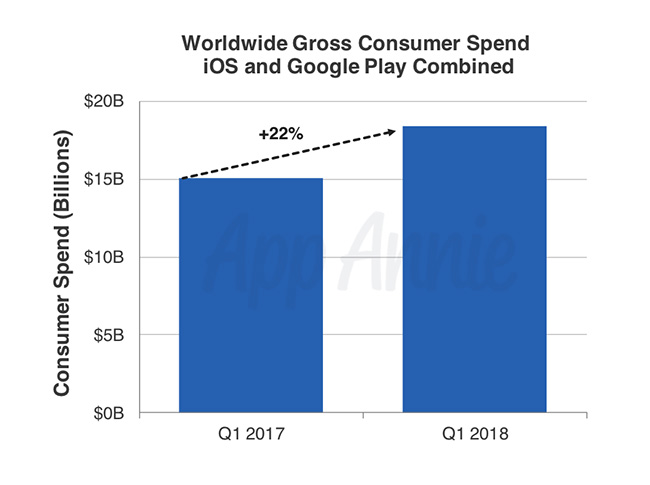
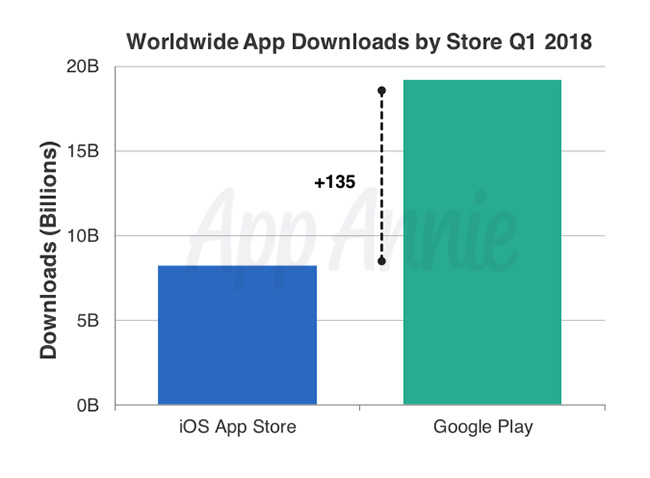
Global app downloads and consumer spending in apps had yet another record quarter, according to a new report from App Annie, out on Monday. In the first quarter of 2018, iOS and Google Play downloads grew more than 10 percent year-over-year to reach 27.5 billion – the highest figure to date. In addition, consumer spending on iOS and Google Play grew 22 percent year-over-year to reach $18.4 billion – also a record number.

The download figure is especially notable because App Annie is not counting app updates or re-installs. That means someone re-downloading an app on a new phone – like one received as a gift over the holidays – wouldn’t have been counted here. Only new app installs were counted.

Plus, the report points out that the total dollar amount to the app economy is much higher than the $18.4 billion reported for Q1, as App Annie only takes into account paid apps, in-app purchases, and subscriptions. It’s not measuring things like in-app advertising, the commerce taking place in apps (e.g. shopping and ride-sharing), or the money being made on the third-party Android app stores around the world.

This is not the first time App Annie has reported record numbers for downloads and consumer spending. The app marketplaces have continued to see steady growth, even as reports of app saturation in the U.S. circulate.

In Q4 2017 – the busy holiday quarter – the app stores had also broken these same records around downloads and revenues. Specifically, Google Play saw its highest downloads to date in the fourth quarter. The app stores had a record-breaking Q3 2017, too – something App Annie attributed then to the growth of the app market in China, India, and other Southeast Asian nations.

This time, App Annie pointed to India, Indonesia and Brazil’s impact on the year-over-year growth in Google Play downloads, and the U.S., Russia and Turkey’s impact on the growth of iOS downloads.

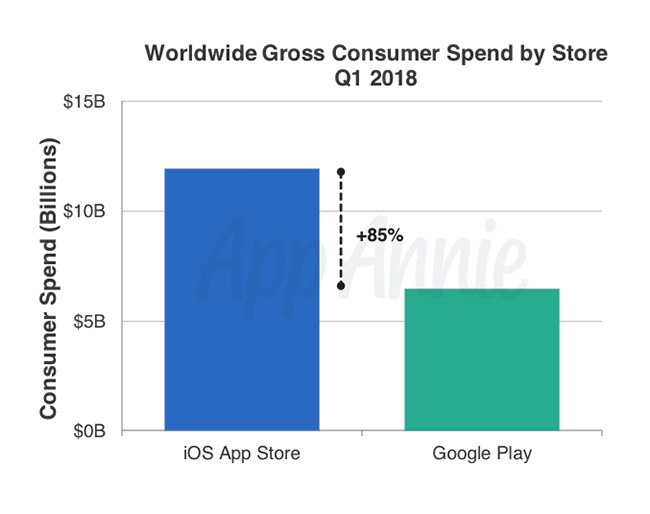
Also notable is that Google Play achieved another record of its own in Q1 2018, with record growth in consumer spend thanks to the U.S, followed by Japan and the Philippines. The Play Store grew 25 percent year-over-year, versus iOS’s 20 percent growth. Despite this, iOS continued to have a large lead in terms of total dollars spent.

Music & Audio along with Entertainment apps had a big impact on Google Play spending, the report noted, both on a quarter-over-quarter and year-over-year basis. This is attributed to the rise in music and video subscription services delivered via apps. App Annie isn’t the only one to spot this trend – app store intelligence firm Sensor Tower had previously found that top subscription video on demand apps grew by 77 percent in 2017, reaching $781 million in revenues across iOS and Google Play. And Netflix became 2017’s top non-game app by revenue.

App Annie said also that iOS spending in Q1 2018 benefitted from subscriptions to health and fitness apps, driven by New Year’s Resolutions and people’s embrace of the subscription model. The U.S., followed by the U.K. then Germany saw the largest market share growth quarter-over-quarter and year-over-year.

Combined, Google Play and the iOS App Store offered 6.2 million apps by the end of Q1 2018, with games driving downloads across both stores during the quarter. PUBG Mobile and Fortnite were especially big, App Annie noted.

Shopping apps also saw large year-over-year growth in market share, the report found.

More broadly, the new report is yet another example of how big a role emerging markets are having on app downloads and the app economy. This trend, while still remarkable, is not all that new. In 2016, China overtook the U.S. in App Store revenue, and App Annie has continued to note China, India and other emerging markets as key drivers of growth in its quarterly and annual reports.

09 Apr 2018

Scribd will get Veronica Roth’s ‘Fates Divide’ on launch day

Scribd is setting its sights on bigger, newer titles.

E-book and audiobook versions of The Fates Divide, the second volume in Veronica Roth’s Carve the Mark series, will go live on Scribd tomorrow. It’s not an exclusive deal — you’ll be able to buy The Fates Divide in bookstores and from online retailers — but Scribd will be the only subscription service where you can find the e-book on launch day.

Roth’s publisher HarperCollins was the first of the Big Five to partner with the service back in 2013. Last year, it began offering some of its newer, “frontlist” titles on Scribd as well.

So even if you haven’t been eagerly awaiting the next book in the series, it’s noteworthy that HarperCollins is willing to launch major titles on Scribd, rather than just treating the service as a way monetize older books.

Roth is best-known as the author of the Divergent series of young adult novels. She’s also making a splash with her new books, with the first volume debuting at number one on The New York Times Young Adult bestseller list. According to reviewersCarve the Mark resembles Divergent in its combination of dystopian science fiction and teen romance — but with a touch of Star Wars as the action shifts to a distant planet.

In the announcement, HarperCollins’ senior director of digital business development Adam Silverman said:

We’re confident that Scribd’s subscription model is an excellent retail platform on which to launch new titles and generate buzz for a huge release such as The Fates Divide. Over the five years we’ve worked with Scribd, we’ve seen increasing value in providing our books on the service — their wonderful recommendation engine and merchandising efforts are hard to beat — and we’re excited to work with Scribd to promote even more of our best books in the future as our partnership continues to grow.

Scribd says it now has more than 750,000 paying subscribers. It also recently returned to a model where those subscribers can read and listen to an unlimited number of books (though there are some limitations for the most voracious readers).

09 Apr 2018

Facebook teams with nonprofits to launch election research commission

Facebook’s post-Cambridge Analytica apology tour continues this morning with the announcement of an initiative aimed at helping social science researchers gauge the site’s impact on key political events.

In a post issued this morning, the company’s Vice President of Communications and Public Policy Director of Research outlined the plan and hammered home its focus on impartial data collection. “Facebook will not have any right to review or approve their research findings prior to publication,” the pair writes.

The initiative is backed by a who’s who of nonprofit foundations that will sound familiar to anyone who’s spent any time with the dial tuned to NPR. The group hopes lessons learned from Brexit and the presidential election will help shed some light on how the social media behemoth could potentially impact upcoming elections like U.S. midterms, Brazil, India and Mexico — a pretty aggressive timeframe for this kind of work.

“[W]e think it’s an important new model for partnerships between industry and academia,” the pair writes. “Second, the last two years have taught us that the same Facebook tools that help politicians connect with their constituents — and different communities debate the issues they care about — can also be misused to manipulate and deceive.” 

If you've followed me for a while, you know one of my top priorities for 2018 in making sure Facebook prevents…

Posted by Mark Zuckerberg on Monday, April 9, 2018

Mark Zuckerberg addressed the creation of the commission in a post today that once again acknowledged that Facebook’s response time could have been better. The site has gotten pushback from nearly all sides on its handling of the issue, including a recent dressing down from the U.S. Senate.

“Looking back, it’s clear we were too slow identifying election interference in 2016, and we need to do better in future elections,” the CEO writes. “This is a new model of collaboration between researchers and companies, and it’s part of our commitment to protect the integrity of elections around the world.”

No word yet on the timeframe for all of this, but Zuckerberg promised an update “soon.”

09 Apr 2018

Comma.ai raises $5 million

Transportation startup Comma.ai has raised $5 million, according to a new SEC filing.

George Hotz, the founder of Comma.ai, started the company in an attempt to take on Tesla. Initially, Hotz was working on a self-driving car kit called Comma One. The Comma One was an add-on that would’ve enabled certain cars to have Tesla Autopilot-like driving assistance capabilities.

But Hotz cancelled that project following a warning letter from the National Highway and Traffic Safety Administration pertaining regulatory compliance. Comma One is now only available as an open-source project.

Last July, Hotz launched an $88 universal car interface called Panda. Panda plugs into your car’s OBD port to collect and record your driving data. At the time, Holtz described it to TC’s Sarah Buhr as a Fitbit for your car.