09 Apr 2018

Bots on Twitter share two-thirds of links to popular websites: Pew

It’s official: Bots are doing a lot of PR grunt work on Twitter — especially when it comes to promoting porn websites.

That perhaps unsurprising conclusion about what automated Twitter accounts are link sharing comes courtesy of a new study by the Pew Research Center which set out to quantify one aspect of bot-based activity in the Twittersphere.

Specifically the researchers wanted to know what proportion of tweeted links to popular websites are posted by automated accounts, rather than by human users?

The answer they came up with is that around two-thirds of tweeted links to popular websites are posted by bots rather than humans.

The researchers say they were interested in trying to understand a bit more about how information spreads on Twitter. Though for this study they didn’t try to delve directly into more tricky (and sticky) questions about bots — like whether the information being spread by these robots is actually disinformation .

Pew’s researchers also didn’t try to determine whether the automated link PR activity actually led to significant levels of human engagement with the content in question. (Something that can be difficult for external researchers to determine because Twitter does not provide full access to how it shapes the visibility of tweets on its platform, nor data on how individual users are making use of controls and settings that can influence what they see or don’t on its platform).

So, safe to say, many bot-related questions remain to be robustly investigated.

But here at least is another tidbit of intel about what automated accounts are up to vis-a-vis major media websites — although, as always, these results are qualified as ‘suspected bots’ as a consequence of how difficult it is to definitively identify whether an online entity is human or not. (Pew used Indiana University’s Botometer machine learning tool for identifying suspected bots; relying on a score of 0.43 or higher to declare likely automation — based on a series of their own validation exercises.)

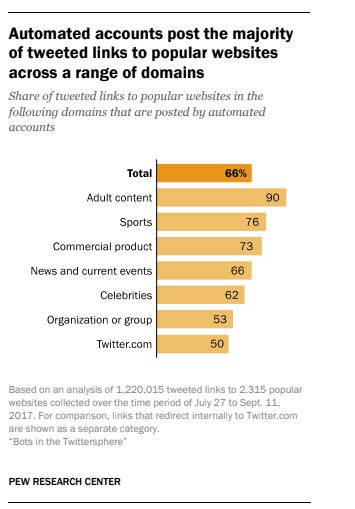
Pew’s top-line conclusion is that suspected automated accounts played a prominent role in tweeting out links to content across the Twitter ecosystem — with an estimated 66% of all tweeted links to the most popular websites likely posted by automated accounts, rather than human users.

The researchers determined website popularity by first conducting an analysis of 1.2 million English-language tweets containing links (pulling random sample tweet data via Twitter’s streaming API) — which they boiled down to a list of 2,315 popular sites, i.e. once duplicates and dead links were weeded out.

They then categorized these into content domains, with any links that pointed to any other content on Twitter (i.e. rather than externally) collected into a single Twitter.com category.

After that they were able to compare how (suspected) bots vs (probable) humans were sharing different categories of content.

Below are the results for content being PRed by suspected bots — as noted above it’s unsurprisingly dominated by adult content. Though bots were found to be responsive for the majority of link shares to popular websites across the category board. Ergo, robots are already doing a major amount of PR grunt work…
 

(Looking at that, a good general rule of thumb seems to be that if a Twitter account is sharing links to porn sites it’s probably not human. Or, well, it’s a human’s account that’s been hacked.)

The researchers also found that a relatively small number of automated accounts were responsible for a substantial share of the links to popular media outlets on Twitter. “The 500 most-active suspected bot accounts alone were responsible for 22% of all the links to these news and current events sites over the period in which this study was conducted. By contrast, the 500 most-active human accounts were responsible for just 6% of all links to such sites,” they write.

Clearly bots aren’t held back by human PR weaknesses — like needing to stop working to eat or sleep.

Pew says its analysis also suggests that certain types of news and current events sites appear “especially likely” to be tweeted by automated accounts. “Among the most prominent of these are aggregation sites, or sites that primarily compile content from other places around the web. An estimated 89% of links to these aggregation sites over the study period were posted by bot accounts,” they write.

tl;dr: Bots appear to be less interested in promo-ing original reporting. Or, to put it another way, bot grunt work is often being deployed to try to milk cheap views out of other people’s content.

Another interesting observation: “Automated accounts also provide a somewhat higher-than-average proportion of links to sites lacking a public contact page or email address for contacting the editor or other staff.

“The vast majority (90%) of the popular news and current events sites examined in this study had a public-facing, non-Twitter contact page. The small minority of sites lacking this type of contact page were shared by suspected bots at greater rates than those with contact pages. Some 75% of links to such sites were shared by suspected bot accounts during the period under study, compared with 60% for sites with a contact page.”

Without reading too much into that finding, it’s possible to theorize that sites without any public content page or email might be more likely to be hosting disinformation. (Pew’s researchers don’t go as far as to join those dots exactly — but they do note: “This type of contact information can be used to submit reader feedback that may serve as the basis of corrections or additional reporting.”)

That said, Pew also found political content to be of relatively lower interest to bots vs other types of news and current affairs content — at least judging by this snapshot of English-language tweets (taken last summer).

“[C]ertain types of news and current events sites receive a lower-than-average share of their Twitter links from automated accounts,” the researchers write. “Most notably, this analysis indicates that popular news and current events sites featuring political content have the lowest level of link traffic from bot accounts among the types of news and current events content the Center analyzed, holding other factors constant. Of all links to popular media sources prominently featuring politics or political content over the time period of the study, 57% are estimated to have originated from bot accounts.”

The researchers also looked at political affiliation — to try to determine whether suspected bots skew left or right in terms of the content they’re sharing.

(To determine the ideological leaning of the content being linked to on Twitter Pew says they used a statistical technique known as correspondence analysis — examining the media link sharing behavior of publications’ Twitter audience in order to score the content itself on an ideological spectrum ranging from “very liberal” to “most conservative”.)

In fact they found automated accounts posting a greater share of content from sites that have “ideologically mixed or centrist human audiences”. At least where popular news and current events sites “with an orientation toward political news and issues” are concerned.

“The Center’s analysis finds that suspected autonomous accounts post a higher proportion of links to sites that are primarily shared by human users who score near the center of the ideological spectrum, rather than those shared more often by either a more liberal or a more conservative audience,” they write. “Automated accounts share roughly 57% to 66% of the links to political sites that are shared by an ideologically mixed or centrist human audience, according to the analysis.”

Pew adds that right-left differences in the proportion of bot traffic were “not substantial”.

Although, on this, it’s worth emphasizing that this portion of the analysis is based on a pretty small sub-set of an already exclusively English-language and US-focused snapshot of the Twittersphere. So reading too much into this portion of the analysis seems unwise.

Pew notes: “This analysis is based on a subgroup of popular news and current events outlets that feature political stories in their headlines or have a politics section, and that serve a primarily U.S. audience. A total of 358 websites out of our full sample of 2,315 popular sites met these criteria.”

Really the study underlines a core truth about Twitter bots: They’re often used for spam/PR purposes — to try to drive traffic to other websites. The substance of what they’re promoting varies, though it can clearly often be adult content.

Bots are also often used to try to cheaply drive clicks to a cheap content aggregator or product sites so that external entities can cheaply cash in thanks to boosted ad views and revenue.

Political disinformation campaigns may well result in a lower volume of bot-generated spam/PR than porn or content farms. Though the potential damage — to democratic processes and societal institutions — is arguably way more serious. As well as being very difficult to quantify.

And, well, where the influence of bots is concerned, we still have many more questions than answers.

09 Apr 2018

Over 20 advocacy groups complain to FTC that YouTube is violating children’s privacy law

A coalition of over 20 child advocacy, consumer and privacy groups filed a complaint with the U.S. Federal Trade Commission asking it to investigate and sanction YouTube for violation of federal children’s privacy laws. Specifically, the groups say YouTube is violating COPPA, the Children’s Online Privacy Protection Act, which requires that websites directed at children under the age of 13 get parental consent before they’re allowed to collect children’s data. YouTube doesn’t do this, the complaint says.

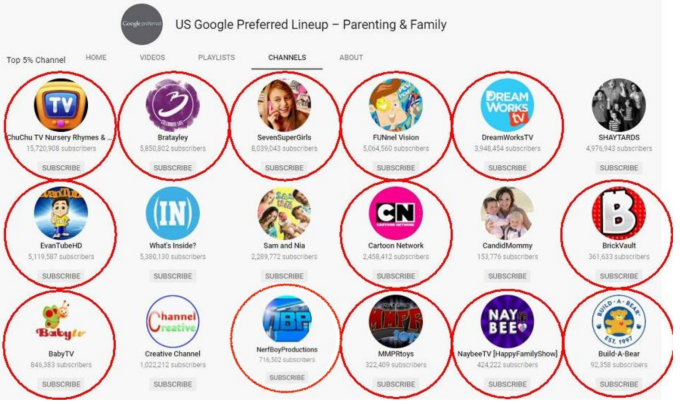
Technically, YouTube’s site is aimed at those users 13 and older, its terms state. That’s how it gets around having to abide by child privacy laws. But the complaint points to several examples of how the site is clearly targeting younger children, including its hosting of cartoon videos, nursery rhymes, and toy ads. Some of the most popular channels on YouTube are also those aimed at young kids,like ChuChu TV Nursery Rhymes & Kids Songs, which has 15.9 million subscribers and over 10 billion channel views, and LittleBabyBum, which has 14.6 million subscribers and over 14 billion channel views.

Plus, advertisers can target kids’ programming through the “Parenting and Family” lineup in the Google Preferred ads platform, the complaint states.

“Google has acted duplicitously by falsely claiming in its terms of service that YouTube is only for those who are age 13 or older, while it deliberately lured young people into an ad-filled digital playground,” said Jeff Chester of the Center for Digital Democracy, one of the groups who signed the complaint, in a statement. “Just like Facebook, Google has focused its huge resources on generating profits instead of protecting privacy.”

The groups have a point. The proliferation of children’s’ videos on YouTube and the potential harm that came from having them mixed in with more adult-oriented content is what led YouTube to launch the YouTube Kids app several years ago. So it’s hard to argue, simply, that “YouTube is not for kids.”

However, even that YouTube Kids has come under fire in recent days because it doesn’t fully protect children from inappropriate videos, including those that took advantage of YouTube’s algorithms for suggested videos, in order to attract views to their shady and sometimes downright disturbing content.

YouTube has tried to crack down on these videos and demonetize them, but inappropriate content continues to slip through – most recently, with conspiracy videos suggested to children. Now the company is reportedly preparing to release a version of the YouTube Kids app without the algorithmic suggestions.

YouTube pointed to the creation the Kids app in response to the groups’ complaint, according to CNET’s report, saying the app was built for younger viewers because YouTube itself is “not for children.”

But the advocacy groups say that’s not true. The same content is available both on YouTube Kids and YouTube.com, and the latter benefits from the ability to collect data without having to play by the rules.

“Kids have been watching videos on YouTube for years, something the company has known, and profited off of, by targeting content and ads at children under 13. It is time for Google to be completely transparent with all the facts and institute fundamentally responsible new policies moving forward to protect the privacy of kids,” said James P. Steyer, CEO of Common Sense. “We fully expect Google to work closely with advocates and reach out to parents with information about parental controls, content, and collection practices on YouTube so parents can make informed choices about what content they allow their kids to access and how to protect their privacy,” he added.

The complaint arrives at a time when there’s a heightened awareness and concern over the data collection and data privacy practices of major tech companies in the U.S.,as well as how those systems can be compromised by foreign governments. Most notably, the news cycle is focused on Facebook’s involvement in the Cambridge Analytica scandal which will see CEO Mark Zuckerberg having to testify before Congress. But YouTube, too, has had issues with Russian trolls spreading propaganda on its site, like they had done on Facebook and Twitter.

The combination of the poor data privacy practices across social media, abuse of social media platforms by foreign actors, YouTube’s misbehaving algorithms, and its other missteps with regard to its approach with children, may have this complaint taken more seriously than those in the past.

Others who signed the complaint include:

Campaign for a Commercial-Free Childhood (CCFC), Berkeley Media Studies Group; Center for Media Justice; Common Sense; Consumer Action; Consumer Federation of America; Consumer Federation of California; Consumers Union, the advocacy division of Consumer Reports; Consumer Watchdog; Corporate Accountability; Defending the Early Years; Electronic Privacy Information Center (“EPIC”); New Dream; Obligation, Inc.; Parent Coalition for Student Privacy; Parents Across America; Parents Television Council; Privacy Rights Clearinghouse; Public Citizen; The Story of Stuff Project; TRUCE (Teachers Resisting Unhealthy Childhood Entertainment); and USPIRG.

09 Apr 2018

Join me for an ICO meetup in New York

I’ll be helping build a larger meetup focused on pre-ICO companies in New York on April 23 and I’d love to see you there. It will be held at Knotel on April 23 at 7pm and will feature a pitch-off with eight startups – I will write about the best ones – and two panels with some yet-unnamed stars in the space.

I’d love to see you there so please sign up here. It’s free for early birds so hurry.

The event will be held at 551 Fifth Avenue on the 9th Floor and you can sign up to pitch here. I’ll have more information as we get closer to the event. This is still an experimental format so let’s see how it works.

09 Apr 2018

TechCrunch is back in Africa next week!

TechCrunch is headed back to Africa to find the next wave of early stage startups tackling big ideas! Last October, TechCrunch held Startup Battlefield in Nairobi, Kenya and featured 15 early stage startups from across the continent. We’re impressed by the Sub-Saharan Africa startup scene and can’t wait to meet the next crop of innovators in the coming weeks.

You can meet Startup Battlefield Director, Samantha Stein, and learn more about TechCrunch’s Startup Battlefield program at one of the upcoming meet and greets. Investors, angels, startup community leaders, and startup founders can join to learn more about TechCrunch’s Startup Battlefield. RSVP below as space is filling up fast!

Founders will learn how to apply for Battlefield with a killer application, and investors will learn how to refer companies in their portfolio.

Startup Battlefield is TechCrunch’s renowned startup launch competition. The Startup Battlefield alumni community composes almost 750 companies that have raised over $8 billion USD, and produced over 100 successful exits and IPOs.

2018 TechCrunch Africa Meet and Greets

Lagos, Nigeria

April 17th, Tuesday

Host: CC Hub
Time: 1:30pm – 3:00pm
RSVP

Accra, Ghana

April 20th, Friday

Host: MEST
Time: 3:00pm – 5:30pm
RSVP

April 20th, Thursday

Host: Impact Hub
Time: 6:00pm – 7:30pm
RSVP

*For questions, please email battlefield@techcrunch.com

09 Apr 2018

Uber acquires bike-share startup JUMP

Uber has acquired bike-sharing startup JUMP for an undisclosed amount of money. This comes shortly after TechCrunch reported that JUMP was in talks with Uber as well as with investors regarding a potential fundraising round involving Sequoia Capital’s Mike Moritz. At the time, JUMP was contemplating a sale that exceeded $100 million. We’re now hearing that the final price was closer to $200 million, according to one source close to the situation.

JUMP’s decision to sell to Uber came down to the ability to realize the bike-share company’s vision at a large scale, and quickly, JUMP CEO Ryan Rzepecki told TechCrunch over the phone. He also said Uber CEO Dara Khosrowshahi’s leadership impacted his decision.

“I had a chance to spend a couple of evenings with him, and really talk through his vision for the business and our vision, and saw a lot of alignment,” Rzepecki said.

He noted that while Uber had a rocky 2017, he’s optimistic Uber is on the right track.

“I think it’s really on the right course now and [Khosrowshahi] believes the way we approach working with cities and our vision for partnering with cities” aligns with Uber’s mission, Rzepecki said. “That was important for me and his desire to do things the right way. This is a great outcome and gives me a chance to bring my entire vision to the entire world.”

Meanwhile, becoming a top urban mobility platform is part of Uber’s ultimate vision, Khosrowshahi told TechCrunch over the phone. As more people live in cities, there will need to be a broader array of mobility options that work for both customers and cities, he said.

“We see the Uber app as moving from just being about car sharing and car hailing to really helping the consumer get from A to B int he most affordable, most dependable, most convenient way,” Khosrowshahi said. “And we think e-bikes are just a spectacularly great product.”

As part of the acquisition, JUMP employees will join Uber’s team but the bike-share company will carry on as an independent, wholly controlled subsidiary, Rzepecki said.

JUMP is best known for operating dockless, pedal-assist bikes. JUMP’s bikes can be legally locked to bike parking racks or the “furniture zone” of sidewalks, which is where you see things like light poles, benches and utility poles. The bikes also come with integrated locks to secure the bikes.

Uber’s acquisition of JUMP is not too surprising. In January, Uber partnered with JUMP to launch Uber Bike, which lets Uber riders book JUMP bikes via the Uber app. The majority of trips, however, still come through the JUMP app, Rzepecki said. For the time being, JUMP’s app will continue to exist but that may eventually change.

“It’s our hope the experience will be more deeply integrated into the Uber app moving forward and reflects what Uber has been working on in terms of being a multi-modal platform,” Rzepecki said.

Meanwhile, Uber’s international competitors have made similar moves. India-based ride-hailing startup expanded into bicycles in December. Called Ola Pedal, the service is available on a handful of university campuses in India. Then there’s Southeast Asia’s Grab and China’s Didi, which both launched their own respective bike-share services this year. Both Didi and Grab have also invested directly in bike-sharing startups Ofo and OBike, respectively.

With JUMP under the ownership of Uber, we likely won’t see JUMP partner with any of Uber’s direct competitors, but Rzepecki said other types of partnerships could be interesting.

“I think the idea of us being inside the Lyft app is not necessarily likely but there may be other partnerships that we’re able to do that are less directly competitive,” Rzepecki said.

In January, JUMP closed a $10 million Series A round led by Menlo Ventures with participation from Sinewave Ventures, Esther Dyson and others. JUMP’s January funding brought its total amount raised to $11.1 million. That same month, JUMP became the first stationless bicycle service to receive a permit to launch in San Francisco. Since then, JUMP has launched 250 dockless, pedal-assist bikes on the streets of San Francisco. Currently, people take between six to seven rides per day, with an average trip length of 2.6 miles, Rzepecki said.

“We really know we are serving a commute,” Rzepecki said. “We’re serving the morning and evening commute. I think 22 percent of trips are in the morning and 20 percent in the evening commute. We’ve really been a commuting solution.”

In October, the SFMTA will determine if JUMP can deploy an additional 250 bikes. The SFMTA will make its decision based on an evaluation of the program’s first nine months. That evaluation, the SFMTA told TechCrunch in January, will entail determining where the city should promote stationless bike-share, the impact stationless bike-share has on the public right-of-way, “including maintaining accessible pedestrian paths of travel, as well as the enforcement/maintenance burden on city staff.”

JUMP also operates its e-bike network in Washington D.C., and plans to launch in Sacramento and Providence, Rhode Island later this year. Through its software and hardware offerings, it operates via third-parties, like cities, campuses and corporations, in 40 markets including Portland, New Orleans and Atlanta. JUMP is also interested in deploying its bikes in Europe, where it hopes to be by spring of 2019. JUMP has also applied for a permit to operate in New York, which recently legalized electric, pedal-assist bikes.

E-bikes, of course, are not the only way to get around town these days. This year, we’ve seen a number of startups launch electric scooters. While San Francisco is trying to figure out how to regulate them, people are watching closely to see what comes next.

Khosrowshahi is one of those people. He told me he’s been “staring at some of them quizzically on the streets.”

Scooters are in an “odd spot” due to the lack of regulation, Khosrowshahi said, but Uber will “look at any and all options” that “move in a direction that is city friendly.”

Additional reporting by Katie Roof.

09 Apr 2018

Benioff: Every VC in Silicon Valley turned us down

In an interview last month Parker Harris and Marc Benioff told the story of how when they first launched the company, they were trying to raise money and nobody would give them a dime. Benioff said he went to every venture capital in Silicon Valley — and was turned down every single time.

This could be a lesson for every startup out there with a vision, who is not able to find conventional financing for your idea. Salesforce found the money, but it took one on one fundraising, rather than the traditional VC route.

The company famously launched in an apartment that Benioff rented, and he put up some of his own money to buy the company’s first computers. Then it was time to go downtown and ask the VCs for money and it did not go well.

“I had to go hat in hand, like I was a high tech beggar, down to Silicon Valley to raise some money…And as I go from venture capitalist to venture capitalist to venture capitalist — and a lot of them are my friends, people I’ve gone to lunch with — and each and every one of them said no,” Benioff said. “Salesforce was never able to raise a single dollar from a venture capitalist,” he added.

He suggested there were a lot of reasons for that including competitors who would call after his meetings and deliberately sabotage him or people who simply didn’t believe in the cloud as a vision of the future of software.

Whatever the reasons, Salesforce was eventually able to raise over $60 million from private individual investors, before going public in 2004. In the context of today’s venture capital environment, it is pretty tough to imagine a guy like Benioff not finding one taker, especially when you consider that he was not exactly an unknown quantity. And still no one would write him a check.

But this wasn’t now. It was in the late 1990s when nobody was thinking about cloud computing and the notion of software on the internet was a distant idea. Benioff was imagining something completely different and not one firm had the vision to see what was coming. Today, Salesforce is a $10 billion company and those folks that turned him down have to be wondering what they were thinking.

“When you start something like Salesforce, you want to surround yourself with people who do believe in you, who do believe you’re going to be successful because you’re going to have a whole bunch of people who are going to tell you that you’re not, Benioff said.

That’s something every entrepreneur should remember.

09 Apr 2018

Apple releases a red iPhone 8

Apple is doing it again. The company just unveiled a new version of the iPhone 8 and iPhone 8 Plus. It has a bright red enclosure and a black front. A portion of Apple’s proceeds will fund HIV/AIDS grants from the Global Fund.

Other than that, it’s an iPhone 8. You’ll get the exact same features and components as the ones in other iPhone 8 models. The iPhone 8 is also available in gold, silver and (“space”) gray. Alas, there’s still no rose gold option.

When Apple unveiled the red version of the iPhone 7, many people didn’t understand why Apple put white bezels at the front of the device. Red and black seem like a good match. That’s why some people even bought screen protectors with black borders to fix this.

This year, Apple is switching to black. It’s interesting to see that Apple waits around 6 months before launching red versions of its iPhones. It could be a way to foster sales in the middle of a product cycle.

The red iPhone 8 is going to start at $699 with 64GB just like regular iPhone 8 models. There will be 256GB versions too. Pre-orders start tomorrow and you’ll be able to buy it in Apple stores on Friday.

For iPhone X users, Apple is launching a dark red leather folio. Apple is also sharing some numbers about its partnership with (PRODUCT)RED. Since 2006, Apple has donated $160 million to the Global Fund through limited edition iPods, iPhones and accessories.

09 Apr 2018

SNL roasts Mark Zuckerberg on Weekend Update

The role of Mark Zuckerberg went to Alex Moffat this weekend on Saturday Night Live’s Weekend Update.

While some bits were harmless and hilarious — “Poke! Poke! Remember that feature?” asked Moffat as he poked Jost in the shoulder. “Poke! It was flirting for cowards.” — the Facebook CEO probably didn’t laugh much on Saturday night.

Alex Moffat, playing Zuckerberg, shrieked with laughter, struggled with eye contact, and rebuked any notion that users’ should have control over their own data on Facebook.

When asked if users would be able to delete their own data, the Zuck character simply replied: “Psh, no! Because it’s mine. You gave it to me. No backsies.”

This all comes amidst the Cambridge Analytica scandal, wherein third-party apps scraped data of more than 50 million users on behalf of consultancy firm Cambridge Analytica . This has left Facebook trying to recover trust with the public, all while having lost more than $80 billion in market value since the scandal broke.

This also comes a few short days before Zuckerberg appears in Washington D.C. for both a Senate hearing on April 10 and a House Energy and Commerce hearing on April 11.

You can watch the full SNL segment below:

09 Apr 2018

’90s kids rejoice! Microsoft releases the original Windows 3.0 File Manager source code

Microsoft has released the source code for the original, 1990s-era File Manager that is so familiar to all of us who were dragging and dropping on Windows 3.0. The code, which is available on Github under the MIT OSS license, will compile under Windows 10.

File Manager uses the multiple-document interface or MDI to display multiple folders inside one window. This interface style, which changed drastically with later versions of Windows, was the standard for almost a decade of Windows releases.

These little gifts to the open source community are definitely fun but not everyone is happy. One Hacker News reader noted that “Most of the MSFT open source stuff is either trash or completely unmaintained. Only a couple of high profile projects are maintained and they jam opt-out telemetry in if you like it or not (despite hundreds of comments requesting them to go away). Even Scott Hanselman getting involved in one of our tickets got it nowhere. Same strong arming and disregard for customers.”

Ultimately these “gifts” to users are definitely a lot of fun and a great example of nostalgia-ware. Let me know how yours compiles by Tweeting me at @johnbiggs. I’d love to see it running again.

09 Apr 2018

Armis raises $30 million Series B as enterprise IoT security heats up

When Armis launched in 2015, the company founders looked over the horizon and they saw the Internet of Things requiring a strong security layer. Today, the IoT security startup announced a $30 million Series B.

The company has attracted a strong group of venture capitalists. The round was led by Bain Capital Ventures and Red Dot Capital. Sequoia Capital and Tenaya Capital, who were investors in earlier rounds, also participated. Today’s investment brings the total raised to $47 million.

The company secures IoT devices without an agent because it’s often impossible to put an agent on a connected device like a video camera, light bulb or sensor. That requires some knowledge of these devices and their expected behavior and Armis has created a growing database of more than 5 million devices to track this information.

Company co-founder and CEO Yevgeny Dibrov says it involves taking that database and combining it with other information about the environment in which the device operates to understand if it’s behaving in an expected fashion. When it’s not they may shut it down and alert the customer, depending on how it’s configured and how severe the problem appears to be.

“To build and agentless platform, we [look at] existing infrastructure, traffic, wireless infrastructure and network infrastructure, to get a huge amount of traffic information. We analyze and detect and get a fingerprint of every device and asset in the environment and leverage the 5 million devices in the knowledge base,” he said.

It’s an approach that attracted investor Jeff Williams, operating partner at Bain Capital Ventures. Williams said he has been researching the IoT security market and has been seeing explosive growth in connected devices, which he sees creating a new attack surface for the enterprise. “Armis’ ability to help enterprises discover, manage and secure these devices is what companies today need to get in front of protecting the new era of IoT. All these forces, plus the pedigree of Armis’ executive team and their impressive research division are setting Armis up for powerful growth,” he said.

And the company is growing quickly with dozens of customers and 50 employees. The startup’s R&D team is 35 strong and is located in Israel, while the remaining employees with a focus on sales and marketing are located in the US.

As the number of IoT devices proliferate in the enterprise, the company will devote a portion of today’s money to increasing their R&D budget to continue building the database of devices.