06 Apr 2018

Coinbase unveils fund for early-stage cryptocurrency startups

Coinbase has launched a new fund called Coinbase Ventures to invest in early-stage cryptocurrency and blockchain startups. In a blog post, Coinbase head of corporate and business development Emilie Choi said that the fund’s goal is to strengthen the sector.

“At least in the beginning, our goal is simply helping the most compelling companies in the space flourish,” she wrote. “This means we don’t have the strategic requirement of formalizing partner relationships with such companies, as some corporate venture programs do. Our focus is on building strong relationships and helping spur the development of the ecosystem.”

This includes investing in companies that may potentially compete with Coinbase because “it’s in everyone’s interest to see the ecosystem innovate,” Choi added. She also said the fund will keep an eye on founders who have worked for Coinbase and “enthusiastically invest in ideas from our own alumni network.”

One potential benefit of helping other cryptocurrency and blockchain companies grow is lending more stability to the sector, which is currently under scrutiny by the U.S. Securities and Exchange Commission and considered risky by many investors. In an interview on CNBC’s “Fast Money,” Coinbase chief operating officer Asiff Hirji said that as more mature investors take an interest in cryptocurrency, that will “dampen volatility to some extent.”

There’s been “tremendous take up on the fund, well beyond anything we were expecting,” he added and that it “confirmed what we thought, that there is actually more demand on the investor side than on the trader side.” While Coinbase doesn’t have current plans to add more cryptocurrencies to its exchange, investing in promising startups will help it find promising tokens, Hirji said.

06 Apr 2018

Redpoint Ventures hires Uber’s Annie Kadavy as general partner

Redpoint Ventures has hired Annie Kadavy as its first female general partner. She’ll be on the early stage investment team.

Kadavy has a background in venture capital, having spent several years at CRV. Most recently, she ran strategic operations at Uber’s freight division. She also has an M.B.A. from Stanford University Graduate School of Business.

In a conversation with TechCrunch, Kadavy said she “wanted to focus on consumer but have the ability to do a broader set of investing.” Kadavy also “wanted to join an early stage fund that had a growth fund attached to it, so you can learn from both.”

But she’ll be most focused on seed, Series A and Series B rounds. Kadavy plans to look for opportunities in the Bay Area, LA, Seattle and NYC.

In her blog post, she elaborated on her decision to join Redpoint.

For me, joining a flat and equal partnership was important. While this may be opaque to many, let me tell you, it matters. It is the economic manifestation of how investment decisions are made, how a venture team will work collectively for you (or not), and how that team will evolve over time. This is rare and it exists at Redpoint.”

When Kadavy was at CRV, she sourced or led deals in ClassPass, Patreon, Doordash and she was on the board at Laurel and Wolf. She’s still looking to invest in companies in similar categories.

Kadavy is part of a wave of venture firms finally hiring female partners, in an industry where only 8% are women. Rebecca Kaden recently joined Union Square Ventures, Jess Lee joined Sequoia Capital, and Naomi Pilosof joined Menlo Ventures, to name a few.

There’s also AllRaise, a newly formed organization comprised of the top female venture capitalists. The group is committed to helping the best women find jobs in the industry.

Redpoint has been around since 1999 and has raised $4.1 billion across its funds, according to Crunchbase.


06 Apr 2018

Razer’s gaming ecosystem gets bigger with the launch of its online game store

Razer, known mainly for gaming laptops and peripherals, expanded its ecosystem today with the launch of Razer Game Store, an online game distribution platform. Razer Game Store will compete with Steam and Amazon, but wants to grab the attention of gamers with perks like the chance to earn more credits in Razer’s zSilver loyalty program, plus exclusive discounts on games and Razer hardware.

Razer Game Store is available worldwide, with localized content, payment methods and customer support for the United States, the United Kingdom, Germany and France. Other countries get access through a global storefront. Games come from Razer’s partners (which include developers Ubisoft, Bethesda, Bandai Namco, Deep Silver and Rockstar) and, like titles purchased through other online stores such as Amazon, Green Man Gaming or Humble Bundle, are delivered via Steam or Uplay product keys.

In the company’s announcement, Razer co-founder and chief executive officer Min-Liang Tan said “As gamers, we know the importance of a good deal and the Razer Game Store delivers that to everyone. We have been delighting gamers with our high-performing peripherals, laptops and software, and we’re now also able to provide the content itself that fuels their passion.”

Launched in 2005 to build gaming peripherals like mouses and keyboards, Razer was backed by investors including Horizons Ventures, Accel Partners and Intel Capital before raising $529 million in its debut on the Hong Kong Stock Exchange last November. The company’s other recent products include the gaming-focused Razer Phone, launched after it acquired smartphone maker Nextbit.

05 Apr 2018

3D movie box office totals take another dive

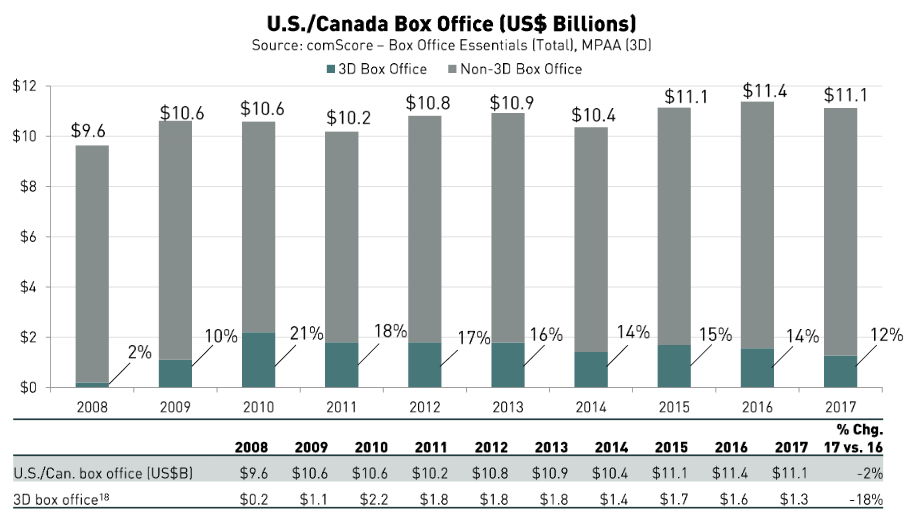
Could it be that the scourge of 3D film is coming to an end? The box office contribution of 3D showings dropped in 2017 to 12 percent of the U.S. and Canada’s $11.1 billion total take, its lowest point essentially since 3D movies became a thing.

The numbers come straight from the horse’s mouth: an MPAA report (PDF) on ticket sales. It’s a mixed bag altogether, for the most part positive: people are still watching lots of movies, and they’re paying to go to theaters all over the world. Global box office hit a new record ($40.6 billion) even if the U.S. and Canada dropped 2 percent.

The decline of 3D, however, is really only noted in the following chart:

You can see that at 12 percent of total box office, it’s the lowest percentage and absolute amount of ticket sales for 3D movies since 2009. The peak, in 2010, was largely due to Avatar, surely the most impressive 3D film and certainly the highest grossing, even if it did use Papyrus for its title font. It’s been largely downhill since then.

And why not? 3D is expensive, uncomfortable, degrades the quality of the picture, rarely adds anything to a film, and in fact is often bolted on after the fact in post-production. (CG films, more easily converted and aimed at a younger crowd, are an exception.)

3D TVs failed, 3D gaming failed, VR’s special take on 3D is at the very least failing to succeed — so why not 3D film?

As an embellishment on moviemaking, it’s largely bankrupt of possibility, but the idea of creating a “premium” tier of moviegoing (the sort-of-stealth motive of 3D) is far from a bad idea. People will pay extra for things like big seats, 21+ showings where you can drink, good food, and so on. And as MoviePass has shown, they’ll also pay for theaters as a service — although whether the company can pull that off at the current price point is a matter of some debate.

Even if Avatar 2 were to give the 3D box office a shot in the arm, it’s unlikely that the enterprise is considered worth saving when other, fresher opportunities to put butts in seats are in the offing. Here’s hoping 2018 or 2019 will be the last time you have to specify 2D when buying tickets.

05 Apr 2018

Machine Learning Zone: OpenAI competition takes on Sonic the Hedgehog

Retro video games have been a useful platform for machine learning research for years, and the systems created have been creeping through the classics, mastering them as they go. Sonic the Hedgehog may be the next to fall: OpenAI has announced a competition to apply machine learning to the classic Sega game.

It’s not vastly different from what’s been attempted before, things like playing Super Mario Bros or Space Invaders, or even the likes of Doom. But the rules are a bit different here.

A very basic summary of how AIs learn to play something like Mario is this: an algorithm is set up with some basic capabilities like recognizing objects on screen and monitoring the in-game score. It’s then set free on the game itself and allowed access to the controls, with the sole goal of maximizing its score.

Over millions of tries the machine learns that in order to score, it needs to hit start first, then that it needs to move to the right, then that goombas kill it (and stop it from scoring more), coins give it points and so on. It does this all basically from recognizing the shapes on the screen or, in some cases, from accessing the game geometry and system memory directly — it doesn’t care about the Princess, and it may develop strange behaviors that result from its single-minded pursuit of incrementing its score integer.

This one, for example, learned that it can glitch through the walls to get ahead quickly:

Great job!

Another thing the OpenAI folks point out is that these systems often learn on the games and levels on which they are evaluated. It’s a sort of “teaching to the test” situation. So in the new competition, not only are the systems more complicated than Mario’s (as anyone who’s played Sonic can tell you), but the systems created will be tested on levels to which they’ve had limited exposure.

They won’t be going in blind — the risk of an AI breaking from the first is too high. But while researchers will have all the time in the world to design a training and learning mechanism based on a selection of Sonic levels, the test will involve applying that training mechanism to a new set of levels, under a strict time limit (18 hours of game time).

This means you have to create an agent that understands not just one level of Sonic, but Sonic as a gestalt. If your AI knows all the shortcuts in Green Valley Zone, it may excel there, but when sent to the Chemical Zone, it’ll choke (like me) when it encounters the scary underwater parts.

You don’t jump like normal! It’s a lot of pressure with the stuff coming up!

It also means your algorithm has to train efficiently, which may involve all kinds of techniques and shortcuts. Minimizing training time means minimizing lazy learning and paying attention to multiple sources of information at once.

There are also different control methods, gimmicks and physics in each game, so it may be that identifying those before making the run could be critical to success. Really, there are all kinds of things to consider. (It’s making me want to go back and play these great games.)

Contestants will be using OpenAI’s Gym Retro platform, which essentially wraps an emulator playing Sonic (and a set of other Sega games) in the tools developers need to extract data, map inputs and so on.

Winners don’t get any cash or anything, but first through third place will get trophies and will have the opportunity to co-author a report on the contest. OpenAI’s reports are interesting and widely read, so it sounds like a good opportunity if you have the time and inclination — although, of course, “it’s great exposure” is the classic payment avoidance strategy.

There are lots more games in the package of games OpenAI is using — I’d like to see an AI take on Gunstar Heroes, or Golden Axe III.

05 Apr 2018

Facebook admits its data drama has ‘a few’ advertisers pressing pause

In an interview with Bloomberg, Facebook’s Sheryl Sandberg disclosed the fact that ongoing privacy revelations around Cambridge Analytica have some advertisers skittish.

When asked about how many advertisers had paused their ad spending, Sandberg would only get as specific as saying that “a few” had done so, leaving plenty of room for interpretation. She told Bloomberg that Facebook was engaged in “reassuring conversations” with advertisers with concerns about data privacy.

The slight chill is just one more way that the Cambridge Analytica scandal is shifting Facebook’s relationship to the advertisers at the core of the company’s business model.

In the interview, Sandberg reiterated that Facebook’s proactive measures around privacy and security — like doubling its safety and security team from 10,000 to 20,000 workers — will negatively affect profitability in the short to medium term.

“We also didn’t build our operations fast enough, and that’s on me,” Sandberg said.

She admitted that Facebook has historically addressed problems on the platform as isolated incidents, an approach that allowed more systemic issues to remain unaddressed.

“What we didn’t do until recently, and what we’re doing now, is just take a broader view, looking to be more restrictive in ways data could be misused,” Sandberg said.

“This is going to be a long process… we’re going to find more things, we’re going to tell you about them, we’re going to shut them down.”

05 Apr 2018

How 3D printing is revolutionizing healthcare as we know it

In 1983, Chuck Hall, the father of 3D printing, created something that was equal parts simple and earth-shattering. He manufactured the world’s first-ever 3D printer and used it to print a tiny eye wash cup.

It was just a cup. It was small and black and utterly ordinary looking. But that cup paved the way for a quiet revolution, one that today is changing the healthcare industry in dramatic ways.

As healthcare costs in America continue to skyrocket, with no political solution in sight, this technology could offer some direly needed relief.

Here are just some the ways in which 3D printing is already revolutionizing the healthcare industry.

Personalized prosthetics

I love to tell the story of Amanda Boxtel, who came to me a few years ago complaining that her robotic suit, a gorgeous piece of design from Ekso Bionics, was uncomfortable to wear. Amanda is paralyzed from the waist down, and while this suit gave her the gift of movement, it couldn’t give her the symmetry and freedom of range of motion that she, like all humans, craved.

Source: Scott Summit, Charles Engelbert Photography

Unlike traditional prosthetics, which are mass-manufactured like any other traditional factory-produced good, 3D-printed prosthetics are custom-tailored for each individual user. By digitally capturing Amanda’s unique measurements, I was able to build her a custom-fit suit, much like a tailor would, creating a beautiful, lightweight design that fit Amanda’s body down to each distinct millimeter. Today Amanda feels so limber and free in her suit that she is now learning how to walk in high heels.

This same technology is now being harnessed to create beautiful conformal ventilated scoliosis braces, supports for amputees and more.

Bioprinting and tissue engineering

Writing in a recent issue of the Medical Journal of Australia, the surgeon Jason Chuen alerted his colleagues to a major technological breakthrough that could eventually do away with the need for human organ transplants. Here’s how it works:

3D printing is performed by telling a computer to apply layer upon layer of a specific material (quite often plastic or metal powders), molding them one layer at a time until the final product — be it a toy, a pair of sunglasses or a scoliosis brace — is built. Medical technology is now harnessing this technology and building tiny organs, or “organoids,” using the same techniques, but with stem cells as the production material. These organoids, once built, will in the future be able to grow inside the body of a sick patient and take over when an organic organ, such as a kidney or liver, fails.

3D-printed skin for burn victims

It may sound like something out of Mary Shelley’s “Frankenstein,” but the implications — and cost savings — make this technological breakthrough in 3D printing particularly immense. For centuries, burn victims have had incredibly limited options for healing their disfigured skin. Skin grafts are painful and produce terrible aesthetics; hydrotherapy solutions offer limited results. But researchers in Spain have now taken the mechanics of 3D printing — that same careful layer-upon-layer approach in which we can make just about anything — and revealed a 3D bioprinter prototype that can produce human skin. The researchers, working with a biological ink that contains both human plasma as well as material extracts taken from skin biopsies, were able to print about 100 square centimeters of human skin in the span of about half an hour. The possibilities for this technology, and the life-changing implications for burn victims, are endless.

Pharmacology

Finally, 3D printing also has the potential to upend the pharmaceutical world and vastly simplify daily life for patients with multiple ailments. So many of us take dozens of pills each day or week, and the organization, timing and monitoring of these multiple medications and their diverse drug interactions and requirements (morning, night, with or without food) is utterly exhausting.

But 3D printing is the epitome of precision. A 3D-printed pill, unlike a traditionally manufactured capsule, can house multiple drugs at once, each with different release times. This so-called “polypill” concept has already been tested for patients with diabetes and is showing great promise.

The bottom line

The medical world, in which treatments, organs and devices are an integral part, stands to be revolutionized by the vast promises of 3D printing. With precision, speed and a major slash in cost, the way we treat and manage the health of our bodies will never be the same. And that’s something to celebrate.


05 Apr 2018

Tap Bio’s mini-sites solve Instagram’s profile link problem

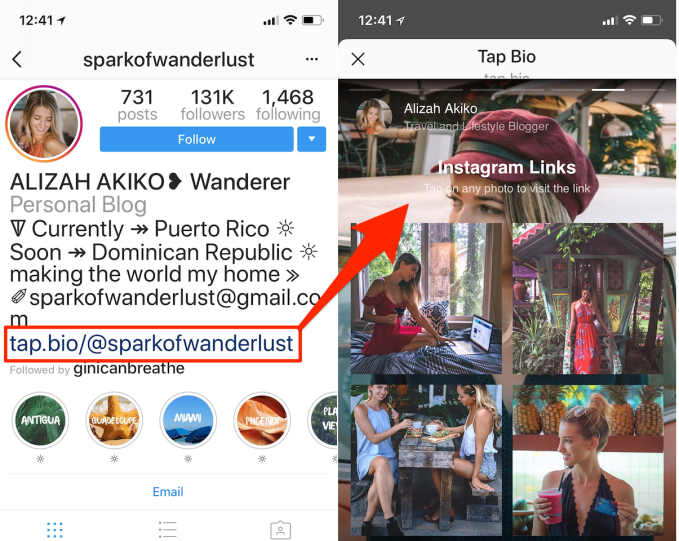
You only get one link on Instagram, but Tap Bio lets you point that to a customized landing page full of all the sites you want to share. Rather than constantly change your Instagram profile URL, you can easily add slides equipped with links to your Tap Bio corresponding to your latest Instagram posts. Tap Bio could be a powerful tool for social media stars, digital entrepreneurs, or anyone trying to market themselves via Instagram.

Tap Bio is About.me for the next generation.

It’s a deceptively simple idea, yet one that the big website creation platforms like Squarespace, Wix, and Weebly have missed. It’s dumbfounding that there’s no popular mobile-first site builder, though an app called Universe was one of the hottest companies that graduated from Y Combinator’s accelerator this month. But by starting with an obvious problem, the bootstrapped Tap Bio could gain a foothold in a business dominated by heavily funded startups, and angle to become the center of your online identity. People interested can sign up for the private beta here.

The whole reason for Tap Bio’s existence is a brilliant decision of Instagram’s. You can’t post links, and you get just one link in your profile. URLs in post captions don’t hyperlink and can’t be copied. That means the focus is on sharing beauty, not driving clicks. But promoters gonna promote, so the “Link in bio” trend began. Instagrammers change their profile link to where they want to send people, then mention that much-derided phrase hoping their followers will open their profile and click through. Unfortunately, though, anyone reading one of their older posts might be confused when the “link in bio” has changed to point somewhere unrelated.
The fact that you can’t link from posts has contributed to the quality of the experience” says Tap Bio CEO Jesse Engle. “But it’s created a major pain point for people who are promoting something, which is a lot of people.”

Engle is experienced with filling social platform gaps. He co-founded Twitter scheduling and multi-account management app CoTweet in 2008, which sold to ExactTarget in 2010 and eventually became part of SalesForce. Over the past few years, him and Tap Bio co-founder Ryan Walker who just left Apple have been running Link In Profile, a more basic but similar tool that just recreates your Instagram profile but with links attached to each post.

With Tap Bio, you set it as your Instagram profile link, and then create a different cards to show on your mini-site. One can show two columns of your recent Instagram posts that instantly open whichever link you want to pair with each. Another offer’s a more visual full-screen profile with links to your other social media presences on like Twitter and YouTube. There’s a focused, single-link call to action page if you’ve got one big thing to promote. And Tap Bio is adding more card styles.

Tap Bio is “forever free” if you only want one profile card and one of any other card. $5 per month gets you three extra plus analytics, while $12 per month grants unlimited cards across up to three Instagram accounts — though there are discounts for yearly billing. It will compete with traditional site builders and less polished alternatives like Linkin.bio and Linktree.

But the biggest risk for Tap Bio isn’t competition, but its host platform. Instagram could always shut down links out to Tap Bio. After all, it did just suddenly kill off a big part of its API three months ahead of schedule as part of Facebook’s big data privacy crackdown. Luckily, Engle says “we’re mitigating this risk by building a close relationship with Instagram, openly sharing our plans and offering whatever value we can to them. They’ve been very helpful in sharing their plans, and we are confident that we’ll continue to play a role in this space well into the future.”

Tap Bio’s potential goes far beyond Instagram, though. It could become the hub for your web presence. About.me is outdated, Twitter’s too temporal, Facebook’s too personal, LinkedIn’s too formal, and Instagram’s too informal. Unless you have your own full-fledged website, it’s unclear what one link your should give people you meet online or off. If Tap Bio plays it right, it could become your digital calling card.

05 Apr 2018

YouTube TV now works in Firefox

YouTube TV is finding life inside a browser not built by Google.

The live TV service is now running on Firefox after previously being locked down to Chrome. The new development first spotted by YourTechExplained isn’t a massive shock, Google had promised support for other browsers would be coming, but it’s nice to see them hold true to that though you’re still out of luck if you’re a loyal Safari or Edge user.

The $40 per month streaming service lets users watch and record content from channels like NBA TV, MLB Network, Comedy Central, MTV and CNN. It’s still a bit of a pricey sell, but as the service continues to add more networks, more capabilities and more options for viewing, it’s slowly becoming a better buy for cord-cutters looking to get live TV on their devices.

05 Apr 2018

Polyvore is shutting down after being acquired by fashion retailer Ssense

Montreal-based fashion site Ssense is acquiring Polyvore from Verizon’s Oath, but the site will not live on. Ssense has already shut down the Polyvore site, taking its user data and redirecting traffic from the site’s main URL.

Terms of the deal were not disclosed.

Polyvore was previously owned by Oath, a Verizon subsidiary which also owns TechCrunch. Yahoo acquired the Pinterest-like social commerce site back in 2015 in the midst of Marissa Mayer’s tenure. According to Recode, Yahoo paid as much as $200 million for the fashion site. While things largely kept moving in the same general direction after the Yahoo acquisition, it appears that Ssense sees more value in redirecting the Polyvore community to the Ssense domain rather than continuing to deal with upkeep.

Ssense is a site largely focused on online retail for designer streetwear, though the site also seems to produce quite a bit of original content as well. Though they don’t seem to have a major tech component to their platform, the fast-growing fashion site will obviously benefit from having access to the data of an online community that kept fashion trends at the core of its product.

In a blog post, the Polyvore team noted that as of today, the company’s website will discontinue operations, redirecting to ssense.com and that the Polyvore apps will no longer be supported. Users can request to download their data from the service here, they’ll have until May 15, 2018 to download it or opt out of sharing it with Ssense. Otherwise, Ssense is going to gain access to the account info of Polyvore’s userbase.

This is a pretty rough ending for the fashion site, which joins a host of other Yahoo startup acquisitions that were mismanaged or ultimately just mistakes.