05 Apr 2018

Virgin Galactic successfully tested its rocket-powered spacecraft today for the first time since 2014

Virgin Galactic took to the skies today for the first test of its rocket-powered spacecraft in over three years. The SpaceShipTwo launch platform deployed the USS Unity at a set altitude where the space craft will fire its engines for as long as 30 seconds bringing the craft to 1 1/2 the speed of sound. This was the first powered test of the Unity since the SpaceShipTwo Enterprise broke up during a test flight in late 2014.

After the accident Richard Branson’s space program reworked a lot of components but as of late ramped up testing including releasing the Unity for glide testing.

For today’s test two pilots — Mark “Forger” Stucky and Dave Mackay — were at the controls of the VSS Unity as its dropped from its mothership. Unlike the original SpaceCraftTwo vehicle, the Unity is built by The Spaceship Company, a subsidiary of Virgin Group, which is also building two more spaceships for the space company.

Virgin Galactic has yet to announce target altitude or speed for this test. This is a big test for the company and it has been relatively quiet about its existence — a stark difference from Elon Musk’s SpaceX .

Update: Richard Branson just released a bit of info minutes after the flight.

Virgin Galactic was founded and so far existed to provide a reusable platform to reach sub-orbital altitudes of about 68 miles above the Earth. It’s capable of carrying passengers who are expected to pay around $250,000 for the trip and today’s showed that the company is back on the track to be a viable space delivery system. It’s unlikely the company could have survived another fatal disaster.

05 Apr 2018

Apple’s 2019 Mac Pro will be shaped by workflows

A year ago, I visited the Apple campus in Cupertino to figure out where the hell the new Mac Pro was. I joined a round table discussion with Apple SVPs and a handful of reporters to get the skinny on what was taking so long.

The answer, it turns out, was that Apple had decided to start completely over with the Mac Pro, introduce completely new pro products like the iMac Pro and refresh the entire MacBook Pro lineup. The reasoning given at the time on the Mac Pro was basically that Apple had painted itself into an architecture corner by being aggressively original on the design of the bullet/turbine/trash-can shaped casing and internal components of the current Mac Pro. There was nothing to be done but to start over.

The secondary objective to that visit was to reassure pro customers that had not had news of updates in some time that Apple was listening, was working to deliver product for them and, overall, still cared.

Now, a year later, I was invited back to Apple to talk to the people most responsible for shepherding the renewed pro product strategy. John Ternus, Vice President of Hardware Engineering, Tom Boger, Senior Director of Mac Hardware Product Marketing, Jud Coplan, Director of Video Apps Product Marketing and Xander Soren, Director of Music Apps Product Marketing.

The interviews and demos took place over the next several hours, highlighting the way that Apple is approaching upgradability, development of its pro apps and most interestingly, how it has changed its process to more fully grok how professionals actually use its products.

After an initial recap in what they’d done over the past year, including MacBooks and the iMac Pro, I was given the day’s first piece of news: the long-awaited Mac Pro update will not arrive before 2019.

When we got the news that it wouldn’t arrive in 2017, there was some implicit messaging that 2018 was not guaranteed either (we were told ‘not this year’, but not ‘definitely next year). This time around, Boger is succinct: the promised Mac Pro will be a 2019 product.

We want to be transparent and communicate openly with our pro community so we want them to know that the Mac Pro is a 2019 product. It’s not something for this year.” In addition to transparency for pro customers on an individual basis, there’s also a larger fiscal reasoning behind it.

We know that there’s a lot of customers today that are making purchase decisions on the iMac Pro and whether or not they should wait for the Mac Pro,” says Boger.

This is why Apple wants to be as explicit as possible now that if institutional buyers or other large customers are waiting to spend budget on, say iMac Pros or other machines, they should pull the trigger without worry that a Mac Pro might appear late in the purchasing year.

But there have been some other very interesting things going on at Apple since our last Mac Pro update, and they’re shaping the future of all of its pro products.

Pro Workflow Team

In that discussion a year ago, Apple SVP Phil Schiller acknowledged that pro customers including developers were hungry for evidence that Apple was paying attention to their needs.

“We recognize that they want to hear more from us. And so we want to communicate better with them. We want them to understand the importance they have for us, we want them to understand that we’re investing in new Macs — not only new MacBook Pros and iMacs but Mac Pros for them, we want them to know we are going to work on a display for a modular system,” Schiller said.

Now, it’s a year later and Apple has created a team inside the building that houses its pro products group. It’s called the Pro Workflow Team and they haven’t talked about it publicly before today. The group is under John Ternus and works closely with the engineering organization. The bays that I’m taken to later to chat about Final Cut Pro, for instance, are a few doors away from the engineers tasked with making it run great on Apple hardware.

“We said in the meeting last year that the pro community isn’t one thing,” says Ternus. “It’s very diverse. There’s many different types of pros and obviously they go really deep into the hardware and software and are pushing everything to its limit. So one thing you have to do is we need to be engaging with the customers to really understand their needs. Because we want to provide complete pro solutions not just deliver big hardware which we’re doing and we did it with iMac Pro. But look at everything holistically.”

To do that, Ternus says, they want their architects sitting with real customers to understand their actual flow and to see what they’re doing in real time. The challenge with that, unfortunately, is that though customers are typically very responsive when Apple comes calling, it’s not always easy to get what they want because they may be using proprietary content. John Powell, for instance, is a long-time logic user and he’s doing the new Star Wars Han Solo standalone flick. As you can imagine, taking those unreleased and highly secret compositions to Apple to play with them on their machines can be a sticking point.

So Apple decided to go a step further and just begin hiring these creatives directly into Apple. Some of them on a contract basis but many full time as well. These are award-winning artists and technicians that are brought in to shoot real projects (I saw a bunch of them walking by in Apple park toting kit for an outdoor shoot on premises while walking). They then put the hardware and software through their paces and point out sticking points that could cause frustration and friction among pro users.

Ternus says that they wanted to start focused and then grow the team and disciplines over time.

“We’ve been focusing on visual effects and video editing and 3D animation and music production as well,” says Ternus. “And we’ve brought in some pretty incredible talent, really masters of their craft. And so they’re now sitting and building out workflows internally with real content and really looking for what are the bottlenecks. What are the pain points. How can we improve things. And then we take this information where we find it and we go into our architecture team and our performance architects and really drill down and figure out where is the bottleneck. Is it the OS is it in the drivers is it in the application is it in the silicon and then run it to ground to get it fixed.”

This information has allowed Apple to make machines like the iMac Pro more performant, but also to enable creative users to stay in their flow and keep them moving forward. From personal experience, I can say that the times I felt most frustrated as a professional photographer using a Mac is when I had to wait. When you’re taken out of your rhythm, it creates layers of frustration that can add up to you wanting to flee the platform.

“These aren’t necessarily always fundamental performance issues,” notes Ternus. “These aren’t things that you’d find in a benchmark or an automated test flow. You know we have examples where we find something like it’s…a window that a 3D animator uses frequently to make some fine fine tweaks. The windows are not super graphically intensive in terms of processing and stewing but we have found an issue where that window was taking like 6 to 10 seconds to open and they’re doing that 100 times a day, right? Like ‘I can’t work on a machine like this, It’s too slow’ so we dig in and we figure out what it was.

“In that case we found something in the graphics driver was not right, and once you know where to look and you fix it, it completely changes the kind of live-on-ability for that system — the productivity for that user completely changed.”

This kind of workflow analysis has enabled Apple to find and fix problems that won’t be solved by throwing more hardware at them. An in-depth analysis of how workflow is affected by the whole stack of hardware and software has, Ternus says, helped them to really understand the pain points. He stresses that it’s not just Apple’s applications that they’re testing and working to help make better. Third-party relationships on this are very important to them and the workflow team is helping to fix their problems faster too.

“We’ve gone from just you know engineering Macs and software to actually engineering a workflow and really understanding from soup to nuts, every single stage of the process, where those bottlenecks are, where we can optimize that,” says Boger. “And to JT’s point because we build the hardware the firmware the operating system the software and have these close relationships with third parties we can attack the entire stack and we can really ferret out where we are we can optimize for performance.”

But the Pro Workflow Team isn’t just there to fix current bugs. It’s also empowered to make improvements on future products, like the Mac Pro.

Future Plans

“What’s really powerful through this exercise is that it’s helping us to kind of map out where we’re headed,” says Ternus. “Because we’re really like digging in these workflows and figuring out where how are the ways we can improve these in the future and then that can help shape our future plans as well.”

I ask, specifically, whether this means that the Mac Pro will be shaped by this team’s work.

“So it’s definitely influencing the architecture of where we’re going, what we’re planning for,” says Tom Boger. “We’re getting a much much much deeper understanding of our pro customers and their workflows and really understanding not only where the state of the art is today but where the state of the art is going and all of that is really informing the work that we’re doing on the Mac Pro and we’re working really really hard on it.”

I’m also curious about whether the process over the last year has changed the timeline on the Mac Pro. To be blunt: is this the original story arc of the Mac Pro’s development, or are we looking at a roadmap that has a fundamentally different timeline than 1 year ago.

“I don’t think that the timeline has fundamentally changed,” says Ternus. “I think this is very much a situation where we want to measure twice and cut once and we want to make sure we’re building a really well thought out platform for what our pro customers are doing today. But also with an eye towards what they’re going to be doing in future as well. And so to do that right that’s that’s what we’re focusing on.”

While there are no further details on the exact shape that the Mac Pro will take, Boger says that they are still very much in the modular mindset.

“As we said a year ago working on modular was inherently a modular system and in looking at our customers and their workflows obviously that’s a real need for our customers and that’s the direction we’re going,” says Boger.

“Well it’s a need for some of them,” adds Ternus. “I want to be clear that the the work that we’re doing as a part of the workflow team is across everything. It’s super relevant for MacBook Pros, it’s super relevant for iMacs and iMac Pros and in the end I think it helps us in dialogue with customers to figure out what are the right systems for you. There is absolutely a need in certain places for modularity. But it’s also really clear that the iMac form factor or the MacBook Pros can be exceptionally good tools.”

What shape that modularity takes is another matter entirely, of course. I know some people have been pining for the days of internal expansion card configurations with standardized hardware – and maybe that is the way that this will go. But on Tuesday I also got a tour of the editing suites where Mac hardware and software is pushed to the limits, including extensive use of eGPU support, and a different vision emerges.

First, we visit the room where they record new instruments for Logic and Garage Band and then on to an edit bay used by the Pro Workflow Team to put Final Cut Pro through its paces.

Throughout, the idea of modularity was omnipresent. An iMac Pro with two iPad Pros hooked up to it allows for direct control, shortcuts and live access to the Logic manual all while you’re mixing a song on the main device. An eGPU with a MacBook Pro running a live edit of an 8K stream with color grading and effects applied.

External GPUs plugged into MacBook Pros, in my opinion, is going to be an enormous shift in the way that people think about portables. I got a live demo of a graphics stress test running on a MacBook Pro natively, then on one and then two external GPUs. The switching is nearly seamless, depending on the age of the app, and some modern rendering software can use all three in concert. It’s one of those things that works exactly the way you think it would and it leans heavily on Thunderbolt 3.

Whether that informs the shape of individual machines in Apple’s future lineup I don’t know, but it’s certainly the way Apple is looking at the pro ecosystem. It’s not just MacBook Pro, iMac Pro, Mac Pro – it’s the enabling force of eGPUs, it’s iPad Pros as input devices, purpose built extensions and portable workstations. And it’s even iPhone, as Logic and Final Cut Pro are both completely compatible with Garage Band and iMovie. You can start a project and continue it on iOS while traveling then put it right back into your pro machine when you’re back and continue riffing. It’s Apple leaning into its advantages of having control of this stuff to the bolts.

Prommunication

With pros, Apple has three options. It can maintain the same amount of locked down, tight-lipped comes it applies to its consumer products, where it still feels the reveal is everything.

It can utilize a ‘whisper campaign’ of on background commentary, quiet liaisons with the developer and professional communities that filter outward in order to quell rumors or allay fears.

Or, it can choose to engage in a meaningful way with pros on their actual workflows and ingest their pain points as actionable intel that helps them head off issues before they become headlines or Medium posts or viral Twitter threads. That’s what the Pro Workflow Team is all about.

One allegory I see here is when companies hire people to help fix structural problems or improve diversity but then do not empower them to effect change.

In this case it’s heartening to see that there is a straight line between the pros that Apple has hired, the conversations it’s having with contractors who come in to contribute and proactive action taken on products. The work of the Pro Workflow Team is directly affecting the development of the new Mac Pro. And the iMac Pro, and Final Cut Pro and macOS. They sit doors away from the engineering team running through real footage and mixing real tracks to figure out what’s working and what’s not. And they use a mixture of software, not just Apple’s first party stuff.

This also includes liaising with external mainstays like Adobe to figure out what their major pains are and figuring out ways to fix them.

This isn’t the perceived culture of covert insularity in which Apple waits for the complaints to hit critical mass or someone to take it up as a cause before it’s addressed. Frankly, a developer shouldn’t have to complain to someone like me to get a company like Apple to change its mind. They should have their own representatives.

And Apple can still have its reveal. All we currently know about the Mac Pro is that it’s modular and that it’s being shaped by the feedback from those pros in house and external conversations with developers and professional users.

My recent conversations with Apple (including the ones cited in this piece, but not those alone) lead me to believe that they knows they kept going on a path with pro customers that they felt was working long after it had in fact begun to erode. I’m not exactly sure what the timeline was, but given the fact that the Mac Pro won’t arrive until 2019, I’m guessing just before the round table discussion a year ago.

As a side note, by the way, I wouldn’t expect to see any more info about Mac Pro at WWDC in June. Maybe Apple will surprise on that front, but I think for anything further about Mac Pro we’re going to have to wait for next year.

In an interesting confluence of themes, I also believe that they had the same revelation recently in the education market. Apple’s second go round at capturing a big chunk of that market ran aground not on the quality of its hardware or onboard software, but on the tools that were used to deploy and manage that hardware in under-resourced school districts that had already begun to commit to web systems. Apple is starting anew there, as it has begun doing in the pro market over the last year with refreshed hardware and a new approach to addressing performance and operation issues. An interesting note too that when it wanted to figure out how to turn edu around what did it do? Hired teachers and educators to tell them how it works in the real world.

As depressing as it has been to see professionals believe that Apple was getting ready to give them up, I find this an interesting and exciting thing to watch. It is very, very hard for a company like Apple whose reputation is built on myth building, to admit that it was mistaken. And it’s even harder to then change course with billions of dollars worth of revenue at stake.

I’m sure it gives a bunch of people at Apple heartburn, but it’s fascinating for me because I don’t have to pull it off.


05 Apr 2018

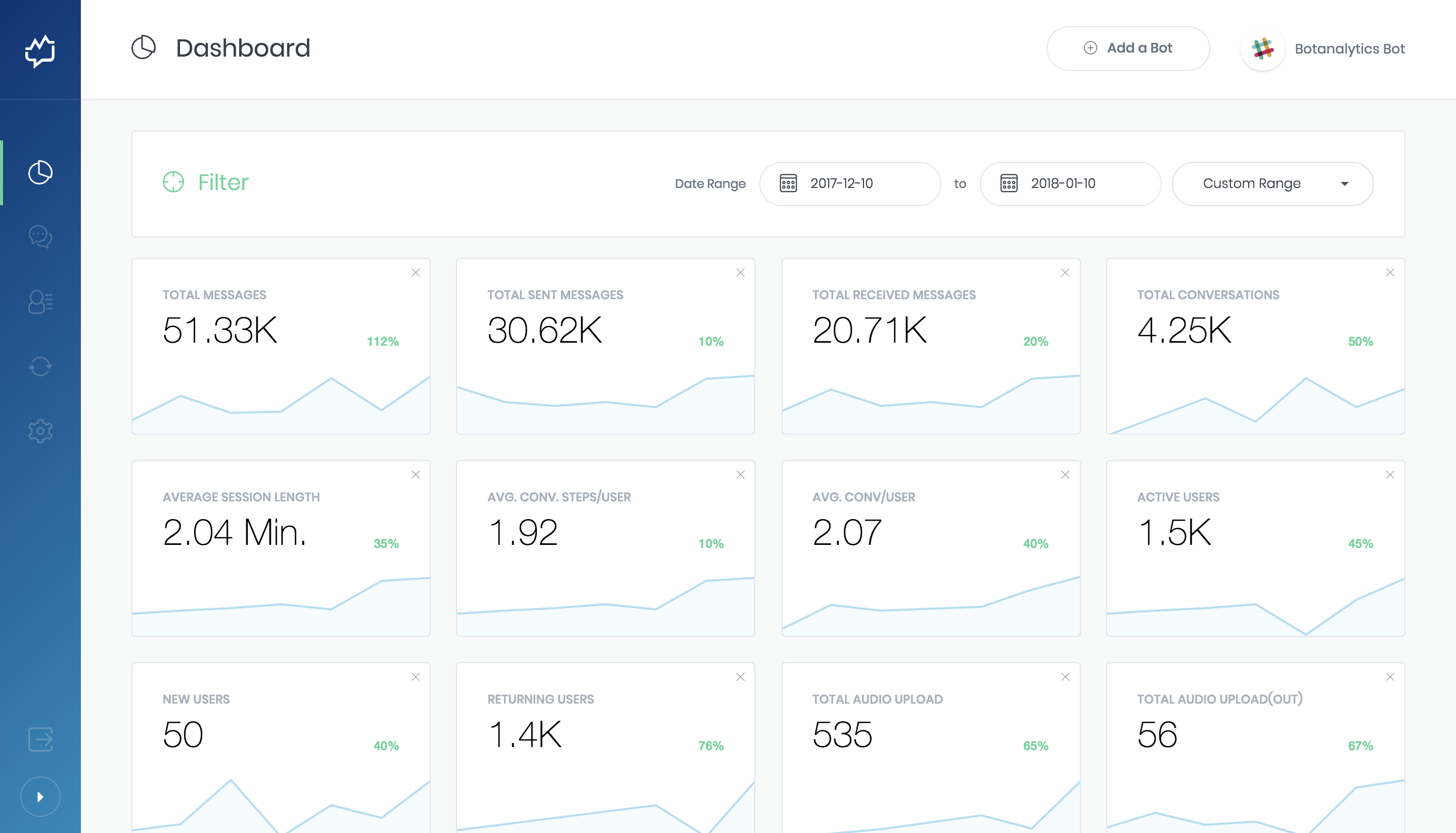
Botanalytics offers analytics for conversational interfaces and chatbots

The rise of chatbots and smart speaker-powered voice assistants, such as Alexa and Google Home, has produced the need for specialist analytics so that developers can track how well those conversational interfaces are working. Hoping to take a chunk of this nascent market, including competing with Google’s own chatbot analytics product Chatbase, is Istanbul and San Francisco-based Botanalytics.

Previously backed by 500 Startups, the company quietly raised $1 million in seed funding late last year. The round was led by ACT Venture Partners and will be used by Botanalytics to further develop its technology.

This will include enhancing support for “voice first” platforms, and enabling business to gain actionable insights based on customer conversations, including understanding how to improve customer support across various channels. The idea is to be able to optimise voice and chatbot performance for engagement, retention and other KPIs.

As it stands, Botanalytics supports a plethora of existing platforms including all of the big names: Google Home, Amazon Alexa, Messenger, Slack, Twitter, Telegram, Kik, Twilio, Skype, Line, Microsoft Teams, WeChat and Viber.

The analytics offering spans a number of features, such as “fundamental metrics” measurement, segmenting conversations, tracking activities of a chatbot, retention of conversations, live take-over, broadcast messages and the ability to set up funnels.

The Botanalytics tech also claims to be powered by AI (presumably NLP). This makes it possible to track transcripts of any conversation — including rich media such as video, audio, location and images — and compare live conversations with historical ones.

CEO Ilker Koksal tells me the main difference with Botanalytics compared to competitors is that is it positioning itself as a broader conversational analytics play, including newer voice interfaces, and traditional customer support, not just chatbots. “We’re analyzing all conversational channels of companies,” he says.

To that end, Koksal says Botanalytics’ customers are agencies that build bots for clients and companies with various customer support channels. They include Coca-Cola, McDonald’s, Ford, L’Oréal and GoPro.

05 Apr 2018

UberX to be parked in Greece after law change

Uber is suspending another international service while it assess whether there’s a business case to continue operations after regulatory changes.

In a blog post announcing the impending suspension of its UberX service in Athens, the company writes: “New local regulations were voted on recently with provisions that impact ridesharing services. We have to assess if and how we can operate within this new framework and so will be suspending uberX in Athens from next Tuesday until we can find an appropriate solution.”

Reuters reports that the new rules in Greece include stipulations for ride-hailing companies including requiring that each trip start and end in the fleet partner’s designated headquarters or parking area — something Uber does not do.

The regulation also requires that a digital registry of all ride-sharing platforms and their passengers is created.

Uber entered the Greek market back in 2015, and says that around 450,000 rides have been booked in the market via its app — so it’s clearly not a major market for the company.

While Uber is suspending its peer-to-peer ride-hailing service in Athens, it says it will continue running its branded taxi service, UberTaxi — which does not face the same regulatory roadblocks.

Taxi drivers in Athens staged an anti-Uber strike last month to protest the continued presence of non-professional drivers. Local press reports taxi unions were been pressing for laws to be passed to regulate ride-hailing rivals.

Elsewhere in Europe, Uber has used a professional taxi service offering as a vehicle to return to some markets — reopening an offering in Barcelona last month, for example, after buying private hire vehicle licenses from a local operator.

The Catalan capital remains an attractive market for ride-hailing operators as the host city for several tech conferences, including the world’s largest mobile trade show which attracts 100k+ smartphone wielding visitors every year.

However local taxi associations have also been robust in challenging the legality of the ride-hailing model in Spain. And continue to actively protest app players such as Uber and Cabify encroaching on the market.

In other European markets Uber has withdrawn service entirely — such as Denmark, which it pulled out of a year ago, also blaming a new taxi law.

It also ended UberX in Hungary back in 2016 — claiming government legislation made it impossible to operate there.

While in London, UK — Uber’s most important European market — the company’s license to operate was withdrawn last September, though it can (and is) continuing to operate in the city during the appeals process.

Transport for London cited safety concerns and anti-regulatory activity among its reasons for not renewing Uber’s license. The regulator also recently published a policy statement setting out its priorities for updating regulations to take account of the fast-paced ride-hailing sector — with safety also among its top stated priorities for shaping new rules.

05 Apr 2018

MoviePass’ parent company acquires Moviefone

Helios and Matheson Analytics, which already owns movie ticket subscription service MoviePass, has acquired Moviefone.

Despite the old-school name, Moviefone is now a digital media business with trailers, movie information and ticketing via Fandango — it says it reaches 6 million unique visitors each month.

Moviefone was previously owned by Oath, the Verizon subsidiary formed from the merger of AOL and Yahoo. (Oath also owns TechCrunch). AOL acquired Moviefone for $388 million back in 1999.

The deal includes a $1 million cash payment, as well as stock that could bring the total value up to $23 million, according to Variety. That means Oath now has a stake in MoviePass . It will also continue sell Moviefone’s digital ad inventory.

MoviePass, meanwhile, allows customers to pay $9.95 a month (or less) to get one free movie ticket per day, albeit with inconveniences like the need to physically buy your ticket at the theater. Acquiring Moviefone is supposed to help the company expand into content and advertising.

“This natural alignment between MoviePass and Moviefone will help us grow our subscriber base significantly and expand our marketing and advertising platform for our studio and brand partners,” said MoviePass CEO Mitch Lowe in the acquisition release. “Moviefone has been a go-to resource for entertainment enthusiasts for years, and we’re excited to bolster its presence and bring this iconic platform into the entertainment ecosystem of the future.”

05 Apr 2018

MoviePass’ parent company acquires Moviefone

Helios and Matheson Analytics, which already owns movie ticket subscription service MoviePass, has acquired Moviefone.

Despite the old-school name, Moviefone is now a digital media business with trailers, movie information and ticketing via Fandango — it says it reaches 6 million unique visitors each month.

Moviefone was previously owned by Oath, the Verizon subsidiary formed from the merger of AOL and Yahoo. (Oath also owns TechCrunch). AOL acquired Moviefone for $388 million back in 1999.

The deal includes a $1 million cash payment, as well as stock that could bring the total value up to $23 million, according to Variety. That means Oath now has a stake in MoviePass . It will also continue sell Moviefone’s digital ad inventory.

MoviePass, meanwhile, allows customers to pay $9.95 a month (or less) to get one free movie ticket per day, albeit with inconveniences like the need to physically buy your ticket at the theater. Acquiring Moviefone is supposed to help the company expand into content and advertising.

“This natural alignment between MoviePass and Moviefone will help us grow our subscriber base significantly and expand our marketing and advertising platform for our studio and brand partners,” said MoviePass CEO Mitch Lowe in the acquisition release. “Moviefone has been a go-to resource for entertainment enthusiasts for years, and we’re excited to bolster its presence and bring this iconic platform into the entertainment ecosystem of the future.”

05 Apr 2018

Benchmark just funded Chainalysis, the crypto intelligence company that helped crack the Mt. Gox case

When the virtual currency exchange Mt. Gox collapsed into bankruptcy in 2014 following the disappearance of hundreds of thousands of bitcoins and tens of millions of dollars, those who lost money were understandably furious.

For a small group of people, however, the theft — likely masterminded, we now know, by a Russian cybercrime suspect who was arrested in Greece this past summer — would prove auspicious.

Specifically, Michael Gronager, who was then chief operating officer of the Kraken bitcoin exchange, spied an opportunity to team up with a new friend, Jonathan Levin, a post-graduate economist from Oxford who’d written academic works on crytpocurrencies. The two were already discussing intelligence software that could trace specific transactions on the blockchain and be sold to law enforcement. Before long, their young company, Chainalysis, was the official investigator on the Mt. Gox case, hired by its bankruptcy trustee to find all those missing coins.

Its small team “cracked the case probably two months in,” Levin says now.

It was a far bigger credit than most companies start off with, and Chainalysis smartly ran with it, signing up customers like the Federal Bureau of Investigations, the Drug Enforcement Administration, the Internal Revenue Service and Europol to help them catch criminals.

But Chainalysis — which now employs 75 people and has offices in New York, Washington, and Copenhagen — isn’t interested in forensics alone. It has much bigger ambitions to work with the world’s financial institutions to help them detect fraud and prevent money laundering. Largely, it aims to do this with a new product called KYT — for Know Your Transaction —  that Levin says provides real-time feedback on the underlying purpose of blockchain transactions and feeds into exchanges’ transaction processing engines. Compliance personnel can also use Chainalysis’s dashboard to generate alerts on risky customers and export suspicious activity reports.

A small group of early customers has already been using the product, whose cost Levin declines to say publicly. Starting today, it says its opening up the product to any financial institution wanting to use it.

For its law enforcement and government customers, Chainalysis is also launching investigation tools around 10 more currencies, in addition to Bitcoin. The first of these: Bitcoin Cash, a fork of Bitcoin that was launched last summer following a longstanding disagreement in the crypto community about how to scale Bitcoin.

The other cryptocurrencies are to be determined, says Levin, adding that as far as Chainalysis is concerned, “The different blockchains that power different cryptocurrencies are all part of the same machine.”

Chainalysis has competitors, including Elliptic, a London-based rival that similarly runs investigations related to cryptocurrency and has raised $7 million in funding to date, including from the bank Banco Santander and Octopus Ventures.

It may be harder than ever to catch Chainalysis, however. To wit, in addition to announcing its new product for financial institutions and it plans to support more cryptocurrencies, the company is today announcing that it has landed $16 million in Series A funding from Benchmark, one of the best venture firms in the business.

The bet is going to mean something to industry watchers, given that Benchmark hasn’t made a crypto related investment in several years. One of its only bets, in fact, was to invest in 2014 in Pantera Capital, the hedge fund operator that buys and sells virtual currencies.

That may well change with Benchmark’s newest general partner, Sarah Tavel, who led the deal in Chainalysis and has joined its board. Tavel has been tracking the industry for several years, including as a VC at her prior firm, Greylock, and it’s a “space I continue to spend time in. “There will be some short-term noise and pain, but I long term believe in it,” she says.

As for Benchmark’s interest in Chainalysis in particular, Tavel suggested that it was a no brainer. It’s a “meat and potatoes company,” she says. “All these regulated institutions want to participate [in cryptocurrency transactions] but they need to understand with whom they are transacting and where their funds are originating. We’d solved these traditional compliance requirements in the fiat world.” With Benchmark’s newest portfolio company, suggests Tavel, the cryptocurrency world has its solution now, too.

05 Apr 2018

Benchmark just funded Chainalysis, the crypto intelligence company that helped crack the Mt. Gox case

When the virtual currency exchange Mt. Gox collapsed into bankruptcy in 2014 following the disappearance of hundreds of thousands of bitcoins and tens of millions of dollars, those who lost money were understandably furious.

For a small group of people, however, the theft — likely masterminded, we now know, by a Russian cybercrime suspect who was arrested in Greece this past summer — would prove auspicious.

Specifically, Michael Gronager, who was then chief operating officer of the Kraken bitcoin exchange, spied an opportunity to team up with a new friend, Jonathan Levin, a post-graduate economist from Oxford who’d written academic works on crytpocurrencies. The two were already discussing intelligence software that could trace specific transactions on the blockchain and be sold to law enforcement. Before long, their young company, Chainalysis, was the official investigator on the Mt. Gox case, hired by its bankruptcy trustee to find all those missing coins.

Its small team “cracked the case probably two months in,” Levin says now.

It was a far bigger credit than most companies start off with, and Chainalysis smartly ran with it, signing up customers like the Federal Bureau of Investigations, the Drug Enforcement Administration, the Internal Revenue Service and Europol to help them catch criminals.

But Chainalysis — which now employs 75 people and has offices in New York, Washington, and Copenhagen — isn’t interested in forensics alone. It has much bigger ambitions to work with the world’s financial institutions to help them detect fraud and prevent money laundering. Largely, it aims to do this with a new product called KYT — for Know Your Transaction —  that Levin says provides real-time feedback on the underlying purpose of blockchain transactions and feeds into exchanges’ transaction processing engines. Compliance personnel can also use Chainalysis’s dashboard to generate alerts on risky customers and export suspicious activity reports.

A small group of early customers has already been using the product, whose cost Levin declines to say publicly. Starting today, it says its opening up the product to any financial institution wanting to use it.

For its law enforcement and government customers, Chainalysis is also launching investigation tools around 10 more currencies, in addition to Bitcoin. The first of these: Bitcoin Cash, a fork of Bitcoin that was launched last summer following a longstanding disagreement in the crypto community about how to scale Bitcoin.

The other cryptocurrencies are to be determined, says Levin, adding that as far as Chainalysis is concerned, “The different blockchains that power different cryptocurrencies are all part of the same machine.”

Chainalysis has competitors, including Elliptic, a London-based rival that similarly runs investigations related to cryptocurrency and has raised $7 million in funding to date, including from the bank Banco Santander and Octopus Ventures.

It may be harder than ever to catch Chainalysis, however. To wit, in addition to announcing its new product for financial institutions and it plans to support more cryptocurrencies, the company is today announcing that it has landed $16 million in Series A funding from Benchmark, one of the best venture firms in the business.

The bet is going to mean something to industry watchers, given that Benchmark hasn’t made a crypto related investment in several years. One of its only bets, in fact, was to invest in 2014 in Pantera Capital, the hedge fund operator that buys and sells virtual currencies.

That may well change with Benchmark’s newest general partner, Sarah Tavel, who led the deal in Chainalysis and has joined its board. Tavel has been tracking the industry for several years, including as a VC at her prior firm, Greylock, and it’s a “space I continue to spend time in. “There will be some short-term noise and pain, but I long term believe in it,” she says.

As for Benchmark’s interest in Chainalysis in particular, Tavel suggested that it was a no brainer. It’s a “meat and potatoes company,” she says. “All these regulated institutions want to participate [in cryptocurrency transactions] but they need to understand with whom they are transacting and where their funds are originating. We’d solved these traditional compliance requirements in the fiat world.” With Benchmark’s newest portfolio company, suggests Tavel, the cryptocurrency world has its solution now, too.

05 Apr 2018

IMAX and Conversive launch a conversational AR app with chatty pandas

While IMAX has become synonymous with enormous theatrical screens, Chief Marketing Officer JL Pomeroy told me the company has “been an innovator at the forefront of technology breakthroughs for the last 50 years” — for example, it recently started creating virtual reality centers.

And today, IMAX is releasing its first augmented reality project, developed in partnership with conversational technology company Conversive and tied to the release of the new IMAX documentary Pandas.

With Pandas AR, children don’t just watch an animated panda in real-world environments — they can also talk to it, getting educated on facts about pandas and taking quizzes about what they’ve learned. The experience is part of a new, free iOS app called Yakables, which Conversive plans to expand with more talking animals.

Pomeroy said she first met with Conversive CEO Kevin Cornish for a general discussion about how IMAX might incorporated AR, but it just so happened that he showed off his platform using a talking panda —  so a collaboration around Pandas seemed obvious. She described the work of Conversive and Cornish’s agency Moth + Flame as “miraculous,” particularly since they had to work on “a very quick timeframe” to get the app ready for the documentary’s release.

In fact, Cornish said that writing the script and finding the right voice actor ended up taking the most time, with the actual animation requiring only a day. That’s because Conversive’s technology can combine motion capture with the “intent” behind an actor’s words to programmatically generate character animations.

“The content can be generated really quickly, at a really low cost, so that having hours of conversational education is actually a realistic thing,” Cornish said.

He also argued that by placing the panda in a real-world environment, the interaction becomes more immersive: “The screen disappears and it becomes about you and this subject.”

And while this is just one project and one app, Pomeroy predicted that we’ll see more AR from IMAX in the future.

“This particular app in support of the documentary Pandas is a great test for us,” she said. “We fully anticipate this will be the first of many.”

05 Apr 2018

IMAX and Conversive launch a conversational AR app with chatty pandas

While IMAX has become synonymous with enormous theatrical screens, Chief Marketing Officer JL Pomeroy told me the company has “been an innovator at the forefront of technology breakthroughs for the last 50 years” — for example, it recently started creating virtual reality centers.

And today, IMAX is releasing its first augmented reality project, developed in partnership with conversational technology company Conversive and tied to the release of the new IMAX documentary Pandas.

With Pandas AR, children don’t just watch an animated panda in real-world environments — they can also talk to it, getting educated on facts about pandas and taking quizzes about what they’ve learned. The experience is part of a new, free iOS app called Yakables, which Conversive plans to expand with more talking animals.

Pomeroy said she first met with Conversive CEO Kevin Cornish for a general discussion about how IMAX might incorporated AR, but it just so happened that he showed off his platform using a talking panda —  so a collaboration around Pandas seemed obvious. She described the work of Conversive and Cornish’s agency Moth + Flame as “miraculous,” particularly since they had to work on “a very quick timeframe” to get the app ready for the documentary’s release.

In fact, Cornish said that writing the script and finding the right voice actor ended up taking the most time, with the actual animation requiring only a day. That’s because Conversive’s technology can combine motion capture with the “intent” behind an actor’s words to programmatically generate character animations.

“The content can be generated really quickly, at a really low cost, so that having hours of conversational education is actually a realistic thing,” Cornish said.

He also argued that by placing the panda in a real-world environment, the interaction becomes more immersive: “The screen disappears and it becomes about you and this subject.”

And while this is just one project and one app, Pomeroy predicted that we’ll see more AR from IMAX in the future.

“This particular app in support of the documentary Pandas is a great test for us,” she said. “We fully anticipate this will be the first of many.”