05 Apr 2018

Pinterest aims for products from the store down your street as its next big ad business

Pinterest is known for having, and promoting, a lot of business content. It’s actually a majority of the content, and it’s usually from some of the most well-known brands that feed into the kinds of sometimes dream-level wants and needs of its users.

And while Pinterest a majority of Pinterest’s potential is locked up there, the company has increasingly turned its gaze toward smaller and smaller businesses to try to entice users with local content — including that clothing store right down your street. That’s part of the reasoning behind Pinterest’s Propel program, which it started a year ago to work with small businesses that really either didn’t know what they were doing, or had just never done it before. In another step toward that goal, Pinterest has hired Matt Hogle to be the global head of small business.

Hogle spent 9 years at Facebook, working with small businesses and will be part of the effort for the company to try to find the right set of tools and strategies in place to appeal to small businesses as it starts to ramp it into a significant portion of its revenue. The number of small businesses on Pinterest has increased by around 50% year-over-year, the company said, and it looks to continue to refine a kind of hybrid strategy that mixes platforms and interactions with real people in order to entice those businesses. That’s important for, say, a local clothing store that only has one store and a limited online shop, but has products that would perform well on their own as content on Pinterest — and could quickly add revenue if they started advertising on it.

“We, as an ads business, know what customers’ business objectives are, and we capture that at the early stages,” Pinterest head of global sales Jon Kaplan said. “We know what they’re targeting, how they’re targeting, who, and we know the creative best practices. We should be able in the very near future to take all these elements and say, oh this is your objective, we’ll obfuscate all this complexity and hit a target [return on ad spend] you have. We’re not far. We’ve obfuscated a lot of the levers one can pull in Propel.”

Propel, for now, is adopting an increasingly popular human/digital approach for smaller businesses that are looking to advertise for the first time on Pinterest. If they have no experience whatsoever, or don’t even know what to do, Pinterest’s goal is to serve as a resource for best practices when it comes to creative content down to where to target it. Pinterest is increasingly rolling out more self-serve tools with more robust targeting and tracking, but the kind of small businesses — the sum of which could eventually account for a big chunk of its revenue — that Facebook has snapped up with the prospect of getting in front of the exact right people at the right time. The company says it will be rolling out the “promote” button, which allows advertisers to click a button on a pin to quickly spin up a campaign, to Australia, Canada, Ireland, New Zealand and the UK in the next coming weeks.

In the end, Pinterest still has 200 million monthly active users, which is absolutely dwarfed by Facebook’s billions of users. But at the same time, Pinterest may be able to capitalize on the good will that Facebook has torched in light of its massive privacy scandal in which information on as many as 87 million users ended up in the hands of a research firm without authorization or permission. Facebook can prove a return on spend, but it can’t at the moment prove that it’ll be able to keep doing the same things that get that return on spend now that the Internet is revolting against Facebook for its massive breach of trust. (Hogle, to be clear, joined before details on the Cambridge Analytica scandal began pouring in.)

Pinterest’s value to advertisers is that it’s able to capture a potential customer when they are just a user clicking (or tapping) around Pinterest looking for ideas. Whether planning life events or just looking for wardrobe suggestions, Pinterest is able to go to advertisers and say they can catch them in those discovery stages and then stick the right ad in front of them to get their attention. Then, the service can follow the user all the way from when they are actually interested in doing something, searching for what to do, and eventually saving that product — or buying it.

It’s that potential value for advertisers that’s taken it to a $12.5 billion valuation in its most recent financing round. But while Pinterest is probably still a sort of curiosity buy for larger advertisers and brands, the challenge has been to chase down the businesses that don’t have huge marketing budgets and might not even be considering Pinterest as a potential advertising platform. After all, the playbook for Facebook is robust and there are plenty of success stories, and the same is true for Google. But at the same time, that bespoke coffee shop down on Valencia Street in San Francisco may have products that line up perfectly for a Pinterest user that’s looking for a holiday gift down the line.

“Over the coming nine months, into 2019, I think we’re gonna continue to invest in ways that make it easy for our small businesses to grow with us,” Hodle said. “Small businesses are unique in the sense that they don’t have the time or energy or resources — the CEO might also be the HR person and the marketing person, and so on. We need to make it extremely lightweight and seamless. At the end of the day, if we can’t provide value and deliver on the money they spend with us and demonstrate the value that’s created there — sales being that number one performance indicator for these companies — then we’re failing. The things we’re gonna continue to build are ways to make that process as easy and seamless.”
“Small businesses add disproportionate value to Pinners and our ad ecosystem,” Hogle said. “I truly believe that small businesses are part of the fabric of every community, they’re the engine that drives every economy around the world. Their relevancy, category or vertical, or proximity to consumers creates disproportionate organic value to Pinners and also creates disproportionate commercial value. Our goal is to show the people the most relevant ad they possibly can based on what they’re trying to accomplish. We can’t do that if we do not meet the needs of the vast majority of businesses that exist. It is a strategic decision, but it’s not just one that goes into paid ads, it creates disproportionate value for the entire platform and ecosystem.”

Hogle’s conversations started mid last year with Tim Kendall, Pinterest’s former president who left in November last year. What started as an exchange of ideas turned, as these conversations often do, it discussions about a potential job at Pinterest, and finally months later he ended up joining to start helping with the company’s small business efforts. Pinterest is increasingly looking to staff up with a suite of executives that will help it get its business in order ahead of a potential IPO. That includes a new COO, Francoise Brougher, who joined in February from Square.

But if Pinterest is going to eventually go public, and get its employees and investors paid out for their efforts, it needs to show that it can be a business that’s beyond just a curiosity budget for a big brand. Getting small businesses on board, like the ones Hogle looks to capture that are right down the street, are a big part of what the company hopes will eventually show that it has a diversified revenue stream and not beholden to just the big and potentially fickle budgets of larger brands.

“Our ad platform is not very old by industry standards, but the rate of development on our self serve tools and the rate of development on interfaces for our small customers is moving at a place where I’m really pleased,” Hogle said. “The ability to carve out opportunity for advertisers is something that’s moving really quickly. Is it where it needs to be long term, of course not, but we’re gonna continue to invest. One of the reasons I joined was it was very clear to me that small businesses were a priority. We are going to invest in products and we’re also going to invest in educational programs. We’re gonna invest and provide in the necessary resources.”
05 Apr 2018

Pinterest aims for products from the store down your street as its next big ad business

Pinterest is known for having, and promoting, a lot of business content. It’s actually a majority of the content, and it’s usually from some of the most well-known brands that feed into the kinds of sometimes dream-level wants and needs of its users.

And while Pinterest a majority of Pinterest’s potential is locked up there, the company has increasingly turned its gaze toward smaller and smaller businesses to try to entice users with local content — including that clothing store right down your street. That’s part of the reasoning behind Pinterest’s Propel program, which it started a year ago to work with small businesses that really either didn’t know what they were doing, or had just never done it before. In another step toward that goal, Pinterest has hired Matt Hogle to be the global head of small business.

Hogle spent 9 years at Facebook, working with small businesses and will be part of the effort for the company to try to find the right set of tools and strategies in place to appeal to small businesses as it starts to ramp it into a significant portion of its revenue. The number of small businesses on Pinterest has increased by around 50% year-over-year, the company said, and it looks to continue to refine a kind of hybrid strategy that mixes platforms and interactions with real people in order to entice those businesses. That’s important for, say, a local clothing store that only has one store and a limited online shop, but has products that would perform well on their own as content on Pinterest — and could quickly add revenue if they started advertising on it.

“We, as an ads business, know what customers’ business objectives are, and we capture that at the early stages,” Pinterest head of global sales Jon Kaplan said. “We know what they’re targeting, how they’re targeting, who, and we know the creative best practices. We should be able in the very near future to take all these elements and say, oh this is your objective, we’ll obfuscate all this complexity and hit a target [return on ad spend] you have. We’re not far. We’ve obfuscated a lot of the levers one can pull in Propel.”

Propel, for now, is adopting an increasingly popular human/digital approach for smaller businesses that are looking to advertise for the first time on Pinterest. If they have no experience whatsoever, or don’t even know what to do, Pinterest’s goal is to serve as a resource for best practices when it comes to creative content down to where to target it. Pinterest is increasingly rolling out more self-serve tools with more robust targeting and tracking, but the kind of small businesses — the sum of which could eventually account for a big chunk of its revenue — that Facebook has snapped up with the prospect of getting in front of the exact right people at the right time. The company says it will be rolling out the “promote” button, which allows advertisers to click a button on a pin to quickly spin up a campaign, to Australia, Canada, Ireland, New Zealand and the UK in the next coming weeks.

In the end, Pinterest still has 200 million monthly active users, which is absolutely dwarfed by Facebook’s billions of users. But at the same time, Pinterest may be able to capitalize on the good will that Facebook has torched in light of its massive privacy scandal in which information on as many as 87 million users ended up in the hands of a research firm without authorization or permission. Facebook can prove a return on spend, but it can’t at the moment prove that it’ll be able to keep doing the same things that get that return on spend now that the Internet is revolting against Facebook for its massive breach of trust. (Hogle, to be clear, joined before details on the Cambridge Analytica scandal began pouring in.)

Pinterest’s value to advertisers is that it’s able to capture a potential customer when they are just a user clicking (or tapping) around Pinterest looking for ideas. Whether planning life events or just looking for wardrobe suggestions, Pinterest is able to go to advertisers and say they can catch them in those discovery stages and then stick the right ad in front of them to get their attention. Then, the service can follow the user all the way from when they are actually interested in doing something, searching for what to do, and eventually saving that product — or buying it.

It’s that potential value for advertisers that’s taken it to a $12.5 billion valuation in its most recent financing round. But while Pinterest is probably still a sort of curiosity buy for larger advertisers and brands, the challenge has been to chase down the businesses that don’t have huge marketing budgets and might not even be considering Pinterest as a potential advertising platform. After all, the playbook for Facebook is robust and there are plenty of success stories, and the same is true for Google. But at the same time, that bespoke coffee shop down on Valencia Street in San Francisco may have products that line up perfectly for a Pinterest user that’s looking for a holiday gift down the line.

“Over the coming nine months, into 2019, I think we’re gonna continue to invest in ways that make it easy for our small businesses to grow with us,” Hodle said. “Small businesses are unique in the sense that they don’t have the time or energy or resources — the CEO might also be the HR person and the marketing person, and so on. We need to make it extremely lightweight and seamless. At the end of the day, if we can’t provide value and deliver on the money they spend with us and demonstrate the value that’s created there — sales being that number one performance indicator for these companies — then we’re failing. The things we’re gonna continue to build are ways to make that process as easy and seamless.”

“Small businesses add disproportionate value to Pinners and our ad ecosystem,” Hogle said. “I truly believe that small businesses are part of the fabric of every community, they’re the engine that drives every economy around the world. Their relevancy, category or vertical, or proximity to consumers creates disproportionate organic value to Pinners and also creates disproportionate commercial value. Our goal is to show the people the most relevant ad they possibly can based on what they’re trying to accomplish. We can’t do that if we do not meet the needs of the vast majority of businesses that exist. It is a strategic decision, but it’s not just one that goes into paid ads, it creates disproportionate value for the entire platform and ecosystem.”

Hogle’s conversations started mid last year with Tim Kendall, Pinterest’s former president who left in November last year. What started as an exchange of ideas turned, as these conversations often do, it discussions about a potential job at Pinterest, and finally months later he ended up joining to start helping with the company’s small business efforts. Pinterest is increasingly looking to staff up with a suite of executives that will help it get its business in order ahead of a potential IPO. That includes a new COO, Francoise Brougher, who joined in February from Square.

But if Pinterest is going to eventually go public, and get its employees and investors paid out for their efforts, it needs to show that it can be a business that’s beyond just a curiosity budget for a big brand. Getting small businesses on board, like the ones Hogle looks to capture that are right down the street, are a big part of what the company hopes will eventually show that it has a diversified revenue stream and not beholden to just the big and potentially fickle budgets of larger brands.

“Our ad platform is not very old by industry standards, but the rate of development on our self serve tools and the rate of development on interfaces for our small customers is moving at a place where I’m really pleased,” Hogle said. “The ability to carve out opportunity for advertisers is something that’s moving really quickly. Is it where it needs to be long term, of course not, but we’re gonna continue to invest. One of the reasons I joined was it was very clear to me that small businesses were a priority. We are going to invest in products and we’re also going to invest in educational programs. We’re gonna invest and provide in the necessary resources.”
05 Apr 2018

Kahuna comes out of the gate with customer engagement platform

We keep hearing about the value of customer experience from some of the world’s biggest software companies. Last week Adobe trotted out the customer experience system of record at Adobe Summit. Meanwhile, Salesforce announced its Integration Cloud. Today Kahuna, a Redwood City, California startup, announced a platform to compete with the giants to help brands build more targeted interactions.

CEO Sameer Patel says the company is a cloud service designed to give users more information with artificial intelligence underpinnings. The goal is to help them push the customer toward the sale finish line by reducing the online noise around a sale and keeping the conversation going when the customer goes quiet.

“If you are a seller we reduce cognitive overload for buyers by suggesting a few but better targeted products. Using AI, we optimize your message copy and subject lines. We can reduce shopping cart abandonment with better offers. We trigger real-time action to close transactions, facilitating paid placement and promotions,” Patel told TechCrunch.

This involves understanding the customer better and feeding the artificial intelligence engine, and that involves data, of course. Patel says the company spent a year just building a real-time data platform when it was formed in 2011.

Kahuna can ingest data from live interactions via [our] SDK or third-party systems like order management. We can capture any new gestures from [these sources] and update the user’s profile in four seconds or less. Once that’s done, we apply AI to determine the best message, best time, best subject line, best device and best channel,” he explained.

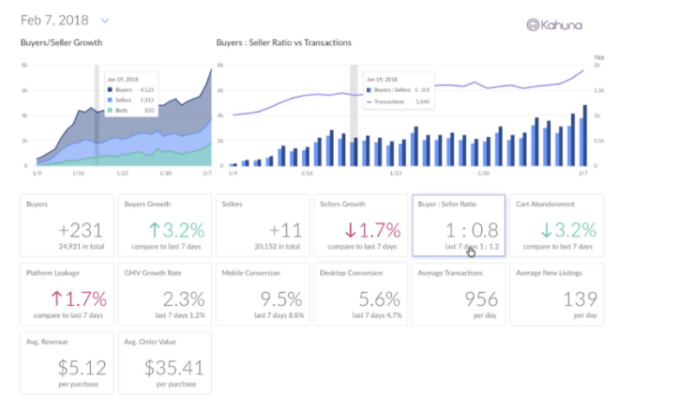
Kahuna analytics dashboard. Screenshot: Kahuna

Whenever there is this level of customer data collection, there are questions about data privacy, especially with EU GDPR data protection rules on the horizon. “Even before GDPR, we always co-opted the user rights from the customer (the marketplace) and no more. iI you didn’t give the marketplace permission, then we don’t have permission. Period,” Patel stated.

A platform like this is only as good as the data integration points, and the company also announced a couple of big partnerships. “For this announcement, we are coming out the gate with Oracle/Responsys integration (their email marketing works with the Kahuna platform) and Magento (Kahuna will incorporate user signals from the commerce engine to make our user profile and AI work smarter).” He says the platform has been designed to plug in other services, and he expects that there will be additional partnerships over time.

Kahuna launched in 2011 and has raised $58 million in venture investment. The company’s $11 million Series A was led by Sequoia Capital in 2014, followed by a $45 million Series B led by Tenaya Capital in 2015

05 Apr 2018

Fetch adds two new robots to its warehouse automation army

Fetch Robotics capped off 2017 with a $25 million Series B, bringing its total up to $48 million. It’s clear that investors are taken with the San Jose-based automation company. By most accounts, increasingly automated warehouses are undergoing a staffing crunch, and Fetch offers the promise of humans and robots working peacefully in tandem.

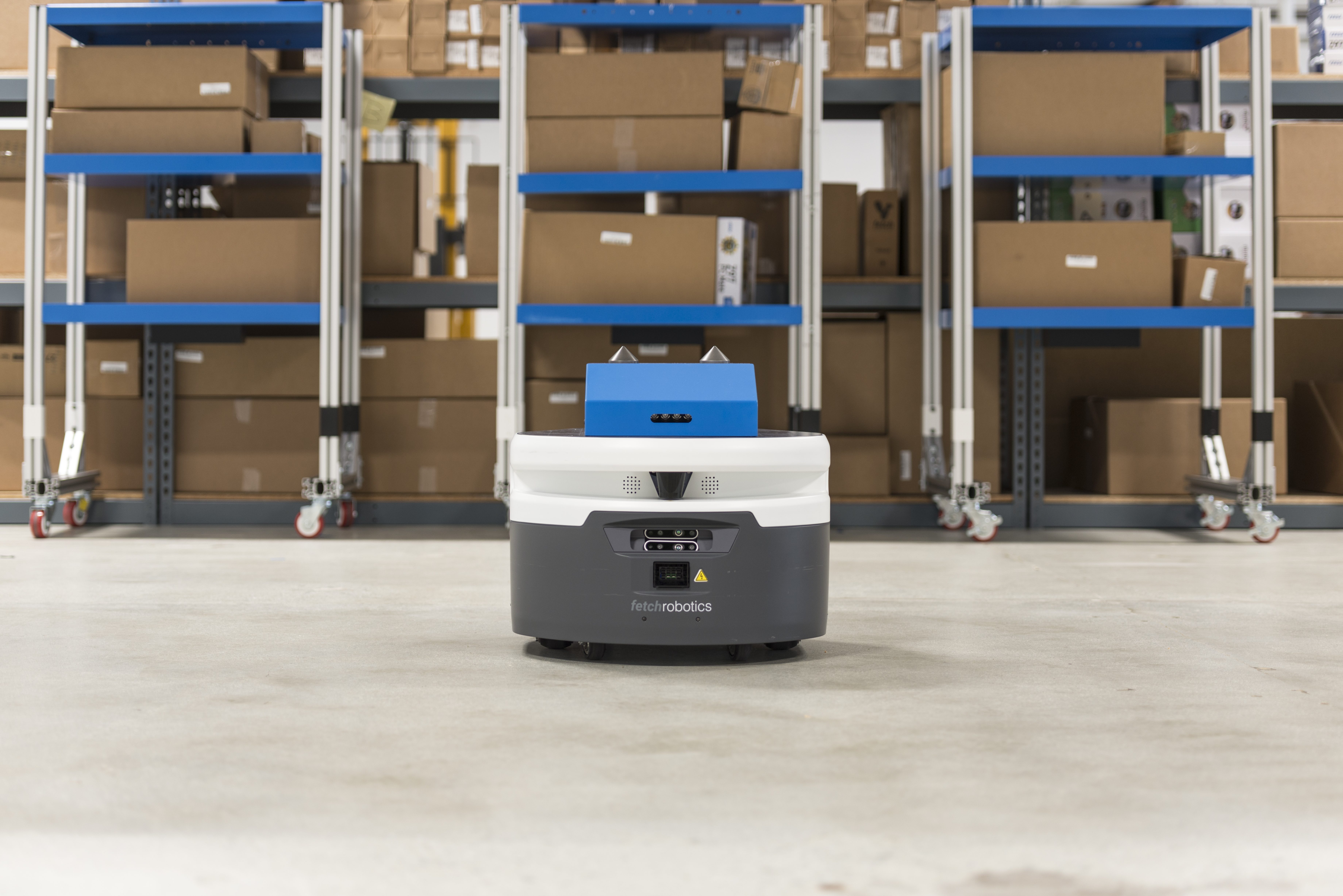
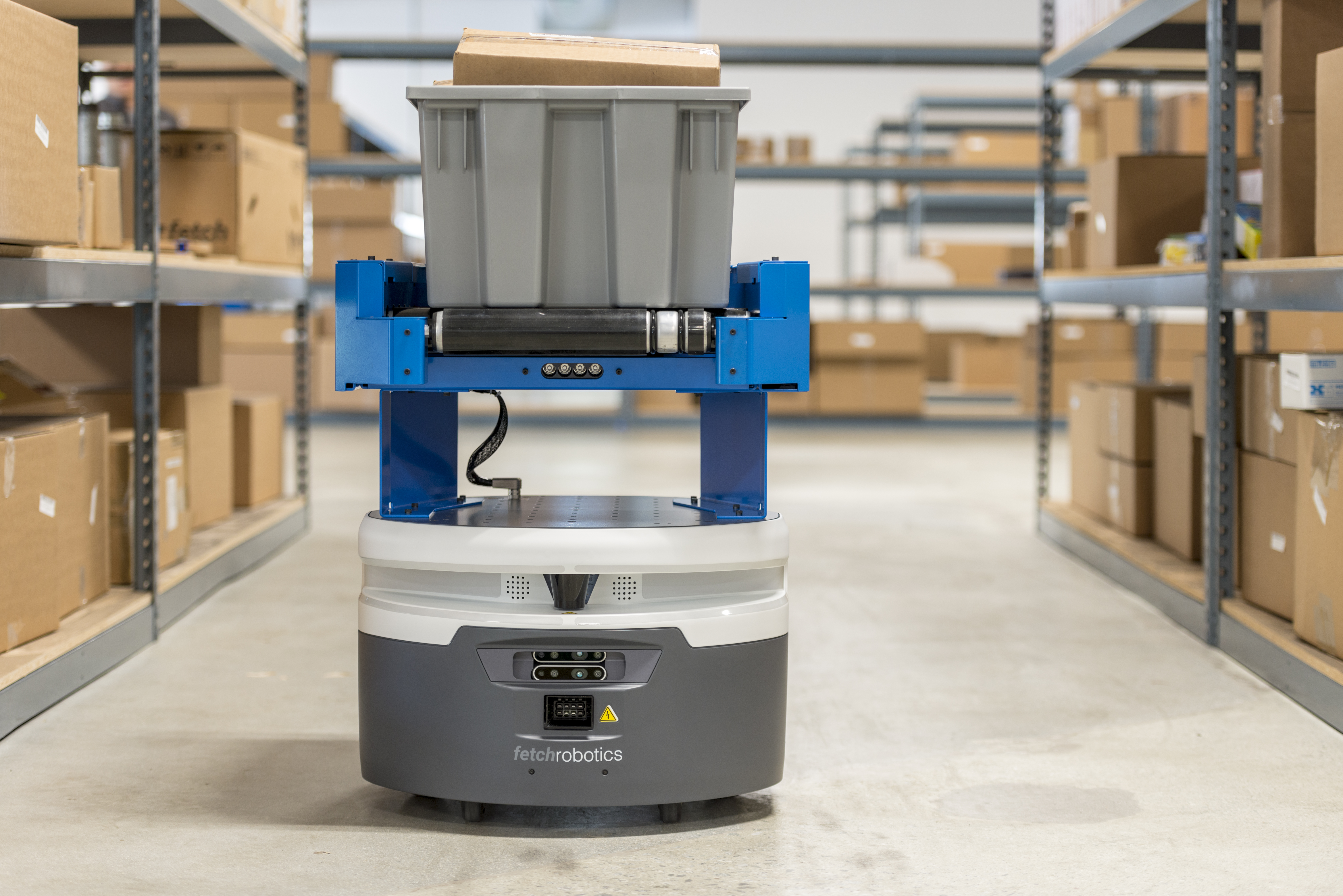
Today the company announced a pair of new robots designed remove some of the pain points from warehouse fulfillment. Both are modules that plug onto the top of the company’s VirtualConveyor robot — a kind of large, warehouse Roomba designed two autonomously navigate from point A to point B in a space, while avoiding collisions with people, aisles and dropped objects, in the process.

RollerTop is, as you may have already guessed by the extremely straight-forward name, adds a series of rollers to the top of the robot. The rollers themselves are powered, so the robot can drive up to a conveyer belt, line itself up and send a box along for pickup. The other big addition here is CartConnect, a module with a pair of metal spikes capable of picking up and transporting carts around the warehouse.

TechCrunch spent some time with CEO Melonee Wise earlier this week at the company’s recently opened San Jose headquarters. The exec told us that the modules represent a big piece of Fetch’s model, moving forward. The company likely won’t iterate too much on the actual robotic hardware base in the near term, instead focusing on these key accessories, along with software updates.

The pieces do, however, point to a way forward for the system, which will be capable of a broad range of different tasks with the right add-ons in place. As companies like Amazon have completely shifted the expectation for warehouse logistics, many companies find themselves rushing the keep up. It’s clear, for example, why DHL has already made a point of deploying some of Fetch’s machines.

The robots are certainly no nonsense and capable of repetitive and strenuous tasks that are putting a strain on factory workers.

05 Apr 2018

Singapore-based smart lock maker Igloohome raises $4M

Singapore-based smart lock maker Igloohome has closed a $4 million Series A round.

The investment was led by Insignia Ventures, the new firm started by ex-Sequoia venture partner Yinglan Tan. Phillip Private Equity, X Capital Ventures, K3 Venture’s Kuok Meng Xiong, angel investor Koh Boon Hwee, and existing backer Wavemaker Partners also took part.

The company is a rare example of a hardware startup coming out of Southeast Asia with a global presence.

Inspired by the rise of Airbnb and hosts on the platform, Igloohome sells a range of key-less products that include digital locks, digital deadbolts and a digital safety deposit box. The products are notable because they work offline, requiring either a manually entry pin code or ‘Bluetooth key’ on a phone to unlock. Despite that, owners can still control access remotely, while there’s a physical key just in case.

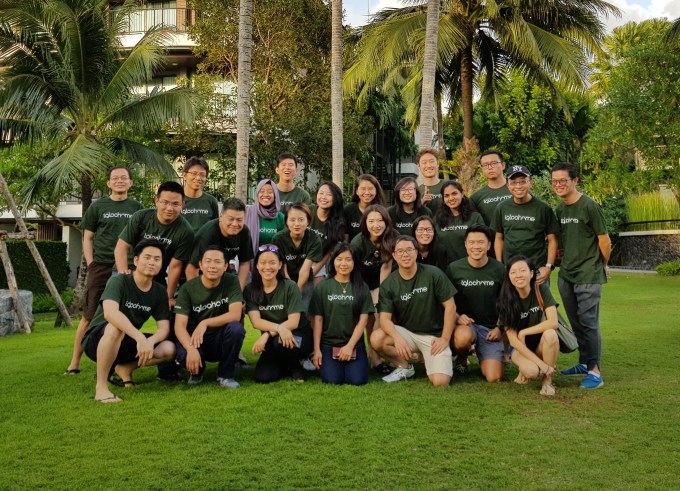
The Igloohome team

The company said that the new funding will go towards R&D for new products, and developing solutions for commercial projects, which could include hospitality, student accommodation and warehouse projects. The company is already a partner seller of Airbnb, rival HomeAway, and China’s Xiaozhu which helps it reach a very targeted audience. Outside of those relationships, it sells directly to consumers in over a dozen countries via the likes of Amazon, Walmart and Home Depot while there are online options for other global markets.

“We are very encouraged by the support provided by our investors. We believe that together, we will be able to bring even more innovative products and services to the table, and grow the Igloohome name into a lifestyle brand,” Anthony Chow, CEO and co-founder of Igloohome, said in a statement.

05 Apr 2018

Australia latest to open probe into Facebook data scandal

Australia’s privacy watchdog has opened an investigation into Facebook in the wake of the Cambridge Analytica data misuse scandal.

Yesterday Facebook revealed that more users than previously thought could have had their personal information passed to the company back in 2014 — saying as many as 87 million Facebook users could have had their data “improperly shared”, thereby confirming the testimony of ex-Cambridge Analytica employee, Chris Wylie, who last month told a UK parliamentary committee he believed that substantially more than 50M Facebook users had had their information swiped.

And while most of these Facebook users are located in the US, multiple millions are not.

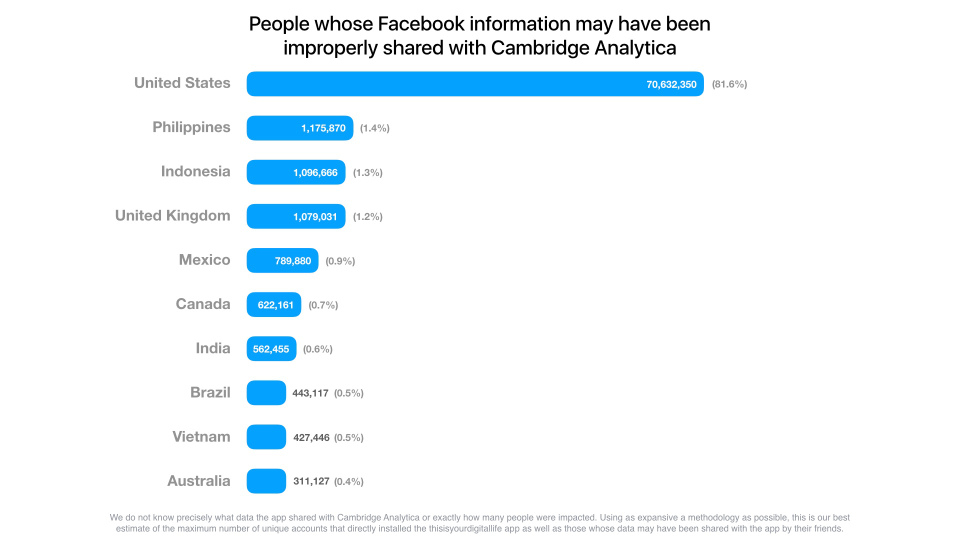
The company confirmed the international split yesterday in a blog post — including that 1 million+ of the total are UK users; more than 620k are Canadian; and more than 300k are Australian.

Though in tiny grey lettering at the bottom of the graphic Facebook caveats that these figures are merely its “best estimates” of the maximum number of affected users.

After the US, the largest proportion of Facebook users affected by the data leakage were in the Philippines and Indonesia.

In a statement today the Australian watchdog (OAIC) said it has opened a formal investigation into Facebook.

“The investigation will consider whether Facebook has breached the Privacy Act 1988(Privacy Act). Given the global nature of this matter, the OAIC will confer with regulatory authorities internationally,” it writes. “All organisations that are covered by the Privacy Act have obligations in relation to the personal information that they hold. This includes taking reasonable steps to ensure that personal information is held securely, and ensuring that customers are adequately notified about the collection and handling of their personal information.”

We’ve reached out to the National Privacy Commission in the Philippines for a reaction to the Cambridge Analytica revelations.

Indonesia does not yet have a comprehensive regulation protecting personal data — and concerned consumers in the country can but hope this latest Facebook privacy scandal will act as a catalyst for change.

Elsewhere, the Office of the Privacy Commissioner of Canada announced that it was opening a formal investigation into Facebook on March 26. In an op-ed, privacy commissioner Daniel Therrien also wrote that the Cambridge Analytica scandal underscored deficiencies in the country’s privacy laws.

“At the moment, for example, federal political parties are not subject to privacy laws,” he said. “This is clearly unacceptable. Information about our political views is highly sensitive and therefore particularly worthy of protection. We must take action in the face of serious allegations that democracy is being manipulated through analysis of the personal information of voters. Bringing parties under privacy laws would be a step in the right direction.”

Back in Europe, the UK’s data watchdog, the ICO, was already investigating Facebook as part of a wider investigation into data analytics for political purposes which it kicked off in May 2017.

We’ve asked if the agency intends to also open a second investigation into Facebook in light of the 1M+ UK users affected by the CA data mishandling — and will update this post with any response.

Late last month the UK’s information commissioner, Elizabeth Denham, revealed the watchdog had been looking into Facebook’s partner category service as part of its political probe, examining how the company used third party data to inform targeted advertising.

In a statement she said she had raised the service as “a significant area of concern” with Facebook — and welcomed Facebook’s decision to shutter it.

And last month the ICO was also granted a warrant to enter and search Cambridge Analytica’s offices.

Reacting to the Cambridge Analytica scandal last month, Andrea Jelinek, chair of the European Union’s influential data protection body, the Article 29 Working Party — which is made up of reps of all the national DPAs — said the group would be supporting the ICO’s investigation.

“As a rule personal data cannot be used without full transparency on how it is used and with whom it is shared. This is therefore a very serious allegation with far-reaching consequences for data protection rights of individuals and the democratic process,” she said in a statement. “ICO, the UK ́s data protection authority, is conducting the investigation into this matter. As Chair of the Article 29 Working Party, I fully support their investigation. The Members of the Article 29 Working Party will work together in this process.”

Also last month the European Commission’s justice and consumer affairs commissioner, Vera Jourova, told the BBC that the executive body would like to see new legislation in the US to strengthen data protection.

In Europe the incoming General Data Protection Regulation (GDPR) beefs up the enforcement of privacy rules with tighter requirements on how data is handled and a new regime of tougher fines for violations.

“We would like to see more robust and reliable legislation on American side,” said Jourova. “Something similar or comparable with the GDPR. And I believe that one day it will happen also in United States and that’s why I am now so curious how American society will react on this scandal — and other scandals which might come.”

The EC has a specific lever to press the US on this point — in the form of the Privacy Shield arrangement which simplifies the process of authorizing personal data flows between the EU and the US by allowing companies to self-certify their adherence to a set of privacy principles.

Both Facebook and Cambridge Analytica are signatories to Privacy Shield — and are currently listed as ‘active participants’ in the framework (for now).

The mechanism was negotiated as a direct replacement for Safe Harbor — after Europe’s top court struck down that earlier arrangement, in 2015, in the wake of the Snowden disclosures about US government mass surveillance programs.

The Privacy Shield arrangement has its critics. It also includes a regime of annual reviews. In the BBC interview Jourova made a point of reminding the US that the arrangement — which thousands of companies rely on to keep their data flows moving — remains under constant review.

She also said she would be writing to Facebook seeking answers about the Cambridge Analytica scandal. “What we want from Facebook is to obey and to respect the European laws,” she added.

For its part Facebook caused confusion about its commitment to raising data protection standards on its platform this week after founder Mark Zuckerberg told a Reuters journalist that it will not be universally applying GDPR for all its users — given the law applies for all Facebook’s international users that essentially means the company intends to apply a lower privacy standard for North American users (whose data is processed in the US, rather than in Ireland where its international HQ is located, within the EU).

However in a follow up conference call with journalists Zuckerberg made some carefully worded remarks that seem to further fog the issue — saying: “We intend to make all the same controls available everywhere, not just in Europe” yet going on to caveat that statement with: “Is it going to be exactly the same format? Probably not. We’ll need to figure out what makes sense in different markets with different laws in different places.”

At this stage it remains unclear whether Facebook will universally apply GDPR or not. Zuckerberg’s remarks suggest there will indeed be some discrepancies in how it handles data protection for different users — what those differences will be remains to be seen.

Yesterday the Facebook founder also revealed that search tools on the platform had made it possible for “malicious actors” to discover the identities and collect information on most of its 2 billion users worldwide — essentially confessing to yet another massive data leak.

He said Facebook had now disabled the tool.

As with the millions of Facebook users whose data was improperly passed to Cambridge Analytica, the company is unlikely to be able to precisely confirm the full extent of how the search loophole was exploited to leak personal data.

Nor will it be able to delete any of the personal information that was maliciously swiped.

05 Apr 2018

‘The end of my VC career’ — Stefan Glaenzer quits Passion Capital to clear way for third fund

Stefan Glaenzer, the prominent European VC and former chairman of Last.fm and founder of Ricardo.de, has quit his role as Partner at Passion Capital. He co-founded the London-based early-stage firm seven years ago with partners Eileen Burbidge and Robert Dighero.

The decision to resign, which the firm’s staff and Limited Partners were informed of last Thursday, is linked to Glaenzer’s arrest and subsequent conviction in 2012 when he pleaded guilty to sexually assaulting a woman on the London Underground Tube network. He claimed to be high on cannabis at the time and was given a suspended prison sentence and a fine, banned from using the Tube for 18 months, and placed on the U.K.’s sex offender registry.

Passion Capital is in the midst of fundraising and Glaenzer’s conviction has become an obstacle to some LPs backing a third fund. This contrasts with 2015 when the London VC firm successfully raised £45 million for fund two, including £17.5 million coming from the U.K. taxpayer via the British Business Bank. In 2012, following Glaenzer’s sexual assault conviction, existing LPs and Passion Capital partners also unanimously voted that he should remain in his role at the firm.

In an interview offered to TechCrunch — which at first I was hesitant to accept until it became clear there was a legitimate news angle — I sat down with Glaenzer to discuss the events that led to his resignation and put questions to him that have persisted over the years within the London investment and technology startup community and have become ever louder following high-profile cases of alleged sexual harassment in Silicon Valley and the wider #metoo movement.

They include why he wasn’t fired from his job at the time of the sexual assault conviction, why he didn’t resign earlier, and how Passion Capital and its investors dealt internally with the incident. I also wanted to understand what changed in 2018. The only red line was that he didn’t want to talk about how it impacted his private life and family.

German-born Glaenzer — a multimillionaire twice over through the sale of Ricardo.de to QXL in 2000 and Last.fm to CBS in 2007 — says Thursday 16th of November 2017 was the day he “instinctively knew” his VC career was over. He and Passion’s two other partners, Burbidge and Dighero, were meeting with an institutional investor who had been lined up as a cornerstone LP in fund three. Quite far along in the due diligence process and with the outcome looking positive, the conference room had been booked for 2.5 hours in preparation for an intense final round of negotiations. Thirty minutes in, however, the meeting was over. The operational team had passed the deal to the investment firm’s compliance department and Glaenzer had turned from key person to “headline risk”.

“It was clear, we banked on them as our cornerstone, everything was positive, and after four or five months they said no and we knew we needed to restart,” he says. “I knew that this chapter was over”.

What that “headline risk” is was never explicitly stated, says Glaenzer, who didn’t think to ask, but it seems almost certainly the reputational damage that could be inflicted on any investor associated with Passion Capital if Glaenzer remained involved and should his conviction resurface in the media. Optics matter more than ever in 2018.

That is precisely what happened two months prior to the investor meeting when Bloomberg news ran a story asking: ‘Will Britain Keep Investing in a Sex Offender’s Venture Fund?’. The article placed Glaenzer’s conviction in the context of a wider debate about the role LPs should play in policing bad behaviour by VCs, even if his conviction was for something that happened outside of work.

“In the end the institution made the right call,” says Glaenzer. “I think, luckily, in some societies we have made sure that compliance has a big function. Over the last ten years this has become more ingrained”.

But if it was the right call not to invest in Glaenzer in 2018, shouldn’t the same call have been made in either 2012 or later in 2015. He says the sentiment has changed a lot since then and that, more broadly, the ecosystem is “stunningly different” today.

“I think all participants agreed on the view there’s a difference between what happens in private and what happens in business.

“There wasn’t this thinking or discussion about it. It was just, with these conditions — they were concerned about drug use or another incident, and we clearly defined consequences for this — people accepted”.

(Glaenzer declined to specify what those conditions were as he says they were private matters, although one was that he undergo regular drug testing for two years).

He says that everybody legally involved in Passion Capital’s first fund voted that he should remain a Partner. “There was not a single against vote,” he says.

But why didn’t he just resign at the time of the incident?

“In 2002, when I was on my break doing nothing, I watched 62 out of the 64 games in the World Cup in Japan and South Korea. Germany had a terrible team, it was a disaster, other than [goalkeeper] Oli Kahn, who brought us into the final. And this man made a mistake in the 66th minute and we lost the game. And we or rather he didn’t win the trophy. He said after the game, ‘and continue’. You have to accept that you made a mistake and you have to take the consequences. Don’t run away. And that is my fundamental belief”.

I suggest that by remaining in his position he took very few consequences, and that in almost any other walk of life a person with less privilege would automatically lose their job after being convicted of sexual assault.

“I’m struggling to find a correlation between having done a private mistake, where we all agreed this was not business related, this was in no way using power or money,” says Glaenzer. “It was a personal mistake which I on the spot acknowledged and accepted and apologised [for]. And I said from day one to my partners and the CFE [now the BBB], it is not my decision, I want to carry on doing this, but I will of course accept any decision. If people have a different opinion, I do understand”.

Glaenzer is almost certain that Passion Capital would not have survived had he quit in 2012 and says that doing so would have let his partners and investors down. With two multimillion dollar exits behind him and regarded as a dot-com poster child back in Germany, he was indisputably the biggest draw for Passion Capital’s original LPs.

“Do you run away or do you accept… and continue what you promised to your partners and to your investors? I went to families, I went to people and said, you know what, this is what I want to do, there’s going to be money, we are aiming for [and] have our own expectations of what sort of return a small venture fund should deliver, and then run away? No. I can understand why people think differently, of course. But I personally, in my value system, I can not.”

That’s not to say there weren’t business consequences for Passion Capital and on Glaenzer’s ability to carry out his job, which he says he “100 percent” underestimated. “I was not even thinking about business consequences. It was more about the private…” he says.

The fund was suspended for five weeks after the incident, as per the LP agreement and so a decision about his future could be voted on. His conviction and details of the sexual assault were widely reported in the British media and he says the perception of him understandably changed amongst some people in the tech industry. This resulted in a halt to public appearances and networking and he says he initially saw a 70-80 percent reduction in unsolicited pitches. Passion also lost at least one deal due to Glaenzer’s conviction.

“With every deal there was this awkward situation,” he says. “We always disclosed this to our founders before we signed the deal, and that is, on many levels, a very awkward situation. For founders and [for] us”.

From the outside, at least, I say that it feels as though Passion Capital quickly underwent a re-branding post-incident that saw partner Burbidge replace Glaenzer as the more visible face of the VC firm, which otherwise has always made a virtue of its openness, pushing initiatives like its ‘Plain English Term Sheet’ and making its investment terms public.

“It was a 180 degree change,” says Glaenzer. A change, nonetheless, that he says would have happened over time anyway.

“We used our respective strengths. The respective strength of Eileen [Burbidge] has been [there] from day one, even though I was probably doing more of the visible media. She was organising every single thing; she should become the face of the company… It was very, very clear because she is way more talented than I will ever be. It was known”.

So what’s next for Glaenzer? He gives little away but says he has spent the last few months quietly working on a couple of MVPs, including one idea he has fallen in love with. “My fundamental goal is I don’t want to have my kids being solely educated from American media and digital platforms,” he says.

More than anything Glaenzer says he is ready to embrace change: admitting that he had become increasingly unhappy working in early-stage venture and now very clearly a burden on Passion, he doesn’t dispute that a simple version of this story is that the events of 2012 have finally caught up with him.

On several occasions during the interview Glaenzer quotes a passage from the poem “Steps” by the German poet Hermann Hesse, which he’s handwritten across several sheets of plain white paper, revealing each line one page at a time.

He says he used the same poem to explain his resignation to members of the Passion team last week and also when he quit Recardo.de in 2000.

“‘A magic dwells in each beginning, protecting us, telling us how to live’,” he reads. “It’s a fundamental belief that this magic is in new beginnings.”

05 Apr 2018

Alibaba is preparing to invest in Grab

Fresh from announcing a deal to buy out Uber in Southeast Asia, Grab looks set to gain further firepower with Chinese e-commerce giant Alibaba preparing to invest in the ride-hailing firm.

Alibaba is in the early stages of making an investment in Grab, two sources with knowledge of discussions told TechCrunch. Isn’t yet clear what size that might be or at what valuation for Grab, which was last valued by investors at $6 billion.

In addition, the timing is unclear due to current anti-trust investigations into the Grab-Uber deal. The Competition Commission of Singapore has said there are grounds to believe the merger may violate the law, while other countries are looking into its implications. But still, there is intent from both sides and key investor SoftBank to make the deal.

Grab declined to comment for this story. An Alibaba spokesperson said the company “doesn’t confirm on market rumors.”

Alibaba and Grab first held talks over an investment last summer but a deal never materialized after the Chinese firm became pre-occupied chasing an investment in Tokopedia, the Indonesia-based e-commerce unicorn. That deal was prioritized because Alibaba’s arch-rival Tencent was in advanced talks over an investment that could give it a foothold in Indonesia, Southeast Asia’s largest economy and the world’s fourth most populous country.

Alibaba leaned heavily on its long-time ally SoftBank — an early backer of Tokopedia and Grab — to get the Tokopedia deal ahead of Tencent. That’s despite Tokopedia’s own founders’ preference for Tencent due to Alibaba’s ownership of Lazada, an e-commerce rival to Tokopedia. SoftBank, however, forced the deal through.

“It was literally SoftBank against every other investor,” a separate source with knowledge of negotiations told TechCrunch.

Ultimately, Alibaba was successful and it led a $1.1 billion investment in Tokopedia in August which did not include Tencent.

TechCrunch understands that one condition SoftBank attached to the Tokopedia deal was that Alibaba would invest in Grab when the time was right. SoftBank is widely seen to have been the deal-maker in the recent Grab-Uber consolidation and now, with that transaction agreed, Alibaba’s investment will follow.

The timing may be ideal for Grab. While it has plenty of money in the bank from past investments, Indonesian rival Go-Jek is preparing to expand into regional markets so the firm will need to brace itself for a new wave of competition.

Despite the background, this is far from Alibaba being strong-armed into an investment, a deal with Grab makes plenty of sense for the firm.

It has been actively seeking investment deals in Southeast Asia’s top internet companies for some time, and Grab clearly fits the bill. In particular, Grab’s focus on payments and its recently-announced financial services play is aligned with Alibaba and its fintech arm Ant Financial’s goals, too.

Last year, Ant Financial went on an investment spree which included multiple investments deals across Southeast Asia and the failed acquisition of MoneyGram. Involvement in Grab Pay, which is shaping up to be a major payment player across the region, would massively boost Alibaba and Ant’s objective.

Finally, there’s the good old competition factor. With Tencent an investor in Grab rival Go-Jek, Alibaba has motivation enough to back a horse in Southeast Asia’s ride-hailing space.

As I wrote last year, the two Chinese internet giants have been carving up Southeast Asia’s most promising startups in search of investments that give them a good position as the region’s internet economy grows.

A report co-authored by Google last year forecast that Southeast Asia’s internet economy will grow to $200 billion in 2025 from $50 billion in 2017. Right now, it is Chinese companies, not those from the U.S., that are seizing the opportunity.


Got a news tip? You can contact TechCrunch reporter Jon Russell via his jr@techcrunch.com email, Twitter DM, or @jonrussell on Telegram. Message privately for phone number or Signal account.

05 Apr 2018

Highlights and audio from Zuckerberg’s emotional Q&A on scandals

“This is going to be a never-ending battle” said Mark Zuckerberg . He just gave the most candid look yet into his thoughts about Cambridge Analytica, data privacy, and Facebook’s sweeping developer platform changes today during a conference call with reporters. Sounding alternately vulnerable about his past negligence and confident about Facebook’s strategy going forward, Zuckerberg took nearly an hour of tough questions.

You can listen to the entire call here:

The CEO started the call by giving his condolences to those affected by the shooting at YouTube yesterday. He then delivered this mea culpa on privacy:

We’re an idealistic and optimistic company . . . but it’s clear now that we didn’t do enough. We didn’t focus enough on preventing abuse and thinking through how people could use these tools to do harm as well . . . We didn’t take a broad enough view of what our responsibility is and that was a huge mistake. That was my mistake.

It’s not enough to just connect people. We have to make sure those connections are positive and that they’re bringing people together.  It’s not enough just to give people a voice, we have to make sure that people are not using that voice to hurt people or spread misinformation. And it’s not enough to give people tools to sign into apps, we have to make sure that all those developers protect people’s information too.

It’s not enough to have rules requiring that they protect the information. It’s not enough to believe them when they’re telling us they’re protecting information. We actually have to ensure that everyone in our ecosystem protects people’s information.”

This is Zuckerberg’s strongest statement yet about his and Facebook’s failure to anticipate worst-case scenarios, which has led to a string of scandals that are now decimating the company’s morale. Spelling out how policy means nothing without enforcement, and pairing that with a massive reduction in how much data app developers can request from users makes it seem like Facebook is ready to turn over a new leaf.

Here are the highlights from the rest of the call:

On Zuckerberg calling fake news’ influence “crazy”: “I clearly made a mistake by just dismissing fake news as crazy — as having an impact . . . it was too flippant. I never should have referred to it as crazy.

On deleting Russian trolls: Not only did Facebook delete 135 Facebook and Instagram accounts belonging to Russian government-connected election interference troll farm the Internet Research Agency, as Facebook announced yesterday. Zuckerberg said Facebook removed “a Russian news organization that we determined was controlled and operated by the IRA”.

On the 87 million number: Regarding today’s disclosure that up to 87 million people had their data improperly access by Cambridge Analytica, “it very well could be less but we wanted to put out the maximum that we felt it could be as soon as we had that analysis.” Zuckerberg also referred to The New York Times’ report, noting that “We never put out the 50 million number, that was other parties.”

On users having their public info scraped: Facebook announced this morning that “we believe most people on Facebook could have had their public profile scraped” via its search by phone number or email address feature and account recovery system. Scammers abused these to punch in one piece of info and then pair it to someone’s name and photo . Zuckerberg said search features are useful in languages where it’s hard to type or a lot of people have the same names. But “the methods of react limiting this weren’t able to prevent malicious actors who cycled through hundreds of thousands of IP addresses and did a relatively small number of queries for each one, so given that and what we know to day it just makes sense to shut that down.”

On when Facebook learned about the scraping and why it didn’t inform the public sooner: This was my question, and Zuckerberg dodged, merely saying Facebook had looked more closely at it in the last few days.”

On implementing GDPR worldwide: Zuckerberg refuted a Reuters story from yesterday saying that Facebook wouldn’t bring GDPR privacy protections to the U.S. and elsewhere. Instead he says, “we’re going to make all the same controls and settings available everywhere, not just in Europe.”

On if board has discussed him stepping down as chairman: “Not that I’m aware of” Zuckerberg said happily.

On if he still thinks he’s the best person to run Facebook: “Yes. Life is about learning from the mistakes and figuring out what you need to do to move forward . . . I think what people should evaluate us on is learning from our mistakes . . .and if we’re building things people like and that make their lives better . . . there are billions of people who love the products we’re building.”

On the Boz memo and prioritizing business over safety: “The things that makes our product challenging to manage and operate are not the tradeoffs between people and the business. I actually think those are quite easy because over the long-term, the business will be better if you serve people. I think it would be near-sighted to focus on short-term revenue over people, and I don’t think we’re that short-sighted. All the hard decisions we have to make are tradeoffs between people. Different people who use Facebook have different needs. Some people want to share political speech that they think is valid, and other people feel like it’s hate speech . . . we don’t always get them right.”

On whether Facebook can audit all app developers: “We’re not going to be able to go out and necessarily find every bad use of data” Zuckerberg said, but confidently said “I actually do think we’re going to be be able to cover a large amount of that activity.

On whether Facebook will sue Cambridge Analytica: “We have stood down temporarily to let the [UK government] do their investigation and their audit. Once that’s done we’ll resume ours … and ultimately to make sure none of the data persists or is being used improperly. And at that point if it makes sense we will take legal action if we need to do that to get people’s information.”

On how Facebook will measure its impact on fixing privacy: Zuckerberg wants to be able to measure “the prevalence of different categories of bad content like fake news, hate speech, bullying, terrorism. . . That’s going to end up being the way we should be held accountable and measured by the public . . .  My hope is that over time the playbook and scorecard we put out will also be followed by other internet platforms so that way there can be a standard measure across the industry.”

On whether Facebook should try to earn less money by using less data for targeting “People tell us if they’re going to see ads they want the ads to be good . . . that the ads are actually relevant to what they care about . . On the one hand people want relevant experiences, and on the other hand I do think there’s some discomfort with how data is used in systems like ads. But I think the feedback is overwhelmingly on the side of wanting a better experience. Maybe it’s 95-5.”

On whether #DeleteFacebook has had an impact on usage or ad revenue: “I don’t think there’s been any meaningful impact that we’ve observed…but it’s not good.”

On the timeline for fixing data privacy: “This is going to be a never-ending battle. You never fully solve security. It’s an arms race” Zuckerberg said early in the call. Then to close Q&A, he said “I think this is a multi-year effort. My hope is that by the end of this year we’ll have turned the corner on a lot of these issues and that people will see that things are getting a lot better.”

Overall, this was the moment of humility, candor, and contrition Facebook desperately needed. Users, developers, regulators, and the company’s own employees have felt in the dark this last month, but Zuckerberg did his best to lay out a clear path forward for Facebook. His willingness to endure this question was admirable, even if he deserved the grilling.

The company’s problems won’t disappear, and its past transgressions can’t be apologized away. But Facebook and its leader have finally matured past the incredulous dismissals and paralysis that characterized its response to past scandals. It’s ready to get to work.

04 Apr 2018

News startup Knowhere aims to break through partisan echo chambers

It’s become a common complaint that social media allows everyone to limit their news consumption to stories that reinforce what they already believe. But the team at Knowhere says it’s found a solution: News stories written by machines.

The idea is that Knowhere’s technology can eliminate some of the in-built human bias, and also pull from a wide variety of sources and write stories with enormous speed. For controversial and political news, it doesn’t limit itself to one story. Instead, it allows you to jump between versions of the story that are written from a left, right or “impartial” perspective.

“I want to establish a source of record that’s indisputably trustworthy for everyone from across all aisles,” said CEO and Editor-in-Chief Nathaniel Barling. “As a Knowhere reader what you are signing up for is the truth and the full context around it.”

At first, I wondered whether Knowhere might simply deepen the same divisions that it claims to fight. Might this approach just reinforce the idea that every piece of news should be interpreted according to our ideological leanings? Or that we can dismiss an accurate piece of reporting by, say, The New York Times because The Times has been painted as a liberal paper?

When I brought this up, Barling said Knowhere is focused on facts, even if those facts (say, the scientific consensus around climate change) are sometimes disputed for political reasons.

Barling’s father Kurt was a longtime reporter at the BBC, and Barling recalled a conversation between the two of them on this topic: “The truth doesn’t care for your politics. What we must do is evaluate all of the evidence that we possibly have available to us, then come to the most accurate conclusion regardless of political stripe.”

So the Knowhere stories that I’ve read tend to be very straightforward and focus on facts that have been corroborated by reputable publications. The left-leaning version of the article might be written so those facts add up to one narrative, while the right-leaning version might tell a different story, but they still agree on the core facts. (And some stories — including most of the ones I read in the Technology section — don’t include multiple spins, just the impartial version.)

And while Knowhere articles are created by machine learning technology (Barling’s co-founders Alexandre Elkrief and Dylan Rhodes are both data scientists), they’re all reviewed by human journalists. In fact, he said there are already eight journalists on his team, making up for half of Knowhere’s headcount — a ratio that he hopes to maintain as the company grows.

Facebook has also been making efforts to show different perspectives on a story, particularly if the story’s accuracy is disputed. When I pointed this out, Barling said, “They do recognize the scale of the issue, but they’re not well-placed to execute on it because of their philosophical stand. As you said, they don’t want to be the arbiters of truth.”

In addition to launching today, Knowhere announced that it has raised $1.8 million in seed funding from investors, including CrunchFund, Danhua Capital, Day One Ventures, Struck Capital and Abstract Ventures. (Like TechCrunch, CrunchFund was founded by Michael Arrington, and it’s backed by our parent company, Oath.)

And while it’s way too early to declare that Knowhere is succeeding at breaking down partisan bias, I’ll say that I’m pretty left-leaning myself and that I get a lot of my news and commentary from left-leaning sources — but the site’s approach and tone made me way more willing to click on the right-wing version of the story.