04 Apr 2018

Millennials could be the answer to government malaise

Millennials are on the move. And they’re moving to cities. According to CityLab, the number of 25- to 34-year-olds will increase each year in the United States through 2024, rising from 44.1 million in 2015 to 47.6 million in 2024. This is the time of life when millennials are most likely to live in urban areas.

Why does this matter?

For those of us interested in the democratic health of our country, data and technology in cities, combined with the energy of millennials, offers an opportunity to reimagine city life. But it requires intentionality and looking beyond just coastal, affluent cities to making fundamental changes in governing that will transform the current perceptions of City Hall.

Urban millennial expectations

Urban millennials live life on demand — their demand. From food delivery apps to live-streaming services, they increasingly expect instantaneous results and an opportunity for engagement. They also want to collaborate and share with one another. Whether it’s their opinions or experiences, in our increasingly atomized lives, people are looking to technology for connection and participation. From Wikipedia to Waze and Yelp, digital tools are leveraging individuals’ experiences for aggregate results.

However, it is still an entirely different story when it comes to government. Residents feel like government’s antiquated systems do not meet their expectations. In fact, it’s even worse than that. American democracy is in crisis. Fewer than 1 out of 3 people find government credible. What does it take to tap into the energy, expertise and excitement of everyday residents and combine that with more entrepreneurial approaches to government?

Millennials are changing notions about life, in part through technology and the awakening of activism following the 2016 election of Donald Trump. With this, there is an opportunity for cities to demonstrate that 1) data and evidence can make urban governance better, 2) City Hall is a dynamic place to work and engage with and 3) cities can tap into residents’ creativity in new and unexpected ways. As the number of 25- to 34-year-old millennials will increase by about 3 million over the next seven years, there are projections that this is the exact time in life millennials are most likely to live in cities.

But this needs to be a conversation that encompasses cities of all sizes and takes seriously concerns about racial, gender, socioeconomic, educational and geographic equity. Addressing inequity among residents caused by outmoded structures is a key issue among cities participating in Bloomberg Philanthropies’ What Works Cities initiative. These 100 cities are working to put the processes and policies in place to insert data at the center of their decision-making, with the goal of more effectively solving city challenges and providing the responsive services and engagement opportunities people have come to expect from their tech-savvy world.

Improving government with data and evidence

Cities have an opportunity to modernize themselves by incorporating data and technology within legacy systems. Cities are where Americans viscerally interact with their government. From roads to subways, cities are literally where the rubber meets the road. Cities are also increasingly taking an entrepreneurial approach.

For example, Kansas City, Missouri, has a track record of effectively addressing issues deemed a priority in quarterly citizen surveys; as a result, in 2017, voters were willing to approve an $800 million bond authorization (which will mean annual property tax increases for 20 years) so the City can address their dissatisfaction with the state of local infrastructure, like streets, sidewalks and roads.

In Gilbert, Arizona, where the average age of residents is 32, the town went, in just six years, from having no established communications department to boasting a six-person Office of Digital Government responsible for “developing forward-thinking policies for and implementation of social media, digital communications, web initiatives and other tools to better serve the public.”

Residents can stay informed via any of the town’s 25+ social media channels. Other notable achievements include: the town’s YouTube channel, including a “You Asked, We Answered” video series that answers questions commonly received from residents via the town’s website or social media platforms. Mayor Jenn Daniels also participates in a Digital State of the Town video, rather than giving an annual address behind a podium. (This year, the town did a premiere screening at a local theater and sold out the tickets.) By bringing civic engagement into the digital age, Gilbert virtually invites residents to Town Hall — then to come inside and get involved wherever they are. 

Making government a fun place to work and engage with

Cities are integrating the online power of data and tech with physical spaces to strengthen communities. In Charlotte, Crown Town Hall, a 2017 Knight Cities Challenge winner, is helping residents connect with their local government through pop-up events and office hours with city managers.

In Louisville, Kentucky, LouieLab is a hub where city employees, members of the civic tech community, residents and other innovators can come together to collaborate and strategize on how to achieve shared goals for Louisville’s future. It also features a co-working space. Mayor Greg Fischer has a term for this focus on engagement: building social muscle. He believes that transparent communication fosters trust with the community.

“It helps set the tone for what citizens should expect,” he says. The physical space of LouieLab is a manifestation of the city’s commitment to open data, including leveraging data to evaluate when departments are (and are not) meeting their goals, through the city’s LouieStat performance management program, which evaluates departments’ work and shares progress with residents.

In addition to creating open spaces for people to engage, we also need more opportunities for millennials to take their passion directly into City Hall. This requires creating more pathways and fellowships to bring young people into local government jobs — and making it clear that these positions are intended to shake up the status quo.

For example, Chris Osgood, a co-founder of the Boston New Urban Mechanics, an innovation unit within the office of Boston Mayor Marty Walsh, started his career on a Harvard Business School Leadership FellowshipCode for America is also working to place talented technologists into local government. Through its Data Science Federation, the City of Los Angeles is partnering with local colleges and universities to accelerate its use of data-driven tools at the same time that it’s creating a pipeline to bring new talent into local government.

“You’d be hard-pressed to find any position where you are a senior manager of a $3 billion organization that impacts people so directly,” said Daniel Koh, former Chief of Staff to Mayor Walsh, who also joined City Hall via the Harvard Business School Fellowship. “There is no greater meaning in life than to use the education opportunities you have to make a difference in people’s lives, and doing that for a city is so tangible.”

Cities are also launching new roles such as chief innovation, information, data and technology officers. Aaron Foley is Detroit’s chief storytelling officer, and Regina Schwartz is the Director of New York City’s Public Engagement Unit, both new positions. There is a growing opportunity for passionate people to work in city government.

Internet of Things connecting in cloud over city scape.

Photo courtesy of Getty Images/chombosan

Unleashing creativity and addressing inequality

Ultimately, cities should work to leverage this creativity and tap into people’s passions, beliefs and capacities to affect change. Cities should be safe, fun and engaging communities for all residents, not just for the privileged. There is rightfully concern about the potential for data and technology to further inequality within cities. Richard Florida has documented the connection between innovation and inequality across global cities, where “winner-take-all urbanism” has deepened inequality, segregation and poverty. Bruce Sterling recently wrote in The Atlantic about the need to “stop saying ‘smart cities’” because of the risk that more affluent cities will reap the rewards of data and technology while leaving less affluent cities even further behind. There are also questions about which cities millennials will go to, or if we’ve reached peak millennial in cities already. If educated millennials flock to big, coastal cities, what happens to other cities?

Cities can proactively make policies and foster public-private partnerships, which harness people’s creativity and address head on the question of inequality. One example: New York City launched the first Neighborhood Innovation Lab in Brownsville, Brooklyn.

New York City is experimenting to see if Brownsville, which has the most densely concentrated area of public housing in the United States, can also be a hotbed of innovation. From tech literacy and coding skills to solar-powered benches and smart trash cans, the Lab in Brownsville is hoping to provide resources and unleash creativity. Osborn Plaza, a public space in Brownsville, is the anchor of the initiative. As New York City’s Chief Technology Officer Miguel Gamino described it: “Our challenge—and responsibility—is to ensure these technologies reach and benefit all New Yorkers, not merely a select few.”

Re-engaging people in their civic and communal life is challenging. Nonetheless, practices of diverse U.S. mayors and dedicated city public administrators offer an opportunity for cities of all sizes to re-engage millennials (and others) with their democracy.

04 Apr 2018

April Underwood is now Slack’s chief product officer

Former Twitter product lead April Underwood is getting another promotion this morning, now rising to the role of chief product officer of what aims to be the dead-simple employee communications platform Slack, according to Fortune.

Underwood previously served as director of product at Twitter, where she worked for five years before joining Slack as its head of platform. Shortly after that Underwood was promoted to the company’s VP of product, and will now serve as the company’s first chief product officer. These kinds of promotions imply some additional responsibility — especially as Slack looks to diversify and pitch itself as a more robust product than just a messenger — but also another point of maturation for Slack. The company hired its first chief financial officer, Allen Shim, in February this year.

Slack is one of those companies that faces a tense push-and-pull as it looks to get into larger and larger enterprises, which all have niche needs. The company is a darling in Silicon Valley thanks to its very simple interface, but with companies with thousands (or, eventually, tens of thousands of employees) just a tool with groups and direct messages could easily become unwieldy. That’s why Slack has invested in a variety of tools, including rolling out threaded messaging a little more than a year ago. Slack is likely one of those companies that gets hundreds of feature requests a year for larger businesses that have niche use cases, but it still has to demonstrate that it’s a simple product without hitting feature creep status.

Underwood getting more authority over that evolution (of which she was already a huge part, including the development of threaded messages) is another signal that the company is looking to tap her consumer background at Twitter to create some kind of middle ground between feeling like a satisfying consumer product while still operating as an enterprise tool. Slack is increasingly looking to apply machine learning to help employees get to answers right away, and it still has to take the same kind of care in rolling out new features that satisfy the needs of larger organizations without sacrificing that simplicity that made it a darling in the first place.

Slack most recently hit a $5.1 billion valuation in a recent investment round, and said it had around 6 million daily active users in September last year. That might be small-ish compared to the size and scale of Twitter, but as something geared toward internal communications at companies, that level of engagement in the workplace is going to increasingly be a selling point for the company as it looks to grow into that valuation.

04 Apr 2018

Facebook rewrites Terms Of Service, clarifying device data collection

Facebook is spelling out in plain english how it collects and uses your data in rewritten versions of its Terms Of Service and Data Use Policy, though it’s not asking for new rights to collect and use your data or changing any of your old privacy settings.The public has seven days to comment on the changes before Facebook will ask all users to consent to the first set of new rules in three years.

Perhaps the most interesting part of the expanded, plain language terms are the specifics of how Facebook collects data from your devices. Conspiracy theories about it snooping on people through its microphone, and confusion about it collecting SMS and call log history likely pushed Facebook to give people details about what data its slurping up.

Facebook now explains that:

Information we obtain from these devices includes:

• Device attributes: information such as the operating system, hardware and software versions, battery level, signal strength, available storage space, browser type, app and file names and types, and plugins.

• Device operations: information about operations and behaviors performed on the device, such as whether a window is foregrounded or backgrounded, or mouse movements (which can help distinguish humans from bots).

• Identifiers: unique identifiers, device IDs, and other identifiers, such as from games, apps or accounts you use, and Family Device IDs (or other identifiers unique to associated with the same device or account).

• Device signals: Bluetooth signals, and information about nearby Wi-Fi access points, beacons, and cell towers. • Data from device settings: information you allow us to receive through device settings you turn on, such as access to your GPS location, camera or photos.

• Network and connections: information such as the name of your mobile operator or ISP, language, time zone, mobile phone number, IP address, connection speed and, in some cases, information about other devices that are nearby or on your network, so we can do things like help you stream a video from your phone to your TV.

• Cookie data: data from cookies stored on your device, including cookie IDs and settings. Learn more about how we use cookies in the Facebook Cookies Policy and .

Facebook has also clarified how new products it’s launched since the last TOS update like Marketplace, fundraisers, Live, 360, and camera effects work. It explains how every user’s experience is personalized. Facebook also makes it clear that it, WhatsApp, and Oculus (as well as Instagram) are all part of one company.

If Facebook can give users a better understanding of how it works, it might be able to diffuse privacy scandals and backlashes before they happen.

04 Apr 2018

Skimlinks CEO & founder Navarro moves on, hands reigns to new CEO

Founders don’t always see a startup all the way through to an “exit”. It happens a lot more often than you realise. In fact, it’s quite often the case in Silicon Valley, despite the mythic status the ‘founder story’ has attained there in recent times. So it’s actually a sign of maturity that founders in Europe are making moves of this nature.

The most recent was George Bevis, founder of startup business bank Tide, who has decided he’d rather find a CEO experienced at scaling a business after the initial startup phase. And today two more UK founders have decided to call it a day and move on.

Alicia Navarro will today step down from the role of CEO of Skimlinks — the commerce monetisation platform for content publishers — handing the reigns to Sebastien Blanc, currently Chief Revenue Officer. Sources say the move was been amicably approved by the Skimlinks board. Both Navarro, and her co-founder Joe Stepniewski who was Chief Product & Strategy Officer, are to now leave the day to day running of the company, although Navarro will become “President” and maintain a role as “founding visionary, client and partner advocate, and board member.” The company will also now go on the hunt for a Chairman.

Under Navarro’s leadership, Skimlinks raised $25 million in venture funding and built a monetisation platform that today includes over 57,000 publisher clients running Skimlinks technology on 4.5 million websites around the world, driving billions in e-commerce sales.

Blanc brings a wealth of experience to the role. In a statement, Navarro said “he has a drive for excellence and a disciplined growth mindset that will take Skimlinks to the next level. As our Chief Revenue Officer for the past two years, Seb was instrumental in driving an acceleration in growth and efficiency that helped Skimlinks reach profitability. Skimlinks’ culture is one of our most important assets. Seb’s deep appreciation for our team, our customers, and our mission make him my natural choice to take over the responsibility of the company I started and led for ten years.”

Blanc has over 15 years experience in the media and advertising industry as an investor, advisor, and senior executive. Prior to joining Skimlinks, Blanc was a director at Quantcast, where he built and led the global media buying operations across five countries and signed the first 3,000 private deals with premium publishers. He joined Quantcast through their acquisition of the UK startup Struq, a programmatic advertising and retargeting specialist, where he launched the US operation and took revenues from $0 to $10 million in 18 months.

Blanc said: “Over the last two years, as CRO of Skimlinks, I have enjoyed working with Alicia and seeing her lead with a level of passion and dedication that only a founder can truly bring. She built a great business and a great team. I am looking forward to building upon what already makes us special, and finding new ways to deliver value for our customers and opportunities for growth to our people.”

He told me: “The main plan is to continue the current strategy of encouraging large content publishers to increase the amount of commerce they do as part of revenue. The goal is to double down and give them better tools to do that. Big publishers have just started working on eCommerce revenue. But most publishers are making very low revenue per user. So “service journalism” and “commerce journalism” can become a real revenue source.”

John Brimacombe, Partner at Sussex Place Ventures and lead investor in Skimlinks’ Series A, will assume the role of interim executive chairman while the company conducts a search for a permanent chairman. Brimacombe commented, “Alicia is a model founder. Along with her co-founder Joe Stepniewski, Alicia took Skimlinks from an idea to more than $50 million in annual revenues. As the company now enters a new chapter of growth, Alicia made the bold decision to find a successor and guide the board through a thoughtful process to select a new CEO. I deeply respect and appreciate all that Alicia and Joe have done, and I’m delighted to work with Seb in his role as CEO.”

Joe Krancki, Partner at Frog Capital commented: “Since we led their Series C, Skimlinks has solidified its position as a lucrative partner to many of the world’s best-known digital publishers, becoming the undisputed leader in the category they created for commerce-related content monetisation. We’re thrilled to have Seb carry Alicia’s vision forward as the new CEO of Skimlinks and continue transforming the way publishers earn revenue from their content.”

So what will Navarro do now?

She plans to help start and build other early-stage companies, mainly in an advisory role, and also public speaking.

“This has not been an easy decision, as you would expect. I am incredibly proud of what we’ve achieved as a team. However, my passion and talents lie in turning an idea into a thriving business,” she says. People will now be able to follow her exploits on Facebook, Twitter, and LinkedIn.

04 Apr 2018

Amazon is bringing hands-free Alexa to Fire 7 and Fire HD 8 tablets

Amazon is bringing “hands-free” access to Alexa – a feature currently found on its flagship Fire HD 10 tablet – to the rest of its Fire tablet line, the company announced this morning. Starting this week, owners of either the Fire 7 and the Fire HD 8 (2017) will be able to launch Alexa using their voice, whenever the tablet’s screen is in use or the device is connected to power.

While Alexa has been available on Amazon’s devices for some time, it wasn’t until the Fire HD 10 arrived that Alexa could be used in a hands-free mode. Now that same functionality will roll out to Amazon’s other tablets through a free, over-the-air software update.

Once enabled, device owners will be able to talk to Alexa without touching their tablet – asking her to do things like play a song, turn off the lights, start or pause a movie, check your calendar, control your smart home (including viewing video from connected cameras or doorbells) and more.

The feature essentially turns the tablet into a poor man’s Echo Show, the $230 Echo device with a screen. Of course, there are some drawbacks to Alexa on tablets. The speakers aren’t as good as a full-sized Echo, and tablets don’t have the mic array you’d find on an Echo, either. But being able to say “Alexa,” is a familiar experience for users who expect to be able to talk to a device’s virtual assistant hands-free, as they can with Siri or Google Assistant on other devices.

Alexa on the Fire HD 10 is a better experience than on the 7 or HD 8 because customers can access Alexa hands-free even when the screen is on standby. It also doesn’t require a power connection.

But because the Fire 7 or Fire 8 HD device has to be plugged in or the screen has to be in use, it’s a better option for using the tablet as a smart display, rather than a full replacement for an Echo that works anytime.

Amazon says the feature is rolling out this week.


04 Apr 2018

Is venture capital ready for companies with no founders?

Initial coin offerings (ICOs) — a funding mechanism based on the technology behind cryptocurrencies like bitcoin — are a hot new way to launch a startup and they’re forcing investors to look at the startup process anew.

Venture firms like mine understand that ICOs can reinvent how entrepreneurs bring innovations to life, but no one is quite sure how this will play out.

The tech community is so perplexed by the swelling interest in ICOs, notable firms that traditionally compete to invest in the early stages of a company are trying to figure it out together, and often end up co-investing in the ICOs.

Until recently, investors in Silicon Valley were obsessed with finding founders who have a great sense of purpose and a vision for a product or service. All the great companies have been driven by visionary founders, from Bill Hewlett and David Packard, to Bill Gates and Mark Zuckerberg. So early-stage investors spend all their time looking for great founders and helping them build a company behind their instincts and leadership. This has been the model for 50 years.

In many ways, that model has been beneficial to the economy. We’ve built a lot of companies that have had an astounding impact on our lives and employed massive numbers of people. But the model has also created problems. The most formidable companies have accreted tremendous resources and power and are responsible for making profound decisions that affect whole industries and billions of people. Ultimately, all that power now lies in the judgment of a very few people — founders such as Zuckerberg, Amazon’s Jeff Bezos and Google’s Larry Page.

But all this could be about to change. Just like the origins of cryptocurrency were in deep dissatisfaction with hyper-scaled banks, initial coin offerings are in response in part to the lack of transparency and misalignment of interests between companies and consumers.

ICOs won’t just break traditional company models – they may also temper the concentration of power brought on by traditional company models. For instance, a company’s ICO could be set up to encourage responsible innovation that benefits society, and ICO-backed collectives owned and operated by billions of people worldwide could challenge tech monopolies and spread wealth beyond the richest 1 percent.

But first, we have to make ICOs work in an acceptable, repeatable way. Right now, the ICO frenzy seems like a whirlwind of experimentation, and none of the outcomes have had much commercial impact.

ICOs are based on blockchain technology. A key component of blockchain is that it allows two entities (or people) to exchange value without a central authority (like a stock exchange or bank) executing the transaction. The transactions are tracked and carried out in software that runs on computers distributed all over the world. This mechanism is great for issuing a kind of software-based stock called tokens.

These tokens can be embedded with software instructions that dictate the rules of that investment. A token doesn’t have to be a passive share of a company like traditional stock. It might instead include a promise to deliver a service or product, which is similar to the way fundraising campaigns work on Kickstarter. Tokens can govern themselves and track every transaction, so no central stock exchange is necessary and no nation’s government can easily regulate the instruments.

An ICO company might, for instance, decide it will reveal financial information weekly — or annually, or never –depending on how management wants to run the company. Investors get to see those rules and decide whether they like the idea of investing in such a company.

Unlike today’s startups, an ICO can be a completely decentralized way of founding and running an enterprise. A person or collective could set up an ICO and program it with all the parameters that govern the entity – what it will do, how it will operate, and so on – and start a company that builds itself. That’s a more sophisticated version of how Wikipedia became the biggest encyclopedia on the planet: it set up rules for writing and editing, and then the community took over.

Can this work in real life? Pavel Durov, the Russian founder of popular messaging app Telegram, got global press coverage for his $1.7 billion pre-ICO sale to create a cryptocurrency that would become a way for Telegram users to make payments anywhere in the world. But keep in mind that Durov is using his ICO to raise millions for a global project that so far has no product. If he’s successful, the resulting cryptocurrency can become a platform for apps and financial transactions. But whatever this becomes, the rules embedded in the ICO will operate it – not Durov.

Pavel Durov, Telegram CEO

Imagine services or applications built on blockchain that no company or person can dominate. A collective version of Facebook could make users and developers feel more in control, and less subject to Facebook’s whims. You could set your own rules on how much privacy to give up, or how much you’d get paid by every person who listens to the music you post. I’m convinced that at some point, someone will set up a blockchain social network that gets all the rules right and becomes an attractive alternative to Facebook.

As a long-time investor in startups, though, I have concerns about ICOs that I can’t yet resolve. Getting consensus among a large group is harder and slower than a powerful leader issuing orders. Social good is wonderful, but it won’t get anywhere unless the entity can execute and build great products and services – hard to do without a structure and dedicated staff.

The decentralized nature of ICO enterprises seems to often lead to chaos. One company, Tezos, raised $232 million in a 2017 ICO, but now seems to be falling apart. The founding team is fighting among themselves, the ICO participants can’t get access to the tokens they bought, and at least four class-action lawsuits have been filed, most charging Tezos with violating security laws and defrauding those who joined the ICO.

Then again, some run-of-the-mill venture-backed startups end up in similar messes.

I am keen to see early success with the ICO model because I believe it will benefit society. Entrepreneurs in small towns who have crazy ideas would typically find it impossible to even get a meeting with a top-tier VC. ICOs give them a way to get funded by a broader range of individual investors, and that should help spread wealth to more people in more places.

Blockchain today, as many have said, seems a lot like the internet in the early-1990s, when the internet’s rules were evolving and few people understood what it could be used for. Like the internet, blockchain is a free protocol on which all sorts of new products and services will ride. It’s going to drive massive innovation, and as investors, it’s our job to support that innovation and bring it to market. Now we have to figure out how to best do that.

As I orient myself to ICO-based opportunities, I’ve come to realize there are some important questions we have to ask of these new ICO ventures. Is there economic alignment between the company and its investors or token holders? Is the crypto-token model essential for the technology under consideration, or is someone just taking advantage of the cryptocurrency frenzy? Is an ICO raising the right amount of money – or raising a crazy amount of money that will never pay off?

I also think it’s more important than ever to ask if the ICO’s rules are aligned with society’s core values instead of with the motivations of a founder.

And then, odd as it can seem, VCs need to retrain themselves to assess blockchain-based algorithms in the way we’ve long assessed founders. After all, the next time we find ourselves considering an investment in a company that might change the world, we might be examining blockchain code and reading a governing white paper. There won’t even be a founder to talk to.

04 Apr 2018

Some data science on the newly-released Trump and China tariffs

War! The Trump administration announced late last night its next daring attack on China’s unfair trade practices, and it has gone straight for the jugular, announcing that it is putting tariffs on about 1330 goods including “Parts for air conditioning machines” and “Bakery ovens, including biscuit ovens.”

Including biscuit ovens! Without the heat emanating from our precious biscuit ovens, we will be able to avoid using air conditioning when all the A/C parts run out. Brilliant.

There’s even more heat packed into these tariffs though, since Chinese-made flamethrowers were included on the list. No word yet on whether Elon Musk’s Boring Company Not A Flamethrower Flamethrower will be counted as a flamethrower (or made in China for that matter).

Of course, the Chinese have responded with their own new tariffs list (a list different from the new tariffs the country announced on Monday). The new new tariffs includes soy, cars, and other goods from America.

Okay, I admit it: tariffs are really boring. The tit-fot-tat attacks are like a really boring game of Battleship. Actually, that’s redundant — it’s just a game of Battleship, so I am going to try to spice things up with some data science.

The modern economy is complicated. What exactly is a “biscuit oven” anyway? How does the government know when to apply a tariff to a good and when not to? To solve these dilemmas, the U.S. government invented a mechanism called the Harmonized Tariff Schedule which has categories for every product in the world organized into chapters numbered 1 through 99.

Some chapters, like chapter 86 (“Railway or tramway locomotives, rolling-stock and parts thereof; [blah blah blah]”) have only a couple of dozen categories, while chapter 84 (“Nuclear reactors, boilers, machinery and mechanical appliances; parts thereof,” i.e. the cool stuff) has by my count more than 2000 categories.

I wanted to look at the 1333 categories the Trump administration picked to understand what goods seemed to draw the most attention from the trade team. Unfortunately, the list of categories was released as a PDF (thanks government!), so I had to perform several conversions to get the raw data. The entire Harmonized Tariff Schedule is available in a machine-readable format through Data.gov.

Using Python, I performed counts of the various HTS numbers to compare the number of categories available under the schedule with the number of categories that the Trump administration proposed for tariffs. This is a pretty rough analysis, since the categories are administrative and not economic (in other words, some categories could be worth billions of dollars while others are much less valuable). That said, this analysis can still give us a sense of where the administration focused on.

Two categories were hit hard by the tariffs – Chapter 30 pharmaceuticals and Chapter 86 locomotive parts. Both had more than a third of their categories added to the tariffs list with China, far above the percentage of other categories. From there, precision equipment and machinery (Chapters 90 and 84 respectively) were hit, covering roughly a quarter of products each. My complete analysis list is included below.

One hypothesis I would take from these tariffs is that they could actually be quite a bit more punitive than first meets the eye. While the tariffs are being applied to roughly $50 billion worth of goods, the goods appear to have been specifically chosen to encompass a range of parts and machines required in manufacturing.

For instance, imagine that your “Instrument panel clocks” suddenly got more expensive, so you have to source clocks from a new vendor in another country. If you have to find new sources for enough parts, you might just consider adjusting your entire supply chain in the process, even for parts that didn’t come under the new tariffs regime. It’s this second-order economic effect that I think will be important to pay attention to.

No one should read the Harmonized Tariffs Schedule, but these categories do matter for the economy, and companies are going to be racing to understand the decisions made by the administration and what it means for them. As typical with proposed rules, there is a public comment period, so expect heavy lobbying from companies to get certain items off the list (or even maybe on the list in order to drive away cheaper competitors).

Data on Trump Tariffs

Ordered by percentage.

  • Chapter 30: 47 of 129 categories (36.43%) (“Pharmaceutical products”)
  • Chapter 86: 17 of 47 categories (36.17%) (“Railway or tramway locomotives, rolling-stock and parts thereof; railway or tramway track fixtures and fittings and parts thereof; mechanical (including electro-mechanical) traffic signalling equipment of all kinds”)
  • Chapter 90: 164 of 569 categories (28.82%) (“Optical, photographic, cinematographic, measuring, checking, precision, medical or surgical instruments and apparatus; parts and accessories thereof”)
  • Chapter 84: 537 of 2173 categories (24.71%) (“Nuclear reactors, boilers, machinery and mechanical appliances; parts thereof”)
  • Chapter 88: 16 of 72 categories (22.22%) (“Aircraft, spacecraft, and parts thereof”)
  • Chapter 89: 11 of 54 categories (20.37%) (“Ships, boats and floating structures”)
  • Chapter 85: 241 of 1222 categories (19.72%) (“Electrical machinery and equipment and parts thereof; sound recorders and reproducers, television image and sound recorders and reproducers, and parts and accessories of such articles”)
  • Chapter 93: 15 of 93 categories (16.13%) (“Arms and ammunition; parts and accessories thereof”)
  • Chapter 76: 27 of 176 categories (15.34%) (“Arms and ammunition; parts and accessories thereof”)
  • Chapter 72: 108 of 731 categories (14.77%) (“Iron and steel”)
  • Chapter 87: 48 of 470 categories (10.21%) (“Vehicles other than railway or tramway rolling stock, and parts and accessories thereof”)
  • Chapter 73: 44 of 746 categories (5.90%) (“Vehicles other than railway or tramway rolling stock, and parts and accessories thereof”)
  • Chapter 40: 8 of 272 categories (2.94%) (“Vehicles other than railway or tramway rolling stock, and parts and accessories thereof”)
  • Chapter 29: 38 of 1409 categories (2.70%) (“Vehicles other than railway or tramway rolling stock, and parts and accessories thereof”)
  • Chapter 94: 5 of 310 categories (1.61%) (“Furniture; bedding, mattresses, mattress supports, cushions and similar stuffed furnishings; lamps and lighting fittings, not elsewhere specified or included; illuminated sign illuminated nameplates and the like; prefabricated buildings”)
  • Chapter 28: 4 of 430 categories (0.93%) (“Inorganic chemicals; organic or inorgani c compounds of precious metals, of rare-earth metals,of radioactive elements or of isotopes”)
  • Chapter 83: 1 of 117 categories (0.85%) (“Miscellaneous articles of base metal”)
  • Chapter 91: 1 of 230 categories (0.43%) (“Clocks and watches and parts thereof”)
  • Chapter 38: 1 of 250 categories (0.40%) (“Miscellaneous chemical products”)
04 Apr 2018

China’s Didi Chuxing confirms it has launched a food delivery business

Amid plenty of speculation, China’s ride-hailing leader Didi Chuxing has officially entered the food delivery space.

The company, which acquired Uber’s China-based business in 2016, confirmed today it is running a pilot food delivery service in Wuxi, a city in southern Jiangsu province, with a view to expanding further. The service began on April 1, and Didi claims to have captured one-third of the market since then.

It’s a little early to get carried away with market share data — like ride-hailing, food delivery services launch with short-term offers and low prices to get initial attention — but it is clear that Didi has its eyes on another segment beyond point-to-point transportation services. The firm recently raised $1.6 billion (supposedly) for the new business and it began recruiting delivery drivers in Wuxi early last month, according to our Chinese partner site Technode.

Luo Wen, who heads up the new Didi service, said the company plans complete the Wuxi trial “as swiftly as possible” in order to launch the food delivery platform more widely. “We are looking to expand the service to more cities in the near term,” he added.

Still, it’s a surprise that it has taken the five-year-old company this long to get into food delivery.

Uber Eats went on a major global expansion last year, while regional competitors Ola, Grab and Go-Jek all entered the space some time ago. Yet Didi, a big dog with its $56 billion valuation and investments across five continents, is only just dipping its toes in now.

Right now the timing seems particularly apt given that China’s largest food delivery service is actively taking on Didi’s core business. Meituan Dianping, a $30 billion-valued startup, launched ride-hailing services over the past six months and this week it scooped up Mobike, one of China’s top two bike-sharing companies, in a $2.7 billion deal. The company has raised over $8 billion from investors, including a massive $4 billion round last October, so there’s money to burn to fuel its expansion ambitions.

04 Apr 2018

Google matches 100 percent of its power consumption with renewables

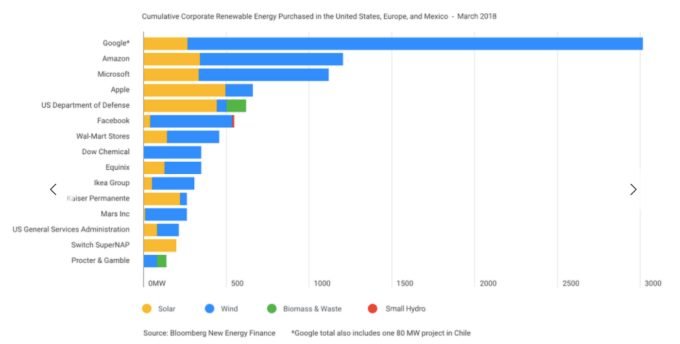
When you look at the number of datacenters the hyperscale companies are developing worldwide, it can be a little frightening from an energy usage standpoint, but Google announced today that it acquired enough renewable energy to match 100 percent of its power consumption in 2017. That’s good news, but it’s not as good as using 100 percent renewable energy.

The distinction is important. Think of this kind of purchase like a carbon offset. For every bit of polluting energy, they buy a corresponding bit of renewables. It’s not ideal, but it’s a step in the right direction.

Urz Hölzle, Google’s senior vice president for technical infrastructure announced the milestone in a company blog post this morning. “Over the course of 2017, across the globe, for every kilowatt hour of electricity we consumed, we purchased a kilowatt hour of renewable energy from a wind or solar farm that was built specifically for Google. This makes us the first public Cloud, and company of our size, to have achieved this feat,” he wrote.

While bragging, he could even take a swipe at rivals that Google was the strongest company in this regard, having purchased three gigawatts (3GW) of output from renewable energy projects to the tune of $3 billion in energy investments. That’s the kind of competition we need to see more of.

He even included a graph to prove his point (and who doesn’t like visuals?).

Of course, the ultimate goal would be to use 100 percent renewables to power its vast network of datacenters around the world, and Hölzle acknowledges that. “We say that we “matched” our energy usage because it’s not yet possible to “power” a company of our scale by 100 percent renewable energy. It’s true that for every kilowatt-hour of energy we consume, we add a matching kilowatt-hour of renewable energy to a power grid somewhere,”

The company does hope one day to acquire all of its energy requirements from renewable sources, but until then this program is a way of giving back. “This program has always been a first step for us, but it is an important milestone in our race to a carbon-free future. We do want to get to a point where renewables and other carbon-free energy sources actually power our operations every hour of every day. It will take a combination of technology, policy and new deal structures to get there, but we’re excited for the challenge,” he wrote.

04 Apr 2018

Tinder begins testing its first video feature, Tinder Loops

Tinder is getting into video. On Wednesday, the popular dating app will begin testing its first video-based feature, Tinder Loops, with iOS users in Canada and Sweden. The company says it will evaluate how users respond to Loops before making a decision to roll it out to other markets.

As you may have guessed by the name – “Loops” – the feature isn’t focused on traditional video, but rather on a shorter, almost GIF-like looping video format that’s been popularized by apps like Instagram’s Boomerang and, before that, Twitter’s Vine. In Tinder’s case, Loops will be just two seconds long, and can be added to users’ profiles alongside their photos.

The company says it decided to test videos because it believes videos can show more of users’ personalities, and that can increase people’s chances of getting right-swiped (liked, that is). It suggests the videos could be used for showing off your favorite activities – like shooting hoops or cliff jumping. But it’s likely that Tinder users will find other use cases for looping videos beyond that.

Loops represents the next step in the evolution of our classic profile,” said Brian Norgard, Chief Product Officer at Tinder. “With the addition of video, users have a new way to express themselves while also gaining key insights into the lives of potential matches. Whether it’s dancing at a concert, doing cartwheels on the beach, or clinking glasses with friends, Loops makes profiles come alive. We anticipate Tinder Loops will lead to even more matches and conversations and look forward to seeing how our users creatively adopt the feature,” he added.

More realistically, looping videos may better show people as they are – not hidden behind a soft photo filter or snapped from a classic MySpace angle. And that could lead to less surprise on first dates, as people will have already gotten a better sense of who they’re meeting, as well as how they like to have fun.

But at only two-seconds long, Loops are not as intimidating as posting a “real” video for users who are more shy.

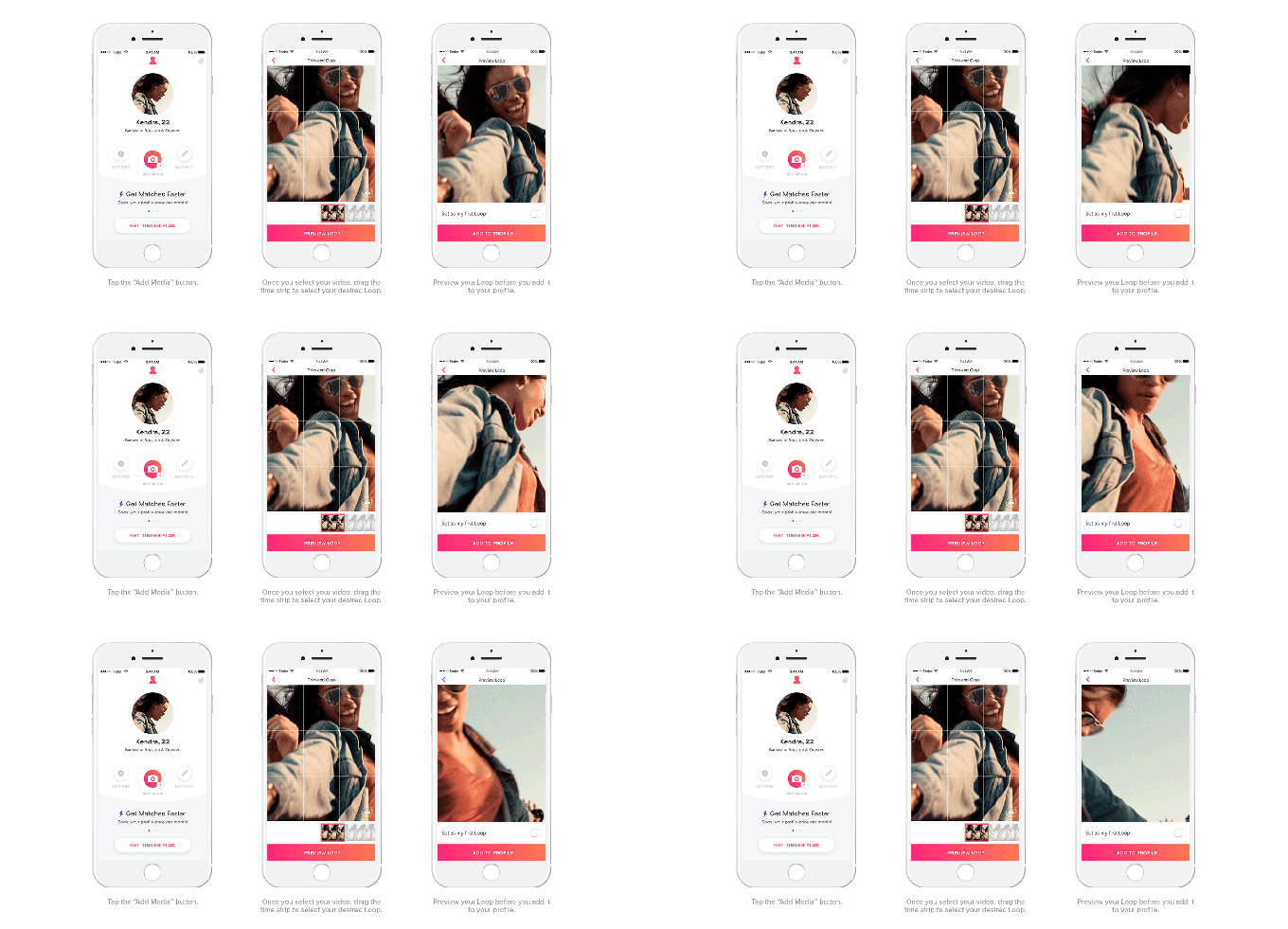
To try the new feature, iOS users in the supported markets will be able to go to their profile, then tap the “Add Media” button to upload a video. Once the video is selected, you can drag the time strip to select the part you want to loop, preview it, and post it to your profile.

Tinder Loops currently supports only videos or Live Photos imported from your iOS Camera Roll. It doesn’t allow users to capture Loops directly from the app.

Alongside the option to add Loops, a subset of users in the test markets will also be given the ability to upload nine photos (or Loops), instead of just six. That could encourage more uploads of Loops as users won’t have to remove their existing photos to give the feature a try.

Tinder would not be the first dating app to dabble with video.

Starting last year, a number of its rivals began to support video in various contexts, as well. Hinge started allowing users to add videos up to 30 seconds long to their profiles; Match and Bumble announced Stories-like features involving video (BumbleVID didn’t pan out); and Zoosk tried video in a separate app, Lively, which has since pivoted to trivia. Integrating video, it appears, is not that easy.

The feature’s launch comes at a time when the competition between modern dating apps has been heating up. Specifically, Tinder and Bumble’s battles have gotten nasty, with Tinder parent Match Group suing Bumble over patents, and Bumble suing Match Group back for fraudulently obtaining trade secrets. Tinder also recently said it would roll out a ladies-first option in its app, which is the thing Bumble is best known for.

Now, with Loops, Tinder is differentiating itself further from the rest of the pack. Whether or not users will respond, however, remains to be seen.

Loops is rolling out today to the supported test markets.