04 Apr 2018

iOS could detect when you hover your finger over the screen

According to a new report from Bloomberg, Apple could be working on new gestures for its iPhones. In addition to normal touch gestures, iOS could detect when you hover your finger over the screen to trigger some actions.

When Steve Jobs introduced the first iPhone, he spent quite a bit of time demonstrating the multitouch interface. You could touch the screen with your finger without applying any pressure, which was already something new back then. You could also swipe your finger on the screen, use multiple fingers in order to pinch to zoom or rotate a photo.

Starting with the iPhone 6S, Apple also introduced another gesture with 3D Touch. By applying some pressure on the screen, you can preview a photo or an email, open a shortcut menu and more. The iPhone detects multiple levels of pressure so that you can first preview and then open a document.

According to Bloomberg, upcoming iPhones could also detect touchless gestures right above the display. It’s unclear how Apple plans to use those new gestures when it comes to software implementation. This feature won’t be ready for this year’s new iPhones.

Bloomberg also says that Apple has been experimenting with curved iPhones. But they won’t look like the Samsung Galaxy S9 as Apple is thinking about a banana-shaped iPhone from top to bottom.

Finally, Bloomberg confirms KGI Securities’ report about this year’s iPhone lineup. Apple is working on three new devices — an updated iPhone X, a new iPhone that looks like an iPhone X but is cheaper thanks to an LCD display, and a larger version of the updated iPhone X.

The larger version could feature a 6.5-inch OLED display. This number seems insane given that the first iPhone only had a 3.5-inch screen. But people spend so much time on their phone that there should be a market for this huge phone.

04 Apr 2018

Yellow raises $9 million to launch dockless bike-share in Brazil

Yellow, a Brazil-based mobility startup, just raised a $9 million seed round for its dockless bike-share service.

Yellow was founded by Ariel Lambrecht and Renato Freitas, who sold their ride-share company 99 to Didi in a $1 billion deal earlier this year. Yellow’s third co-founder is Eduardo Musa, CEO of bike manufacturer Caloi.

Yellow intends to use the funding to deploy its first 20,000 dockless bikes. This summer. Yellow plans to deploy a total of 100,000 bikes. Ultimately, Yellow envisions deploying more than one million bikes.

“As local residents, we’re acutely aware of the pain points caused by Brazil’s inefficient public transit, and we built Yellow specifically to address them,” Musa said in a press release. “Our goal is to improve circulation of urban traffic and curb harmful greenhouse gas emissions by providing a fun, cost-effective mode of transportation that integrates with other public transit systems to optimize daily routes in big cities.”

Since e-scooters and e-bikes are the new craze, it’s no surprise Yellow also plans to deploy those modes of transportation.

04 Apr 2018

Zuckerberg will testify before Congress on April 11

Mark Zuckerberg will testify before the House Energy and Commerce Committee on April 11. E&C Committee Chairman Greg Walden (R-OR) and Ranking Member Frank Pallone, Jr. (D-NJ) made this announcement this morning, clarifying that Zuckerberg will speak on the company’s use and protection of user data.

Here’s what the Congressmen had to say in a prepared statement:

This hearing will be an important opportunity to shed light on critical consumer data privacy issues and help all Americans better understand what happens to their personal information online. We appreciate Mr. Zuckerberg’s willingness to testify before the committee, and we look forward to him answering our questions on April 11th.

This all comes amidst the greatest existential threat to Facebook we’ve yet to see.

In 2014, a third-party quiz app developed by Aleksandr Kogan collected the data of around 50 million raw profiles. Only 270,000 some people who downloaded the app and participated in the survey, but at the time, Facebook allowed third parties to collect information around friends of friends.

Facebook no longer allows this data sharing, and had asked for certification in 2015 that this data had been deleted.

Kogan harvested and sold that data to Cambridge Analytica, a political firm that would use information on identity, social networks and likes to target demographics and influence voters. In 2016, the Trump Campaign hired Cambridge Analytica.

Following these revelations, a movement to #deletefacebook sprang up across the internet. But it wasn’t just users who reacted.

On March 21, Zuck issued his first response to the scandal, adding: “If it is ever the case that I am the most informed person at Facebook in the best position to testify, I will happily do that.”

Two short days later, the House and Senate put Zuckerberg on notice, saying that he is the right person to testify. CNN reported on March 27 that Zuck had come to terms with the fact that he’d have to testify and the Facebook team began preparing for his day on the Hill.

That day now has a precise date: April 11.

04 Apr 2018

Hot security startup Duo Security opens office in Downtown Detroit

Duo Security is opening a new office in Downtown Detroit, expanding from its headquarters in Ann Arbor, Michigan . The company will immediately relocate 30 team members to a shared space in Bamboo Detroit in the Madison Building and by the end of the year, plans on moving into a 9,000 square foot space to accommodate additional employees.

This is a big win for Detroit.

Duo Security is one of the hottest security startups in the space and arguably one of the largest in the state of Michigan. The company raised a $70 million series D in late October 2017, placing its valuation north of a billion. Duo employees 350 people in Ann Arbor, Michigan and an additional 250 in other offices around the world. Through it all Duo has remanded loyal to Ann Arbor but the talent and excitement in Detroit is impossible to ignore.

“Metro Detroit has more engineers per capita than any region in the US next to Silicon Valley,” CEO and co-founder Dug Song tells TechCrunch. “And while our college town of Ann Arbor is a cornerstone of innovation in the region, the urban area of Detroit is nearly 4 million people strong. Jon Oberheide and I have been eager for Duo to help play a role in the city’s growing momentum and support ongoing efforts to bolster the region’s technology profile.”

Dug tells me that the company picked Bamboo to house the first Duo employees as a move back to the company’s roots. Duo was founded in a coworking space and the company is ready to help build a the platform for the city.

04 Apr 2018

Sarah Lacy launches Chairman Mom, a social platform for working mothers

Sarah Lacy, founder of media site Pando, has unveiled her newest company, Chairman Mom. The subscription-based startup aims to provide resources to working mothers, and ultimately set them up to succeed in all areas of their lives.

“One of the things that’s actually pretty distinct for us is we focus really on the woman, not the children,” Lacy told TechCrunch. “There’s a lot of sites where you can get a lot of answers of what’s a great pre-school or where’s a restaurant that is kid-friendly. and a lot of things are always very kid-centric. We’re really woman centric.”

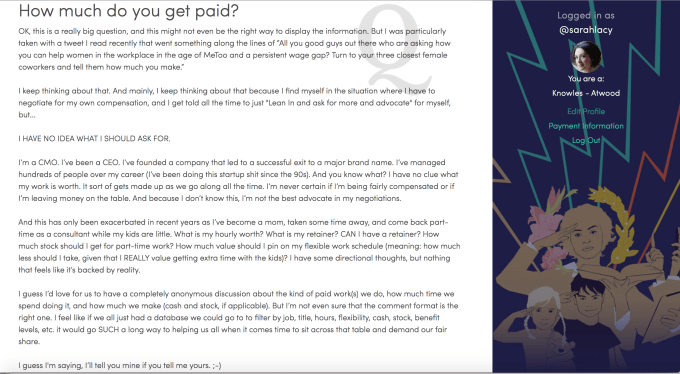
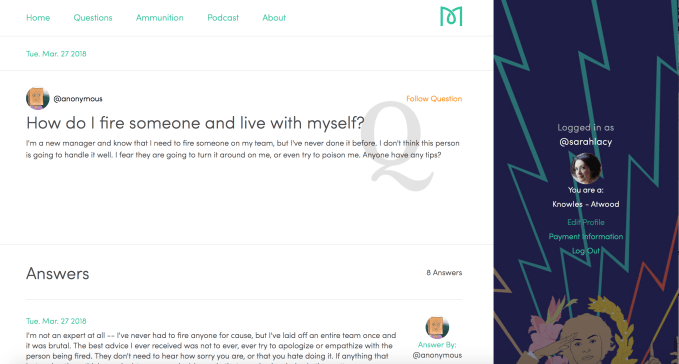
At launch, Chairman Mom is focused on one key functionality: a question and answer platform. Every day, Chairman Mom’s team of three curates two questions — one about life and one about work — from the community to feature on the site for answers and discussion. These questions can range from “How much do you get paid?” to “What’s the best way to handle harassment at work?” to “What should I do if I think my spouse is cheating on me?”

“The goal of each thread is to get that mom the best answer,” Lacy said. “It’s really not to have an open discussion board of everyone’s views on that topic.”

What makes Chairman Mom different from the likes of other social media sites is its emphasis on using real names while also offering anonymity. Real names are required to sign up but community members can ask and respond to questions anonymously. There is also no up-voting or direct messaging.

“We don’t have things that have created tribalism and fights on other mom networks,” Lacy said.

The goal with Chairman Mom is to rebrand what working mothers and what working motherhood represents, Lacy said. Before Lacy first became a mother, she heard horror stories about what to expect, she said. Some people, for example, told her to expect to feel like a failure at home and at work. But that’s not what it was like for her, Lacy said.

“I was shocked at the disconnect between that and what happened when I actually had kids,” Lacy said. What happened when I had kids was I became better at everything. I became more ambitious, I wrote more quickly, I was so much better as a manager. I was so much more productive. You really have this amazing ability to prioritize what’s important.”

Lacy went with the name Chairman Mom to “telegraph in charge and maternal,” she said. It was important to her, she said, for the name not to conjure up any connotations of shame around pregnancy and motherhood.

“It’s even a step beyond ‘I’m not ashamed,’ but like ‘No, this is our source of power,'” she said. “Something that just sounds so declaratively in charge but also maternal. And it’s still called the chairman of the board. And it’s this idea of we’re overthrowing a patriarchy. This is a man’s world that we’re overthrowing and we don’t have any illusion about that fact.”

Chairman Mom costs $5 per month for access to its community of honest answers to questions about working motherhood. By having people pay to access the platform, one hope is that trolls won’t pay actual money to troll, Lacy said. The platform is also free of advertisers and intends to remain that way, Lacy said.

Chairman Mom is not the only startup targeting mothers. There’s Peanut, which is a Tinder-like experience for finding other moms to hang out. There’s also Winnie, which helps parents find kid-friendly places and access other resources that may be helpful to parents.

Lacy said she recognizes Chairman Mom has competitors, but also recognizes that “it’s such a massive market no one’s building for,” she said. It’s so massive, Lacy said, that she envisions seeing “a handful of billion-dollar consumer internet companies that are geared toward women.

Chairman Mom has been in private beta for the last month or so, with “several hundred” people using it. Chairman Mom has raised a $1.4 million seed round led by Ann Miura-Ko of Floodgate Ventures and Tim Connors from PivotNorth Capital, with participation from Greylock Discovery and Precursor Ventures.


04 Apr 2018

Facebook to exclude US users from some privacy enhancements

There’s no way to sugarcoat this message: Facebook’s founder Mark Zuckerberg believes North America users of his platform deserve a lower data protection standard than people everywhere else in the world.

In a phone interview with Reuters yesterday Mark Zuckerberg declined to commit to universally implementing changes to the platform that are necessary to comply with the European Union’s incoming General Data Protection Regulation (GDPR).

Rather, he said the company was working on a version of the law that would bring some European privacy guarantees worldwide — declining to specify to the reporter which parts of the law would not extend worldwide.

“We’re still nailing down details on this, but it should directionally be, in spirit, the whole thing,”  Reuters quotes Zuckerberg on the GDPR question.

This is a subtle shift of line. Facebook’s leadership has previously implied the product changes it’s making to comply with GDPR’s incoming data protection standard would be extended globally.

Back in January, COO Sheryl Sandberg said the company would be rolling out “a new privacy center globally” — putting “the core privacy settings for Facebook in one place and make it much easier for people to manage their data”.

A spokeswoman for Facebook confirmed to TechCrunch today that the changes it revealed late last month — including finally reducing its historical settings sprawl from 20 screens to just one — were what Sandberg was talking about in those earlier comments. Ergo, even those basic tweaks are a direct result of the EU regulation.

However that universal privacy center looks to be just one portion of the changes Facebook needs to make to comply with the new EU standard. And not all these changes are going to be made available to US and Canadian Facebook users — per Zuckerberg’s remarks.

In a blog about the new privacy center late last month, Facebook flagged additional incoming changes to its terms of service — including “commitments” to users, and the language it uses to explain how it’s processing people’s data.

It said these incoming changes would be “about transparency”.

And indeed transparency is a key underlying principle of GDPR, which places requirements on data controllers to clearly explain to people what personal data they intend to collect and for what exact purpose — in order to gain informed consent for processing the data (or, if not consent, another valid basis is required for the data processing to be legal).

What’s less clear is exactly which portions of GDPR Facebook believes it can safely separate out for users on its platform and not risk accidentally mishandling the personal data of an international user — say who might be visiting or living in the US — thereby running the risk of privacy complaints and, ultimately, financial sanctions (penalties for violations can be very large under GDPR).

Facebook did not respond to additional questions about its GDPR compliance intentions so we can but speculate at this stage.

It’s even just a risky strategy in pure PR terms. As we wrote in January in our GDPR explainer: “[S]ome US companies might prefer to swallow the hassle and expense of fragmenting their data handling processes… But doing so means managing multiple data regimes. And at very least runs the risk of bad PR if you’re outed as deliberately offering a lower privacy standard to your home users vs customers abroad.”

Safe to say, the calls for equal application of GDPR in the US have started already…

On the speculation front, consent under GDPR for processing personal data means offering individuals “genuine choice and control”, as the UK’s data watchdog explains it. So perhaps Facebook isn’t comfortable about giving North American users that kind of autonomy to revoke specific consents at will.

Or maybe Zuckerberg is unwilling to let Americans ask for their personal data in an adequately portable form — so they could go and plug it into a rival service. (Though it does already let users download their data.)

Or it could be that Facebook isn’t comfortable with what GDPR has to say about profiling — which is, after all, the core of the company’s ad targeting business model.

The regulation’s transparency requirements do extend to profiling — meaning Facebook will need to inform (at least its international) users they are being profiled when they use the platform, and explain what it means for them.

So perhaps Zuckerberg thinks Americans might balk if they really understood how pervasively it tracks them when it has to explain exactly what it’s doing — as indeed some Facebook users did recently, when they found out Messenger had been logging their call and SMS metadata, for example.

The EU regulation also places some restrictions on the practice of using data to profile individuals if the data is sensitive data — such as health data, political belief, religious affiliation and so on — requiring an even higher standard of explicit consent for doing so.

And of course, with the Cambridge Analytica data misuse scandal, we’ve seen how massive amounts of Facebook data were expressly used to try to infer US voters’ political beliefs.

Let’s not forget that Facebook itself ploughs its own resources into engaging politicians to use its platform for campaigning too. So perhaps it’s worried it might risk losing this chunk of elite business in the US if American Facebook users have to give explicit consent to their political leanings being fair game for ad targeting purposes. (And when many people would probably say ‘no thanks Mark; that’s none of your business’.)

But, as I say, we can but speculate what kind of GDPR carve outs Zuckerberg has planned for users on his home turf at this stage. The regulation comes into force on May 25 — so Facebookers don’t have long to wait to play a game of ‘spot the privacy standard discrepancy’.

What’s most curious about the Facebook founder demurring on an universal application of GDPR is the timing of it — in the midst of arguably the company’s biggest ever privacy scandal.

And if he feels North Americans’ privacy can be handled as a backburner consideration even now, by revealing he plans to work really hard to make sure domestic Facebook users are given second tier privacy status below everyone else in the rest of the world, well, you have to question the authenticity of his recent apology for the “mistakes” that he claimed led to the Cambridge Analytica scandal.

Facebook was actually warned over app permissions in 2011, as we’ve reported before. Yet it did not shut down the developer access that was used to pass personal data on 50M+ Facebook users to Cambridge Analytica until mid 2015. So, frankly, if that was a mistake, it was a very, very, slow moving one.

Some might say it looks rather more like reluctance to comply with data protection standards.

Here’s one of the core architects of GDPR — European MEP Jan Philipp Albrecht — asking the key question now: How long will consumers in North America take being put in privacy coach class? Over to you…

04 Apr 2018

Google’s latest undersea cable project will connect Japan to Australia

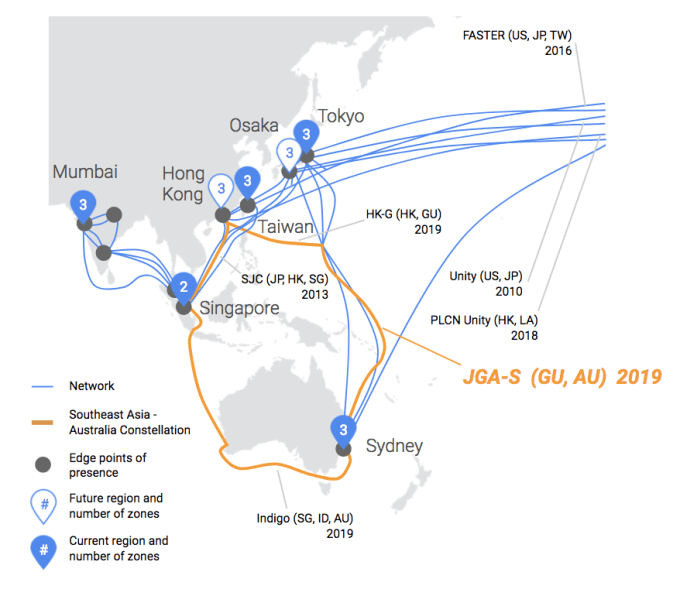
When you’re a company as large as Google, you need to make build versus buy decisions every day, whether that’s buying a company or building the software or renting time on an undersea cable or building your own. Today, the company announced that it’s decided to build another undersea cable. This one will run from Japan to Guam and from Guam to Australia.

That’s a lot of territory, approximately 9,500 KM or almost 6000 miles, and it’s a major undertaking. The company doesn’t take a project of this scope lightly, but they felt that it was in their best interest from an economic and technical perspective. The cable has been dubbed JGA and will connect up with the existing Hong Kong-Singapore-Australia cable to build a ring that covers the Asia-Pacific region.

Map: Google

“JGA is being co-built by NEC Corporation and Alcatel Submarine Networks. The JGA-South segment is being developed by a consortium of AARnet, Google, and RTI-C, while the JGA-North segment is a private cable being developed by RTI-C,” according to a blog post on the published on the project today.

The decision to build the cable came down to an economic decision related to the sheer scale of Google usage, says Vijay Vusirikala, principal engineer at Google, whose specialty involves undersea cables. It becomes much more cost-effective to build their own cables than it does to rent time on somebody else’s when you reach a certain usage level. “This is essentially building infrastructure at scale and with scale getting the optimization benefits,” Vusirikala explained.

The parts of an undersea cable. Diagram: Google

“We have been using existing cables to connect to the different parts of the region. This announcement is part of the series of investments [we are making] to get us to scale and improve economics, he added.

Today’s announcement is really just the beginning of a project that could take well into next year to complete. It starts with building the cables in factories. The cables are built to last and withstand the conditions of lying in an ocean bed. Each cable contains fibre cables made of extremely high quality glass that can carry 100 terabits of traffic. To put that in perspective, Google says this is equal to 63,000 photos per second, or more than 650,000 simultaneous HD video streams.

While that’s going on a team of experts will map out the optimal routes for the cable to have the least amount of latency, while taking into account the easiest way to lay the cable. It’s a balancing act.

Eventually they put the cable on big spools, put the spools on ships and lay the cable in the sea bed. Each cable has a repeater ever 80 KM that pushes the signal further on its journey down the cable.

Michael Francois from Google’s Global Network Infrastructure team says these cables are built to last, but they can break occasionally. “They generally don’t fail once they are put in. They are [designed] to sit there a long time. Generally when something happens — it could be dropping an anchor on it and breaking through armoring of the cable. If it does break, it needs to be repaired by ship,” he said.

The project is part of a network of 300 cables worldwide. There has been an uptick in the number the last couple of years as cloud providers and hyper scalers like Facebook, Amazon and others require more connectivity across regions.

__

This video explains how the cable makes it from factory to sea bed.

04 Apr 2018

1Password replaces Teams Pro with new business plan

Popular password manager 1Password has a new subscription product aimed at business users with larger teams. The new offering, 1Password Business, replaces the Teams Pro plan — with what’s billed as additional features and “flexibility”. (Although existing Teams Pro users can choose to say on it for now, or opt to switch to Teams or Business if they wish.)

1Password Business is priced at $7.99 per user, per month, which includes a free 1Password Families membership for each user — to extend workplace security hygiene to employees’ home computing environments too.

“1Password Business provides the features you need as a larger team. It gives you the tools to protect your employees, secure your most important data, and stay compliant. Your administrators will love it for the control it gives them, and your employees will love how easy it is to use,” writes AgileBits in an introductory blog for the product.

The company introduced subscription pricing back in 2016, evolving its model from the earlier single license price. It now offers a range of subscription options for personal & family use, and for teams & business users. And with 1Password Business it’s linking those two product buckets.

While the remaining $3.99 Teams product is geared towards smaller businesses or group users, the new Business plan offers enhanced customer support; more per person document storage; and a larger number of guest accounts.

On top of that it includes the aforementioned free family plans for all users, plus “fine-grained access control” for each vault where passwords are stored, including being able to limit where access is granted; activity logs for tracking changes; automated provisioning (including Active Directory and Okta integration); support for business-wide multi-factor authentication (via Duo); custom groups to organize teams; and custom roles to design and delegate responsibility.

AgileBits’ first Teams product for 1Password launched in 2015. It says more than 30,000 businesses have signed up thus far.

It adds that it’s growing fast as a business, saying it’s looking to hire another 100 people this year.


04 Apr 2018

500 Startups takes strategic investment from Abu Dhabi Financial Group

500 Startups, the U.S.-headquartered VC firm hit by scandal last year after co-founder Dave McClure resigned following allegations of sexual misconduct, has announced an unconventional deal that sees Abu Dhabi Financial Group (ADFG) take a stake in its parent company.

It is normal for VC firms to work closely with big corporates as LPs that supply money for their funds — the Middle East has proven to be fertile hunting ground for the likes of 500, Uber and Softbank — but direct investment in parents is not common in VC-land. ADFG has been an LP with 500 for some time and Christine Tsai, who heads the VC firm up, said there is “strong alignment on vision and complementary strengths” between the two.

Founded in 2011, ADFG claims to have $6 billion in assets under management via offices in the UAE, UK and Eastern Europe. The firm covers public markets, private markets, real estate and debt investments.

500 isn’t saying what size ADFG’s investment other than it will lead to “substantial capital” being injected into the firm to “accelerate the growth of our key initiatives, expand into new markets, and anchor future 500 funds.”

ADFG will also get a board seat at 500, Tsai confirmed.

Unlike most U.S. VCs, 500 has offices, accelerator programs and micro-funds across the world including Europe and Asia. In the aftermath of McClure’s scandal last year, the firm shuttered its Canada-based fund while a maiden Australia-based program was axed by partner LaunchVic, a $60 million entrepreneurship scheme backed by the government of Victoria, before it even started.

04 Apr 2018

This new venture fund has more than $180 million to invest in interactive entertainment startups

Most brand-new venture funds don’t start life with $180 million in capital commitments, especially if they are launched by people who have not worked as venture capitalists before, and particularly not if those people want to focus narrowly on the global interactive entertainment industry.

That Makers Fund is the culmination of all of these things makes it one of the more interesting debut funds about which we’ve heard (and we hear about a lot of new venture funds).

We talked earlier this week with firm cofounder Jay Chi, who previously spent eleven-and-a-half years at McKinsey & Co., where he says he led its global video games practice. We asked how he and cofounder Michael Cheung — a McKinsey alum who more recently spent a year as a senior director with Tencent Holdings —  managed to put the fund together and what they are aiming to do.

TC: You’ve closed on $180 million for your first fund and it’s not even officially closed yet. That’s a pretty big opening statement.

JC: We figured if we’re trying to do something, we want enough capital to move the needle. Fifty million for a gaming and interactive entertainment fund isn’t enough. We think the Series A is where you can make the biggest dent.

TC: Who are your investors?

JC: We’re not allowed to [name] them, but it’s institutions and family offices and high net worth individuals, mostly across Asia, from Japan to Korea.

TC: How did you persuade them to invest in you?

JC: People in the gaming world know me. I’ve been a whisperer and long-time advisor in this business, helping my friends make a lot of investment decisions at both the early and very late stage. I’ve never been a portfolio manager before, but I’ve seen a lot of successes and failures and I think LPs look at the history of my involvement in industry and also my passion for the industry.

TC: Does Michael have any investing experience?

JC: He had some investing experience in his previous role and he has made angel investments.

The gaming industry is only 40 years old, and it’s very unique. On the one hand, it changes rapidly; it’s at the forefront of technology, driving monetization and engagement. But it’s also fickle. It’s like a new dish. If you aren’t familiar with a certain type of cuisine, it’s hard to tell if one dish is better than another. 

Not many are willing to invest in early-stage companies as a result. That means there aren’t enough enough experienced thinkers and investors in this space to help the many real founders and tide them over. We’re here to bridge that gap.

TC: All over the world, correct? Am I right in thinking you are targeting 13 cities globally that you see as interactive entertainment hubs?

JC: Yes. If you want to have a strong impact in gaming, you have to do it globally. By nature, it’s a global market, with hubs in Montreal and Vancouver and Seattle and the U.K, and the Nordic region and Seattle, L.A., Austin, and San Francisco.

It’s not as complicated as you might think. It’s a very global community.

TC: What size checks are you writing?

JC: We’re writing $1 million to $10 million checks, mostly at the Series A stage, though we’ll dabble in seed if we can find some good cases. We also lead when we invest, and we usually take a board seat. 

TC: How many companies have you already backed with this new fund?

JC: We’ve made around 12 investments across the value chain, from content to interactive entertainment to back-end technologies to information data providers in the space. I believe we’re picking the cream of the crop of the companies, too. We have a database that tracks the deals we’re seeing and since May, we’ve reviewed 600 pitches. I think that’s probably 80 percent of what’s in the space.

TC: Are many of these VR related? Is that an area of interest, or an area to avoid?

JC: We invest in VR but we won’t do as much. There are enough dedicated VR funds out there that I don’t think another adds much. I’m a long-term believer, but from an investor perspective, i think the opportunity is around broader interactive entertainment.

TC: Interactive entertainment, even more broadly, is very hits driven. Why isn’t that a concern for you?

JC: If you really look, something new is happening every 12 to 24 months because the target segment is very young and attention spans are very short. You had Pokémon Go. Now Fortnite is taking over in schools across the U.S.

We’re focused on what the next 18 to 24 months holds but also on the sustainable ways that we can help these companies grow over a four- or five-year range. For example, one of our theses centers on cloud-related development tools for game space. It’s a big shift, with more complexity and calculations or computation required in cloud for the types of experiences that we’ll see coming to mobile and PCs. One of our related investments is in Genvid, whose interactive streaming technology allows a viewer to actually touch the screen and impact the game state. It sounds like sci fi, but we’re getting to a stage where spectators can participate, too.

TC: You’re hopping on a plane shortly leaving San Francisco. Where are you based?

JC: On a Boeing 747. [Laughs.] I’m based in Hong Kong, but I’m maybe here a day or two a month. In April, I’ll be in 16 different places across the U.S., Europe, and Asia.