04 Apr 2018

Chinese bike-sharing pioneer Mobike sold to ambitious Meituan Dianping for $2.7B

Meituan Dianping, the fast-growing Chinese firm valued at $30 billion, is buying Mobike, a Chinese startup that helped pioneer bike-sharing services worldwide, in a major piece of consolidation.

The deal was heavy rumored yesterday and TechCrunch has today confirmed with a source that it has been concluded at a price of $2.7 billion.

TechCrunch understands that the deal will be officially announced today, but already key personnel have let the cat out of the bag on social media. Mobike President and co-founder Hu Weiwei posted a cryptic WeChat message about “a new beginning,” as our Chinese partner Technode noted, while SCMP reported that Meituan CEO Wang Xing said the company will “build a new future with Mobike.”

Representatives from Meituan Dianping and Mobike did not respond to requests for comment.

Meituan Dianping is best known for food deliveries via electric bike, but that is just one part of its platform which connects local retailers to consumers via a so-called offline to online, or O2O, platform. The company was formed through a multi-billion dollar merger between China’s largest group buying services in 2015 and it has since raised boat-loads of capital from investors, including $4 billion last October, to expand into new areas.

Transportation is a major focus for Meituan Dianping. The firm began offering ride-hailing services earlier this year and it has invested in Go-Jek in Southeast Asia, so adding Mobike to its stables makes perfect sense on that front, not to mention potential synergies with its core delivery business, too.

These new forays might lead to an IPO. A host of Chinese firms have jumped into the public markets lately, and Bloomberg recently reported that Meituan Dianping hopes to join them with a listing that could value it as high as $60 billion.

The deal will also be a major win for Tencent against its long-time foe Alibaba.

Tencent is an investor in Meituan Dianping and Mobike, and unifying the two could help Meituan Dianping battle Ele.me, the $9.6 billion delivery service that Alibaba just bought in full last week. Indeed, Caixin reports that Tencent CEO Pony Ma himself brokered the deal.

Mobike and Ofo pioneered bike-sharing in China and the rest of the world. Mobike raised nearly $1 billion from investors that, Tencent aside, include Temasek, Foxconn, Hillhouse Capital and Vertex Ventures.

Mobike has been an investment and acquisition target for many.

Last year, a deal to merge with close rival Ofo was widely speculated. Ultimately, reports suggest that it fell through out of fear that Didi Chuxing, the ride-hailing giant that invested in Ofo, would become too powerful if the two bike-sharing firms tied up. That theory seemed to have its merits after Didi rolled out a hostile bike-sharing platform that sits inside its hugely popular ride-hailing app and is aimed at extinguishing the threat of Ofo, Mobike and others by simply turning them into features rather than fully-fledged rivals.

04 Apr 2018

JUMP Bikes weighing Uber $100m+ acquisition, investment offers

JUMP Bikes, the on-demand biking service that integrates with Uber, has been weighing both acquisition and investment offers.

A decision has not yet been reached, but right now possible options include a sale to Uber at a price that exceeds $100 million, or a venture investment round, multiple sources tell TechCrunch. One of the possible investor names that has been floated is Mike Moritz of Sequoia Capital, but we are told that JUMP has several options.

We are also told that various parties have been upping their offers over the past week, as they fiercely compete to get ownership of JUMP.

“E-bikes” are expected to become more popular, where users are able to find and rent bikes quickly via apps. They are part regular bike and part electric, which makes it easier to go up hills.

JUMP launched as Social Bicycles in 2008, but the startup recently rebranded as JUMP when it announced its $10 million Series A investment round a few months back. Menlo Ventures and Sinewave Ventures invested.

Since then, JUMP has launched a partnership with Uber, available in select cities like San Francisco and Washington, D.C. Users are able to identify a nearby bike via the Uber app and are given a PIN to unlock it. They do not require bike docks, meaning they can be picked up and dropped off everywhere. It costs $2 for every 30 minutes.

We’ve reached out to JUMP and Sequoia for comment. Uber declined to comment.

04 Apr 2018

Spotify’s missing money-maker is artist-to-fan messaging

Streaming royalties are too expensive for Spotify to thrive as a public company just playing us songs. Spotify’s shares closed down 10 percent today during its NYSE trading debut. Luckily it controls much of the relationship between musicians and their fans on its app, poising it to build a powerful revenue and artist loyalty generator by connecting the two through native advertising and messaging that doesn’t stop the music.

Spotify already has a wide range of ad experiences built for traditional brands, from audio ads to display units to sponsored sessions where users get ad-free playback in exchange for watching a commercial. But none of these ad units are designed to help musicians grow their audience within Spotify, even if they can be bent to that purpose.

Spotify could win big by following Facebook’s roadmap.

Back in 2007, Facebook already had ads that led offsite. Think of these as Spotify’s existing audio and display ads. But when Facebook built Pages that let businesses reach you through the News Feed, it also launched ads that let them promote and grow their Pages within Facebook. Unlike the stock banner ads you see all over the web, these ads were native to Facebook, targeted with its profile data, and they used social referrals about Pages your friends interacted with to rope you in. These gave entities on Facebook a paid way to grow their popularity inside the platform.

This is Spotify’s opportunity.

Spotify’s existing ad units are designed for brands, not musicians

A few years ago, Spotify’s user base was too small for artists to focus on spending money there to get popular. But Spotify has grown to the size where it’s replacing top 40 radio, and over 30 percent of listening now comes from its recommendations and algorithmic playlists like Discover Weekly. The record labels now need Spotify to have a hit. Between that influence and it’s stature as the biggest on-demand music streaming service, Spotify has the leverage to offer artists the best tool to boost their fan base. Whether artists want to build an following on Spotify, sell collectors’ items, or fill premium front-row seats at their shows, Spotify could hook them up.

The no-longer-a-startup has already built the groundwork for this with the launch of its Spotify For Artists analytics dashboard app last year that shows a musician’s top songs, and the demographics of their fans including their location, gender, age, and what else they listen to. Spotify’s proven the power of this data with its Fans First email campaigns that let artists reach their most frequent listeners with access to concert ticket pre-sales and exclusive merchandise. It claims the emails see a 40 percent open rate, and 17 percent click-through rate — way higher than the industry standard.
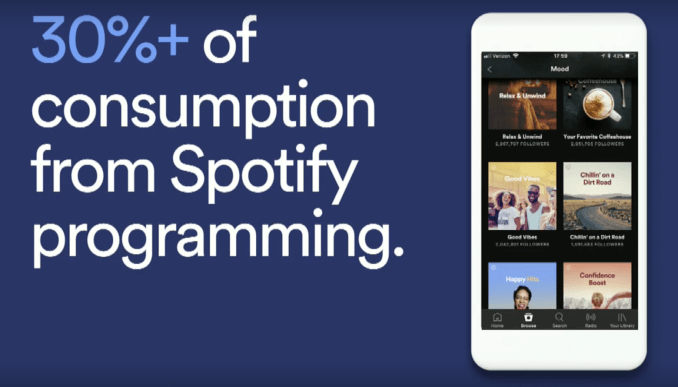
But if Spotify built new surfaces for artists to reach out directly to fans within its apps, it could become the destination for record label marketing money. Since these artist ads and messages would all drive users deeper into the app rather than away from it like brand ads, Spotify could charge less than traditional ads and make them affordable to labels on a budget or musicians paying out-of-pocket.

Here are some ways Spotify could create native artist-to-fan marketing channels:

Sponsored songs on its algorithmic playlists could expose fans to artists in the most natural way possible, or turn one-time listeners into loyalists. Wherever there’s recommendations, there’s room for paid discovery. Listeners could easily skip the track or switch to a different playlist, but might end up falling in love with the band, and diving into their catalogue. It’s the equivalent of Facebook’s in-News Feed native ads, but with a musician promoted instead of a business’ Page. Spotify was actually spotted testing what was effectively a sponsored song in mid-2017 above the start of some playlists. While there was an opt-out option within the app’s Settings that’s since disappeared, Spotify has at least considered this idea.
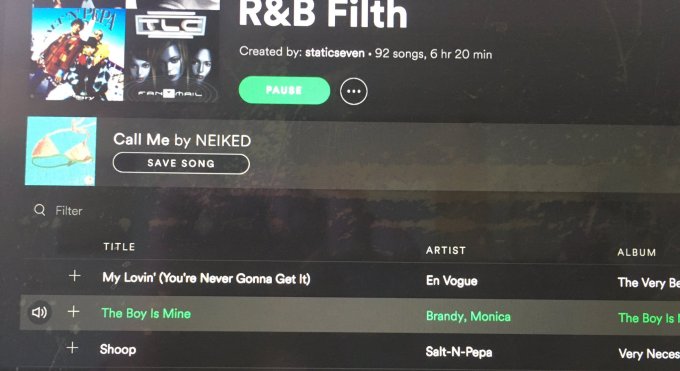
Spotify was spotted testing what was effectively a Sponsored Song back in mid-2017

Promoted Artists could use a similar model to Google’s AdWords sponsored search results. When users search for an artist, they could be shown similar artists who’ve paid to be promoted in the search typeahead or results page. Spotify could also insert a box within the profile of another artist you’re browsing below their top tracks. Spotify already lists a slew of related artists in text, but could highlight one that pays, perhaps showing one of their songs that could be instantly played.
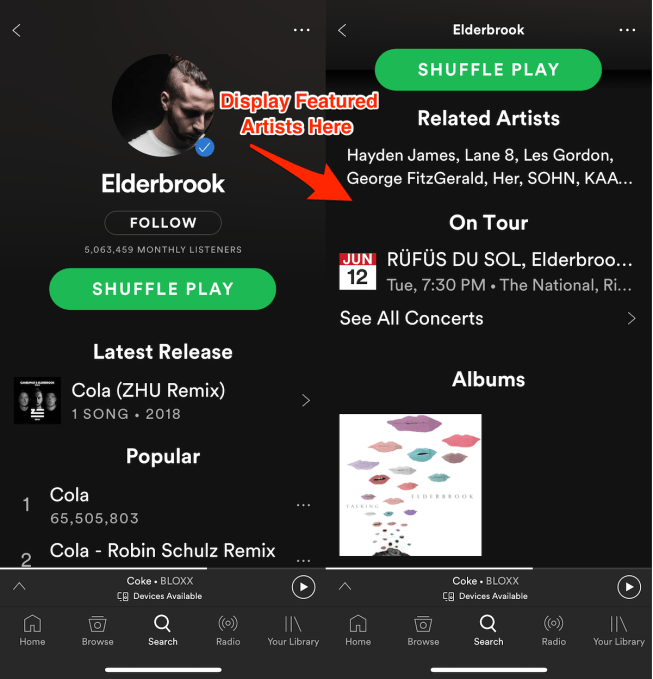
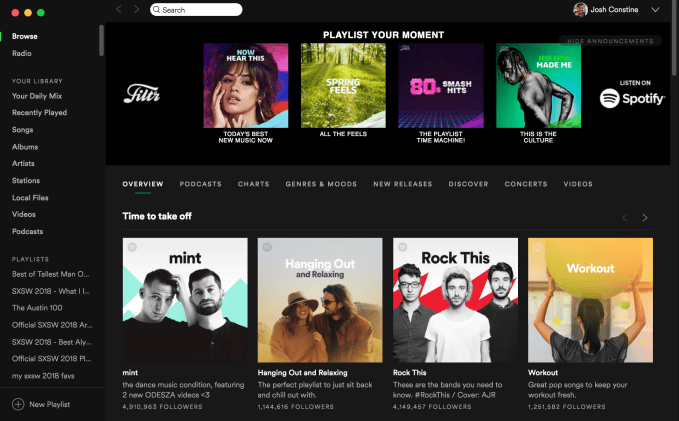
Featured Artists could give artists that pay a special slot on Spotify’s browse page. With so many recommendations here, it’d be easy to insert a sponsored section without feeling interruptive.
Sponsored Visualizations could make better use of your screen while you listen. Rather than just staring at the album art and playback controls, Spotify could let artists pitch fans their other music, tickets, gear, or social media channels. Spotify could also fill this space with entertaining silent video clips, photo slideshows, and biographical info as I suggested as a differentiator in 2016, and similar to how lyrics site Genius started doing with its Stories this week. Given users are currently listening to the artist, they might be primed for these experiences. Spotify has already tested letting artists show GIFs during playback, and has partnered with Genius to show Behind The Music factoids, but this is real estate that could help artists earn more money as well as entertain fans.

Direct Messaging

The most ambitious and audacious way to let artists reach fans would be a special artist-to-fan messaging channel. Spotify got rid of its in-app inbox and messaging feature for sending friends songs a few years ago, instead pushing users to share music via their chat app of choice. But similar to the Fans First email campaigns, Spotify could create a special artist-to-fan messaging section in its app that could alert users to new releases and playlists as brand advertising, or even push tours and merchandise as more direct performance advertising.
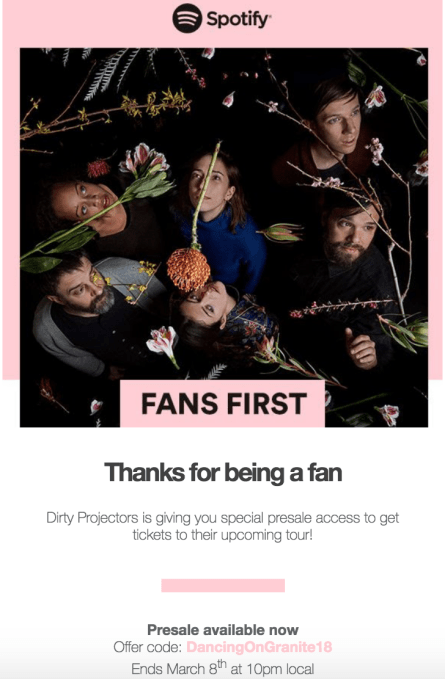
Spotify could give all artists a certain volume of messages they could send for free or let them reach out just to the top 1% of fans a certain number of times per month or year. Then artists could pay to send more messages beyond the limits. Alternatively, it could just charge for any use of messaging.

Done wrong, the above options could feel like Spotify gouging artists to reach their own fans. But done right, users might actually enjoy it. These connections wouldn’t be too far off from following an artist on other social media, but where people are already listening. Finding out about one of your favorite band’s new albums, tours, or t-shirts might feel less like an ad and more like an inside tip from the fan club.

Spotify might be able to get away with showing some of these different experiences to users who’ve subscribed if they don’t get in the way of music listening. Swinging to the other end of the opportunity spectrum, the company could just give away all these experiences to artists, boosting their loyalty to Spotify and getting them to promote their presence there instead of on competing streaming services like Apple Music.

If Spotify doesn’t figure out a way to improve its margins with additional revenue drivers, it may have a tough time surviving as a public company. If it becomes too profitable from just music streaming, the labels can always try to increase their royalty rates. Spotify might hope that more artists work with it directly, cutting out the middlemen, but the record labels still provide some important marketing, radio promotion, and distribution services that artists need. Meanwhile, startups including United Masters (which raised a $70 million Series A from Google parent Alphabet and Andreessen Horowitz) adnd subscription crowdfunding platforms like Patreon want to usurp the record labels and become the way artists earn more before Spotify can.
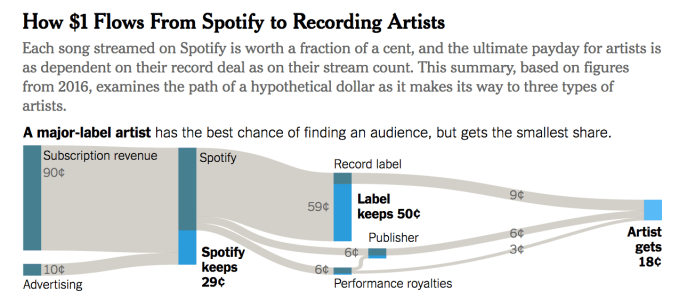
This New York Times’ chart shows why musicians feel screwed, even though it’s labels keeping their money not Spotify

Creating ways to connect with listeners could offer Spotify a way to combat the enduring narrative that it’s screwing over musicians. If Spotify can prove these artist-to-fan messaging options earn them more than they cost, it could be seen as the streaming service that’s actually trying to help musicians make a living.

Recorded music has always been a promotional tool for all of a musician’s other revenue monetization methods. Streaming’s on-demand structure and no-extra-cost-per-play nature turns the curious listener who’s only heard of an artist or just likes one single into a diehard fan who shells out the big bucks every time their favorite act is in town.

As we shift to an experiential culture where our possessions are digitized and its our interests that define us, people want to feel closer to the creators they love. Artist-to-fan messaging could bring the whole life-cycle from discovery to affinity to real monetization beyond the royalties all within one green and black app.

For more on Spotify going public, read our feature stories:


04 Apr 2018

Amazon opens Echo Button games to developers

Echo Buttons are one of the stranger bits of hardware to come out of the Amazon labs in recent memory. Announced alongside the latest Echos, the little light up devices are designed to bring interactive game play to the Alexa Echo system.

The company’s already announced a handful of compatible titles, and it seems that list is about to get a bit longer, as it opens up a beta version of the Gadgets Skill API for the hardware.

Developers can platform to associate button presses with different skills and send light up animation to the hardware. A preview version of the API lead to the development of a number of experiences for the two for $20 peripherals, including light up playback of Martin Luther King Jr.’s “I Have a Dream” speech and Trivial Pursuit from Hasbro. The selections are nothing if not eclectic.

The toy company is also using the announcement to launch a new game: an Echo Button version of Simon, the popular 1980s light up memory game. You can download Simon Tap now, and Alexa will list a sequence of colors the players then match. The hardware works with most of the Echo line, including, Echo, Echo Dot, Echo Show, Echo Plus and Echo Spot.

03 Apr 2018

Apple steals Google’s AI chief

Apple has just poached one of Google’s top AI executives in a move likely to have far-reaching consequences.

Apple has hired John Giannandrea, previously Google’s Head of AI and Search, the NYTimes reports. Giannandrea will lead Apple’s “machine learning and A.I. strategy,” the Cupertino company said in a statement to the Times, he will be one of only 16 executives that report directly to CEO Tim Cook.

Just yesterday, The Information (paywalled) had reported that Giannandrea would be stepping down from his role at Google and would be replaced by 19-year Google veteran Jeff Dean. Giannandrea first joined Google in 2010 after it acquired MetaWeb, where he served as CTO. The startup sought to make search results more contextually aware through its hefty database of tagged data.

The hire is particularly important as Apple has seemed to fall far behind its rivals in the race to build smarter software powered by artificial intelligence. Siri, the digital assistant which Apple has pumped much of its consumer-facing AI technologies into, is far behind Amazon’s Alexa and Google’s Assistant in capabilities.

TechCrunch chatted with Giannandrea at our most recent Disrupt SF conference where he chatted at length about how humans could help make computers smarter, but that we could also lend them our biases if we aren’t careful.


03 Apr 2018

NASA grants Lockheed Martin $248M contract to develop a quieter supersonic jet

The Concorde was a generation ago, yet its legend persists — and the dream of supersonic flight may be returning. NASA and Lockheed Martin are taking concrete steps toward the creation of jets that travel faster than the speed of sound but are “about as loud as a car door closing.”

NASA announced today that it has awarded Lockheed a juicy $247.5 contract to produce a single “X-plane,” or experimental plane, meeting certain requirements by the end of 2021. The company created a preliminary design under a previous contract.

Much of the engineering is up to Lockheed, of course, but in the end the single-pilot craft will travel at some 940 MPH at high altitude — 55,000 feet — and produce around 75 perceived decibels (compared with the Concorde’s 90) at ground level.

Of course it will be louder up close — you can’t run engines and split the air at that speed without making a racket, and this thing is using a fighter jet engine. A big problem with supersonic flight was that the sonic boom made it too loud to fly over populated areas. (The Concorde had more problems than that, but the boom was part of it.)

But there’s been a great deal of research (dramatic NASA video here) into improving the aerodynamics of a supersonic craft and carefully designing every contour to control the inevitable pressure waves it creates. This new plane will be the first to test many of those principles.

Once the craft is delivered at the end of 2021, assuming everything plays out according to schedule, NASA will start flight tests and collect community responses. Presumably that means asking if they heard anything unusual that day.

That data will be passed on to regulators as support for new rules on supersonic flight — which could in turn give the aerospace industry the green light to develop practical applications.

As you can see there’s a long way to go before a quiet supersonic jet is even built and tested, but the work is underway.

03 Apr 2018

NASA grants Lockheed Martin $248M contract to develop a quieter supersonic jet

The Concorde was a generation ago, yet its legend persists — and the dream of supersonic flight may be returning. NASA and Lockheed Martin are taking concrete steps toward the creation of jets that travel faster than the speed of sound but are “about as loud as a car door closing.”

NASA announced today that it has awarded Lockheed a juicy $247.5 contract to produce a single “X-plane,” or experimental plane, meeting certain requirements by the end of 2021. The company created a preliminary design under a previous contract.

Much of the engineering is up to Lockheed, of course, but in the end the single-pilot craft will travel at some 940 MPH at high altitude — 55,000 feet — and produce around 75 perceived decibels (compared with the Concorde’s 90) at ground level.

Of course it will be louder up close — you can’t run engines and split the air at that speed without making a racket, and this thing is using a fighter jet engine. A big problem with supersonic flight was that the sonic boom made it too loud to fly over populated areas. (The Concorde had more problems than that, but the boom was part of it.)

But there’s been a great deal of research (dramatic NASA video here) into improving the aerodynamics of a supersonic craft and carefully designing every contour to control the inevitable pressure waves it creates. This new plane will be the first to test many of those principles.

Once the craft is delivered at the end of 2021, assuming everything plays out according to schedule, NASA will start flight tests and collect community responses. Presumably that means asking if they heard anything unusual that day.

That data will be passed on to regulators as support for new rules on supersonic flight — which could in turn give the aerospace industry the green light to develop practical applications.

As you can see there’s a long way to go before a quiet supersonic jet is even built and tested, but the work is underway.

03 Apr 2018

GoFundMe acquires YouCaring as charitable crowdfunding continues to consolidate

GoFundMe, the startup that focuses on crowdfunding for charitable causes, has made another acquisition to scale up its platform: It has acquired YouCaring, a smaller rival, creating a combined community of 50 million donors in some 19 countries in the process. Financial terms of the deal are not being disclosed, but it comes amid a flurry of acquisitions in the space as smaller companies look to consolidate in the face of growing competition from the likes of Facebook, and, it seems, Amazon.

Other acquisitions among charitable crowdfunding startups have included GoFundMe buying CrowdRise (and relaunching it last month), and YouCaring acquiring Generosity.com from Indiegogo in January of this year.

GoFundMe says that current YouCaring campaigns will continue as is if they have been started on the latter site. Future campaigns will all be initiated on GoFundMe. Campaigns will be backed by GoFundMe’s guarantee going forward.

Crowdfunding has become one of the biggest levers for raising money over the internet. Using emotional storytelling campaigns that spread virally through social media (and more traditional media), charitable giving specifically has been given a huge boost. GoFundMe was already the world’s biggest platform for causes-based online giving, and this deal will extend its margin further.

It’s not completely clear why GoFundMe decided to gobble up YouCaring (or YouCaring chose to sell up), rather than both continuing to grow organically, but one reason could be because of changing business models in the charitable crowdfunding space.

Last November, GoFundMe announced that it would drop the 5 percent platform fee that it was charging for personal campaigns in the U.S. (its biggest market) and opt for a tips-based model. Notably, this is the model that forms the basis of how YouCaring — which is profitable — works.

“We have never had a platform fee and never will,” Dan Saper, CEO of YouCaring, told me earlier this year. More than 70 percent of all its users tip the company something, he added. “It has been remarkably sustainable and predictable,” he said. “We treat people like adults and let them decide who to support and how much to give.”

YouCaring also has the distinction of having hosted and run the largest crowdfunding campaign of all time, on any platform, raising $37 million for JJ Watt’s Hurricane Harvey Relief Fund.

It could be that GoFundMe decided to bring in YouCaring either to help it build out its business in the tips-based space, or to work more closely with high-profile fundraisers, or (more cynically) to take out its closest independent rival in order to have less competitive pressure around how it chooses to build out fees and tips in the future. (We’re asking the question and will update as we learn more.)

For now, the combination is being described by GoFundMe as a move to strengthen its lead in the market — putting truth to the adage of “strength in numbers.”

“GoFundMe and YouCaring share a common mission of making it easier than ever for people to get the support they need. With this acquisition, we strengthen our position as the place where more people can unite to make an impact far greater than they can on their own,” said Rob Solomon, CEO of GoFundMe, in a statement. “We’re excited to welcome the YouCaring community to GoFundMe and empower a global community of more than 50 million changemakers to help make a difference in each other’s lives.”

GoFundMe has never revealed how much it has raised from investors, but its backers include Iconiq, Stripes Group, Accel, TCV, Greylock and Meritech. YouCaring also has never disclosed how much it has raised and has only ever disclosed one backer, Alpine Investors.

03 Apr 2018

GoFundMe acquires YouCaring as charitable crowdfunding continues to consolidate

GoFundMe, the startup that focuses on crowdfunding for charitable causes, has made another acquisition to scale up its platform: It has acquired YouCaring, a smaller rival, creating a combined community of 50 million donors in some 19 countries in the process. Financial terms of the deal are not being disclosed, but it comes amid a flurry of acquisitions in the space as smaller companies look to consolidate in the face of growing competition from the likes of Facebook, and, it seems, Amazon.

Other acquisitions among charitable crowdfunding startups have included GoFundMe buying CrowdRise (and relaunching it last month), and YouCaring acquiring Generosity.com from Indiegogo in January of this year.

GoFundMe says that current YouCaring campaigns will continue as is if they have been started on the latter site. Future campaigns will all be initiated on GoFundMe. Campaigns will be backed by GoFundMe’s guarantee going forward.

Crowdfunding has become one of the biggest levers for raising money over the internet. Using emotional storytelling campaigns that spread virally through social media (and more traditional media), charitable giving specifically has been given a huge boost. GoFundMe was already the world’s biggest platform for causes-based online giving, and this deal will extend its margin further.

It’s not completely clear why GoFundMe decided to gobble up YouCaring (or YouCaring chose to sell up), rather than both continuing to grow organically, but one reason could be because of changing business models in the charitable crowdfunding space.

Last November, GoFundMe announced that it would drop the 5 percent platform fee that it was charging for personal campaigns in the U.S. (its biggest market) and opt for a tips-based model. Notably, this is the model that forms the basis of how YouCaring — which is profitable — works.

“We have never had a platform fee and never will,” Dan Saper, CEO of YouCaring, told me earlier this year. More than 70 percent of all its users tip the company something, he added. “It has been remarkably sustainable and predictable,” he said. “We treat people like adults and let them decide who to support and how much to give.”

YouCaring also has the distinction of having hosted and run the largest crowdfunding campaign of all time, on any platform, raising $37 million for JJ Watt’s Hurricane Harvey Relief Fund.

It could be that GoFundMe decided to bring in YouCaring either to help it build out its business in the tips-based space, or to work more closely with high-profile fundraisers, or (more cynically) to take out its closest independent rival in order to have less competitive pressure around how it chooses to build out fees and tips in the future. (We’re asking the question and will update as we learn more.)

For now, the combination is being described by GoFundMe as a move to strengthen its lead in the market — putting truth to the adage of “strength in numbers.”

“GoFundMe and YouCaring share a common mission of making it easier than ever for people to get the support they need. With this acquisition, we strengthen our position as the place where more people can unite to make an impact far greater than they can on their own,” said Rob Solomon, CEO of GoFundMe, in a statement. “We’re excited to welcome the YouCaring community to GoFundMe and empower a global community of more than 50 million changemakers to help make a difference in each other’s lives.”

GoFundMe has never revealed how much it has raised from investors, but its backers include Iconiq, Stripes Group, Accel, TCV, Greylock and Meritech. YouCaring also has never disclosed how much it has raised and has only ever disclosed one backer, Alpine Investors.

03 Apr 2018

Alexa’s routines can now play music, podcasts and radio shows

Alexa’s routines are getting a musical upgrade. First launched last year, routines allow Alexa device owners to string together a series of actions that kick off with a simple command — like “good morning” or “I’m home,” for example. Until today, the feature included support for news, weather, traffic, smart home skills, as well as, more recently, a set of “Alexa says” commands that let you add a little personality to a given routine. Starting today, Alexa can play your favorite music, podcast or radio show in a routine, too.

To use the feature, you’ll select an artist, playlist, album or station from your music library or one of the supported streaming services. Currently, the supported services are those that already work with Alexa — Amazon Music, Spotify, Pandora, iHeartRadio, Saavn, Deezer and TuneIn.

Amazon says you’ll also be able to create a volume action to control the audio output on your device.

The addition has the potential to make routines more useful for those who like to have music in their home on a more regular basis. For instance, if you like to start your day with a playlist that gives you energy, you could create a “good morning” routine that turns on your lights and smart coffee maker, then starts playing your favorite upbeat songs.

You also could create a routine for relaxing that includes more soothing music or a nighttime routine that locks the door then plays sleep sounds. A party playlist could be included in a routine that puts your smart light bulbs into a flashing disco mode or crazy colors.

But music isn’t the only option — because some of the services support radio shows or podcasts, those can now be integrated into your routines, too. For instance, a “welcome home” routine could play your daily briefing followed by a podcast or favorite radio show from TuneIn.

Although Alexa gained the ability to run routines before its rival, Google Assistant, Google’s version already supports music, podcasts and radio. So Amazon is playing a bit of catch-up here. In addition, Google Assistant routines can also pick up an audiobook where you left off — that’s oddly not one of Alexa’s routines options today, even though Alexa can read to you from your Audible library. Presumably, Audible support in routines is in the works.

Music is an increasingly important business for Amazon, so better integration with Alexa makes sense. The company this week told Billboard it now has “tens of millions” of paid customers, confirming earlier reports that it has become the third-largest music service behind Spotify and Apple Music.

The ability to customize routines with music and other audio content will be available within the Alexa app for iOS and Android. However, the feature is just now beginning to roll out — so you may not see the option immediately.