
03 Apr 2018

MIT cuts ties with brain preservation startup Nectome

MIT is disassociating itself from Nectome, the Y Combinator-backed startup promising to preserve customers’ brains for the possibility of future digital upload.

Co-founder Robert McIntyre described the procedure as “100 percent fatal” — it involves connecting terminally ill patients to a machine that pumps embalming fluids into their arteries.

The company has collected (refundable) $10,000 payments for a wait list, but its website now carries a note in “response to recent press,” suggesting that the company would only carry the procedure out after further research:

We believe that clinical human brain preservation has immense potential to benefit humanity, but only if it is developed in the light, with input from medical and neuroscience experts. We believe that rushing to apply vitrification today would be extremely irresponsible and hurt eventual adoption of a validated protocol.

As noted in the MIT Technology Review, MIT has been criticized for potentially giving the company credibility by association — MIT Media Lab professor Edward Boyden was receiving money through a federal grant won by Nectome. (McIntyre and his co-founder Michael McCanna are both MIT graduates.)

Now the Media Lab has released a statement saying that after reviewing “the scientific premises underlying the company’s commercial plans, as well as certain public statements that the company has made,” it will “terminate the subcontract between MIT and Nectome in accordance with the terms of their agreement.”

The Media Lab says that the grant involved a research project to “combine aspects of Nectome’s chemistry with the Boyden group’s invention, expansion microscopy, to better visualize mouse brain circuits for basic science and research purposes.” Apparently Prof. Boyden has “no personal affiliation — financial, operational, or contractual — with the company Nectome.”

The statement concludes with a discussion of the science behind Nectome. The Media Lab doesn’t completely rule out the possibility of brain preservation and uploading in the future, but it suggests that science isn’t solid yet:

Neuroscience has not sufficiently advanced to the point where we know whether any brain preservation method is powerful enough to preserve all the different kinds of biomolecules related to memory and the mind. It is also not known whether it is possible to recreate a person’s consciousness.

McIntyre told the Technology Review, “We appreciate the help MIT has given us, understand their choice, and wish them the best.”

03 Apr 2018

MIT cuts ties with brain preservation startup Nectome

MIT is disassociating itself from Nectome, the Y Combinator-backed startup promising to preserve customers’ brains for the possibility of future digital upload.

Co-founder Robert McIntyre described the procedure as “100 percent fatal” — it involves connecting terminally ill patients to a machine that pumps embalming fluids into their arteries.

The company has collected (refundable) $10,000 payments for a wait list, but its website now carries a note in “response to recent press,” suggesting that the company would only carry the procedure out after further research:

We believe that clinical human brain preservation has immense potential to benefit humanity, but only if it is developed in the light, with input from medical and neuroscience experts. We believe that rushing to apply vitrification today would be extremely irresponsible and hurt eventual adoption of a validated protocol.

As noted in the MIT Technology Review, MIT has been criticized for potentially giving the company credibility by association — MIT Media Lab professor Edward Boyden was receiving money through a federal grant won by Nectome. (McIntyre and his co-founder Michael McCanna are both MIT graduates.)

Now the Media Lab has released a statement saying that after reviewing “the scientific premises underlying the company’s commercial plans, as well as certain public statements that the company has made,” it will “terminate the subcontract between MIT and Nectome in accordance with the terms of their agreement.”

The Media Lab says that the grant involved a research project to “combine aspects of Nectome’s chemistry with the Boyden group’s invention, expansion microscopy, to better visualize mouse brain circuits for basic science and research purposes.” Apparently Prof. Boyden has “no personal affiliation — financial, operational, or contractual — with the company Nectome.”

The statement concludes with a discussion of the science behind Nectome. The Media Lab doesn’t completely rule out the possibility of brain preservation and uploading in the future, but it suggests that science isn’t solid yet:

Neuroscience has not sufficiently advanced to the point where we know whether any brain preservation method is powerful enough to preserve all the different kinds of biomolecules related to memory and the mind. It is also not known whether it is possible to recreate a person’s consciousness.

McIntyre told the Technology Review, “We appreciate the help MIT has given us, understand their choice, and wish them the best.”

03 Apr 2018

Higher Ground Labs backs 13 startups to help Democrats win in 2018 and beyond

With 2018 midterms around the corner, the Democrats are looking for their answer to Cambridge Analytica, the Robert Mercer-backed political data firm that either won the 2016 election or tricked everyone into believing that it did, depending on who’s talking.

To that end, a prominent left-leaning accelerator is out with a new graduating class, just in time to gear up for November. Higher Ground Labs seeks to “supercharge” political startups with progressive causes at heart. The incubator and accelerator’s main cause is notching Democratic wins, from local to federal elections.

The group just announced a class of 13 politics-minded companies offering “innovative solutions” to get Democrats elected. The 13 new companies join ten companies from Higher Ground’s 2017 class. The chosen startups will each receive around $100,000 each in seed funding, an invitation to Higher Ground’s accelerator bootcamp and proximity to the group’s star-studded advisory board which boasts a former COO of the Obama Foundation, a former Clinton campaign CTO and current Strava Chief Product Officer, a former FCC chairman, the guys at Crooked Media and the chief technology officer of the DNC among many other high profile names. The political accelerator’s investor list features notable names like LinkedIn co-founder Reid Hoffman and Silicon Valley super angel investor Ron Conway.

“Last year, Higher Ground Labs invested in companies and entrepreneurs that provided game-changing technologies in Virginia’s state elections and the Alabama Senate race,” said Ron Klain, chair of the Higher Ground board and former White House aide. “Now, we are more than doubling the size of our portfolio, and will be backing two dozen companies that aim to have a major impact on the 2018 election, up and down the ballot.”

The 2018 class startups include:

5 Calls, an affordable phone banking platform for everything from school board elections to federal campaigns.

Avalanche, a cognitive science-driven communications company.

CallTime, which aggregates data into comprehensive donor profiles using AI to optimize donor outreach.

Change Research, quick, accurate public opinion polling that cuts costs by as much as 90%.

Civic Eagle, a SaaS platform for policy advocacy campaigns.

Factba.se, a “transparency engine” that collects “every word spoken” by a political opponent to allow for discrepancies and shifts to be identified quickly.

GiveMini, a micro-donation tool that lets donors round up to the nearest dollar.

GrowProgress, a tool that predicts audience personality for message targeting.

Humanize, “a platform that democratizes the tools of advertising” to give regular people access to ad strategies that would normally be price prohibitive.

New Mode, engagement tools that highlight supporters’ stories.

Same Side, a platform to activate supporters who are “already doing cool things” in music, art and culture.

Swayable, a data science platform that enables rapid-response digital campaigns and examines “which kinds of people respond to which content.”

Voter Protection Partners, a group that works with campaigns to “manage voter protection teams and track, analyze, and respond to voting incidents and election administration problems.”

Projects like Higher Ground are fueling the kind of political technology operations that Democrats hope can translate into wins in 2018 and beyond. While national post-mortems on the 2016 election remain obsessed with the right’s deep pocketed big data mythos, plenty of folks in tech’s left-leaning epicenters believe that democrats can do better with the right tools.

03 Apr 2018

Snapchat brings back GIPHY after removal due to racist GIF

After a racial slur GIF caused Snapchat to remove its GIPHY sticker feature, Snapchat confirms to TechCrunch it’s reinstated its integration. GIPHY has apologized, fixed the bug that let the objectionable GIF slip through, and reviewed its GIF sticker library four times in an effort to guarantee that offensive content won’t end up in apps that embed it. Instagram had also removed GIPHY, but re-instated it last week with Snapchat saying it had nothing to share yet.

A Snap spokesperson told TechCrunch that over the past weveral weeks, the Snap team worked with GIPHY to revamp its moderation systems. Now Snap is confident that the fresh approach will protect users, so its brought the GIF stickers back. They let people embellish their photos and videos with overlaid animated illustrations and video clips.

So ends a month-long ordeal that started when a U.K. user spotted a GIF containing a racial slur for people of color. Snapchat removed the GIPHY feature as press backlash in the U.K. mounted. Instagram wasn’t aware of the issue until informed by TechCrunch, leading it to remove the GIPHY feature within an hour.

Warning: We’ve shared a censored version of the GIF below, but it still includes graphic content that may be offensive to some users.

The situation highlights the risks of working with outside developers that aren’t entirely under a platform’s control. Piping in external utilities lets apps quickly expand their offering it users. But if developers misuse people’s data, deliver broken functionality, or let objectionable content through, it can reflect poorly on the app hosting them. Facebook is currently dealing with this backlash surrounding Cambridge Analytica. Meanwhile, Instagram just severely restricted its APIs without warning, breaking many developers’ apps in what’s believed to be part of Facebook’s push to shore up data privacy.

Favoring news publishers, Snapchat historically never actively embraced developers, banning use of outside apps that require your Snapchat credentials. It’s more recently started letting devs build and promote their own augmented reality lenses. But after this set-back, we’ll have to see if Snapchat becomes any more reluctant to work with partners.

03 Apr 2018

Motiv’s neat little fitness ring gets Android and Alexa support

I was pleasantly surprised by Motiv . Sure, my expectations were low for a fitness tracking ring, but pleasantly surprised is pleasantly surprised is still pleasantly surprised. The $200 Fitbit alternative gets a couple of key software upgrades this week, including, most notably, the addition of Android compatibility, along with some Alexa integration.

Initially launched as iOS-only, the Ring is taking baby steps toward working with the world’s most popular mobile operating system. It’s launching first as part of an open beta with, “a more comprehensive feature set” coming by middle of the year. But adventurous users can download the app from the Google Play Store right now.

The fitness tracking ring now works with Alexa, as well. Users can ask Amazon’s smart assistant to sync data and check their heart rate. More metrics are on the way by year’s end, in an attempt to save having to look at a phone screen every time, I suppose. After all, Motiv doesn’t seem likely to cram a tiny screen into the ring any time soon.

Speaking of Amazon, the Ring is now on sale through the online retail giant. Motiv will also be selling the ring at b8ta stores, for those who went to see it in person before dropping $200.

03 Apr 2018

NYC paves the way for pedal-assist bike-sharing

While dockless, electric bike-sharing programs have taken off in San Francisco and the surrounding Bay Area, the same can’t be said for New York City, yet. Today, Mayor Bill de Blasio effectively paved the way for bike-sharing startups with pedal-assist functionality to hit the streets in a legal way.

“As cycling continues to grow in popularity for commuting, deliveries and tourism, we are seeing the demand for pedal-assist bicycles that can help cyclists travel longer distances and more easily climb steep hills,” Mayor de Blasio said in a press release. “With new and clear guidelines, cyclists, delivery workers and businesses alike will now understand exactly what devices are allowed.”

This framework comes several months after Mayor de Blasio cracked down on e-bikes, which led to the NYPD confiscating 923 e-bikes and issuing about 1,800 citations to people who were caught riding them.

Before today, it was legal to own an e-bike, but it was technically illegal to operate them. Now, the Department of Transportation is working on rules and regulations to make pedal-assist bikes legal to ride in the city. The new framework legalizes pedal-assist bikes while keeping in tact regulations that make illegal throttle e-bikes that go above 20 MPH.

“Cycling, including on pedal-assist bikes, is not only fun, it’s a fast, affordable, healthy and sustainable way of getting around,” NYC DOT Commissioner Polly Trottenberg said in a statement. “With challenges like the L train tunnel closure on the horizon, our aim is to balance moving even more New Yorkers on two wheels with the need to manage that growth safely.”

The DOT is also exploring opportunities for dockless bike-sharing in the city. In December, the DOT requested “expressions of interest” from companies looking to launch some pilots in the city.

“Dockless bike share holds the potential to bring meaningful and affordable transportation services to wide areas of the City, and the City wishes to evaluate, in a careful and controlled fashion, whether Dockless vendors can operate safely and successfully in the City’s environment,” the memo stated.

JUMP, the NYC-based bike-sharing startup that scored an exclusive contract with San Francisco to operate its pedal-assist bikes, is obviously happy about this. In addition to San Francisco, JUMP operates its dockless pedal-assist bikes in Washington, D.C. and Sacramento.

“If biking is to become a more viable transportation option, it’s got to be accessible to people no matter their zip code, age, or physical ability,” JUMP CEO Ryan Rzepecki said in a statement. “Pedal-assist will do just that, opening up access for individuals who haven’t been on a bike in years, and who live and work far from bus and train options.”

As TechCrunch has previously noted, bike-share is not the only hot new way of getting around town. Over the last couple of months, a number of companies have unveiled e-scooter sharing services. Last week, a number of them launched in San Francisco.

It’s not clear where NYC stands on scooters, but I’ve reached out to the mayor’s office to learn more.

03 Apr 2018

Facebook fights fake news with author info, rolls out publisher context

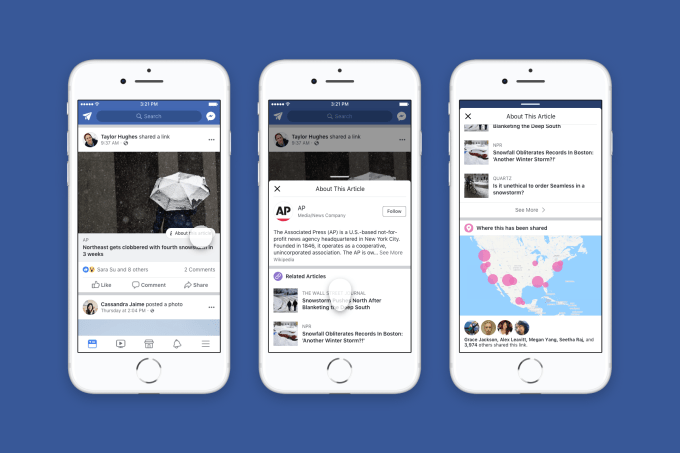
Red flags and “disputed” tags just entrenched people’s views about suspicious news articles, so Facebook hoping to give readers a wide array of info so they can make their own decisions about what’s misinformation. Facebook will show links to a journalist’s Wikipedia entry, other articles, and a follow button to help users make up their mind about whether they’re a legitimate source of news. The test will show up to a subset of users in the U.S. if the author’s publisher has implemented Facebook’s author tags.

Meanwhile, Facebook is rolling out its test from October that gives readers more context about publications by showing links to their Wikipedia pages, related articles about the same topic, how many times the article has been shared and where, and a button for following the publisher. Facebook will also start to show whether friends have shared the article, and a a snapshot of the publisher’s other recent articles.

These moves are designed to feel politically neutral to prevent Facebook from being accused of bias. After former contractors reported that they suppressed conservative Trending topics on Facebook in 2016, Facebook took a lot of heat for supposed liberal bias. That caused it to hesitate when fighting fake news before the 2016 Presidential election…and then spend the next two years dealing with the backlash for allowing misinformation to run rampant.

Newsroom: Article Context Launch Video

Posted by Facebook on Monday, April 2, 2018


03 Apr 2018

23andMe’s Anne Wojcicki and Unity’s John Riccitello to join us at Disrupt SF 2018

Disrupt SF might feel familiar to many of you, but I encourage you to be prepared for a surprise. The world’s most impactful tech startup conference is about to get bigger and better than ever.

We’re moving to Moscone West, doubling attendance capacity, and tripling our programming with a total of four stages across three days. Which means we need the greatest minds in the biz to grace our stage.

That said, I’m pleased to announce that 23andMe’s Anne Wojcicki and Unity’s John Riccitello will be joining us on stage!

Anne Wojcicki

After a decade investing in healthcare, Anne Wojcicki co-founded 23andMe in 2006. The company launched with a primary focus of giving consumers access to their own genetic information, disrupting an industry that Ancestry.com (founded in 1983) had been dominating.

But it wasn’t always smooth sailing for the company. In 2013, the FDA started to intervene with 23andMe after growing concerned that the company might be giving consumers possibly inaccurate information about their genetic health risk. This led to the FDA halting the marketing and sale of 23andMe’s personal genome service.

Regulatory approval, especially from the FDA, is a nightmare for many startups just getting their footing. But Wojcicki made the best of a tough situation and pivoted the company towards drug research and development, while simultaneously working on FDA approval.

Later that year, the company got the green-light to offer 10 carrier tests, including one for Parkinson’s and one for late-onset Alzheimer’s.

Since then, the company has partnered with Pfizer to help with drug research using 23andMe’s genetic data, introduced a therapeutics division, and hired top talent including Genentech’s Richard Sheller.

In 2017, 23andMe raised $250 million led by Sequoia, bringing total funding to $491 million to date. At the time, Wojcicki said that they had only begun to scratch the surface of direct-to-consumer genetics. The company also recently got approval for a new cancer risk test, becoming the first and only direct-to-consumer genetics company to receive FDA authorization to test for cancer risk without a prescription.

There’s more than plenty to discuss with Wojcicki when we get her on stage at Disrupt SF September 5 – September 7 and we’re thrilled to have her as a guest!

John Riccitello

At one point, a gaming engine was just that. A gaming engine. But today’s landscape, complete with a plethora of mobile, console and desktop games as well as the rise of AR/VR puts a gaming engine square in the middle of a brave new world.

John Riccitello’s Unity, a company whose software provides the backbone for more than half of all new mobile games, is poised to be one of the most important technology companies of the next decade, according to DFJ Growth partner Barry Schuler, an investor at the company.

As of mid-2017, Unity’s engine powered more than two-thirds of all content created for AR and VR. Ninety-one percent of applications on emerging AR platforms like the Microsoft HoloLens are created on the engine, while Samsung’s Gear VR has about 90 percent of its gaming titles built using Unity.

Alongside the growth of gaming, Unity’s ability to provide infrastructure for spatial computing puts Unity in a position to see other industries line up at its doorstep, from fashion to arts to the enterprise. As these spaces continue to heat up, Unity will be at the center of it all.

With nearly $700 million raised, Riccitello was pretty quiet when asked about the potential of Unity going public as of May 2017. Hopefully, the former EA COO will have more to share on that front on the Disrupt SF stage. But in the case he doesn’t, we have plenty of questions about the future of Unity.

Disrupt SF 2017 runs from September 5 to September 7 at Moscone West. Super early bird tickets are available here.

03 Apr 2018

Minit is a monochromatic adventure that eats up hours 60 seconds at a time

If the overstuffed buffets of Far Cry 5 and other expansive AAA games leave a sour taste in your mouth, you may find Minit a suitable palate cleanser. This charming little top-down adventure combines some clever puzzle solving with a well-realized black and white art style.

The pitch is simple: You’re a little guy who picks up a cursed sword that causes you to die every 60 seconds and start over from your home. So whatever you do in this game, you have to do in less than a minute.

Some things reset when you die, and some things stay done — enemies will return, but favors will be remembered, keys retained and so on. Figuring out how to effect lasting progress is a big part of the fun.

Also fun is the art style, which is determinedly monochromatic; not even a shade of grey to be found, only the kind of patterning and hatching I remember from my Mac Classic days. But the developers, a motley crew assembled from a variety of teams, use the simplicity to create a wealth of personality. The limited writing is also fun, with characters barking everything from subtle hints to total non sequiturs.

The simplicity of the graphics and controls (there are just the directions, a button to use your item and a button to die early so as not to have to wait) don’t mean pushover gameplay, though. You’ll have to be very observant and explore every nook and cranny to be sure you have what you need to proceed. I was stuck near the end of the game because I didn’t explore literally every corner of one particularly dark area.

It isn’t boring pixel-peeping — I’m just saying you need to keep your eyes peeled, because everything is where it is for good reason.

I finished my first run (there’s a New Game+ mode) in a bit under two hours, but there was definitely a lot of stuff I didn’t find and side quests I didn’t pursue to their ends. I kept surprising myself with locations I thought I’d explored completely, but rushed to the end so I could write this extremely detailed review.

Minit is a bargain at $10 — you can pick it up for PC, PS4 or Xbox One. No Switch yet, although yes, it’d be perfect for it.

03 Apr 2018

AllRaise wants to increase the amount of venture funding female founders receive

AllRaise, a new nonprofit organization that’s behind diversity and inclusion efforts like Female Founder Office Hours (FFOH) and Founders for Change (FfC), wants to increase the amount of funding female founders receive, Forbes first reported earlier today.

Currently, female founders receive just 15 percent of all venture funding, according to AllRaise. Within the next five years, AllRaise wants to increase that to 25 percent, while also doubling the percentage of women in VC partner roles in the next 10 years.

“Our mission is simple — to accelerate the success of female funders and founders,” AllRaise co-founder Aileen Lee wrote on Medium. “We believe that by improving the success of women in the venture-backed tech ecosystem, we can build a more accessible community that reflects the diversity of the world around us.”

AllRaise intends to achieve these goals through FFOH, FfC, creating a diverse candidate database for venture capital, data sharing, facilitating introductions between limited partners and female VCs and by working in solidarity with other diversity organizations. AllRaise joins the likes of Project Include, the Kapor Center for Social Impact’s Leaky Tech Pipeline and other organizations — all of which all aim to address the lack of diversity and inclusion throughout the multiple areas of the tech industry.

[gallery ids="1616278,1616277,1616276,1616275,1616274"]