03 Apr 2018

betaworks VisionCamp introduces seven new AR/computer vision companies

More than ten years ago, betaworks launched to foster an ecosystem of startups focused on the intersection of media and consumer behavior. While the mission hasn’t changed, the structure has seen some tweaks. The company has introduced its own venture arm, led by Matt Hartman, as well as the more recent launch of betaworks Studios.

But nestled gently between the two are betaworks Camps program. Camps are a sort of hyper-specific accelerator program, within which a small cohort of early-stage startups build out their products within a certain theme, complete with the full resources of betaworks (marketing, legal, space, etc.) as well as a small investment.

Camps first launched with BotCamp, followed shortly by VoiceCamp, and today the graduates of VisionCamp are showing off their wares for the first time at Demo Day.

Camera IQ

Camera IQ calls itself a camera experience manager. The company works with brands and publishers to develop virtual worlds for customers, with partners including Spotify, Neiman Marcus and Viacom. The technology integrates AR toolkits and mobile OSes with brands native apps to offer different experiences for consumers. Camera IQ was founded by Allison Wood and Sonia Tsao. The founders say that the camera represents the next great consumption experience, as well as the next great transaction experience. The company hopes to sit at that intersection.

Facemøji

Livestreaming and FaceTime are now accessible to everyone, but not everyone wants to show their face on these platforms. Enter Facemøji. The startup offers 3D avatar webcams that streams your facial expressions via the avatar without ever showing your real likeness. The company was originally focused on gamers who stream on Twitch, with plans to expand to video chat. Facemøji was founded by Robin Taszka and Tom Krcha.

Leo

Originally called Surreal, Leo offers a vast marketplace of AR objects, stamps and artwork so that users can change the world around them. Leo has raised $1.5 million in seed and has relationships with upwards of 2,000 artists on the platform. The company, which was founded by Dana Loberg and Sahin Boydas, makes money by sharing revenue with artists who create objects for the platform.

Numina

Nearly half of land area in cities is made up of streets, sidewalks and parks, and cities have no data or insights on these spaces. Numina partners with cities to place computer vision sensors on light poles in these areas and offer anonymous flow data about pedestrians in these spaces. The company offers an API for streets, as well, to give developers access to real-time activity and a backlog of activity for their apps, whether it’s for mobility, insurance, real estate, or logistics. Numina was founded by Tara Pham.

Selerio

Selerio brings together the real world and the virtual world by using computer vision to map the layout and objects in a room and replace them with a virtual world. Imagine putting old-school Victorian furniture inside an existing space. The company uses deep learning and computer vision in its technology, which was spun out of Cambridge University. Selerio offers an SDK to developers and is currently being integrated with Apple’s ARKit. Selerio was founded by Ghislain Tasse.

Streem

Streem supports the professional home services industry by using computer vision, machine learning, and AR to capture vital information (like model, make and serial number) through a simply live video chat. Through Streem’s technology, service pros can capture information, take measurements and save notes without ever stepping foot in the client’s home, letting them offer quotes much faster and solve the problem in one try. Streem was founded by Patrick Ezell and Jef Holove.

Trash TV

Despite the fact that capturing and editing video is more accessible than ever, video editing remains a time-consuming and tedious process. The Trash TV app uses computer vision and AI to edit consumer videos into something beautiful and usable. The company uses a stock video repository that includes proof of creation to fill in the gaps. Trash TV was founded by Hannah Donovan and Anton Marini.

This is the third of betaworks’ Camps. The next one, according to Camps General Manager Danika Laszuk, is focused on the intersection of live streaming and participatory audiences. It’s unclear what they’ll name the next camp, but as Twitch streaming and apps like HQ continue to pull in large viewerships, the lines between performer and audience are blurred, betaworks hopes to find startups working on evolving the space.
03 Apr 2018

Facebook launches bulk app removal tool amidst privacy scandal

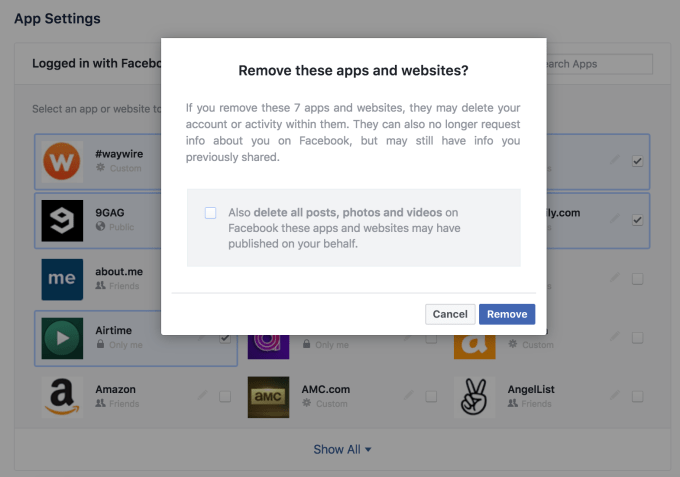
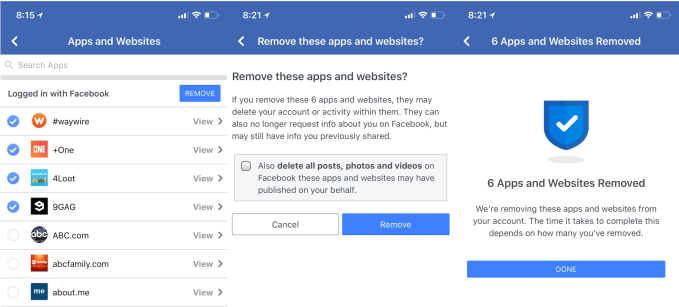
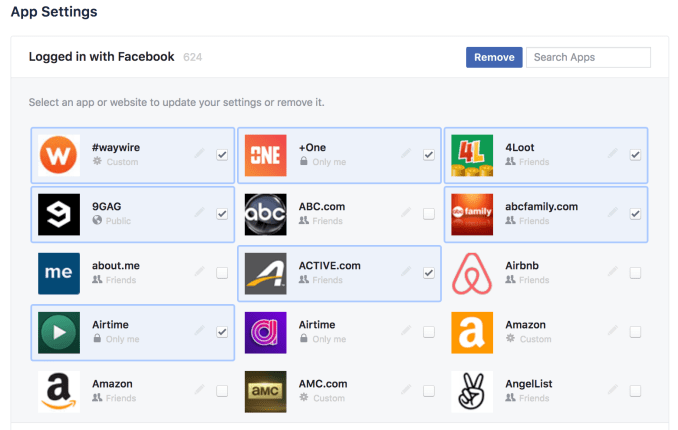
Following the Cambridge Analytica scandal, users have flocked to their Facebook privacy settings to sever their connection to third-party apps that they no longer wanted to have access to their data. But deleting them all took forever because you had to remove them one by one. Now Facebook has released a new way to select as many apps as you want, then remove them in bulk. The feature has rolled out on mobile and desktop, and Facebook also offers the option to delete any posts those apps have made to your profile.

Facebook confirmed the launch to TechCrunch, pointing to its Newsroom and Developer News blog posts from the last few weeks that explained that “We already show people what apps their accounts are connected to and control what data they’ve permitted those apps to use. In the coming month, we’re going to make these choices more prominent and easier to manage.” Now we know what “easier” looks like. A Facebook spokesperson told us “we have more to do and will be sharing more when we can.” The updated interface was first spotted by Matt Navarra, who had previously called on Facebook to build a bulk removal option.

Facebook stopped short of offering a “select all” button so you have to tap each individually. That could prevent more innocent, respectful developers from getting caught up in the dragnet as users panic to prune their app connections. One developer told me they’d been inundated with requests from users to delete their data acquired through Facebook and add other login options, saying that the Cambridge Analytica scandal “really hurt consumer trust for all apps…even the good guys.” The developer chose to change its Terms of Service to make users more comfortable.

The bulk removal tool could make it much easier for users to take control of their data and protect their identity, though the damage to Facebook’s reputation is largely done. It’s staggering how many apps piggyback off of Facebook, and that we gave our data without much thought. But at least now it won’t take an hour to remove them all.


03 Apr 2018

Zendesk hits $500M run rate, launches enterprise content management platform

Over the last several years, Zendesk has been making the transition from a company that caters mostly to small businesses to one with larger enterprise customers — and their revenue reflects that. The company announced it has crossed the $.5 billion annual run rate since its last earning report in February. It also announced a new enterprise content management product specifically geared for large customer service organizations.

The company was just shy of the goal after its most recent earnings report (pdf) with $123.4 million for the quarter. They say they have since passed that goal, but have not announced it until now, based on revenue that closed March 31, 2018. The company is projecting between $555 and $565 million in revenue for fiscal 2018, according to its last earnings report. When you consider that when the company went public in 2014, it was at $100 million in annual revenue, reaching a half billion dollars in 4 years is significant.

Zendesk reports that 40 percent of its revenue now comes from larger enterprise customers, which they define as 100 seats or more. The company is predicting it will cross the $1 billion run rate by some time in 2020.

“When we IPOed, our run rate was $100 million. We had great momentum, but we were seen as SMB scaling to mid market. To reach a half a billion dollars shows momentum for building up enterprise market and enterprise products,” Adrian McDermott, Zendesk’s president of products told TechCrunch.

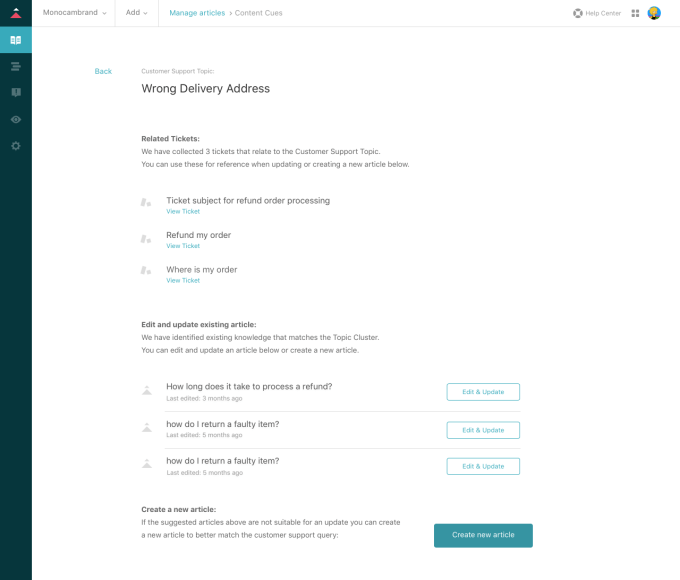
As for the new product, it’s called Guide Enterprise and it’s designed to provide those larger customer service organizations with a knowledge base and a content management platform for editorial planning and review. The idea is to empower customer service reps to write up solutions to problems they encounter and build up that knowledge base as part of the natural act of doing their jobs.

Zendesk Guide Enterprise. Photo: Zendesk

That gives organizations a couple of advantages. First of all, the reps can find their fellow employees’ notes and not have to reinvent the wheel every time, and the notes and articles they write can pass through editorial review and become part of the permanent knowledge base.

When customers hit the site or app, they can access solutions to common problems before having to talk to a human. The platform also includes reminders to check the content regularly so the knowledge base stays fresh and stale content is removed.

Finally, the company is applying AI to the problem. The artificial intelligence component can review the corpus of information currently available in the entire knowledge base and identify gaps in content that the company might want to add, allowing for proactive content creation.

The content management idea isn’t new to Zendesk. McDermott says they shipped the first content management product years ago, but what’s different is that this is geared to larger organizations and that the AI piece allows for some automation of this process. “The new workflow brings rich AI concepts like content analytics into the publishing flow,” he said.

03 Apr 2018

Spotify opens at $165.90, valuing company at almost $30 billion

Spotify opened on the New York Stock Exchange at $165.90, giving the company a market value of $29.5 billion.

The first trade didn’t happen until 12:45pm Eastern. This is halfway through the trading day, and a record for the latest opening time for a public debut.

Shortly after the open, shares fell to a little above $160.

The digital music company isn’t selling its shares on the stock market, meaning the company isn’t raising any money today. Instead, the event known as a “direct listing,” is a collection of transactions from existing shareholders (like employees and investors) selling shares directly to stock market investors. It took a while for the market makers to sort this out.

Spotify is basically trying to recreate the secondary market activity that happened before it went public.  The company says that in 2018, shares traded on the private markets between $90 and $132.50. Since Spotify didn’t do an IPO, it set a “reference price” of $132 per share, which would have given the company a valuation of $23.5 billion.

Unlike a traditional IPO where employees don’t sell shares for months, known as a “lock-up,” Spotify insiders are already allowed to sell.

If few people opt to sell, it will drive share prices up, because of limited supply. If a lot of insiders sell, the reverse could happen, if investor demand doesn’t meet it. This may lead to increased volatility in the first few days or weeks of trading.

In the long-run, Spotify’s performance in the stock market will largely depend on its business performance and outlook.

Some investors are concerned that Spotify will run the course of competitor Pandora, which has struggled as a public company, partly due to hefty artist fees. Others argue that Spotify could be viewed as a Netflix, which has been successful in entertainment licensing agreements.

It’s certainly a big and growing business. The company says it is present in 61 countries and its platform includes 159 million monthly active users and 71 million premium subscribers.

Spotify had 4.09 billion Euros in revenue last year (or close to $5 billion), compared to 2.95 billion Euros (about $3.6 billion) the year before. 2015 saw 1.94 billion Euros in revenue (about $2.38 billion).

Losses for last year were 1.2 billion Euros ($1.47 billion), which compares to 539 million Euros ($661 million) the year before.

Spotify previously raised about $2.7 billion in both debt and equity financing. Tencent, Tiger Global, Sony Music and Technology Crossover Ventures (TCV) are amongst its largest shareholders.

CEO and co-founder Daniel Ek has voting power that represents 23.8% of the company. Yet some of this voting power is on behalf of shares owned by Tiger, TME Hong Kong and Image Frame. Ek owns closer to 9% of the business.

Martin Lorentzon, who co-founded Spotify, owns 12.4%.


03 Apr 2018

HTC is looking for a savior in VR, but it won’t find it

Times are certainly tight at HTC, but their plays in the consumer VR market are starting to look like Hail Marys.

The company’s central VR platform play, their Viveport subscription product is regarded by a lot of people I’ve talked to as little more than bloatware, while their newest product, the Vive Pro, is an impressive piece of tech with a price tag that serves as a middle finger to the company’s fans.

Today, HTC announced that it would be bundling previous generation controllers and sensors with the Vive Pro for an additional $299, bringing the all-in price for consumers to a mind-boggling $1098 for a system that’s only mildly better than its competitors.

HTC had a sort of first-to-market advantage with the Vive, but its playing in a space where the potential victors are eyeing the spoils with telescopes. Competing in the US with Google and Facebook and Microsoft is a startling task, but companies that have succeeded have been able to do so because they are incredibly nimble. HTC is a clear underdog, but as more pressure has been put on its VR arm to save the company and deliver meaningful returns now, it’s clear that it doesn’t have enough to offer.

The HTC Vive Pro

The company is fresh off another awful quarterly earnings report, where it made it clear that it was driving some strategy changes in its VR and smartphone businesses.

Following a strategic business review aimed at optimizing its teams and processes — both for smartphones and VR — it also says it now has “a series of measures in place to enable stronger execution”, and is touting fresh innovations coming across its markets this year.

The company sold a chunk of its smartphone business to Google for $1.1 billion earlier this year and the company said it plans to pump that money back into “greater investment in emerging technologies.”

The Taiwanese company certainly has had a tough challenge competing with a deep-pocketed competitor like Facebook which really has no interest in hardware margins and has already invested and pledged funds into its VR ambitions that equal HTC’s market cap several times over.

HTC’s recent moves seems to be aiming more towards a market Facebook wouldn’t serve, which in this case is the super high-end. The thing is, the Vive Pro isn’t even that high-end, the screen resolution bump is already available on the $499 Samsung Odyssey. The Vive Pro is probably the best VR headset available now, but given the competition, it’s a premium I’d maybe pay $599 for, especially noting how much better the Oculus Touch controllers are compared to the dated Vive wands.

Here’s the field at the moment (high-end PC costs not included):

  • Windows MR Acer system – $299
  • Oculus Rift system – $399
  • Original Vive headset – $499
  • Samsung Odyssey system – $499
  • Vive Pro headset – $1098

If HTC wanted to sell this as a tool for professionals, that would have been fine, but HTC had already built a more expensive “enterprise edition” of the Vive. They should have done the same here, bundled it with SteamVR 2.0 tracking and sold it at an exorbitant price marketed solely towards enterprise customers who could use the giant tracking area afforded by Valve’s new tech advances. Then they could’ve sold this Vive Pro “consumer edition” at an all-in price that was still too expensive at like $799 with a lower headset-only price. If they can’t afford to do that, then they clearly are aiming to sell this thing to more consumers than reality will allow.

Facebook CEO Mark Zuckerberg introduces the $199 Oculus Go headset.

The one thing holding most consumers to the Vive isn’t the HTC hardware or the company’s Viveport subscription, it’s Valve’s SteamVR tech which is the gold standard in high-end VR for accurately determining the position of the headset and controllers. It’s only one piece of the puzzle, but for VR enthusiasts it’s the Vive’s secret sauce. That’s not great for HTC which does not have an exclusive relationship with Valve. It’s left the company looking to distance themselves from Valve with their Viveport store which seems like an incredibly difficult sell to both consumers and developers right now.

The company isn’t just looking at PC VR though. The company also released a Vive Focus standalone headset to the Chinese market. But after canning its plans to release the headset on Daydream in the US, it seems that HTC is chasing markets outside China after all. That move that offers some separation between HTC and Valve, but would leave them fending for themselves on mobile hardware that has a wirelessly tracked headset but no tracked controllers. Facebook is likely releasing its non-tracked Oculus Go headset in the next few months for $199, while it has already begun getting tracked “Santa Cruz” headset dev kits out.

It’s hard enough to succeed in the VR market when you’re not worried about making money, and that’s not exactly a recipe to thrive for a company trying to find the road to recovery. The company’s latest efforts show that it wants to speed up the timelines for its VR business to begin earning back its investment, but I suspect that in the fragile market, it will only serve to alienate its core consumers. HTC wants “emerging tech” to lead it out of gutter, but virtual reality is too much of a long-game technology for a company that is in desperate need of some short-term answers.

03 Apr 2018

Stackery lands $5.5 million for serverless platform

When Stackery’s founders were still at New Relic in 2014, they recognized there was an opportunity to provide instrumentation for the emerging serverless tech market. They left the company after New Relic’s IPO and founded Stackery with the goal of providing a governance and management layer for serverless architecture.

The company had a couple of big announcements today starting with their $5.5 million round, which they are calling a “seed plus” — and a new tool for tracking serverless performance called the Health Metrics Dashboard.

Let’s start with the funding round. Why the Seed Plus designation? Company co-founder and CEO Nathan Taggart says they could have done an A round, but the designation was a reflection of the reality of where their potential market is today. “From our perspective, there was an appetite for an A, but the Seed Plus represents the current stage of the market,” he said. That stage is still emerging as companies begin to see the benefits of the serverless approach.

HWVP led the round. Voyager Capital, Pipeline Capital Partners, and Founders’ Co-op also participated. Today’s investment brings the total raised to $7.3 million since the company was founded in 2016.

Serverless computing like AWS Lambda or Azure Functions is a bit of a misnomer. There is a server underlying the program, but instead of maintaining a dedicated server for your particular application, you only pay when there is a trigger event. Like cloud computing that came before, developers love it because it saves them a ton of time configuring (or begging) for resources for their applications.

But as with traditional cloud computing — serverless is actually a cloud service — developers can easily access it. If you think back to the Consumerization of IT phenomenon that began around 2011, it was this ability to procure cloud services so easily that resulted in a loss of control inside organizations.

As back then, companies want the advantages of serverless technology, but they also want to know how much they are paying, who’s using it and that it’s secure and in compliance with all the rules of the organization. That’s where Stackery comes in.

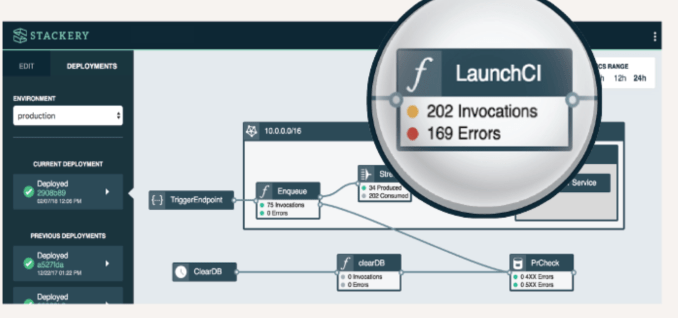
As for the new Health Metrics Dashboard, that’s an extension of this vision, one that fits in quite well with the monitoring roots of the founders. Serverless often involves containers, which can encompass many functions. When something goes wrong it’s hard to trace what the root cause was.

Stackery Health Metrics Dashboard. Photo: Stackery

“We are are showing architecture-wide throughput and performance at each resource point and [developers] can figure out where there are bottlenecks, performance problems or failure.

The company launched in 2016. It is based in Portland, Oregon and currently has 9 employees, of which five are engineers. They plan to bring on three more by the end of the year.

03 Apr 2018

Bancor takes on Crypto exchanges with wallet that converts across tokens

With the number for cryptocurrencies passing 1,000, and the craze continuing, things are getting pretty wild out there to say the least. And these cryopto asssets can vary from the tokens issued by some no-name startup all the way up to Ether and the venerable Bitcoin. The trouble is, converting those coins into other currencies which you might actually use, or perhaps into the more fiat-friendly Bitcoin and Ether, has been hard. Users have to use exchanges to convert their cryptocurrencies via exchanges where prices can fluctuate wildly. Since cryptocurrency is the main “application” for blockchain technologies right now, that would mean wallets where they are held effectively becoming a new type of ‘browser’.

This is the thinking behind the launch today of Bancor’s wallet. Bancor was already an open-source protocol for automated token conversions, and had raised approximately $153 million in in ICO last year. It’s new wallet will offer built-in conversion between 75 cryptocurrencies, with more being added each day. This means users will not need to send their cryptocurrencies to exchanges if they wish to acquire other forms of crypto-assets and can instead convert cryptocurrencies directly inside the Bancor Wallet. The wallet is not a native smartphone app, but is optimised for mobile use.

Problems at the major crypto exchanges have been mounting, putting many off joining the crypto world. So it’s likely that many Crypto holders will be tempted by the relative stability of in-wallet conversion, even if they can’t play the arbitrage game so easily.

Instead of converting the currencies by matching buyers and sellers as an exchange does, Bancor’s in-wallet conversions are made against smart contracts. In theory, this gives users transparent and efficient pricing without the spreads and fees associated with exchanges. Users are always in control of their keys and Bancor neither holds nor has access to users funds.

In addition, the Bancor Wallet allows users to purchase tokens with any major credit or debit card and instantly convert them to any token in the Bancor Network, including heavily-traded coins like Ether and EOS.

Galia Benartzi, co-founder of Bancor said in statement: “In the new Internet of value, where anyone can create a currency, digital wallets are becoming the browsers which allow users to navigate the emerging world of decentralized apps. To be useful, users need seamless and secure interfaces to blockchain-based products as well as on-demand conversion between the tokens that power them.

“Money is changing, and digital wallets must be as dynamic as the currencies they hold. Imagine if your coffee shop loyalty points were accepted at any cash register in the world, or your airline miles could buy cellular minutes with the click of a button… Bancor’s new wallet aims to deliver on that promise by offering continuous access to crypto tokens and instant convertibility between virtual assets, unlocking enormous purchasing power for consumers,” she added.

Bancor Wallet users can open accounts using an email address, Telegram, WeChat, or Facebook Messenger .

The Bancor Wallet will only likely to get uptake if it can continue to add integration with tokens and maintain a live status and instant conversions. If it can do that then it may well attract users away from many buggy and controversial exchanges.

03 Apr 2018

Google rolls out a better way to search for movies

Google is rolling out a new feature today that will help you better plan your night at the movies. While the company has supported displaying movie showtimes within Google Search results following the closure of its standalone movie site in 2016, this update will help you narrow down your options more efficiently, thanks to the additions of drop-down filters in the Movies Showtimes interface that appears at the top of Google’s search results.

After you perform a search for “showtimes” and are directed to Google’s Movies Showtimes screen as usual, you’ll notice a new set of drop-down filters at the top.

You can use these to filter the movies near you by a number of factors, including screen type (e.g. 3D or IMAX), the movie’s genre, ratings, the critic scores, language, and preferred chains. That way you could click a few buttons to do a very specific search for something like “Family” movies rated “PG” or “G” at Cobb or AMC theaters in the afternoon on Sunday, for example. Or “R” rated “Dramas” with a critics’ score of 70% or higher on Rotten Tomatoes.

The Critics’ Score filter supports reviews from Metacritic and IMDb, as well.

Once the filters are applied, you’ll be shown all the matching results that meet your exact criteria. When you’re ready to go, you can then click on the showtime you want to purchase your ticket using Fandango, MovieTickets.com, AMC Theatres, or Atom Tickets.

In addition to the showtime search filters, you can also now tap over to the “Theaters” tab to see what’s playing at your favorite theaters, that also matches your requirements.

Google says the update is rolling out to the Google Search app on Android in the U.S. and India in Hindi and English, as well as in mobile search in the browser, and soon, the Google Search app for iOS.

03 Apr 2018

Announcing the agenda for TC Sessions: Robotics at UC Berkeley’s Zellerbach Hall on May 11

TechCrunch is partnering with UC Berkeley on May 11 to produce TC Sessions: Robotics, a one-day show focused on emerging robotic technologies and the startup scene.

The editorial team had a blast planning this agenda as, between the Bay Area’s universities and startup ecosystem, there are far more robotics-driven technology projects and startups on the West Coast than most appreciate. There is no question that the huge steps forward in AI, sensors and GPUs are quickly shifting robotics to the fast lane of the startups ecosystem.

Tickets are currently available and at an early-bird rate – buy your tickets here before prices increase.

Agenda

TC Sessions: Robotics

Friday, May 11, 2018 @ Berkeley’s Zellerbach Hall

9:00 AM – 9:05 AM

Opening Remarks with Matthew Panzarino (TechCrunch)

9:05 AM – 9:25 AM

  • Getting A Grip on Reality: Deep Learning and Robot Grasping

Ken Goldberg (UC Berkeley)

Building on 35 years of research, Professor Goldberg will discuss the  “New Wave” in robot grasping for e-commerce warehouse order fulfillment.

9:25 AM – 9:50 AM

  • The Future of the Robot Operating System (ROS)

Brian Gerkey (Open Robotics) and Morgan Quigley (Open Robotics).  Melonee Wise (Fetch Robotics)

The open ROS has been a boon to robot creators. Can ROS keep up with the dazzling array of new demands?  

9:50 AM – 10:10 AM

  • Eyes, Ears and Data: Robot Sensors and GPUs

Deepu Talla (NVIDIA)

NVIDIA is the market-leader in the development of the processors and sensors crucial to autonomous cars and drones as well as human safety.

10:10 AM – 10:30 AM

  • The Best Robots on Four Legs  

Marc Raibert (Boston Dynamics)

Boston Dynamics rocked the world with the DARPA-funded Big Dog, and founder Marc Raibert will show off its latest creation, SpotMini.

10:30 AM – 10:50 AM

Coffee Break

10:50 AM – 11:20 AM

  • Old McDonald Needs a Robot

Dan Steere (Abundant Robotics), Brandon Alexander (Iron Ox), Sebastian Boyer (Farmwise), and Willy Pell (Blue River Technology)

The future of agribusiness is robots, and these founders are already putting automated farm workers in the fields.

11:20 AM – 11:40 AM

  • Teaching Robots New Tricks with AI 

Pieter Abbeel (UC Berkeley, Embodied Intelligence)

The latest developments in AI can extend what robots do and make it possible for anyone to teach a robot new skills, without costly re-reprogramming. Professor Abbeel’s Embodied Intelligence is taking that technology to market.

11:40 AM – 12:05 PM

  • Making Robots Less Robotic 

Ayanna Howard (Georgia Tech), Leila Takayama (UC Santa Cruz) and Patrick Sobalvarro (Veo Robotics)

Robots and humans are working and living together more than ever, and that means we have to watch out for one another — literally.

12:05 PM – 1:00 PM

Lunch and Workshops

  • WORKSHOP: DARPA and the Subterranean Challenge

Dr. Timothy Chung (DARPA)

A primer on how to work with DARPA and DARPA’s latest robotics challenge.

1:00 PM – 1:20 PM

To be announced.

1:20 PM – 1:50 PM

  • Venture investing in Robotics

Renata Quintini (Lux Capital), Chrissy Meyer (Root Ventures) and Rob Coneybeer (Shasta Ventures), Chris Evdemon (Sinovation Ventures)

Has robotics become a mainstream investment focus for venture capitalists?

1:50 PM – 2:10 PM

  • Betting Big on Robotics

Andy Rubin (Playground Global)

The creator of the Android mobile operating system and former head of Google’s robotics division, Andy Rubin wants Playground Global to invest in all things robotics.  

2:10 PM – 2:35 PM

  • From the Lab Bench to Term Sheet

Manish Kothari (SRI), Kaijen Hsiao (Mayfield Robotics) and Paul Birkmeyer (Dash Robotics, Dishcraft Robotics)

Researchers in AI and robotics are well positioned to launch startups, but what does that transition look like?

2:35 PM – 2:45 PM

Demo to be announced.

2:45 PM – 3:05 PM

Coffee Break

3:05 PM – 3:30 PM

  • Autonomous Systems

Raquel Urtasun (Uber), Alex Rodrigues (Embark Trucks)

How and when will autonomous vehicles (safely) take to the roads in in meaningful numbers? 

3:30 – 3:50 PM

  • What Robots Can Learn from Nature

Robert Full (UC Berkeley)

When it comes to mobility, the animal world is full of elegance and adaptation as well as lessons for robotics. Professor Full has built those bio-inspired robots.

3:50 PM – 4:10 PM

  • The Future of Transportation

Chris Urmson (Aurora)

Many of the first generation self-driving cars will carry systems from Aurora, and Chris Urmson, former head of Google’s self-driving car project, knows the technical challenges and promise.

4:10 PM – 4:40 PM

Session to be announced.

4:40 PM – 5:00 PM

  • Building Stronger Humans

Homayoon Kazerooni (SuitX)

Wearable robotics have already provided mobility to the paralyzed; they will do much more in the near future. Professor Kazerooni is one of the field’s pioneers as well as leading entrepreneurs.

5:00 PM -7:00 PM

Reception  

Early-bird tickets are on sale now – buy your tickets here before prices increase.

Students can save 90% on tickets by booking here.

If you’re interested in a sponsorship, contact us.

03 Apr 2018

Messenger adds support for sharing HD video, 360-degree photos

Perhaps aiming to snag some attention away from Snapchat’s big group video call update out this morning, Facebook also announced an update to its chat app Messenger, which will now allow users to share 360-degree videos and HD quality video (720p). In both cases, you’ll have to capture the photo or video outside the Messenger app, the company notes.

The update follows another that rolled out last fall, allowing users to share high-resolution photos through Messenger – something that Facebook said was the result of its significant investments in helping people “communicate visually.”

The idea that mobile messaging is often a camera-first experience isn’t unique to Facebook Messenger, of course – it’s the premise of the Snapchat experience and, these days, Instagram too.

Unfortunately for Facebook, news of improved media-sharing capabilities comes at a time when the company is under siege for its mishandling of user data, and, most recently, another reveal that it had been retaining videos that users believed to be deleted. The broader effect of this news cycle around Facebook’s approach to privacy, is an increased general mistrust of Facebook’s products as the place to share – including sharing through Messenger, which isn’t as distanced from the core product as Facebook-owned Instagram and Whatsapp are.

Facebook says if you want to share a 360-degree photo, you’ll need to first snap it with your camera or another 360-photo app before uploading it to Messenger where it will then be converted to an immersive experience that can be navigated through by the recipients via either tapping and dragging on mobile, or clicking and dragging on Messenger.com.

Similarly, HD videos will need to be first captured from the phone, or re-shared from the Facebook Newsfeed or other messages.

The rollout of the HD feature is limited to select markets for now, including Australia, Belgium, Canada, Denmark, Finland, France, Hong Kong, Japan, Netherlands, Norway, Romania, Singapore, South Korea, Sweden, Switzerland, Taiwan, the U.K. and the U.S. on iOS and Android.

360 photos, however, are available worldwide on iOS and Android.