
03 Apr 2018

South Korean capital Seoul mulls “S-Coin” tokens and blockchain-based government

South Korea has been at the forefront of the blockchain movement, with some of the highest density of cryptocurrency traders anywhere in the world. Now, as the frenzy around cryptocurrency prices recedes (Bitcoin is around $7350 right now, down from a high of almost $20,000 last December), the country is starting to consider the more utilitarian aspects of blockchain that might not immediately lead to riches.

Seoul’s mayor, Park Won-soon, discussed the city’s plans to launch what is currently being dubbed the S-coin in an interview with CoinDesk. In his vision of the program, the coin could be used for subway fares, as well as “a payment method for city-funded welfare programs for public employees, young job seekers and citizens helping the environment by saving electricity, water and gas.”

That’s a remarkable statement coming from an office that is widely considered to be the second most important in the country. It’s also a far cry from the strong opposition that national leaders and regulators voiced toward blockchain — and cryptocurrencies in particular — during the run up in Bitcoin and Ethereum prices last year, particularly in the wake of a series of Bitcoin heists by North Korea.

Back then, the Korean financial authorities and the Justice Ministry said that they were considering outright banning cryptocurrencies. Now, over the past few weeks, national authorities have quietly floated new proposals around Initial Coin Offerings (ICOs), potentially creating a procedure that would allow ICOs in well-regulated circumstances. Mayor Park also said in his interview with CoinDesk that further regulation would be necessary around blockchains before any of Seoul’s proposals could be brought into effect.

The invention of blockchain, and Bitcoin in particular, was seen by many in the community as a way to “disrupt” politics as usual, by moving power away from central authorities to decentralized players. However, the technology increasingly looks like it will be subsumed by the state to improve existing institutions.

South Korean cities, like counterparts elsewhere around the world, are investigating whether blockchain technology could provide mechanisms like algorithmic zoning. City governments often hold many records of interest to blockchain specialists, including property records, ID records, zoning codes, business and health licenses, as well as construction permits. Creating a transparent and efficient clearinghouse for such information could generate significant gains for the quality of urban governance.

In this context, it is important to clearly delineate blockchain as database and cryptocurrencies as money. The proposals from Seoul and elsewhere have been designed around the former. Even when such tokens might provide a financial benefit, such as a discount on subway fares or housing, these tokens are not designed to be fungible currencies in the same way that cryptocurrencies are, but instead convenience tools to provide digital access to amenities.

That’s in contrast to initiatives like the one from Venezuela to create an oil-backed cryptocurrency called Petro, which many analysts saw as a convenient means to avoid U.S.-led sanctions on the Maduro regime. The Trump administration blocked the purchase of Petro last month.

Seoul is expected to announce a roadmap for blockchain in the coming weeks, and other cities are coming close to launching their own initiatives. The value bubble in cryptocurrencies may be receding, but their practical uses may well drive the next wave of innovation.

03 Apr 2018

Twitter to live stream weekly MLB games in renewed deal

Major League Baseball games are coming to Twitter as a result of a renewed partnership. This Thursday, Twitter will live stream the Texas Rangers versus the Oakland Athletics at 3:35 PM ET. The game will be the first of the weekly day-game live streams of out-of-market MLB games in the weeks ahead, during the 2018 season.

The MLB will announce the games that will air on Twitter ahead of each month’s slate, usually via a tweet.

Twitter has worked with the MLB before. As the company was ramping up its live streaming efforts in 2016, it announced it would begin streaming weekly MLB games, along with those from other sports organizations like the NHL and NFL. It then aired weekly games from April through October 2017.

Now it will be a home to weekly games, available to U.S. users to stream for free from April through September 2018.

Fans can watch the games on live.twitter.com/MLB online and on connected devices, and they don’t need to login to a Twitter account in order to do so. However, the games will not be exclusive to Twitter. The company notes that each stream is a simulcast with a participating team’s local TV broadcast, and that Twitter will be offering advertising packages for the content to be made available to sponsors.

There is a rev share on those ad deals, but Twitter declined to comment on how the revenue is split.

Twitter is not the only online home to MLB games. Facebook recently scored an exclusive deal to live stream 25 afternoon games – which means they won’t be available elsewhere.

The MLB has been busy making its games available on newer streaming services, too. For example, YouTube TV announced last month a multi-year deal to be the presenting sponsor for the World Series, which includes plans to heavily market its service with in-stadium signage, TV ads, on-air callouts, and more. And ESPN+, the Disney-owned streaming service arriving this month, will air over 180 MLB games, with the option to view more by purchasing the MLB.TV out-of-market package.

In addition to the games, the MLB will again be making real-time highlights available via its @MLB Twitter account throughout the season, with Spanish highlights available from @LasMayores during 2018, says Twitter.  And Twitter has partnered with the MLB on hashtag-triggered emoji for all 30 MLB teams.

The April schedule of games is available below:


03 Apr 2018

Mozilla shows off a Firefox ‘mixed reality’ browser for headsets

Mozilla wants its newest internet conquest to be mixed reality. The company has just showed off its first look at “Firefox Reality,” a browser built specifically for headsets. Mozilla has been behind some super important work here already with things like A-Frame and the WebVR/WebAR standards, so this isn’t a big surprise at all.

The big deal here is that Mozilla is committed to running this cross-platform and open source which should be a welcome change for a platform where every headset maker has its own way to access traditional web content.

Firefox Reality isn’t quite ready for primetime, but the team had a short demo to show off.

The demo certainly isn’t the most convincing use case of browser-based virtual reality, but it kind of reflects one of the big issues for VR browsing. In a 2D web content world, what’s the point? And is 3D content enthralling enough for site’s to restructure their web presence for headset users?

The thing is at the end of the day, browsers like this aren’t focused on sites like TechCrunch building experiences that let you walk up to a virtual table and pick up a virtual copy of a TechCrunch magazine to start flipping through, they’re more focused on turning the web into an engine to hop through different realities. In the longish short-term, that’s likely going to be focused on gaming, but Firefox’s blog post on the topic didn’t have much to say about that, instead mostly noting that you just have to start somewhere. “This is the first step in our long-term plan to deliver a totally new experience on an exciting new platform,” the post notes.

03 Apr 2018

Snap introduces group video calls for up to 16 people

Snapchat has today introduced a new group video chat feature, letting users chat with up to 16 of their closest friends. If users need more people in the chat (which, for those of us who have large conference calls, sounds awful!), Snap is also offering group voice calls with up to 32 participants.

The feature is relatively simple. Just tap the video icon in a group chat to get started, or start up a call with a few people and invite new friends to join.

As one might expect, Snapchat’s crown jewel filters will also be available to use within a group video chat.

Folks that aren’t camera ready can easily toggle between voice and video to just voice.

[gallery ids="1616138,1616139,1616140"]

Snap first introduced group chat and video chat in 2016, looking to give people new ways to communicate on the image-first platform. Snap says that the community is making millions of calls a day since launch.

That said, it’s worth wondering about the timing of this new feature, which comes almost two years after the company announced video chat. It’s possible that Snap wants to take advantage of the #deletefacebook movement offering people as much functionality as possible to connect on their platform instead of the incumbent’s.

It’s also worth noting that Snap’s 16-person group video chat is strikingly similar to Houseparty, the video chat app launched by the founders of live streaming app Meerkat.

Alongside the introduction of group video calls, Snap is also bringing @mentions to the platform. Users can now tag each other in their snaps and Stories by simply typing @ before their user name. Users who have been tagged will be notified when they appear in their friends’ Stories.

03 Apr 2018

SalesLoft soars with $50 M Series C

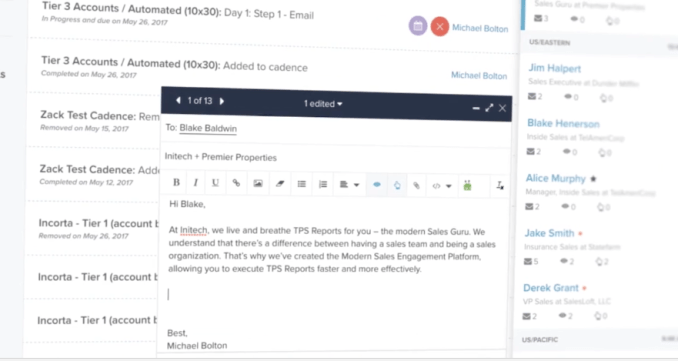
SalesLoft, an Atlanta-based startup that helps companies manage the contact phase of the sales process, announced a $50 million Series C today.

Insight Venture Partners was lead investor with participation from LinkedIn and Emergence Capital, which also participated in the company’s A and B rounds. Today’s investment brings the total raised to $75 million, so this was a significant capital infusion.

What attracted investors was that SalesLoft has concentrated on an area of the sales pipeline called ‘sales engagement.’ It provides a framework for sales people around how to contact potential customers, how often and with what language. It is significant enough that it caught the attention of Jeff Horing, co-founder and managing director at Insight Venture Partners, who was willing to write a big check.

He sees sales engagement an emerging and fast-growing area of the sales stack. “SalesLoft consistently helps customers increase their pipelines, but also strengthen their relationships with buyers — that’s a huge differentiator,” Horing said in a statement.

Kyle Porter, co-founder and CEO at SalesLoft says that what his company does is essentially create a contact workflow for the sales team. It provides a framework or blueprint, while applying a measurable structure to the process for management. Whether the sale is successful or not, there is an audit trail of all the interactions and what the software recommended for actions and what actions the sales person took.

That involves providing the sales team with the next best actions, which could be an email, a phone call or even a handwritten note.”The suggested email content and phone scripts come from experience with buyers. Here’s the right way to communicate,” Porter said. “At the end of the day, we are enabling our customers to deliver better sales experience,” he added.

The software can recommend the best person to email next with suggested text. Photo: SalesLoft

Machine learning will play an increasing role in building that workflow, as the system learns what types of interactions work best for certain types of customers, it will learn from that, and the system’s recommendations should improve over time.

It appears to be working. The company, which launched in 2011, currently has 230 employees and over 2000 customers including Square, Cisco, Alteryx, Dell and MuleSoft (which Salesforce bought last month for $6.5 billion.) The company reported that they have increased revenue over the last two years by 800 percent (yes, 800 percent).

Porter says this money sets them up to really scale the company with plans to reach 350 employees by the end of the year. In fact, they have more than 40 openings at the moment.

03 Apr 2018

SoftBank leads $450M investment in Paytm’s e-commerce business

SoftBank is at it again giving money companies that rival startups it has already invested in.

The Japanese firm and its long-time ally (and existing Paytm backer) Alibaba have come together to invest $450 million more into Paytm’s e-commerce business, Paytm Mall, as first reported by Mint. The deal is said to value the business at $1.6-$2 billion, with SoftBank providing around $400 million of the committed investment.

SoftBank is already present in India’s e-commerce space courtesy of an investment in Flipkart via its Vision Fund. The firm also previously backed Snapdeal which it tried to shoehorn into a merger deal with Flipkart that was ultimately unsuccessful.

Alibaba meanwhile has been behind the core Paytm business, which specializes in mobile payments with plans for financial services, having invested $1.4 billion into parent firm One97 Communications last year. This new deal signals its crossing into the e-commerce business, too.

“This latest investment led by Softbank and Alibaba reaffirms the strength of our business model, growth trajectory, execution capability and the potential of India’s massive O2O model in the retail space,” Amit Sinha, Paytm Mall COO, told Mint in a statement.

SoftBank added: “Paytm Mall’s offline-to-online operating model, combined with the strength of the Paytm ecosystem, is uniquely positioned to enable India’s 15 million offline retail shops to participate in India’s eCommerce boom.”

Alibaba’s involvement in Paytm has seen the business — or rather, its many businesses — become proxies for Alibaba in India.

Paytm Mall has linked up with Alibaba’s Taobao marketplace in China to extend the reach of Chinese merchants into India. Similar arrangements have also been reached in Southeast Asia via Alibaba’s Lazada e-commerce business.

Alibaba has also got behind the mobile payment component of Paytm — which bears a likeness to its Alipay  unit — while you can see the influence of the Chinese firm, and in particular its Ant Financial affiliate, with Paytm’s plans to launch digital banking and other online financial services in India.

Indeed, it was through investments by Ant Financial that Alibaba first became associated with Paytm. It’s not a huge surprise, then, to see that SoftBank — often a co-investor — is also spreading its influence across the Paytm business. After all, Alibaba needs all the help it can get to battle Amazon directly in India.

03 Apr 2018

Greenhouse Inclusion aims to reduce bias in the hiring process

Unconscious and implicit biases can show up every step of the hiring the process. That’s why Greenhouse, a recruiting and applicant tracking program, has partnered with diversity and inclusion consulting firm Paradigm to bake in inclusive hiring practices throughout the entire process.

Greenhouse Inclusion is designed to help companies employ inclusive hiring practices throughout a job candidate’s entire interaction with the company, from application to interview to job. The platform’s features include automatic resume anonymization, real-time interventions to reduce bias, safeguards to ensure every candidate is evaluated consistently, as well as candidate data and analytics.

“We considered interventions that would have impact across the hiring funnel, influencing who applies to a role in the first place, how hiring decisions are made, and the inclusivity of the process end-to-end,” Paradigm CEO Joelle Emerson said in an email to TechCrunch. “We then collaborated with Greenhouse to determine how software could make those inclusive best practices scalable. For example, we know that when interviewers evaluate candidates in a more structured way – assessing only relevant qualifications and considering those same qualifications for all candidates – they’ll make more objective and equitable decisions. This product includes interventions designed to prompt greater structure and reflection from interviewers.”

[gallery ids="1615814,1615815,1615816,1615817,1615818"]


The platform also features something called “nudges,” which act as tips to remind hiring managers to draft inclusive job descriptions, prompt employees to take diversity into account when making referrals and remind interviewers to slow down and reflect while evaluating a candidate.

Over the years, Greenhouse has become a popular recruiting tool for tech companies like Airbnb, Pinterest, Twilio, Lyft, SurveyMonkey, DocuSign, Evernote and Vimeo. That means there’s some potential for the implementation of Greenhouse Inclusion to result in actual change, in terms of the demographic makeup of the tech industry’s workforce. So far, Pinterest is the only company that has signed on to use Greenhouse Inclusion.

“We’re the first to bring out a holistic technological solution to address bias in hiring,” Greenhouse Inclusion product manager Alex Powell said in a blog post. “We’re the de facto leaders and we need to set the right path for this.”

03 Apr 2018

InVision acquires design visibility tool Wake

InVision, the NY-based design platform focused on collaboration, has today announced the acquisition of Wake.

Wake is a design tool focused squarely on supporting design visibility throughout a particular organization. Wake allows companies to share design assets and view work in progress as designers build out their screens, logos, or other designs. Design team leaders, or other higher-ups at the company, can upvote certain design projects or give feedback on specific tweaks.

InVision CEO Clark Valberg said that one of the most attractive features of Wake is that sharing on the Wake platform was implicit, rather than on InVision where designers have to take an extra step to upload their prototypes on InVision.

Wake will continue to operate independently within InVision, and Valberg has plans to integrate some of the Wake tools into the InVision core product. Moreover, as part of the deal, Wake will be introducing a free tier.

“We’re in the midst of a shift,” said CEO Clark Valberg. “The screen is the most important place in the world. Every company is now a digital product company. The world of design is growing and the Wake product represents a very interesting philosophical vector of that market.”

The entire Wake team will join InVision. Wake was founded in 2013 by Chris Kalani and Johan Bakken, with a customer list that includes Capital One, Spotify, Palantir, Stripe, and Airbnb. In fact, InVision’s Valberg said that Wake’s customer overlap with InVision was one of the first things that alerted InVision to Wake.

Wake has raised a total of $3.8 million, with investments from FirstMark Capital and Design Fund.

The terms of the deal were not disclosed.

03 Apr 2018

More countries are probing Grab-Uber deal over anti-competition concerns

Singapore’s competition agency last week opened an investigation into Grab’s acquisition of Uber’s Southeast Asia, and now authorities in the Philippines and Malaysia are following suit by looking closely at the deal.

From The Philippines Competition Commission:

The Grab-Uber acquisition is likely to have a far reaching impact on the riding public and the transportation services. As such, the PCC is looking at the deal closely with the end view of potentially reviewing it for competition concerns, as a notified transaction, or by opening a motu proprio case.

And Malaysia’s minister in charge of public transport licensing, speaking to Reuters:

We won’t take it lightly. We will monitor this because it is still early days and we don’t know what will happen next. We have stressed that if there is any anti-competitive behavior, the Competition Act will come into force. We have spelt this out to them.

Reuters reports that Indonesian authorities aren’t yet commenting on whether they will probe the tie-up.

Announcing the deal last week, Grab said it planned to close the Uber app within two weeks — meaning by the end of this week at the time of writing — while Uber Eats will continue until the end of May before being folded into the Grab Food service.

However, the Competition Commission of Singapore (CCS) requested that both companies maintain their products and pricing while it conducts an overview of how the transaction impacts the competitive landscape. The organization said it has “reasonable grounds” to suspect that the deal may fall foul of section 54 of Singapore’s Competition Act.

Meanwhile, Grab CEO Anthony Tan told the BBC in an interview that there are “zero issues” with how the deal was done. Tan said Grab will work with regulators and that it has already committed to maintaining prices.

03 Apr 2018

Grindr hit with privacy complaint in Europe over sharing user data

The Norwegian Consumer Council has filed a privacy complaint about Grindr, arguing it’s in breach of national and European data protection laws after it emerged the dating app has been sharing personal information about its users with third parties.

As we reported earlier, Norwegian research outfit SINTEF analyzed the app’s traffic and found that — if set — a user’s HIV status is included in packets sent to two app optimization firms, Apptimize and Localytics.

This data was sent via an encrypted transmission. But users were not informed their HIV status was being shared.

Grindr has claimed HIV status data is being shared only for testing and platform optimization purposes — and that the third parties in question are “under strict contractual terms that provide for the highest level of confidentiality, data security, and user privacy” .

But, in SINTEF’s assessment, it is not strictly necessary to transmit such data for analytics and functionality testing (A/B testing) purposes.

As well as HIV statuses, SINTEF found Grindr transmits a raft of other personal data points to third party ad firms — this time via unencrypted transmissions — namely: precise GPS position, gender, age, “tribe” (aka group-affiliation, e.g. trans, bear), intention (e.g. friends, relationship), ethnicity, relationship status, language and device characteristics.

The Council is objecting to both the sharing of highly sensitive HIV statuses and other personal information with third parties without Grindr gaining explicit user consent for the data sharing.

“Information about sexual orientation and health status is regarded as sensitive personal data according to European law, and has to be treated with great care. In our opinion, Grindr fails to do so,” said Finn Myrstad, director of digital services at the Council in a statement on its action.

“We expect the company to ensure that its users receive both the privacy protection and security that they are entitled to. This also applies to how the information is used by Grindr’s service partners.”

The Council argues that by transmitting sensitive personal data to third parties for ad purposes this is outside the original purposes for the data collection — thereby constituting a breach of the principle of purpose limitation.

To be legal under European law Grindr would need to gain separate and clear consent from users for their personal info to be shared, it argues.

“If such data sharing is to be in accordance with European law, the service has to obtain a separate and clearly given consent from the user. Grindr, who only mention sharing user data in their privacy policy, does not obtain clear consent,” Myrstad asserts.

The Council is basing its complaint on the published report from the technical test by SINTEF (available on Github) and Grindr’s privacy policy, dated August 9, 2017.

In the complaint it also takes aim at Grindr for adding what it describes as an “unfortunate” disclaimer to its privacy policy which warns users their personal data may be processed in other countries — “including the United States, where laws regarding Personal Data may be less stringent than the laws in your country”.

“The Consumer Council regard this disclaimer as unfortunate, especially when Grindr is transferring sensitive personal data about European users. European users of the app have the right to have their personal data protected according to European law,” it writes. “The Consumer Council cannot see that Grindr is registered under the trans-Atlantic data transfer agreement Privacy Shield, which is meant to ensure that personal data that is transferred to the United States is protected in line with European data protection law. The Consumer Council see this as a cause for concern regarding whether the privacy rights of European Grindr users are sufficiently respected.”

It also argues Grindr is not gaining sufficient consent from users to their personal data being processed because the app asks for consent to the terms of service as a whole — “without individual elements being emphasized or singled out”.

“In the view of the Consumer Council, information about sensitive personal data being shared with third parties should not be hidden away in long terms of service and privacy policies. The Consumer Council cannot see that Grindr fulfill the conditions for gathering an informed and explicitly given consent,” it adds.

We’ve reached out to Grindr for comment and will update this story with any response.