03 Apr 2018

Singapore issues first fines to Airbnb hosts for violating rental laws

Singapore has fined two Airbnb hosts who broke the country’s rules on apartment rentals.

In a first for the country, two men were fined SG$60,000 (US$45,800) each for unauthorized lettings at four apartments using the U.S.-based rental platform, Reuters reports. Singapore’s law prevents public housing rentals that are under six months — or three months in the case of private housing — without the explicit permission of the Urban Redevelopment Authority (URA).

The fines come as the URA is working to figure out how to work with short-term leasing platforms like Airbnb. The organization is currently developing a proposed regulatory framework and there are plans for a public consultation component that would allow homeowners and the likes of Airbnb, rival HomeAway and others to provide input.

“The issue of short-term accommodation in private homes is complex and multi-faceted, and has wide-ranging implications. It will take some time to work through the consultation process and to amend legislation, if necessary, for the new rules to take effect,” the URA said in a letter published by Singapore’s Straits Times.

“We welcome the statements of several home-sharing platform operators that they would like to work with the Government on this matter, and look forward to their input during the consultation process,” it added.

“We look forward to obtaining greater clarity for our community following the upcoming public consultation,” Mich Goh, Airbnb’s head of public policy for Southeast Asia, told Reuters in a statement.

Space is at a premium in Singapore, which is ranked by World Bank as one of the world’s most densely populated countries. Not only that, but the country is often named as the most expensive place in the world for expats. No wonder, then, that short-term leasing options are popular despite existing in a legal grey area.

03 Apr 2018

Self-care startup Shine raises $5 million Series A

Shine, an early arrival in market now teeming with self-care apps and services, has closed on $5 million in Series A funding, the company announced today, alongside the milestone of hitting 2 million active users. The round was led by existing investor by Comcast Ventures with betaworks, Felix Capital and The New York Times also participating.

The investment comes roughly two years after Shine launched its free service, a messaging bot aimed at younger users that doles out life advice and positive reinforcement on a daily basis through SMS texts or Facebook’s Messenger.

At the time, the idea that self-help could be put into an app or bot-like format was still a relatively novel concept. But today, digital wellness has become far more common with apps for everything from meditation to self-help to talk therapy.

“We’re proud that we were part of the catalyst to make well-being as am industry something that is so much more top-of-mind. We really sensed where the world was going and we were ahead of it,” says co-founder Naomi Hirabayashi, who built Shine along with her former DoSomething.org co-worker Marah Lidey. The founders had wanted to offer others something akin to the personal support system they had with each other, as close friends.

“Marah and I are both women of color, and we created this company from a very non-traditional background from an entrepreneurship standpoint – we didn’t go to business school,” Hirabayashi explains. “We saw there was something missing in the market because wellbeing companies didn’t really reach us – they didn’t speak to us. We didn’t see people that looked like us. We didn’t feel like the way they shared content sounded like how we spoke about the different wellbeing issues in our lives,” she says.

The company’s free messaging product, Shine Text, was the result of their frustrations with existing products. It tackles a timely theme every day in areas like confidence, productivity, mental health, happiness and more. And it isn’t just some sort of life-affirming text – Shine converses with you on the topic at hand using research-backed materials to help you better understand the information. It’s also presented in a style that makes Shine feel more like a friend chatting with you.

The service has grown to 2 million users across 189 countries, despite not being localized in other languages. 88 percent of users are under the age of 35, and 70 percent are female.

Shine attempted to generate revenue in the past with a life-coaching subscription, but users wanted to talk to a real person and the subscription was fairly steep at $15.99 per week. That product never emerged from testing, and the founders now refer to it as an “experiment.”

[gallery ids="1615987,1615986,1615985,1615984,1615983"]

The company gave subscriptions another shot this past December, with the launch of a freemium (free with paid upgrades) app on iOS. The new app offers meditations, affirmations, and something called “Shine Stories.”

The meditations are short audio tracks voiced by influencers that help you with various challenges. There are quick hit meditations for recentering and relaxing, those where you can focus on handling a specific situation – like toxic friendships or online dating – and seven-day challenges that deal with a particular issue like burnout or productivity.

Affirmations are quick pep talks and Shine Stories are slightly longer – around five minutes-long, and also voiced by influencers.

“The biggest thing is that we want to meet the user where they are – and we know people are on the go,” says Hirabayashi. “You can expect a lot more to come in the future around how we combine this really exciting time that’s happening for audio consumption and the hunger that there is for audio content that’s motivational and makes you feel better.”

Asked specifically if the company was considering a voice-first app, like an Alexa skill, or perhaps a more traditional podcast, Hirabayashi said they weren’t yet sure, but didn’t plan on limiting the Shine Stories to a single platform indefinitely. But one thing they weren’t interested in doing in the near-term was introducing ads into Shine’s audio content.

The Shine app for iOS is a free download with some selection of its audio available to free users. Users can unlock the full library for $4.99 per month, billed as an annual subscription of $59.99, or $7.99 per month if paid monthly.

The founders declined to offer specifics on their conversions from free to paid members, but said it was “on par with industry standards.”

With the Series A now under its belt, Shine plans to double its 8-person team this year, launch the app on Android, continue to grow the business, including potentially launching new products.

Now the question is whether the millennials are actually so into self-care that they’ll pay. There are some signs that could be true – the top ten self-care apps pulled in $15 million last quarter, with meditation apps leading the way.

“We’re dominating the self-care routine of millennial women right now and we want to keep doing that,” Hirabayashi says.


03 Apr 2018

Skyscanner adds train travel booking, starting in UK

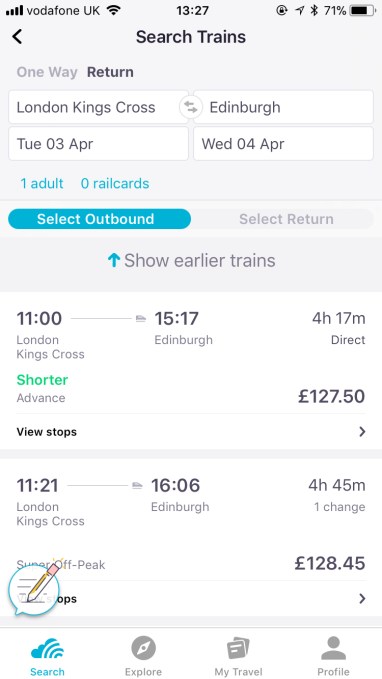
UK-based travel search engine Skyscanner has expanding its offering with a train ticket booking feature that lets users of its iOS app book UK train journeys. The feature is slated as coming to UK Android users shortly.

The company’s travel booking platform already offers booking for flights, hotels and car hire. The ability to search and book rail tickets (without booking fees) is intended to capture more of UK travelers’ spending — given how many destinations aren’t served by a nearby airport.

Train travel can also of course be a preferential option for some trips and travelers.

Skyscanner says the data behind its new rail feature is powered by Trip.com, Ctrip’s new international travel booking service, which will also provide 24-hour customer service.

The Chinese online travel giant acquired Skyscanner back in 2016 for $1.74BN, though Skyscanner remains operationally independent.

While Skyscanner’s new rail feature is currently UK domestic only, a spokeswoman told us it expects to roll out to further international markets “in due course”. Doing so looks aimed at beefing up its competitive edge against the likes of multimodal travel planners, such as GoEuro

In a statement, Bryan Dove, Skyscanner’s CTO, said: “Being part of the Ctrip group allows us to take advantage of elements of Ctrip’s technology and experience and bring that value to Skyscanner’s travellers.

“The launch of our train booking product is one such example. Our focus has always been on making travel as easy as possible and our new train feature will do just that, with the benefit of no booking fees.” 

03 Apr 2018

JPMorgan’s blockchain head is leaving to start her own business

JPMorgan’s key blockchain executive is departing the bank for the world of startups, it has emerged.

Amber Baldet heads up JPMorgan’s Blockchain Center of Excellence, which explores the development of distributed ledger technology and uses cases of blockchain technology across the firm’s business. A high-profile figure in the blockchain space in her own right, she is leaving to start her venture, according to Reuters.

Baldet set up JPMorgan’s blockchain strategy and headed up its enterprise-focused Quorum blockchain, which is reportedly being considered for a spinout. As Baldet’s six-year tenure at the bank ends, she will be replaced by Christine Moy, who led blockchain services across the bank’s Investor Services and Capital Markets segments, according to Fortune.

The exit is an example of a talent drain that is beginning to take shape in banking and financial services with engineers and business execs moving over to blockchain and crypto projects that are seen to have serious growth potential.

That’s despite a rocky year to date for crypto, at least in terms of valuations.

Bitcoin reached nearly $20,000 per coin in December but it spent much of March below $10,000. As of today, one bitcoin is worth $7,387, according to Coinmarketcap.com. Top tokens like Ethereum, Litecoin and Ripple are also down significantly on their record January-December prices.

There’s a strong case to be made that a more stable crypto market is for the best, even if there is a loss in value. High prices led to high transaction fees, which made life difficult for developers whilst also adding uncertainty for market speculators and token collectors.

Note: The author owns a small amount of cryptocurrency. Enough to gain an understanding, not enough to change a life. (That’s definitely the case lately.)

03 Apr 2018

Facebook blames bug for saving users’ deleted videos

Facebook has been caught archiving videos users thought they had deleted. The New York Magazine flagged the problem to the company last week, after a user downloaded their Facebook archive and was surprised to discover multiple takes of a video they had thought had been discarded at the time the recording was made, years earlier.

Facebook has now apologized for failing to delete the videos, saying “a bug” prevented draft videos from being deleted. It adds that it’s in the process of deleting the content now.

A company spokesperson told us: “We investigated a report that some people were seeing their old draft videos when they accessed their information from our Download Your Information tool. We discovered a bug that prevented draft videos from being deleted. We are deleting them and apologize for the inconvenience.”

It has also confirmed the deleted content was never publicly shared, although it’s less clear whether Facebook’s systems used the outtakes in any other way — such as as another signal for its ad targeting systems, for example.

The social network’s business model is based on building detailed profiles of users so they can be segmented into custom audiences for advertisers to pay to reach.

The undeleted videos were recorded via an old feature that allowed Facebook users to make and post videos directly from their web browser. This system functioned by streaming the videos to Facebook as they were being recorded — hence, without a working delete function being in place, it was possible for reams of outtakes to be unintentionally archived on Facebook’s servers.

Having proper systems in place to delete personal data on request will be essential for Facebook’s compliance with the EU’s incoming General Data Protection Regulation (GDPR) — or the company risks massive fines.

While Facebook is ‘fessing up to having stored data that users believed they had deleted in this instance, it has previously denied that it collects unposted status updates — after rumors about Facebook keylogging anything users input into the platform swirled in 2013.

That was following the publication of a Slate article about a research paper written by a Facebook data scientist and an intern examining moments when users started to write a status but subsequently did not post it.

“Facebook does not collect or track any content that people have chosen not to post,” a Facebook spokesperson told Mashable in early 2014, in response to the status update logging rumors. (Albeit that statement is not accurate in the case of the archived draft videos — so it would probably have been more sensible if it had also included the word “intentionally”.)

In the 2013 study, Facebook users whose status writing activity was looked at for the research were anonymized (“researchers were not privy to any specific user’s activity”, the paper notes); and content of any self-censored posts/comments was not sent back to the company’s servers — rather only a binary value indicating that content was entered was sent.

03 Apr 2018

Uber’s India rival Ola could add public transport services following latest acquisition

The rumors are true, India’s Uber rival/potential-future-M&A-buddy Ola has acquired transportation startup Ridlr in an undisclosed deal.

Mint reported the imminent transaction last week, describing it as a fire sale, and today Ola confirmed the deal. The terms are undisclosed so you can make of that what you will.

Founded in 2010, Ridlr operates as a personal transport portal that allowed users buy tickets for public transport in 17 Indian cities and also monitor traffic congestion using IOT devices. The company had raised over $6 million from investors that include Qualcomm Ventures, Times Internet, Matrix Partners (which is also an Ola backer.)

Ola isn’t saying too much about how it plans to use Ridlr other than that the deal will “bring new technology and mobility options as [Ola] works to expand into and partner with cities in India and abroad.” The company already offers a range of ride-sharing options, bike-sharing, food deliveries and a mobile wallet, but it plans to give more color on the proposed new services in the next month or so.

In its deal scoop, Mint claimed Ridlr will help improve Ola’s navigation and potentially see it add public transport booking options. That might sound at odds with a ride-hailing app, but when you consider that many people use buses or trains for the bulk of their commute and a taxi to get to their final destination, the move could help Ola own the “end-to-end” journey in full. At the least, that’s a strategy that Uber hasn’t explored and that potential alone — to be a differentiator — might make it worth a look.

Ridlr will continue to operate as an independent business “for now,” an Ola representative told TechCrunch, who also clarified that it will become a wholly owned subsidiary of Ola parent Ani Technologies.

Albeit seemingly not an expensive one, this deal marks Ola’s seventh investment.

The largest outlays have been rival TaxiForSure for $200 million in 2015 and FoodPanda India last December which relaunched its food delivery business. Other deals have included taxi radio service Gcabs.in, trip-planning service Geotagg and payment startup Qarth. The firm also made a minority investment in Zipcash.

Despite today’s news, the larger story around Ola is whether it will merge with Uber in the same way that the U.S. firm recently struck a deal with Grab to exit money-losing market Southeast Asia.

Uber CEO Dara Khosrowshahi has said that there will be no more global retreats — Uber previously struck exit deals in China and Russia — but there has been constant press speculation and reports of an ongoing dialogue between Uber and Ola over a potential deal. Unlike China and Southeast Asia, sources at Uber believe that the company’s India-based service is ahead of the local rival so don’t feel the need to push for consolidation.

But there are other factors.

As was the case with Grab and Didi, Ola counts SoftBank as an investor and, since it landed an investment in Uber, the Japanese firm has been pushing for Uber to do deals in unprofitable markets and focus on more lucrative countries in the West. The issue is particularly acute since Uber is reportedly targeting an IPO as soon as 2019 and it would need to get its finances in line accordingly.

Nonetheless, Ola is already branching out overseas via a recent launch in Australia and, publicly at least, it is committed to being around for “decades.”

“In India’s transformative digital journey, Ola will always be an active and integral part for decades to come. SoftBank and all other investors are committed in realizing this ambition. Ola is always actively looking for opportunities for expansion of its footprint,” the firm told TechCrunch in a statement.

03 Apr 2018

What to expect when Spotify goes public Tuesday

Digital music giant Spotify is joining the stock market on Tuesday, making it the biggest consumer tech company to go public since Snap debuted early last year.

But unlike Snap, Spotify isn’t doing an IPO. The “o” part of IPO stands for offering and Spotify isn’t raising any money.

Instead, existing Spotify shareholders will be selling shares directly onto the stock market. This means that employees, venture capitalists or anyone else who managed to buy Spotify shares on the  “secondary markets” can make money right away. But Spotify doesn’t know yet how many will want to sell their shares.

In fact, no one really knows how this “direct listing” is going to go. Even in Spotify’s prospectus, the company acknowledged that what it’s doing is “risky.” Smaller companies have listed without an IPO, but for a company of Spotify’s size, this is unprecedented.

Co-founder and CEO Daniel Ek claims that they are doing things differently because “Spotify has never been a normal kind of company.” In a release today, he wrote that “our focus isn’t on the initial splash. Instead, we will be working on trying to build, plan, and imagine for the long term.”

In a recent investor presentation, Ek said Spotify is doing this because of “our desire to become more transparent and more accessible.” Unlike a traditional IPO where employees don’t sell shares for months, known as a “lock-up,” Spotify insiders can sell on day one.

But like a typical IPO, Spotify will still be working with “market makers” to help determine the price that the company should begin trading. I’m told that this could anytime during the trading day on Tuesday.

Spotify doesn’t know how many people will be selling shares. If few people opt to sell, it will drive the share price up, because of limited supply. If a lot of people sell, the reverse could happen, if investor demand doesn’t match it. It’s likely that this process will lead to increased volatility in the first few days or weeks of trading.

But in the long-run, Spotify’s performance in the stock market will largely depend on investor philosophies about the company and its business model.

Some are concerned that Spotify will run the course of competitor Pandora, which has struggled on the stock market, partly due to hefty artist fees. Others argue that Spotify could be viewed as a Netflix, which has been successful at its entertainment licensing agreements.

But regardless of what happens Tuesday, Ek said that listing day is not time to celebrate. “You won’t see us ringing any bells or throwing any parties.”


03 Apr 2018

Insider raises $11M to help internet marketers do better internet marketing

Insider, a service that aims to help brands go about their internet marketing with greater efficiency and success, has landed an $11 million investment led by Sequoia India.

The startup is originally from Turkey where it began life in 2012 as a platform that helped optimize online marketing campaigns. Now at 240 staff across 16 markets, it recently moved HQ to Singapore and today it launches its new ‘Growth Management Platform.’

Those three words together don’t really tell much about Insider’s new product, the aim of which is to help brands, marketers and website owners generally serve dynamic content that is tailored to their visitors. The idea according to Insider CEO Hande Cilingir — who is one of six co-founders of the business — is to give a visitor the most optimized version of the site based on who they are. In many ways, it is similar to LiftIgniter, the U.S. startup that raised $6.4 million last year and was a finalist at TechCrunch Disrupt London 2016.

Insider goes about that task by collecting pieces of data about the visitor — the 90-odd parameters include obvious things include location, the website they are visiting from, the device they are on, etc — all of which is used to showcase the most relevant content or information to ensure that this visitor gets the best experience. Insider said it uses artificial intelligence and machine learning to boost its model, too, helping match potential similarities between users to build a wider and more intelligent picture about the type of people visiting a website.

The goal is really quite simple: keep people more engaged on a website and help website owners with their call to action, whatever that may be. Insider believes it can help lower customer acquisition costs through increased efficiency, while also boost existing conversion rates through customization.

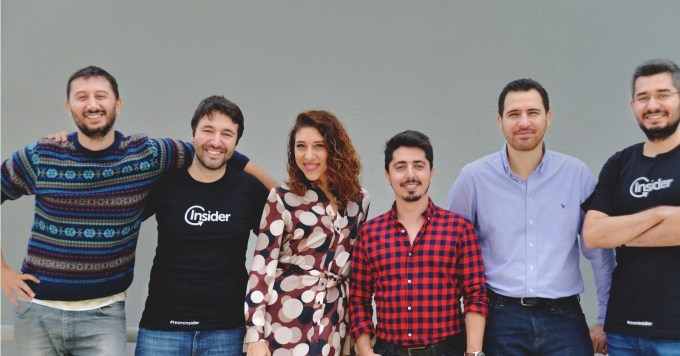
Insider’s six co-founders

In the case of internet marketing, it is most often to e-commerce or other types of purchases.

That’s strongly reflected in the customer base that Insider claims. The company has put a big focus on Asia’s growing internet market — hence the move to Singapore — and publicly-announced clients for the startup include Singapore Airlines, Indonesian e-commerce firm Tokopedia, UNIQLO, Samsung, McDonald’s, Nissan and CNN.

Sequoia could help open doors, too, since the firm has invested in major consumer names in Asia such as Go-Jek, Carousell and Zomato.

“We were impressed with Insider’s AI platform, and the profound impact on their customer’s key metrics: lower customer acquisition costs, higher retention, faster growth. These customers quickly started to use more and more products from the Insider platform. That has put Insider on a fast growth trajectory, especially in Asia,” said Pieter Kemps, principal at Sequoia India.

Cilingir said the new funds will go towards expanding Insider’s sales team and hiring data scientists and machine learning engineers to develop the platform. The headquarters may be in Singapore now, but Istanbul remains the base for product development while the company’s core tech team is located in Ukraine.

The team is firmly focused on developing its business in Southeast Asia, she added, but it is also eying potential expansions with China and the U.S. among the more audacious new markets that it is considering at this point.

Already, Cilingir said the startup is on track to hit $100 million in annual recurring revenue by the end of 2018 while it is bullish that there’s more to come. Marketing giant Group M predicts that this is the year that online advertising spend overtakes TV for the first time in 17 countries worldwide and she’s optimistic that there will be a greater need for Insider’s products among brands and major consumer names worldwide.

Alongside Sequoia, Insider said that its existing investors Wamda Capital and Dogan Group also took part in the newest round, which is its Series B. The company previously raised a $2.2 million Series A in September 2016 to fund its initial foray into emerging markets.

03 Apr 2018

Insider raises $11M to help internet marketers do better internet marketing

Insider, a service that aims to help brands go about their internet marketing with greater efficiency and success, has landed an $11 million investment led by Sequoia India.

The startup is originally from Turkey where it began life in 2012 as a platform that helped optimize online marketing campaigns. Now at 240 staff across 16 markets, it recently moved HQ to Singapore and today it launches its new ‘Growth Management Platform.’

Those three words together don’t really tell much about Insider’s new product, the aim of which is to help brands, marketers and website owners generally serve dynamic content that is tailored to their visitors. The idea according to Insider CEO Hande Cilingir — who is one of six co-founders of the business — is to give a visitor the most optimized version of the site based on who they are. In many ways, it is similar to LiftIgniter, the U.S. startup that raised $6.4 million last year and was a finalist at TechCrunch Disrupt London 2016.

Insider goes about that task by collecting pieces of data about the visitor — the 90-odd parameters include obvious things include location, the website they are visiting from, the device they are on, etc — all of which is used to showcase the most relevant content or information to ensure that this visitor gets the best experience. Insider said it uses artificial intelligence and machine learning to boost its model, too, helping match potential similarities between users to build a wider and more intelligent picture about the type of people visiting a website.

The goal is really quite simple: keep people more engaged on a website and help website owners with their call to action, whatever that may be. Insider believes it can help lower customer acquisition costs through increased efficiency, while also boost existing conversion rates through customization.

Insider’s six co-founders

In the case of internet marketing, it is most often to e-commerce or other types of purchases.

That’s strongly reflected in the customer base that Insider claims. The company has put a big focus on Asia’s growing internet market — hence the move to Singapore — and publicly-announced clients for the startup include Singapore Airlines, Indonesian e-commerce firm Tokopedia, UNIQLO, Samsung, McDonald’s, Nissan and CNN.

Sequoia could help open doors, too, since the firm has invested in major consumer names in Asia such as Go-Jek, Carousell and Zomato.

“We were impressed with Insider’s AI platform, and the profound impact on their customer’s key metrics: lower customer acquisition costs, higher retention, faster growth. These customers quickly started to use more and more products from the Insider platform. That has put Insider on a fast growth trajectory, especially in Asia,” said Pieter Kemps, principal at Sequoia India.

Cilingir said the new funds will go towards expanding Insider’s sales team and hiring data scientists and machine learning engineers to develop the platform. The headquarters may be in Singapore now, but Istanbul remains the base for product development while the company’s core tech team is located in Ukraine.

The team is firmly focused on developing its business in Southeast Asia, she added, but it is also eying potential expansions with China and the U.S. among the more audacious new markets that it is considering at this point.

Already, Cilingir said the startup is on track to hit $100 million in annual recurring revenue by the end of 2018 while it is bullish that there’s more to come. Marketing giant Group M predicts that this is the year that online advertising spend overtakes TV for the first time in 17 countries worldwide and she’s optimistic that there will be a greater need for Insider’s products among brands and major consumer names worldwide.

Alongside Sequoia, Insider said that its existing investors Wamda Capital and Dogan Group also took part in the newest round, which is its Series B. The company previously raised a $2.2 million Series A in September 2016 to fund its initial foray into emerging markets.

03 Apr 2018

Walmart reportedly in talks to acquire prescription delivery service PillPack

Walmart is in discussions to acquire medication delivery service PillPack for “under $1 billion,” reports CNBC. CNBC’s sources said the deal isn’t final yet, but talks have been going on for months and Amazon was also a potential suitor for the startup, which delivers medications to tens of thousands of customers in the United States.

Launched in 2013, PillPack has raised $118 million in funding from investors including Accel Partners, Atlas Venture and CRV. PillPack doesn’t just fill prescriptions: it also helps patients manage their medications by sorting pills into packets for individual doses, automatically delivering refills to homes and providing 24/7 customer service, all major selling points for seniors and people with multiple conditions. Last year, PillPack also unveiled prescription management software called PharmacyOS, which it described as “the first backend pharmacy system designed specifically for customers with complex medication regimes.”

Last November, co-founder and chief executive officer T.J. Parker, who trained as a pharmacist, said PillPack would do over $100 million revenue in 2017. It has a loyal customer base, who helped PillPack win a public relations battle in 2016 with Express Scripts, the country’s largest pharmacy-benefits manager. After Express Scripts cut off its partnership with PillPack, claiming that the company needed to be licensed as a mail-order operation instead of a retail pharmacy, PillPack said this would force it stop delivering to a third of its customers. It also accused Express Scripts, which runs its own home delivery service, of trying to block competition. Online outcry by customers, driven by a PillPack campaign, forced Express Scripts to back down.

Both Walmart and PillPack declined to comment on a potential acquisition to CNBC.

Amazon is said to be working on its own prescription delivery service, after launching a line of over-the-counter health products like allergy treatments. If its pharmacy business comes to fruition, that means Amazon will compete even more closely with Walmart, putting increasing pressure on the big-box store chain.

Walmart is also reportedly in talks to acquire health insurer Humana.