02 Apr 2018

Elon Musk just took charge of Model 3 production, saying it’s his “most critical” job right now

You can probably argue over whether it’s a good or a bad sign, but Tesla CEO Elon Musk confirmed on Twitter today a report in The Information that he has taken over direct control of the division that’s producing Tesla’s Model 3 electric sedan after the company failed to meet the delivery goals it had set.

Specifically, Tesla had intended to produce 500 Model 3 cars per day or 2,500 per week by the end of last month. But according to a companywide email to employees that was sent today and obtained by Jalopnik, Musk said Tesla has been making closer to 2,000 of the cars per week. (Musk estimated last July that Tesla would be making 20,000 of the cars per month by December.)

In his email — fired off at 3. am. PDT — Musk added that if “things go as planned today, we will comfortably exceed that number over a seven day period!”

Musk may have been referring in part to the reorganization. But while the Information reported that Musk had seemingly “pushed aside the company’s senior vice president of engineering, Doug Field, who had been overseeing manufacturing in recent months,” Musk quickly took issue with that characterization of events.

He complained on Twitter to Information reporter Amir Efrati, “Can’t believe you’re even writing about this. My job as CEO is to focus on what’s most critical, which is currently Model 3 production. Doug, who I regard as one of the world’s most talented engineering execs, is focused on vehicle engineering.”

Musk continued, tweeting: “About a year ago, I asked Doug to manage both engineering & production. He agreed that Tesla needed [engineering and production to be] better aligned, so we don’t design cars that are crazy hard to build. Right now, tho, better to divide & conquer, so I’m back to sleeping at factory. Car biz is hell …”

That Musk is feeling sensitive to press reports right now won’t come as a surprise to anyone who follows the company, given the string of negative publicity that Tesla has received in recent weeks.

In addition to a voluntary recall of 123,000 Model S vehicles that owes to a problem with the power-steer component of some of the cars, the National Highway Traffic Safety Administration last week launched an investigation into the role of Tesla’s Autopilot in a fatal crash.

In fact, in a series of separate tweets today, Musk responded to the National Transportation Safety Board, a safety agency that said it was “unhappy” with Tesla’s decision on Friday to publish a blog post about the accident, given that investigations are ongoing.

In that post, Tesla said the driver, since identified as an Apple engineer, “had received several visual and one audible hands-on warning earlier in the drive and the driver’s hands were not detected on the wheel for six seconds prior to the collision.” The company also noted that a highway safety barrier that might have lessened the impact of the collision had been “crushed in a prior accident without being replaced.”

The suggestion was plainly that Tesla can’t be blamed, at least not entirely, for the fatality.

In response to the NTSB’s newly public frustration over the release of these details by Tesla, Musk wrote on Twitter today, “Lot of respect for NTSB, but NHTSA regulates cars, not NTSB, which is an advisory body. Tesla releases critical crash data affecting public safety immediately & always will. To do otherwise would be unsafe.”

Tesla closed down 5.1 percent at $252.48 in trading today.
02 Apr 2018

Skydio R1 review: a mesmerizing, super-expensive self-flying drone

The idea of a robot methodically hunting you down isn’t the most pleasant of concepts. A metal-bodied being zooming after you at up to 25 miles per hour with multiple eyes fixed on your location seems… out of your best interest.

The Skydio R1 drone seems friendly enough. though. I wouldn’t call it loving or cute by any means, but it really just wants to keep up with you and ensure it captures your great life moments with its big blue eye.

What makes the $2,499 Skydio R1 special is that it doesn’t need a pilot — it flies itself. The drone uses 12 of its 13 on-board cameras to rapidly map the environment around it, sensing obstacles and people as it quickly plans and readjusts its flight paths. That means you can launch the thing and go for a walk. You can launch the thing and explore nature. You can launch the thing and go biking and the R1 will follow you with ease, never losing sight of you as it tries to keep up with you and capture the perfect shots in 4K.

That was the company’s sell anyway; I got my hand on one a few weeks ago to test it myself and have been zipping it around the greater West coast annoying and impressing many with what I’ve come to the conclusion is clearly the smartest drone on the planet.

The R1 has a number of autonomous modes to track users as it zips around. Not only can the drone follow you, it also can predict your path and wander in front of you. It can orbit around you as you move or follow along from the side. You can do all this by just tapping a mode, launching the drone and moving along. There are options for manual controls if you desire, but the R1 eschews the bulky drone controller for a simple, single-handed control system on the Skydio app on your phone.

The app is incredibly simple and offers a wide range of tracking modes that are pretty breezy to swipe through. Setting the drone up for the first flight was as simple as connecting to the drone via password and gliding through a couple of minutes of instructional content in the app. You can launch it off the ground or from your hand; I opted for the hand launch most times, which powers up the propellers until it’s tugging away from you, flying out a couple of meters and fixing its eye on you.

Walking around and having it follow you is cool and all, but this thing shines when you’re on the move and it’s speeding to catch up with you. It’s honestly so incredible to fire up the R1 and run through a dense forest with it trailing you; same goes for a bike ride. It speaks to Skydio’s technology how few hiccups it had in the midst of extended sessions, though by extended session I mean around 15 minutes, as that was the average flight time I got from a single battery charge. The Frontier Edition R1 ships with a second battery, which was a godsend.

When it comes to capturing precise, buttery smooth footage, there’s no replacement for a skilled drone pilot. Even with a perfectly good gimbal, the movements of the R1 are often pretty sudden and lead to direction changes that look a bit weird on camera. Not every continuous shot you gather from the R1 will make the cut, but what’s crazy is that you literally don’t have to do anything. It just follows and records you, leaving you a lot of footage that you’ll be able to pare down in editing.

There are some things I don’t love. It’s too big for one; the company insists that it’s still small enough to fit in a backpack, but unless it’s a backpack that you could also load a 17-inch gaming laptop in, I kind of doubt that. The body feels light and substantial; but the rigidity of its outer frame and its overall size made me a little nervous at times that I was going to catastrophically break it, which was enough to make me consciously leave it at home when I was out on a snowboarding trip.

I’m also a little distraught by the company’s decision to make this purely Wi-Fi controlled over your phone connection, a decision that definitely helps you from losing it, but also kind of limits its core utility when it comes to tracking people who are not holding the phone. I sicced the drone on a friend of mine who was running around a neighborhood area but after he took off in a sprint, the R1 lost the signal and it came to a stop over a street where I was left trying to reconnect and move it to safety as cars zoomed by a few feet beneath it.

For $2,499, it’s not ridiculous to desire some features that also make this more of a general-purpose drone, as well; all of the propellers are there, so it doesn’t seem like it should be a coup to offer an add-on controller that extends the range from a few hundred feet as it currently is.

Not a complaint at all, but I am excited to see the functionality gains this gets from future software updates; namely I think it’d be really to fun to track a pet (it currently can only recognize humans). At one point when it was following me around in a park, it majorly freaked out a bunch of dogs, who promptly started chasing it — and by extension, me. The sadist in me kind of wanted to chase them back with the R1.

The R1 is a $2,499 product with a feature that makes it particularly attractive to the first-time drone user who definitely won’t spend that much money in the first place. In some ways this mismatch shows just how disruptive this tech could be, but in the short-term the targeted buyer of this drone is an extremely tight niche.

For the early adopter who just loves getting the new thing, you’ll be pleased that it actually works and isn’t another half-baked dream on the road to autonomy. If you’re a creator or vlogger who does a lot of solo trips in the great outdoors, this drone could definitely transform how you capture your trips and end up being a great buy — albeit a super pricey one.

02 Apr 2018

Self-care apps are booming

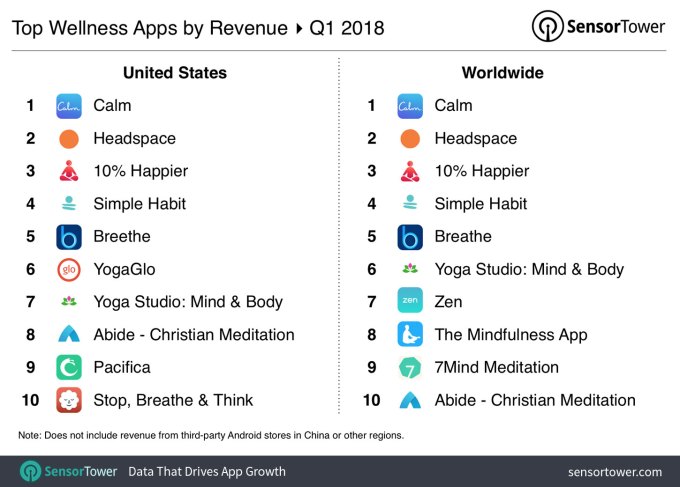
Millennials may be a bit obsessed with self-care — and it’s beginning to pay off for the makers of self-care and digital wellness apps. According to data from multiple app store intelligence firms, the category is now seeing notable growth. In the first quarter of 2018, the top 10 grossing self-care apps in the U.S. earned $15 million in combined iOS and Android revenue, and $27 million in worldwide revenue, according to Sensor Tower.

The firm also found that the top 10 wellness apps (e.g. mindfulness and meditation) made about 170 percent more revenue worldwide in Q1 2018 than the top 10 wellness apps did in Q1 2017 across both the App Store and Google Play. In the U.S., they made about 167 percent more.

However, a big chunk of self-care apps’ revenue is being claimed by just two apps — Calm and Headspace, both of which focus on mindfulness and meditation. Calm, the top grosser, earned about half the total revenue in the U.S. and worldwide, equating to roughly $8 million in the U.S. and $13.5 million worldwide. Combined with Headspace, the two generated more than 90 percent of the top 10 apps’ revenue last quarter.

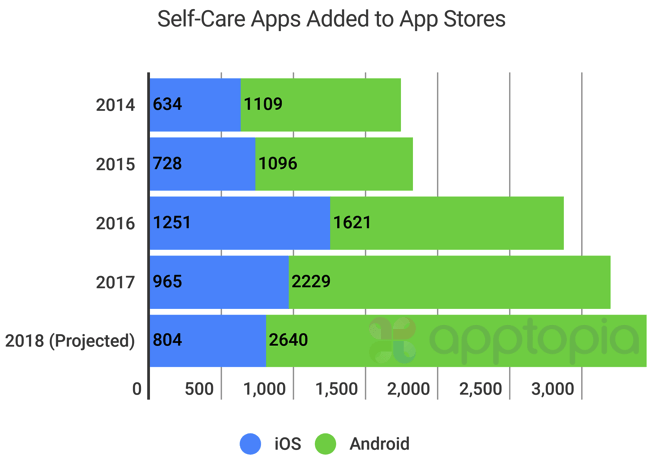
Apptopia is also reporting a surge in self-care app revenues and installs, but its numbers don’t agree with Sensor Tower data. (Sensor Tower believes its data is within a couple of percentage points of actual, on the underestimating side.)

Both firms agreed on the top three, however: Calm, followed by Headspace, then 10% Happier: Meditation Daily. Other mindfulness apps appeared on both charts, including The Mindfulness App and Stop, Breathe & Think.

The discrepancies may be attributed to how the companies define “self-care” — as it’s not a specific app store category — as well as data quality.

Apptopia also claimed self-care app installs are up year-over-year, with more new self-care apps arriving every year.

Regardless of which firm is closer to actual, the trend is clear: self-care app adoption is booming.


Apple, for example, pegged self-care as one of its top four breakout trends for 2017, saying “never before have we seen such a surge in apps focused specifically on mental health, mindfulness and stress reduction.”

As to why self-care apps are the latest craze, that’s a bit more complicated.

Some experts say millennials’ use of the informational resources on the internet increased awareness about self-care in general; others would say the always-on news cycle of the web combined with the depressing nature of social media led to a growing need for self-care tools. And, of course, cynics would argue it’s simply because millennials are more self-absorbed than other generations, and this trendy focus on self-care is the proof.

But there are plenty of other factors beyond that. Millennials married later and were slower to buy homes as a result — that may have led them to have more time to remained self-focused, as they may not have had the same set of distracting responsibilities as their parents. (Or the related drains on their extraneous funds!)

Meanwhile, the stigma around mental illness is also on the decline, which aids a self-care app surge.

However, not all self-care apps are a replacement for traditional mental health care, when it comes to more serious matters. Some of the talk therapy apps were found to be ineffective, expensive, inconsistent in the quality of care provided and, at worst, potentially dangerous.

For those problems that can’t be meditated away, please still call a doctor or an emergency hotline.

02 Apr 2018

Self-care apps are booming

Millennials may be a bit obsessed with self-care — and it’s beginning to pay off for the makers of self-care and digital wellness apps. According to data from multiple app store intelligence firms, the category is now seeing notable growth. In the first quarter of 2018, the top 10 grossing self-care apps in the U.S. earned $15 million in combined iOS and Android revenue, and $27 million in worldwide revenue, according to Sensor Tower.

The firm also found that the top 10 wellness apps (e.g. mindfulness and meditation) made about 170 percent more revenue worldwide in Q1 2018 than the top 10 wellness apps did in Q1 2017 across both the App Store and Google Play. In the U.S., they made about 167 percent more.

However, a big chunk of self-care apps’ revenue is being claimed by just two apps — Calm and Headspace, both of which focus on mindfulness and meditation. Calm, the top grosser, earned about half the total revenue in the U.S. and worldwide, equating to roughly $8 million in the U.S. and $13.5 million worldwide. Combined with Headspace, the two generated more than 90 percent of the top 10 apps’ revenue last quarter.

Apptopia is also reporting a surge in self-care app revenues and installs, but its numbers don’t agree with Sensor Tower data. (Sensor Tower believes its data is within a couple of percentage points of actual, on the underestimating side.)

Both firms agreed on the top three, however: Calm, followed by Headspace, then 10% Happier: Meditation Daily. Other mindfulness apps appeared on both charts, including The Mindfulness App and Stop, Breathe & Think.

The discrepancies may be attributed to how the companies define “self-care” — as it’s not a specific app store category — as well as data quality.

Apptopia also claimed self-care app installs are up year-over-year, with more new self-care apps arriving every year.

Regardless of which firm is closer to actual, the trend is clear: self-care app adoption is booming.


Apple, for example, pegged self-care as one of its top four breakout trends for 2017, saying “never before have we seen such a surge in apps focused specifically on mental health, mindfulness and stress reduction.”

As to why self-care apps are the latest craze, that’s a bit more complicated.

Some experts say millennials’ use of the informational resources on the internet increased awareness about self-care in general; others would say the always-on news cycle of the web combined with the depressing nature of social media led to a growing need for self-care tools. And, of course, cynics would argue it’s simply because millennials are more self-absorbed than other generations, and this trendy focus on self-care is the proof.

But there are plenty of other factors beyond that. Millennials married later and were slower to buy homes as a result — that may have led them to have more time to remained self-focused, as they may not have had the same set of distracting responsibilities as their parents. (Or the related drains on their extraneous funds!)

Meanwhile, the stigma around mental illness is also on the decline, which aids a self-care app surge.

However, not all self-care apps are a replacement for traditional mental health care, when it comes to more serious matters. Some of the talk therapy apps were found to be ineffective, expensive, inconsistent in the quality of care provided and, at worst, potentially dangerous.

For those problems that can’t be meditated away, please still call a doctor or an emergency hotline.

02 Apr 2018

Instagram suddenly chokes off developers as Facebook chases privacy

Without warning, Instagram has broken many of the unofficial apps built on its platform. This weekend it surprised developers with a massive reduction in how much data they can pull from the Instagram API, shrinking the API limit from 5,000 to 200 calls per user per hour. Apps that help people figure out if their followers follow them back or interact with them, analyze their audiences or find relevant hashtags are now quickly running into their API limits, leading to broken functionality and pissed off users.

Two sources confirmed the new limits to TechCrunch, and developers are complaining about the situation on StackOverflow.

In a puzzling move, Instagram is refusing to comment on what’s happening while its developer rate limits documentation site 404s. All it would confirm is that Instagram has stopped accepting submissions of new apps, just as Facebook announced it would last week following backlash over Cambridge Analytica. Developers tell me they feel left in the dark and angry that the change wasn’t scheduled or even officially announced, preventing them from rebuilding their apps to require fewer API calls.

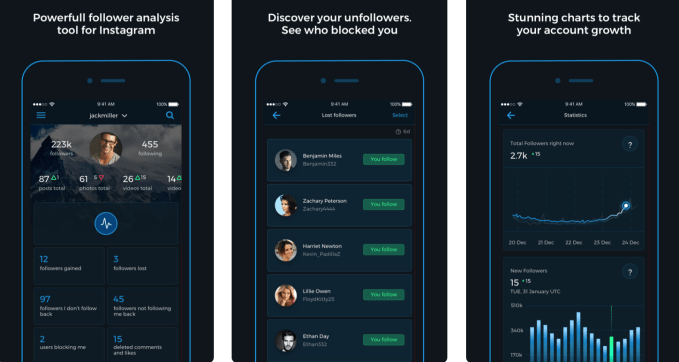
Third-party Instagram platform apps like Reports+ provide users analytics on their audiences, but are breaking due to the new API limits

Some developers suspect the change is part of Instagram parent company Facebook’s scramble to improve data privacy in the wake of its non-stop string of data scandals. In the past week, Facebook announced it was shutting down Partner Categories ad targeting based on third-party data brokers. TechCrunch reported that Facebook also plans to require businesses to pledge that they have consumers’ consent to attain their email addresses, which they use for ad targeting through Custom Audiences.

Most public backlash has focused on #DeleteFacebook and ignored its subsidiaries like Instagram and WhatsApp. But Instagram may hope to prevent the virus of distrust from infecting its app too by cutting the API call limit to 1/25th of its previous volume.

Causing this kind of platform whiplash could push developers away from the Instagram ecosystem, not that the company was too keen on some of these apps. For example, Reports+ charges $3.99 per month to give people analytics about their Instagram followers. Sensor Tower tells TechCrunch that Reports+ has grossed more than $18 million worldwide since October 2016 on the App Store and Google Play, and made more than $1.2 million last month alone.

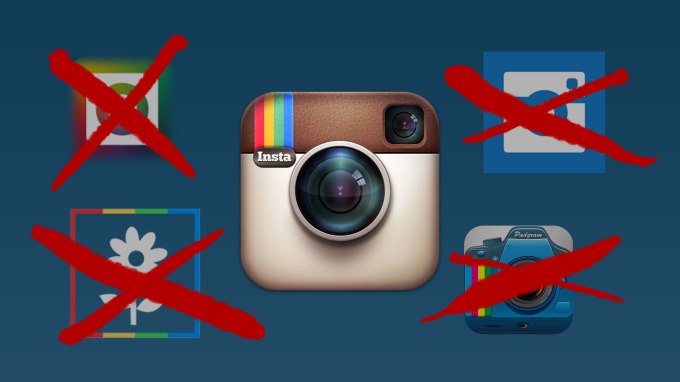
Instagram might have understandably seen these apps as parasitic, charging users for unofficial functionality or encouraging audience growth hacking that can lead to spam. In January, Instagram announced it would shut down the old API over the next two years, starting with removing the ability to pull a user’s follower list and follow/unfollow people on their behalf on July 31st. Instagram has been slowly trying to clean up its platform for years, having previously threatened legal actions against derivative apps with “Insta” or “Gram” in their names in 2013, and shut down its feed API in 2015 that allowed for unofficial Instagram feed-reading apps.

Instagram is now pushing developers on a much more restrictive platform that only lets approved partners post at users’ behest, and that can only pull mentions of and analytics about business accounts. These changes were slated to kill many of the apps broken by this weekend’s API limit reductions.

But at least developers were given fair warning about the July 31st deadline. The problem is exacerbated by the fact that Facebook put a pause on reviewing any new applications last Monday as it tries to shore up data privacy safeguards in the wake of Cambridge Analytica . Instagram confirms to TechCrunch that the moratorium on app submissions extends to Instagram’s new Graph API, but wouldn’t explain anything about the API limits. So Instagram is breaking old apps while not allowing developers to submit new, compliant ones.

“Instagram’s lack of communication is frustrating to me because now I’m scrambling to update my apps and dealing with loads of unhappy customers,” a developer told me on the condition of anonymity. “If I had had a month to prep for this, I could’ve tweaked things so that limit was harder to reach. I’d be more frugal with my requests. What happened is all of a sudden, I’m getting dozens of emails, DMs on Instagram, with people saying the app’s not working.”

While Facebook is wise to scrutinize apps pulling in lots of user data, doing so without warning or even an announcement is how Facebook hurt its relationships with developers circa 2009 as it tried to rapidly reign in spammy virality. Facebook is enduring a crisis of conscience regarding whether its apps can be misused as weapons by those trying to interfere with elections or just exploit our data for profit.

But as the owner of some of the world’s most popular developer platforms, it’s worrying to see it flail and thrash this way. If Facebook and Instagram can’t even communicate changes to its policies with proper procedure and transparency, it’s hard to imagine it’s composed enough to firmly and fairly enforce them.

For more on Facebook and Instagram’s troubles, check out our feature pieces:


02 Apr 2018

Instagram suddenly chokes off developers as Facebook chases privacy

Without warning, Instagram has broken many of the unofficial apps built on its platform. This weekend it surprised developers with a massive reduction in how much data they can pull from the Instagram API, shrinking the API limit from 5,000 to 200 calls per user per hour. Apps that help people figure out if their followers follow them back or interact with them, analyze their audiences or find relevant hashtags are now quickly running into their API limits, leading to broken functionality and pissed off users.

Two sources confirmed the new limits to TechCrunch, and developers are complaining about the situation on StackOverflow.

In a puzzling move, Instagram is refusing to comment on what’s happening while its developer rate limits documentation site 404s. All it would confirm is that Instagram has stopped accepting submissions of new apps, just as Facebook announced it would last week following backlash over Cambridge Analytica. Developers tell me they feel left in the dark and angry that the change wasn’t scheduled or even officially announced, preventing them from rebuilding their apps to require fewer API calls.

Third-party Instagram platform apps like Reports+ provide users analytics on their audiences, but are breaking due to the new API limits

Some developers suspect the change is part of Instagram parent company Facebook’s scramble to improve data privacy in the wake of its non-stop string of data scandals. In the past week, Facebook announced it was shutting down Partner Categories ad targeting based on third-party data brokers. TechCrunch reported that Facebook also plans to require businesses to pledge that they have consumers’ consent to attain their email addresses, which they use for ad targeting through Custom Audiences.

Most public backlash has focused on #DeleteFacebook and ignored its subsidiaries like Instagram and WhatsApp. But Instagram may hope to prevent the virus of distrust from infecting its app too by cutting the API call limit to 1/25th of its previous volume.

Causing this kind of platform whiplash could push developers away from the Instagram ecosystem, not that the company was too keen on some of these apps. For example, Reports+ charges $3.99 per month to give people analytics about their Instagram followers. Sensor Tower tells TechCrunch that Reports+ has grossed more than $18 million worldwide since October 2016 on the App Store and Google Play, and made more than $1.2 million last month alone.

Instagram might have understandably seen these apps as parasitic, charging users for unofficial functionality or encouraging audience growth hacking that can lead to spam. In January, Instagram announced it would shut down the old API over the next two years, starting with removing the ability to pull a user’s follower list and follow/unfollow people on their behalf on July 31st. Instagram has been slowly trying to clean up its platform for years, having previously threatened legal actions against derivative apps with “Insta” or “Gram” in their names in 2013, and shut down its feed API in 2015 that allowed for unofficial Instagram feed-reading apps.

Instagram is now pushing developers on a much more restrictive platform that only lets approved partners post at users’ behest, and that can only pull mentions of and analytics about business accounts. These changes were slated to kill many of the apps broken by this weekend’s API limit reductions.

But at least developers were given fair warning about the July 31st deadline. The problem is exacerbated by the fact that Facebook put a pause on reviewing any new applications last Monday as it tries to shore up data privacy safeguards in the wake of Cambridge Analytica . Instagram confirms to TechCrunch that the moratorium on app submissions extends to Instagram’s new Graph API, but wouldn’t explain anything about the API limits. So Instagram is breaking old apps while not allowing developers to submit new, compliant ones.

“Instagram’s lack of communication is frustrating to me because now I’m scrambling to update my apps and dealing with loads of unhappy customers,” a developer told me on the condition of anonymity. “If I had had a month to prep for this, I could’ve tweaked things so that limit was harder to reach. I’d be more frugal with my requests. What happened is all of a sudden, I’m getting dozens of emails, DMs on Instagram, with people saying the app’s not working.”

While Facebook is wise to scrutinize apps pulling in lots of user data, doing so without warning or even an announcement is how Facebook hurt its relationships with developers circa 2009 as it tried to rapidly reign in spammy virality. Facebook is enduring a crisis of conscience regarding whether its apps can be misused as weapons by those trying to interfere with elections or just exploit our data for profit.

But as the owner of some of the world’s most popular developer platforms, it’s worrying to see it flail and thrash this way. If Facebook and Instagram can’t even communicate changes to its policies with proper procedure and transparency, it’s hard to imagine it’s composed enough to firmly and fairly enforce them.

For more on Facebook and Instagram’s troubles, check out our feature pieces:


02 Apr 2018

California DMV has new regulations for self-driving car companies

Self-driving car programs have been under close scrutiny as of late. That is due in part to a fatal accident involving one of Uber’s self-driving cars in Tempe, Arizona, as well as a fatal crash involving one of Tesla’s Model X vehicles, which had its semi-autonomous Autopilot system engaged. Today, the California Department of Motor Vehicles adopted new regulations pertaining to autonomous vehicles.

“State law requires the California DMV to develop regulations for the safe testing and deployment of autonomous vehicles on public roads,” a DMV spokesperson said in a statement to TechCrunch. “With the adoption of regulations effective April 2, 2018, the DMV has the authority to issue permits for driverless testing or deployment of autonomous vehicles. When an application is received, it will be thoroughly reviewed. The Department will not approve any permits until it is clear that the applicant has met all of the safe operation requirements set forth in law and in the regulations.”

What’s new is that the DMV now has three autonomous vehicle permit options: testing with a driver, driverless testing and deployment. Most of the new elements of the regulations are around driverless testing and deployment.

For example, in order to conduct driverless testing, companies must have previously tested the vehicles in controlled conditions. The vehicles must also, among many other things, meet the definition of an SAE Level 4 or 5 vehicle. With deployment, companies need to ensure cars can detect and respond to roadway situations, meet best practices to detect cyberattacks and more.

What many people have their eyes on pertain to operating autonomous vehicles without a safety driver, as well as deploying self-driving cars for public use. To date, no company has applied for a deployment permit and just one company has applied for a permit to test fully autonomous cars, the DMV spokesperson told TechCrunch. The DMV has 10 days to let the applicant know if it’s complete.

“If it is deemed complete the application will be thoroughly reviewed,” the spokesperson told TechCrunch. “There is not a timeline on when the DMV approves a permit after receiving a complete application.”

The DMV did not disclose which company applied for driverless testing, but it’s definitely not Uber. Last week, Uber decided not to re-apply for its self-driving car permit in California, which expired on March 31.

02 Apr 2018

Here are the five things I learned installing a Smart Mirror

I recently received a review unit of the Embrace Smart Mirror . It’s essentially a 24-inch Android tablet mounted behind a roughly 40-inch mirror. It works well when 3rd party software is installed. Here’s what I learned.

It’s impossible to get a good photo of the smart mirror

I tried a tripod, selfie stick, and every possible angle and I couldn’t get a picture that does this mirror justice. It looks better in person than these photos show. When the light in the bathroom is on, the text on the mirror appears to float on the surface. It looks great. The time is nice and large, and the data below it is accessible when standing a few feet away.

When the room is dark, the Android device’s screen’s revealed since it can’t reach real black. The screen behind the mirror glows gray. This isn’t a big deal. The Android device turns off after a period of inactivity and is often triggered by the light to the bathroom is turned on. More times than not, people walking into the room will be greeted with a standard mirror until the light is turned on.

There’s a handful of smart mirror apps, but few are worthwhile.

This smart mirror didn’t ship with any software outside of Android. That’s a bummer but not a deal breaker. There are several smart mirror Android apps in the Play Store though I only found one I like.

I settled on Mirror Mirror (get it) because the interface is clean, uses pleasant fonts and there’s just enough customization though it would be nice to select different locations for the data modules. The app was last updated in July of 2017 so use at your own risk.

Another similar option is this software developed by Max Braun, a robotistic at Google’s X. His smart mirror was a hit in 2016, and he included instructions on how to build it here and uploaded the software to GitHub here.

Kids love it.

I have great kids that grew up around technology. Nothing impresses these jerks, though, and that’s my fault. But they like this smart mirror. They won’t stop touching it, leaving fingerprints all over it. They quickly figured out how to exit the mirror software and download a bunch of games to the device. I’ve walked in on both of kids huddled in the dark bathroom playing games and watching YouTube, instead, of you know, playing games or watching YouTube on the countless other devices in the house.

That’s the point of the device, though. The company that makes this model advertises it as a way to get YouTube in the bathrooms so a person can apply their makeup while watching beauty YouTubers. It works for that, too. There is just a tiny bit of latency when pressing on the screen through the mirror. This device isn’t as quick to use as a new Android tablet, but since it’s sealed in a way to keep out moisture, it’s safe to go in a steamy bathroom.

Adults will find it frivolous.

I have a lot of gadgets in my house, and my friends are used to it. Their reaction to this smart mirror has been much different from any other device, though.

“What the hell is this, Matt,” they’ll say from behind the closed bathroom door. I’ll yell back, “It’s a smart mirror.” They flush the toilet, walk out and give me the biggest eyeroll.

I’ve yet to have an adult say anything nice about this mirror.

It’s frivolous.

A smart mirror is a silly gadget. To some degree, it’s a , but in the end, it’s just another gadget to tell you the weather. It collects fingerprints like mad, and the Android screen isn’t bright enough to use it as a regular video viewer or incognito TV.

As for this particular smart mirror, the Embrace Smart Mirror, the hardware is solid but doesn’t include any smart mirror software. The Mirror is rather thin and easily hangs on a wall thanks to a VESA port. There are physical controls hidden along the bottom of the unit including a switch to manually turn off the camera. It’s certified IP65 so it can handle a bathroom. A motion detector does a good job turning the device on so. If you don’t have kids, it should stay smudge-free.

The Embrace Smart Mirror does not ship with any smart mirror software. The instructions and videos tell users to add widgets to the Android home screen. This doesn’t work for me, and I expect a product such as this to include at least necessary software. Right now, after this product is taken out of the box, it’s just an Android tablet behind a mirror, and that’s lame. Thankfully there are a couple of free apps on the Play Store to remedy this problem.

At $1,299, the Embrace Smart Mirror is a hard sell but is among the cheapest available smart mirrors on the market. Of course, you can always build one yourself, and as The Verge points out, it’s rather easy.

02 Apr 2018

Lyft Line may be prepping for launch in Toronto

Lyft seems to be gearing up to launch its carpooling service, Line, in its first international city. This comes after Lyft launched its standard, Plus, Premier, Lux and SUV services in Toronto back in December.

“With the response we’ve had since coming to Toronto, the growing network of riders and drivers makes it easier than ever to match passengers traveling in the same direction,” Lyft’s Kae Hondorp wrote in a blog post that has since been deleted. “Line is available when requests are in high demand based on traffic patterns, helping us bring new sustainable and affordable transportation options to the city.”

Lyft says Line will only be available when the requests in a popular area are high. I’ve reached out to Lyft and will update this story if I hear back.

02 Apr 2018

Fitbit is crashing after a pretty rough note from Wall Street

Fitbit shaved off another roughly 10% of its value in trading today after a downgrade from a Wall Street firm, which will once again throw on more skepticism as to whether or not Fitbit can be a viable business in the smartwatch market.

The note came from Morgan Stanley this morning, which said it was “hard to see a floor” for the company. This comes amid an increased push from Apple to position its smartwatch as a health-oriented device through a myriad of updates for its health tools, as well as efforts to actually detach it from your smartphone with its own cellular chip. These kinds of notes often tend to send stocks soaring or tumbling depending on the direction they go in as investors look to better calibrate their positions in the market.

Fitbit is working on its next generation of smartwatches that look to go up against the Apple Watch, including the new Fitbit Versa, which my colleague Brian Heater said was the watch “the smartwatch the Ionic should have been” (Fitbit’s first foray into the smartwatch ecosystem, which was a bust). The company is also working on a fitness tracker for kids, and appears to be still doubling down on that health aspect of its wearables that first made it a popular choice among consumers in the first place. Fitbit also bought Twine, a cloud-based health management platform, in February.

Here’s another one of the rough excerpts from the note published by CNBC: “We think new smartwatches will be outweighed by declines in legacy products, while software opportunities in health coaching will take time to ramp.”

Fitbit made its name as a fitness tracker, but Apple increasingly has come out pitching itself not only as a fitness tracker, but one with a robust toolkit for health in general. In addition to a heart monitor, Apple has the ability to create a whole health software ecosystem tied directly into the iPhone, which apps like MyFitnessPal and others can use for data. So Apple will clearly be the biggest hurdle for Fitbit as it looks to figure out what its next-generation fitness wearable looks like, especially as Apple if Apple looks to continue to drop the price of the Apple Watch.