02 Apr 2018

ESPN’s streaming service, ESPN+, to launch April 12

ESPN’s new streaming service, ESPN+, was already expected to arrive this spring. Now we have the launch date: April 12, 2018. The service will cost subscribers $4.99 per month, and offer streaming access to live sports, original content, and on-demand programming delivered a redesigned and personalized ESPN app, as well as ESPN.com

In August 2017, Disney first announced its plans for new streaming businesses, including its acquisition of a majority stake in the streaming technology company BAMTech, and its two new streaming services: ESPN+ and a Disney-branded service arriving in late 2019.

Details on the ESPN service have been steadily trickling out in the months since.

Last November, for example, Disney CEO Bob Iger offered a brief overview of what the company had in store for ESPN+, amid news of a disappointing quarter for ESPN. He said at the time that ESPN+ would be able to stream ESPN channels on an authenticated basis, in addition to the extra over-the-top live content provided by the ESPN+ subscription.

In February, the company further confirmed access to ESPN’s 8 TV channels, like ESPN and ESPN2, would still require a pay TV subscription. The updated ESPN app would offer access to these channels through a special live streaming section (“TV Everywhere” video), alongside other sections dedicated to scores and news, ESPN audio, and ESPN+. The $4.99 subscription pricing was also announced then.

Today, ESPN is also detailing more details about what ESPN+ will include, when it arrives.

The lineup will offer thousands of live sports events, such as:

  • Over 180 MLB games: This equates to a game per day throughout the regular season. Every MLB team will be included.
  • Over 180 NHL games: ESPN+ subscribers will get a daily HNL game throughout the regular season, in keeping with the NHL schedule.
  • Year-round boxing: ESPN+ will feature boxing throughout the year, including exclusive fights like the April 21 Amir Khan vs. Phil Lo Greco bout in Liverpool, England; as well as undercard fights throughout the year from Top Rank on ESPN events, re-airs of all Top Rank on ESPN and PPV events. A library of legendary fights from the Top Rank and ESPN Big Fights archives will also be available.
  • Over 250 MLS games: Exclusive access to the entire MLS out-of-market schedule, with over 250 games. It will also be the exclusive local-market home to the Chicago Fire, with 27 matches available to Chicago subscribers.
  • Thousands of College Sports games and events: Baseball, Softball, Lacrosse, Tennis, Track & Field, Football, Men’s and Women’s Soccer, Volleyball, Field Hockey, Wrestling, Swimming, Diving, Gymnastics, and Ice Hockey will all be seasonally available. Conferences include America East, ASun, Big South, Big West, Horizon, Ivy League, MAAC, MAC,  MEAC, Missouri Valley, NEC, Southern Conference, Southland, Summit League, Sun Belt, WAC and more.
  • PGA Tour live golf: More than 100 days of coverage from 31 PGA Tour events, including THE PLAYERS Championship, the FedEx Cup Playoffs, AT&T Byron Nelson, AT&T Pebble Beach Pro-Am, Travelers Championship, Arnold Palmer Invitational and dozens more.
  • Grand Slam Tennis: Hundreds of singles and doubles tennis matches from Wimbledon, U.S. Open, and Australian Open
  • Rugby & Cricket: Hundreds of matches from SANZAAR (including Super Rugby, The Rugby Championship, the Lions Series, Mitre10 Cup, Currie Cup, Bledisloe Cup and other international matches), the HSBC World Rugby Sevens series, and 18 regular-season matches in the inaugural season of Major League Rugby, the new American professional rugby union league. Also available are matches across Test, ODI and T20 formats from New Zealand Cricket and Cricket Ireland.

Subscribers will also be able to buy the MLB.TV out-of-market package through the ESPN app for $24.99 per month, as well as the NHL.TV out-of-market package, the company says.

ESPN showed off the ESPN+ logo for the first time today, too. The black-and-yellow logo still has the same font as ESPN’s logo, but with an added plus sign to the right of the text.

The arrival of ESPN+ comes at a time when Disney’s cable networks’ income has been declining, and ESPN specifically has been seeing lower advertising revenues. In fiscal Q1 2018, ESPN reported an 11 percent decline in ad revenue. The company needs ESPN+ subscriptions to help stem these losses.

“The launch of ESPN+ marks the beginning of an exciting new era of innovation for our media businesses – one defined by an increasingly direct and personal relationship with consumers,” said Kevin Mayer, Chairman, Direct-to-Consumer and International, The Walt Disney Company, in a statement about the new service.

Mayer just recently moved into this position, reporting directly to Iger, as part of a massive reorg of Disney’s business last month to put more focus on streaming efforts.

“This new product reflects our direct-to-consumer strategy focused on combining our beloved brands with our proprietary, industry-leading technology to give users unparalleled access to our world-class content,” he said.



02 Apr 2018

Activist investors Elliott snag 10.3 percent stake in Commvault

Elliott Management, an investment firm long known for its activist streak, set it sights on Commvault today, purchasing a 10.3 percent stake and nominating four Elliott-friendly members to the company’s board of directors. It likely means that Elliott is ready to push the company to change direction and cut costs, if it sticks to its regular MO.

As an older public company founded in 1988 with a strong product, but weak stock performance, Commvault represents just the kind of company Elliott tends to target. In its letter outlining why it acquired its stake in Commvault, it presented a stark picture of a company in decline.

As just one small example, Elliott discussed the stock performance and it didn’t pull punches or mince words when it stated:

“Commvault’s strategy, operations, execution and leadership over the past eight years have failed to generate returns to shareholders, despite a leadership position in a growing market with a product set that customers like and competitors respect. Commvault’s underperformance has been so profound that an investor would have been better off buying the NASDAQ index instead of Commvault’s stock on 99% of trading days in the last eight years. …”

Ouch.

As it is wont to do, Elliott buys a stake and then forces its way onto the board of directors and this deal is no different where it will be adding 4 members:

“Given the long-term issues at the Company, we believe the Board would benefit from fresh perspectives, primarily in the area of operational execution, software go-to-market experience and current technology expertise. The level of required change at the Company is significant and requires a Board with new and relevant experiences to guide the Company’s turnaround. We have been involved in dozens of similar situations and have worked constructively with many companies to add top-tier, C-suite executives and experienced Board members to these companies. For Commvault, we are submitting a group of highly qualified director nominees with what we believe is the right experience to help guide the Company on its path forward.”

As some examples of that past experience it alluded to in the letter, Elliott bought a stake in EMC in 2014 and began to pressure the Board to sell its stake in VMware. The company turned back the attempt and eventually sold out to Dell for $67 billion, still giving Elliott a nice return on its one percent investment in the company, no doubt.

More recently, it bought a  6.5 percent stake in Akamai in December. At the next earnings call in February, the company announced it was laying off 400 employees, which accounted for almost 5 percent of the worldwide workforce. The layoffs are consistent with cost cutting that tends to happen when Elliott buys a stake in a company.

What happens next for Commvault is difficult to say, but investors obviously think there is going to be some movement as the stock is up over 11 percent as of this writing. Chances are they are onto something, and given Elliott’s track record they are probably right.

02 Apr 2018

Music app Genius launches its own take on Stories, aided by YouTube

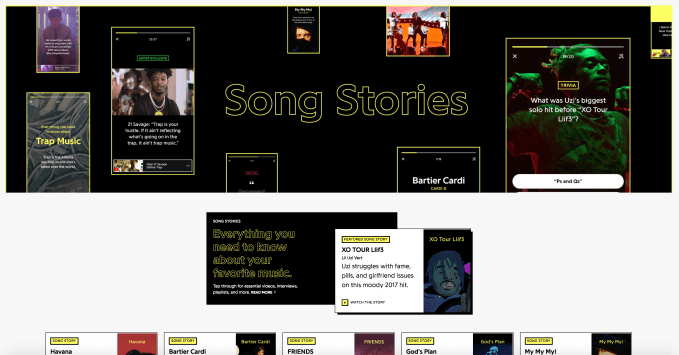
Genius, the big database of song lyrics and musical knowledge, is today launching its own version of “stories,” the Snapchat and Instagram-like short form sharing format that’s been rapidly spreading to a number of sites and apps, including Facebook, Messenger, Skype, and even Google. Genius’ “Song Stories,” as the new product is called, combine Genius artist interviews with YouTube content like concert footage, music video clips, and playlists.

As the user moves through the story, they’ll see the sort of behind-the-music details that Genius is known for, but in a more interactive format.

If you’re already familiar with Instagram Stories or Snapchat Stories, you’ll find Song Stories easy to use as well.

As you listen to the song, you can tap to advance through the cards in the Story, tap and hold to pause a card, or do nothing and watch the story advance automatically, appropriately synced with the music.

On some of the cards, you’ll also be able to swipe up to access additional YouTube content directly.

For example, a Song Story might point you to other YouTube videos to watch, like concerts, covers, interviews with the artist, themed playlists, and more.

The collaboration between Genius and YouTube is notable, given YouTube’s plans to launch a revamped premium subscription service in the near future. A deeper integration with Genius could be a competitive advantage for YouTube.

And while nothing was announced in terms of a YouTube product today, this launch signals a closer and productive working relationship between two companies – despite the fact that Genius already works with YouTube Music’s competitor Spotify to power its “Behind the Music” feature.

“At YouTube we’re working every day to push the envelope and find new ways to enhance the overall music experience by better connecting artists and fans,” said Lyor Cohen, YouTube’s Global Head of Music, in a statement. “This project with Genius provides a more immersive way to explore music—it’s the perfect example of innovating in pursuit of this goal.”

“Genius and YouTube, the two biggest sources of musical deep cuts and rabbit holes on the planet, are natural collaborators on this mission,” added Ilan Zechory, Genius’s co-founder and president.

Not all bands and artists have been given the Song Story experience, however.

At launch, there’s a Gallery of Stories available on the Genius website, featuring artists like Lil Uzi VertCardi B feat. 21 SavageJoy DivisionTroye Sivan, and others. It remains to be seen how widely the Story format will roll out across the Genius database of song info going forward.

02 Apr 2018

82Labs raises $8M to create a better hangover recovery drink

While taking some time off to travel before his next gig, Sisun Lee spent a lot of time in Korea — where he found himself drinking alcohol pretty much every night and then getting rolling the next morning, regardless of hangover status.

He also found that there were popular local herbal hangover drinks that everyone kept raving about. So he brought a bunch of them back to the U.S., handed them out to friends, and generally got interested in the drink as a thought experiment. After reaching out to scientists in academia about the herbal drinks and finding no one had really commercialized it into a product in the U.S. — and that there might actually be something behind the idea — he decided to start 82Labs and roll out the Morning Recovery drink. The startup has also raised $8 million in new financing from Altos Ventures, Slow Ventures, Strong Ventures and Thunder Road Capital.

“My friends would go to work the next day and they would swear by these hangover drinks with an herbal base,” Lee said. “In many ways that was almost when I was first inspired by it. That was at the back of my head. It turned out it was a massive market, it wasn’t one major brand — all the CPG companies had their own brand. It’s like the energy drink market. I did some research, and [people in academia] might be really passionate about something, and give you this conviction that this is the next big thing, but they wouldn’t commercialize it. They didn’t know how to get going.”

The drink is based on a flavonoid component of popular herbal medicines called DHM. The original concept for the drink was also based on research on DHM from USC, where Lee had gotten in touch with the scientists working on it to see if the idea was actually worth pursuing. That’s then bottled with other components like vitamins, electrolytes, milk thistle and some others which are known to have some detoxifying components. 82Labs initially launched in August, but at the time was literally handing out white powder in little bags — something Lee wasn’t particularly thrilled about. But as more and more interest came in after handing it out to area friends (and product managers) throughout the course of an unscientific experiment, they decided to roll with it and try to turn it into the kind of market you’d find abroad.

Lee and his friends decided to create a website to start sending it out for free for anyone who was interested in signing up. They made a few hundred bottles, gave it a flavor, and put a sign-up sheet online where they would ship it to you. Naturally, however, this is Silicon Valley, so the site ended up going viral and they got so many requests that they needed to figure out what to do next because larger bottling orders came in the tens of thousands. After some work figuring out how they could actually get it to market abiding by rules and regulations by the FDA, the team ended up making an Indiegogo campaign, which raised more than $250,000

“Because of our margins, every user we onboard is profit we generate,” Lee. “But we’ve had to learn a lot really quickly. The big thing for us last year was a big production mistake and we were always supply constraint every order. Sometimes we had compliance issues, quality issues, or mistakes on timeline. everything has been around putting out fires and making sure customers are happy, or giving them refunds December was the first month we had inventory and started to sell during holiday season when people are drinking a lot. We really never had time to think and go, “holy crap, what are we actually doing, what’s the goal here, what’s the mission here.”

Lee said that while Morning Recovery, which costs $30 for a six-pack of the 3.4-ounce drink, is their first drink they don’t want to just stop there. After all, getting a successful beverage to market — even if it turns out there’s plenty of work to do on the science side — requires getting into retail outlets and into the hands of consumers. But if that’s successful, that could easily build a brand and help the company start thinking about the next product that they should make. That direct-to-consumer approach has been increasingly popular amid the success fo companies like Dollar Shave Club and others.

But that also means that 82Labs will likely face a lot of challenges, especially if it starts to get traction and larger companies start to take notice of it. Since the market is popular internationally — Lee says it’s a few hundred million dollars annually in countries like Korea — it wouldn’t take much for a consumer packaged goods company with beverage experience to try to produce something similar. So the goal will be to build up enough traction before that happens in order to continue growing.

“If big companies take notice, while they can’t make the exact same product as us, I’m sure they can figure something out,”  Lee said. “We have the advantage of a couple months — once we get to at a threshold in revenue companies will probably notice us. We thought we could keep growing slowly, but if any of these pharmaceutical companies or CPG companies do something, we’re gonna be crushed. Or, we thought we would raise money to front-load expansion purely on growth.”

02 Apr 2018

Tesla is now worth less than Ford

Tesla’s stock price is falling and in doing so, has retreated on milestones it set last year. As of publication, the company’s value is less than Ford’s for the first time in a year. At current levels, Tesla’s market cap is $42.063 billion while Ford is trading at $43.588. It was a year ago tomorrow that Tesla overtook Ford’s market cap.

Both company’s stock price is trading down on the day though Tesla’s stock is seemingly crashing over the last week and is at a 52-week low. The company is still reeling from a week of bad news that included a mass recall, a report on manufacturing woes, and a fatal crash involving Tesla vehicle operating in its self-driving mode.

Ford’s stock is, however, trending up over the last month though is also trading around a 52-week low.

Much fanfare was made when Tesla overtook Ford’s market value. It was championed as the wave of a future, but some cautioned that the stock price was overvalued. Elon Musk seems to be taking the news well, tweeting in jest yesterday, on April Fool’s, that the company is bankrupt.

02 Apr 2018

Walmart brings its partnership with JD.com into the food business

Walmart is bringing its partnership with JD.com into its grocery business.

The Chinese physical store will stock products that customers can also buy through its Walmart’s virtual storefront on the Chinese electronic marketplace, JD.com, according to a report in Reuters.

Walmart first partnered with JD.com two years ago as both companies struggled to overcome the retail dominance of Alibaba, China’s ecommerce juggernaut.

Throwing the ouroboros of 21st century economics into sharp relief, the partnership was established in 2016 to sell Walmart’s China-made, U.S.-branded products to Chinese consumers through JD.com’s online marketplace and by setting up electronics showrooms hawking JD.com’s tech wares in Walmart locations throughout China.

Now the integration of JD.com’s online and Walmart’s offline supply chains will extend to groceries. Beginning with a store in China’s southern megacity — Shenzhen — 8,000 items ranging from fresh fruit to seafood will not only be stocked in stores, but will also be available for online orders through JD.com.

Customers in a 3 kilometer radius from the store will get their food delivered within 30 minutes — and will be able to use a new shopping application available through WeChat to skip checkout counters. 

The new stores step up the competition for convenience that’s now top of mind for big retailers from Amazon and Alibaba to Target and Walmart.

The integration of the online and physical retail experience for consumers through mobile purchasing, contactless check-out and delivery and in-store pickup are going to be the next front in the war for customers’ clicks and trips online and offline.

02 Apr 2018

Tesla makes Autopilot easier to use in the Model 3

The Model 3 now has a new way to control Autopilot. The company recently sent out an update that moved the controls from the center infotainment stack to the steering wheeling. Previously, drivers had to use the large screen to change Autopilot’s speed and cruise distance and in doing so, required drivers to take their eyes off the road to change these options.

The Model 3 is an exercise in minimalism, and to that end, the company is seemingly still working out the best interface. To that end, the controls on the Model 3’s steering wheel were purposely not labeled or dedicated to a specific function and instead change depending on the car’s role.

Thanks to the 2018.12 update, the right-hand scroll wheel controls the speed of the vehicle while the buttons flanking that wheel changes the follow distance. The new controls do not replace the existing controls but rather supplement them.

During our review of the Model 3, we noted the sparse cockpit design and found it good and bad. On the one hand, it’s terrific to have an unobstructed view of the road – it’s as pure as driving experience as rolling down the track in the soapbox derby car of your youth, and it leaves you feeling connected to the road itself. But yet the car feels too reliant on the center touchscreen, which often requires drivers to look away from the road for simple commands.

Tesla is operating under increasing scrutiny following a fatal accident that involved Autopilot. Updates like this show the company is at least listening to owners and updating its vehicles in kind.

02 Apr 2018

YouTube launches a shorter, skippable ad format

YouTube today is introducing a new ad format that will allow viewers to skip even shorter ads. Called “TrueView for reach,” the format arrives around two years after YouTube’s introduction of the six-second bumper, which the company says advertisers have learned how to best use to raise brand awareness, despite having only a few seconds to tell their story. Now, advertisers will have the option to build ads as short as 6 seconds, which can be skipped after 5.

However, most advertisers will build ads a bit longer than that, though under the 30-second mark required by TrueView in-stream ads.

With the existing TrueView in-stream ads, which air before or during a video, advertisers only pay when the viewer watches at least 30 seconds or to the end of the video, or they take action by clicking on a card or other elements of the creative to learn more.

TrueView for Reach, meanwhile, is meant to combine the best of both worlds – the short-form bumper ads, and the user choice offered through the in-stream format.

“TrueView for reach brings our popular in-stream format built on user choice together with the simplicity of CPM buying,” says YouTube, in an announcement. “Optimized for efficient reach, this format can help you to raise awareness among a broad set of customers — and do so within our 95% viewable and 95% audible environment.”

The company says that during beta testing the format across 84 campaigns, 9 out of 10 drove a significant lift in ad recall, with average lift of nearly 20 percent.

Samsung Electronics America said it was able to reach 50+ percent more people at half the CPM with TrueView for Reach, when it tested the format, while Pepsi France said that format helped deliver high reach, but also high completion rates for its 10-second video.

“Moreover, CPMs proved to be more competitive: we saw 30% lower CPMs on average compared to previous campaigns. This ultimately drove lower average costs on incremental reach points: -46% versus TV on specific target audiences,” explained Vanessa Tsangaratos, Digital Marketing Manager at Pepsi France.

The expansion of ad format options for YouTube is becoming even more critical to brands and advertisers, given the continued rise in cord cutting and adoption of subscription video on demand services, like Netflix, which are ad-free.

As YouTube notes in a blog post, advertising was simpler in the TV era – you’d just find the most popular shows, and place your brand there in the commercial breaks. Now advertisers are trying to find a place to gain attention for their brand in a far more complex landscape – there are video ads not only on streaming services like Hulu, but also on live TV services, on YouTube and even on social media, like Facebook and Instagram.

The goal is to now find a place to advertise where you can actually capture users’ attention.

YouTube claims it’s that place, of course. It cites a recent Ipsos study that found people are 3 times more likely to pay attention to online video ads compared with TV ads.

TrueView for reach is not the only TrueView option for YouTube advertisers. The newer TrueView for action is also available for those advertisers who want to customize a call-to-action that’s important to their business, like leads or referrals.

02 Apr 2018

Alexa users can now donate to charity with their voice

Just in time to be too late for your 2017 taxes, Amazon’s added a new skill for Alexa that lets users donate with their voice. The command is pretty much as you’d expect — say, “Alexa, donate $20 to the American Cancer Society” and the smart assistant will pull that money from your associated account.

Alexa uses a four-digit voice confirmation code to help users from making accidental purchases — and so other people in your household don’t go around donating away your life savings. Not that that would be the worst thing to spend that money on, I guess.

Amazon also says it shares users’ name, email and address with the organization, but not credit card info. Users will also get an email confirmation of the donation and can track that info over at Amazon Pay.

The list is 40 charities long and can be found here. Users can also just say, “Alexa, make a donation,” and the assistant will help you select a name from the list. The action joins the site’s existing Amazon Pay offering, which the company says more than one million customers have used to make donations to charity. 

02 Apr 2018

Zuckerberg fires back at Tim Cook, opens up about fake news

Zuckerberg has been on a bit of a publicity tour following the Cambridge Analytica scandal and a generally tough year for the social media behemoth.

This morning, an interview with Zuck was published on Vox. In it, the Facebook CEO waded through some of the company’s most pressing issues, including how to deal with fake news and help support good journalism and how to deal with governing a community of 2 billion people. Zuck also clapped back at Tim Cook who has criticized Facebook’s model of generating revenue through advertising.

Fake News

On the problem of Fake News and transparency in the past:

It’s tough to be transparent when we don’t first have a full understanding of where the state of some of the systems are. In 2016, we were behind having an understanding and operational excellence on preventing things like misinformation, Russian interference. And you can bet that that’s a huge focus for us going forward.

On how Facebook is trying to serve up content, including news content, that is meaningful to users:

The way that this works today, broadly, is we have panels of hundreds or thousands of people who come in and we show them all the content that their friends and pages who they follow have shared. And we ask them to rank it, and basically say, “What were the most meaningful things that you wish were at the top of feed?” And then we try to design algorithms that just map to what people are actually telling us is meaningful to them. Not what they click on, not what is going to make us the most revenue, but what people actually find meaningful and valuable. So when we’re making shifts — like the broadly trusted shift — the reason why we’re doing that is because it actually maps to what people are telling us they want at a deep level.

Zuck was also asked about supporting news organizations, as some slice of Facebook’s revenue comes from users consuming news on the platform:

For the larger institutions, and maybe even some of the smaller ones as well, subscriptions are really a key point on this. I think a lot of these business models are moving towards a higher percentage of subscriptions, where the people who are getting the most value from you are contributing a disproportionate amount to the revenue. And there are certainly a lot of things that we can do on Facebook to help people, to help these news organizations, drive subscriptions. And that’s certainly been a lot of the work that we’ve done and we’ll continue doing.

He also addressed that subscriptions might not work for local news, which the CEO believes are equally important:

In local news, I think some of the solutions might be a little bit different. But I think it’s easy to lose track of how important this is. There’s been a lot of conversation about civic engagement changing, and I think people can lose sight of how closely tied that can be to local news. In a town with a strong local newspaper, people are much more informed, they’re much more likely to be civically active. On Facebook we’ve taken steps to show more local news to people. We’re also working with them specifically, creating funds to support them and working on both subscriptions and ads there should hopefully create a more thriving ecosystem.

In Reaction to Tim Cook

In an interview last week, the Apple CEO said that tech firms “are beyond” self-regulation. When asked what he would do if he was in Zuckerberg’s position, Cook said “I wouldn’t be in this situation.” The CEO has long held that an advertising model, in which companies use data around users to sell to brands, is not what Apple wants to become.

“They’re gobbling up everything they can learn about you and trying to monetize it,” he said of Facebook and Google in 2015. “We think that’s wrong. And it’s not the kind of company that Apple wants to be.”

Zuck was asked about Cook’s statements in the interview:

You know, I find that argument, that if you’re not paying that somehow we can’t care about you, to be extremely glib. And not at all aligned with the truth. The reality here is that if you want to build a service that helps connect everyone in the world, then there are a lot of people who can’t afford to pay. And therefore, as with a lot of media, having an advertising-supported model is the only rational model that can support building this service to reach people.

That doesn’t mean that we’re not primarily focused on serving people. I think probably to the dissatisfaction of our sales team here, I make all of our decisions based on what’s going to matter to our community and focus much less on the advertising side of the business.

Zuck even took the opportunity to clap back at Cook a bit, saying we shouldn’t believe that companies trying to charge us more actually care about us.

But if you want to build a service which is not just serving rich people, then you need to have something that people can afford. I thought Jeff Bezos had an excellent saying on this in one of his Kindle launches a number of years back. He said, “There are companies that work hard to charge you more, and there are companies that work hard to charge you less.” And at Facebook, we are squarely in the camp of the companies that work hard to charge you less and provide a free service that everyone can use.

I don’t think at all that that means that we don’t care about people. To the contrary, I think it’s important that we don’t all get Stockholm Syndrome and let the companies that work hard to charge you more convince you that they actually care more about you. Because that sounds ridiculous to me.

The Government of Facebook

Vox’s founder and Editor-at-Large Ezra Klein brought up something Zuck said in an earlier interview, that Facebook was more like a government than a traditional company. Zuck explained that disputes over what content is admissible on Facebook has grown to a scale that requires a certain level of governance.

But I think it’s actually one of the most interesting philosophical questions that we face. With a community of more than 2 billion people, all around the world, in every different country, where there are wildly different social and cultural norms, it’s just not clear to me that us sitting in an office here in California are best placed to always determine what the policies should be for people all around the world. And I’ve been working on and thinking through, how can you set up a more democratic or community-oriented process that reflects the values of people around the world?

That’s one of the things that I really think we need to get right. Because I’m just not sure that the current state is a great one.

On how Facebook could prepare for its own overwhelming scale:

One is transparency. Right now, I don’t think we are transparent enough around the prevalence of different issues on the platform. We haven’t done a good job of publishing and being transparent about the prevalence of those kind of issues, and the work that we’re doing and the trends of how we’re driving those things down over time.

And on long-term goals for governance:

But over the long-term, what I’d really like to get to is an independent appeal. So maybe folks at Facebook make the first decision based on the community standards that are outlined, and then people can get a second opinion. You can imagine some sort of structure, almost like a Supreme Court, that is made up of independent folks who don’t work for Facebook, who ultimately make the final judgment call on what should be acceptable speech in a community that reflects the social norms and values of people all around the world.

You can read the full interview at Vox.com.