01 Apr 2018

Charting the adoption of direct startup investments by family offices

There’s money, and then there’s wealth. In all likelihood, money is what most of us have (or don’t have). It’s what we use to buy lunch, pay rent or put a down payment on a house. Wealth, on the other hand, is what buys yachts. But more than superficial material things, wealth also buys financial security (and all the good and ill that comes with it) for subsequent generations.

What is a family office?

Although close to half of Americans hold no stocks, bonds or real estate, most of the remaining half that are lucky and prosperous enough to do so choose to manage their assets on their own, or perhaps with the help of a financial advisor. But as you move further along the privileged end of the socio-economic curve, managing, preserving and growing one’s wealth becomes more complicated.

Many of the world’s highest-net-worth (HNW) families employ an entire office full of accountants, lawyers and investment professionals to manage their assets. These “family offices” sometimes manage the assets of more than one family, but they are still relatively close-knit.

Historically, family offices haven’t made many direct investments into individual tech startups, instead favoring a more diversified approach to tech investing by being limited partners in venture capital and other private-market funds. Or, outside of tech, they invest in public-market equities, real estate, fixed income or other “alternative” asset classes besides VC, PE and hedge funds, according to a 2017 article about ultra HNW investors’ portfolios from KKR.

Increasingly, however, family offices are investing more into individual tech startups, at least according to anecdotal reports and a recent funding round Crunchbase News covered. But one anecdote doesn’t document a trend, so let’s take a look at the numbers.

Family offices’ direct investment into startups picked up the pace

Data covering direct startup investments from family offices listed in Crunchbase bears out that trend. The chart below is based on more than 1,700 venture deals (seed, angel, equity crowdfunding, Series A, Series B, etc.) struck with individual technology companies by 193 family offices located around the world.
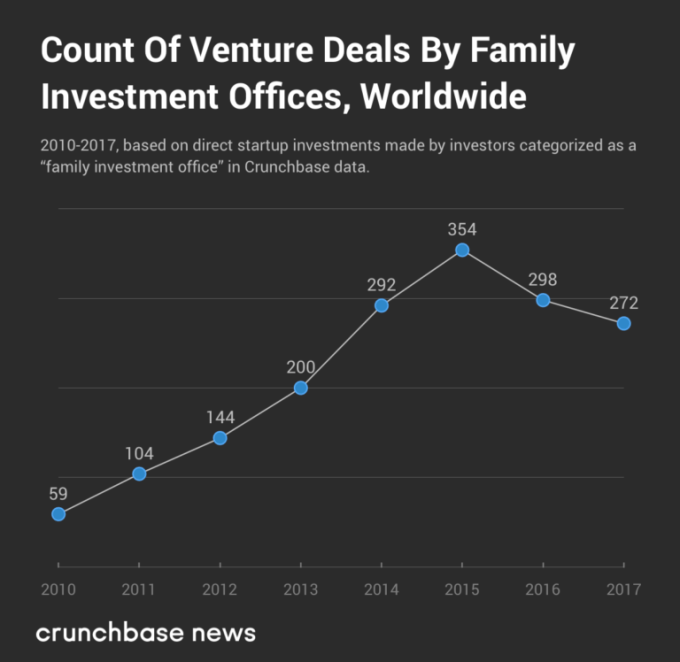
The 193 family offices with listed venture investments are, no doubt, only a fraction of the total count of such groups, which tend to be private. Combined with the fact that many startups are slow to announce funding, it’s not like the list of funding rounds or their participants is comprehensive. However, assuming it’s fairly representative, we can treat the figure above as a directional indicator of general trends.

And what are those trends?

First off, at least when it comes to deal volume, family offices’ startup investment activity tracks with the broader venture investment market (which includes individual angels, venture capital groups, seed funds, accelerators and others).

During the several years leading up to 2015, there was a run-up in the number of deals being struck. After that high point, though, deal volume began to decline in the U.S., which Crunchbase News has documented, as investors eschewed writing many smaller checks to early-stage startups, instead favoring fewer, larger checks with later-stage tech companies. On a global scale, projected deal volume is roughly flat on an annualized basis from 2015 through 2017, whereas reported deal data is down primarily due to reporting delays. Because there are more U.S. family offices that invest in startups than international ones, it’s not surprising to see that family office deal volume hews closer to the U.S. market in general.

Family office venture deal volume growth outpaced VC

But what’s different about family offices — and what lends credence to the anecdotal evidence suggesting there are more family offices investing in more startups — is the growth rate in deal volume over time as compared to institutional venture capital investors. To be sure, worldwide, there were more deals struck by both types of investor in 2017 than in 2010 (even when accounting for reporting delays). But the difference between these two types of investor is in the magnitude of the change.

In the chart below, we compare reported deal volume between VC funds (which have a lot of known deals per year) and family offices (which, as we showed above, have much fewer recorded startup investment deals per year). We adjust for this discrepancy in deal volume by indexing reported deal volume against 2010 levels. In doing so, we’re able to deliver a relativistic, apples-to-apples comparison between the two.
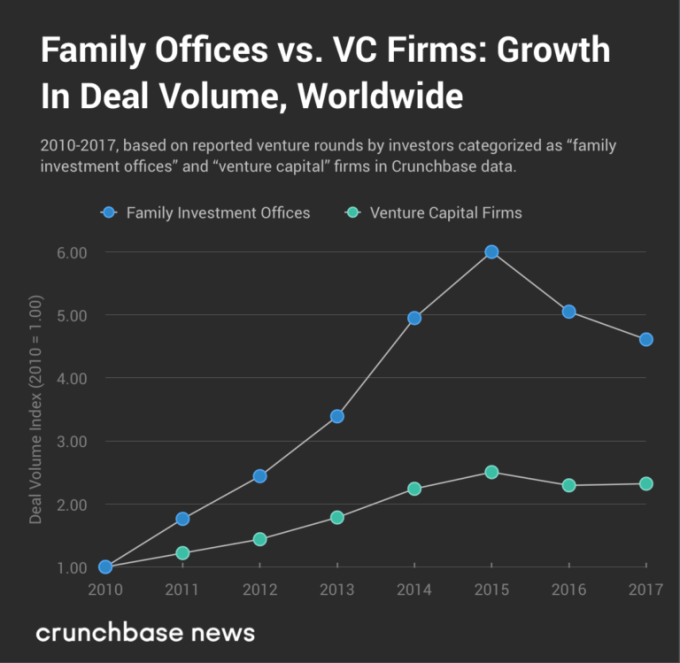
Worldwide, in 2015, reported deal volume from VC firms was almost precisely 2.5x that of 2010’s totals. But that multiple for family offices is roughly 6x. And, although it isn’t pictured above, family office deal volume growth outperformed traditional VC between 2011-2017, 2012-2017 and 2013-2017.

In relative terms, across a range of measures, deal volume growth was higher and faster among family offices than VC funds for a significant period of time. The data suggest that family offices making direct investments into startups recently became a trend. Especially for that period through 2014, family offices were on the early side of the adoption curve for making direct startup investments. Whatever growth we see on the VC side is the product of growth in the market in general, but it’s not like VC funds are still adopting direct startup investments into their repertoire. It’s been their model for decades. For comparatively stodgy family offices, it was still the new, new thing.

01 Apr 2018

Nostalgia eats itself in ‘Ready Player One’

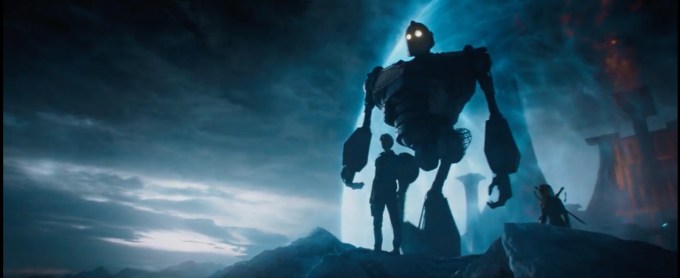
First things first: I had a really good time watching Ready Player One. As promised, the movie feels like a chance for Steven Spielberg to return to his roots as a blockbuster filmmaker, and to take all the toys out of the box and smash them together.

The film is based on Ernest Cline’s bestselling novel, with a script by Cline and Zak Penn. It’s ostensibly set in Columbus, Ohio, 30 years in the future, in a world overwhelmed by climate change and overpopulation. But Ready Player One‘s real setting is the OASIS, an enormous virtual reality world.

The story’s hero is Wade Watts (played by Tye Sheridan), who spends most of his time in the OASIS, hoping to complete three challenges  left behind by James Halliday, the technology’s inventor. Halliday has promised that the first person to complete the challenges will gain control of the OASIS.

The film’s central achievement is bringing this virtual world to life. Rather than aiming for a photo-real effect, Spielberg has embraced the OASIS’ essentially cartoony and video game-like qualities, and after a few minutes of acclimation, I had no problem jumping back-and-forth between the movie’s digital free-for-all and its live action dystopia.

ready player one

It’s clear that the characters take what happens in the OASIS as seriously as anything in the “real world,” and that they see their virtual avatars as an extension or expression of their real selves, so I was happy to follow their lead.

And as Who Framed Roger Rabbit? and Wreck-it Ralph have already shown, there can be something exhilarating about seeing elements from classic films and video games thrown together. I genuinely felt like I was 10 years old again as I watched the first big set piece, with Wade racing through the streets of New York City in his Back to the Future-style DeLorean, dodging King Kong and the Tyrannosaurus from Jurassic Park.

But I also felt a rapidly growing sense of diminishing returns.

True, Spielberg and other directors of his generation have openly borrowed from old movies throughout their careers. Raiders of the Lost Ark and Star Wars were inspired by the pop culture that Spielberg and his friend George Lucas loved as kids, but those movies transformed what had come before into something new.

There’s nothing quite as magical here. At its worst, Ready Player One amounts to little more than a game of spot-the-reference. And even at its best, any excitement feels more like a rapidly fading sugar rush, not the indelible thrill of Spielberg’s best work.

He’s has been happy to talk about Ready Player One as a return to making movies “from the audience, for the audience,” but Spielberg’s also suggested that he has more on his mind than pure entertainment — that the film is meant to highlight some of the ways that the Internet and virtual reality could be used to isolate us, to distract from the world’s very real problems.

Some of that comes across in the film’s opening moments, when Wade climbs down a tower of rundown trailers. Inside each one, we can see that his neighbors are all hidden behind goggles, living in their own fantasies.

But despite a few pious nods towards the importance of the real world, the film doesn’t seem very interested in the flaws of the OASIS — or the dark side of the nostalgic fan culture that Wade embodies. Sure, Wade has a hard time to talking to girls, but it’s clear that when he confronts the film’s villain (a corporate executive who could never love John Hughes movies the way Wade does), we’re meant to see cheer him on as he declares, “A fanboy knows a hater.”

And while Mark Rylance delivers the film’s most compelling performance as Halliday, the script falls short. By portraying the most powerful technologist in the world as a lonely, awkward but ultimately benign and Willy Wonka-ish figure, it feels strangely out-of-sync with 2018, when everyone seems to be wrestling with the damage that these digital platforms may be doing.

And yet … I had a good time. I felt plenty of reservations as I left the theater, but I made my peace with them by accepting Ready Player One as the ultimate expression of geek nostalgia, with all the virtues and the limitations that implies.

I suspect Spielberg and Cline have taken us as far down the pop culture rabbit hole as any movie can go. Hopefully, other filmmakers will realize that, and they’ll look elsewhere for inspiration.

01 Apr 2018

Patterns, Predictability, and the Rise of Donald Trump 

Think you’ve heard that song before? Were there more Jennifer’s or Jessica’s in your class at school? And what does this have to do with the rise of Donald Trump?

In the latest episode of the Interesting People in Interesting Times podcast, Derek Thompson, author of Hitmakers: The Science of Popularity in an Age of Distraction, explains what influences our thinking, drives our choices, and ultimately dictates human behavior.

Thompson argues that patterns and predictability are the essence of human life. What makes a hit song, a winning politician, a bestselling product, and even a successful tech startup, comes down to repetition. 

At the core of Thompson’s theory is the myth of novelty: We seemingly love to discover new things, but they only resonate with us if they’re grounded in an element of familiarity.

“We live in a culture where there’s enormous pressure to be aware of and to like new things, to be aware of new songs, to see new movies, to read new books, to seek out new ideas, to be up on the hottest fashion or the most salacious thing happening on Twitter,” Thompson says. “Yet the most fundamental finding from psychology is that people do not like new things. The [concept of] the mere-exposure effect says that the mere exposure to any stimulus to us biases us towards that stimulus: we are suckers for the familiar.”

“Take movies. We love to see new movies. That said, every year this century, a majority of the top 10 films in America have been sequels, adaptations, or reboots. This is even true in the landscape of ideas. It’s thrilling and wonderful to read a brilliant essay but what we love and pass on the most is those essays that have a clever joke or framing device to tell us that that thing we believe in is in fact true.” 

The reason we fall for certain people and products comes down to “familiar surprises: ideas that strike us as original when we confront them, but in investigating them, it’s like stepping through a door and seeing an old friend on the inside. Discovering a feeling of familiarity within products and discovering a-ha moments is what all consumers are looking for throughout the cultural landscape.” 

In politics, Thompson says, “We love new faces. But we only fall for them when they tell us familiar stories.” For example, “Make America Great Again is not only the most traditional thing you could possibly say, but it’s so traditional, Ronald Reagan said it 28 years ago.”

“For a long period of time, elites could use scarce media channels like radio to dictate taste to consumers, and consumers through sheer repetition and familiarity bias would lap up the ideas of the elites. Taste was top-down for most of history, but now it’s bottom-up.”

What does that have to do with Donald Trump?

The dominant theory in political science about elections was called “the party decides” — voters don’t decide who becomes the presidential nominee of any particular party. The party decides. The party equals the elites. The exact same phenomenon that’s happening in music, is happening in politics. But now, you have this explosion in the channels of exposure.

“Taste in politics, just like taste in music, has gone from being dictated top down to where it bubbles up. Across the cultural landscape, taste itself is becoming more chaotic, harder to predict, harder to control.”

Turns out, the structure of making a hit song, and its devices, like repetition, are key to political speechwriting, as well as marketing.

The most famous line in speech making in the 20th century is John F. Kennedy’s “Ask not what your country can do for you, ask what you can do for your country.” Mark Twain said “It’s not the size of the dog in the fight, it’s the size of the fight in the dog.” Hillary Clinton’s perhaps most well-known line is: “Human rights are women’s rights, and women’s rights are human rights.”  

“The reason this is so common in speechwriting, so clever and so powerful, is that it turns ideas into music through repetition. It takes any concept and musicalizes it so that our brain falls in love with the music before it even has time to process the substance.”

And here’s where this connects to Andrew Yang, who is running for President in 2020, as featured in the first episode of the IPIT podcast.< According to Thompson, “Andrew Yang is selling a huge proposal with Universal Basic Income. And he’s selling it based on a rather large, scary principle: that our jobs are going away in way that’s never happened before. I think it’s important for politicians to have huge visions, particularly when those visions are based in an element of morality. I would urge him however to find more ways to fit the concept of a freedom dividend within the system that we have, by suggesting, for example, that he’s open to doubling or tripling the income tax credit. Or by suggesting that he’s willing to expand Medicare maybe from 65 to 55 and even to 45, and that he has plans to expand Medicaid as well. I think that having an element of radical idealism is really really important for running for president. But it’s important that we ground our visions of radicalism to an element of familiarity, because politics, like music, is a popularizing business. Running for president is essentially the largest popularity contest in the U.S. And we know people are afraid of ideas that sound too radical.”

The takeaway here is: “Dream as big as possible, but just as it’s important to sell something familiar by making it surprising, if you’re trying to sell something surprising, do remember to make it familiar.”  

Interesting People in Interesting Times is a podcast hosted by Tom Goodwin and Adriana Stan. This episode was recorded last month at Soho House New York.

Listen to the podcast here.

01 Apr 2018

Patterns, Predictability, and the Rise of Donald Trump 

Think you’ve heard that song before? Were there more Jennifer’s or Jessica’s in your class at school? And what does this have to do with the rise of Donald Trump?

In the latest episode of the Interesting People in Interesting Times podcast, Derek Thompson, author of Hitmakers: The Science of Popularity in an Age of Distraction, explains what influences our thinking, drives our choices, and ultimately dictates human behavior.

Thompson argues that patterns and predictability are the essence of human life. What makes a hit song, a winning politician, a bestselling product, and even a successful tech startup, comes down to repetition. 

At the core of Thompson’s theory is the myth of novelty: We seemingly love to discover new things, but they only resonate with us if they’re grounded in an element of familiarity.

“We live in a culture where there’s enormous pressure to be aware of and to like new things, to be aware of new songs, to see new movies, to read new books, to seek out new ideas, to be up on the hottest fashion or the most salacious thing happening on Twitter,” Thompson says. “Yet the most fundamental finding from psychology is that people do not like new things. The [concept of] the mere-exposure effect says that the mere exposure to any stimulus to us biases us towards that stimulus: we are suckers for the familiar.”

“Take movies. We love to see new movies. That said, every year this century, a majority of the top 10 films in America have been sequels, adaptations, or reboots. This is even true in the landscape of ideas. It’s thrilling and wonderful to read a brilliant essay but what we love and pass on the most is those essays that have a clever joke or framing device to tell us that that thing we believe in is in fact true.” 

The reason we fall for certain people and products comes down to “familiar surprises: ideas that strike us as original when we confront them, but in investigating them, it’s like stepping through a door and seeing an old friend on the inside. Discovering a feeling of familiarity within products and discovering a-ha moments is what all consumers are looking for throughout the cultural landscape.” 

In politics, Thompson says, “We love new faces. But we only fall for them when they tell us familiar stories.” For example, “Make America Great Again is not only the most traditional thing you could possibly say, but it’s so traditional, Ronald Reagan said it 28 years ago.”

“For a long period of time, elites could use scarce media channels like radio to dictate taste to consumers, and consumers through sheer repetition and familiarity bias would lap up the ideas of the elites. Taste was top-down for most of history, but now it’s bottom-up.”

What does that have to do with Donald Trump?

The dominant theory in political science about elections was called “the party decides” — voters don’t decide who becomes the presidential nominee of any particular party. The party decides. The party equals the elites. The exact same phenomenon that’s happening in music, is happening in politics. But now, you have this explosion in the channels of exposure.

“Taste in politics, just like taste in music, has gone from being dictated top down to where it bubbles up. Across the cultural landscape, taste itself is becoming more chaotic, harder to predict, harder to control.”

Turns out, the structure of making a hit song, and its devices, like repetition, are key to political speechwriting, as well as marketing.

The most famous line in speech making in the 20th century is John F. Kennedy’s “Ask not what your country can do for you, ask what you can do for your country.” Mark Twain said “It’s not the size of the dog in the fight, it’s the size of the fight in the dog.” Hillary Clinton’s perhaps most well-known line is: “Human rights are women’s rights, and women’s rights are human rights.”  

“The reason this is so common in speechwriting, so clever and so powerful, is that it turns ideas into music through repetition. It takes any concept and musicalizes it so that our brain falls in love with the music before it even has time to process the substance.”

And here’s where this connects to Andrew Yang, who is running for President in 2020, as featured in the first episode of the IPIT podcast.< According to Thompson, “Andrew Yang is selling a huge proposal with Universal Basic Income. And he’s selling it based on a rather large, scary principle: that our jobs are going away in way that’s never happened before. I think it’s important for politicians to have huge visions, particularly when those visions are based in an element of morality. I would urge him however to find more ways to fit the concept of a freedom dividend within the system that we have, by suggesting, for example, that he’s open to doubling or tripling the income tax credit. Or by suggesting that he’s willing to expand Medicare maybe from 65 to 55 and even to 45, and that he has plans to expand Medicaid as well. I think that having an element of radical idealism is really really important for running for president. But it’s important that we ground our visions of radicalism to an element of familiarity, because politics, like music, is a popularizing business. Running for president is essentially the largest popularity contest in the U.S. And we know people are afraid of ideas that sound too radical.”

The takeaway here is: “Dream as big as possible, but just as it’s important to sell something familiar by making it surprising, if you’re trying to sell something surprising, do remember to make it familiar.”  

Interesting People in Interesting Times is a podcast hosted by Tom Goodwin and Adriana Stan. This episode was recorded last month at Soho House New York.

Listen to the podcast here.

01 Apr 2018

‘Highly critical’ CMS bug has left over 1 million sites open to attack

The team behind the popular open-source CMS Drupal is urging admins to update their sites to ward off a nasty bug that could leave their sites “highly compromised” to attackers, according to the organization.

The effected versions (Drupal 6, 7 and 8) of the CMS power over one million websites on the internet.

Drupal has marked the security risk as “highly critical” and warns that any visitor to the site could theoretically hack it through remote code execution due to a missing input validation.

“This potentially allows attackers to exploit multiple attack vectors on a Drupal site, which could result in the site being completely compromised,” the group noted in a blog post.

Drupal sent out an alert last week, telling users that they’d be dropping a “highly critical release” this weekend and they should update immediately. The announcement was unusual for Drupal and left developers on high alert for the targeted time frame of the release on Friday. Sites running vulnerable versions of Drupal, should update to Drupal 7.58 or Drupal 8.5.1 as soon as possible to avoid exploits. Drupal notes that they have yet to see any reports of exploits in the wild yet.

The bug’s official identifier is CVE-2018-7600 though users on social media have taken to calling it drupalgeddon2, referencing another major release from the org in 2014.

01 Apr 2018

Parasitism and the fight for the wrong century

Generals are famously always “studying how to fight the last war,” with the last war’s technology, while dismissing how the world and its tech have changed in the interim. This is true for dissidents, rebels, and culture wars too. Our fears tend to be of 20th century boogeymen, the Nazis and the Soviet Union — but we should be worrying about other things entirely. The world and its dystopias have moved on.

The Nazis and the Soviets obviously inspired Orwell’s “1984,” which was stunning, visionary, and enormously influential … while still being slightly myopic compared to Huxley’s earlier, much weirder, and much more subversive “Brave New World.” But Orwell too was already able to prophesy a world in which no one really fought for territory any more. What would be the point?

Militaries around the world are constructed primarily for national defense against an invading, conquering force, but invading and conquering territory makes no sense any more. Wealth and power are no longer remotely related to how much real estate or raw materials you control. South Korea’s US-dollar GDP is higher than that of Russia.

The US swept Iraq’s military away like gauze paper when they invaded in 2003, but it turns out that, even after you overthrow a brutal dictator, even when it’s one of the most oil-rich nations on the planet, attempting to occupy and control a hostile nation inevitably becomes a horribly expensive catastrophe that costs enormously more than any possible benefits.

Nation-states don’t invade and conquer each other any more because of military defenses, or any kind of Pax Americana, or because everyone has gotten nicer and kinder over the last hundred years. They don’t do it because, thanks to technology-driven transformations over that time, it simply doesn’t make any sense; in fact it has become complete madness.

Similarly, counterculture individualists and lovers of freedom worry about Nazi fascism or Soviet police states. How twentieth century of us. There are plenty of neo-fascists out there, to my dismay, and we often seem to be doing our best to accidentally construct the tools of a police state out of modern technology — smartphones, drones, facial recognition technology, etc. in the much-abused name of “security.” I’m certainly not suggesting that people or societies today are somehow less likely to construct such horrors because they have grown morally better over time. There are plenty of awful people out there.

I am, however, suggesting that awful people today are a lot less likely to aim for fascism or totalitarianism because awful people benefit a lot less from those systems than they used to. The Soviet Union collapsed because it was an economic disaster as well as a moral one. The closest things we have to fascist states today — monarchies like North Korea and Saudi Arabia — are fragile, riven by internal contradictions and internecine warfare, facing the future with desperation and fear.

There’s a new playbook for oppression today. Instead of outright totalitarian rule, you construct the appearance of democracy, while controlling it by subtly — in some cases perhaps not even consciously — restricting the options available to individual voters; by controlling a tiered system of “representative” electors behind the scenes; or by simply outright stuffing the ballot box. (There can be much sound and fury about the distinctions between the available candidates, but if you’ve done your job correctly, and made democracy as awful as possible, in general only establishment candidates or easily manipulated narcissists will ever be nominated.)

Then you give your people enough freedom to thrive; to create, to disrupt, to innovate. And you siphon as much as you can of that created wealth.

You don’t give them enough to actually seriously challenge the establishment, of course; to, say, remake the system so that the siphoned wealth goes to its poor and oppressed people instead of its silent, invisible masters. That is a red line that must not be crossed. But the beauties of this system — call it parasitism — is that it is very rare to encounter a challenger who cannot be co-opted. It vampire-squids enough wealth for its upper-tier members and their families to live lives of extraordinary, gilded luxury, without the unpleasant threat of being assassinated or deposed that comes with outright fascism or totalitarianism.

These parasitic systems couldn’t exist without today’s technology. They are mostly networked, not hierarchical. They watch, they adapts, and they distract. They construct shell corporations that shuttle gobs of money around the globe like 747s. And they very rarely needs to resort to violence, because, like the Borg, and like capitalism itself — from which it is distinct, although there are places where it has been so successful that people rarely recognize any difference — parasitism usually has the capacity to absorb all those who confront it.

I’m not saying fascism and totalitarianism are things we should be completely unworried about. They’re out there, they’re real, and they’re terrifying. But there are playbooks for how to fight them. Parasitism, though, seems almost unstoppable. Presumably the solution is a technological one; let’s hope it’s discovered soon.

01 Apr 2018

Krablr’s ICO is cookin’ on gas

How many second acts can a startup have before its procession of unlikely pirouettes must raise more than a quizzical eyebrow?

It depends where you’re asking the question of course.

And as we sit here, contemplating the smooth-faced Krablr founder, Wilson Poney, gazing out at the Pacific ice blue from inside his underwater glass cube, it’s clear this company hasn’t had any such clouds of doubt fogging its public trajectory.

A large Sea Nettle wafts past Poney’s head, pausing momentarily to lend him a gelatinous hairpiece.

He breathes in with vast calm.

“We’re going to run the biggest token sale in blockchain history,” he announces. “We connect crab to the blockchain. Period.

“You read the whitepaper right? Bona fide golden ticket. You want to be cut in? I could pull some strings if you’re keen but you’ll need at least $100k for phase I. We’ll be going up to 100x or more in later rounds. We’re not after tiddlers or hodlers or whatever they’re called. Just top tier investment funds.

“Okay, okay, a few family offices in Saudi, Qatar — and Puget and Scranton. Gotta keep our little local connection happy.”

He laughs a little too heartily.

“We’ve also been talking to SoftBank. Masayoshi might join the board. He’s very interested in the long term future of crab futures.”

Poney has the face of a man who’s eaten more than his fair share of crab dinners.
But he cuts into our next question — about how much Krablr is targeting for its token sale — to bark into a lobster-handled landline telephone, summoning an afternoon snack.

Is that an original Dalí, your correspondent wonders. Poney ignores all our questions.

“How do I know these crab sticks are going to be fucking great? Blockchain that’s how. It’s a fucking miracle.

“People have been emailing me saying they’re selling their grandmothers to get into KrabCoin,” he adds. “Fucking A-Okay. As I always told grammy, nothing beats the smell of capitalism in the morning.”

He takes a huge sniff of his own air.

“All the time actually. It smells like fresh cooked crab. Maybe that’s just me. My girlfriend thinks capitalism smells like diamonds — but that was after I gave her a 22 carat diamond necklace. I had the rock cut into the shape of a carapace.”

He flashes a full set of brilliantly pearly teeth.

“Anyway, where was I? — blockchain! Did you see my number plate? There’s only one car parking space here. Y’know how it is with land in the Bay. But I don’t mind telling you this office was cheaper than Fresno. Marine mid shallows is actually a criminally untapped opportunity. We’re going to be using a chunk of the ICO to plough into underwater real estate. Think Manhattan in an aquarium with underwater drones to ferry you home and jellyfish waving you to beddie byes. I can send you the brochure if you’re interested?

“Anyway the lobster-colored lambo in the lot is mine. Did you notice the plate? It’s the timestamp of Satoshi’s Genesis block. I paid a small fortune to some guy in the Mission to peel it off his electric scooter. I’d have happily paid twice.

“People are going to say I’m fucking Satoshi himself soon!”

Poney ejects another ripe belly laugh. Or it might have been a belch. His assistant hurries into the room carrying a large platter of crab sticks.

“At last! I could murder a bucket of lobster! Help yourself to the shrimp. It’s blockchain certified.”

So why did Krablr move its HQ to SF? Was it to be closer to Pacific crab catches?

Poney pauses his vigorous mastication for a moment. “How much crab is left in the Pacific?” he muses. “No one knows. Truly no one. But they will know — we’ll be putting all that on the blockchain.

“Frankly I’d put grammy on the blockchain if I could. You can quote me on that.”

He grins wolfishly through a mouthful of crabs sticks and then laughs with gusto, blasting the room with fragments of impossibly fresh crab meat.

“Pot baits, carapace metrics, poundage, sex distribution, discards, toss backs, deadloss, offload times,” he reels off, staccato style, after his last gulp. “You’ll know exactly how many deckhands manhandled your dinner. Down to the color of their fucking fingernails.

“Now tell me that’s not worth $1TR?”

“Here, take a claw,” he adds without waiting for an answer and tossing a souvenir of his snack towards the door. “You can tell your friends you got yourself a bite of KrabCoin.”

01 Apr 2018

Facebook plans crackdown on ad targeting by email without consent

Facebook is scrambling to add safeguards against abuse of user data as it reels from backlash over the Cambridge Analytica scandal. Now TechCrunch has learned Facebook will launch a certification tool that demands that marketers guarantee email addresses used for ad targeting were rightfully attained. This new Custom Audiences certification tool was described by Facebook representatives to their marketing clients, according to two sources. Facebook will also prevent the sharing of Custom Audience data across Business accounts.

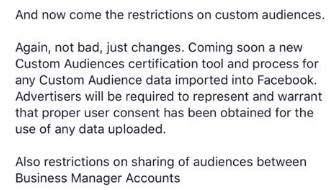
This snippet of a message sent by a Facebook rep to a client notes that “for any Custom Audiences data imported into Facebook, Advertisers will be required to represent and warrant that proper user content has been obtained.”
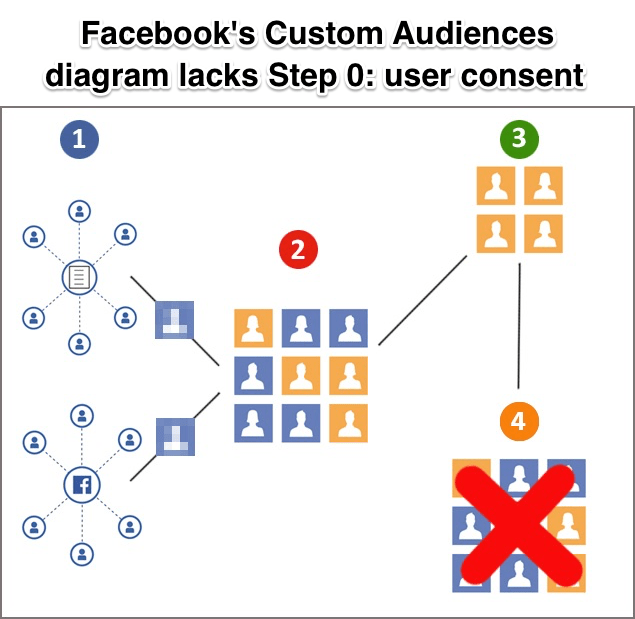
Once shown the message, Facebook spokesperson Elisabeth Diana told TechCrunch “I can confirm there is a permissions tool that we’re building.” It will require that advertisers and the agencies representing them pledge that “I certify that I have permission to use this data”, she said.

Diana noted that “We’ve always had terms in place to ensure that advertisers have consent for data they use but we’re going to make that much more prominent and educate advertisers on the way they can use the data.” The change isn’t in response to a specific incident, but Facebook does plan to re-review the way it works with third-party data measurement firms to ensure everything is responsibly used. This is a way to safeguard data” Diana concluded.The company declined to specify whether it’s ever blocked usage of a Custom Audience because it suspected the owner didn’t have user consent. ”

The social network is hoping to prevent further misuse of ill-gotten data after Dr. Aleksandr Kogan’s app that pulled data on 50 million Facebook users was passed to Cambridge Analytica in violation of Facebook policy. That sordid data is suspected to have been used by Cambridge Analytica to support the Trump and Brexit campaigns, which employed Custom Audiences to reach voters.

Facebook launched Custom Audiences back in 2012 to let businesses upload hashed lists of their customers email addresses or phone numbers, allowing advertisers to target specific people instead of broad demographics. Custom Audiences quickly became one of Facebook’s most powerful advertising options because businesses could easily reach existing customers to drive repeat sales. The Custom Audiences terms of service require that businesses have “provided appropriate notice to and secured any necessary consent from the data subjects” to attain and use these people’s contact info.

But just like Facebook’s policy told app developers like Kogan not to sell, share, or misuse data they collected from Facebook users, the company didn’t go further to enforce this rule. It essentially trusted that the fear of legal repercussions or suspension on Facebook would deter violations of both its app data privacy and Custom Audiences consent policies. With clear financial incentives to bend or break those rules and limited effort spent investigating to ensure compliance, Facebook left itself and its users open to exploitation.

Last week Facebook banned the use of third-party data brokers like Experian and Acxiom for ad targeting, closing a marketing featured called Partner Categories. Facebook is believed to have been trying to prevent any ill-gotten data from being laundered through these data brokers and then directly imported to Facebook to target users. But that left open the option for businesses to compile illicit data sets or pull them from data brokers, then upload them to Facebook as Custom Audiences by themselves.

The Custom Audiences certification tool could close that loophole. It’s still being built, so Facebook wouldn’t say exactly how it will work. I asked if Facebook would scan uploaded user lists and try to match them against a database of suspicious data, but for now it sounds more like Facebook will merely require a written promise.

Meanwhile, barring the sharing of Custom Audiences between Business Accounts might prevent those with access to email lists from using them to promote companies unrelated to the one to which users gave their email address. Facebook declined to comment on how the new ban on Custom Audience sharing would work.

Now Facebook must find ways to thwart misuse of its targeting tools and audit anyone it suspects may have already violated its policies. Otherwise it may receive the ire of privacy-conscious users and critics, and strengthen the case for substantial regulation of its ads (though regulation could end up protecting Facebook from competitors who can’t afford compliance). Still the question remains why it took such a massive data privacy scandal for Facebook to take a tougher stance on requiring user consent for ad targeting. And given that written promises didn’t stop Kogan or Cambridge Analytica from misusing data, why would they stop advertisers bent on boosting profits?

For more on Facebook’s recent scandals, check out TechCrunch’s coverage:


31 Mar 2018

Original Content podcast: We drop by Netflix’s ‘Terrace House’

Terrace House is a tough show to explain.

Like The Real World and other reality TV, the show puts a group of largely young and attractive strangers together in a house. But that’s about where the similarities end.

On Terrace House, most of the cast members genuinely seem to be rooting for each other. And while there’s drama, it’s scaled way back, so that passive aggressive remarks about soup can end up dominating an episode.

Darrell’s a big fan, so on this week’s episode of the Original Content podcast, we checked out the latest season, Opening New Doors (a co-production of Netflix and Japanese TV network Fuji). Sadly, this is his final episode as a regular host, but at least he got to go out with a bang. (And we’re hoping to lure him back.)

We also covered the week’s streaming and entertainment news, like the (distant) launch date for Apple’s TV efforts, Netflix’s plans for Carmen Sandiego and new trailers for The Handmaid’s Tale and Westworld. Plus, Jordan finishes watching the entire Star Wars saga.

You can listen in the player below, subscribe using Apple Podcasts or find us in your podcast player of choice. If you like the show, please let us know by leaving a review on Apple. You also can send us feedback directly.