30 Mar 2018

Tesla voluntarily recalls 123,000 Model S vehicles

If you own a Model S built before April 2016, you’re probably going to want to swing by a dealer and get it checked out…

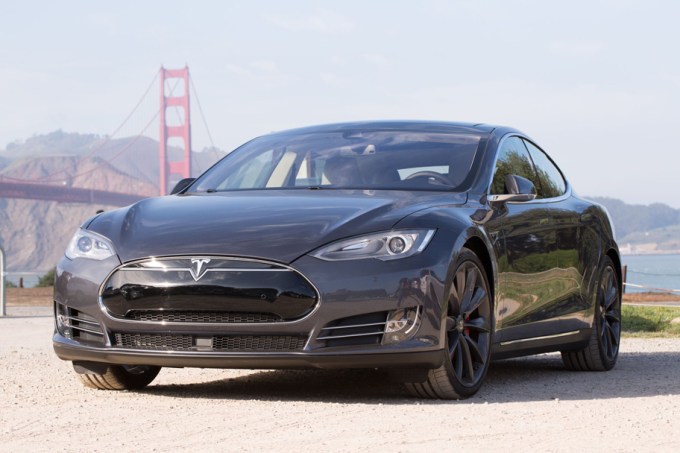
Tesla has just issued a voluntary recall for 123,000 Model S vehicles, having found that the power steering bolts in some were displaying “excessive corrosion.” Model X and Model 3 vehicles aren’t affected here, nor are Model S built after April 2016.

The company says that the corrosion is primarily occurring in cars driven in particularly cold climates, but isn’t limiting the recall to those cars (because, well, who knows where you’ll be driving it a few years from now).

In an email outlining the recall to affected owners, Tesla notes that swapping out the bolts will “take around an hour,” and that no accidents or injuries are believed to have been caused by this issue.

This isn’t the first time Tesla has issued a recall, but it’s their biggest recall to date. It recalled around 53,000 Model S and Model X vehicles in April of last year due to parking brakes that could potentially get stuck in the “on” position; a few months later, it recalled 11,000 Model X because of a faulty cable in the second-row seating.

29 Mar 2018

University of Michigan opens up its M-Air UAV testing facility to students

Companies and students who want to test an autonomous vehicle at the University of Michigan have the excellent Mcity simulated urban environment. But if you wanted to test a drone, your options were extremely limited — think “at night in a deserted lecture hall.” Not anymore: the school has just opened its M-Air facility, essentially a giant netted playground for UAVs and their humans.

It may not look like much to the untrained eye, and certainly enclosing a space with a net is considerably less labor-intensive than building an entire fake town. But the benefits are undeniable.

Excited students at a school like U-M must frequently come up with ideas for drone control systems, autonomous delivery mechanisms, new stabilization algorithms and so on. Testing them isn’t nearly as simple, though: finding a safe, controlled space and time to do it, getting the necessary approvals and, of course, containing the fallout if anything goes wrong — tasks like these could easily overwhelm a few undergrads.

M-Air serves as a collective space that’s easy to access but built from the ground up (or rather, the air down) for safe and easy UAV testing. It’s 80 by 120 feet and five stories tall, with a covered area that can hold 25 people. There are lights and power, of course, and because it’s fully enclosed it technically counts as “indoor” testing, which is much easier to get approval for. For outdoor tests you need special authorization to ensure you won’t be messing with nearby flight paths.

We can test our system as much as we want without fear of it breaking, without fear of hurting other people,” said grad student Matthew Romano in a U-M video. “It really lets us push the boundaries and allows us to really move quickly on iterating and developing the system and testing our algorithms.”

And because it’s outside, students can even test in the lovely Michigan weather.

“With this facility, we can pursue aggressive educational and research flight projects that involve high risk of fly-away or loss-of-control — and in realistic wind, lighting and sensor conditions,” said U-M aerospace engineering professor Ella Atkins.

I feel for the neighbors, though. That buzzing is going to get annoying.

29 Mar 2018

University of Michigan opens up its M-Air UAV testing facility to students

Companies and students who want to test an autonomous vehicle at the University of Michigan have the excellent Mcity simulated urban environment. But if you wanted to test a drone, your options were extremely limited — think “at night in a deserted lecture hall.” Not anymore: the school has just opened its M-Air facility, essentially a giant netted playground for UAVs and their humans.

It may not look like much to the untrained eye, and certainly enclosing a space with a net is considerably less labor-intensive than building an entire fake town. But the benefits are undeniable.

Excited students at a school like U-M must frequently come up with ideas for drone control systems, autonomous delivery mechanisms, new stabilization algorithms and so on. Testing them isn’t nearly as simple, though: finding a safe, controlled space and time to do it, getting the necessary approvals and, of course, containing the fallout if anything goes wrong — tasks like these could easily overwhelm a few undergrads.

M-Air serves as a collective space that’s easy to access but built from the ground up (or rather, the air down) for safe and easy UAV testing. It’s 80 by 120 feet and five stories tall, with a covered area that can hold 25 people. There are lights and power, of course, and because it’s fully enclosed it technically counts as “indoor” testing, which is much easier to get approval for. For outdoor tests you need special authorization to ensure you won’t be messing with nearby flight paths.

We can test our system as much as we want without fear of it breaking, without fear of hurting other people,” said grad student Matthew Romano in a U-M video. “It really lets us push the boundaries and allows us to really move quickly on iterating and developing the system and testing our algorithms.”

And because it’s outside, students can even test in the lovely Michigan weather.

“With this facility, we can pursue aggressive educational and research flight projects that involve high risk of fly-away or loss-of-control — and in realistic wind, lighting and sensor conditions,” said U-M aerospace engineering professor Ella Atkins.

I feel for the neighbors, though. That buzzing is going to get annoying.

29 Mar 2018

Uber has settled with the family of the homeless victim killed last week

Uber has reportedly come to a fast settlement with the family of 49-year-old Elaine Herzberg, who was fatally struck last week by one of the company’s self-driving vehicles as she crossed a darkened street, pushing a bicycle.

Terms of the settlement are not being disclosed; Uber declined to comment when we asked the company for further information.

The move helps Uber avoid what could have been an ugly civil case against it, even while it isn’t clear how big or sophisticated a support system Herzberg had.

Reuters reported last week that Herzberg was homeless and close to getting off the streets, with friends describing her as someone who took care of those around her. She was reportedly known in the homeless community as “Elle” and “Ms. Elle.”

She did have a daughter and was apparently married. Indeed, according to a separate Reuters report, a Glendale, Arizona attorney who typically focuses on bankruptcy and debt negotiation, told the outlet “the matter has been resolved” between Uber and Herzberg’s daughter and husband. No further information about them was disclosed.

Presumably, the case was settled at a high cost to the company, but could have been higher had it dragged out. Personal injury lawsuits typically arrive at a settlement amount after both sides determine on their own what they think a case is worth; typically, that amount is reached by reviewing similar cases and seeing what juries have awarded past victims.

Given the unique circumstances of this case — Herzberg was the first person to be killed by a self-driving car — and given Uber’s unprecedentedly high private market value of $72 billion, determining the amount would be particularly tricky.

Uber is still facing fallout from all corners over last week’s incident, including, potentially, criminal charges. The Tempe Police Vehicular Crimes Unit is actively investigating the details of last week’s incident.

Uber also announced it wouldn’t reapply to test its self-driving technology on public roads in California in the wake of the accident, meaning that as of next week, after its current permit expires, it won’t be able to operate its self-driving cars on that state’s public roads.

Arizona Governor Doug Ducey separately suspended the company’s right to operate autonomous cars on public roads in Arizona on Monday night, though emails have since surfaced that suggest Ducey himself enabled the program with limited oversight.

Pictured above: the type of vehicle that struck Herzberg.

29 Mar 2018

FCC approves SpaceX plan for 4,425-satellite broadband network

SpaceX has a green light from the FCC to launch a network of thousands of satellites blanketing the globe with broadband. And you won’t have too long to wait — on a cosmic scale, anyway. Part of the agreement is that SpaceX launch half of its proposed 4,425 satellites within six years.

The approval of SpaceX’s application was not seriously in doubt after last month’s memo from FCC Chairman Ajit Pai, who was excited at the prospect of the first U.S.-based company being authorized to launch a constellation like this.

“I have asked my colleagues to join me in supporting this application and moving to unleash the power of satellite constellations to provide high-speed Internet to rural Americans,” he wrote at the time. He really is pushing that “digital divide” thing. Not that Elon Musk disagrees:

SpaceX COO Gwynne Shotwell echoed the sentiment in a statement provided to TechCrunch:

We appreciate the FCC’s thorough review and approval of SpaceX’s constellation license. Although we still have much to do with this complex undertaking, this is an important step toward SpaceX building a next-generation satellite network that can link the globe with reliable and affordable broadband service, especially reaching those who are not yet connected.

The proposed service, which will be called Starlink, was opposed by several existing satellite operators like OneWeb and Spire. They’re rightly concerned that another operator in space — especially one that wants to launch thousands of satellites — will crowd both spectrum and orbit.

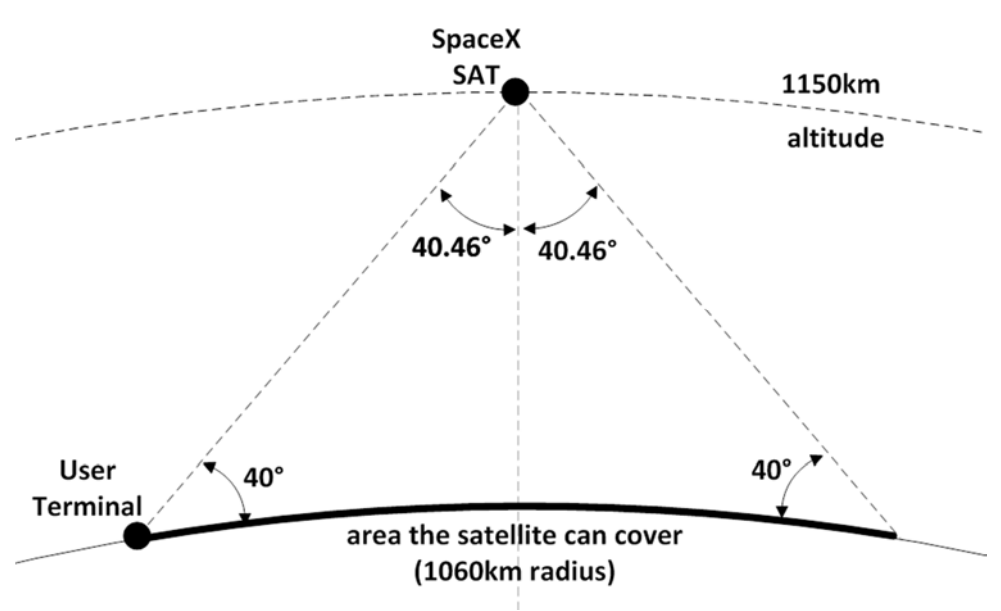
Illustration of SpaceX satellite coverage from the FCC application

OneWeb, for example, said that SpaceX satellites shouldn’t be allowed to be deployed within 125 kilometers of altitude of its own. You do want to avoid interference, but really, it’s too much to ask for a 150-mile buffer zone around your gear.

One objection that did carry water, however, was the request for an extensive orbital debris mitigation plan.

The unprecedented number of satellites proposed by SpaceX and the other [non-geostationary orbit fixed-satellite service] systems in this processing round will necessitate a further assessment of the appropriate reliability standards of these spacecraft, as well as the reliability of these systems’ methods for deorbiting the spacecraft.

So SpaceX will have to provide more studies on this by the time it finalizes its designs and starts launching.

And that will have to be fairly soon. To move things along, the FCC requires SpaceX to get underway in a hurry or else, presumably, it will have to be reauthorized:

SpaceX must launch 50 percent of the maximum number of proposed space stations, place them in the assigned orbits, and operate them in accordance with the station authorization no later than March 29, 2024.

The company has already launched test versions of the satellites, but the full constellation will need to go out more than two at a time.

The Falcon 9 carrying SpaceX’s test Starlink satellites launches on February 22

Commissioner Rosenworcel, in a separate statement, also called for a general revisiting of regulations around commercial space.

“This rush to develop new space opportunities requires new rules,” she writes. “Despite the revolutionary activity in our atmosphere, the regulatory frameworks we rely on to shape these efforts are dated. Across the board, we need to prepare for the proliferation of satellites in our higher altitudes. In short, we have work to do.”

29 Mar 2018

New York City is launching public cybersecurity tools to keep residents from getting hacked

In a week of harrowing city-level cyber attacks, New York is taking some precautions.

While the timing is coincidental, New York City Mayor Bill de Blasio just announced that the city will introduce the first tools in its suite of cybersecurity offerings to protect residents against malicious online activity, particularly on mobile devices.

When it launches this summer, New York residents will be able to download a free app called NYC Secure. The app will alert smartphone users to potential threats on their devices and offer tips for how to stay secure, “such as disconnecting from a malicious Wi-Fi network, navigating away from a compromised website, or uninstalling a malicious app.”

Because the app will take no active steps on its own, it’ll be up to users to heed the advice presented to them. NYC Secure will not collect or transmit any personal identifying information or private data.

The city will also beef up security over its public Wi-Fi networks, a notorious target for malicious actors looking to snoop on private information as it passes by unencrypted. The city will implement DNS protection through a service called Quad9, a free public cybersecurity product out of the partnership between Global Cyber Alliance (GCA), IBM and Packet Clearing House.

“In order to stay a step ahead of cyber criminals that are continuously finding new ways to hack devices, we must invest in the safety of the digital lives of our residents,” said Geoff Brown, Citywide Chief Information Security Officer. “While no individual is immune to cybersecurity threats, this program will add an extra layer of security to personal devices that often house a huge amount of sensitive data.”

New York’s NYC Cyber Command (NYC3), a city-level cyber defense organization established by mayoral executive order in July 2017, will introduce the new public security tools and oversee their implementation.

“Initiatives like this one in New York City will help grow awareness of the increasing cyberattack problem and may urge citizens to take more action to protect themselves,” McAfee CEO Christopher Young said of the city’s cyber plan.

Because New York faces so many unique cybersecurity threats as an international business hub and a dense cultural epicenter, the city could provide a compelling model for other metropolitan areas looking to take their cyber problems into their own hands.

29 Mar 2018

Under Armour says MyFitnessPal data breach affected 150 million users

Under Armour, the fitness company that owns MyFitnessPal, disclosed today a data breach that affected about 150 million users. MyFitnessPal, a food and nutrition application, earlier this week became aware of the breach, which took place late last month.

The breached data did not include any Social Security numbers, driver license numbers or any other government-issued identifiers, according to Under Armour. The company also said payment card information was not collected.

“The company quickly took steps to determine the nature and scope of the issue and to alert the MyFitnessPal community of the incident,” Under Armour wrote in a press release.

Four days after Under Armour became aware of the issue, the company said it started to notify members of the MyFitnessPal community via email and in-app messaging. Under Armour recommends MyFitnessPal users change their passwords.

“Under Armour is working with leading data security firms to assist in its investigation, and also coordinating with law enforcement authorities,” the press release stated. “The investigation indicates that the affected information included usernames, email addresses, and hashed passwords – the majority with the hashing function called bcrypt used to secure passwords.”

29 Mar 2018

Facebook tries to prove it cares with “Fighting Abuse @ Scale” conference

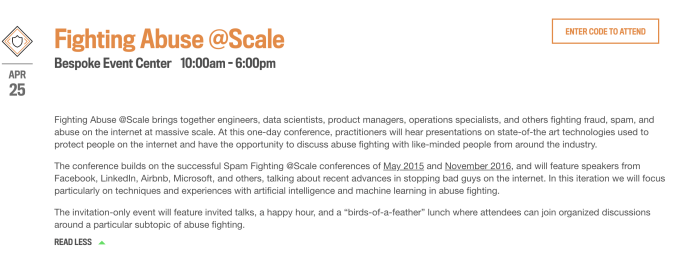
Desperate to show it takes thwarting misinformation, fraud, and spam seriously, Facebook just revealed that it’s hosting a private “Fighting Abuse @Scale” invite-only conference in San Francisco on April 25th. Speakers from Facebook, Airbnb, Google, Microsoft, and LinkedIn will discuss how to stop fake news, prevent counterfeit account creation, using honeypots to disrupt adversarial infrastructure, and how machine learning can be employed to boost platform safety.

[Update: Though never publicly announced, Facebook has already privately filled the event to capacity. The company’s PR says this isn’t a “last-minute” event as we originally described it, and initial invites went out February 6th. But the sudden move to invite journalists less than a month ahead seems timed to humanize Facebook’s efforts to combat its ongoing data abuse and election interference scandals.]

Fighting Abuse @Scale will be held at the Bespoke Event Center within the Westfield Mall in SF. We can expect more technical details about the new proactive artificial intelligence tools Facebook announced today during a conference call about its plans to protect election integrity. The first session is titled “Combating misinformation at Facebook” and will feature an engineering director and data scientists from the company.

Facebook previously held “Fighting Spam @Scale” conferences in May 2015 and November 2016 just after the Presidential election. But since then, public frustration has built up to a breaking point for the social network. Russian election interference, hoaxes reaching voters, violence on Facebook Live, the ever-present issue of cyberbullying, and now the Cambridge Analytica data privacy scandal have created a convergence of backlash. With its share price plummeting, former executives speaking out against its impact on society, and CEO Mark Zuckerberg on a media apology tour, Facebook needs to show this isn’t just a PR problem. It needs users, potential government regulators, and its own existing and potential employees to see it’s willing to step up and take responsibility for fixing its platform.

29 Mar 2018

How big money can drive diversity in venture capital

The world’s largest asset manager just called for more corporate responsibility in governance. Twenty-one countries already legislate diversity on corporate boards or mandate practices that enhance diversity in the workplace. The United States has avoided proactive rules, often citing adverse results from implementing quotas. But in the USA, money talks. And the money behind venture capital funds is starting to take diversity seriously.

When Larry Fink, CEO of BlackRock (with $5.7 trillion under management), says, “We also will continue to emphasize the importance of a diverse board,” that is a lot of votes for diversity. Similarly, the largest private foundation, Bill & Melinda Gates Foundation, just backed Aspect Ventures, a women-led venture fund, to help change the ratio in technology.

Someone working on behalf of a LARGE pool of capital recently asked me what actions would help it produce strong returns with diverse venture capital investors and diverse entrepreneurs. Their investments to date had all been with middle-aged white guys — literally — and they worried about both social justice and business relevance and returns.

Diversity is important for investment performance, both for better financial outcomes and for ameliorating risks. The trend toward requiring more diverse governance bodies, whether investment managers or corporate boards, spans from early-stage startups to public company boards. At the largest scale, governance advisers such as Glass Lewis will start to advise voting against boards that are not diverse (see page 23.) Women- and minority-owned venture capital (VC) firms are flourishing, partly driven by public employee pension funds. Strong performance in venture capital is tied to access to the best companies, many of which are now founded by a diverse range of entrepreneurs: young, racially diverse and not all male.

In the post-Binary Capital era, limited partners (LPs) are increasingly concerned with the downside risks present in non-diverse investment firms, where old-fashioned monocultures may foster illegal or undesirable behavior. Astute LPs are asking their general partners to document their diversity statistics — inside the firms and among their portfolios — and to document their policies that foster a diverse and inclusive workplace, such as policies on sexual harassment, fraternization, maternity leave, etc. The National Venture Capital Association (NVCA) provides model HR documents for free to the community for use in firms and portfolio companies.

The large pool of capital (let’s call them “LPOC”) was aware of all these trends, but sought advice on how to influence their investment portfolio of firms and their broad ecosystem. I gave LPOC these simple recommendations:

  • LPOC to track and publish its diversity stats and those of its partner firms, including the results of Rooney Rule usage in searches

  • LPOC to adopt a diversity pledge, including implementing the Rooney Rule in hiring and in considering firms for investments

  • LPOC’s partner firms to adopt a diversity pledge, including adopting the Rooney Rule in the pledge

  • LPOC to consider a broad range of managers for partnership mandates, including open solicitation of proposals for partnership

  • LPOC to encourage startups to develop diverse executive teams and to consider employing the Rooney Rule and/or other efforts to recruit diverse talent

  • LPOC to create an advisory committee to provide guidance on diversifying its investment strategy

These suggestions don’t include a capital allocation to women-owned or minority-owned firms — in other words, no quotas. But they do require LPOC to measure where it invests its money and staffing, and requires its investment partners to do the same. I believe their returns from measuring their actions will move them to the top quartile in every metric they care about — financial and social.

29 Mar 2018

Wondery wants to become Hollywood’s podcast dream factory

When Hernan Lopez, the former chief executive of Fox International, started the podcast network Wondery roughly two years ago with a seed investment from his former bosses at Fox Networks Group, podcasting was still emerging as a media platform.

Now, with voice ascendant, and podcasting proving to be a breeding ground for new narratives that other storytelling mediums can latch onto — the move into the reinvention of radio for the 21st century seems prescient.

It’s not just Fox that is now backing the podcast business, new investors led by storied venture capital and private equity investor Alan Patricof’s Greycroft Partners are coming aboard with a $5 million commitment to expand the scope of Wondery’s wonder factory. Additional investors include Lerer Hippeau Ventures and Advancit Capital — the investment vehicle for Shari Redstone (daughter of billionaire media mogul Sumner Redstone).

Previous investors  BAM Ventures, Watertower Ventures, Fox Networks Group and BDMI also participated in the round.

According to The Hollywood Reporter, Wondery intends to add new shows to its stable including American Innovations, Dr. Death, and I, Survivor and has optioned Sward and Scale and Tides of History as projects for movies and television.

While traditional media companies are being forced to join forces and combine assets to protect their market from new competitors like Facebook, Apple, Amazon, Hulu, and Netflix coming from the tech industry — new media platforms like podcasting are opening up opportunities for different kinds of studios to emerge. 

I believe there’s a huge opportunity in audio,” Lopez says. “There isn’t anywhere close to enough quality audio content being produced.”

On average, the modern consumer listens to four hours of audio per day, according to Lopez. Even though most of that is music, an increasing number of Americans are turning to podcasts as a new form of entertainment. And podcasts are beginning to attract more advertising dollars.

“In the podcast world the ads seem to work. They’re native, they’re integrated into the shows. The listeners are welcoming,” says Wondery’s chief executive. That in itself would be a welcome change for media companies hungry for new ways to maintain their ad-supported business models. 

Netflix, Amazon, and Hulu have trained a generation of consumers on subscription models that eschew advertising altogether — but podcasts still hold out promise, says Lopez.

Demographics are another key reason that advertisers are moving to podcasts, he says and Comscore research (funded by Wondery) seems to back up his assertions.
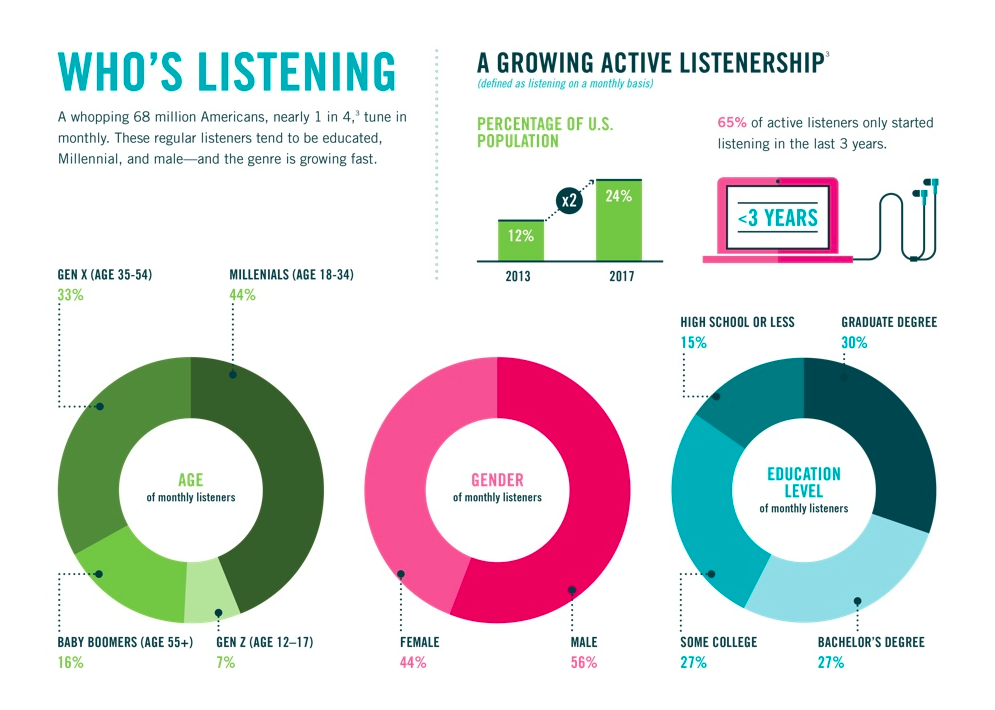
According to Comscore, nearly one in five Americans aged 18-49 said they’d listened to podcasts at least once a month — a number that increases when it’s restricted to the highly coveted demographic of men between the ages of 18 and 34. while nearly one in three men 18-34 do so. Podcast listeners are also more likely to have a college degree, make over $100,000 and be early adopters of electronics, consumer goods, and entertainment.

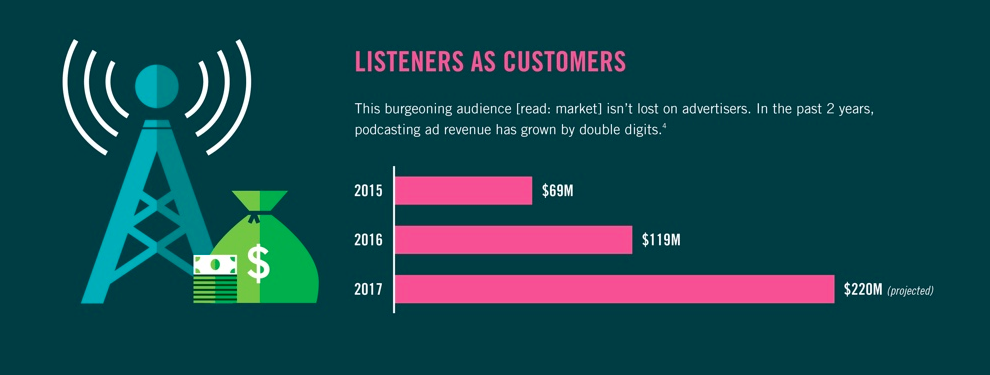
Advertisers are beginning to take notice, with $119 million spent on podcast advertising in 2016 and an estimated $220 million spent on podcast ads last year (according to estimated figures in a survey underwritten by major podcast networks).
Some of Wondery’s podcasts have already racked up impressive numbers. Dirty John has been dowloaded more than 20 million times; American History Tellers has been downloaded more than 3 million times; and Business Wars more than 2 million times, says Lopez. 

Wondery is also bucking the media trend of serving up micro-content to audiences.

“We don’t produce much micro-content — if any,” says Lopez. “The stories that we tend to gravitate towards tend to work better in long-form. We have to keep their attention for as long as possible.”

Lopez’s Wondery isn’t the only company to rake in money from institutional investors for building a podcasting empire.

On the other side of the country in the borough of Brooklyn stands Gimlet Media, the $20 million king of the podcast market these days. Gimlet — which raised from a slew of investors including WPP, Betaworks, Stripes Group, Lowercase Capital, LionTree Parters, Emerson Collective, Cross Culture Ventures, and music manager turned investor Troy Carter.

Success among podcasts is also translating into options in other formats. As The New York Times noted yesterday, podcasts are getting “the Hollywood treatment“.

Wondery’s own “Dirty John,” is being turned into series for two networks — true crime stories on Oxygen — and as the basis for a scripted series on Bravo.Meanwhile, “Welcome to Night Vale”, “Alice Isn’t Dead”, “Up and Vanished” and “Crimetown” are all being turned into series by different production companies.

“In the last year or so, podcasts have been the thing,” Matt Tarses, the creator of “Alex, Inc.” (a new ABC show based off of Gimlet Media’s “Startup” podcast) told The New York Times.