
29 Mar 2018

Wondery wants to become Hollywood’s podcast dream factory

When Hernan Lopez, the former chief executive of Fox International, started the podcast network Wondery roughly two years ago with a seed investment from his former bosses at Fox Networks Group, podcasting was still emerging as a media platform.

Now, with voice ascendant, and podcasting proving to be a breeding ground for new narratives that other storytelling mediums can latch onto — the move into the reinvention of radio for the 21st century seems prescient.

It’s not just Fox that is now backing the podcast business, new investors led by storied venture capital and private equity investor Alan Patricof’s Greycroft Partners are coming aboard with a $5 million commitment to expand the scope of Wondery’s wonder factory. Additional investors include Lerer Hippeau Ventures and Advancit Capital — the investment vehicle for Shari Redstone (daughter of billionaire media mogul Sumner Redstone).

Previous investors  BAM Ventures, Watertower Ventures, Fox Networks Group and BDMI also participated in the round.

According to The Hollywood Reporter, Wondery intends to add new shows to its stable including American Innovations, Dr. Death, and I, Survivor and has optioned Sward and Scale and Tides of History as projects for movies and television.

While traditional media companies are being forced to join forces and combine assets to protect their market from new competitors like Facebook, Apple, Amazon, Hulu, and Netflix coming from the tech industry — new media platforms like podcasting are opening up opportunities for different kinds of studios to emerge. 

I believe there’s a huge opportunity in audio,” Lopez says. “There isn’t anywhere close to enough quality audio content being produced.”

On average, the modern consumer listens to four hours of audio per day, according to Lopez. Even though most of that is music, an increasing number of Americans are turning to podcasts as a new form of entertainment. And podcasts are beginning to attract more advertising dollars.

“In the podcast world the ads seem to work. They’re native, they’re integrated into the shows. The listeners are welcoming,” says Wondery’s chief executive. That in itself would be a welcome change for media companies hungry for new ways to maintain their ad-supported business models. 

Netflix, Amazon, and Hulu have trained a generation of consumers on subscription models that eschew advertising altogether — but podcasts still hold out promise, says Lopez.

Demographics are another key reason that advertisers are moving to podcasts, he says and Comscore research (funded by Wondery) seems to back up his assertions.
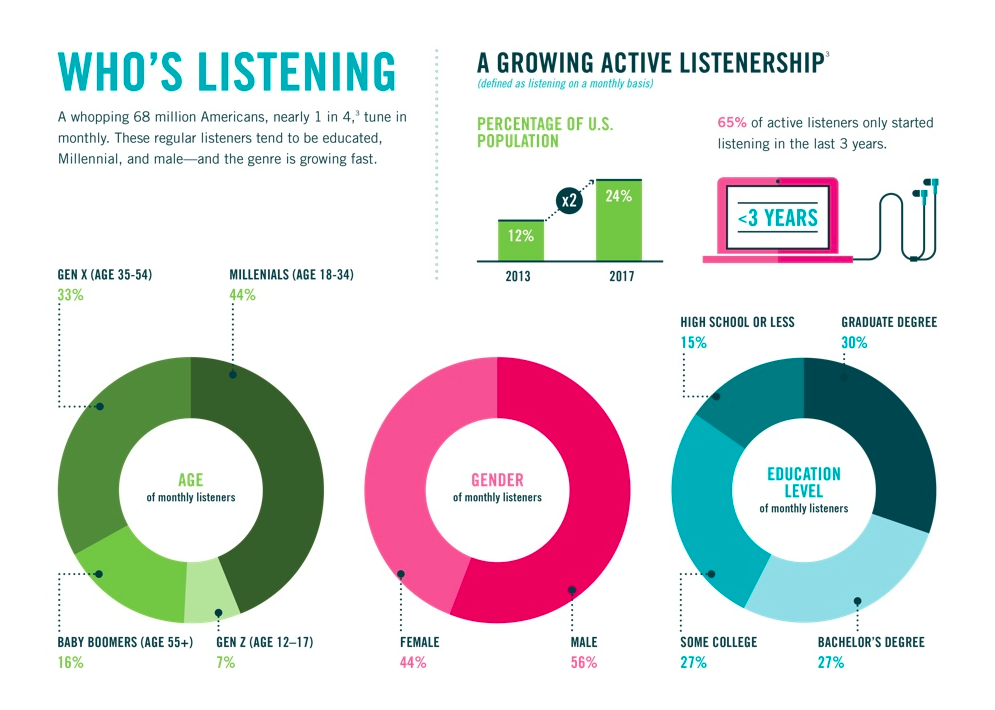
According to Comscore, nearly one in five Americans aged 18-49 said they’d listened to podcasts at least once a month — a number that increases when it’s restricted to the highly coveted demographic of men between the ages of 18 and 34. while nearly one in three men 18-34 do so. Podcast listeners are also more likely to have a college degree, make over $100,000 and be early adopters of electronics, consumer goods, and entertainment.

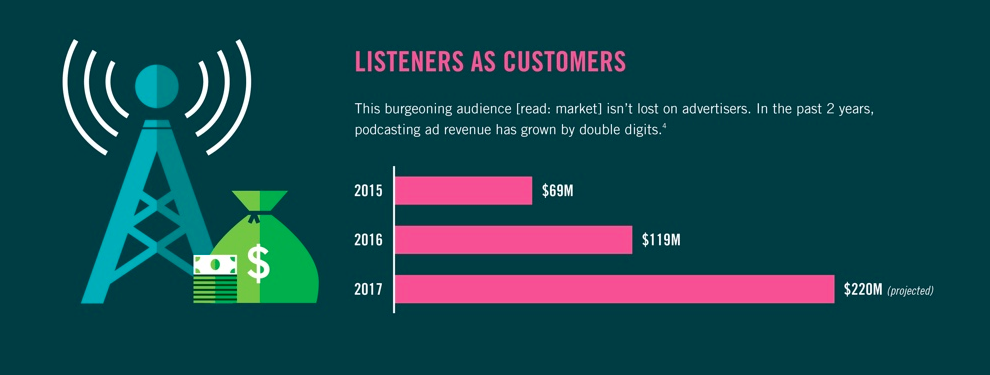
Advertisers are beginning to take notice, with $119 million spent on podcast advertising in 2016 and an estimated $220 million spent on podcast ads last year (according to estimated figures in a survey underwritten by major podcast networks).
Some of Wondery’s podcasts have already racked up impressive numbers. Dirty John has been dowloaded more than 20 million times; American History Tellers has been downloaded more than 3 million times; and Business Wars more than 2 million times, says Lopez. 

Wondery is also bucking the media trend of serving up micro-content to audiences.

“We don’t produce much micro-content — if any,” says Lopez. “The stories that we tend to gravitate towards tend to work better in long-form. We have to keep their attention for as long as possible.”

Lopez’s Wondery isn’t the only company to rake in money from institutional investors for building a podcasting empire.

On the other side of the country in the borough of Brooklyn stands Gimlet Media, the $20 million king of the podcast market these days. Gimlet — which raised from a slew of investors including WPP, Betaworks, Stripes Group, Lowercase Capital, LionTree Parters, Emerson Collective, Cross Culture Ventures, and music manager turned investor Troy Carter.

Success among podcasts is also translating into options in other formats. As The New York Times noted yesterday, podcasts are getting “the Hollywood treatment“.

Wondery’s own “Dirty John,” is being turned into series for two networks — true crime stories on Oxygen — and as the basis for a scripted series on Bravo.Meanwhile, “Welcome to Night Vale”, “Alice Isn’t Dead”, “Up and Vanished” and “Crimetown” are all being turned into series by different production companies.

“In the last year or so, podcasts have been the thing,” Matt Tarses, the creator of “Alex, Inc.” (a new ABC show based off of Gimlet Media’s “Startup” podcast) told The New York Times. 

29 Mar 2018

AngelPad, the accelerator, just closed on a new $35 million fund

AngelPad, an accelerator program that has launched more than 140 companies across 11 different “classes,” has raised a new, $35 million venture fund, shows a new SEC filing.

Its husband-and-wife cofounders, Thomas Korte and Carine Magescas, declined to comment on the filing.

The fund appears to be its first fund of substantial size, following a trial fund the duo had begun investing at AngelPad’s outset in 2010 with their own capital, and a second fund that was roughly $7 million in size and included some outside investors.

Korte has told us in the past that AngelPad also relies heavily on special purpose vehicles (or SPVs) to double-down on its breakout companies. In recent years, for example, the outfit and its investors have made an outsize bet on the delivery company Postmates, say our sources. (Postmates was among the earliest companies to pass through AngelPad’s program.)

We wrote about AngelPad last week, noting that it recently decided to do away with its twice-yearly demo days in San Francisco, in favor or organizing a day of one-on-one investor meetings with its startups instead. (Y Combinator, known for its very full demo days, also helps set up one-on-one meetings with investors and startups that want to meet each other over the course of one day.)

What hasn’t changed at AngelPad: it continues work with roughly the same, low, double-digit number of founding teams as it always has.

You can check out its newest batch of startups — 10 in all — right here. Others of its portfolio companies include the insurance comparison site Coverhound; Vungle, which helps developers insert video ads into their apps; Kinnek, a marketplace that helps small businesses find suppliers; the growth marketing platform Iterable; drone mapping and analytics platform Drone Deplo ; and Zum, a company offering on-demand rides for kids.

All have gone on to raise substantial rounds of follow-on financing, though Vungle had a rocky 2017, after its cofounding CEO was arrested and charged with shocking abuses that police officials believe may have taken place while he was under the influence of LSD. (Vungle quickly replaced him with the company’s former COO, Rick Tallman.)

AngelPad has also had numerous exits over the years. Its biggest win may be Mopub, a startup that helped mobile publishers manage their ad inventory and was acquired Twitter in 2013 for $350 million.

Other trade sales include the acquisition of shopping optimization startup Adku by Groupon in 2011, the sale of to-do app Astrid & Blik to Yahoo in 2014, and the sale of the social search engine Spotsetter to Apple.

Terms of these last three deals were not disclosed publicly.

Korte joined us on stage in Berlin at TC’s Disrupt event last December to talk about his penchant in particular for European founders willing to come to the U.S.

He said at the time that he admired the “fiscal responsibility that Europeans have, because they’re so used to building their companies with relatively little money or knowing they might not get another round.”

29 Mar 2018

Tim Cook hits Facebook again over privacy concerns

Tim Cook took a break from criticizing Facebook on Tuesday to present the next step in Apple’s big education plans. But the CEO is back at it. Sitting down with MSNBC and Recode at a town hall event, Cook was once again asked about consumer privacy in the wake of fallout over Facebook’s Cambridge Analytica quagmire.

Cook interviews that while he believed self-regulation is best in the case of these tech giants, “I think we’re beyond that.” Asked what he would do, were he in Zuckerberg’s position, he added, simply, “I wouldn’t be in this situation.”

The executive has never shied away from criticizing Facebook, of course. In 2015, he indirectly criticized the approach of internet companies like Google and Facebook, stating “They’re gobbling up everything they can learn about you and trying to monetize it. We think that’s wrong. And it’s not the kind of company that Apple wants to be.”

Just this weekend, he echoed that statement, with a more direct jab at Facebook, following the Cambridge Analytica revelations, telling the audience at a conference in China, “The ability of anyone to know what you’ve been browsing about for years, who your contacts are, who their contacts are, things you like and dislike and every intimate detail of your life — from my own point of view it shouldn’t exist.”

Cook echoed those statements onstage this week, adding, “The truth is, we could make a ton of money if we monetized our customer — if our customer was our product. We’ve elected not to do that.”

The company reflected that sentiment in an updated privacy policy posted back in January, explaining that,

Apple believes privacy is a fundamental human right, so every Apple product is designed to:

  • Use on-device processing wherever possible
  • Limit the collection and use of data
  • Provide transparency and control over your information
  • Build on a strong foundation of security
29 Mar 2018

Gwyneth Paltrow’s Goop raises another $50 million

Actress-turned-entrepreneur Gwyneth Paltrow is getting more capital to accelerate her startup’s growth.

Goop, the lifestyle brand which she founded ten years ago, is announcing a $50 million Series C round from NEA, Lightspeed Venture Partners and Felix Capital. It brings the total outside investment to $82 million. A source close to the situation tells us that the latest round is being done at about a $250 million post-money valuation, although the company denies it. Pitchbook has separately reported Goop’s post-money valuation to be $250 million.

Paltrow is more than just a celebrity attached to the company. She also runs it as creative director and CEO and has become nearly as well-known for her unusual diet and beauty rituals as for her Oscar-winning acting.

Goop, meanwhile, is growing. Not only does its digital property feature content about fashion, travel, and beauty, but it increasingly sells relevant products, something the company calls “contextual commerce.” These include categories like apparel, skincare, vitamins and bath products.

Some of the more unusual items the company promotes are gem-infused water bottles that are said to promote positive energy. Such claims have landed Goop in hot water; a handful of the wellness products have been accused of false advertising.

Consumers may be less interested in the controversies, however. The startup says it has tripled its revenue each of the past two years. (Goop didn’t share specific sales numbers, however.)

We’re also told that a large portion of the company’s 2018 growth will come from continued international expansion. Goop’s commerce business recently launched in Canada, and it expects to ship to Europe by the end of the year.

Goop says that new product lines like home furnishings may also be on the horizon.


29 Mar 2018

NASA’s beautiful snowflake simulations could help predict inclement weather

There’s a lot about snow we don’t know. Where does it come from? Where does it go? What does it taste like? Admittedly there are tentative answers to these questions. But there are yet more complex ones like how exactly, on a microscopic level, snow melts in mid-air. That’s the focus of one project at NASA, the results of which are both practical and beautiful.

Snow is a critical part of the weather system (did you know there’s a whole “cryosphere”), and the ways in which it forms and melts can help meteorologists predict, for example, the likelihood or severity of a storm. But it’s not enough to catch a flake in your hand and look closely. Like anything else, you need a mathematical model of a phenomenon in order to understand it properly.

Jussi Leinonen has been working on this problem for years at NASA’s Jet Propulsion Laboratory.

“I got interested in modeling melting snow because of the way it affects our observations with remote sensing instruments,” he said in a news release. As you can imagine, it’s rather important for a rocket science lab to be able to understand and predict weather patterns.

Leinonen’s contribution has been an exact model of how and why snowflakes melt — which types of flakes, at what temperatures, in what ways, and so on. The basic version is this: water collects in concave regions of snowflakes where it can stay liquid. Those little lakes expand, eventually covering the whole ice crystal and encasing the core, which also eventually melts.

Sounds straightforward, but Leinonen’s model shows how this happens at an extremely detailed level with arbitrarily shaped snowflakes and clumps thereof. The 3D visualization of this process is remarkably beautiful, and more importantly seems to be correct.

With an accurate model meteorologists can profile different snow and rain types, see how they perform in various conditions, and produce relevant details like how those differences would affect a radar image.

No word on when we can get a screensaver of snowflakes melting with high precision. Leinonen published his research in the journal Geophysical Research.

29 Mar 2018

HBO’s new trailer for Westworld season 2 showcases robot-induced chaos

As HBO prepares itself for the end of Game of Thrones, it’s apparent that they’re putting weight on Westworld to take over as the network’s dominant fantasy epic. A new trailer dropped today for the show’s second season and it’s clear that the robot uprising is going to take the brutal, violent spirit of the season-one finale and pour it over the existential questions that are the backbone of the show.

Things are going to get even darker very quickly, it looks like.

The new trailer captures all of the actions and struggles of Dolores, Teddy, Bernard, Maeve and the Man in Black with an orchestral cover of Nirvana’s “Heart-Shaped Box” playing in the background. While the end of the last season suggested that a new Shogunworld destination would play a major role in season two, our peeks at the destination have been pretty limited in the first pair of trailers.

We’re still seeing the show’s central characters traverse through the desolation of the old West and the high-tech opulence of the world behind it.

Westworld’s second season begins April 22 on HBO.

29 Mar 2018

The CW goes live on Hulu with Live TV

Hulu has added the live, linear version of the CW to its Hulu with Live TV platform.

Hulu has had a deal with the CW to offer streaming on-demand content from the network, but this is the first time that the CW will be available live on Hulu.

The company first launched Hulu with Live TV in the summer of 2017, offering more than 50 channels for $39.99/month, complete with access to Hulu’s on-demand content library and 50 hours of DVR storage.

The service launched with some competition from YouTube, which launched a similar offering called YouTube TV in April 2017.

According to a report from January, Hulu with Live TV has around 450,000 subscribers, while YouTube TV has 300,000 subscribers.

Live CW on Hulu is not available everywhere, but will be on Hulu with Live TV in the following markets: Philadelphia, San Francisco, Atlanta, Tampa, Detroit, Seattle, Sacramento, Pittsburgh. The company says it’s rolling out live CW to more markets soon.

29 Mar 2018

Tesla reportedly wants Model 3 factory workers to prove the ‘haters’ wrong

Tesla has reportedly asked its Model 3 factory workers to prove the “haters” wrong by stepping up car production.

In a memo obtained by Bloomberg, Tesla engineering chief Doug Field told staff it would be an “incredible victory” to exceed the production of 300 Model 3 vehicles a day. Field’s memo, reportedly sent on March 23, expressed feeling insulted by people doubting Tesla’s ability to hit its production targets.

“Let’s make them regret ever betting against us,” Field wrote. “You will prove a bunch of haters wrong.”

Tesla has also decided to shutdown Model S and Model X production on Friday, but it is not related to Model 3 production targets, according to the memo. That’s because Tesla is ahead of its production targets on those models. For the workers affected by the production pause on Friday for the S and X, they have the option to work on the Model 3.

Over the last couple of days, a number of analysts have expressed concern and doubt over Tesla’s ability to hit its Model 3 production targets this quarter.

Tesla declined to comment on this story.

29 Mar 2018

New federal rules blamed in disappearance of Kindle erotica titles

The upcoming Fight Online Sex Trafficking Act, in addition to making Microsoft move to reduce obscenity on its platform, has hit erotica authors on Amazon. After many authors saw their rankings stripped on the Kindle store, essentially reducing their availability and visibility, while forcing others in the romance category to recategorize or get dinged as well.

The Digital Reader followed the changes this week, reporting that “I have seen numerous reports on Facebook, KBoards, and elsewhere that Amazon has adopted a new policy where some romance titles, most notably those titles that Amazon has identified as erotica, have been removed from the Kindle Store best-seller list.” Amazon’s changes began on March 22.

Delisting titles from the Amazon Kindle store essentially buries them completely, leading to massive revenue loss for indie authors. One author received a note from KDP – Kindle Direct Publishing – discussing the changes:

I’m following up concerning some of your books missing their best sellers ranking.

After hearing from our technical team we have confirmed that this is due to a recent update to the filter option for Erotica ebooks.

All adult themed titles will be filtered from the main category sales rank as part of this update. However, you will still continue to keep all of your category rankings. I know this wasn’t the answer you were looking for but appreciate your understanding on this policy.

Please let us know if you have any further questions.

The FOSTA Bill is ostensibly about preventing online sex trafficking and has already caused Craigslist to shut down its online personals. However, it can also be construed as a bill that prevents sexual material of all kinds from receiving ready distribution online, a fact that is giving some big content providers pause. The Digital Reader notes that “the change in policy only affects the main Amazon site, and not other sites like Amazon UK.”

I have reached out to authors and Amazon for further comment.

29 Mar 2018

Disney’s ultra-realistic Millennium Falcon flight simulator will need 8 GPUs to run

Disney is building a real-time, ultra-high-res flight simulator for the Millennium Falcon and they’re powering it with eight daisy-chained high-end Nvidia GPUs.

The experience, which is destined to arrive at Disneyland and Walt Disney World Resorts next year, was done in partnership with Nvidia, Epic Games and Lucasfilm’s ILMxLAB. When it’s finished, guests at the Disney properties will be able to hop into the cockpit of the Millennium Falcon, fire the ship’s blasters and get the vessel prepped to enter hyperspace.

The company talked about their still-in-progress work at Nvidia’s GTC conference, where they chatted about how they’ve had to milk the latest game engine tech for all its worth to power the real-time immersive mission-based experience.

Each and every implementation of the sim will be powered by a Boxx workstation running eight Nvidia Quadro P6000 GPUs connected via Quadro SLI, so this definitely won’t be something available to consumers. Disney had to build multi-GPU workflows, which they helped Epic Games integrate into the company’s Unreal Engine which will continue to use that code moving forward.

The screenshot above is an early render of what the new experience will look like.

This whole experience will be just one part of Star Wars: Galaxy’s Edge, a new section of Disneyland Park at the Disneyland Resort in California and Disney’s Hollywood Studios at Walt Disney World in Florida, which will encapsulate a lot of the nerd canon of the Star Wars universe into awesome experiences that take Disney’s theme parks and resorts to new technical ends.