29 Mar 2018

African VC TLcom Capital invests $5M in Nigerian data analytics firm Terragon Group

The African venture firm TLcom Capital is betting on Africa’s data analytics markets with a $5 million investment in Nigerian-based Terragon Group, the developer of a software analytics service for customer acquisition.

TLcom’s commitment is the second from its $40 million TIDE Africa Fund for early and growth-stage digital companies.

“We liked…that the business has matured into a new platform with very strong technology behind it,” said TLcom Capital Partner, Ido Sum. “It allows the largest advertisers and brands…to reach consumers in a way they couldn’t do before.”

Located in Lagos, Terragon’s software services give its clients — primarily telecommunications and financial services companies — data on Africa’s growing consumer markets.

Products allow users to drill down on multiple combinations of behavioral and demographic information and reach consumers through video and SMS campaigns while connecting to online sales and payments systems, according to the company.

“We can track across several layers — web, mobile, mobile money — and track data to do things channel agnostically,” said Terragon CEO Elo Umeh, on how Terragon captures consumer info from multiple sources.

These tracking services are enabled by a lack of regulation around data privacy in the country. “There is currently no comprehensive data privacy or personal information protection law in Nigeria,” said CTO Ayodeji Balogun of Terragon’s largest market. “A bill is being considered and we are actively engaging with regulators and legislators to create a clear path.”

Beyond government mandates, Balogun highlighted Terragon’s internal controls. “Adrenaline was built using a comprehensive data governance framework to ensure data security and consumer privacy,” he said. The company is also working with Deloitte to implement ISO/IEC 27001 information security standards “across all our platforms, systems, and processes,” said Balogun.

The company has a team of 100 employees across Nigeria, Kenya, Ghana and South Africa. Top customer sectors across countries span fast-moving consumer goods, financial services, gaming and betting and NGOs, according to Umeh.

“We are helping everyone we work for to intelligently reach the mobile user in Africa,” he said. “We are providing them data…driving accuracy, and making sure they are communicating with the right person at the right time, and at the right place.”

Terragon generates revenue primarily on transaction facilitation for its clients. TLcom Capital is their first formal investor, according to Umeh. Though the company does not release financial statements, he said Terragon had bootstrapped itself into the black. “We are profitable. We’ve been in business for eight years and have grown to revenues of between $4 and $5 million dollars a year.”

Consumer research in Africa is emerging as a professional industry as the continent’s large informal business space — representing some 55 percent of the continent’s economic activity — modernizes. The growth of consumer spending, e-commerce, mobile penetration and Africa’s improving broadband landscape are facilitating this, while creating opportunities for data services.  

Big global firms such as Nielsen and Euromonitor have upped their African consumer research offerings. An American company, GeoPoll, has also built out a digital survey service and database in multiple African countries, and mSurvey, a Kenyan-based startup specializing in mobile data collection, developed a Consumer Wallet product with partner Safaricom in 2017 and recently expanded in to Nigeria.

Meanwhile, Umeh sees global possibilities for the company’s platform. Terragon already has a consumer data research and development team in India and is contemplating expansion in Asia and the Americas. “Today the strategy is to be dominant on the continent of Africa,” said Umeh. “At some stage we’ll look at licensing our technology into Southeast Asia and Latin America. We think our technology is relevant South of the equator. We also think we can generate interest out of large advertisers looking at Africa from New York,” he said.

29 Mar 2018

Instagram reenables GIF sharing after GIPHY promises no more racism

A racial slur GIF slipped into GIPHY’s sticker library earlier this month, prompting Instagram and Snapchat to drop their GIPHY integrations. Now Instagram is reactivating after GIPHY confirmed its reviewed its GIF library four times and will preemptively review any new GIFs it adds. Snapchat said it had nothing to share right now about whether it’s going to reactivate GIPHY.

“We’ve been in close contact with GIPHY throughout this process and we’re confident that they have put measures in place to ensure that Instagram users have a good experience” an Instagram spokesperson told TechCrunch. GIPHY told TechCrunch in a statement that “To anyone who was affected: we’re sorry. We take full responsibility for this recent event and under no circumstances does
GIPHY condone or support this kind of content . . . We have also finished a full investigation into our content moderations systems and processes and have made specific changes to our process to ensure soemthing like this does not happen again.”

We first reported Instagram was building a GIPHY integration back in January before it launched a week later, with Snapchat adding a similar feature in February. But it wasn’t long before things went wrong. First spotted by a user in the U.K. around March 8th, the GIF included a racial slur. We’ve shared a censored version of the image below, but warning, it still includes graphic content that may be offensive to some users.

When asked, Snapchat told TechCrunch ““We have removed GIPHY from our application until we can be assured that this will never happen again.” Instagram wasn’t aware that the racist GIF was available in its GIPHY integration until informed by TechCrunch, leading to a shut down of the feature within an hour. An Instagram spokesperson told TechCrunch “This type of content has no place on Instagram.” After 12 hours of silence, GIPHY responded the next morning, telling us “After investigation of the incident, this sticker was available due to a bug in our content moderation filters specifically affecting GIF stickers.”

The fiasco highlights the risks of major platforms working with third-party developers to brings outside and crowdsourced content into their apps. Snapchat historically resisted working with established developers, but recently has struck more partnerships particularly around augmented reality lenses and marketing service providers. While it’s an easy way to provide more entertainment and creative expression tools, developer integrations also force companies to rely on the quality and safety of things they don’t fully control. As Instagram and Snapchat race for users around the world, they’ll have to weigh the risks and rewards of letting developers into their gardens.

GIPHY’s full statement is below.

CHANGES TO GIPHY’S STICKER MODERATION
Before we get into the details, we wanted to take a moment and sincerely apologize for the
deeply offensive sticker discovered by a user on March 8, 2018. To anyone who was affected:
we’re sorry. We take full responsibility for this recent event and under no circumstances does
GIPHY condone or support this kind of content.
The content was immediately removed and after investigation a bug was found in our content
moderation filters affecting stickers. This bug was immediately fixed and all stickers were re-
moderated.
We have also finished a full investigation into our content moderation systems and processes
and have made specific changes to our process to ensure something like this does not happen
again.

THE CHANGES
After fixing the bug in our content moderation filters and confirming that the sticker was
successfully detected, we re-moderated our entire sticker library 4x.
We have also added another level of GIPHY moderation before each sticker is approved into
the library. This is now a permanent addition to our moderation process.
We hope this will ensure that GIPHY stickers will always be fun and safe no matter where you
see them.

THE FUTURE AND BEYOND
GIFs and Stickers are supposed to make the Internet a better, more entertaining place.
GIPHY is committed to making sure that’s always the case. As GIPHY continues to grow, we’re
going to continue looking for ways to improve our user experience. Please let us know how we
can help at: support@giphy.com.
Team Giphy.


29 Mar 2018

The U.S. IPO market just had the best quarter in three years

The U.S. IPO market had its best quarter by proceeds in three years, according to the IPO research company Renaissance Capital.

That kind of momentum has seemingly set the stage for some big names in tech to march onto the public market in the second quarter.

Forty-three companies raised a collective $15.6 billion through their IPOs, says Renaissance, though not all were tech deals. One was the IPO of security company ADT, which had been taken private in early 2016 in a $6.9 billion leveraged buyout by the private equity group Apollo Global Management. As MarketWatch noted at the time of ADT’s January IPO, Apollo continues to own a majority of the company’s shares, meaning it’s a “controlled company” where Apollo is still basically in charge.

Another big, non-tech IPO was that of Hudson, operator of the Hudson “travel essentials” and bookstores found at airports across the U.S. and Canada. Hudson is also a controlled company that remains majority owned by a parent company, Dufry AG of Switzerland. In fact, Dufry earmarked all the proceeds from Hudson’s IPO ($750 million) to pay down its own debt.

Neither of their IPOs performed terribly well. Hudson priced at the low end of its proposed range and its shares started to sink almost immediately. ADT’s shares are also trading below their offering price.

As Renaissance notes, three companies that went public and performed much better are the biotechs Menlo Therapeutics and ARMO BioSciences, and the cybersecurity company Zcaler.

Menlo is a seven-year-old, Redwood City, Ca.-based drug developer focused on severe skin itching and chronic cough, and demand for its shares was such that it increased its proposed IPO terms from offering 5.7 million shares at $14 to $16, to offering 6.5 million shares at $16 to $17. Those shares are now trading at roughly $37.

ARMO BioSciences is a four-year-old, Redwood City-based late-stage immuno-oncology company. And it similarly priced its shares above their initial range, owing to demand. The original idea was to sell 6.7 million shares at between $14 and $16; it wound up selling 7.5 million shares at $17. Today, those shares are also trading at around $37.

Both companies went public in January. Meanwhile, Zcaler, a nearly 11-year-old, San Jose, Ca.-based security startup that confidentially filed for an IPO last year, started trading less than two weeks ago at $27.50 per share. Its shares are trading at around the same point as of this writing.

Indeed, biotechs and other tech companies led deal flow, says Renaissance, with 13 and 10 IPOs being staged, respectively.

Some of them were China-based companies, like the video streaming platform iQIYI, which raised a whopping $2.3 billion in a sale of American depositary shares.

The market also had a taste of its first, long-awaited tech company, when the cloud-storage firm Dropbox finally IPO’d last week. It was everything its private investors could have hoped for, too. After selling 36 million shares at $21 apiece last Thursday night, its shares soared 36 percent in their first day of trading last Friday.

Dropbox may have been helped along by its investment bankers (they have a way of making these things pop). Either way, if its performance holds up, we can probably expect more splashy debuts in very short order.

Already on deck, or course, is the music streaming service Spotify. The company has filed to sell shares on the public markets this coming Tuesday, April 3.

29 Mar 2018

Apple releases iOS 11.3 with new Animojis

Apple just released an iOS update for your iPhone and iPad. 11.3 introduces a ton of bug fixes but also a bunch of new features. If you forgot about Animjois, today is your lucky day as Apple is adding four new Animojis — a dragon, a bear, a lion and a skull.

But that’s not all. Apple already shared a preview of iOS 11.3 a couple of months ago. There’s a big ARKit update to ARKit 1.5. It can recognize more objects and surfaces.

And iOS 11.3 is also the battery update we’ve all been waiting for. There’s some new info in the settings about the status of your battery. It tells you the overall capacity and if it’s time to change your battery.

You can also choose to disable Apple’s controversial decision to throttle performance with old batteries. Apple says it’s a beta feature for now.

Apple is also introducing a new feature in the Health app. You can now centralize all your health records in the app. It’s only limited to a handful of clinics for now.

Apple is adding customer support conversations to Messages. You can initiate a conversation with a business to order something, book a table and more. Discover, Hilton, Lowe’s and Wells Fargo are already on board. Health Records and Business Chats are only available in the U.S. as a beta for now.

You’ll also see a new privacy icon across the operating system. A new website to export all your data is coming in May as well. Apple needs to add those features to comply with GDPR.

Finally, Apple Music is getting a new video clips section, the App Store Updates tab now shows you the size of each update and more tiny little things. And if you care about security, it’s always a good thing to update to the latest version of iOS. Unfortunately, iOS 11.3 still doesn’t include iMessage in iCloud.

Back up your iPhone or iPad to iCloud or your computer using iTunes before updating. You can then head over to the Settings app, then ‘General’, then ‘Software Update’. macOS, watchOS and tvOS updates are also available today.

29 Mar 2018

Twitter makes it easier to share the right part of a live video with launch of ‘Timestamps’

Twitter today is introducing a new feature that will make it easier to share a key moment from a live video, so those viewing the tweet don’t have to scroll to the part of the broadcast you want to talk about. The feature, called “Timestamps,” is something Twitter says it built in response to existing user behavior on Twitter.

Before, users could only tweet an entire live video . So, if they wanted to highlight a particular segment, they would tweet the video along with the specific time in the video where the part they’re trying to share begins.

Those viewing the tweet would then have to scroll through the video to the correct time, which can be cumbersome on longer broadcasts and challenging on slower connections.

For instance:

The new Timestamps feature makes this whole process simpler. Now, when you tap to share a live video (or a replay of a live video), you’re able to scroll back to the exact time you want the audience to watch. You can then add your own thoughts to the tweet, and post it as usual.

But anyone seeing the tweet will start watching right at the time you specified.

If the video is still live, they’ll then be able to skip to what’s happening now by clicking the “live” button, or they can scroll back and forward in the video as they choose.

The new option ties in well with Twitter’s live streaming efforts, which has seen the company focused on offering live-streamed sporting events, news broadcasts, and other events.

For example, those live-streaming a sports match could re-share the same live video broadcast every time the team scores a goal, with the video already positioned to the right part of the broadcast to capture that action. That could increase the video’s number of viewers, which could then translate to better advertising potential for those live streams.

However, Twitter will not allow advertisers to place their ads against the Timestamped moments at launch, because they don’t want to get into a situation where an advertiser is positioned up against a moment that’s not considered ‘brand-safe.’

Beyond the sports-focused use cases, people could also take advantage of Timestamps to share their favorite song from a live-streamed concert, while reporters could highlight something important said during a press conference.

Twitter notes the Timestamps feature will be available to anyone – not just professional content publishers. It will also work for anyone doing a broadcast from their phone, and will support live videos both on Twitter and Periscope.

On Twitter, you’ll be able to share the live video as a tweet, while on Periscope you’re  able to share to your Periscope followers, in addition to sharing to Twitter or sharing as a link.

Timestamps isn’t the first feature Twitter built by watching how people were using its product. The company has a long history of adapting its product to consumer behavior as it did with the previous launches of @ replies, the hashtag, retweets and, most recently, threads. 

The update that delivers support for Timestamps is rolling out today on Twitter for Android and iOS, Twitter.com and Periscope.


29 Mar 2018

Here’s Cambridge Analytica’s plan for voters’ Facebook data

More details have emerged about how Facebook data on millions of US voters was handled after it was obtained in 2014 by UK political consultancy Cambridge Analytica for building psychographic profiles of Americans to target election messages for the Trump campaign.

The dataset — of more than 50M Facebook users — is at the center of a scandal that’s been engulfing the social network giant since newspaper revelations published on March 17 dropped privacy and data protection into the top of the news agenda.

A UK parliamentary committee has published a cache of documents provided to it by an ex CA employee, Chris Wylie, who gave public testimony in front of the committee at an oral hearing earlier this week. During that hearing he said he believes data on “substantially” more than 50M Facebookers was obtained by CA. Facebook has not commented publicly on that claim.

Among the documents the committee has published today (with some redactions) is the data-licensing contract between Global Science Research (GSR) — the company set up by the Cambridge University professor, Aleksandr Kogan, whose personality test app was used by CA as the vehicle for gathering Facebook users’ data — and SCL Elections (an affiliate of CA), dated June 4, 2014.

The document is signed by Kogan and CA’s now suspended CEO Alexander Nix .

The contract stipulates that all monies transferred to GSR will be used for obtaining and processing the data for the project — “to further develop, add to, refine and supplement GS psychometric scoring algorithms, databases and scores” — and none of the money paid Kogan should be spent on other business purposes, such as salaries or office space “unless otherwise approved by SCL”.

Wylie told the committee on Tuesday that CA chose to work with Kogan as he had agreed to work with them on acquiring and modeling the data first, without fixing commercial terms up front.

The contact also stipulates that Kogan’s company must gain “advanced written approval” from SCL to cover costs not associated with collecting the data — including “IT security”.

Which does rather underline CA’s priorities in this project: Obtain, as fast as possible, lots of personal data on US voters, but don’t worry much about keeping that personal information safe. Security is a backburner consideration in this contract.

CA responded to Wylie’s testimony on Tuesday with a statement rejecting his allegations — including claiming it “does not hold any GSR data or any data derived from GSR data”.

The company has not updated its press page with any new statement in light of the publication of a 2014 contract signed by its former CEO and GSR’s Kogan.

Earlier this week the committee confirmed that Nix has accepted its summons to return to give further evidence — saying the public session will likely to take place on April 17.

Voter modeling across 11 US States

The first section of the contract between the CA affiliate company and GSR briefly describes the purpose of the project as being to conduct “political modeling” of the population in 11 US states.

On the data protection front, the contract includes a clause stating that both parties “warrant and undertake” to comply with all relevant privacy and data handling laws.

“Each of the parties warrants and undertakes that it will not knowingly do anything or permit anything to be done which might lead to a breach of any such legislation, regulations and/or directives by the other party,” it also states.

CA remains under investigation by the UK’s data protection watchdog, which obtained a warrant to enter its offices last week — and spent several hours gathering evidence. The company’s activities are being looked at as part of a wider investigation by the ICO into the use of data analytics for political purposes.

Commissioner Elizabeth Denham has previously said she’s leading towards recommending a code of conduct for use of social media for political campaigning — and said she hopes to publish her report by May.

Another clause in the contract between GSR and SCL specifies that Kogan’s company will “seek out informed consent of the seed user engaging with GS Technology” — which would presumably refer to the ~270,000 people who agreed to take the personality quiz in the app deployed via Facebook’s platform.

Upon completion of the project, the contract specifies that Kogan’s company may continue to make use of SCL data for “academic research where no financial gain is made”.

Another clause details an additional research boon that would be triggered if Kogan was able to meet performance targets and deliver SCL with 2.1M matched records in the 11 US states it was targeting — so long as he met its minimum quality standards and at an averaged cost of $0.50 or less per matched record. In that event, he stood to also receive an SCL dataset of around 1M residents of Trinidad and Tobago — also “for use in academic research”.

The second section of the contract explains the project and its specification in detail.

Here it states that the aim of the project is “to infer psychological profiles”, using self-reported personality test data, political party preference and “moral value data”.

The 11 US states targeted by the project are also named as: Arkansas, Colorado, Florida, Iowa, Louisiana, Nevada, New Hampshire, North Carolina, Oregon, South Carolina and West Virginia.

The project is detailed in the contract as a seven step process — with Kogan’s company, GSR, generating an initial seed sample (though it does not specify how large this is here) using “online panels”; analyzing this seed training data using its own “psychometric inventories” to try to determine personality categories; the next step is Kogan’s personality quiz app being deployed on Facebook to gather the full dataset from respondents and also to scrape a subset of data from their Facebook friends (here it notes: “upon consent of the respondent, the GS Technology scrapes and retains the respondent’s Facebook profile and a quantity of data on that respondent’s Facebook friends”); step 4 involves the psychometric data from the seed sample, plus the Facebook profile data and friend data all being run through proprietary modeling algorithms — which the contract specifies are based on using Facebook likes to predict personality scores, with the stated aim of predicting the “psychological, dispositional and/or attitudinal facets of each Facebook record”; this then generates a series of scores per Facebook profile; step 6 is to match these psychometrically scored profiles with voter record data held by SCL — with the goal of matching (and thus scoring) at least 2M voter records for targeting voters across the 11 states; the final step is for matched records to be returned to SCL, which would then be in a position to craft messages to voters based on their modeled psychometric scores.

The “ultimate aim” of the psychometric profiling product Kogan built off of the training and Facebook data sets is imagined as “a ‘gold standard’ of understanding personality from Facebook profile information, much like charting a course to sail”.

The possibility for errors is noted briefly in the document but it adds: “Sampling in this phase [phase 1 training set] will be repeated until assumptions and distributions are met.”

In a later section, on demographic distribution analysis, the contract mentions the possibility for additional “targeted data collection procedures through multiple platforms” to be used — even including “brief phone scripts with single-trait questions” — in order to correct any skews that might be found once the Facebook data is matched with voter databases in each state, (and assuming any “data gaps” could not be “filled in from targeted online samples”, as it also puts it).

In a section on “background and rationale”, the contract states that Kogan’s models have been “validity tested” on users who were not part of the training sample, and further claims: “Trait predictions based on Facebook likes are at near test-rest levels and have been compared to the predictions their romantic partners, family members, and friends make about their traits”.

“In all the previous cases, the computer-generated scores performed the best. Thus, the computer-generated scores can be more accurate than even the knowledge of very close friends and family members,” it adds.

His technology is described as “different from most social research measurement instruments” in that it is not solely based on self-reported data — with the follow-on claim being made that: “Using observed data from Facebook users’ profiles makes GS’ measurements genuinely behavioral.”

That suggestion, at least, seems fairly tenuous — given that a portion of Facebook users are undoubtedly aware that the site is tracking their activity when they use it, which in turn is likely to affect how they use Facebook.

So the idea that Facebook usage is a 100% naked reflection of personality deserves far more critical questioning than is implied by Kogan’s description of it in the contract with SCL.

And, indeed, some of the commentary around this news story has queried the value of the entire exposé by suggesting CA’s psychometric targeting wasn’t very effective — ergo, it may not have had a significant impact on the US election.

In contrast to claims being made for his technology in the 2014 contract, Kogan himself claimed in a TV interview earlier this month (after the scandal broke) that his predictive modeling was not very accurate at an individual level — suggesting it would only be useful in aggregate to, for example, “understand the personality of New Yorkers”.

Yesterday Channel 4 News reported that it had been able to obtain some of the data Kogan modeled for CA — thereby supporting Wylie’s testimony that CA had not locked down access to the data. And in its report, the broadcaster spoke to some of the named US voters in Colorado — showing them the scores Kogan’s models had given them.

Unsurprisingly, not all their interviewees thought the scores were an accurate reflection of who they were.

However regardless of how effective (or not) Kogan’s methods were, the bald fact that personal information on 50M+ Facebook users was so easily sucked out of the platform is of unquestionable public interest and concern.

The added fact this data set was used for psychological modeling for political message targeting purposes — without, in many cases, people’s knowledge or consent — just further underlines the controversy. Whether the political microtargeting method worked well or was hit and miss is really by the by.

In the contract, Kogan’s psychological profiling methods are described as “less costly, more detailed, and more quickly collected” than other individual profiling methods, such as “standard political polling or phone samples”.

The contract also flags up how the window of opportunity for his approach was closing — at least on Facebook’s platform. “GS’s method relies on a pre-existing application functioning under Facebook’s old terms of service,” it observes. “New applications are not able to access friend networks and no other psychometric profiling applications exist under the old Facebook terms.”

As I wrote last weekend, Facebook faced a legal challenge to the lax system of app permissions it operated in 2011. And after a data protection audit and re-audit by the Irish Data Protection Commissioner, in 2011 and 2012, the regulator recommended it shutter developers’ access to friend networks — which Facebook finally did (for both old and new apps) as of mid 2015.

But in mid 2014 existing developers on its platform could still access the data — as Kogan was able to, handing it off to SCL and its affiliates.

Other documents published by the committee today include a contract between Aggregate IQ — a Canadian data company which Wylie described in his evidence session on Tuesday as ‘CA Canada’ (aka yet another affiliate of CA/SCL).

This contract, which is dated September 15, 2014, is for the: “Design and development of an Engagement Platform System”, also referred to as “the Ripon Platform”, and described as: “A scalable engagement platform that leverages the strength of SCLs modelling data, providing an actionable toolset and dashboard interface for the target campaigns in the 2014 election cycle. This will consist of a bespoke engagement platform (SCL Engage) to help make SCLs behavioural microtargeting data actionable while making campaigns more accountable to donors and supporter”.

Another contract between Aggregate IQ and SCL is dated November 25, 2013, and covers the delivery of a CRM system, a website and “the acquisition of online data” for a political party in Trinidad and Tobago. 

In this contract a section on “behavioral data acquisition” details their intentions thus:

  • Identify and obtain qualified sources of data that illustrate user behaviour and contribute to the development of psychographic profiling in the region

  • This data may include, but is not limited to:

    • Internet Service Provider (ISP) log files

    • First party data logs

    • Third party data logs

    • Ad network data

    • Social bookmarking

    • Social media sharing (Twitter, FB, MySpace)

    • Natural Language Processing (NLP) of URL text and images

    • Reconciliation of IP and User-Agent to home address, census tract, or dissemination area

In his evidence to the committee on Tuesday Wylie described the AIQ Trinidad project as a “pre-cursor to the Rippon project to see how much data could be pulled and could we profile different attributes in people”.

He also alleged AIQ has used hacker type techniques to obtain data. “AIQ’s role was to go and find data,” he told the committee. “The contracting is pulling ISP data and there’s also emails that I’ve passed on to the committee where AIQ is working with SCL to find ways to pull and then de-anonymize ISP data. So, like, raw browsing data.”

Another document in the bundle published today details a project pitch by SCL to carry out $200,000 worth of microtargeting and political campaign work for the conservative organization ForAmerica.org — for “audience building and supporter mobilization campaigns”.

There is also an internal SCL email chain regarding a political targeting project that also appears to involve the Kogan modeled Facebook data, which is referred to as the “Bolton project” (which seems to refer to work done for the now US national security advisor, John Bolton) — with some back and forth over concerns about delays and problems with data matching in some of the US states and overall data quality.

“Need to present the little information we have on the 6,000 seeders to [sic] we have to give a rough and ready and very preliminary reading on that sample ([name redacted] will have to ensure the appropriate disclaimers are in place to manage their expectations and the likelihood that the results will change once more data is received). We need to keep the client happy,” is one of the suggested next steps in an email written by an unidentified SCL staffer working on the Bolton project.

“The Ambassador’s team made it clear that he would want some kind of response on the last round of foreign policy questions. Though not ideal, we will simply piss off a man who is potentially an even bigger client if we remain silent on this because it has been clear to us this is something he is particularly interested in,” the emailer also writes.

“At this juncture, we unfortunately don’t have the luxury of only providing the perfect data set but must deliver something which shows the validity of what we have been promising we can do,” the emailer adds.

Another document is a confidential memorandum prepared for Rebekah Mercer (the daughter of US billionaire Robert Mercer; Wylie has said Mercer provided the funding to set up CA), former Trump advisor Steve Bannon and the (now suspended) CA CEO Alexander Nix advising them on the legality of a foreign corporation (i.e. CA), and foreign nationals (such as Nix and others), carrying out work on US political campaigns.

This memo also details the legal structure of SCL and CA — the former being described as a “minority owner” of CA. It reads:

With this background we must look first at Cambridge Analytica, LLC (“Cambridge”) and then at the people involved and the contemplated tasks. As I understand it, Cambridge is a Delaware Limited Liability Company that was formed in June of 2014. It is operated through 5 managers, three preferred managers, Ms. Rebekah Mercer, Ms. Jennifer Mercer and Mr. Stephen Bannon, and two common managers, Mr. Alexander Nix and a person to be named. The three preferred managers are all United States citizens, Mr. Nix is not. Cambridge is primarily owned and controlled by US citizens, with SCL Elections Ltd., (“SCL”) a UK limited company being a minority owner. Moreover, certain intellectual property of SCL was licensed to Cambridge, which intellectual property Cambridge could use in its work as a US company in US elections, or other activities.

On the salient legal advice point, the memo concludes that US laws prohibiting foreign nationals managing campaigns — “including making direct or indirect decisions regarding the expenditure of campaign dollars” — will have “a significant impact on how Cambridge hires staff and operates in the short term”.


29 Mar 2018

Tesla will probably miss Model 3 production targets, analyst Gene Munster says

Analyst Gene Munster is predicting Tesla will likely miss its Model 3 production targets, Bloomberg reports. In an interview with Bloomberg, Munster said investors expected to see Tesla produce 2,500 to 3,000 cars per week, but it’ll more likely be 1,500 to 2,000 a week. Despite this predicted miss, Munster says he’s still optimistic about Tesla and its stock bouncing back.

“This is rare that you have a car that has the kind of pre-orders that the Model 3 has,” Munster said. “They don’t break that out anymore, but it’s probably somewhere around 400,000 pre-orders, and so there’s more demand than supply, so I think that [Elon Musk] will emphasize that. Likely fall on deaf ear with investors in the near term but I think longer term, as they start to ramp production, the stock is going to quickly reverse.”

Munster’s predictions come shortly after Bernstein analysts argued Tesla overuses automation in the final assembly for Model 3 vehicles. The analysts pointed to over-automation as the reason why Tesla isn’t able to hit its production targets.

Last August, Tesla said it expected to produce 5,000 Model 3 vehicles per week by the end of 2017. Tesla has since adjusted that number. In January, Tesla said it expects to end this quarter with a weekly rate of 2,500 Model 3 cars, with the goal to hit 5,000 per week by the end of Q2.

Tesla declined to comment for this story.

29 Mar 2018

Senior living services startup raises $4.5 million, partners with Lyft

Cubigo, a tech startup aimed at addressing the senior living market, recently closed a $4.5 million Series A round led by Urbain Vandeurzen with participation from Transvision.

Cubigo is also rolling out its services in five senior living communities in Florida, California and Ohio. Across those five communities, Cubigo’s platform will reach 100,000 residents.

To help fuel its mission to modernize the senior living industry, Cubigo has partnered with Lyft around transportation and has become an Apple mobility partner.

“Senior care is a $400 billion industry that remains untouched by technology we carry in our pockets every day,” Cubigo CEO Geert Houben said in a statement. “With our new apps built for iPad and iPhone, we see an opportunity to radically streamline processes at independent- and assisted-living residences, which is a huge relief for staff members. Most importantly, however, Cubigo is easy-to-use technology that gives seniors independence over their daily activities.”

[gallery ids="1613781,1613783,1613782"]

Cubigo’s solution is geared toward senior living providers, residents and their family members. Through Cubigo, providers can manage activities, transportation, meals, engage with residents and more. For residents, they can access entertainment, order meals and manage their calendars. For family members, they can stay up to date with what’s going on with their loved ones.

As part of Cubigo’s work with Lyft, Cubigo will be able to integrate Lyft’s API into its platform, which will make it easier for seniors to schedule and receive transportation.

“By partnering with Cubigo to enable a seamless transportation experience for seniors, we’re getting one step closer to our mission of improving people’s lives with the world’s best transportation,” VP of Lyft Business Gyre Renwick said in a press release. “The ability to request rides independently can be life-changing, with the added benefit of freeing up time for senior living staff to address other priorities.”

29 Mar 2018

Polish bank begins using a blockchain-based document management system

A blockchain company called Coinfirm has announced a partnership with PKO BP, a major Polish bank, to provide blockchain-based document verification using a tool called Trudatum. The project is a an actual implementation of one of the primary benefits of blockchain-based tools, namely its ability to permanently and immutably store data. This announcement brings blockchain implementations out of the realm of proof-of-concept and into the real world.

“Every document recorded in the blockchain (e.g. proof of a transaction, or bank’s terms and conditions for a given product) will be issued in the form of irreversible abbreviation or hash signed with the bank’s private key. This will allow a client to verify remotely if the files he received from a business partner or from the bank are true, or if a modification of the document was attempted,” wrote the Coinfirm team.

Coinfirm founders Paweł Kuskowski, Pawel Aleksander, and Maciej Ziółkowski have experience in cryptocurrency and banking and they bootstrapped the company over the past two years. They also run a blockchain-based AMC/KYC platform for investments that is reaching the break-even point. They entered the world of blockchain after becoming frustrated with banking but the industry sucked them back in.

“Together with Pawel Aleksander we decided to leave the banking world as we saw that the AML process in the financial industry is broken – it’s very arbitrary, takes thousands of people, and has a very low efficiency,” said Kuskowski. “Our early observation of the digital currency space and it’s challenges showed a huge need for AML solutions. Also because of the nature of the ledgers we could create a data driven machine-learning based software as opposed to the people-based process prone to human error and subjectivity that is the standard for the banking industry. Once we understood the blockchain technology better we continued to launch new products that are using it to solve compliance challenges – starting with the Coinfirm AML/KYC Platform, and then Trudatum.”

The Trudatum tool essentially allows PKO BP to create “durable media” – “a digital solution for storing all agreements with clients that is now required by the law.”

“Every document recorded in the blockchain (e.g. proof of a transaction or bank’s terms and conditions for a given product) will be issued in the form of irreversible abbreviation („hash”) signed with the bank’s private key. This will allow a client to verify remotely if the files he received from a business partner or from the bank are true or if a modification of the document was attempted,” said Kuskowski.

For their part, PKO BP is pleased with the pilot project, making it one of the first European banks to publicly admit that they’re using a blockchain tool for document management.

“Coinfirm is one of the startups that we discovered thanks to the ‘Let’s Fintech with PKO Bank Polski’ acceleration process,” said Adam Marciniak, a Vice President at PKO BP. “It already has considerable experience in blockchain technology acquired in several countries. Last year we started tests of the Trudatum platform developed by Coinfirm. As tests in the banking environment were highly satisfying, we decided to cooperate more closely. We believe that together we will be able to carry out a pioneering operation of implementing blockchain technology into the Polish banking sector.”

29 Mar 2018

Facebook starts fact checking photos/videos, blocks millions of fake accounts per day

Facebook has begun letting partners fact check photos and videos beyond news articles, and proactively review stories before Facebook asks them. Facebook is also now preemptively blocking the creation of millions of fake accounts per day. Facebook revealed this news on a conference call with journalists [Update: and later a blog post] about its efforts around election integrity that included Chief Security Officer Alex Stamos who’s said to be leaving Facebook later this year.

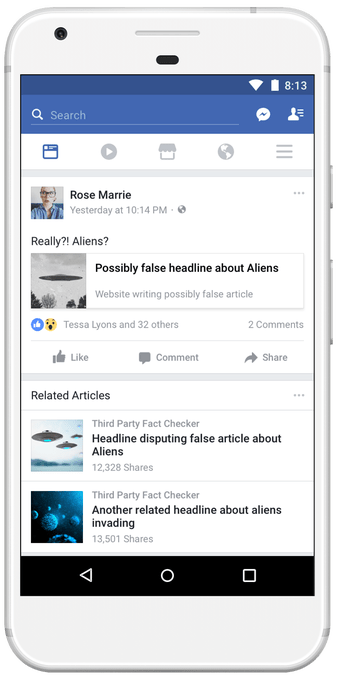
Articles flagged as false by Facebook’s fact checking partners have their reach reduced and display Related Articles showing perspectives from reputable news oulets below

Stamos outlined how Facebook is building ways to address false identities and fake accounts, false audiences grown illicitly or pumped up to make content appear more popular, acts of spreading false information, and false narratives that are intentionally deceptive and shape people’s views beyond the facts. “It’s important to match the right approach to each of these challenges” says Stamos, explaining that Facebook customize its solutions to these problems for different countries around the world.

Samidh Chakrabarti, Facebook’s product manager for civic engagement also explained that Facebook is now proactively looking for foreign-based Pages producing civic-related content inauthentically. It removes them from the platform if a manual review by the security team finds they violate terms of service.

“This proactive approach has allowed us to move more quickly and has become a really important way for us to prevent divisive or misleading memes from going viral” said Chakrabarti. Facebook first piloted this tool in the Alabama special election, but has now deployed it to protect Italian elections and will use it for the U.S. mid-term elections.

Meanwhile, advances in machine learning have allowed Facebook “to find more suspicious behaviors without assessing the content itself” to block millions of fake account creations per day “before they can do any harm”, says Chakrabarti.

Facebook implemented its first slew of election protections back in December 2016, including working with third-party fact checkers to flag articles as false. But those red flags were shown to entrench some people’s belief in false stories, leading Facebook to shift to showing Related Articles with perspectives from other reputable news outlets. As of yesterday, Facebook’s fact checking partners began reviewing suspicious photos and videos which can also spread false information. This could reduce the spread of false news image memes that live on Facebook and require no extra clicks to view, like doctored photos showing the Parkland school shooting survivors ripping up the constitution.

Normally, Facebook sends fact checkers stories that are being flagged by users and going viral. But now in countries like Italy and Mexico in anticipation of elections, Facebook has enabled fact checkers to proactively flag things because in some cases they can identify false stories that are spreading before Facebook’s own systems. “To reduce latency in advance of elections, we wanted to ensure we gave fact checkers that ability” says Facebook’s News Feed product manager Tessa Lyons.

A photo of Parkland shooting survivor Emma Gonzalez ripping up a shooting range target was falsly doctored to show her ripping up the constitution. Photo fact checking could help Facebook prevent the false image from going viral. [Image via CNN]

With the mid-terms coming up quick, Facebook has to both secure its systems against election interference, as well as convince users and regulators that it’s made real progress since the 2016 presidential election where Russian meddlers ran rampant. Otherwise, Facebook risks another endless news cycle about it being a detriment to democracy that could trigger reduced user engagement and government intervention.