28 Mar 2018

Sony cuts PlayStation VR bundle price by $100

Diving into VR on PS4 is continuing to get cheaper and cheaper.

Sony has slashed the prices of PSVR bundles by $100. The Camera bundle and the Doom VFR bundle now stand at $299 while the Skyrim VR bundle which also includes the Move controllers retails for just $349.

It hasn’t really been too difficult to come by a sale or deep discount on the PlayStation VR, but you can probably expect those deals to sink even further given its new $299 starting retail price. When the headset launched at the end of 2016, it retailed for $399 and users had to purchase the required PlayStation Camera sensor separately.

The world of high-end VR headsets has been getting significantly less pricey over the past year or two overall with the path largely being paved by Facebook’s Oculus which halved the price of its system within its first two years. While HTC’s Vive now sits at $499 and Oculus’s Rift resides at $399, Sony is in a much better place to control the all-in costs as the PS VR is powered by a PS4 rather than a price variable PC.

With today’s headset price drop, the cost of getting everything you need to get into VR — including the system, headset and motion controllers — is now just $649. Sony is admittedly second-tier among the PC-powered headsets, but this new price drop coupled with its closed ecosystem simplicity makes it a pretty attractive option, especially for existing PlayStation 4 owners.

28 Mar 2018

Neighbor, a p2p self-storage marketplace, bags $2.5M seed

Neighbor is another startup with designs on your spare space. Not for letting to guests to bed down in, like Airbnb, but for self-storage. The 2017 founded, Salt Lake City based startup is announcing $2.5 million in seed funding today, raised from Peak Ventures and Pelion Ventures.

The core business idea is to build a trusted marketplace for storage needs by offering people with items on their hands what it bills as a cheaper (and potentially easier) alternative to traditional self-storage solutions — and, on the host side, a platform to earn a little money for not having to do too much (just having space where you can let stuff safely sit).

There’s a social element in that Neighbor is plugging into Facebook’s Graph API and another of its APIs (called All Mutual Friends) so that users who sign in with Facebook can make use of a “store with a friend” feature — which shows which (if any) of their Facebook friends or mutual friends are also hosts or renters on the platform.

The idea being that a degree of linked acquaintance will help Neighbor offer users “more personalized, localized and trustworthy storage options while helping hosts advertise their storage spaces to friends and family on social media”, as it puts it.

The startup claims this feature is “completely unique to the sharing economy space”, though it has been used by other apps — such as dating app, Tinder, to (in that case) enable people to hook up with friends of friends.

Neighbor says it’s banking on the Facebook connection to help it build trust between users and grease activity for a marketplace that’s otherwise essentially asking a pair of strangers to agree to store/host others’ items in their home.

Co-founder Preston Alder says he came up with the idea for the business when he was a student about to move to Peru for a summer internship and needed to find a nearby place to store his stuff — but didn’t want to fork out on traditional storage costs.

“On the two hour drive to a friend’s house who had agreed to store his stuff, he realized there were probably a lot of people with extra storage space who lived closer that would agree to store his stuff for the summer —  he just didn’t know how to find them,” say other co-founders Joseph Woodbury (also CEO) and Colton Gardner.

The team put up a basic landing page was put up in early 2017 — initially fielding enquiries by phone. In March 2017 they launched a website to meet early demand.

“During that time, we won grants from Get Seeded, the Opportunity Quest, the New Venture Challenge, and the Utah Entrepreneurship Challenge, which helped us build out the website and do some basic local marketing,” they add. “We then turned down the jobs we had lined up post-graduation to keep building the business. Since then, our primary focus has been to build out the platform — we’re just now coming to a point where we’re going to double down on marketing.”

A year on from the website launch they say they have “thousands” of users in 11 different US states — claiming this is mostly organic as they’ve only done a regional marketing rollout in Utah thus far.

They are about to step up on that front now though, with the VC cash injection — including with discount offers for people wanting to rent space to store stuff.

“The seed funding will be used for continued platform improvements and to market the service more broadly across the US,” they tell TechCrunch. The funding will also go towards “technologies to foster trust”.

“Trust is our central focus at Neighbor — it’s why we chose to call our company ‘Neighbor’,” they add. “Our goal is not just to provide you storage, but to provide the safest option available on the market.”

To back up that claim the startup says it’s carrying out verification of users (both hosts and renters) — including by ID verification and background checks.

“We require the submission of a government ID or passport, and any user can request that a background check be performed,” they say. “A host can request the check on their renter or a renter on their respective host.”

On the trust front there are some pretty obvious risks when strangers are caching unknown items in other people’s home. So there’s also a list of banned items — such as firearms, toxins, drugs and so on.

Space renters are also required to submit a list of the exact items that will be stored for Neighbor and the host to approve ahead of a transaction getting the go ahead.

“If a renter is caught misleading a host or Neighbor about their items, then they are promptly evicted and fined,” they say. “It is worth noting that there is an excellent sifting mechanism that occurs due to Neighbor’s business model. Because of the high amount of personal interaction that occurs on Neighbor, individuals seeking to store prohibited items are likely to avoid Neighbor because they are concerned about keeping their items concealed from their host. We anticipate renters with illicit items will naturally prefer industrially zoned storage facilities.”

Who’s liable if something goes wrong? “Neighbor assigns liability in the same way as a self-storage facility,” the team says. “The host is liable for gross negligence (i.e. the host knocks over one of the renter’s boxes and the contents break). The renter, however, is liable for all other instances (i.e. fire, flood, etc). For this reason we provide a $10,000 guarantee to the renters and encourage renters to obtain a renter’s insurance policy through our local insurance partner.”

Another perhaps more sticky potential issue vis-a-via insurance is whether a host might be risking voiding any existing buildings or contents insurance they have by using the service and thereby opening their home to a third party (and their stuff).

Neighbor says it recommends hosts verify with their insurance provider “on a case by case basis”. Though it also claims there hasn’t yet been a single host insurance dispute in the history of the company.

“Storing a neighbor’s items is a longstanding and accepted practice,” it adds, saying it doesn’t currently have any plans to offer hosts insurance packages.

In terms of other logistics, space renters are asked on sign up how long they estimate they’ll need to store their stuff to give hosts an idea of the time commitment.

“Once their stuff makes it into storage, the renter starts paying a monthly subscription that can be cancelled anytime by the host or renter with 30 days notice. So the length of storage time is ultimately up to both the host and renter,” they add.
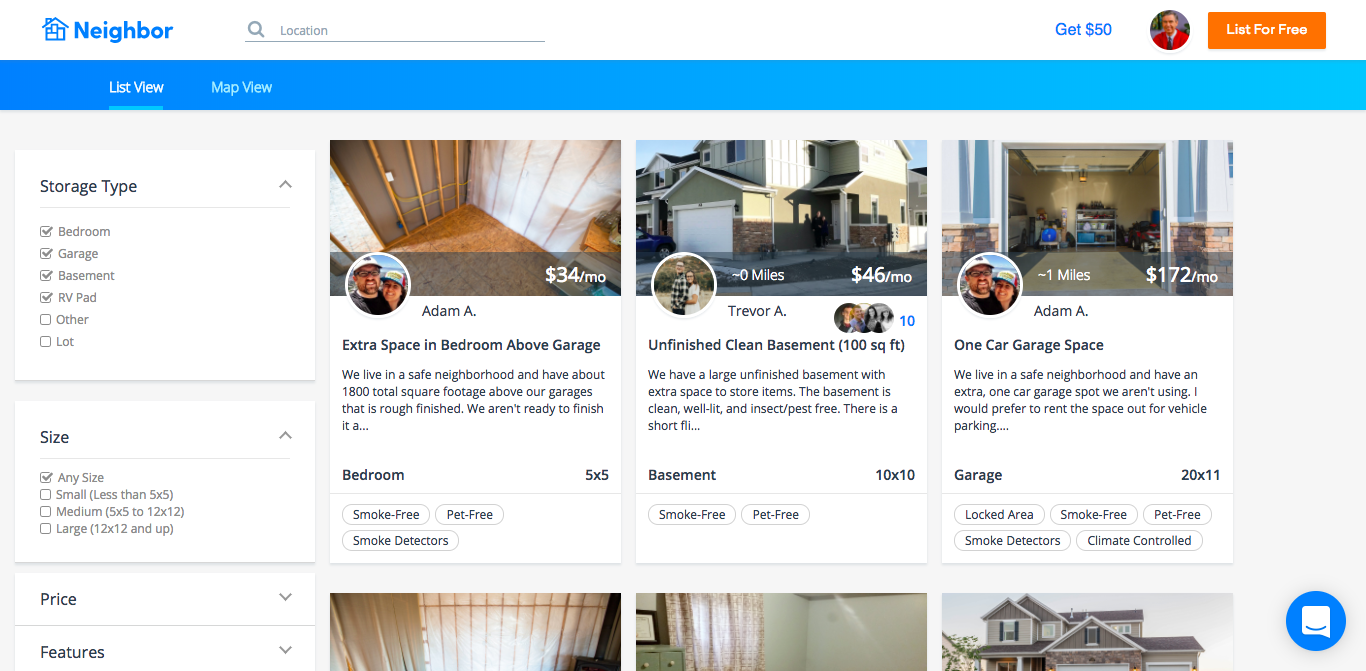
While hosts can set their own flexibility in terms of providing renters with access to their stuff — from 24/7, to ‘upon request’ — which, in turn, renters would be agreeing to ahead of time.

Hosts can also set their own pricing for the space rental, with Neighbor charging renters a 15% service fee on top of that to make its cut.

Hosts aren’t charged for listing their space on the platform. And while they are free to choose how much to charge for their space, Neighbor also says it’s using algorithmic pricing to recommend how much they charge — with the aim of keeping prices on the platform at half the cost of a traditional self-storage facility. So it sounds confident it can nudge hosts to set the kind of prices that will drive custom.

“When we saw what Neighbor was doing, we were blown away by the potential,” said Chad Packard, investor at Pelion Ventures, commenting on the funding in a statement. “The concept is simple and straightforward, the market potential is incredibly high, and the team is whip-smart. We knew really quickly that we wanted to work with them.”

So what are early Neighbor users using the service to store at this point? All sorts of stuff, according to the founders — although the biggest chunk of current business (~35%) involves big but moveable stuff: Boats, vehicles, trailers or RV’s.

Then they say another 25% is household goods; another 25% large furniture items; and the remaining 15% is “comprised principally of small business inventory”.

On the competitive front, the team names Spacer (based in Australia but with a US presence) and Stowit as US operating rivals with similar business models. Internationally, it lists the likes of Stashbee and Costockage but says that 80 percent of the global storage market is in the US — arguing that “no one has won that market yet”.


28 Mar 2018

Spoke looks to create a simpler workplace requests management tool

When Jay Srinivasan’s last company got acquired by Google, he and his co-founders were ready to get going right away — but they couldn’t figure out how to get ramped up or where things were.

That’s sometimes a refrain you’ll hear from employees of companies that are acquired, or any employees really, who suddenly have to get used to a new system of doing things. It can go all the way down to just getting a new laptop with the right software on it. And it’s a pain point that convinced Srinivasan and his co-founders Pratyus Patnaik and David Kaneda to start Spoke, a new tool for trying to solve those workplace management and request tickets — and finally getting your laptop ready so you can get to work. Spoke is launching for general availability to day, and the company says it has raised $28 million to date from investors like Accel, Greylock, and Felicis Ventures.

“Some internal ticketing systems you can use are searchable — as you imagine it finds all the answers, the problem is when you have all that many people you get 10,000 results,” Srinivasan said. “There’s too much to look at. In a larger company, the breaking point tends to be that there are probably a bunch of relevant answers, but there’s no way to find the needle in the haystack. So I really wanted to figure stuff out from scratch.”

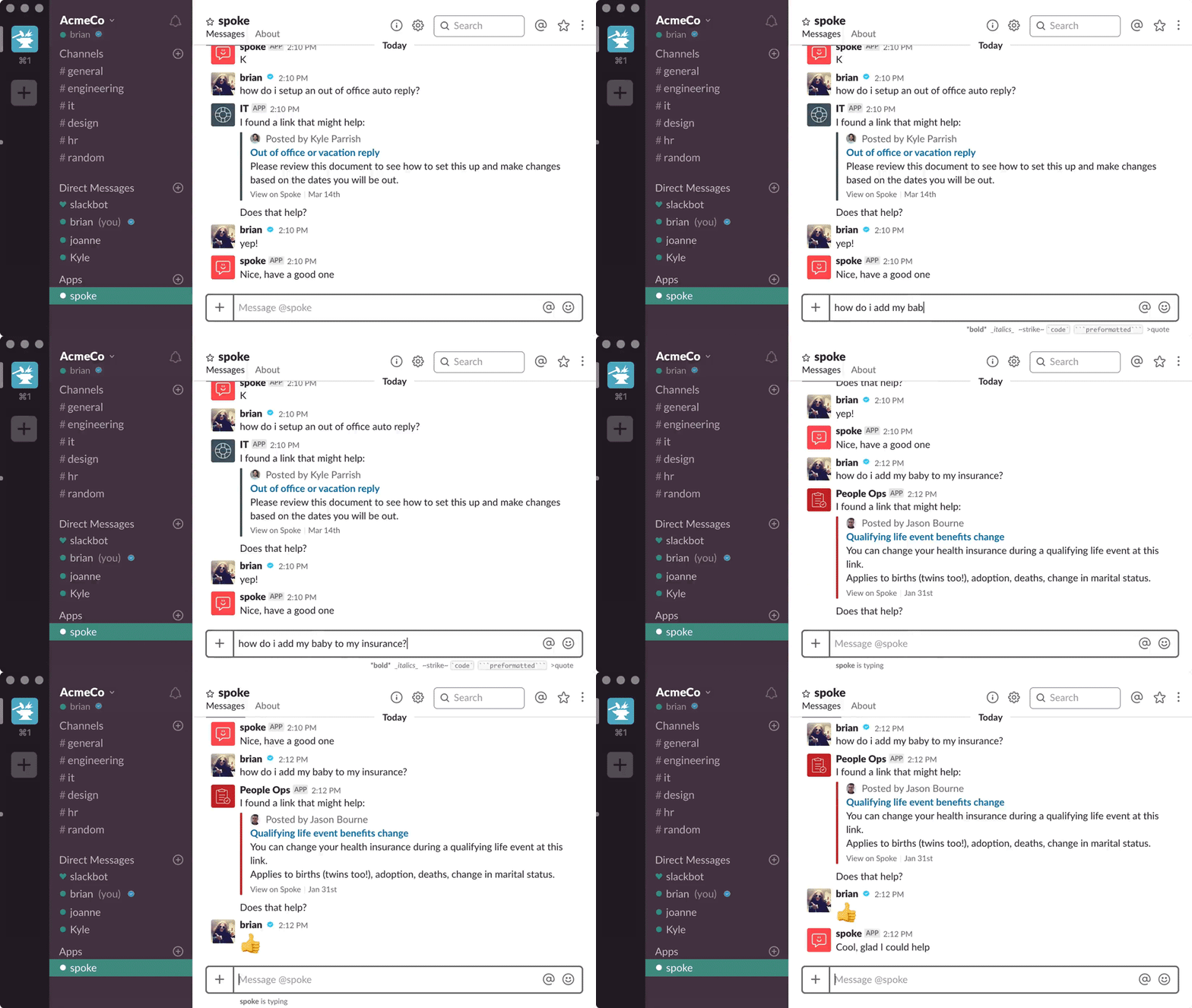
With many companies switching to internal collaboration tools like Slack, the theory is that these kinds of requests should be made wherever the employee is. So part of Spoke is an actual bot that exists in Slack, looking to surface the right answers right away from a database of employee knowledge that’s built up over time. But Spoke’s aim, like many workplace tools that look to be simple, is to hide a lot of complex processes behind that chat window in terms of creating request tickets and other employee queries so they can pop in and pop out quickly enough.

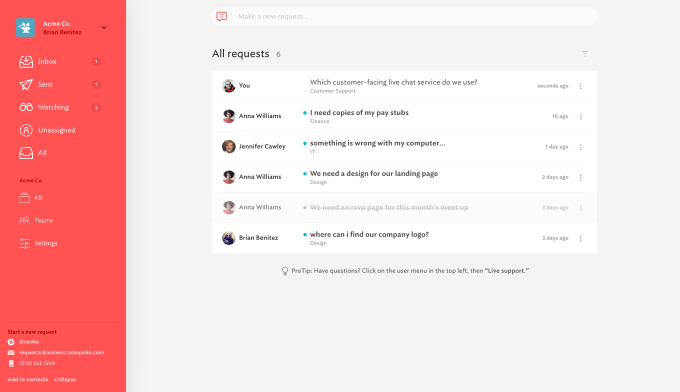
The other side for Spoke is for the managers, which then need to handle all of these requests. Spoke converts all those requests made through Slack (and, theoretically, other platforms) and streams them into a feed of tickets which they can then tackle one-on-one. Rather than a complex interface, Spoke aims to create a simple array of buckets that managers can pop in and pop out in order to plow through those requests as quickly as possible. As Spoke gets more and more data about how those requests are initiated — and solved — it can over time get smarter about optimizing that ticketing flow.

“If I’m the IT manager, I don’t want you to have to log into a ticketing system,” Srinivasan said. “We allow you to make a request through Slack. You’re in slack and talk to Spoke and say, hey, I need a new laptop. I want you to stay in slack or teams. And a lot of time is spent on a specialized tool like a ticketing tool — it’s the same thing as a salesperson spending time in a CRM. Slack is a good way to get an input to that tool, but I still need a specialized standalone tool.”

You could consider Spoke as one interpretation of a couple of approaches to make data about the workplace more accessible. While Spoke is going after the bot-ish, come-to-me results route, there are others looking to create more of a centralized Wiki that’s easy to find and search. At the end of the day, both of these are trying to compress the amount of time it takes for employees to find answers to the information that they need, in addition to making it less frustrating. For the latter, there are some startups like Slab that have also raised venture financing.

For Spoke, the more challenging parts may actually come from the platforms where it lives. Slack, for example, is working on tools to make information much more searchable and accessible. It’s investing in tools to, for example, help users find the right person to ask a question in order to get information as fast as possible. As Slack — and other platforms — get more and more data, they can tune those tools themselves and potentially create something in-house that could be more robust. Srinivasan said the goal is to target the whole process of the workplace request in addition to just the search problem that he hopes will make Spoke something more defensible.

“You’re not looking for knowledge, you’re looking for services,” he said. “Let’s say I need a new laptop — by all means you can search Slack to get the answer of who you need to contact. But you still need to follow up and essentially create a request with them. Slack sometimes could solve the information access to knowledge access problem, but even then it doesn’t solve the service issue. Ticketing and request management consists of requests and responses with accountability. You have to make sure nothing falls through the cracks”

28 Mar 2018

Siren raises $3.4 million for smart socks that track diabetic health

Siren, a startup that has develops fabric with embedded microsensors, has unveiled its product, a sock for people with diabetes. Siren also announced a $3.4 million investment from DCM, Khosla Ventures and Founders Fund.

Powered by its Neurofabric technology, the diabetic sock can monitor foot temperatures with the idea that those with diabetes will be able to detect potential foot injuries.

“What we do is we take proven technology and we put it inside of socks so people can use it easily,” Siren co-founder and CEO Ran Ma told me. “If you get injured and have diabetic nerve damage, it’s hard to feel pain. The pain can go unnoticed, become infected, turn into an ulcer and lead to an amputation.”

Each sock is fitted with six sensors, so 12 sensors for every pair of socks. They’re also machine-washable and don’t need to be charged.

Siren sells for $19.95 a month, which gets people an initial pack of five pairs of socks, access to fresh socks every six months and access to the Siren Hub for monitoring.

Since its conception, Siren has had a few versions of its socks. Over the years, Siren has fine-tuned its development process to more seamlessly integrate the technology into the socks. Last January, Siren Care won TechCrunch’s Hardware Battlefield at the Consumer Electronics Show.

Moving forward, the plan is to create additional products in the health space with this technology.

“It’s very easily scalable,” Ma said. “It’s the same process. You just switch out the component. We already know sensors and electronics are getting cheaper and smaller every single day. So we just take advantage of this trend. Most of this stuff is made for wearables but we’re hijacking it and putting it in your clothes. And we think that’s the best use case.”

28 Mar 2018

Pandora takes on Spotify with dozens of personalized playlists built using its Music Genome

Just ahead of Spotify’s public debut planned for early April, Pandora is punching its rival where it hurts: personalized playlists. Spotify’s playlists customized to its individual users – like Discover Weekly, Release Radar and Daily Mix – have been a key draw for its service, but Pandora believes it can do even better. The company today is launching its own take on personalization with playlists built to fit users’ moods, activities, and genres, which are all powered by Pandora’s Music Genome.

The Music Genome is Pandora’s biggest asset in its battle with Spotify. This music information database has been in development for over a decade and is capable of classifying music at the song level across 450 different attributes – “genes” that can be as specific as what types of strings are on the guitar, for example.

The Music Genome already powers Pandora’s other personalization efforts, like its Thumbprint Radio, or the feature where it can automatically play similar music when you reach the end of a playlist you created. But it’s never yet been used to build specific playlists for Pandora users like this.

“We’ve been building out, for many years, a collection of well over 75 machine learning algorithms and techniques to help drive content discovery and delivery,” explains Chris Phillips, Pandora’s Chief Product Officer, of the personalization technology. “What we’re doing is what we believe is the bleeding edge of deep learning algorithms,” he says.

The new playlists are built using these various machine learning algorithms, combined with the raw audio analysis from the Music Genome, more traditional collaborative filtering methods, and in-house editorial curation.

At launch, Pandora is capable of creating over 60 personalized playlists – but that doesn’t mean users will log in and see 60 new playlists immediately.

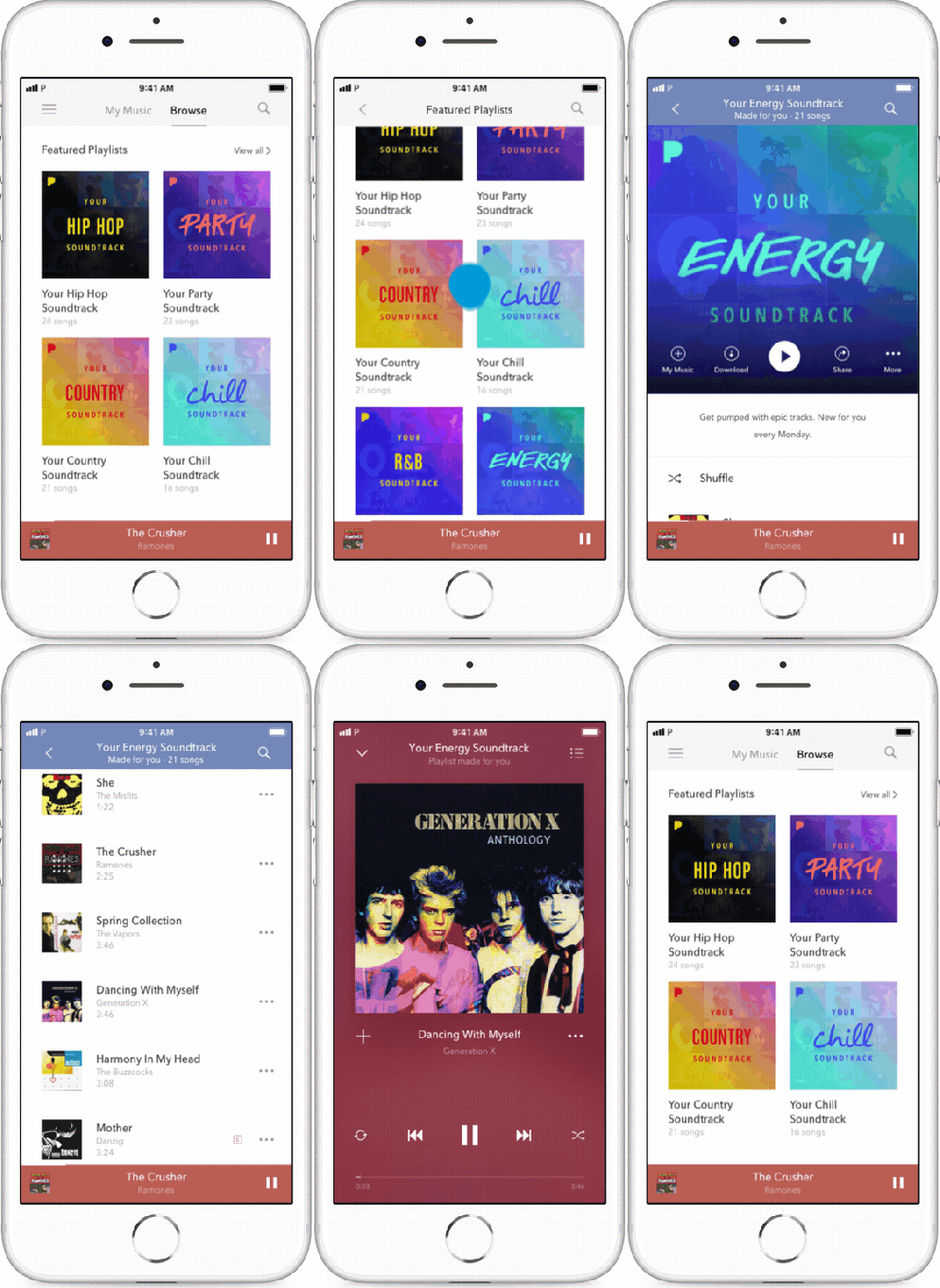
Instead, Pandora will roll them out in response to users’ listening activity. For example, if you’re playing a lot of upbeat pop music, you may see a playlist appear called “Your Party Soundtrack.”

There are also playlists for things like chilling out, focusing, working out, and more, as well as those for various moods – like “happy” or “rainy days” – or favorite genres, like hip hop or pop. And Pandora plans to quickly expand the types of playlists it offers here, with new ones arriving for certain events or cultural activities – like the holidays – and others.

The playlists won’t contain just those tracks you explicitly liked – meaning those you thumbs’d up or added to a playlist of your own. They’ll also surprise you with tracks Pandora believes you’ll like, such as new releases, deep cuts from favorite bands, or other songs that fit well and make sense for you, as determined by Pandora’s algorithms and analysis.

“When we think about what the competition’s doing, they’re really putting more generic buckets of music together,” says Phillips, seemingly referencing Spotify’s personalized playlists. “And they have a generic name for the playlist, whereas I can go right in [to Pandora’s personalized playlists] and say, “oh this is mood I’m in,’ and it’s spot on.”

[gallery ids="1613177,1613176,1613175,1613174,1613173,1613172,1613167,1613161"]

That’s not to say that other music services don’t have playlists available for users’ moods or activities – it’s just that they’re not personalized to the individual.

In addition, after using Spotify for some time, it can be hard to find the right selection of music you want to hear from its longer list of “Daily Mix” playlists, as it continues to create more mixes over time.

Pandora, on the other hand, is going after a more lean-back experience – something that ties into its radio roots, where it builds custom stations you like and continue to configure with a thumbs up or down. Spotify, meanwhile, has begun to overly rely on the power of its popular curated playlists – like Rap Caviar – to cement its importance in the world of music. (And Rap Caviar’s curator just left Spotify for YouTube.)

Spotify’s more recent launches, in terms of new personalized playlists, haven’t been as innovative as Discover Weekly. It has since rolled out fun – but not as useful – playlists like those that look back on your summer fun, and one with nostalgic tracks from your youth.

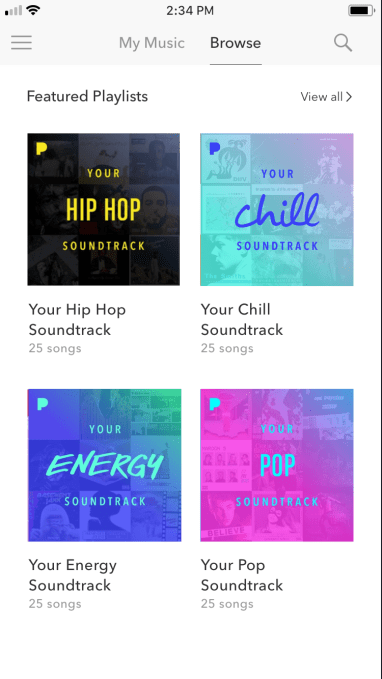
Pandora’s new playlists will start rolling out today to Pandora’s Premium subscribers. That’s the top tier of Pandora’s paid offerings, and Pandora’s equivalent to Spotify or Apple Music. If a playlist is created for you, it will appear in the “Browse” section under “Featured Playlists” in the Pandora mobile app.

Once live, the playlists will be updated weekly to keep them fresh – so if you want to save a playlist in full, you’ll need to duplicate it to your own collection.

You can also share the playlist with friends, including free users, through Pandora’s newer “Access” feature.

This offers Pandora users a way to temporarily access Premium by watching a video ad first. It’s a way to test drive the Premium product without paying, then transition back to the free radio service after your session. The feature was launched in December, and has since been used by “millions,” Phillips says.

The addition of personalized playlists could help Pandora give its subscription business a jump at a time when it’s starting to see some growth. The company reported in Q4 a 25 percent year-over-year increase in subscribers, which now number 5.48 million. In total, Pandora counted 74.7 million active users in the quarter.

That still puts it behind Spotify, which claims 157 million active users, 71 million of whom are paying customers. And Spotify said it’s projecting as many as 96 million subscribers by year-end 2018. Apple Music, meanwhile, is well ahead of Pandora in terms of paying customers too, with 38 million subscribers. Even Amazon has a stake in this market, with 16 million (estimated) subscribers.

Pandora says a certain percentage of its Premium users will start seeing personalized playlists appear as soon as today.


28 Mar 2018

Princeton study finds very few affiliate marketers make required disclosures on YouTube and Pinterest

Convincing humans to buy products is a massive business called marketing, and few areas of marketing are growing as fast as influencer marketing. Influencers on platforms like Instagram, Pinterest, and YouTube can command prodigious fees based on their audience size and engagement: some data suggests that a single video on YouTube by a top influencer can command as much as $300,000.

While top influencers often have direct partnerships with product companies, others with smaller audiences often take advantage of affiliate networks to build their revenues. These networks allow an influencer to take a small cut of any sales that are generated through their unique affiliate link, and their flexibility means that influencers can prioritize products that they believe best match their audience.

This industry is regulated by the Federal Trade Commission, which has set out a series of rules requiring paid affiliate links to be disclosed to users. There’s just one problem according to a new analysis by Princeton researchers: very little content on sites like YouTube and Pinterest with affiliate links actually disclose their monetization.

Computer scientists Arunesh Mathur, Arvind Narayanan, and Marshini Chetty compiled a random sample of hundreds of thousands of videos on YouTube and millions of pins on Pinterest . They then used text extraction and frequency analysis to investigate URLs located in the descriptions of these items to determine whether the URL or any redirects behind it connected to an affiliate network.

For all the growth in affiliate marketing, the researchers found that less than 1% of videos and pins in their random sample had affiliate links attached to them. Some categories had a significantly higher percentage of affiliate links though, such as science and technology videos on YouTube which averaged 3.61% and women’s fashion on Pinterest, which had a rate of 4.62%.

What’s more interesting is that content with affiliate links was statistically more engaging than videos without affiliate links. The researchers found that affiliated videos had longer run times as well as more likes and view counts, and a similar pattern was seen on Pinterest. The incentives around affiliate marketing then are clearly working.

The researchers next investigated the text of content with affiliate links and analyzed whether they made any disclosures about their economics to users. Among content that had affiliate links, 10.49% of YouTube videos and 7.03% of pins on Pinterest had disclosures. Worse, the disclosure language recommended by the FTC was only included on roughly 2% of affiliated content across the two platforms.

Given the NLP and basic machine learning methodology of the paper, these numbers should be perceived as a lower bound on disclosures. Nonetheless, it is clear that much of the influence economy that exists on these platforms remain cloaked from everyday users, despite being in clear violation of FTC guidelines and rules.

These results raise a series of challenging product and policy questions for startup companies with user-generated content. In the wake of the 2016 election where fake news factories built viral content and generated serious advertising revenues, social networks like Facebook have had to confront the tradeoff between a maniacal focus on quantitative engagement like page views and time on site and the quality of that engagement. If affiliated content does have higher engagement statistically as this study showed, that poses a dilemma for companies looking to boost revenue while also improving engagement quality at the expense of quantity.

For instance, the authors of the study suggest that products like YouTube should have better native features to disclose affiliate sponsors. Placing disclosures though could dampen enthusiasm for some clearly high-engagement content. How then can companies build a framework for building ethical policies that follow FTC requirements while also ensuring their products reach the right metrics?

Finally — and much harder to measure — is evaluating the effect of disclosures on affiliate revenue. Do people click on links less if they know they were placed there because of marketing economics? If proper disclosures dampen the influencer industry, that could put a brake on its breakneck growth.

Such policy and product challenges aren’t simple to answer, but the intensity of the problem is only going to increase with more and more money flowing into the influencer economy. This research clearly shows that there is a wide gap between what the government requires, and what affiliate marketers actually do that needs to be rectified.

28 Mar 2018

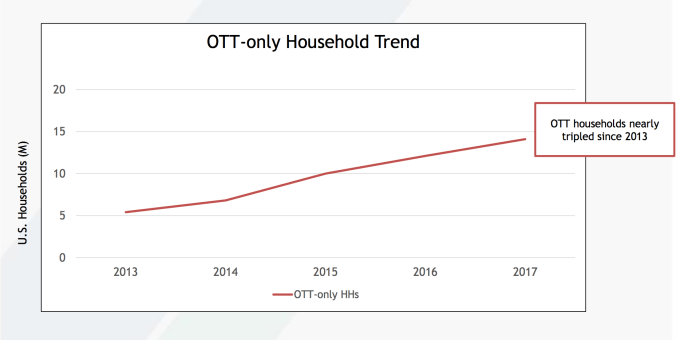
Over-the-top-only U.S. households nearly tripled since 2013, impacting TV ad dollars

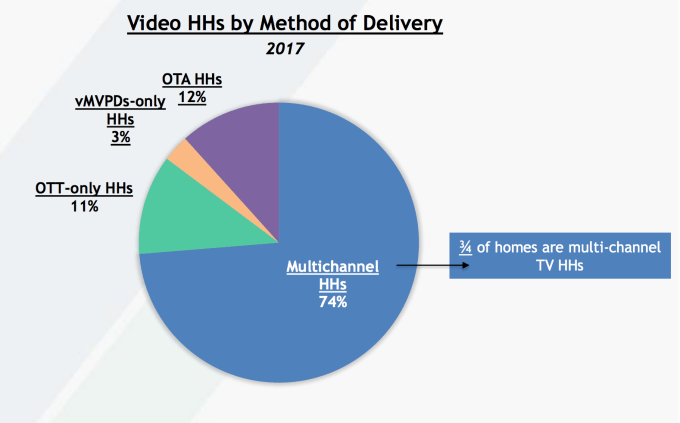
The number of U.S. households using only over-the-top streaming services to access TV programming and movies has nearly tripled over the past five years, according to a new report (PDF) from the Video Advertising Bureau out today. While on its own, that figure sounds impressive, the report points out that cord cutters’ slice of the pie is still fairly small – there are 14.1 million over-the-top only households, which is just 11 percent of all U.S. TV households.

That’s less than the 12 percent of households that receive broadcasts over-the-air using a TV antenna, and far smaller than the 74 percent – or 90.3 million – multichannel households who access television through a cable, satellite or telco subscription.

In addition, the report found that over-the-top services are often being used alongside traditional pay TV subscriptions, not in place of them. In fact, 70 percent of over-the-top households also had a cable, satellite or telco TV subscription.

However, adoption of over-the-top services is growing. The VAB report forecasts that by 2021, over-the-top only households will grow 8.2 percent to 17.9 million homes, while multichannel households drop 2.4 percent.

This continued growth means these over-the-top customers may be spending less time watching traditional television going forward, too.

For starters, nearly a third of over-the-top streaming service subscribers have three or more means to access over-the-top content, which represents an eight-fold increase over just the past two years.

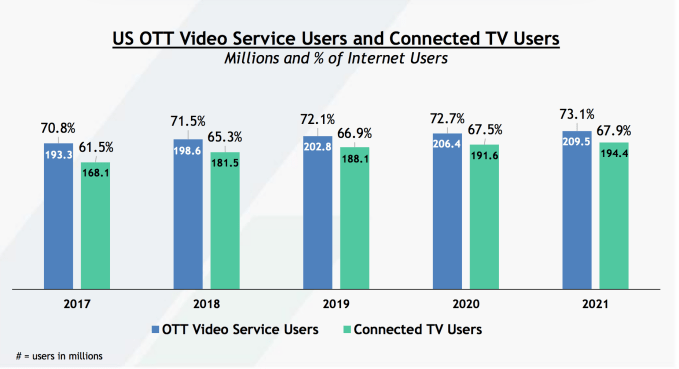
And 70.8 percent, or 193.3 million U.S. consumers. are today accessing an over-the-top video service at least once per month – a figure that will grow to 200 million U.S. consumers by 2021.

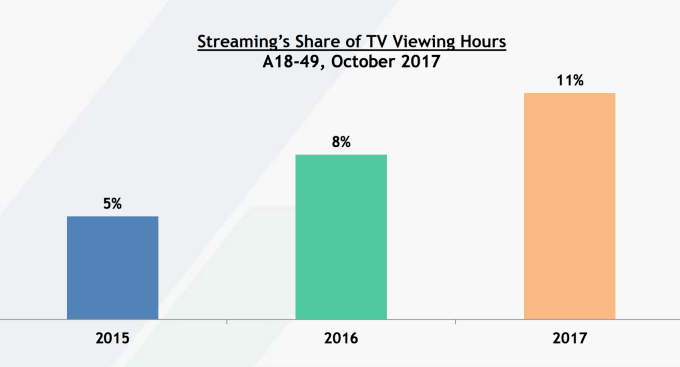
But the VAB report notes that streaming is still a small fraction of TV viewing hours, accounting for 11 percent of TV viewing hours from those ages 18 to 49 during October 2017. That’s up from 8 percent in 2016, and 5 percent the year prior.

Still, the shift to over-the-top streaming is starting to have an impact on the TV ad industry.

In a related report from eMarketer, also out this morning, analysts found that TV ad spending will continue to decline in 2018, following its initial drop in 2017. Specifically, TV ad spending will drop 0.5 percent in 2018 to $69.87 billion, resulting in TV’s share of total U.S. media ad expenditures dropping from 33.9 percent in 2017 to 31.6 percent this year.

Spending will perk back up in 2020 with the U.S. presidential election and summer Olympics in Tokyo, but then will fall again to reach only a quarter of total ad spend by 2022.

“The shift of audiences to [over-the-top] viewing is changing the climate of the TV ad market,” said eMarketer senior forecasting director Monica Peart, in a statement. “As ratings for TV programming continue to decline, advertiser spending will also continue to see declines, especially in years that do not boast major events such as presidential elections and Olympic games.”

As TV ad spending declines, digital ads will climb – and over-the-top platforms will play a big role here, says eMarketer.

For example, Roku’s ad revenues, which include both video and display ads, will surpass $293 million, up 93.0 percent over 2017. And Hulu’s ad revenue will grow more than 13 percent to $1.12 billion.

Emarketer’s figures on over-the-top viewers are roughly in line with the Video Advertising Board. It says the number of over-the-top viewers will grow to 198.6 million this year, versus VAB’s calculation that 193.3 million U.S. consumers now stream via an over-the-top service as least once per month.

“Over-the-top platforms are growing in number and size, and many compete directly with pay TV by offering bundles of live channels at attractive price points,” said eMarketer principal analyst Paul Verna. “Consumers who want to cut or shave the cord now have a wealth of options that didn’t exist a couple of years ago. And we expect the offerings to become even more robust as more players enter the market,” he added.


28 Mar 2018

Energy-saving Bitcoin rival Chia raises from A16Z, plans mini-IPO

Bram Cohen invented torrenting. Now he’s building a cryptocurrency called Chia that doesn’t waste electricity like Bitcoin, and top investors are lining up. Chia has just raised a $3.395 million seed round led by AngelList’s Naval Ravikant and joined by Andreessen Horowitz, Greylock and more. The money will help the startup build out its Chia coin and blockchain powered by proofs of space and time instead of Bitcoin’s energy-sucking proofs of work, which it plans to launch in Q1 2019.

But that’s just the start of Chia’s ambitious plan to disrupt Bitcoin. It’s avoiding the often-abused ICO process that Chia president Ryan Singer says comes with “a lot of issues with regulatory uncertainty and investor protection.” Instead, it’s working with its general council and the SEC to do a mini-IPO this summer or fall through the JOBS Act’s Regulation A+ equity crowdfunding rule. That could let Chia raise a maximum of $50 million from the public, non-accredited amateur investors included.

“People who buy in an ICO are uncertain of how the company will spend the money and how they’ll get the things they were promised,” says Singer, who was COO of cryptocurrency exchange Tradehill and started several other blockchain companies. “We’re going to operate the company with the transparency and accountability expected of a public company, which is very different than most ICOs.”

Chia Network co-founder and president Ryan Singer

Chia will do a pre-mine of its currency but initially retain ownership of 100 percent of the coins, using the mini-IPO to foster a community of investors. “We’re planning on issuing a dividend of Chia to our shareholders in advance of the network launch,” says Singer. “This ensures we can get it in people’s hands to use on the network without marketing and selling it as a security or investment opportunity.”

Because the public offering is capped at $50 million, Chia will use an auction where investors choose how much they’ll bid for how many shares. It’s similar to the process Google used to IPO. The more popular it is and higher people bid, the less equity Chia will have to sell to get the $50 million. Once a clearing price is locked in, everyone who bid below it will get no shares and their deposit back, while those who bid over get their shares plus a refund of the difference between their high bid and actual price.

“This may be the first fully compliant public offering for a crypto company,” a Chia spokesperson writes.

The killer feature in crypto: Legitimacy

After Cohen invented the torrenting file transfer protocol in 2004 and co-founded a company around it called BitTorrent, the startup suffered through a decade of mismanagement by other CEOs. So this time around, he seems determined to keep control, holding the CEO title himself. Still, Singer the businessman has been the one orchestrating the fundraises and growing Chia’s team to six, while Cohen works to derisk the startup’s complex technical roadmap.

“There’s been a fair amount of pretty deep algorithmic work and that’s been going quite well, but these are things that have to be taken seriously,” says Cohen, who makes maddeningly difficult handheld 3D puzzles in his spare time. “You absolutely must worry on a technical level about all the ways something could go wrong because building secure distributed databases is hard.” It’s quite a statement from a guy who built the protocol BitTorrent said at one point moved 40 percent of world’s internet traffic per day. Chia is now aggressively hiring engineers with experience in decentralized network protocols, math and cryptography to lay the code for its coin launch.

They’ll be working on an alternative to Bitcoin’s proofs of work, which require CPUs and GPUs that drain huge amounts of electricity in order to verify the blockchain. This has led to massive Bitcoin mining pools that split the proceeds while operating near cheap electricity sources and cold air to cool the mining rigs, like in the Pacific Northwest. These centralized teams of miners threaten to allow manipulation of Bitcoin’s price and network.

Chia ditched proofs of work for proofs relying on file storage space that people often have sitting around unused on their computers and can use for free. Chia layers on proofs of time that thwart a range of attacks on proofs of space. It’s also building in “non-outsourceability” that prevents mining pools from forming. Essentially, anyone in a Chia mining pool could secretly run off with the rewards without sharing them, so no one will want to trust their fellow miners not to rip them off.

Cohen believes these features of Chia will fix both the electricity waste and centralization of Bitcoin.

“Do you have a white paper?” he says people ask, referring to the often vague, theoretical and unverified claims the blockchain companies make about their technology. “We have actual papers in refereed journals,” Cohen laughs. Chia had a peer-reviewed article published in the 38-years-running cryptography conference AsiaCrypt’s journal.

The regulated public offering, the scientific rigor and the seed round joined by True Ventures, Danhuacap, DCM and Ravikant’s MetaStable crypto hedge fund are all part of a campaign to establish Chia as more reputable than the rest of the blockchain industry. “It’s important to us to be seen by the marketplace as a real investment and not just a pump and dump, hence us going for more institutional investors that aren’t trying to flip their positions as soon as they become liquid,” Cohen explains.

The cryptocurrency space has been dominated by bold claims, weak follow-through, limited utility and plenty of scams. That’s poisoned the well, souring the public and inviting government regulation. Chia has a lot to live up to. Even if the technology works, beating the network effect of other cryptocurrencies and getting enough Chia owners so it actually becomes useful will be tough. But with a solid team, set of investors and plan, Chia could prove the blockchain’s worth beyond Bitcoin.

For more on Chia, read our scoop about it coming out of stealth:

28 Mar 2018

Silver Lake is buying a $500M stake in Credit Karma in a massive secondary round

Credit Karma, which once started as a simple credit report system and is now looking to expand into a true financial assistant, announced today it is getting a massive $500 million secondary investment from Silver Lake.

As part of the investment, Credit Karma says it is getting a 23% bump in the valuation from its last secondary round, which was around $3.25 billion. That means the company is now going to be worth roughly $4 billion altogether, while founder and CEO Kenneth Lin will remain the company’s largest shareholder. That, in the end, is likely important for investors and early employees even as they look to get some liquidity as many look to these founders to ensure that they intend to see the company all the way to the end. Silver Lake’s Mike Bingle is joining the company’s board of directors as part of this deal.

As companies stay private longer, those early employees that spend years at a startup before it hits that huge exit may have to wait longer for some kind of payout for their work. Investors, too, face the same dilemma, especially as the early bets are often just taken on a founder and an idea. And compensation packages early on also typically include equity as a significant portion as companies try to use the financing they raise for growth or other purposes. That makes these kinds of secondary rounds important as it shortens the window for at least some liquidation, which could help employees and investors be a little more patient.

Silver Lake is buying common stock in the company, which is now more than a decade old. But it does mean, with some kind of liquidation for shareholders, that it can likely hold off on an IPO for a little longer. It’s still building out it’s cachet as a financial advisory tool, so it may be that they sought to stay private and not be beholden to the quarterly pressures of a public company while they continue to build out that suite of tools.

Credit Karma is increasingly trying to build a suite of tools that will help it expand just beyond a simple credit score notifier. Late last year, Credit Karma rolled out a tool to be the hub for handling everything related to your cars. All of this sums up to its goal to be a financial assistant, and not just a credit report.

28 Mar 2018

Salesforce introduces Integration Cloud on heels of MuleSoft acquisition

Salesforce hasn’t wasted any time turning the MuleSoft acquisition into a product of its own, announcing the Salesforce Integration Cloud this morning.

While in reality it’s too soon to really take advantage of the MuleSoft product set, the company is laying the groundwork for the eventual integration into the Salesforce family with this announcement, which really showcases why Salesforce was so interested in them that they were willing to fork over $6.5 billion.

The company has decided to put their shiny new bauble front and center in the Integration Cloud announcement, so that when they are in the fold, they will have a place for them to hit the ground running

The Integration Cloud itself consists of three broad pieces: The Integration Platform, which will eventually be based on MuleSoft; Integration Builder, a tool that lets you bring together a complete picture of a customer from Salesforce tools, as well as across other enterprise data repositories and finally Integration Experiences, which is designed to help brands build customized experiences based on all the information you’ve learned from the other tools.

For now, it involves a few pieces that are independent of MuleSoft including a workflow tool called Lightning Flow, a new service that is designed to let Salesforce customers build workflows using the customer data in Salesforce CRM.

It also includes a dash of Einstein, Salesforce’s catch-all brand for the intelligence layer that underlies the platform, to build Einstein intelligence into any app.

Salesforce also threw in some Trailhead education components to help customers understand how to best make use of these tools.

But make no mistake, this is a typical Salesforce launch. It is probably earlier than it should be, but it puts the idea of integration out there in the minds of its customers and lays a foundation for a much deeper set of products and services down the road when MuleSoft is more fully integrated into the Salesforce toolset.

For now, it’s important to understand that this deal is about using data to fuel the various pieces of the Salesforce platform and provide the Einstein intelligence layer with information from across the enterprise wherever it happens to live, whether that’s in Salesforce, another cloud application or some on-prem legacy systems.

This should sound familiar to folks attending the Adobe Summit this week in Las Vegas, since it’s eerily similar to what Adobe announced on stage yesterday at the Summit keynote. Adobe is calling it a customer experience system of record, but the end game is pretty much the same: bringing together data about a customer from a variety of sources, building a single view of that customer, and then turning that insight into a customized experience.

That they chose to make this announcement during the Adobe Summit, where Adobe has announced some data integration components of its own could be a coincidence, but probably not.