28 Mar 2018

It was not consent, it was concealment 

Facebook’s response to the clutch of users who are suddenly woke — triggered to delve into their settings by the Facebook data misuse scandal and #DeleteFacebook backlash — to the fact the social behemoth is, quietly and continuously, harvesting sensitive personal data about them and their friends tells you everything you need to know about the rotten state of tech industry ad-supported business models.

“People have to expressly agree to use this feature,” the company wrote in a defensively worded blog post at the weekend, defending how it tracks some users’ SMS and phone call metadata — a post it had the impressive brass neck to self-describe as a “fact check”.

“Call and text history logging is part of an opt-in feature for people using Messenger or Facebook Lite on Android . This helps you find and stay connected with the people you care about, and provides you with a better experience across Facebook.”

So, tl;dr, if you’re shocked to see what Facebook knows about you, well, that’s your own dumb fault because you gave Facebook permission to harvest all that personal data.

Not just Facebook either, of course. A fair few Android users appear to be having a similarly rude awakening about how Google’s mobile platform (and apps) slurp location data pervasively — at least unless the user is very, very careful to lock everything down.

But the difficulty of A) knowing exactly what data is being collected for what purposes and B) finding the cunning concealed/intentionally obfuscated master setting which will nix all the tracking is by design, of course.

Privacy hostile design.

No accident then that Facebook has just given its settings pages a haircut — as it scrambles to rein in user outrage over the still snowballing Cambridge Analytica data misuse scandal — consolidating user privacy controls onto one screen instead of the full TWENTY they had been scattered across before.

ehem

Insert your ‘stable door being bolted’ GIF of choice right here.

Another example of Facebook’s privacy hostile design: As my TC colleague Romain Dillet pointed out last week, the company deploys misleading wording during the Messenger onboarding process which is very clearly intended to push users towards clicking on a big blue “turn on” (data-harvesting) button — inviting users to invite the metaphorical Facebook vampire over the threshold so it can perpetually suck data.

Facebook does this by implying that if they don’t bare their neck and “turn on” the continuous contacts uploading they somehow won’t be able to message any of their friends…

An image included with Facebook’s statement.

That’s complete nonsense of course. But opportunistic emotional blackmail is something Facebook knows a bit about — having been previously caught experimenting on users without their consent to see if it could affect their mood.

Add to that, the company has scattered its social plugins and tracking pixels all around the World Wide Web, enabling it to expand its network of surveillance signals — again, without it being entirely obvious to Internet users that Facebook is watching and recording what they are doing and liking outside its walled garden.

According to pro-privacy search engine DuckDuckGo Facebook’s trackers are on around a quarter of the top million websites. While Google’s are on a full ~three-quarters.

So you don’t even have to be a user to be pulled into this surveillance dragnet.

In its tone-deaf blog post trying to defang user concerns about its SMS/call metadata tracking, Facebook doesn’t go into any meaningful detail about exactly why it wants this granular information — merely writing vaguely that: “Contact importers are fairly common among social apps and services as a way to more easily find the people you want to connect with.”

It’s certainly not wrong that other apps and services have also been sucking up your address book.

But that doesn’t make the fact Facebook has been tracking who you’re calling and messaging — how often/for how long — any less true or horrible.

This surveillance is controversial not because Facebook gained permission to data mine your phone book and activity — which, technically speaking, it will have done, via one of the myriad socially engineered, fuzzily worded permission pop-ups starring cutesy looking cartoon characters.

But rather because the consent was not informed.

Or to put it more plainly, Facebookers had no idea what they were agreeing to let the company do.

Which is why people are so horrified now to find what the company has been routinely logging — and potentially handing over to third parties on its ad platform.

Phone calls to your ex? Of course Facebook can see them. Texts to the number of a health clinic you entered into your phonebook? Sure. How many times you phoned a law firm? Absolutely. And so on and on it goes.

This is the rude awakening that no number of defensive ‘fact checks’ from Facebook — nor indeed defensive tweet storms from current CSO Alex Stamos — will be able to smooth away.

“There are long-standing issues with organisations of all kinds, across multiple sectors, misapplying, or misunderstanding, the provisions in data protection law around data subject consent,” says data protection expert Jon Baines, an advisor at UK law firm Mishcon de Reya LLP and also chair of NADPO, when we asked what the Facebook-Cambridge Analytica data misuse scandal says about how broken the current system of online consent is.

“The current European Data Protection Directive (under which [the UK] Data Protection Act sits) says that consent means any freely given specific and informed indication of their wishes by which a data subject signifies agreement to their personal data being processed. In a situation under which a data subject legitimately later claims that they were unaware what was happening with their data, it is difficult to see how it can reasonably be said that they had “consented” to the use.”

Ironically, given recent suggestions by defunct Facebook rival Path’s founder of a latent reboot to cater to the #DeleteFacebook crowd — Path actually found itself in an uncomfortable privacy hotseat all the way back in 2012, when it was discovered to have been uploading users’ address book information without asking for permission to do so.

Having been caught with its fingers in the proverbial cookie jar, Path apologized and deleted the data.

The irony is that while Path suffered a moment of outrage, Facebook is only facing a major privacy backlash now — after it’s spent so many years calmly sucking up people’s contacts data, also without them being aware because Facebook nudged them to think they needed to tap that big blue ‘turn on’ button.

Exploiting users’ trust — and using a technicality to unhook people’s privacy — is proving pretty costly for Facebook right now though.

And the risks of attempting to hoodwink consent out of your users are about to step up sharply too, at least in Europe.

Baines points out that the EU’s updated privacy framework, GDPR, tightens the existing privacy standard — adding the words “clear affirmative act” and “unambiguous” to consent requirements.

More importantly, he notes it introduces “more stringent requirements, and certain restrictions, which are not, or are not explicit, in current law, such as the requirement to be able to demonstrate that a data subject has given (valid) consent” (emphasis his).

“Consent must also now be separable from other written agreements, and in an intelligible and easily accessible form, using clear and plain language. If these requirements are enforced by data protection supervisory authorities and the courts, then we could well see a significant shift in habits and practices,” he adds.

The GDPR framework is also backed up by a new regime of major penalties for data protection violations which can scale up to 4% of a company’s global turnover.

And the risk of fines so large will be much harder for companies to ignore — and thus playing fast and loose with data, and moving fast and breaking things (as Facebook used to say), doesn’t sound so smart anymore.

As I wrote back in 2015, the online privacy lie is unraveling.

It’s taken a little longer than I’d hoped, for sure. But here we are in 2018 — and it’s not just the #MeToo movement that’s turned consent into a buzzword.
28 Mar 2018

ARKit-only apps top 13 million installs, nearly half from games

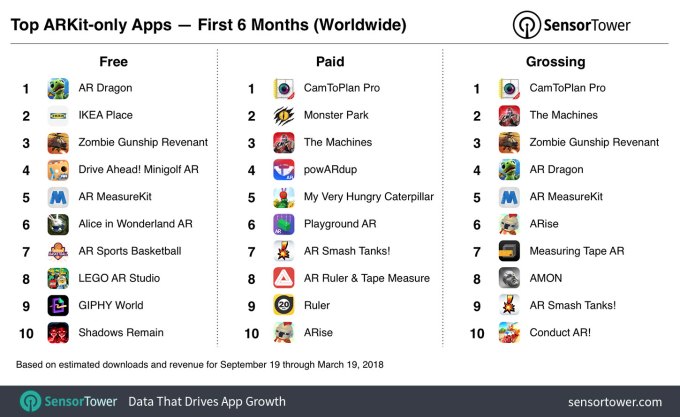
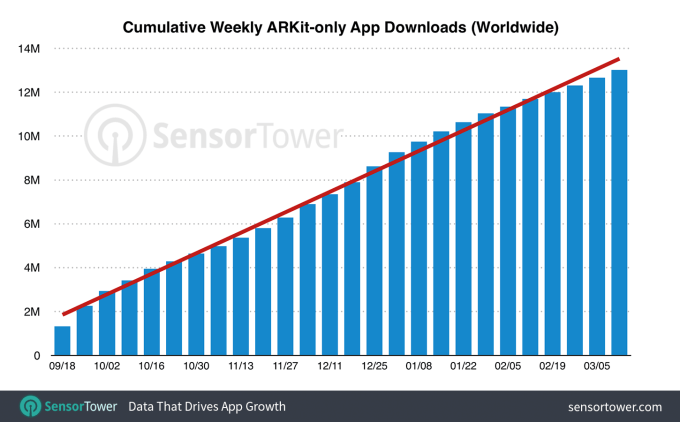
Over 13 million augmented reality apps built using Apple’s ARKit have been downloaded since the release of iOS 11 on September 19, 2017, according to new data from app intelligence firm, Sensor Tower, which took a look at the state of the AR app ecosystem, now that it’s had time to become more established. It found that – as with many new developments in the app world – games have been seeing the most traction, in terms of ARKit adoption.

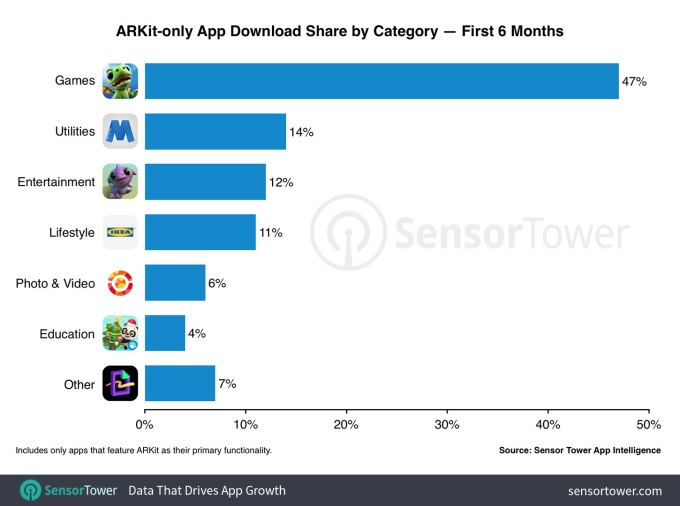
Nearly half (47%) of the ARKit-only app downloads worldwide during the first six months were games, which has been leading the ARKit-only app installs since launch.

A month after iOS 11’s release, ARKit-only apps had then surpassed three million downloads, with games accounting for 35 percent of downloads. Six months later, games have grown to 47 percent of the now 13 million ARKit-only app downloads.

Games, of course, helped to popularize augmented reality before ARKit’s launch. Thanks to the worldwide craze that was Pokémon Go, mobile users became familiar with AR’s potential to enhance gaming as they tried to catch the animated Pokémon appearing in the real world, visible only through their smartphone camera’s viewfinder.

The app seeing the most free downloads is the virtual pet simulator AR Dragon from Australia’s PlaySide Studios. The top paid and top grossing ARKit-only app is CamToPlan Pro, a paid AR measuring tape app from Tasmanic Editions.

If you’re wondering why the top app isn’t Pokémon Go, it’s because Sensor Tower’s analysis focused on ARKit-only apps, not ARKit-compatible apps that added some AR functionality over the past six months. Pokémon Go is part of that latter group.

But if you were to combine all AR apps, including ARKit-only apps and those that added new AR functionality when ARKit was released, then there would be well over 2,000 AR apps on the App Store today, says Sensor Tower. This matches up with Apple’s officially released figures, too.

Other popular ARKit-only app categories include utilities (like AR measuring tapes or eBay’s tool for finding the right shipping box), entertainment apps (like the AR children’s book, My Very Hungry Caterpillar), lifestyle apps (like the now numerous apps for helping consumers shop furniture by placing items in their own rooms via AR), photo and video apps (like Holo), and educational apps.

In addition to games, ARKit-only lifestyle apps have seen sizable download growth, as well, more than doubling their share of AR app installs from 5 percent to 11 percent on the heels of releases from IKEA, Houzz, Wayfair, and others. Meanwhile, utilities have seen their share of downloads decline from 19 percent to 15 percent.

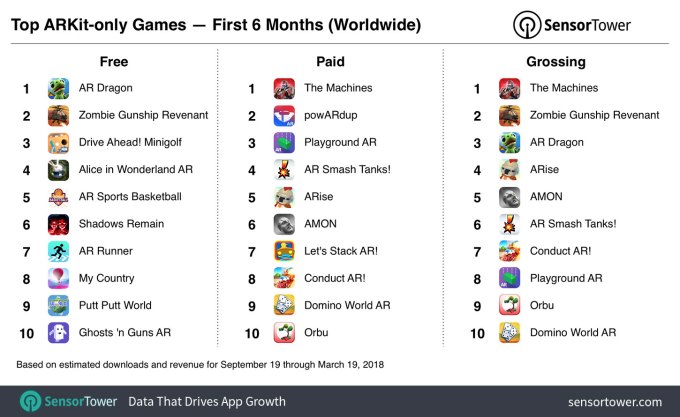
The ARKit-only gaming chart has remained largely the same as it was six months ago, however, save for a few additions like Shadows Remain from Halfbrick, the gaming studio behind Fruit Ninja and Jetpack Joyride. Other news entries include AR Smash Tanks!, Playground AR, and Orbu, all of which have benefited from Apple’s promotion.

AR Dragon has been at the top of the top free game chart for months, while The Machines has been the number one top paid and top grossing game.

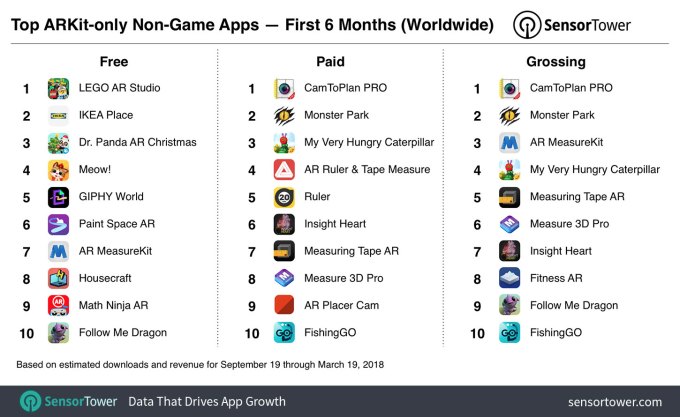
In non-games, kid-friendly ARKit apps dominate. The number one free app is LEGO AR Studio, which is followed by Dr. Panda AR Christmas Tree (#3), Meow! (#4), Math Ninja AR (#9), and Follow Me Dragon (#10).

Other top apps include IKEA Place (#2) and GIPHY World (#5). The top paid and grossing app charts are instead cluttered with utilities, generally AR rulers and measuring tapes.

Apple has played a big role in pushing ARKit adoption, with everything from on-stage demos to App Store features, and even integration into Apple’s learn-to-code app for kids, Swift Playgrounds, as of late.

But the AR app industry is still in its early days, and as ARKit itself develops, there’s room for more types of AR apps to emerge, too.

One potentially interesting upgrade to ARKit 1.5, which rolled out in beta to developers back in January, is the added support for wall detection. With this feature, ARKit can now recognize vertical surfaces, and place objects on those surfaces. The kit was also improved with better horizontal plotting, 1080p video, and computer vision-based image recognition – meaning ARKit apps can now “see” things like 2D objects, such as posters or art on a wall, then place related objects nearby.

Apple is not alone in giving AR apps a boost. Google also released its answer to ARKit with ARCore earlier this year. In the months since, a number of the ARKit-only apps have rushed to make their Android versions ARCore-compatible as well. Last week, Google said there are now over 60 ARCore apps on the Play Store, many of them games.


28 Mar 2018

Volkswagen’s Atlas Tanoak concept is a short-bed pickup truck dream

Volkswagen debuted a concept pickup truck at the New York Auto Show this week, and the Atlas-based design features a short bed design, based on VW’s MQB platform. It’s basically the Atlas 7-seater SUV with the back cut off and a small (but versatile) truck bed in place of the SUV’s cargo storage and third seating row – but that could be exactly the right balance to strike if Volkswagen wants to make a pickup that’s attractive to U.S. consumers.

The Atlas Tanoak, named after a type of tree found in the U.S. Pacific Coast, also features an extended wheelbase compared to the Atlas, with a total overall vehicle length of 214 inches. It has 10 inches of vertical ground clearance, and a 276-horsepower V6 engine with all-wheel drive, along with an eight-speed automatic transmission.

It’s got a variety of on-and off-road driving modes, too, and a more rugged front end and exterior so that you don’t have to hew to only the very beaten paths. The cargo bed in back is 64 inches long and 57 inches wide, and VW says you can even transport ATVs and dirt bikes on the back with the tailgate in the down position.

[gallery ids="1613395,1613393,1613392,1613391,1613390,1613389"]

Basically, it’s functionally, aesthetically and conceptually a lot like a Honda Ridgeline – but Americans like the Honda Ridgeline. Heck, just looking at photos of this thing makes me think “Yes, I am a city dweller who sometimes escapes to the country for some outdoorsy fun and this vehicle calls to me” so I think VW is on the right path here. Or off it, so to speak.

Volkswagen currently has no plans to put the Atlas Tanoak into production, however – it’s taking the temperature of interest and market fit with this New York Auto Show reveal. Consider this article my vote: Please make this truck.

28 Mar 2018

Einride’s autonomous trucks will be Nvidia-powered, and deliveries start this fall

Einride’s T-pod all-electric, self-driving transport vehicle will use the Nvidia Drive AI platform to provide its autonomous smarts, the Swedish technology company revealed today. Einride also announced that the very first customer deliveries of its production T-pod truck will begin this fall, meaning it could be making actual deliveries sooner rather than later.

The Nvidia Drive AI platform will allow Einride’s T-pods to operate autonomously for up to 124 miles, with path planning and intelligent environment sensing. The T-pod is designed for remote operations, too, and the company is initially planning a route connecting the Swedish towns of Gothenburg and Helsingborg, with a fleet of 200 vehicles traversing the distance.

In the video above, you can see the T-pod vehicle actually making a fully autonomous trip. They’re functionally designed to provide as much cargo space as possible (each can carry up to 15 standard-sized pallets) in a vehicle with a relatively small physical footprint, which helps with battery efficiency. Used in concert with one another in convoys, they can transport significant amounts of cargo cleanly and efficiently when compared with today’s big rig gas-powered freight trucks.

For uncomplicated, highway routes (ie. distribution depot to distribution depot), the T-pod is a potentially perfect solution – but ensuring the autonomous features work safety and as intended will be the key ingredient to allow for broad consumer adoption.

28 Mar 2018

Ubiquity6 nabs $10.5 million from top investors to build a deeper augmented reality

Smartphone AR is available on hundreds of millions of devices but it doesn’t really seem like many of those devices are making regular use of the feature. A lot of people in the industry see this as representative of the platform’s technical shortcomings especially in regards to enabling social experiences.

Ubiquity6 is approaching some of the tech problems that make shared augmented reality experiences a possibility. The team was founded last year by alums from Metamind, Facebook, Tesla, Twitter and Stanford. The startup’s co-founder and CEO Anjney Midha previously was a founding partner at KPCB’s emerging tech-focused EDGE fund where he focused specifically on AR, VR and computer vision.

The small team announced today that they’ve raised a $10.5 million Series A led by Index Ventures, with participation from First Round Capital, Kleiner Perkins, Google’s Gradient Ventures, LDVP, A+E and WndrCo.

In a very ethereal blog post, the startup detailed that they want to turn the smartphone camera into something that lets “you edit reality together with the people you care about, in physical spaces that matter to you.”

In a more technical sense, the team is working on many of the hard problems that several other backend augmented reality startups are looking to solve, namely ensuring that objects stay put in the same physical spot long after sessions have ended and that users can easily sync up and see the same AR objects in the same places. Once these things have been solved in a smooth capacity, a lot more becomes possible but AR needs this for repeatable, social experiences to really feel worthwhile.

In addition to tackling the mapping and syncing challenges noted above, Ubiquity6 is also going after more general object recognition challenges so that your phone will know what your bed and table and door look like and will have the intelligence to know what to do with that data.

“We believe that augmented reality holds the key to unlocking a new atomic unit of communication — a creative medium that can bring people together in and around the physical spaces they care about,” First Round Capital’s Phin Barnes said in an emailed statement.

28 Mar 2018

This young lending startup just secured $70 million to lend $2 at a time

You don’t hear of many $2 loans in the United States, where $2 won’t buy you more than a chocolate bar. But in cities like Lagos, Nigeria, and Nairobi, Kenya, $2 has the buying power of roughly $40, making such “micro” loans useful when you’re running a small business. And borrowing $2 from a startup called Branch is a way onto a platform that promises much bigger loans, based on your credit worthiness.

What is Branch and why is it bothering with such small amounts of money? For answers to those questions, we talked this week with its founder and CEO Matt Flannery, who previously cofounded and co-led Kiva, a now 14-year-old micro-lending platform that enables families to make small loans to entrepreneurs in developing countries.

Flannery realized while running Kiva that a nonprofit — which Kiva is — can only get so far when it comes to fundraising. Meanwhile, fascinated by the spread of smart phones and digital payment systems in Africa, Flannery knew that if he could raise serious capital, he could make even more loans to small business owners without needing to meet and interview them first.

In service to that idea, what Branch built is an app that analyzes all kinds of information on a user’s phone that determines how to score their credit. For example, in Nigeria, every time you use an ATM, the bank sends you an SMS message with your bank balance. That’s useful information to Branch. In Kenya, every time you pay your energy bill, the receipt comes via SMS. Knowing if you pay it and how big a bill you’re paying is valuable information, too.

Users apparently don’t see the app as invading their privacy — or it’s worth the trade-off to them if they do. Since its 2015 founding, Branch has been downloaded onto more than one million mobile phones in Sub-Saharan Africa, says Flannery.

Based on that momentum, Branch has attracted the kind of financial muscle Flannery was seeking when he left Kiva to start the company. In fact, Branch is announcing today that it has lined up $70 million in Series B funding to expand its financial offerings to additional countries, including India.

Trinity Ventures led the $20 million equity portion of the round, along with participation from International Finance Corporation, Andreessen Horowitz and CreditEase Fintech Investment Fund. Branch also secured a $50 million debt facility from Victory Park Capital, an investment firm with a focus on alternative credit whose other portfolio companies include LendingClub and LendUp.

Altogether, Branch has now raised $80 million. It suggests that lending incremental amounts isn’t just helpful to small business owners in developing countries; there’s a lucrative opportunity in it.

“The banking infrastructure in the U.S. is so robust and complete,” says Schwark Satyavolu, the general partner at Trinity Ventures who led the round for his firm. Meanwhile, Branch, he says, “seems like an application of Silicon Valley tech to create financial services. But it’s substantially more interesting, because Branch is doing it in emerging markets where you don’t have a robust stack or credit bureaus or information that’s nearly as rich or as deep as in the Western world.”

It’s worth noting that Branch is not a bank, despite that it calls itself a “branchless bank.” Its straightforward terms of use are just one giveawayBranch charges 15 percent interest on a loan as low as $2 at the end of one month. It also charges a 15 percent APR on its largest loans, which are $1,000 and can be paid over a 12-month period. Branch basically loses money on the $2 loan in order to drum up repeat business — and the strategy is working, according to Flannery. New customers borrow from Branch 20 times on average in the first year after they’ve downloaded the app.

If that sounds like a risky proposition for new borrowers, the good news, in our view, is that Branch never charges its users overdraft fees. “I’ve worked in microfinance long enough to know that late fees create a cycle of debt,” Flannery says.

What investors like even more is that Branch — which has 100 employees in San Francisco, Lagos, and Nairobi — was profitable before taking on this new funding.

It’s also growing 20 percent month over month, and it plans to roll out savings accounts next.

“We see savings as a critical next step,” says Flannery. “People typically don’t have them, or the yield is super low to non-existent.”

It will be a “big regulatory issue for us,” he says, explaining such accounts could be a year out, based on Branch’s dealings with the banks it needs as partners. It’s worth it, though, he adds. There’s a “big opportunity in these places.”

28 Mar 2018

Google Cloud tackles applications performance monitoring

As Google builds out its cloud platform, it has been continually taking tools and services it has created in-house for its own team and putting them out in the world for its customers as products. Today, it added a key ingredient for developers building applications on the Google Cloud Platform when it announced a suite of application performance management tools called Stackdriver APM.

Google is doing something a bit different with its APM approach, designing it for developers to track issues in the applications they have built instead of passing that responsibility onto operations. The thinking is that the developers who built the applications and are closest to the code are therefore best suited to understand the signals coming from it.

StackDriver APM is made up of three main tools: Profiler, Trace and Debugger. Trace and Debugger have already been available, but by putting them together with Debugger, the three tools work together to identify, track and repair code issues.

“All of these tools work with code and applications that run on any cloud or even on-premises infrastructure, so no matter where you run your application, you now have a consistent, accessible APM toolkit to monitor and manage the performance of your applications,” Morgan McLean, Product Manager at Google wrote in a blog post announcing Stackdriver APM.

When you put this together with Stackdriver Monitoring and logging tools, you have a full APM suite that could potentially compete with a number of vendors from Splunk to Datadog to New Relic and AppDynamics (now owned by Cisco). But Sam Ramji, VP of product management at Google says these vendors are partners as much as competitors, and they see these tools all working together to help teams track down code issue.

“We are doing a better job at making core systems visible to everybody. People will continue to use tools they favor to know how production systems are doing and have alerting systems in place for the objectives for their business,” he said.

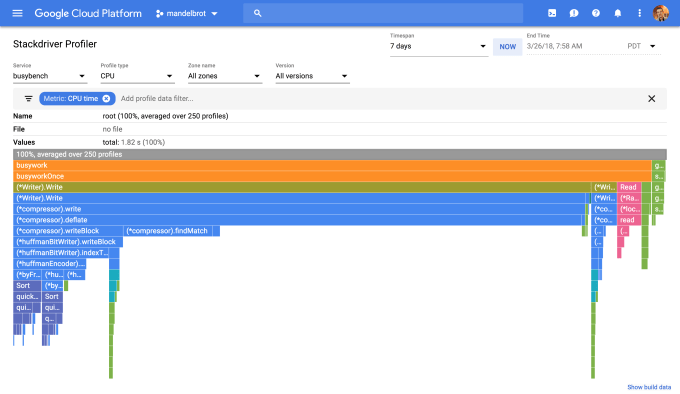
It all starts with The Profiler, which McLean writes, lets developers collects data via lightweight sampling-based instrumentation that runs across all of their application’s instances.

Stackdriver Profiler. Image: Google

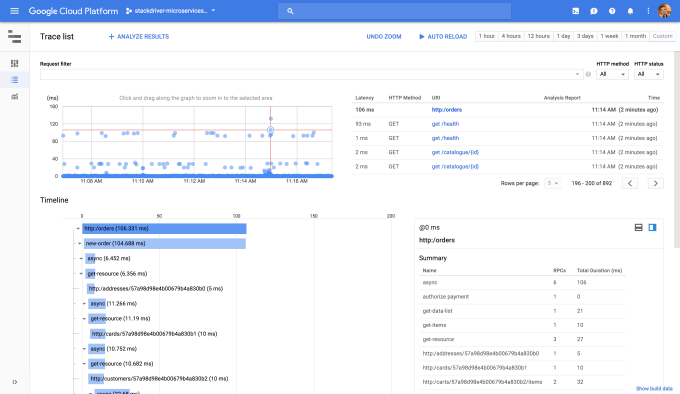
Once the programmer sees a problem, that’s where Trace comes in. Ramji says that code issues almost always follow a critical path, and they can use this tool to understand how the problem propagates across distributed systems. They do this in the form of visual analytics that really illustrate the nature of the problem and the impact it’s having on compute resources.

Stackdriver Trace tool. Image: Google

Finally, there is Debugger, a piece that Ramji is particularly fond of because it reminds him of tools in the 90s, when could stop and start an application to see where issues were happening with your compute resources. This tool provides similar functionality in a modern context, letting developers stop code at certain points to help identify the core issues affecting the code.

What’s really remarkable about this process, what Ramji calls “the magic” is that it enables developers to start and stop the code without affecting the customer. As McLean wrote, it gives programmers “a familiar breakpoint-style debugging process for production applications, with no negative customer impact.”

Stackdriver APM is available today and it provides a full-service monitoring suite. Whether Google intends to compete with some of the other players in this space or not, that would seem to be the end result.

28 Mar 2018

Waze officially launches its ad program for small businesses

With the launch of Waze Local, Google-owned navigation app Waze is offering small businesses a way to market themselves to consumers  on the road.

Waze has allowed larger brands to buy ads for years, and it’s been beta testing Waze Local since 2016.

“It’s been a gradual strategy,” said Matt Phillips, who leads the Waze Local team. “We wanted to get it right.”

He added that the key is understanding the needs of small businesses — like the fact that most of them are more interested in driving traffic to their physical stores than their websites.

As Phillips explained it, Waze Local’s “core ad format” is the branded pin, which will appear on users’ screens as they drive near a store’s location. For some advertisers, such as coffee shops, a branded pin might persuade drivers to make a quick detour before they continue their commute. For others, the pin might not lead to an immediate action, but it still helps build awareness.

In addition, Waze Local offers advertisers the opportunity to promote their listings in Waze search results, and to run what the company calls a zero-speed takeover — a big banner ad across the top of the screen, which only appears when the driver has come to a complete stop. And advertisers can see real-time data on how their campaigns are performing.

Waze will charge for ads on a CPM basis, and Phillips said businesses running the most basic campaigns could pay as little as $2 per day.

If you’re worried about the app getting overrun with ads, it’s worth remembering that Waze was already offering these formats to larger advertisers. So you may just see more ads now, and more of them are likely come from local businesses. (Phillips also said Waze will never show more than three branded pins at one time.)

During the beta test, Waze Local ended up driving an average 20 percent increase in navigations to the businesses buying ads. One of the early advertisers was Kung Fu Tea, which saw more than 5,500 drivers navigating via Waze Local to 16 Kung Fu Tea locations over a three-month period.

When asked if Google might eventually connect Waze Local to its other ad products, Phillips acknowledged that Waze does share some anonymized data with Google around things like traffic, but he said, “Our focus is to build this platform for small and medium businesses … We’re happy with the roadmap as is.”

28 Mar 2018

BMW and Daimler agree to merge mobility service businesses

It’s been hinted at, but Daimler and BMW are officially bringing together their mobility services business groups into one combined company, with a 50 percent stake owned by each automaker. That means tying up all their on-demand mobility offerings, including care share services Car2Go and DriveNow; ride-hailing like myTaxi, Chauffeur Privé and Clever Taxi; parking products like ParkNow and Parkmobile; on-demand services like moves and ReachNow; and charging solutions including ChargeNow and Digital Charging Solutions.

If approved (the proposed deal still has to be signed off by relevant competition protective regulators and government agencies), the deal would bring together a large number of entities either acquired or spun up in-house by both Daimler and BMW Group . The combined reach and global footprint of the resulting company should help these mobility service offerings gain more purchase and grow more quickly in a space where growth is difficult and resource intensive, if it goes through.

The plan as shared by both automakers currently doesn’t indicate what will happen to the sub-brands listed above, and whether these will be combined or unified under a merged entity. The automakers also note that they’ll both remain distinct competitors in their primary business (aka, making cars).

Every automaker is at least experimenting with mobility service offerings, and many have created dedicated sub brands and companies specifically for the emerging market opportunity. BMW and Daimler have actually been at it for a while – Car2Go, for instance, debuted in 2008 before expanding across Europe, North America and Asia. But the market is still very nascent, relatively speaking, and it’s cost-intensive to build out things like fleets of shared vehicles, so combining efforts likely makes best fiscal sense for both BMW and Daimler at this stage.

28 Mar 2018

LetsGetChecked raises $12M for its personal health tests

LetsGetChecked, an Irish startup that offers a health test kit service so that you can take various common laboratory tests from the comfort of your home, has picked up $12 million in Series A funding.

Leading the round is Optum Ventures, the independent venture fund of health services provider Optum, and Qiming Venture Partners, the Chinese VC firm.

The funding will be used to scale the company, including growing the LetsGetChecked full clinical support team. In addition, the health tech startup plans to further invest in its technology platform that links customers to laboratories.

Founded in 2014 by Peter Foley, LetsGetChecked has set out to build a technology and logistics platform to bridge the gap between traditional lab testing and consumers. The startup’s home testing kits span a number of categories including “lifestyle testing,” cancer screening, sexual health testing, fertility, and hormone testing.

“Our aim is to make lab testing better, more convenient and patient led,” Foley tells me. “Traditionally, you need to attend a doctor’s office to obtain a lab test. The physician will determine what test is right for you, complete a paper requisition form, collect your sample and send it off to the lab for analysis. You will wait for a period of time to hear back from your physician and may never see the results. This is a slow process and far from convenient”.

Instead, LetsGetChecked mirrors the process that happens in a doctor’s office but in a way that Foley claims puts the patient at the center and makes it more convenient. “We eliminate the middleman and link customers directly to labs enabling them to better manage and control their personal health,” Foley says.

First you decide which tests or groups of tests you wish to access based on hereditary risk, curiosity or simply for health monitoring purposes. You then order the test via LetsGetChecked, which will be authorised by a medical board certified LetsGetChecked physician. A test kit is then dispatched from a LetsGetChecked accredited facility direct to your home. It is also worth noting that the kits are anonymised, containing just a barcode.

Once the test kit arrives, you’re responsible for collecting your own sample, whether that be finger prick, stool (for colorectal cancer), or a swab. You then send the sample to LetsGetChecked and can track progress via the app ‘dashboard’ at any stage during the process or request a call from the clinical team. When the lab processes the sample, the corresponding result will be reviewed by a LetsGetChecked physician and the company’s nursing support team.

“For positive or out of range results, patients will get a call from the team to discuss treatment options,” says Foley. “Only after a consultation will the results be released to the patient’s dashboard where the customer can track and monitor their health over time”.

The tests themselves range hugely in cost, from £39 for a cortisol test, £69 for a prostate cancer test, all the way up to £500 for a BRCA check (why is it that breast cancer tests are 7 times more expensive than testing for prostate cancer). Despite the extra convenience that a service like LetsGetChecked affords, the price of each test soon adds up and begs the question as to why you wouldn’t just visit your GP and request the same tests for free through the NHS.

Meanwhile, the LetsGetChecked founder wouldn’t be drawn on who the startup’s direct competitors are — although in the U.K., Thriva is an obvious example — except to say it was focused internally on innovating and building on its technology platform.

“The aim is to make the patient experience more enriched over time and through API integrations provide for a more consolidated and cohesive healthcare engagement,” he says, hinting at future partners as another way to market. No doubt the strategic investment from Optum Ventures will be able to help on that front, too.