Blog

28 Mar 2018

Facebook makes its privacy, data downloading and deletion settings easier to find

With Facebook facing a wave of public backlash over how it has handled user data over the years — a backlash that was kicked off two weeks ago with the revelation that data analytics firm Cambridge Analytica had worked on targeted election campaigns using personal and private Facebook data — the company today announced a new set of changes to help users find and change their privacy settings, as well as download and delete whatever data has been collected through Facebook’s network of social media services.

To be clear, many of these settings and features already existed in Facebook, but now Facebook is making them significantly clearer for the average user to find and use. It’s possible that Facebook would have had to do a lot of this work anyway in light of the new GDPR requirements that are coming into place in Europe.

What today’s changes do not do is provide any indications that Facebook plans to do anything different in terms of what information it’s gathering and using to run its service, and its bigger, profitable business. (Indeed, even upcoming changes to its terms of service, which will include more clarity on Facebook’s data policy, will contain no changes in it, the company says: “These updates are about transparency – not about gaining new rights to collect, use, or share data,” writes Erin Egan, Facebook’s chief privacy officer.)

We’ve seen a lot of people already downloading their Facebook data in the last week or so (without today’s update), and the impression you get is that they are generally coming away shocked by the amount of information that had been amassed through Facebook’s various apps across web and mobile. That in itself — combined with more scrutiny from regulators over how data is collected, used, and shared, and bigger changes that Facebook is making in terms of how it works with third-party apps that link into the Facebook platform (which CEO Mark Zuckberg announced last week) — will hopefully lead to more meaningful changes on that front.

For the time being, however, the main idea here is that if you choose to stay and use Facebook, caveat emptor, and proceed armed with more control. Facebook highlights several areas where changes are being put in place:

  1. User controls. Facebook said that it has redesigned its settings menu for mobile, consolidating all of the primary controls on one screen. This is already a major change, given that previously they were spread across 20: a gating factor that would have meant it was hard to find what you were trying to change, or perhaps leading many to give up altogether. It’s also making it clear what can and cannot be shared with apps, specifically: “We’ve also cleaned up outdated settings so it’s clear what information can and can’t be shared with apps,” writes Egan. The fact that it seems there were some out of date elements in the menus highlights that this might not have been Facebook’s biggest priority up to now.
  2. Privacy shortcuts. For those who don’t want to dive into their settings, Facebook said it is also going to put in a new item into its menu, directly linking users to privacy settings. Privacy Shortcuts, Facebook said, will come by way of a few taps and will let people add in two-factor authentication; composite access to what you’ve shared via Facebook with the option of deleting if you choose; controls for your ad settings, which will also include an explanation of how ads work on Facebook for those who might want to know more; and a link to help you control what and how you share on the site — that is, the setting of “public, friends only, and friends of friends.” Again, that control has been in place for years already at Facebook, but many don’t know how to access it, or what it means. Putting it a little more front and center might change that.
  3. Downloading and deleting Facebook data. The aim here is to make it easier for people to do both if they want. Access Your Information will be a secure link that people can use to collect this, and it will make it easier for people to do both. Will the ease and openness make it less likely that users will decide to leave Facebook altogether? That remains to be seen.

The news comes in the wake of CEO Mark Zuckerberg last week posting an acknowledgement of Facebook’s role in the scandal, and a pledge to improve the company’s practices with regards to third-party apps and how Facebook works with them, and what data it will provide in the future, which he also followed up with a full-page apology printed in several newspapers. It has not been enough for some, and #deletefacebook has become a trending concept, with the company’s stock taking a nosedive in the last two weeks.




28 Mar 2018

Facebook just lost another user — New Zealand’s privacy commissioner

Mark Zuckerberg’s friend count continues to tick down in the face of a major data misuse scandal griping the company. The latest individual to #DeleteFacebook is no less than the privacy commissioner of New Zealand.

Writing in The Spinoff, John Edwards accuses Facebook of being non-compliant with the New Zealand Privacy Act — and urges other New Zealanders to follow his lead and ditch the social network.

He says he’s acting after a complaint that Facebook failed to provide a user in New Zealand with information it held on them.

“Every New Zealander has the right to find out what information an agency holds about them. It is a right of constitutional significance,” he writes. “Facebook failed to meet its obligations under the Privacy Act, and when given a statutory demand from my office to produce the information at issue so that I could discharge my statutory duty to the requester to review it, Facebook initially refused to provide it, and then asserted that Facebook was not subject to the New Zealand Privacy Act, and was therefore under no obligation to provide it.

“Our investigation was not able to proceed, and we notified the parties that while we were able to conclude that Facebook’s actions constituted an interference with privacy, and a failure to comply with its obligations both to the requester, and to my Office, there was nothing further we could do.”

Facebook’s strategy of arguing it is not under the jurisdiction of privacy laws in international markets is a standard play for the company which instructs its lawyers to argue it is only subject to Irish data protection law, given its international HQ is based in Ireland.

(NB: The geographical distance between Ireland and New Zealand is roughly 18,600km — a vast physical span that of course presents no barrier to Facebook’s digital business making money by mining personal data in New Zealand.)

The company’s ‘your local privacy rules don’t apply to our international business’ strategy appears to be on borrowed time, in Europe at least — with some European courts already feeling able to deny Facebook’s claim that Ireland be its one-stop shop for any/all international legal challenges.

The EU also has a major update to its data protection framework incoming, the GDPR, which will apply from May 25 — and which ramps up the liabilities for companies ignoring data protection rules by bringing in a new penalty regime that scales as high as 4% of a organizations global turnover (for Facebook that could mean fines as large as $1.6BN, based on the ~$40.6BN it earned last year — per its 2017 full year results).

And that’s all before you consider the huge public and political pressure now being brought to bear on the company over data handling and user privacy, as a result of the current data misuse scandal. Which has also wiped off billions in share value — and led to a bunch of lawsuits.

“We applied our naming policy and today have identified Facebook as non-compliant with the New Zealand Privacy Act in order to inform consumers of the non-compliance, the associated risks, and their options for protecting their data,” adds Edwards, joining the anti-Facebook pile-on.

“Under current law there is little more I am able to do to practically to protect my, or New Zealanders’ data on Facebook. I will continue to assert that Facebook is obliged to comply with New Zealand law in relation to personal information it holds and uses in relation to its New Zealand users, and in due course a case may come before the courts, either through my Office, or at the suit of the company.”

He goes on to suggest that the 2.5 million New Zealanders who use Facebook could consider modifying their settings and postings on the platform in light of its current non-compliant terms and conditions — or even delete their account altogether, linking to a page on the commission’s own website which explains how to delete a Facebook account.

So, er, ouch.

In response to the commissioner’s actions, Facebook has decided to try to brand the country’s privacy commissioner himself as, er, hostile to privacy…

A Facebook spokesperson emailed us the following statement:

We are disappointed that the New Zealand Privacy Commissioner asked us to provide access to a year’s worth of private data belonging to several people and then criticised us for protecting their privacy. We scrutinize all requests to disclose personal data, particularly the contents of private messages, and will challenge those that are overly broad. We have investigated the complaint from the person who contacted the Commissioner’s office but we haven’t been provided enough detail to fully resolve it. Instead, the Commissioner has made a broad and intrusive request for private data. We have a long history of working with the Commissioner, and we will continue to request information that will help us investigate this complaint further.

This of course is pure spin — and a very clunky attempt by Facebook to shift attention off the nub of the issue: Its own non-compliance with privacy laws outside its preferred legal jurisdictions.

Frankly it’s a very risky PR strategy at a time when it really has become impossible for Facebook to deny quite how comfortable the company was, up until mid 2015, to hand over reams of personal information on Facebookers to third party users of its developer platform — without requiring these external entities gain individual level consent (friends could ‘consent’ for all their friends!).

Hence the Cambridge Analytica scandal.

The non-compliance of Facebook with European data protection laws was in the spotlight yesterday, during an oral hearing in front of the UK parliamentary committee that’s looking into the Cambridge Analytica-Facebook data misuse scandal — as part of a wider enquiry into online disinformation and political campaigning.

Giving testimony to the committee as an expert witness Paul-Olivier Dehaye, the co-founder of PersonalData.IO — a startup service designed to help people control how their personal information is accessed by companies — recounted how he had spent “years” trying to obtain his personal information from Facebook.

Dehaye said his persistence in pressing the company eventually led it to build a tool that lets Facebook users obtain a subset list of advertisers who hold their contact information — though only for a rolling eight week period.

“I personally had 200 advertisers that had declared to Facebook that they had my consent to advertise. One of them is Booz Allen Hamilton, which is an information company,” Dehaye told the committee. “I don’t know how [BAH got my data]. I don’t know why they think they have my consent on this. Where that information comes from. I would be curious to ask.”

Asked whether he was surprised by the data Facebook held on him and also by the company’s reluctance to share this personal information, Dehaye said he had been surprised they “implemented something” — i.e. the tool that gives an eight week snapshot.

But he also argued this glimpse is illustrative because it underlines just how much Facebook still isn’t telling users.

“They implicitly acknowledge that yes they should disclose that information,” said Dehaye, adding: “You have to think that these databases are probably trawled through by a tonne of intelligence services to now figure out what happened in all those different circumstances. And also by Facebook itself to assess what happened.”

“Facebook is invoking an exception in Irish law in the data protection law — involving, ‘disproportionate effort’. So they’re saying it’s too much of an effort to give me access to this data. I find that quite intriguing because they’re making essentially a technical and a business argument for why I shouldn’t be given access to this data — and in the technical argument they’re in a way shooting themselves in the foot. Because what they’re saying is they’re so big that there’s no way they could provide me with this information. The cost would be too large.

“It’s not just about their user base being so large — if you parse their argument, it’s about the number of communications that are exchanged. And usually that’s taken of a measure of dominance of a communication medium. So they are really arguing ‘we are too big to comply with data protection law’. The costs would be too high for us. Which is mindboggling that they wouldn’t see the direction they’re going there. Do they really want to make that argument?”

“They don’t price the cost itself,” he added. “They don’t say it would cost us this much [to comply with the data request]. If they were starting to put a cost on getting your data out of Facebook — you know, every tiny point of data — that would be very interesting to have to compare with smaller companies, smaller social networks. If you think about how antitrust laws work, that’s the starting point for those laws. So it’s kind of mindboggling that they don’t see their argumentation, how it’s going to hurt them at some point.”

28 Mar 2018

Palantir confirms a staff link with Cambridge Analytica

Turns out there is a link between Peter Thiel’s secretive big data analytics firm, Palantir, and Cambridge Analytica — the political consulting firm at the center of the current Facebook data misuse scandal.

Starting in 2013, the New York Times reports that a UK-based Palantir employee worked with Cambridge Analytica — going on to gain access to the dataset of 50M+ Facebook users the latter firm obtained in 2014 via a third party personality quiz app deployed on the social network giant’s platform.

In testimony to the UK parliament yesterday, CA whistleblower Chris Wylie told MPs that senior Palantir employees worked with the firm on the Facebook data to help it build models off of the dataset to use for political ad targeting purposes.

At the time Wylie worked for SCL Group, the UK defense contractor that went on to form CA with funding from US billionaire, Robert Mercer. CA was later engaged by the Trump campaign, for the 2016 presidential election.

Reached yesterday for a response to Wylie’s allegations, a Palantir spokeswoman flatly denied Wylie’s claim — telling us: “Palantir has never had a relationship with Cambridge Analytica nor have we ever worked on any Cambridge Analytica data.”

However in a statement to the NYT, Palantir has now modified this line — saying: “We learned today that an employee, in 2013-2014, engaged in an entirely personal capacity with people associated with Cambridge Analytica. We are looking into this and will take the appropriate action.”

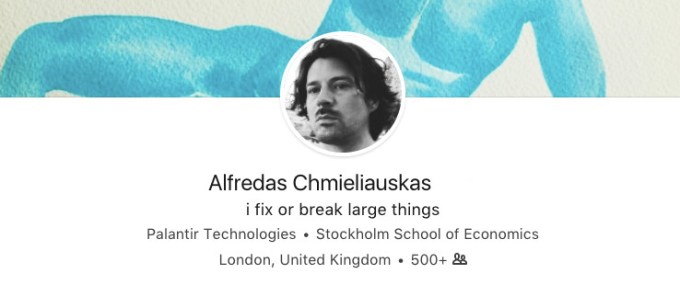
The NYT reports it has seen documents showing that a London-based employee of the big data firm — named as Alfredas Chmieliauskas — worked with the CA data scientists who were building its psychological profiling technology.

The documents were presumably provided by Wylie (pictured below), who has also handed email and other documentary evidence to the DCMS committee investigating online disinformation in political campaigning, as well as to the UK’s data watchdog and Electoral Commission — both of which are also probing digital political campaigning issues (including around the UK’s 2016 Brexit referendum vote, which Wylie alleges CA also worked on).

According to the NYT report, it was actually Chmieliauskas who came up with the idea for cloning the work of Michal Kosinski, the first Cambridge University academic that Wylie says CA approached for help to gather data.

Kosinski was deputy director at Cambridge University’s Psychometrics Centre at the time and, along with another professor at the department, David Stillwell, had already worked on a project drawing links between anonymized Facebook profiles and responses from personality surveys — with that data also obtained via a Facebook app — aiming to connect interests with voting tendencies.

Yesterday Wylie told the committee that Kosinski had asked for $500k up front from CA and 50% equity in the commercial venture to work on the project — which he said was ultimately why it ended up signing a data licensing deal with another Cambridge professor, Aleksandr Kogan, who agreed to work first on gathering the Facebook data and to discuss commercial terms later.

“I had left field idea,” Chmieliauskas wrote in May 2014, the NYT reports. “What about replicating the work of the cambridge prof as a mobile app that connects to facebook?” — going on to suggest this “could be a valuable leverage negotiating with the guy”.

Chmieliauskas’ LinkedIn profile states that he joined Palantir in April 2013 and remains employed at the company in London — working on “business development”.

It also includes the mission statement: “i fix or break large things”.

In the event, Chmieliauskas’ suggestion to clone Kosinski’s app led to CA’s data licensing relationship with Kogan, whose own personality test app — thisisyourdigitallife — was built bespoke for its project and successfully used to harvest data on 50M+ Facebook users so CA could, in turn, build psychological profiles on millions of American voters.

Wylie told the committee yesterday that a pilot of Kogan’s quiz app was launched in May 2014 with 10,000 Facebook users, before formal contracts were signed between CA and GSR — GSR being the company Kogan set up to commercialize the work with CA.

The app then was used to harvest the full Facebook dataset over the summer of 2014, garnering ~270,000 downloads — but able to pull far more data via Facebook’s (now shuttered) friends API.

Yesterday Wylie also claimed CA was able to pull data on “substantially” more Facebook users than even the 50M users that’s been reported so far.

Returning to Palantir, according to the NYT there were also discussions between SCL and Thiel’s firm in 2013 about working together on election campaigns. The newspaper said a Palantir spokeswoman confirmed the companies had briefly considered working together but claimed it had declined a partnership — in part because executives wanted to steer clear of election work.

Further emails seen by the NYT show CA’s (now suspended) CEO Alexander Nix and Palantir’s Chmieliauskas also sought to revive talks about a formal partnership in early 2014 — but Palantir executives again declined.

We reached out to Palantir for confirmation and a spokeswoman sent its updated statement — following what she described as an “initial investigation”.

28 Mar 2018

Refugee charity turns to crypto with $1M donation from Ethereum’s founder and OmiseGo

The crypto industry is often criticized from the outline for creating wealth that exists only in digital form, is unstable and driven by greed. That’s why a new charity initiative from top figures inside the Ethereum community might make a few non-believers sit up for a moment.

GiveDirectly, a charity that provides no-strings-attached grants to the world’s “extreme poor,” has revealed it has received a $1 million donation from OmiseGo, a fintech startup that held a $25 million ICO last year to develop a decentralized payment network, and Ethereum creator Vitalik Buterin.

The donation will go towards a GiveDirectly campaign in Uganda aimed at providing more than 12,000 refugee households with a grant to change their life by enabling business growth and other opportunities fueled by investment.

An initial pilot project reached 4,400 households (covering an estimated 21,500 individuals) with $650 which the recipient can choose to use in any way they wish. GiveDirectly said it is “looking to scale significantly over the next year” on the back of this new donation and others.

GiveDirectly is backed by a range of well-known tech names including Google, eBay founder Pierre Omidyar, and Facebook co-founders Dustin Moskovitz and Chris Hughes. The company opened its donation drive to the public in 2013, and since then it has raised over $200 million. Now it is looking to work more closely with the crypto industry, both in terms of high-profile figures and crypto enthusiasts themselves who can take part in the Uganda campaign by donating to the charity’s crypto wallet directly.

“This is a major new chapter for us, entering the humanitarian space with a service to give money directly to refugees,” GiveDirectly’s head of communications Catherine Diao told TechCrunch. “We’re really excited to be working with leaders in the crypto community to translate some of the recent boon to impact for some of the poorest people in the world.”

To clarify, recipients of the donations themselves won’t receive crypto, instead, it is switched to local currency and transferred either using mobile money services or a traditional bank transfer. But some of the principles behind cryptocurrencies themselves do apply to GiveDirectly.

The charity aims to offer a more efficient model that lets recipients receive a larger chunk of donations than regular charities (it claims to be at 85 percent), while it carries out thorough checks on recipients before they receive the money and documents how they spend the capital, too. A ‘live feed’ tracking how the donations are impacting lives is here.

“While cash transfers have been used in humanitarian contexts before, this initiative is a significant departure from the status quo because we’re giving families transformative amounts of money versus small, subsistence amounts,” Diao explained.

Ethereum founder Vitalik Buterin made the donation to GiveDirectly alongside OmiseGo

“The crypto economy has grown immensely over the last year, bringing a great deal of wealth to many people and organizations within the ecosystem. In part we simply see an exciting opportunity to share that wealth. We hope the fortunes made in the crypto space will lead not to extravagant lifestyles but to extravagant generosity,” Jun Hasegawa, CEO of Omise — OmiseGo’s parent company — wrote in a blog post.

Anyone wanting to take part can send ETH or other ERC-20 token donations to the GiveDirectly wallet: 0xc7464dbcA260A8faF033460622B23467Df5AEA42

(It looks like the big donation hasn’t come just yet, fwiw)

Separately, OmiseGo said it will explore the opportunity to include GiveDirectly on the decentralized payment that it is developing. Called the OMG network, it is planned to allow transactions between any individual in the world, be that consumer or store, instantly and without the payment fees that exist today.

“We have a strong desire to support GiveDirectly’s unconditional cash transfers on the OMG Network in the future when it becomes possible,” Althea Allen, ecosystem growth lead at OmiseGO, told TechCrunch.

28 Mar 2018

CardUp raises $1.7M to help small businesses get more out of their credit cards

CardUp founder and CEO Nicki Ramsay (front, second from right) with her team

CardUp, a Singapore-based startup that enables users to make large, recurring payments by credit card even to recipients that don’t accept cards, has raised $2.2 million SGD (about $1.7 million) led by Sequoia India and SeedPlus. This is CardUp’s first institutional investment round and will be used to expand its business serving small- to medium-sized enterprises.

Before launching CardUp in 2015, founder and chief executive officer Nicki Ramsay worked at American Express for seven years, where her last position before leaving was director of international business development in the Asia-Pacific region. Ramsay says she created CardUp to solve challenges for both credit card users and providers.

“In my years spent in the payments industry, we repeatedly set the same goal, which was to increase credit card usage, but a lot of initiatives actually just ended up shifting share from one card issuer to another,” Ramsay told TechCrunch in an email. “CardUp extends the way you can use credit cards, so it really grows the pie. On top of this was my own personal frustration that I was getting limited value from my credit card as I couldn’t use it for any of my big expenses.”

CardUp claims it’s seen an average monthly user growth rate of 41% since launching in late 2016, which it attributes to the fact that it doesn’t require payment recipients to sign up for a CardUp account, too, reducing barriers to adoption. It’s also inked partnerships with major financial institutions like UOB, Citibank, Bank of China and Mastercard to promote its services. Over the last 12 months, more than $55 million SGD in payments were made through CardUp, which it says represents more than one percent of overall credit card spend growth in Singapore from 2016 to 2017.

CardUp positions itself as the middleman between organizations that don’t usually accept credit cards, such as landlords or the government, and people who want to use their cards for recurring payments so they can take advantage of things like reward programs and extended credit terms. The company’s value proposition for small business owners is the ability to use their existing credit card limits to extend business payables up to 55 days, interest-free, which means they have more working capital and cash flow.

Ramsay says the company plans to pursue SMEs in Singapore and other countries as well, targeting the many types of payments that are still usually made by checks or transfers, including payroll expenses, rent and supplier invoices.

“A trillion dollars is still spent by check or bank transfer in Singapore alone, that’s 30 times that of the credit card industry,” she said. “Globally, 124 trillion in business payments is still going via cash, transfer or check, and only 1% of that is currently captured on cards. Right now we’re very encouraged by the strong user adoption we’ve seen, validating the need for our service locally, and are therefore focused on capturing this large local market opportunity, but of course the pain point we are solving for SMEs is universal, and so new markets are on the horizon.”

In a press statement, SeedPlus operating partner Tiang Lim Foo said “SMEs are the main economic driving force in Asia, but are currently underserved. CardUp is bringing an innovative payments and cash management technological solution to help SME owners better manage their cash flow and payments processes. We are truly excited to be working with Nicki and her team to embark on the mission to improve the economic productivity of SMEs.”

28 Mar 2018

What Tesla knows about the fatal Model X crash

Tesla has shed some more light on the fatal crash and fire involving a Model X car last week. In a blog post tonight, Tesla said it’s not yet clear what happened in the time leading up to the accident. Tesla also said it does not yet know what caused it.

Tesla did note that, according to its data, Tesla owners have driven that same stretch of Highway 101 with Autopilot engaged about 85,000 times since Tesla first rolled out the automated control system in 2015. Since the beginning of this year, Tesla drivers have successfully handled that stretch of the highway 20,000 times, according to Tesla.

“The reason this crash was so severe is that the crash attenuator, a highway safety barrier which is designed to reduce the impact into a concrete lane divider, had either been removed or crushed in a prior accident without being replaced,” the company wrote.

Below, you can see what the barrier was supposed to look like versus what it looked like the day before the accident.

Tesla says it obtained the image of the more recent photo from the dash cam of a witness who regularly makes the commute. The company went on to say it has “never seen this level of damage to a Model X in any other crash.”

As previously reported, the accident also caused a fire. In the event there is a fire, Tesla says its battery packs are designed so that people have enough time to get out of the car.

“According to witnesses, that appears to be what happened here as we understand there were no occupants still in the Model X by the time the fire could have presented a risk,” Tesla wrote. “Serious crashes like this can result in fire regardless of the type of car, and Tesla’s billions of miles of actual driving data shows that a gas car in the United States is five times more likely to experience a fire than a Tesla vehicle.”

The promise of Tesla’s Autopilot system is to reduce car accidents. In the company’s blog post, Tesla notes Autopilot reduces crash rates by 40 percent, according to an independent review by the U.S. government. Of course, that does not mean the technology is perfect in preventing all accidents.

Earlier today, the National Transportation Safety Board announced it is conducting an investigation into the accident, which killed the driver and resulted in a fire.

“Out of respect for the privacy of our customer and his family, we do not plan to share any additional details until we conclude the investigation,” Tesla’s blog post stated. “We would like to extend our deepest sympathies to the family and friends of our customer.”

28 Mar 2018

Oracle wins appeal against Google in copyright case

If you thought the Oracle v. Google saga was over at last, we have some bad news for you. On Tuesday, the U.S. Court of Appeals for the Federal Circuit breathed new life into the case, ruling that Google violated copyright law when it used Oracle’s Java APIs to create the Android mobile operating system. You can read the full ruling here.

The case revolves around a central question: Is a programming language like Java covered by copyright protection? The advent of a third Oracle v. Google trial demonstrates that the far-reaching copyright debate is far from over.

Google has maintained that its use of Java fell under fair use, an argument that a jury agreed with in 2016. Google also won the first round, when Oracle sued the company in 2010. Oracle was previously seeking $9 billion in damages, making the financial stakes just as massive as the implications for the broader software development world.

27 Mar 2018

Oscar Health raises $165 million at reported $3B valuation

Oscar Health, the startup run by Josh Kushner (yes, brother of Jared), has raised $165 million at a reported valuation of $3.2 billion, CNBC’s Christina Farr reports. The funding comes from Alphabet’s Capital G investment company and Verily life sciences corporation, Founders Fund and others.

Oscar’s goal is to outpace existing industry-leading insurers, including UnitedHealth and Aetna, with an emphasis on mobile technology, including an appointment booking app and other tools for encouraging engaged consumers across its platform.

The startup seemed to be in some potential trouble because of its focus providing an insurance marketplace for Affordable Care Act beneficiaries, but the company has changed its model to one in which customers are charged higher premiums, and with closer relationships with a select group of care providers to help them work out more competitive pricing.

Per CNBC, Oscar Health also left the door open for potential partnerships with one of its newest investors, Verily. The Alphabet-owned healthtech company has a number of potential ventures it’s working on, and insurance could feature in a few of those plans, so this could turn out to be a very strategic investor partner.

27 Mar 2018

Family networking app Life360 acqui-hires PathSense team to boost location-based services

Life360, the app for networking families together via mobile devices, has acquired the developer team behind PathSense, responsible for the creation of a location-based mobile application toolkit, to build out its location-based offerings.

The San Francisco-based Life360 will see all of PathSense’s employees joining its staff, while the tech that PathSense developed will be licensed by the family networking and security monitoring service.

PathSense uses location software and sensing technologies that use less battery power than other GPS apps, according to the company.

“For Life 360 it is very critical to have accurate geofencing to locate assets especially family members and if they leave specific geofenced areas,” wrote Neil Shahe, an analyst for Counterpoint Research.

Specifically, Life360 is applying the technology to crash detection services for families in the event of an accident.

“The PathSense technology, and the team’s expertise in utilizing all of the sensors available on smartphones in a unique way, provides our users with a world-class car crash detection and response system,” said Alex Haro, co-founder and CTO of Life360. “This ensures we fulfill our vision to make every family member a safer driver and be there for them when accidents happen.”

That service will detect when an accident occurs and initiates a call to the phone of whichever subscriber was in the accident. If the user needs assistance, Life360 says it will notify emergency contacts and dispatch emergency services to a location.

The feature is part of the company’s Driver Protect subscription service — which also includes monitoring of phone usage in cars.

PathSense’s team, now a part of Life360 was behind the development of Trapster — a Waze -like app using crowd-sourced data to provide traffic and accident alerts.

As part of the talent acquisition, Life360 gets a new technology development hub in San Diego — which the company intends to continue to staff up as it develops new location-based applications.

PathSense will also remain a going concern and will look to bring on new clients in its Southern California office.


27 Mar 2018

Build your own PC inside the PC you built with PC Building Simulator

Considering we’ve got simulators for everything from driving a junker (x2) to moving into a neighborhood with a bunch of hot dads in it, I suppose it was only a matter of time until someone made a game where you assemble your own PC. It’s called PC Building Simulator, as you might guess, and it looks fabulous.

I’ve built all my PCs over the years, including my current one, which I really should have waited on, since the early Skylake mobos were apparently trash. I’m sure we can line up the screw holes better than that, MSI!

What was I talking about? Oh yes, the simulator. This is no joke game: it uses real, licensed parts from major manufacturers, which are (or will be) simulated down to their power draws, pins, draw counts and so on. So if you pick a power supply without enough molex connectors to handle your SLI rig and PCIe solid state system drive (or whatever), it won’t start. Or if you try to close the ultra-slim case with an 8-inch-tall heatsink on your overclocked CPU, it’ll just clank. (Some of these features are still in development.)

Add LEDs inside the case, replace the side panel with acrylic (no!), try out a few cooling solutions… the possibilities are endless. Especially since manufacturers like Corsair, AMD, and so on seem hot to add perfectly modeled virtual versions of their components to the selection.

There’s even a “game” aspect where you can start your own PC repair business — someone sends you a machine that won’t boot, or shuts down randomly, and you get to figure out why that is. Run a virus scan, reseat the RAM, all that. Damn, this sounds just like my actual life.

Seriously though, this is great — it might help more people get over the idea that building a PC is difficult. I mean, it is, but at least here you can go through the motions so it isn’t a total mystery when you give it a shot.

The best part is that this game is made by a teenager who put together the original as a lark (it’s free on itch.io) and attracted so much attention that it’s been blown up into a full-blown game. Well, an Early Access title, anyway.