27 Mar 2018

Facebook data misuse scandal affects “substantially” more than 50M, claims Wylie

Chris Wylie, the former Cambridge Analytica employee turned whistleblower whose revelations about Facebook data being misused for political campaigning has wiped billions off the share price of the company in recent days and led to the FTC opening a fresh investigation, has suggested the scale of the data leak is substantially larger than has been reported so far.

Giving evidence today, to a UK parliamentary select committee that’s investigating the use of disinformation in political campaigning, Wylie said: “The 50 million number is what the media has felt safest to report — because of the documentation that they can rely on — but my recollection is that it was substantially higher than that. So my own view is it was much more than 50M.”

We’ve reached out to Facebook about Wylie’s claim — but at the time of writing the company had not provided a response.

“There were several iterations of the Facebook harvesting project,” Wylie also told the committee, fleshing out the process through which he says users’ data was obtained by CA. “It first started as a very small pilot — firstly to see, most simply, is this data matchable to an electoral register… We then scaled out slightly to make sure that [Cambridge University professor Alexsandr Kogan] could acquire data in the speed that he said he could [via a personality test app called thisisyourdigitallife deployed via Facebook’s platform]. So the first real pilot of it was a sample of 10,000 people who joined the app — that was in late May 2014.

“That project went really well and that’s when we signed a much larger contract with GSR [Kogan’s company] in the first week of June… 2014. Where the app went out and collected surveys and people joined the app throughout the summer of 2014.”

The personal information the app was able to obtain via Facebook formed the “foundational dataset” underpinning both CA and its targeting models, according to Wylie.

“This is what built the company,” he claimed. “This was the foundational dataset that then was modeled to create the algorithms.”

Facebook has previously confirmed 270,000 people downloaded Kogan’s app — a data harvesting route which, thanks to the lax structure of Facebook’s APIs at the time, enabled the foreign political consultancy firm to acquire information on more than 50 million Facebook users, according to the Observer, the vast majority of whom would have had no idea their data had been passed to CA because they were never personally asked to consent to it.

Instead, their friends were ‘consenting’ on their behalf — likely also without realizing.

Earlier this month, after the latest CA revelations broke, the DCMS committee asked Facebook founder Mark Zuckerberg to answer their questions in person but he has so far declined their summons. Though it has just been reported that he may finally appear before Congress to face questions about how users’ data has been so widely misused via his platform.

In a letter to the DCMS committee, dated yesterday, Facebook said it is working with regulators in different countries to confirm exactly how many local users have been affected by data leak.

It adds that around 1 per cent of the users whose data was illicitly obtained by CA were European Union users. This small proportion seems unsurprising, given CA was working for the Trump campaign — and therefore aiming to gather data on Americans for 2016 presidential campaign targeting purposes.  EU citizens’ data wouldn’t have had any relevance to that.

“There will be two sets of data,” Facebook writes in its letter to the committee discussing the data passed to CA. “The first is people who downloaded the app, and the second is the number of friends of those people who have their privacy settings set in such a way that the app could see some of their data. This second figure will be much higher than the first and we will look to provide both broken down by country as soon as we can.”

Facebook’s privacy settings have caused major regulatory and legal headaches for the company over the years. In 2012, for example, Facebook settled with the FTC over charges it had deceived users by “telling them they could keep their information on Facebook private, and then repeatedly allowing it to be shared and made public”.

And in 2011 and 2012, following a legal complaint by European privacy campaigner and lawyer Max Schrems, Facebook was urged by the Irish Data Protection Commissioner to tighten app permissions to avoid exactly the kind of friends data leakage that has now scaled into this major privacy scandal.

Instead, Facebook put off tightening up API permissions until as late as mid 2015 — thereby giving CA a window of opportunity to pull massive amounts of Facebook user data ahead of the 2016 US presidential election.

When CA’s (currently suspended) CEO, Alexander Nix, appeared before the DCMS committee in February he was asked whether it worked with GSR and what use it made of GSR data. At that time Nix claimed CA had not used any GSR data.

The company is continuing to push this line, claiming in a series of tweets today that while it paid $500k for GSR data it subsequently “deleted the data”. It further claims it used alternative data sources and data sets to build its models. “Our algorithms and models bear no trace of it,” it has also tweeted re: the GSR data.

(Following the session, CA has also now put out a longer response statement, refuting multiple parts of Wylie’s testimony and claiming he has “misrepresented himself and the company”. In this it also claims: “Cambridge Analytica does not hold any GSR data or any data derived from GSR data. We have never shared the GSR data with Aggregate IQ [another alleged affiliate company], Palantir or any other entity. Cambridge Analytica did not use any GSR data in the work that we did for the Donald J. Trump for President campaign.”)

Asked by the committee about Nix’s earlier, contradicting testimony, Wylie wondered out loud why CA spent “the better part of $1M on GSR” — pointing also to “copious amounts of email” and other documents he says he has provided to the committee as additional evidence, including invoicing and “match rates on the data”.

“That’s just not true,” he asserted of CA’s claim not to have used GSR (and therefore Facebook) data.

Kogan himself has previously claimed he was unaware exactly what CA wanted to use the data for. “I knew it was for political consulting but beyond that no idea,” he told Anderson Cooper in a TV interview broadcast on March 21, claiming also that he did not know that CA was working for Trump or whether they even used the data his app had gathered.

Kogan also suggested the data he had been able to gather was not very accurate at an individual level — claiming it would only be useful in aggregate to, for example, “understand the personality of New Yorkers”.

Wylie was asked by the committee how the data was used by CA. Giving an example he says the company’s approach was to target different people for advertising based on their “dispositional attributes and personality traits” — traits it sought to predict via patterns in the data.

He said:

For example, if you are able to create profiling algorithms that can predict certain traits — so let’s say a high degree of openness and a high degree of neuroticism — and when you look at that profiles that’s the profile of a person who’s more prone towards conspiratorial thinking, for example, they’re open enough to kind of connect to things that may not really seem reasonable to your average person. And they’re anxious enough and impulse enough to start clicking and reading and looking at things — and so if you can create a psychological profile of a type of person who is more prone to adopting certain forms of ideas, conspiracies for example, you can identify what that person looks like in data terms. You can then go out and predict how likely somebody is going to be to adopt more conspiratorial messaging. And then advertise or target them with blogs or websites or various — what everyone now calls fake news — so that they start seeing all of these ideas, or all of these stories around them in their digital environment. They don’t see it when they watch CNN or NBC or BBC. And they start to go well why is that everyone’s talking about this online? Why is it that I’m seeing everything here but the mainstream media isn’t talking about [it]… Not everyone’s going to adopt that — so that advantage of using profiling is you can find the specific group of people who are more prone to adopting that idea as your early adopters… So if you can find those people in your datasets because you know what they look like in terms of data you can catalyze a trend over time. But you first need to find what those people look like.

“That was the basis of a lot of our research [at CA and sister company SCL],” he added. “How far can we go with certain types of people. And who is it that we would need to target with what types of messaging.”

Wylie told the committee that Kogan’s company was set up exclusively for the purposes of obtaining data for CA, and said the firm chose to work with Kogan because another professor it had approached first had asked for a substantial payment up front and a 50% equity share — whereas he had agreed to work on the project to obtain the data first, and consider commercial terms later.

“The deal was that [Kogan] could keep all the data and do research or whatever he wanted to do with is and so for him it was appealing because you had a company that was the equivalent of no academic grant could compete with the amount of money that we could spend on it, and also we didn’t have to go through all the compliance stuff,” added Wylie. “So we could literally just start next week and pay for whatever you want. So my impression at the time was that for an academic that would be quite appealing.”


“All kinds of people [had] access to the data”

Another claim made by Wylie during the session was that the secretive US big data firm Palantir helped CA build models off of the Facebook data — although he also said there was no formal contract in place between the two firms.

Wylie said Palantir was introduced to CA’s Nix by Sophie Schmidt, Google chairman Eric Schmidt’s daughter, during an internship at CA.

“We actually had several meetings with Palantir whilst I was there,” claimed Wylie. “And some of the documentation that I’ve also provided to the committee… [shows] there were senior Palantir employees that were also working on the Facebook data.”

The VC-backed firm is known for providing government, finance, healthcare and other organizations with analytics, security and other data management solutions.

“That was not an official contract between Palantir and Cambridge Analytica but there were Palantir staff who would come into the office and work on the data,” Wylie added. “And we would go and meet with Palantir staff at Palantir. So, just to clarify, Palantir didn’t officially contract with Cambridge Analytica. But there were Palantir staff who helped build the models that we were working on.”

Contacted for comment on this allegation a Palantir spokesperson refuted it entirely — providing TechCrunch with this emailed statement: “Palantir has never had a relationship with Cambridge Analytica nor have we ever worked on any Cambridge Analytica data.”

The committee went on to ask Wylie why he was coming forward to tell this story now, given his involvement in building the targeting technologies — and therefore also his interests in the related political campaigns.

Wylie responded by saying that he had grown increasingly uncomfortable with CA during his time working there and with the methods being used.

“Nothing good has come from Cambridge Analytica,” he added. “It’s not a legitimate business.”

In a statement put out on its Twitter yesterday, CA’s acting CEO Alex Tayler sought to distance the firm from Wylie and play down his role there, claiming: “The source of allegations is not a whistleblower or a founder of the company. He was at the company for less than a year, after which he was made the subject of restraining undertakings to prevent his misuse of the company’s intellectual property.”

Asked whether he’s received any legal threats since making his allegations public, Wylie said the most legal pushback he’s received so far has come from Facebook, rather than CA.

“It’s Facebook who’s most upset about this story,” he told the committee. “They’ve sent some fairly intimidating legal correspondence. They haven’t actually taken action on that… They’ve gone silent, they won’t talk to me anymore.

“But I do anticipate some robust pushback from Cambridge Analytica because this is sort of an existential crisis for them,” he added. “But I think that I have a fairly robust public interest defense to breaking that NDA and that undertaking of confidentiality [that he previously signed with CA].”

The committee also pressed Wylie on whether he himself had had access to the Facebook data he claims CA used to build its targeting models. Wylie said that he had, though he claims he deleted his copy of the data “some time in 2015”.

During the testimony Wylie also suggested Facebook might have found out about the GSL data harvesting project as early as July 2014 — because he says Kogan told him, around that time, that he had spoken to Facebook engineers after his app’s data collection rate had been throttled by the platform.

“He told me that he had a conversation with some engineers at Facebook,” said Wylie. “So Facebook would have known from that moment about the project because he had a conversation with Facebook’s engineers — or at least that’s what he told me… Facebook’s account of it is that they had no idea until the Guardian first reported it at the end of 2015 — and then they decided to send out letters. They sent letters to me in August 2016 asking do you know where this data might be, or was it deleted?

“It’s interesting that… the date of the letter is the same month that Cambridge Analytica officially joined the Trump campaign. So I’m not sure if Facebook was genuinely concerned about the data or just the optics of y’know now this firm is not just some random firm in Britain, it’s now working for a presidential campaign.”

We also asked Facebook if it had any general response to Wylie’s testimony but at the time of writing the company had not responded to this request for comment either.

Did Facebook make any efforts to retrieve or delete data, the committee also asked Wylie. “No they didn’t,” he replied. “Not to my knowledge. They certainly didn’t with me — until after I went public and then they made me suspect number one despite the fact the ICO [UK’s Information Commissioner’s Office] wrote to me and to Facebook saying that no I’ve actually given over everything to the authorities.”

“I suspect that when Facebook looked at what happened in 2016… they went if we make a big deal of this this might be optically not the best thing to make a big fuss about,” he said. “So I don’t think they pushed it in part because if you want to really investigate a large data breach that’s going to get out and that might cause problems. So my impression was they wanted to push it under the rug.”

“All kinds of people [had] access to the data,” he added. “It was everywhere.”

27 Mar 2018

Apple doubles down on book creation with iPad app

Apple’s ebook creation tools – first launched in 2012 – have long played an interesting if minor role in the ecosystem. While Amazon has the indie book world sewn up with Kindle Direct Publishing, the desktop-based iBooks Author has always been the multimedia alternative and a favorite for folks creating one-off texts. Although there are no clear numbers (the last announcement happened in 2015 when Apple claimed seeing 1 million new iBooks users per week), there is some evidence that it behooves indie authors to at least support the platform and with the new iPad Author tools it looks like creators – and educators – will be able to create and distribute their own iPad-based texts.

The app, which is part of Pages and is called Digital Books in new iOS parlance, allows users to create multimedia books just as they would create regular documents. The app also supports group editing and multiple templates allow you to flow images and text into the app seamlessly.

The new application is a direct attack on the current popular educational authoring tool, Google Docs. Anecdotally, the Brooklyn schools my kids attend all finish and turn in their homework via the schools own private Google accounts, a fact that probably keeps iOS educational team leads up at night. This move from a dedicated desktop app mostly aimed at indie authors and higher education to an iPad app aimed at small groups and, presumably, elementary and high school teachers who want to produce their own lightweight content, is a step in the right direction.

27 Mar 2018

Google Play Movies & TV becomes a one-stop shop for everything that streams

With the explosion of streaming services now available, it’s becoming more difficult to figure out not just what movie or TV show to watch next, but where you can actually watch it. Google today is rolling out its solution to this problem with a significant revamp of its Google Play Movies & TV app and an update to the Google Play Store itself that will show you which streaming services have the content available, in addition to whether it’s available for rent or purchase, as before.

The end result is something that’s similar to Apple’s own TV app, which combines users’ own library of movies and TV with the ability to seek out what’s trending and available in the world of online video.

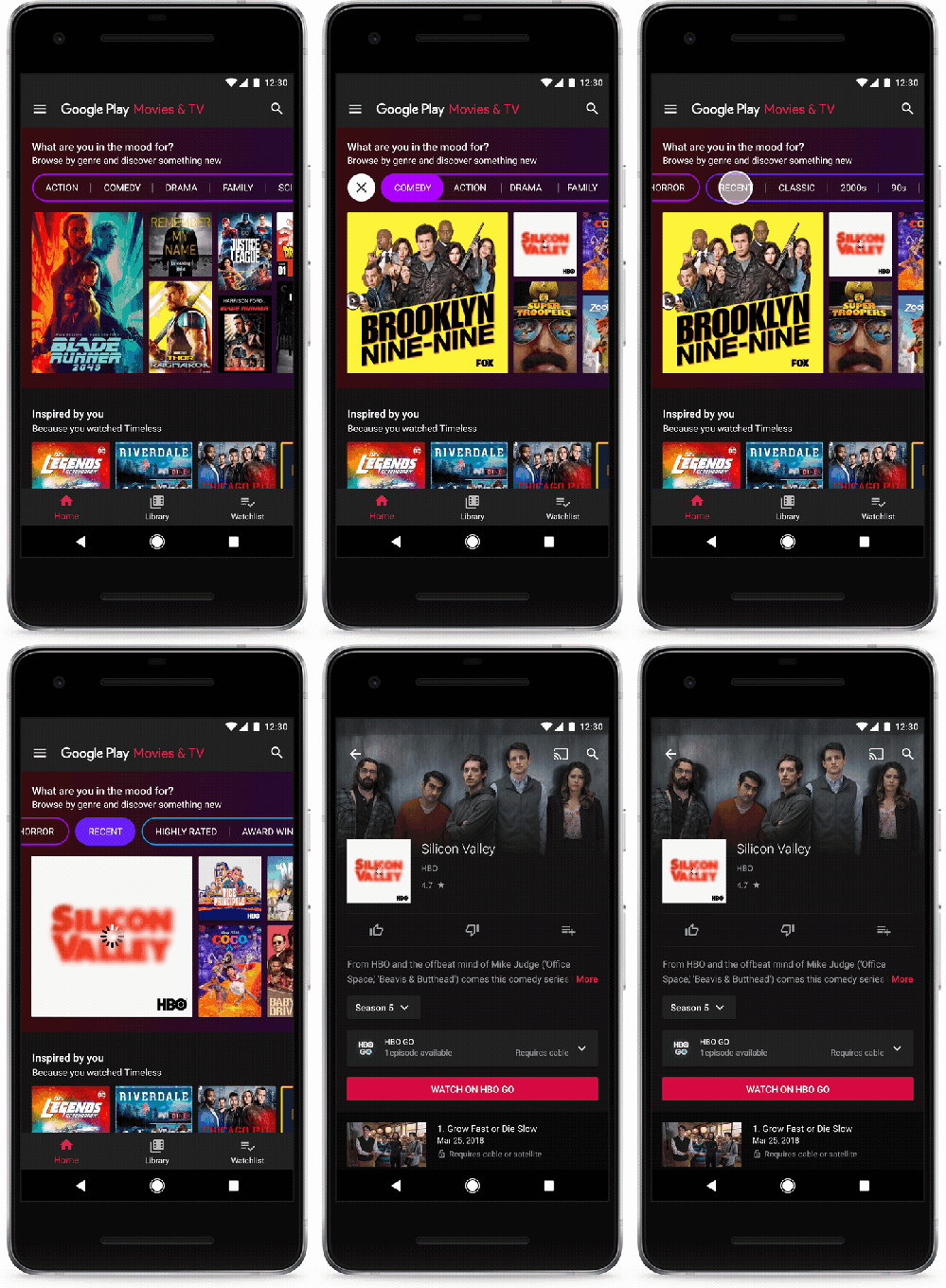
In the updated Google Play Movies & TV app, you’ll now find three tabs in the new bottom navigation bar which will direct you to your Home, Library or your Watchlist. The watchlist is a feature the app recently gained as well, but now it has a much more prominent position.

As you browse through the app, you can click on titles to read more about them, as before, but now you’re also able to see where the item can be streamed.

At launch, Google is working with 28 streaming services whose content libraries are now integrated in Google Play Movies & TV. That’s fewer than Apple’s TV app supports, which is currently over 60.

But it will find content even if it’s an exclusive to the streaming provider, and not necessarily something Google has for rent or sale. That means you can find original programming – like Amazon’s “The Man in the High Castle” – and then start watching it on the streaming service that hosts it.

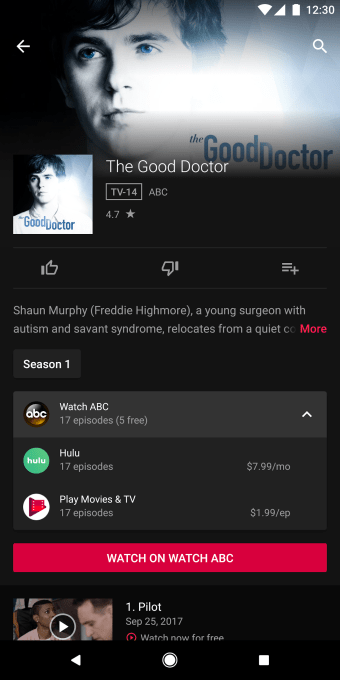
“We deeplink right into playback for that [third-party streaming] app,” explains Ben Serridge, the product manager for the Movies & TV app at Google. “So if I wanted to start watching ‘The Good Doctor’ pilot, I press the play button and it goes into the ABC app and start playback.”

Beyond the big names, Hulu and Amazon Prime Video, the app also pulls in content from ABC, CBS, FOX NOW, NBC, HBO NOW, HBO Go, Showtime, Showtime Anytime, Max Go, Starz, Disney Now, HGTV, BET Now, Comedy Central, A&E, Cooking Channel, Crackle, DIY Network, Food Network, History, Lifetime, MTV, The CW, Travel Channel, Tubi TV and VH1.

Notably missing is Netflix, whose content is searchable in Apple’s TV app.

Serridge didn’t explain why it’s missing, saying only that “we would very much like to have all the apps that distribute this kind of content on Play participating” –  effectively tossing the ball back to Netflix’s court.

Even without Netflix, the feature is useful if not comprehensive. It will show you the services hosting the content, whether it’s freely available to stream, if you need a subscription (as with HBO Now), the associated costs, or if you need to login with pay TV credentials to watch.

This is especially helpful because some of the network TV apps offer a teaser of a show with a few free episodes, but not complete seasons. The Google Play Movies & TV app will help you track down the rest elsewhere, if need be.

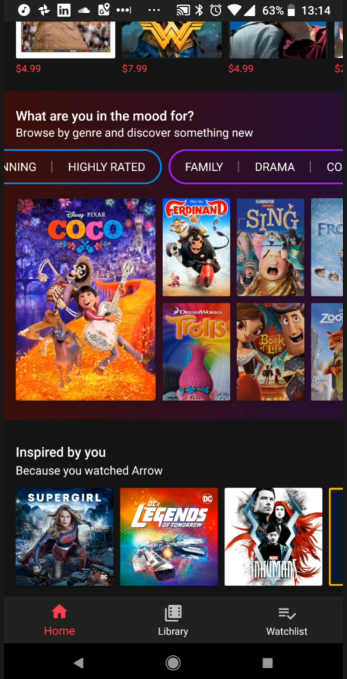
The app will also now help you narrow down searches thanks to a robust filtering system that lets you click on tags by genre, mood, decade, and more. For example, you could click on “Family,” “Drama,” Award winning,” Highly rated,” Comedy,” and other filters.

In addition to helping you find content, stream it, or add it to your Watchlist, the app includes personalized recommendations. These will be partly based on items you’ve previously watched, but you can also explicitly signal your interest or distaste as well, by clicking on the thumbs up or thumbs down button. The thumbs down will remove the item from your suggestions entirely.

Outside the app itself, the Play Store is being updated to show you the same information about content availability.

Solutions like the new Google Play Movies & TV app and Apple’s TV app are handy in the cord cutting era where content is spread out across networks, services, and other over-the-top offerings. But even these apps aren’t enough. Not only is Netflix missing from Google’s app, so is its own YouTube original content – and that’s the same company!

Also not addressed by either Apple or Google’s app are which shows may be available to stream or record via live TV services like YouTube TV, Hulu Live TV, PlayStation Vue, DirecTV Now, and Sling TV. (Although, to be fair, that’s not only a different set of services, it’s also a much larger challenge given that broadcast network availability varies by market. A dedicated solution like Suppose.tv or Fomopop’s live TV finder may work better.)

Meanwhile, there are other tools for finding and tracking favorite shows, like Reelgood or TV Time (or a jailbroken Fire TV stick we should admit), but they don’t have the benefit of matching content from a rent-and-buy marketplace like Google Play, or being available across phone, tablet, and desktop web, like Google Play.

Google says the new features will roll out to Android phones and tablets in the U.S. over the next few days.

27 Mar 2018

Lytro, a light-field imaging startup, is shutting down

Lytro, the light-field imaging startup focused on virtual reality, is shutting down. In a blog post, Lytro said it’s going to begin winding down and will not be taking on any new productions or providing new services.

Earlier this month, we heard Google would be acquiring Lytro in an “asset sale.” While Google is not acquiring the company, there are some Lytro team members joining the Google team, Google confirmed to TechCruch.

Here’s Lytro’s full blog post:

At Lytro, we believe that Light Field will continue to shape the course of Virtual and Augmented Reality, and we’re incredibly proud of the role we’ve been able to play in pushing the boundaries of what’s possible. We’ve uncovered challenges we never dreamed of and made breakthroughs at a seemingly impossible pace. We’ve had some spectacular successes, and built entire systems that no one thought possible. More importantly, we built a team that was singularly unified in its focus and unrivaled in its dedication. It has been an honor and a pleasure to contribute to the cinema and Virtual Reality communities, but starting today we will not be taking on new productions or providing professional services as we prepare to wind down the company. We’re excited to see what new opportunities the future brings for the Lytro team as we go our separate ways. We would like to thank the various communities that have supported us and hope that our paths will cross in the future.

Lytro began as a point-and-shoot camera that was able to refocus images after the fact. It later evolved into using its depth-data, light-field technology in virtual reality.

Lytro was not immediately available for comment.

27 Mar 2018

Nvidia suspends all autonomous vehicle testing

Nvidia is temporarily stopping testing of its autonomous vehicle platform in response to last week’s fatal collision of a self-driving Uber car with a pedestrian. TechCrunch confirmed this with the company, which offered the following statement:

Ultimately [autonomous vehicles] will be far safer than human drivers, so this important work needs to continue. We are temporarily suspending the testing of our self-driving cars on public roads to learn from the Uber incident. Our global fleet of manually driven data collection vehicles continue to operate.

Update: Shortly afterwards, the statement was apparently improved on internally and the following appended (brackets mine, replacing acronyms):

The accident was tragic. It’s a reminder of how difficult [self-driving car] technology is and that it needs to be approached with extreme caution and the best safety technologies. This tragedy is exactly why we’ve committed ourselves to perfecting this life-saving technology.

Likely someone pointed out that it wasn’t particularly charming to respond to a fatal system failure in an autonomous vehicle by saying that “ultimately” they’ll be safer, even if it’s true.

Reuters first reported the news.

The manually driven vehicles, to be clear, are not self-driving ones with safety drivers, but traditionally controlled vehicles with a full autonomous sensor suite on them to collect data.

Toyota also suspended its autonomous vehicle testing out of concern for its own drivers’ well-being. Uber of course ceased its testing operations at once.

27 Mar 2018

Bedrock Capital raises $122 to fund startups that reject conventional wisdom

Most investors don’t like to admit that they’re chasing the latest buzzwords or fads or hot companies, but a new firm called Bedrock Capital says it’s on a mission to do the exact opposite — founders Geoff Lewis and Eric Stromberg told me they’re searching for “narrative violations.”

So rather than just writing a check for the next company in a category that seems to be taking off, Lewis and Stromberg are looking for startups that buck the trends. (For example, Lewis told me he sees bike-sharing as a “narrative mirage” where only one or two startups are likely to be successful.) And they’ve raised a first fund of $122 million to make those investments.

The pair has worked together before at Oyster, where Stromberg was co-founder and CEO, and which Lewis backed as a partner at Founders Fund. (The startup was acqui-hired by Google in 2015.) Before starting Bedrock, Stromberg was making angel investments in startups including Hubble Contacts, Built Robotics and Lattice, while Lewis’ investments at Founders Fund included Lyft, Wish, Nubank and Canva.

Lewis said that the common link between his portfolio companies (besides current valuations of more than $1 billion, according to Bedrock) was the fact that he was offering “the only term sheet” at that point in time. Lyft, for example, might seem like an obvious bet now, but Lewis said that when Founders Fund invested in 2012, there are still questions about whether peer-to-peer rides would work, and whether Uber “would just crush everyone.”

At Bedrock, Lewis and Stromberg are focused on writing Series A checks between of $5 million and $10 million, though they also plan to make follow-on investments from the fund. The firm has already backed three companies: HQ Trivia, RigUp (a marketplace for oil and gas-related work) and another marketplace company that’s still in stealth.

HQ might not seem to fit the Bedrock model, especially since the firm wasn’t the only investor (or even the lead) in the trivia app’s $15 million round. But Lewis said, “We think that’s a narrative violation as well, because it can’t be easily categorized at all.” Plus, many investors think “all the good opportunities in consumer mobile apps are gone.”

The firm is based in New York, with Lewis splitting his time between Silicon Valley and NYC. But the pair said they’re looking to invest beyond those cities (RigUp, for example, is based in Austin), and they’re also hoping to back non-traditional founders.

“We think that the future is going to be much more distributed than the past in all ways,” Lewis said. “That includes types of people that are founding companies, and where companies are coming from. We’re really going to bring this open mindedness to bear.”

Lewis and Stromberg also laid out their vision in a letter to investors, which concludes:

Yet when the pendulum swings too far, narratives become a shortcut for thinking and we shortchange our future. In a Shakespearean twist, Silicon Valley’s success has narratively ensnared it on two levels. Not only has the popular narrative turned against the tech industry, but many in the industry themselves are caught in a narrative thrall that’s supplanting independent thought. We’ve become addicted to consuming the narrative; it’s dopamine hits are delivered by the decisecond on every screen — whether via Twitter, CoinMarketCap, or everything in between …

Against all odds, a few brave entrepreneurs violating the narrative today will come to define profound new truths tomorrow. We’re on a mission to find them.

27 Mar 2018

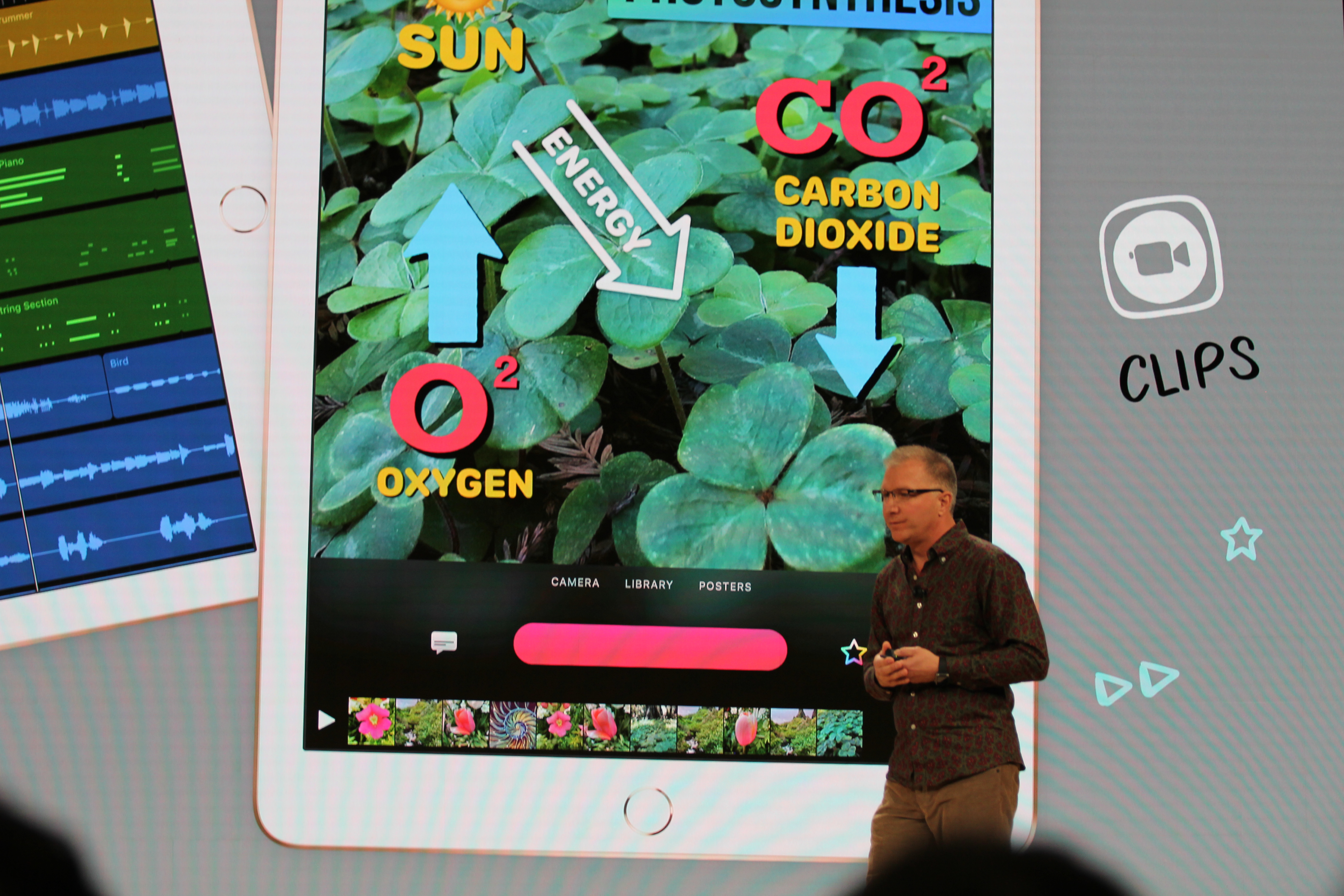
Apple’s learn-to-code app Swift Playgrounds adds AR lessons

Amid a flurry of educational-related announcements at Apple’s press event this morning, the company also unveiled a new feature in its learn-to-code app Swift Playgrounds, that will help teach a younger generation of iOS developers how to build AR-enabled apps. Apple has been heavily pushing augmented reality and its ARKit for developers, as the technology is expected to usher in a whole new ecosystem of smarter apps that can interact with the real world – whether that’s Pokémon-style games, apps that help you pick out your next sofa by visualizing it in the room, apps that animate real-world objects, help you learn, or just entertain.

Now Apple wants to encourage novice developers to get into AR, too.

Swift Playgrounds was first introduced in 2016 as a new tool for teaching kids to code. The app ships with a number of basic coding lessons and challenges, but with a more graphical and engaging interface than some other learn-to-code apps had in the past. It’s also distributed as an iPad app – meaning it’s ready for schools where iPads are used in the classroom.

Today, Apple highlighted AR-focused lessons in Swift Playgrounds.

In one example shown on stage, kids could program an animated character to move through a 3D virtual world as a part of a game. AR would allow characters to be placed in the real world, however.

The addition of the AR module to app was part of a larger “Everyone Can Code” agenda highlighted several times throughout the event, with a focus on how Apple’s tools can help.

The larger news from this morning was the launch of a low-cost iPad with support for Apple Pencil – the company’s effort to combat Google Chromebook’s growing traction in schools.

Apple didn’t say when Swift Playgrounds would add the AR module, or if it already had ahead of the event.

27 Mar 2018

Apple is finally selling the Space Gray mouse, keyboard and trackpad without an iMac Pro

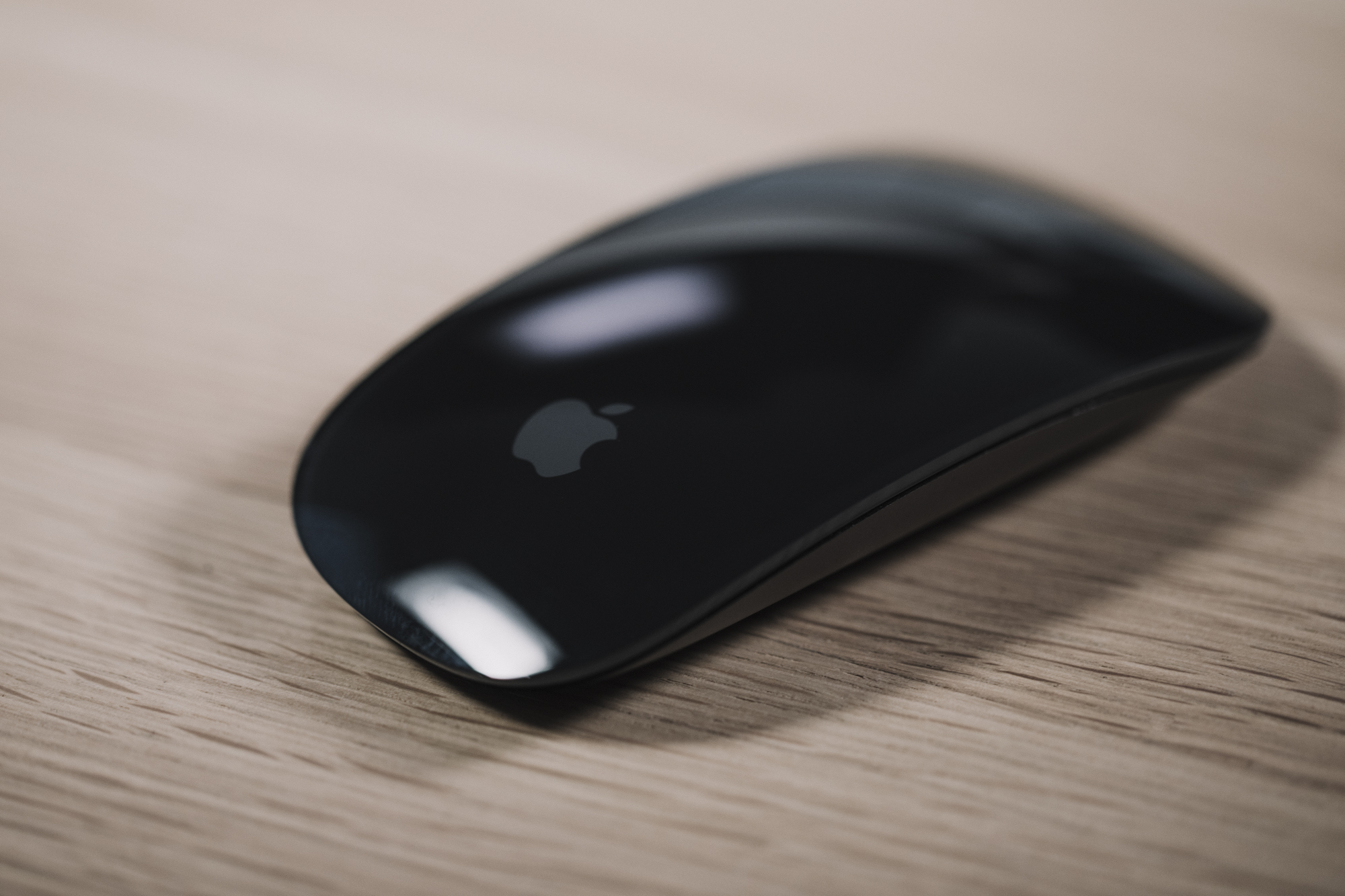
Surprise! You don’t have to pay $5,000 or more to get a Space Gray Magic Mouse 2, Magic Keyboard or Magic Trackpad 2. You can now buy those devices separately.

And because this is Apple, you’ll have to pay more to get the dark items. The Magic Mouse 2 costs $79 in silver and $99 in Space Gray.

The Magic Keyboard costs $129 for the silver version and $149 for the Space Gray one. This keyboard comes with a numeric keypad. The small version of the keyboard only has one color option. The trackpad costs the same price.

This news is going to make many eBay sellers really sad.

Apple iMac Pro mouse

Apple iMac Pro mouse

27 Mar 2018

Apple is finally selling the Space Gray mouse, keyboard and trackpad without an iMac Pro

Surprise! You don’t have to pay $5,000 or more to get a Space Gray Magic Mouse 2, Magic Keyboard or Magic Trackpad 2. You can now buy those devices separately.

And because this is Apple, you’ll have to pay more to get the dark items. The Magic Mouse 2 costs $79 in silver and $99 in Space Gray.

The Magic Keyboard costs $129 for the silver version and $149 for the Space Gray one. This keyboard comes with a numeric keypad. The small version of the keyboard only has one color option. The trackpad costs the same price.

This news is going to make many eBay sellers really sad.

Apple iMac Pro mouse

Apple iMac Pro mouse

27 Mar 2018

Tesla fatal car crash prompts NTSB investigation

The United States National Transportation Safety Board is conducting an investigation into a fatal car crash involving a Tesla Model X car. On March 23, a Tesla car crashed into a freeway divider, killing the driver, causing a fire and shutting down two lanes of Highway 101 near Mountain View, Calif. It’s not clear if Tesla’s automated control system, Autopilot, was active at the time of the crash, the NTSB said in a tweet

This investigation comes shortly after a fatal accident involving one of Uber’s self-driving cars in Tempe, Arizona prompted the NTSB to send over a field team. According to the NTSB’s most recent update, the team was meeting with representatives from Uber, the NHTSA and Tempe Police Department. The department also said it was gathering and collecting information about the test vehicle’s technology, the pedestrian and the safety driver.

Last year, the NTSB looked into a 2016 accident involving Tesla’s Autopilot system in Florida. The NTSB partially faulted Tesla for the fatal crash, saying the system operated as intended but that the driver’s inattentiveness, due to over-reliance on the Autopilot system, resulted in the accident.

Tesla was not immediately available for comment.