27 Mar 2018

Shuly Galili and Yahal Zilka join us in Tel Aviv

In a bit more than two months, the TechCrunch team is heading to Tel Aviv for a day-long event. And I’m excited to announce a couple of new speakers — Shuly Galili from UpWest Labs and Yahal Zilka from Magma Venture Partners.

While both Galili and Zilka are investors, they have two different stories to tell. Galili is based in Silicon Valley and is looking for the most promising seed-stage startups coming from Israel.

She’s been helping entrepreneurs bridge the gap between Silicon Valley and Israel. She has a ton of insights on both ecosystems. As a founding partner for UpWest Labs, she’s already participated in dozens of funding rounds with her tiny team. UpWest Labs is an investor in Airobotics, HoneyBook, SentinelOne and many other startups.

As for Zilka, he’s now mostly known for his role at Magma Venture Partners. Magma has been around for nearly 20 years and is now an established player in Israel.

As a managing partner, Zilka is involved with a handful of startups on the board of directors. He was also involved with Waze, Onavo, Argus and plenty of other Israeli success stories.

Zilka also used to be working for startups before starting his VC career. In particular, he worked for VocalTec Communications in the late 1990s, one of the companies that first worked on voice-over-IP technologies. The company went public in 1996.

These two speakers will have plenty of interesting things to say on June 7 at the TechCrunch Tel Aviv conference. This year, the event will focus on mobility and everything around it, from autonomous vehicles, to sensors, drones and security.

Buy tickets here and see you at the Tel Aviv Convention Center!

27 Mar 2018

Amazon partners with French retailer Monoprix to launch Prime Now grocery deliveries in Paris

Amazon’s business in France is taking a big step forward after announcing a new deal today with retail giant Monoprix to deliver groceries through Prime Now. The service will begin serving Prime Now members in Paris this year and include products carried by Monoprix, including its own branded items and fresh produce.

Monoprix’s website already offers services including home deliveries in some areas and “click and collect,” which lets shoppers pre-order items online before picking them up at a nearby store.

Frédéric Duval, Amazon France’s country manager, told Journal du Dimanche earlier this month that the company wanted to launch grocery delivery there, though at the time he didn’t specify who Amazon would partner with. Monoprix competitors Systeme U, Leclerc and Intermarche were reportedly also considered potential candidates, while struggling big box store operator Carrefour was speculated to be an acquisition target.

Monoprix is owned by Casino Group, a French retail conglomerate that operates stores, including supermarkets, convenience stores and restaurants, in France, Latin America and Southeast Asia. It generated 38 billion Euros in consolidated net sales last year.

In press statement, Duval said “This commercial partnership, which further enlarges Prime Now service selection, will enable Amazon Prime customers to benefit from ultra-fast deliveries for their Monoprix orders.”

27 Mar 2018

Uber blocked from testing self-driving cars on Arizona roads

Uber has been barred from testing its self-driving cars on public roads in Arizona following the accident last week involving one of its testing vehicles that killed a pedestrian crossing the street in its path. Arizona Governor Doug Ducey released a letter sent to Uber CEO Dara Khosrowshahi in which he described the accident as captured by onboard cameras as “disturbing and alarming.”

The governor, who has been a strong proponent of self-driving testing in the state up until this point, advocating for Uber and other companies to bring their programs to Arizona roads, also directed the Arizona Department of Transportation to “suspend” Uber’s self-driving testing access.

Uber had already suspending testing of its autonomous test vehicles not only in Arizona, but in all markets following the crash and pending the results of its investigation.

The ride-hailing company had begun operations in Arizona in 2016, following its launch of its self-driving SUVs on San Francisco streets, in a test which was quickly shut down once the California DMV revealed they did not have the proper permit to test on state roads. Uber made a big show of transporting its test fleet to Arizona, where Ducey voiced strong support and welcome for the relocation of Uber’s self-driving pilot to within his state.

27 Mar 2018

Foxconn buys peripheral maker Belkin for $866M

Foxconn, best known for manufacturing practically everything in the world, has just announced the purchase of Belkin, the PC peripherals company, for $866 million in cash. That certainly makes it one of the larger consumer electronics acquisitions in recent memory.

You probably know Belkin for its various lines of accessories, peripherals, and assorted consumer electronics; Linksys, surely the most recognizable router brand, is a subsidiary. Wemo and Phyn might also ring a bell.

The purchase is likely aimed at giving Foxconn a foothold of its own in the peripherals and networked devices market. Belkin’s CEO and founder (35 years on), Chet Pipkin, will continue to operate the company as a wholly owned subsidiary and may join Foxconn’s management team.

No indication was given that Belkin’s companies would change much, either in makeup or in product lineup. I asked both companies for more details, and got a polite no comment in record time.

Interestingly, the FCC just today announced that it would soon propose that it would ban spending on companies that “pose a national security threat.” Huawei and ZTE were the obvious (but unnamed) targets of the proposed rule, but now Belkin and Linksys may also be included.

27 Mar 2018

Foxconn buys peripheral maker Belkin for $866M

Foxconn, best known for manufacturing practically everything in the world, has just announced the purchase of Belkin, the PC peripherals company, for $866 million in cash. That certainly makes it one of the larger consumer electronics acquisitions in recent memory.

You probably know Belkin for its various lines of accessories, peripherals, and assorted consumer electronics; Linksys, surely the most recognizable router brand, is a subsidiary. Wemo and Phyn might also ring a bell.

The purchase is likely aimed at giving Foxconn a foothold of its own in the peripherals and networked devices market. Belkin’s CEO and founder (35 years on), Chet Pipkin, will continue to operate the company as a wholly owned subsidiary and may join Foxconn’s management team.

No indication was given that Belkin’s companies would change much, either in makeup or in product lineup. I asked both companies for more details, and got a polite no comment in record time.

Interestingly, the FCC just today announced that it would soon propose that it would ban spending on companies that “pose a national security threat.” Huawei and ZTE were the obvious (but unnamed) targets of the proposed rule, but now Belkin and Linksys may also be included.

27 Mar 2018

“Time to keep going” says Harrison Metal, closing on a new, $68 million fund

Harrison Metal, a 10-year-old, San Francisco-based seed-stage venture fund, has closed its fifth vehicle with $68 million, founder Michael Dearing tweeted out a bit ago.

“Ten years ago this month, I started this business,” he wrote. ” I was excited-nervous as could be. Worried I didn’t belong in the venture capital world, I figured I’d keep my head down and work hard, ignore all the nonsense as much as possible, focus on what I loved and where I could help.”

Dearing has indeed kept his head down over the years — as announcing his own new fund on Twitter suggests. (Most venture firms seek out media attention, on the belief that stories about their fresh capital will attract founders.)

Reporter Kara Swisher even dubbed him years ago the “hottest angel investor you’ve never heard of.”

Things haven’t changed much. Dearing — a former senior VP at eBay who joined Stanford’s faculty in 2006 as a consulting associate professor and taught off campus for eight years —  has quietly backed a long string of highly successful companies.

More distantly, he funded AdMob, a mobile advertising start-up acquired by Google for $750 million in late 2009. He also backed Aardvark, a social search engine that was also acquired by Google, for $50 million 2010. (Aardvark cofounder Max Ventilla has since created AltSchool, a richly funded, somewhat controversial network of schools and maker of educational software that Dearing has also backed.)

Dearing had another big win when Acompli, which made a mobile email application, sold to Microsoft for $200 million in cash in 2014. It had raised just $7.3 million from investors.

But Dearing doesn’t have to look too far back into the archives to be proud of his portfolio. Among his “active” bets are such buzzy companies as Harry‘s the shaving company, PagerDuty, and MasterClass.

Harry’s just announced $112 million in funding last month, money it wants to use to take on not just Gillette but Proctor & Gamble, too.

PagerDuty, which sells digital operations management services, is doing well enough that its privately held shares have become a hot commodity to secondary buyers.

MasterClass, which last raised $35 million a year ago, has meanwhile become hugely popular if our spectrum of friends is to believed. Many of them seem to be taking some online course or another by MasterClass, which has enlisted tens of “masters” in their respective fields — tennis great Serena Williams, screenwriter Aaron Sorkin, and chef Thomas Keller, among them — to teach people eager to learn how to succeed in the same industry.

It’s perhaps no wonder that Dearing likes to fly low. Several years ago in StrictlyVC, a newsletter published by this editor, he told interviewer and fellow investor Semil Shah that in his view, the “very best early-stage investor in the business is Steve Anderson” of Baseline Ventures, who also happens to prefer operating in the shadows. (We were able to pull Anderson out of them just once for a story.)

Said Dearing of Anderson in a description that some might say also suits Dearing: “His track record is exceptional, obviously — and he’s well known for it. But I mean ‘best’ in the broadest sense. Tells the truth. Focuses on making the pie big first. Crazy supportive of his founders in good and bad times. He’s honest and hard-working. He’s the very first person I would go see if I were raising money. There are some truly exceptional people in the early-stage business, but he’s at the top of my list.”


26 Mar 2018

Mobileye chastises Uber by detecting struck pedestrian in footage well before impact

A self-driving vehicle fatally striking a pedestrian is a tasteless venue for self-promotion, but it’s also an important time to discuss the problems that created the situation. Mobileye CEO and CTO Amnon Shashua seems to do a little of both in this post at parent company Intel’s blog, running the company’s computer vision software on Uber’s in-car footage and detecting the person a full second before impact.

It first must be said that this shouldn’t be taken to demonstrate the superiority of Mobileye’s systems or anything like that. This type of grainy footage isn’t what self-driving — or even “advanced driver assistance” — systems are meant to operate on. It’s largely an academic demonstration.

But the application of a competent computer vision system to the footage and its immediate success at detecting both Elaine Herzberg and her bike show how completely the Uber system must have failed.

Even if this Mobileye object detection algorithm had been the only thing running in that situation, it detected Herzberg a second before impact (on highly degraded data at that). If the brakes had been immediately applied, the car may have slowed enough that the impact might not have been fatal; even a 5 MPH difference might matter. Remember, the Uber car reportedly didn’t even touch the brakes until afterwards. It’s exactly these types of situations in which we are supposed to be able to rely on the superior sensing and reaction time of an AI.

We’re still waiting to hear what exactly happened that the Uber car, equipped with radar, lidar, multiple optical cameras and a safety driver, any one of which should have detected Herzberg, completely failed to do so. Or if it did, failed to take action.

This little exhibition by Mobileye, while it should be taken with a grain of salt, at least gives a hint at what should have been happening inside that car’s brain.

26 Mar 2018

Robot posture and movement style affects how humans interact with them

It seems obvious that the way a robot moves would affect how people interact with it, and whether they consider it easy or safe to be near. But what poses and movement types specifically are reassuring or alarming? Disney Research looked into a few of the possibilities of how a robot might approach a simple interaction with a nearby human.

The study had people picking up a baton with a magnet at one end and passing it to a robotic arm, which would automatically move to collect the baton with its own magnet.

But the researchers threw variations into the mix to see how they affected the forces involved, how people moved and what they felt about the interaction. The robot had two types each of three phases: movement into position, grasping the object and removing it from the person’s hand.

For movement, it either started hanging down inertly and sprung up to move into position, or it began already partly raised. The latter condition was found to make people accommodate the robot more, putting the baton into a more natural position for it to grab. Makes sense — when you pass something to a friend, it helps if they already have their hand out.

Grasping was done either quickly or more deliberately. In the first condition the robot’s arm attaches the magnet as soon as it’s in position; in the second, it pushes up against the baton and repositions it for a more natural way to pull out. There wasn’t a big emotional difference here, but opposing forces were much less in the second grasp type, perhaps meaning it was easier.

Once attached, the robot retracted the baton either slowly or more quickly. Humans preferred the former, saying that the latter felt as if the object was being yanked out of their hands.

The results won’t blow anyone’s mind, but they’re an important contribution to the fast-growing field of human-robot interaction. Soon there ought to be best practices for this kind of thing for when we’re interacting with robots that, say, clear the table at a restaurant or hand workers items in a factory. That way they’ll be operating with the knowledge that they won’t be producing any unnecessary anxiety in nearby humans.

A side effect of all this was that the people in the experiment gradually seemed to learn to predict the robot’s movements and accommodate them — as you might expect. But it’s a good sign that even over a handful of interactions a person can start building a rapport with a machine they’ve never worked with before.

26 Mar 2018

BMW and Lexus look to car subscriptions

More automakers will soon offer vehicles through subscription services. Lexus today announced its upcoming UX crossover would be available through one and Bloomberg published a report today stating BMW is about to announce a subscription pilot.

These automakers join a growing list of makers offering models through new financing vehicles. Currently, Volvo, Cadillac, Ford and Porsche have a service that ditches traditional financing in favor of a more flexible and innovative way to drive the latest car. Several startups, like Drover and Fair, are also looking at this market as demand increases.

Current subscription services live between short-term rentals and several-year leases. Most of the services give users the ability to swap vehicles or bundle insurance with the cost of the vehicle. The goal is to offer consumers the latest vehicles as efficiently as possible.

The Lexus UX will be the first vehicle Lexus offers through a subscription.

Likewise, BMW is reportedly about to launch a pilot subscription next week in Tennessee. Apparently, it will be called Access by BMW and offered by a local BMW dealership.

Terms of both the Lexus and BMW service have yet to be announced.

26 Mar 2018

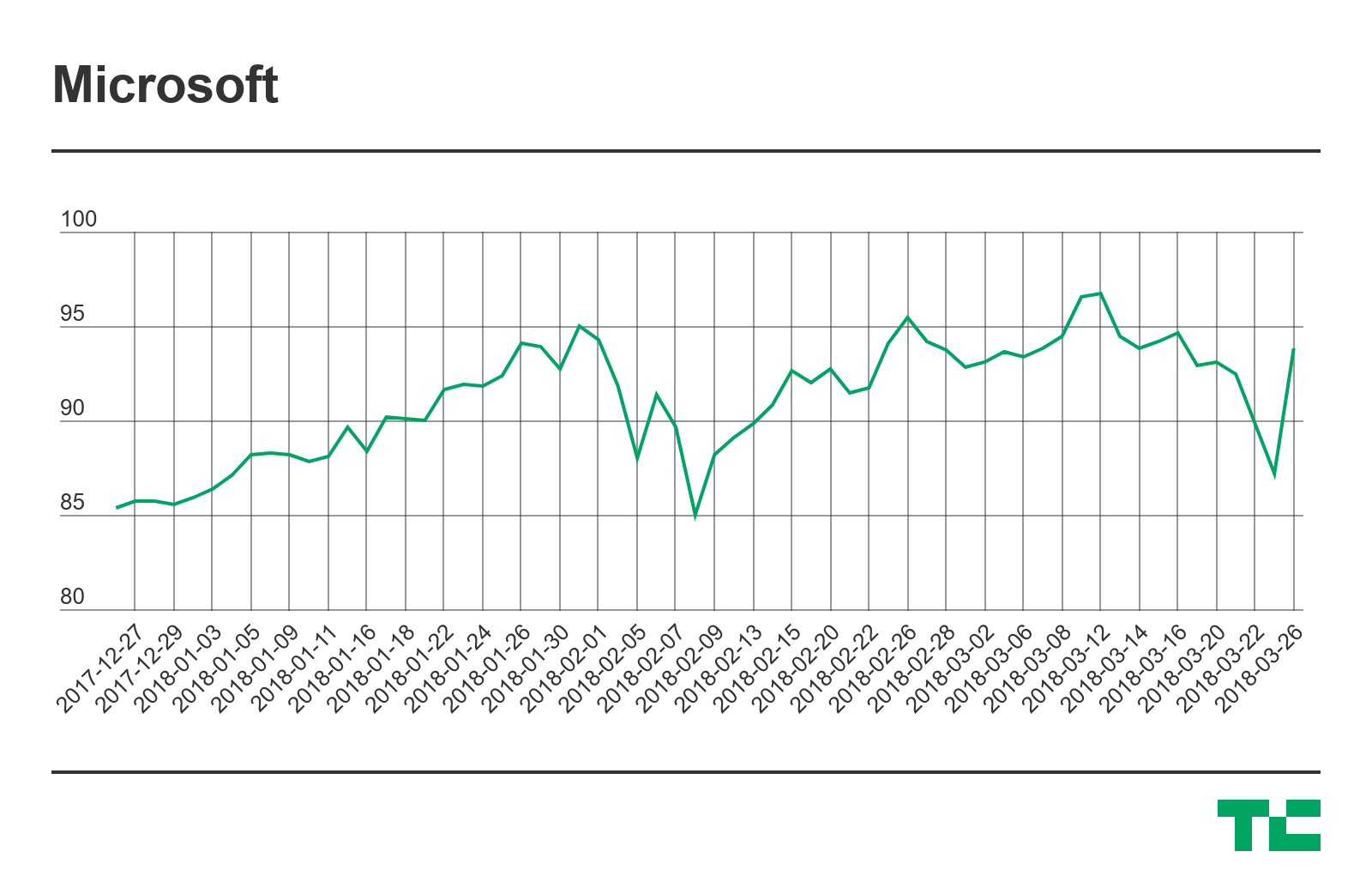
Microsoft surges 8% after Morgan Stanley says it will reach $1 trillion market cap

The Dow surged 669 points on Monday after trade tensions eased.

Tech stocks like Amazon and Apple saw gains, but the biggest winner of all was Microsoft .

The Seattle tech giant, which is a Dow 30 company, benefitted not only from the solid stock market day, but also because a Morgan Stanley analyst had kind things to say about it.

Keith Weiss wrote in a note to clients that he’s raising his 12-month price target to $130, an almost 50% increase from the $90 shares traded at last week. This would give the company a market cap of $1 trillion.

He’s particularly bullish on Microsoft’s cloud business. He believes that it will continue to do well, despite competition from Amazon and Google. He also likes the Office 365 software.

The race to $1 trillion has been talked about for several years. Apple is currently in the lead with a market cap of $877 billion. Amazon is at $753 billion. And After Monday’s strong day of trading, Microsoft is nearing it at $722 billion.

In general, stocks have done very well in recent years, with the Dow up nearly 10,000 points from where it was five years ago.

Microsoft is up 44% in the past year alone.