26 Mar 2018

Dropbox up another 7% on day two

Dropbox’s surge on the stock market has continued, with the company going up another 7% on its second day on the stock market.

The company saw its shares close at $30.45, giving the company above a $13 billion market cap, fully diluted.

When it priced its IPO, there was a question as to whether Dropbox would surpass the $10 billion valuation it achieved in its last private round. It eliminated those concerns overnight.

The first few days have been a strong indicator of investor demand for the cloud storage company.

To recap, Dropbox initially hoped to price its IPO between $16 and $18, then raised it from $18 to $20. Then it ultimately priced its IPO at $21, closing the day above $28. And it still continues to go up.

Bankers price IPOs to “pop” or go up about 20% on the first day. The surge implies that Dropbox exceeded Wall Street’s expectations. It also means that Dropbox could have priced its shares higher and raised more money.

It priced shares at $21, raising $756 million. If Dropbox had priced shares at $24, it would have raised $864 million and new investors would have still seen big gains.

It was certainly a win for stock market investors, which like the company’s improving financials.

It brought in $1.1 billion in revenue in its most recent year. This is up from $845 million in revenue the year before and $604 million for 2015.

Yet while it’s been cash flow positive since 2016, it is not profitable. Dropbox lost nearly $112 million last year. But its margins are looking better when compared with losses of $210 million for 2016 and $326 million for 2015.

Monday was a good day on the stock market in general.  The Dow surged 600 points, partly due to gains from tech stocks like Microsoft and Apple.

Co-founder and CEO Drew Houston is the largest shareholder, owning 25.3% of the company ahead of its IPO. Sequoia Capital owned 23.2% of Dropbox.

Although Dropbox is very different than Spotify which intends to list next week, investors will view this favorable debut as a sign that the IPO window is “open,” meaning that there is strong demand for newly public tech companies.

Zuora, Pivotal and Smartsheet also unveiled IPO filings recently, suggesting that they will go public in April. And we broke the news that DocuSign’s IPO is coming up.


 

26 Mar 2018

Cisco commits $50 million to end homelessness in Silicon Valley

Homelessness in Santa Clara County has gotten worse, with the overall homeless population increasing 13 percent to 7,394 in 2017 over the course of two years. That puts Santa Clara’s homelessness crisis in the same ballpark as San Francisco’s, which has a homeless population of 7,499, according to a 2017 homeless census and survey. Santa Clara also has the third highest rate of chronic homelessness in the entire country.

Today, Cisco announced a $50 million donation to Destination: Home over the next five years. The idea is to help put an end to homelessness in Santa Clara County — an area of Northern California that is home to the tech industry’s Silicon Valley. This area consists of cities like Cupertino (home to Apple’s headquarters), Mountain View (home to Google/Alphabet), Palo Alto (home to Facebook), San Jose and Sunnyvale.

“We have said for a long time that it is up to all of us to end homelessness in our community,” Destination: Home CEO Jennifer Loving said in a statement. “Cisco has fully embraced that concept, and is stepping up in a big way to provide the type of critical private sector leadership and substantial funding that is necessary to address this crisis head on. We couldn’t be more thrilled or grateful to have Chuck Robbins and the Cisco team at the table.”

Cisco has donated an initial $20 million chunk to Destination: Home through its Cisco Fund. The plan is for this money to invigorate Destination: Home’s efforts to achieve its five-year plan to end homelessness, which entails disrupting and transforming homeless response systems, building new housing opportunities and deploying client-centered solutions.

Since implementing the plan in 2015, Santa Clara County has been able to permanently house 5,154 people, according to Destination: Home’s March 2018 progress report.

Click to enlarge

“I believe that this commitment is a smart, long-term investment in the work that Destination: Home does, allowing them to buy land and build additional housing, pioneer technology solutions around homelessness, enhance data collection capabilities, and test promising social service intervention model” Cisco CEO Chuck Robbins (pictured above) wrote in a blog post. “This is also an investment in the place that has been so good to us as a company – the place where so many of us are fortunate not just to work, but to have a home.”

As tech companies grapple with their roles in the displacement of non-tech workers, it’s promising to see some of them try to tackle the problems they helped to exacerbate. It’s worth noting Cisco is not the only tech company putting money behind social good efforts. In October, Google committed $1 billion in grants to train U.S. workers for jobs in the high-tech industry.

26 Mar 2018

Lerer Hippeau Ventures is taking over management of Binary Capital’s debut fund

Lerer Hippeau Ventures, the New York-based early-stage venture firm, is taking over the $125 million debut fund created by Binary Capital, a young San Francisco-based venture firm whose cofounder’s misdeeds became the talk of Silicon Valley last summer.

Axios reported the development earlier this morning. Lerer Hippeau tells us it’s not commenting on the news.

The portfolio includes 25 startups, including Bellhops, a five-year-old, Chattanooga, Tn.-based local moving services startup, and Unikrn, a three-year-old, Bellevue, Wa.-based e-sports wagering service that raised $31.4 million via an initial coin offering last fall. (Billionaire Mark Cuban is also an investor.)

What happens to Binary’s second fund is apparently an open question. Jonathan Teo, a cofounder of Binary, didn’t respond to our requests for more information this morning, but Recode reports that firm has “bogged down in various legal matters, including an attempt by Teo to have his fate decided in arbitration.”

Teo’s cofounder, Justin Caldbeck, had brought the firm to the brink of ruin. Last summer, an in expose published by The Information, Caldbeck, who’d previously been an investor with Lightspeed Venture Partners, was accused of making unwanted sexual advances toward six women who said they were groped and propositioned during their professional relationship with him.

Caldbeck initially denied the claims, telling The Information’s reporter, “Go f— yourself.” A day later, he was apologizing for his behavior and, within short order, was forced to resign under pressure.

Teo had apparently hoped to hang on to the firm, which he’s created with Caldbeck in early 2014. Judging by Recode’s report, he’s still fighting to stay involved.

Caldbeck meanwhile showed up at his alma mater, Duke University, last fall to discuss the male-dominated world of finance. “If we’re going to make change, men need to behave better,” Caldbeck told the school newspaper afterward. “Part of what needs to happen is more education around these issues.”

Caldbeck separately told Bloomberg that he planned to release a website dedicated to the topic of “bro culture” and how to address it.

To the relief of his many critics, he appears not to have moved forward with those plans.

Pictured above, left to right: Teo and Caldbeck.

26 Mar 2018

Facebook fights creeps and apathy with expiring friend requests

Snapchat has ephemeral messages, and now Facebook has ephemeral friend requests. The big blue social network feeds off your social graph, and every time you expand it, it has more content to show you. But if you leave a questionable friend request in limbo for too long, you’ll probably never confirm or delete it. So Facebook is betting that by making those friend requests into exploding offers, you’ll be more likely to accept than lose the opportunity to connect. And if you didn’t want that friend request in the first place, it will self-destruct even if you don’t bother to manually reject it.

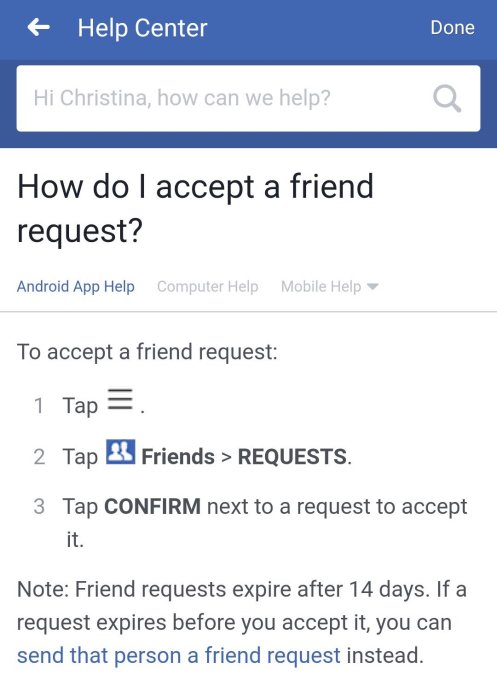
On Friday, TechCrunch reader Christine Hudler provided screenshots of a new expiring friend requests feature that gives you a 14 day countdown to make a decision. Now a Facebook spokesperson has confirmed the feature to TechCrunch, writing “I can confirm that this is a test to help surface the most recent requests.” Facebook tells me it’s a way to assist people with managing unwanted friend requests by eventually deleting those people saw but didn’t accept. It’s currently only appearing to a subset of users, not to everyone.

Those in the test group will see a “14 days to respond” countdown on their friend requests. A ‘Learn More’ link leads to this Help Center article we’ve screenshotted here, as it only shows details about expirations to those in the test.

Keeping people’s friend request queue clean is critical to the company because if you can’t find the legitimate ones from people you know amongst all the randos and spam, you might stop growing your graph. Expiring friend requests could also solve a problem for social media stars and other public figures on Facebook. The app only lets you have up to 5000 friends, and a limited number of pending requests that seems to be 5000 minus your friend count (Facebook wouldn’t say). After that, you won’t receive inbound friend requests any more. The expiration date makes it much less likely that you’ll ever hit the pending friend request maximum.

The “limited time offer” trick has been around in shopping forever as way to boost your sense of urgency. Humans love optionality but hate to miss out. People buy things off of infomercials they don’t actually want because if they “ACT NOW!” they’ll get a discount before it disappears. This same approach compels people to open Snapchat so they don’t miss their friends’ Stories that delete themselves after 24 hours.

The feature comes at a time when Facebook is especially sensitive about appearing respectful of your data, following the Cambridge Analytica scandal. Friend requests from total strangers can make users feel like they’re already sharing too much public information, and that one wrong click could expose their friends-only photos and posts. Keeping these requests from piling up could make users feel safer while ensuring they can keep adding real friends.

For more on what’s up with Facebook, read our feature pieces:

26 Mar 2018

Smartsheet files for IPO

Smartsheet is the latest company to file to go public, now that the IPO window is open. 

The Bellevue, Washington-based company offers enterprise software for communication and collaboration.

It describes itself as the “leading cloud-based platform for work execution, enabling teams and organizations to plan, capture, manage, automate, and report on work at scale, resulting in more efficient processes and better business outcomes.”

Smartsheet says it has 3.6 million users and its products are utilized at 90 percent of the Fortune 100 companies around the world.

It touts clients like Cisco and Starbucks. Smartsheet says Cisco uses it to keep tabs on spending and Starbucks uses it send product and business updates to its thousands of stores.

The company brought in $111.3 million in revenue for its fiscal 2018 year. It’s a big jump from $67 million for 2017 and $40.8 million for 2016.

But losses are also growing, totaling $49.1 million for 2018, up from negative $15.2 million and $14.3 million in prior years.

“We have a history of cumulative losses and we cannot assure you that we will achieve profitability in the foreseeable future,” the company warned in its prospectus.

Smartsheet acknowledges that it competes with Microsoft and Google on spreadsheets and other productivity tools. Its products also compete with Asana, Atlassian, Planview and Workfront.

“The market in which we participate is highly competitive, and if we do not compete effectively, our operating results could be harmed,” reads the “risk factors” section of the filing.

The largest shareholder is Insight Venture Partners, which owned a sizeable 32.1 percent of the company prior to the IPO. Madrona Ventures owned 28.4 percent of the company and Sutter Hill Ventures owned 5.4 percent.

Smartsheet had raised at least $106 million in venture funding, dating back to 2010, according to Crunchbase data. Last year, TechCrunch reported that it had an $800 million valuation.

The company plans to list on the New York Stock Exchange, under the ticker “SMAR.”

Morgan Stanley and J.P. Morgan are managing the offering. Fenwick & West and Wilson Sonsini served as counsel.

The floodgates have opened for enterprise tech IPOs. Last week we saw Dropbox debut and now we’ve seen filings for Zuora and Pivotal. DocuSign is also expected to file in the coming months.

Many of last year’s enterprise tech IPOs performed well, giving pipeline companies confidence in their debuts.

Spring also tends to be an active time for IPOs, with companies looking to debut before the summer slowdown.

And while consumer tech IPOs have been slow for several years now, one of the more anticipated companies looking to debut is Spotify, which is expected to go public next week via a “direct listing.”


26 Mar 2018

This DIY, Alexa-connected robotic tank will bring you a beer

As we enter the upcoming Golden Age of connected robotics it’s important to stay well-lubricated. Thus we must invite the Walabeer tank, a DIY, Alexa-connected robotic tank that serves beer, into our homes and hearts.

The project uses a toy tank chassis connected to a Walabot, a device that lets your projects see through walls. Once all of this is connected to a Raspberry Pi and, in turn, Alexa, you can ask the Walabeer Tank to turn on its lights, open its cargo hold, and follow you around the house. The complex cargo lifting mechanism uses Erector Set pieces and a slow servo motor.

Balázs Simon created the tank as a proof-of-concept project and there is a full bill of materials and build description here.

“There are things that deep inside every man wants to have. Combining beer and tanks is one of these things! This project will be about this thing, a voice controlled tank that delivers beer to you with an autonomous “follow me” function or with an RC control. Let’s build the beer tank of our dreams!” wrote Simon.

While it’s unclear what this beer tank does when it runs out of beer – it cannot yet open the fridge, for example – it’s nice to know someone out there is watching out for our thirsty gullets as we rocket headlong into the future.

26 Mar 2018

Lightweight robo-coat for sea creatures could track habits without interfering

Tracking sea animals is a difficult task for many reasons, not least of which is the robustness necessary for any device to survive longer than a few weeks of water torture. The clunky solutions currently used to watch whales and other creatures might soon have a more lightweight competitor: this flexible, inexpensive “marine skin.”

Developed by researchers at King Abdullah University of Science and Technology, the ultra-light sensor platform was developed out of the simple concern that existing tech simply isn’t pleasant for animals to wear. Muhammad Mustafa Hussain leads the project in collaboration with the Red Sea Research Institute.

The marine skin uses a flexible silicone substrate and a design that can survive being twisted, torqued, and put under serious pressure at up to moderate depth. It tracks the salinity and temperature of the water and distance below the surface; this could be used to track either the creature’s own preferences or to monitor the waters in which it swims or crawls.

It uses a watch battery and the team suggests it could last for up to a year once it’s optimized, although the necessity of transmitting information over long distances could limit that. Currently it can only send information via Bluetooth, and a 30 foot range isn’t particularly useful in the vast ocean. But there are ways to account for that.

At a cost of less than $12 per unit, it’s also extremely cheap. At scale that could be even cheaper, and its low profile means it could be deployed en masse on small animals rather than on carefully chosen high-value targets like itinerant whales.

It’s still in the prototype phase but the team is working with others to test the devices, and publishing its progress in a paper in Flexible Electronics. IEEE Spectrum has a few more details and pictures from Hussain’s group.

26 Mar 2018

General Catalyst just closed its biggest fund ever, as firms race to get bigger, fast

It happened in 2016, and it’s happening like clockwork again in 2018: Venture firms are closing new funds with more money than they ever have before, just two years after closing their most recent funds with more money than they’d ever raised before.

Last week you may have caught wind that Khosla Ventures is raising up to $1.4 billion across an early-stage fund and gigantic seed fund. Battery Ventures also recently upped the ante, raising a fresh $1.25 billion across two funds. Meanwhile, Sequoia Capital is reportedly looking to raise $12 billion across a series of funds. (As the second-largest shareholder of newly public Dropbox, that pursuit just became easier, we’d imagine.)

Don’t expect the announcements to stop anytime soon. Just today, the SEC processed paperwork showing that 18-year-old General Catalyst has closed a $1.375 billion fund, a vehicle that seemingly combines both the firm’s early- and growth-stage investments. That’s a huge leap over the capital commitments that General Catalyst circled in early 2016, when it closed a pair of funds with $845 million.

We’d expect a host of firms that closed their most recent funds around the same window in 2016 to be trotting out their own mega funds in short order. (Think Andreessen Horowitz, Accel Partners, Founders Fund and Lightspeed Venture Partners, among others.)

Whether the trend is a reflection of the natural evolution of venture capital or a race off a cliff will play out over time. It’s famously challenging to return billion-dollar-plus funds, which is why some firms, including Benchmark, won’t do it, no matter what demand from institutional investors looks like. (Benchmark has for years raised funds in the $425 million range after raising a single billion-dollar-fund during the dot.com days and deeply regretting the decision.)

For now, the venture firms may feel they have no choice. Worldwide interest in funding tech startups is as high as it’s ever been. And with a giant like SoftBank’s $100 million Vision Fund to compete with, firms that fund later-stage startups might argue they need to show up at the table with bigger checks than ever.

At least, for better or worse, they want the ability to write them.

26 Mar 2018

Spotify thinks its revenue growth will slow, to reach $6.4 billion this year

Spotify released financial guidance ahead of its public debut planned for early April.

It’s an unconventional move, but the music streaming service isn’t doing a traditional IPO. It’s not raising money and will instead be doing something called a “direct listing,” with insiders selling shares.

This changes up the process, so Spotify decided to announce its business predictions ahead of time. Annual forecasts are something companies typically issue during quarterly earnings reports.

Spotify says it is expecting between 198 million and 208 million monthly active users by the end of its fiscal 2018 year. This is an increase of 26-32 percent from last year.

It believes that between 92 million and 96 million of these users will be paid subscribers, an increase of 30 to 36 percent compared to the previous year.

The company also says that it will have between €4.9 billion and €5.3 billion in revenue for this year, or $6.1 billion to $6.6 billion. This is an annual growth rate of 20 to 30 percent, beneath its 39 percent growth for the previous year. Public investors often pay close attention to the rate of growth.

Spotify is expected to go public on Tuesday, April 3. There’s no IPO and no investor roadshow. It will be comparable to a pre-IPO secondary transaction with individual sellers transacting with prospective buyers.

Spotify claims that it is doing this so that employees can sell right away, without a lock-up period. Most companies require employees to wait about six months before they can sell shares.

It also helps democratize the process, because the exclusive group of institutional investors and others who typically get in on the ground floor of IPOs won’t get early access.

But critics say that the standard IPO process is designed to minimize volatility in the early days of trading. Large IPO buyers can serve as an anchor by buying a lot of stock and holding positions for a while.

Spotify doesn’t say that debt terms were a motivation, but there has been speculation that this unique transaction was initially designed to avoid cumbersome obligations, which have now been resolved.

It’s also possible that it has a different philosophy because it’s a European company and the current IPO process is a uniquely American approach.

Apart from the unconventional listing, the investor community has mixed opinions on whether the stock market will like Spotify’s business. Some are expecting the stock market to value it more like Netflix, due to its licensing agreements with content creators — whereas others think the struggles of competitor Pandora are a bad sign. 

26 Mar 2018

HQ Trivia’s first sponsored games roll out this week from Nike and Warner Bros.

HQ Trivia, the TV-style game show in an app, is starting to make money. The company this week is rolling out its first sponsored games, including a $3 million deal which includes sponsored games from Warner Bros., as well as a sponsored game from Nike, arriving today.

AdAge was the first to report on HQ Trivia’s deal with Warner Bros., which is using the popular live trivia app to promote three movies, beginning with Steven Spielberg’s “Ready Player One.”

According to the report – which HQ Trivia declined to comment on at the time – the overall deal with Warner Bros. is worth $3 million, and will include a $250,000 jackpot on a sponsored game that promotes “Ready Player One,” airing on Wednesday.

The jackpot would be the largest ever seen on the HQ Trivia app, AdAge noted. (HQ Trivia confirmed this is the case, in an email to TechCrunch.) The biggest jackpot the app had seen until now was the $50,000 prize from the game that aired on March 4, 2018, the night of the Academy Awards. The game also saw its peak audience that night, with 2.18 million people logged on at the same time, the company said.

On Sunday evening, Warner Bros. confirmed its sponsorship of a Wednesday HQ Trivia game in a tweet from the “Ready Player One” Twitter account:

Today, HQ Trivia teased another big name sponsor, Nike, in another tweet.

“HQ x Nike Airing 3.26,” is all the tweet said.

Nike confirmed to TechCrunch it will be hosting a surprise game today, on Air Max Day – Nike’s made-up shoe-celebrating holiday.

Nike’s game will offer a $100,000 prize pot, along with some sort “prize that money can’t buy” for 100 winners. While neither HQ Trivia nor Nike would provide more information on what that prize may be, folks on Twitter are speculating it’s some sort of special edition shoe to tie-in to Air Max Day.

The Nike game will be a separate, surprise game that airs in addition to its regular games, HQ Trivia tells TechCrunch. Typically, HQ Trivia runs games at 3 PM EDT on weekdays and 9 PM EDT every day.

These sponsored game launches are notable because they represent HQ Trivia’s first serious attempts at generating revenue. But they don’t come as a surprise.

The company has said for some time that it would collaborate with brands as a means of making money. For example, it told Variety in December that the focus with its brand deals would be on enhancing gameplay. And when HQ Trivia recently announced its $15 million round of funding, it again reiterated how it would work with brands to sponsor questions or provide bigger jackpots in the future, instead of just running ads.

However, with bigger jackpots, there comes a bigger risk of cheating – something that’s been an increasing concern thanks to the numerous bots that have been built to help people answer questions accurately.

In fact, HQ Trivia recently kicked the remaining players out of a $25,000 game, which it followed up by tweeting that moderators kick people out who violate its terms and contest rules. The company never officially confirmed what the players did, but the general consensus is that they were caught cheating.

The HQ Trivia app is a free download on both iOS and Android.