Self-driving technology company Aurora has made some key moves on its leadership team and overall company growth: It’s bringing on SpaceX’s now former head of software engineering, Jinnah Hosein, to lead its own software engineering team in a VP role. The autonomous software provider is also opening up two new offices, including one in San Francisco, and another in Pittsburgh, in addition to its existing HQ in Palo Alto.
Bringing on Hosein is a huge move for Aurora, which will now have some additional senior leadership taken to help direct and organize its growing engineering team, according to Aurora co-founder Chris Urmson . Hosein’s background includes his time as VP of Software Engineering at SpaceX, where he spent the past four years and oversaw projects including the recent successful Falcon Heavy launch. Before that, he was Director of Software Engineering at Google working on Google Cloud, site reliability and other software projects.
“It’s a pretty incredible set of experiences he has,” Urmson said. “We’re just excited about him bringing that leadership capability, that experience in building both cloud and incredibly reliable software to our team and working with the rest of the folks here.”
Hosein also worked for a brief time overseeing Tesla’s software operations as well as SpaceX’s when he served as acting VP of Tesla’s Autopilot Software prior to Tesla hiring Apple’s Chris Lattner for the role. Urmson says that Hosein’s proven track record launching rockets, and organizing software projects on that level of complexity is more important to Aurora than any brief time he may have spent on Autopilot, however.
Aurora is also opening two new physical offices and testing locations, as mentioned, including the San Francisco one that Urmson says will be a welcome relief to some of their employees currently commuting south to Palo Alto, as well as a way to attract more talent looking to work in the city proper. The Pittsburgh office gives them a new testbed, where they can prove their tech in inclement driving conditions and adverse winter weather, and it also puts them in close proximity to Carnegie Mellon and Pittsburgh’s robotics talent pool.
“When you combine that, between the offices we have in the South Bay, the San Francisco test areas that we’ll now have more access to and the Pittsburgh test areas, we have a pretty exciting diversity of test environments and places to operate,” Urmson added.
Aurora has already announced partnerships with Volkswagen, Hyundai, Byton and more, and recently added LinkedIn founder Reid Hoffman and
Index Ventures’ Mike Volpi to its board.
Walmart has brought on Tesco veteran, Simon Belsham, to serve as president of its e-commerce business, Jet.com, acquired for $3 billion in 2016 to help the company better combat the Amazon threat. Belsham will be based out of Hoboken and will oversee the full operation of the Jet.com business, including its increasing focus on online grocery.
Belsham will take the role vacated by Liza Landsman, who became president following the Jet.com acquisition when founder Marc Lore moved up to oversee Walmart’s U.S. e-commerce operations. Landsman announced last month she’s joining VC firm NEA.
Lore, who previously sold Quidsi (Diapers.com) to Amazon, built Jet with the goal of disrupting e-commerce yet again – this time, with a model that rewarded shoppers with discounts when they took certain actions, like agreeing not to return items or buying in bulk, for example. The site is also meant to appeal to younger shoppers who may not have an affinity for the Walmart brand itself. Even its own label products reflect this more millennial focus, with their artistic, almost tattoo-like designs and call-outs to product sourcing (e.g. “fair trade” or “organic”).
In an email to Jet.com employees, first reported by Reuters, Lore specifically notes how Belsham’s experience at Tesco and U.K. online grocery business Ocado will help Jet.com as its scales its own efforts in this space with Jet Grocery.
“Simon spent seven years at Tesco, UK’s top grocery and general merchandise retailer, leading their Grocery Online transformation from ‘tablet to table’ for all of U.K. and 10 markets across Central Europe and Asia. He also built a general merchandise platform for Ocado, a U.K.-based innovator in online grocery,” wrote Lore, in the email. “Most recently, he built deep experience in reinventing retail as CEO of venture-backed Notonthehighstreet.com, a curated gifting platform. His omnichannel experience and track record of innovation from his time in consumables and durables will help spearhead Jet’s focus to be the leading online retailer for the urban consumers,” Lore said.
Jet Grocery is only one way Walmart is tackling online grocery – the company has also rolled out online ordering with curbside pickup across the U.S., and has committed to expanding its grocery delivery options in partnership with Uber and Deliv. Its Sam’s Club division also partnered with Instacart for same-day grocery delivery and launched an Amazon Prime-like membership model offering free delivery for most of its online products.
Despite these efforts, Walmart’s e-commerce growth slowed over the holidays, and the company is now facing claims from a former exec who says Walmart has been inflating its e-commerce growth numbers.
As president of Jet.com, Belsham will report directly to Lore.
Meanwhile, Jet’s existing leadership team, including GM Andrew Gasper, Chief Customer Officer J. David Echegoyen, and VP of Analytics Jack Hanlon, will report to Belsham.
“I’m incredibly excited to join Jet and become part of the Walmart eCommerce team. I’ve long been an admirer of both Walmart and the Jet founders, and together we have a formidable team combining some of the world’s best retailers and entrepreneurs,” said Besham, in a statement. “There are so many ways technology can change retail and be a force for good in our lives. In my view, there is no business better positioned to take advantage of the opportunity ahead than the combination of Walmart and Jet. I believe this creates a unique moment to build something very differentiated and engaging for customers and I’m eager to roll up my sleeves and lead Jet during this exciting and transformative time,” he added.
In the deepening trade negotiations between China and the U.S., the bargaining chips are quite literally chips.
According to multiplereports, China has offered to increase the percentage of semiconductor chips it buys from American sources, replacing offerings from South Korea and Taiwan, if the two countries can come to an economic agreement on moving their trade relationship forward. The hope is that the redirected purchases could lower the trade deficit between China and the U.S., which hit an all-time high last year of $375 billion. China is the largest consumer of semiconductors in the world, so its trade decisions have an outsized impact on the industry and its players.
The tariff on steel pipes is a reciprocal response to the original steel tariffs, but why would China choose pork and apples? Well, the states that produce those two goods also happen to be high-priority states in the U.S. presidential election system. The largest pork producing state by a long shot is Iowa, which happens to be the first nominating contest for the presidency. The same is true of apples: among the top 10 states are Michigan, Pennsylvania, Virginia, and Ohio, all of which are critically important for Trump’s reelection campaign.
Clever, but obvious. But there is another interesting card for China to play in these complex negotiations, and that is Qualcomm’s purchase of NXP Semiconductors.
I have talked a lot about Qualcomm and the complicated strategic position it finds itself in. Qualcomm’s corporate strategy has been to invest in growing markets outside smartphones, since the smartphone market has saturated and future growth is believed to be more limited. NXP is a market leader in hot areas like automative, growth that could be quite accretive to its acquirer. The leadership of Qualcomm has made the purchase of NXP an absolute must win for the future of the company, particularly after it fended off Broadcom’s hostile takeover.
There’s just one problem. The NXP transaction has received regulatory approval in all jurisdictions except one: China.
According to Bloomberg, China’s Ministry of Commerce, which has jurisdiction over the Qualcomm-NXP decision, is under heavy pressure to increase protections for local semiconductor players, or even more aggressively, outright block the deal. A decision from China has been expected for some time now, and Qualcomm was forced to extend its tender offer to April 2nd to accommodate China’s widening timeline.
Such a move wouldn’t be unprecedented given that China has taken Qualcomm to task before. In early 2015, Qualcomm signed an agreement with Chinese antitrust regulators to pay a $975 million fine and also to lower royalty rates for local manufacturers. Royalties are a uniquely critical part of Qualcomm’s revenue mix, and given that China is the world’s largest semiconductor market, the deal foreshadowed the challenges Qualcomm was going to face from a government determined to stand up its own semiconductor industry.
The collapse of the NXP deal could be a remarkably strong blow to Qualcomm. It would represent the collapse of almost two years of work to prepare for the transaction, forcing the company to deeply consider its future. It would also raise questions about what exactly it can do to grow, given that NXP is one of a vanishing few number of companies that could drive major value for Qualcomm shareholders. Even if it found other potential transactions, China could theoretically intervene in those deals as well.
That’s a terrible negotiation position to be in with China. Little wonder then that last week’s shareholder meeting led to remarkably low support for the election of its board members. The current CEO of Qualcomm, Steve Mollenkopf, failed to get a majority of support from shareholders, a highly unusual situation given that board members of publicly-traded U.S. companies are often reelected with vote totals exceeding dictators in third-world countries. Many shareholders voted against the slate — which ran unopposed — as a protest over Qualcomm’s handling of the Broadcom takeover among many other grievances.
Buying more U.S. semiconductors then, while simultaneously knocking Qualcomm, looks like an amazing win-win for China right now. China’s import of semiconductors stays the same, since it is merely replacing U.S. parts for other Asian suppliers, while at the same time, its decision with Qualcomm could hurt America’s sole company fighting Huawei for dominance in 5G wireless technologies.
Ultimately, I predict the NXP transaction to be approved. For all of the trade negotiations and complex strategies going on here, China needs to be seen as a place open to doing business, now more than ever as its trade practices are placed in the spotlight. However, that doesn’t mean it won’t exact serious concessions from Qualcomm, which could further erode the company’s revenues and standing in China.
For a president who came to power arguing that America needed to get smart about negotiations, maybe it is time to look at how the Chinese government is playing its hand. They are not just playing their cards well, but also securing better cards all the time from other players around the table. Little wonder then that the chips in the center increasingly seem to be heading in its direction.
Apple’s upcoming slate of original TV shows may finally see the light of day as early as next March, according to a report from The New York Times on Sunday. Citing producers and entertainment exec sources, the article says Apple has been taking advantage of its significant cash stores to fund its TV efforts – and is, in fact, spending north of the $1 billion budget it had first committed to original programming.
The report also notes Apple has now outspent both Facebook and YouTube on original content, and has beaten Netflix in a few bidding wars for new series.
So far, Apple has greenlit 12 projects, nine of which are straight-to-series orders – meaning, they’re skipping the pilot phase and heading straight into production.
Many of Apple’s forthcoming series include big names in Hollywood. They also sound far more promising than its first efforts in this space, which had included a pitch-off show about apps (“Planet of the Apps”) and a longer version of “Carpool Karaoke.”
Beyond who’s involved with each of these projects, details about the shows themselves are still vague. But The NYT report claims Apple is not focused on shows that are “gratuitously dark” or heavy on social issues. In other words, don’t expect the next “The Handmaid’s Tale” (Hulu’s Emmy winner) on Apple, it seems.
Unlike Netflix, Apple will limit the number of series it puts out, focusing on quality over quantity.
It’s still unclear how Apple will distribute its series to customers, though it’s expected access will be tied to a subscription of some sort. The shows might be housed in Apple’s existing TV app, which today organizes video programming from Prime Video, Hulu, CBS, Starz, Showtime, HBO, and others that require sign-in from a TV provider.
The TV app is already starting to shape up to become an alternative to television, especially with the recent addition of streaming news channels, CBS News, CNN, Fox News, Cheddar, CNBC and Bloomberg.
The March 2019 launch date is the best-case-scenario for Apple, which has so far ceded a ton of ground to rivals like Amazon, Google (YouTube), Netflix, and Hulu in terms of streaming TV and original programming.
The target launch time frame is actually anywhere from March to summer 2019, the report said.
FedEx is the latest major logistics company to lock in an order for Tesla’s forthcoming Semi electric Class 8 trailer trucks. The shipping provider has ordered 20 of the vehicles, according to a press release from FedEx itself, which will go into service in its FedEx Freight department.
The FedEx order is dwarfed by rival UPS’s initial commitment: Big brown laid down reservations for 125 of the Tesla trucks late last year, shortly following the vehicle’s initial unveiling. FedEx Freight CEO Mike Ducker said in a statement that the company’s investment in this initiate reservation is part of its overall efforts to reduce its impact on the environment, however, so it seems likely if this works out it could commit to more.
Tesla has a lot of cumulative orders for its Semi, though each only represents a small pilot relative to the size of the business of the companies placing the order. Tesla recently started running actual hauls with its pre-production vehicles for its own use, and is targeting a 2019 initial production date for the al-electric trucks.
Elon Musk’s The Boring Company is indeed living up to its namesake and boring tunnels, but its primary source of revenue still seems to be selling stuff branded with its logo. First there was the hat, then the ‘not a flamethrower,’ and now Musk has said that the company will produce and sell large, “lifesize” interlocking bricks created using rock collected while the company’s boring machines dig out tunnels under the earth.
These will be “super strong,” but with their middles hollowed out to make them lighter and easier to actually move around and use. They’re “rated for California seismic loads,” too, according to Musk, which sounds like he thinks people could use these to actually build dwellings.
First kit set will be ancient Egypt — pyramids, Sphinx, temple of Horus, etc
First up for sale will be a kit with an ancient Egypt motif, according to Musk, which would provide the parts necessary (and instructions?) for putting together iconic Egyptian archaeological wonders like the pyramids, the Sphinx, the Temple of Horus and more. But life-size versions of these, really? We have so many questions, and Musk has so few answers.
One answer he does have: These bricks are guaranteed to be impervious to the Boring Company flamethrower. So… that’s… good?
Owning a Tesla comes with plenty of perks, but there is still one major pain point for most Tesla owners: navigation.
Even though these cars feel like they’re from the future, the navigation systems on board look like any old navigation system you might have seen in a car or on a smartphone, with some of the information in desperate need of an update.
But after promising a navigation update last year, Elon Musk seems to be prepping for its release. Early this morning the Tesla CEO tweeted:
New nav starts rolling out this weekend. Should be considered a mature beta at first, so won’t be perfect, but will improve rapidly. With the old system, we were stuck with legacy 3rd party black box code and stale data. No way to improve.
Back in December, Musk said that the new system will be “light-years ahead of current system.”
Musk’s comments on the new nav system suggest that this will go beyond map updates and will instead rethink navigation from top to bottom within Tesla vehicles.
Tesla Maps, as the nav system is called, will roll out this upcoming weekend.
It’s about making the lives of scientists and researchers easier, Jensen Huang, CEO and co-founder of Nvidia tells TechCrunch. He’s speaking of the keynote address he intends to give at the company’s upcoming GTC conference. Held in San Jose, miles away from the company’s new imposing headquarters, Nvidia is set to host thousands of attendees from the world’s top artificial intelligence, automotive and gaming companies. To Huang, his address needs to inspire and entertain. That should be easy. He’s naturally inspiring and entertaining.
Huang has risen to the elite among Silicon Valley’s visionary leaders. Scores of reports show Nvidia employees love working for him and his addresses are often technical yet accessible. He commands an audience through his passion for the technology his company is creating.
He’s been at the helm of Nvidia since co-founding the company at age 30 in 1993 and has led Nvidia from the maker of computer graphics cards to become the premier platform for artificial intelligence and machine learning. This positions Nvidia at the forefront as the computing industry contemplates a fundamental shift in processing.
Nvidia saw it coming.
In 2008 and 2009 researchers started using GPUs made by Nvidia and AMD to handle work typically performed by microprocessors. The parallel computing processors built into graphics cards made by these two companies offered distinct advantages over the X86 platform championed by Intel. At the time Nvidia was pushing hard into mobile and computing graphics, but several years earlier the company started heavily investing in designing graphics chips to handle non-graphical functions. The industry noticed, and Nvidia made a play for supercomputers.
Now, nearly ten years later, Nvidia’s products are among the fastest and most efficient supercomputing platforms available. Nvidia is set to, literally, power the computing world.
“We’ve been pioneering this computing approach called GPU computing for over the last decade,” Jensen said. “Over the last seven or eight years, it really went into turbo charge because the model is perfect for artificial intelligence.”
He explained that Nvidia watched the GTC conference explode in popularity with over 22,000 attendees last year. Because of this, at this year’s show, he says, every major artificial intelligence and car company will be there along with every major university. In short, this show has become the largest gathering of machine learning researchers and technologists.
The show, like most company-sponsored events, is primarily to demonstrate the capabilities of Nvidia’s platforms, most of which are aimed at machine learning. With this comes developments in self-driving cars, robotics and, of course, computer graphics. Jensen stressed, in the end, Nvidia is a computer tools company, and he hopes to inspire developers with new tools and by tapping into discoveries made by other researchers.
Nvidia is soaring right now, and there’s a lot to celebrate. Its stock is hovering around its all-time high of $242 up from the mid-teens in 2009, the year of the first GTC conference. The company’s value of $141 billion surpassed IBM’s and is sneaking up on Oracle and Cisco. Even with increasing competition, Nvidia is managing to hold onto its considerable GPU, but supply issues continue to challenge Nvidia.
Operators of distributed ledgers and cryptocurrency mining efforts favor the parallel processing found in GPUs and Nvidia’s products are among the most popular in this market. This popularity has created a significant shortage of graphics cards resulting in developers and gamers often being unable to purchase the latest product from Nvidia. I asked Huang about this supply problem.
“We’re sold out of many of our high-end SKUs, and so it’s a real challenge keeping [graphic cards] in the marketplace for games,” he said, adding “At the highest level the way to think about that is because of the philosophy of cryptocurrency — which is really about taking advantage of distributed high-performance computing — there are supercomputers in the hands of almost everybody in the world so that no singular force or entity that can control the currency.”
It’s about distributed control, he said, and touted the notion that Nvidia GPUs are the world’s largest installed base of distributed computers, though he still attributes crypto’s demands as a small percentage of Nvidia’s overall business.
“This still doesn’t change the fact that I’m frustrated so many developers and gamers around the world cannot get access to their GeForces,” Huang said.
So what is he going to do about it? “We have to build a whole lot more,” he said. “The video supply chain is working really hard, and you know all of our partners are working around the clock. We’ve got to come closer to the demand of the market. And right now, we’re not anywhere near close to that and so we’re just going to have to keep running.”
“It’s a good problem to have,” Huang said in a more upbeat tone. “I still wish that we can put more GPUs in the hands of gamers that want to play PUBG.”
And Huang has every reason to be upbeat. His company is racing towards a conclusion that could result in the most significant paradigm shift in computing in decades. Parallel processing units will likely power advanced artificial intelligence which is key to self-driving cars and significant research products in healthcare, climate, and next-generation transportation.
Challenges abound, and the future isn’t guaranteed for Nvidia. The company has to keep pushing deeper into critical markets, get ahead of supply issues and keep courting developers and researchers onto its platforms — but those are issues for another day. On the eve of GTC 2019 Jensen Huang seems to have a more immediate goal: deliver a rousing keynote address.
Editor’s note: Portions of this interview were edited for clarity.
For most companies, the Ionic would have felt like a disappointment. For Fitbit, it was something more. It wasn’t just a fully realized piece of hardware running undercooked software, it was the basket into which the company seemed to have placed all of its eggs.
The company’s first official smartwatch was the product of a startup shopping spree that included Pebble, Coin and Vector, and CEO James Park exuded confidence that it would be precisely what the company needed to get back on track after a few years of financial fumbling. It was a lot to put on a single product, and perhaps the whole thing just buckled under the weight.
When the company revealed the Versa last week, I called the device “the smartwatch the Ionic should have been.” After several days and nights of wearing on my wrist, I stand by that comment. It’s still far from perfect, and the company clearly has some important mountains to climb before the company has any real shot of challenging the Apple Watch’s throne, but the Versa feels like a welcome do-over, and is exactly the kind of watch the company ought to have released in the first place.
Squircle motion
It never ceases to amaze how little thought some companies appear to put into the wearability of their wearables. I mean, it’s right there in the name folks, product designed to be worn on the human body all day — and, in many cases, all night. That the Ionic was big and ugly was baffling for any number of reasons, not the least of which is the fact that the company bought Pebble.
Sure, Fitbit’s been making its own hardware for years now, and I can totally empathize with the desire to put one’s own stamp on the product, in an attempt to differentiate it right out of the gate. But Pebble was one of the most important innovators in the smartwatch space, and the company delivered consistently interesting product design, generation after generation.
Shortly before the Ionic was announced, Park told me that the company had essentially acquired Pebble so Fitbit could build its own smartwatch app store. The company, it seemed, had no interest in the hardware side of things — that much seemed clear with one look at the Ionic. I recognize that the Versa has been in the works for some time now, but the watch really does feel like a response to all of those who wondered aloud why the company didn’t take design cues from the company it required.
From a pure hardware design perspective, the Versa really does feel like the smartwatch Pebble would have made in 2018. When the company showed us the product for the first time at an event in New York, they went into the design philosophy around why the product ended up in the shape it did. I’ll spare you the specifics, but the long and short of it is that round watches are a relic of analog time keeping. The display is square more or the less for the same reason your laptop and tablet have a square (okay, fine, rectangular) display.
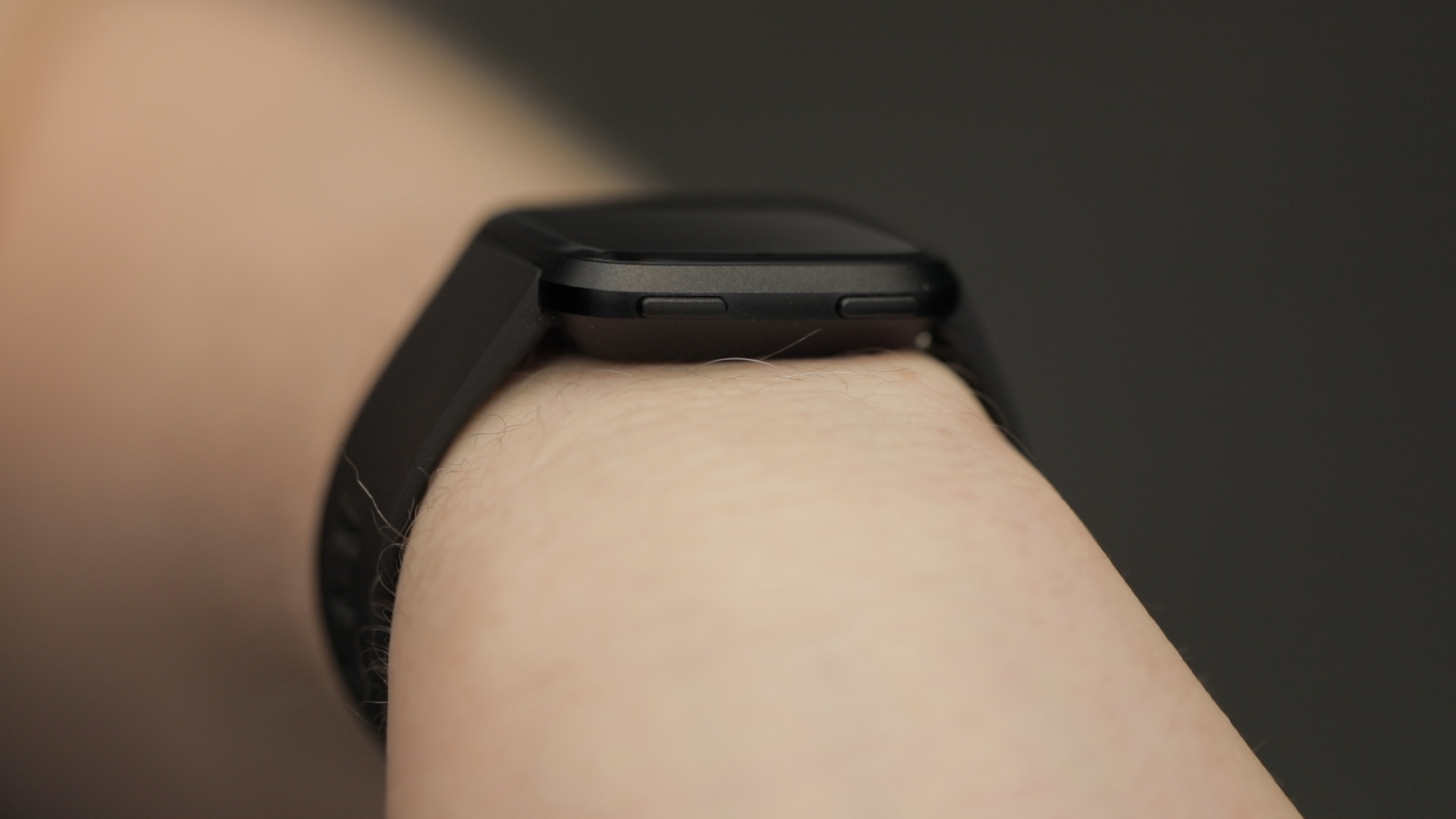
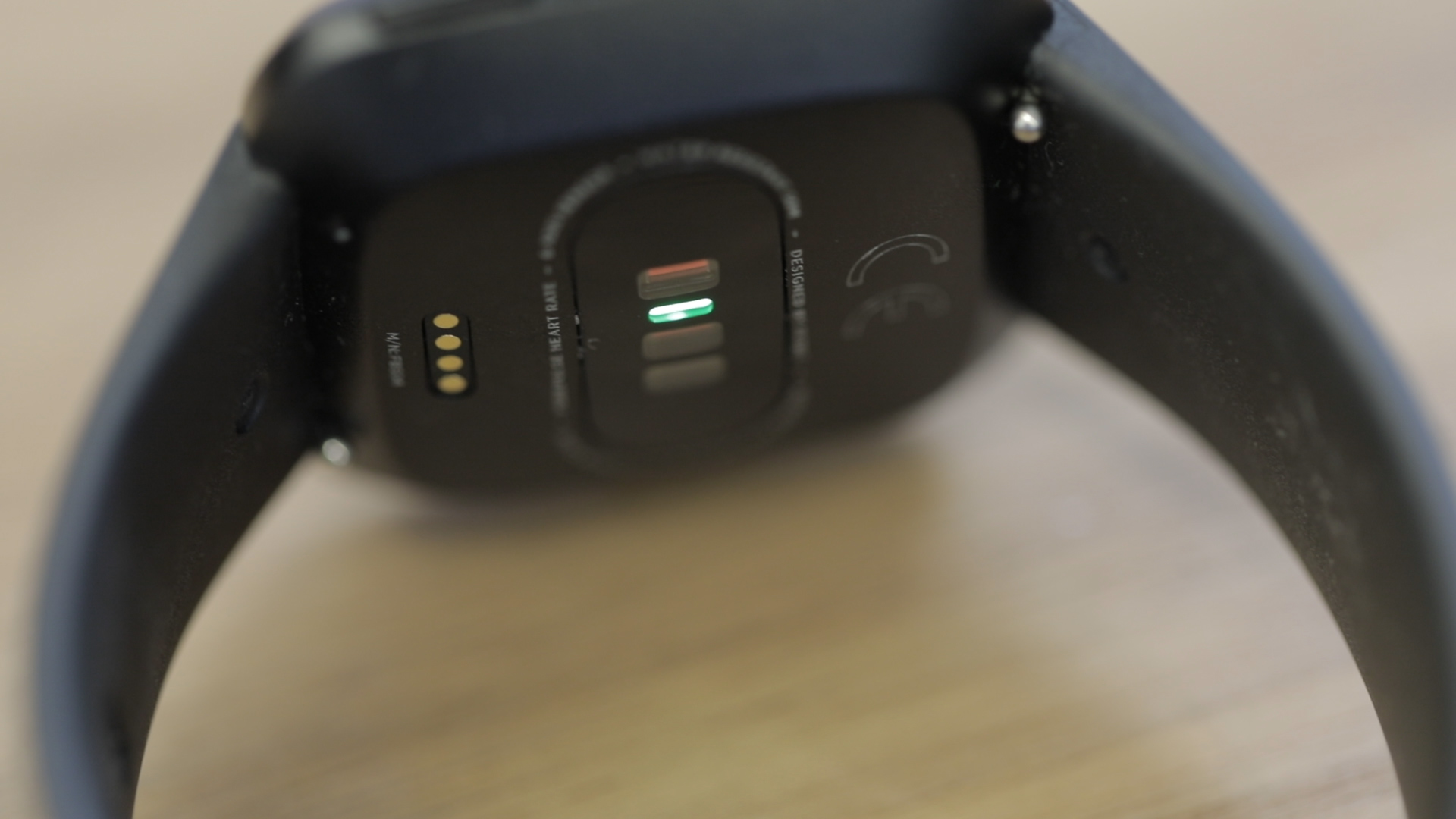
The company calls the shape of case design a “squircle” — which, I was actually surprised to find, is apparently a legitimate geometric term. The case is thin and light, as advertised — notably when placed up against the Apple Watch. It’s made of metal, but it’s light enough to fool you into believing it isn’t, which means it doesn’t have quite as much of a premium feel as Apple’s device.
The front also sports some pretty massive bezels, seemingly another holdover from the Pebble days. The case is shorter, but significantly wider than the larger Apple Watch model. That means it will fit on a lot more wrists than its predecessors — a smart move on Fitbit’s part, given how the company blocked out a wide potential user base the last time around. Even so, the company may want to consider moving toward two sizes for the next generation product. Choice would go a long way as the company works to appeal to a broader range of users.
Software
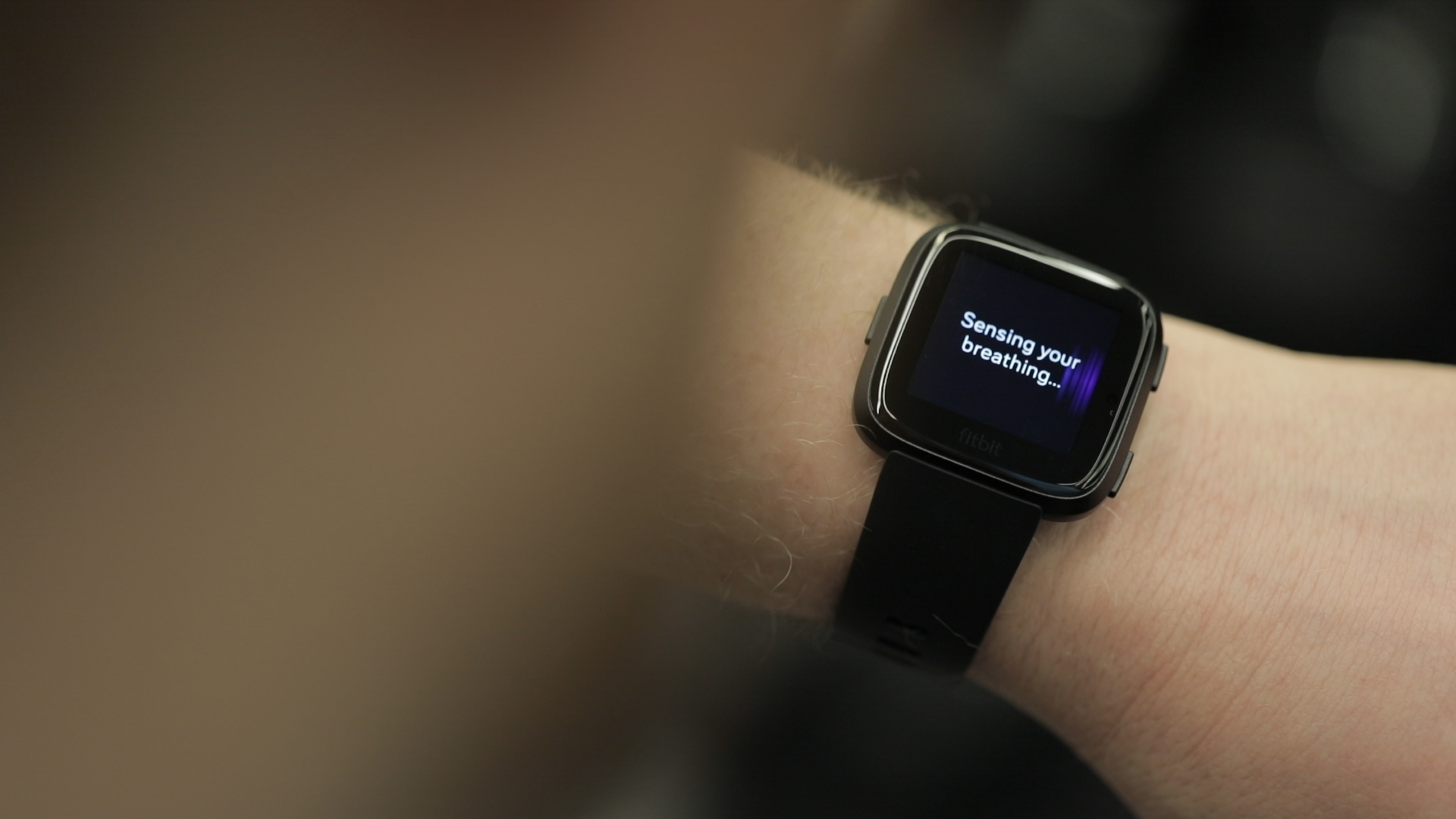
The interface is basically unchanged since the Ionic. No surprise there — the Versa arrives about half a year after the Ionic. Fitbit’s watch OS is pretty bare-bones, from a design perspective, but that’s fine. The icons are big and bright, laid out on a grid, four per screen. It’s all very utilitarian — though it does require a lot of swiping or button pressing, given that there’s no spinning crown or watch bezel for navigation like you find on Apple and Samsung offerings, respectively.
While the Versa is quite as fitness-centric as the Ionic, it’s still a centerpiece. No surprise there, of course — even Apple has readily admitted that fitness is the primary driver in purchasing the company’s wearable, and Fitbit certainly has the right foundation to deliver on that front. The default watch face offers your step count for the day, along with easy access to your heart rate and calories burned.
A swipe up from there shows your daily numbers in a row, along with some fitness tips, while a swipe to the left shows the first row of app icons, with Exercise out front. Clicking that little running guy will pop up a series of pre-programmed exercises for more accurate activity tracking.
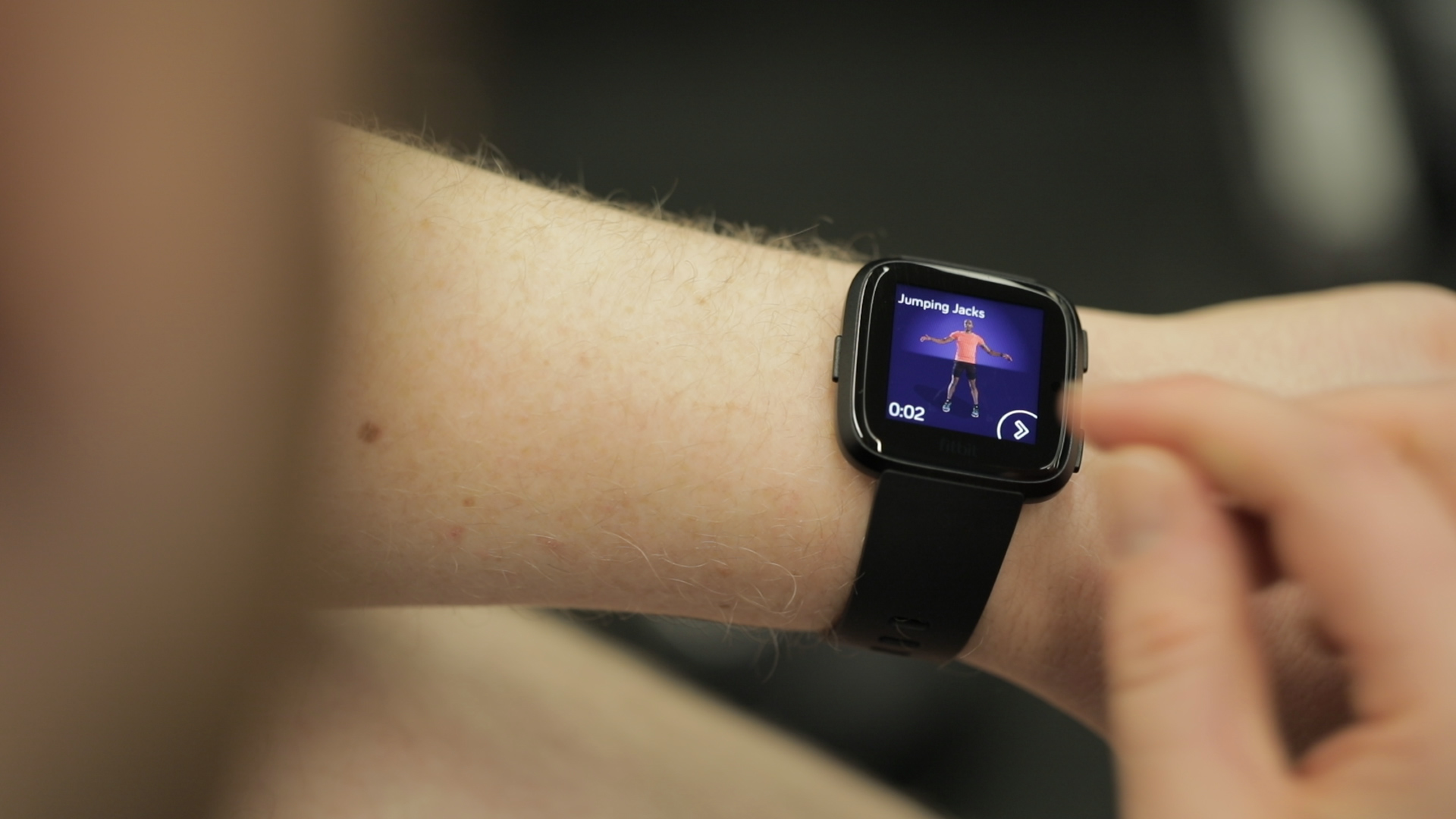
The first page also features Coach, which offers up a handful of quick (five to 15 minute) workouts for strengthening your abs and such. The workouts feature a simple animation of a person performing the exercise, but given the small, low-res screen, you’re really better off using the company’s guided coaching on your phone.
App score
The biggest update on the software side, however, is the addition of some friggin’ apps. For all the talk of buying Pebble for app store and development purposes, that was a mile-wide blindspot for the Ionic. After all, the inclusion of third-party apps is the thing that officially made the product a smartwatch. A few months after the Ionic’s release, Fitbit announced 60 additional apps for the device and a boatload of watch faces.
Of course, there’s still a lot of catching up to do with the competition, but it’s a start. Some, like Uber/Lyft and The New York Times, are genuinely useful. For music, the company has Pandora and Deezer — both of which have their user base, but they ultimately make the lack of a Spotify offering that much more glaring. At the very least, Fitbit’s proven it’s committed to growing the selection, going forward.
The not special edition
And, of course, there’s the Starbucks app — though anything that uses direct payment is a bit of a moot point, since there’s no NFC on the standard Versa model here in the States. That was clearly a cost-cutting measure, but if paying with your wrist is important to you, you can shell out the additional $30 for the “special edition.”
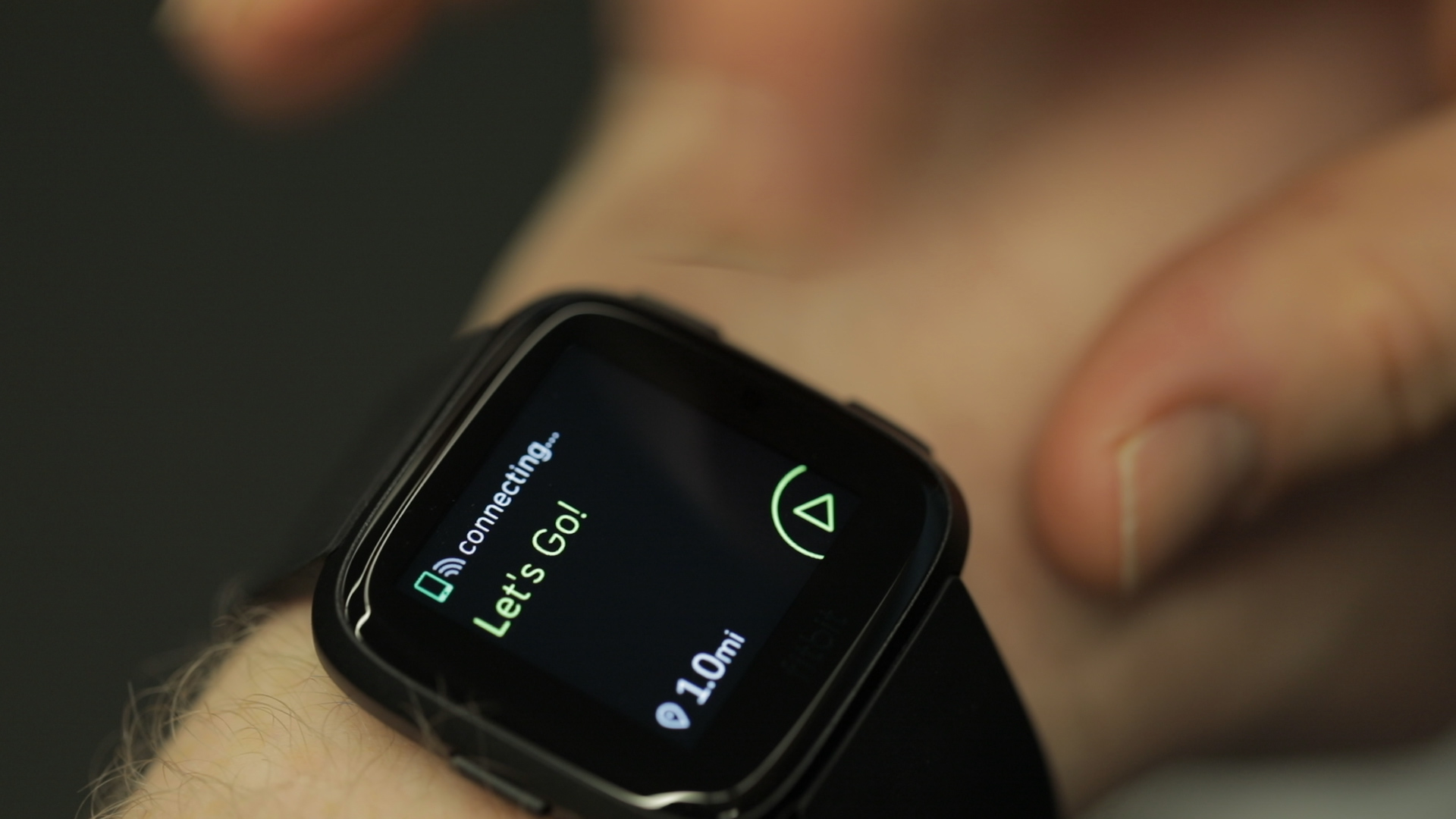
The other key feature missing from the Versa is GPS. You can still do tracking when hooked up to the GPS on your handset, but dropping it from Versa hardware means the watch is less appealing as a standalone tracker. Ditto for NFC.
There is so storage for music (only 2.5GB of the on-board 4GB, mind), but on a whole, this isn’t the device for people who want to go on a run without their phone. That, Fitbit, will happily tell you, is a job for the Ionic — assuming, of course you want to pay $100 more for the privilege.
Nice versa
In our interview ahead of the Versa announcement, Park was very candid about the fact that the Ionic didn’t sell as well as the company had hoped. Perhaps the Versa simple wasn’t ready in time, but this device really ought to have been the one Fitbit lead with. It’s imperfect, but it addresses a number of the key issues many, myself included, had with the Ionic. It fits and looks better, has a more robust app selection and, at $199, it’s pretty nicely priced.
Like the Ionic, this isn’t the device that’s going to turn around Fitbit’s fortunes once and for all — a fact the company seems keenly aware of as it pivots a big chunk of its business to the professional health sector. But it does feel like precisely the kind of smartwatch Fitbit should have made all along.
Microsoft is using the 3D optimization startup it bought last year to give it an in to the “mixed reality” enterprise market.
Simplygon has previously had a heavy skew towards gaming services with technology that allowed developers more freedom over the kind of detail they offered end users. True to the name, Simplygon allowed companies to optimize 3D data and simplify (reduce) polygon counts of 3D files for devices that might not have the compute to handle them in their raw glory.
In the past this has been a much easier solution but it still required a fair amount of leg work from developers. With this new update, the company is aiming to make the experience a lot more automatic than the old method, which left developers building a ton of recipes that they would still have to implement and manage.
Today, the company is announcing some changes that will expand its sights beyond gaming and hook its claws into the enterprise world, specifically the manufacturing space, as it adds support for JT and STEP file formats that are among the most common CAD file types.
The company announced in December, that the company would be integrating Simplygon into its Azure cloud services, so their desire to expand its utility to more customers isn’t a shock. Microsoft is emphasizing that a big focus of this shift is on its mixed reality platform so that files can seamlessly be viewed in the appropriate detail on a HoloLens or a desktop PC or a VR headset.
In a blog post, the company doubled down, saying, “CAD support for Simplygon empowers more industries to painlessly and efficiently bring their existing assets into mixed reality.”

 In an email to Jet.com employees, first reported by