26 Mar 2018

Roboticist Gil Weinberg talks about our weird android future

Georgia Tech’s Gil Weinberg has a thing or two to say about interacting with robots. A musician and roboticist, Weinberg has created some of the coolest robots I’ve seen including Shimon, a robot that can play the marimba alongside human musicians. Weinberg learned early on that musicians need visual cues from their bandmates and so Shimon bops along to the beat and can totally its own in a jazz combo.

In this episode of Technotopia we talk to Weinberg about robotics, human interfaces, and, for the briefest of moments, the possibility of sex robots that can play Isaac Hayes. It’s a fun conversation with a cool researcher.

Technotopia is a podcast by John Biggs about a better future. You can subscribe in Stitcher, RSS, or iTunes and listen the MP3 here.

26 Mar 2018

Facebook is now prioritizing local news globally

As Facebook continues to face fierce media scrutiny over how it handles user data, the company may well be wishing for some gentler headlines. So it’s perhaps no accident it’s chosen today to announce the international rollout of a News Feed tweak it made in the US, back in January, that’s designed to inject more local news into users’ feeds.

The tweak to Facebook’s algorithmic recipe is part of wider efforts to tackle the problem of Facebook’s AIs preferring and promoting ‘low quality’ content — at the expense of users’ eyeballs and even community cohesion.

Divisive, politicized social media messages were the medium used by Kremlin agents to try to disrupt the 2016 US presidential election.

Facebook’s response to this existential threat to its business model is an attempt to surface trusted local news — which it says “helps people connect to their communities about the issues that are closest to home”.

Albeit, as my TC colleague Brian Heater previously noted, there is a parallel risk that “a hyperlocal, decentralized version of Facebook’s news feed could ultimately have the effect of further polarizing sources if not balanced with broader, national news coverage”.

Time will tell how this latest unilateral shift by Facebook will shake out for users, publishers and communities around the world.

“Now, people around the world will see more news on Facebook from local sources covering their current city and other cities they may care about,” writes Alex Hardiman, Facebook’s head of news product, and Campbell Brown, head of news partnerships, announcing the global rollout of the local news tweak.

They add that the update is intended to help boost local publishers who cover “multiple, nearby cities reach audiences in those cities”.

“We’ll consider a publisher as local to multiple cities if the people in those cities are more likely than the people outside of those cities to read articles from the publisher’s domain. By expanding the scope of what may be considered local to people, we’re including other cities that people may care about and connecting people to local publishers from those cities.”

26 Mar 2018

Facebook is now prioritizing local news globally

As Facebook continues to face fierce media scrutiny over how it handles user data, the company may well be wishing for some gentler headlines. So it’s perhaps no accident it’s chosen today to announce the international rollout of a News Feed tweak it made in the US, back in January, that’s designed to inject more local news into users’ feeds.

The tweak to Facebook’s algorithmic recipe is part of wider efforts to tackle the problem of Facebook’s AIs preferring and promoting ‘low quality’ content — at the expense of users’ eyeballs and even community cohesion.

Divisive, politicized social media messages were the medium used by Kremlin agents to try to disrupt the 2016 US presidential election.

Facebook’s response to this existential threat to its business model is an attempt to surface trusted local news — which it says “helps people connect to their communities about the issues that are closest to home”.

Albeit, as my TC colleague Brian Heater previously noted, there is a parallel risk that “a hyperlocal, decentralized version of Facebook’s news feed could ultimately have the effect of further polarizing sources if not balanced with broader, national news coverage”.

Time will tell how this latest unilateral shift by Facebook will shake out for users, publishers and communities around the world.

“Now, people around the world will see more news on Facebook from local sources covering their current city and other cities they may care about,” writes Alex Hardiman, Facebook’s head of news product, and Campbell Brown, head of news partnerships, announcing the global rollout of the local news tweak.

They add that the update is intended to help boost local publishers who cover “multiple, nearby cities reach audiences in those cities”.

“We’ll consider a publisher as local to multiple cities if the people in those cities are more likely than the people outside of those cities to read articles from the publisher’s domain. By expanding the scope of what may be considered local to people, we’re including other cities that people may care about and connecting people to local publishers from those cities.”

26 Mar 2018

HTC had a terrible holiday quarter

Smartphone and VR headset maker HTC has published its consolidated results for Q4 2017 — and it makes for grim reading.

The topline figures are:

  • Flat quarterly revenue of NT$15.7 billion (~$540M) with gross margin of -30.8%
  • Quarterly operating loss of NT$9.6 billion (~$330M) with operating margin of -60.8%
  • Quarterly net loss after tax: NT$9.8 billion (~$337M), or -NT$11.93 (-$0.41) per share

HTC says this latest quarterly loss was due to “market competition, product mix, pricing, and recognized inventory write-downs”. So pretty much a full house of operational and business problems.

The one bright spot for HTC’s business is a deal worth $1.1BN, in which Google acquired a chunk of HTC’s hardware business — which was completed at the end of January.

That one-off cash injection is not reflected in the Q4 results but will rather give some passing uplift to HTC’s Q1 2018 results.

HTC says it will be using the Google windfall for “greater investment in emerging technologies”, writing that they will be “vital across all of our businesses and present significant long-term growth opportunities”.

There’s no doubt that any business revival would require hefty investment. But exactly what long-term growth opportunities HTC believes it can capture is questionable, given how fiercely competitive the smartphone market continues to be (with Chinese OEMs making what running there is in a shrinking global market); and how the VR market — which HTC bet big on in 2015, with Vive and Valve, to try to diversify beyond mobile — has hardly turned out to be the next major computing paradigm. Not yet anyway.

So the emphasis really is on the “long-term” earning potential of VR — say five or even ten years hence.

HTC flags the launch of its VIVE Focus standalone VR system in China — which it last week said it would also be bringing to the UK and other global markets later this year — and the launch of a VIVE Pro premium PC VR system in January, which it was showing off at CES, as examples of focused product innovation in the VR space.

Following a strategic business review aimed at optimizing its teams and processes — both for smartphones and VR — it also says it now has “a series of measures in place to enable stronger execution”, and is touting fresh innovations coming across its markets this year.

But HTC is going to need a whole lot more than squeezable gimmicks and shiny finishes to lift out of these doldrums.

26 Mar 2018

Southeast Asia exit deal is a win, not a defeat, for Uber

They say in sport that the best teams win even when they don’t perform. On those terms, Uber seems unstoppable.

The day’s big news is that the U.S. ride-hailing firm is leaving Southeast Asia after it agreed to sell its business to local rival Grab. That much is true, but claims that Grab beat Uber out may be overstating the situation.

Ordinarily, you’d call the exit a loss for Uber and a win for Grab, but the devil is in the detail. The deal that has been agreed is a very solid win for both sides which reads more than an alliance than a settlement between winner and loser.

Let’s consider the facts:

Uber takes a 27.5 percent stake in a growing business that was most recently valued at $6 billion.

That stake — worth north of $1.6 billion — is a strong return considering that Uber said today it has invested $700 million in Southeast Asia over the past five years.

Grab takes over and shuts down its largest rival’s business, all while importing any drivers and passengers that aren’t already on its platform and adding Uber Eats to its nascent food delivery play.

That’s a notable outcome for Grab, which started out offering licensed taxis only and required passengers to pay their bill in cash until three years ago. When Uber first arrived the two were hugely differentiated and market share was fairly even, but now Grab is the dominant player in the region by some margin.

Out-gunned

Despite humble beginnings, Grab — which started out in Malaysia but relocated to Singapore — has made strides over the past two years. Today, it offers more than 10 transportation services — including taxis, private cars, car-pooling, bicycle sharing, and bike taxis — across eight countries.

You might read about its localization strategy and how important it is, and for sure it is impressive.

Beyond food delivery — which is now a fairly standard expansion for ride-sharing companies — it has made a push into financial services through its GrabPay service, which allows users to pay for goods and services offline, and a new venture that provides micro-loans and insurance products.

Grab’s focus on fanning out beyond ride-sharing is designed to capture and engage users beyond just offering transportation. The theory is that this not only makes it more useful to users, but it introduces entirely different (and potentially more lucrative) business opportunities that set the company up to become a profitable entity further down the line.

But — and this is the important caveat — this product expansion is in its early stages so the effect didn’t play out on Grab’s rivalry with Uber.

In fact, it looks like a lot of the rivalry came down to the usual factor: Money.

Put simply, Grab has consistently secured the financial backing of its investors.

As one senior Uber employee in Southeast Asia aptly explained to TechCrunch recently: “They just kept giving them money!”

Over the past two years the money factor appeared to swing in Grab’s favor. It raised $750 million in late 2016, and then followed that up with more than $2.5 billion last year to take it to more than $4 billion from investors at a valuation of over $6 billion.

Compare that to the $700 million Uber had invested in Southeast Asia and you can already see an advantage which is particularly key in ride-hailing when two firms are locked in an ongoing subsidy war.

So, for all those comparisons and fancy charts that show the total amount Uber raised as a global business, it was financially outmuscled in Southeast Asia presumably because it chose to limit its investment.

Grab’s money was strategic, too.

SoftBank and Didi, the ‘Uber slayer’ of China, fronted $2 billion of the newest round, while the likes of Toyota, Hyundai, Tiger Global, Coatue Management and influential Indonesian firms Emtek and Lippo are among others to have come aboard in recent years.

That network allowed Grab to hire experienced executives to fill out its team, including most notably Ming Maa, a “deal-maker” who joined as company President from SoftBank 18 months ago.

Uber was often quick to point out that it gave country offices the freedom to suggest and implement localized policies and ideas, but in Southeast Asia it seemed to lack overall coherence. For example, it only appointed a regional head for Southeast Asia last August, some four years after its initial arrival.

That symbolizes its struggle to develop a strategy until it was too late. And that’s without even mentioning the wave of controversies that hit Uber as a company in 2017, which no doubt impacted decision-making outside of the U.S..
Win-win deal

Uber struck decent deals to exit China and Russia, and it appears to be the same again here.

As a private company, it isn’t possible to analyze Grab’s shareholders and their ownership percentages, but Uber is likely now one of the largest investors in the business. That’s the ideal scenario for Uber and its shareholders because Southeast Asia is forecast to be a major growth market for ride-hailing, and Uber is now in the front seat with the market leader.

Currently a loss-making region for Grab and Uber, revenue from taxi apps in Southeast Asia is said to have more than doubled over the past two years to cross $5 billion in 2017, according to a recent report co-authored by Google. The industry is expected to grow more than four-fold to hit $20 billion by 2025, according to the same research.

Uber could have continued on, increased its investment and still seen success, but the deal it has landed allows it to maintain a presence via proxy while diverting resources to other markets worldwide. That stake in Grab, which is worth north of $1.6 billion as of Grab’s most recent funding round, is likely to appreciate significantly over time as the market grows and Grab’s fintech play yields fruit.

Sources close to the deal indicate that Grab gave Uber less than $100 million as part of this deal, and it will take on Uber’s roughly 500 staff across the region in addition to its ride-hailing business and Uber Eats, which is present in three countries.

More than the operational gains, Grab can now count on both Uber and China’s Didi as investors, with Uber CEO Khosrowshahi joining the board. That’s the kind of influence and experience that money can’t buy, and it may be essential for what comes next.

The next stage of ride-sharing in Southeast Asia will pit Grab against Indonesia’s Go-Jek, a $5 billion startup backed by big names including Google and Tencent. Go-Jek is leading in its home market — where it pioneered the kind of financial products and on-demand services that Grab is just launching now — and it houses ambitions to export its empire to new markets starting this year.

One source close to Go-Jek told TechCrunch that the company is preparing to launch in the Philippines potentially before the end of March. Go-Jek has been very deliberate about taking its time, but now that Uber is out of the equation in Southeast Asia, it’s time to walk to walk and amp up the battle.


26 Mar 2018

Uber CEO says there will be no more global exit deals

Uber has exited three global markets by selling to rivals, but enough is enough after its deal with Grab so says CEO Dara Khosrowshahi.

Following today’s announcement with Grab which sees Uber leave Southeast Asia hot on the heels of exits in China (2016) and Russia (2017), Khosrowshahi told employees that there will be no more repeats under his leadership.

It is fair to ask whether consolidation is now the strategy of the day, given this is the third deal of its kind, from China to Russia and now Southeast Asia. The answer is no.

One of the potential dangers of our global strategy is that we take on too many battles across too many fronts and with too many competitors. This transaction now puts us in a position to compete with real focus and weight in the core markets where we operate, while giving us valuable and growing equity stakes in a number of big and important markets where we don’t.

Rather that deals, the Uber CEO said he plans to develop the business organically via “growth that comes from building the best products, services and technology in the world.”

Since SoftBank’s investment in Uber closed in January there has been heightened speculation about potential consolidations in emerging markets, where the ride-hailing business is further from profitability than more developed markets like Europe and the U.S.. Indeed, SoftBank itself has called for Uber to focus on more financially-sustaining regions of the world.

Southeast Asia, where SoftBank has backed Grab, was a prime candidate for consolidation while India, where SoftBank-backed Ola competes with Grab, is another.

Just weeks ago, Khosrowshahi said Uber would invest to compete aggressively in Southeast Asia and yet this deal has been completed. Time will tell if this new denial of future deals will ring true, or whether SoftBank and others seeking consolidation will ring out.

26 Mar 2018

Facebook denies it collects call and SMS data from phones without permission

After an Ars Technica report that Facebook surreptitiously scrapes call and text message data from Android phones and has done so for years, the scandal-burdened company has responded that it only collects that information from users who have given permission.

Facebook’s public statement, posted on its press site, comes a couple of days after it took out full page newspaper ads to apologize for the misuse of data by third-party apps as it copes with fallout from the Cambridge Analytica scandal (follow the story as it develops here). In the ad, founder and chief executive officer Mark Zuckerberg wrote “We have a responsibility to protect your information. If we can’t, we don’t deserve it.”

The company’s response to the Ars Technica story, however, struck a different tone, with Facebook titling the post “Fact Check: Your Call and SMS History.” It said “You may have seen some recent reports that Facebook has been logging people’s call and SMS (text) history without their permission. This is not the case,” before going on to explain that call and text history logging is included with an opt-in feature on Messenger or Facebook Lite for Android that “people have to expressly agree to use” and that they can turn off at any time, which would also delete any call and text data shared with that app.

Ars Technica has already amended its original post with a response to Facebook’s statement, saying it contradicts several of its findings, including the experience of users who shared their data with the publication.

“In my case, a review of my Google Play data confirms that Messenger was never installed on the Android devices I used,” wrote Ars Technica IT and national security editor Sean Gallagher in the amendment to his post. “Facebook was  installed on a Nexus tablet I used and on the Blackphone 2 in 2015, and there was never an explicit message requesting access to phone call and SMS data. Yet there is call data from the end of 2015 until late 2016, when I reinstalled the operating system on the Blackphone 2 and wiped all applications.”

In its statement, Facebook said “Contact importers are fairly common among social apps and services as a way to more easily find the people you want to connect with. This was first introduced in Messenger in 2015, and later offered as an option in Facebook Lite, a lightweight version of Facebook for Android .”

When people first sign up for Messenger or Facebook Lite on Android or log into Messenger on an Android device, they see a screen giving them the option to continuously upload contacts as well as call and text history. Facebook added that on Messenger, users are then given three options: to turn the feature on, “learn more” for more information or “not now” to skip it. On Facebook Lite, they get two options: turn it on or skip. If users who opted in change their minds later, Facebook said they could turn it off in the app’s settings, with the option of turning off continuous call and text history logging while keeping contact uploading enabled or deleting all contact information they’ve uploaded from that app.”

An image included with Facebook’s statement.

Facebook emphasized in bold text that it “never sell this data, and this feature does not collect the content of your text messages or calls.”

Even though the opt-in screens do state that granting permission will “continuously upload info” about contacts and call and text history, it is arguable that many users don’t really understand what that means and that instead of saying “this lets friends find each other on Facebook and helps us create a better experience for everyone” (a message sweetened with a saccharine cartoon of a figure texting a little heart), Facebook should really be giving more details about what exactly will be recorded and why.

With the Cambridge Analytica scandal still fresh on everyone’s minds, Facebook’s apparent willingness to place the onus for protecting personal data on users who already feel victimized is unlikely to help them regain any goodwill. But even people who truly understand the implications of the feature and chose to opt-in anyway did so assuming that their data would be guarded as Facebook promised. As the Cambridge Analytica fiasco threw into sharp relief, that hasn’t always been the case.

26 Mar 2018

It’s official: Uber sells Southeast Asia business to Grab

It’s official, Uber has announced that it has sold its Southeast Asia-based business to rival Grab .

The deal follows a month of speculation, and it will see Grab — which is valued at over $6 billion — buy up Uber’s ride-sharing business in eight countries in Southeast Asia. It will also take over Uber Eats, which is currently present in three, and expand that service across the region during the first half of this year.

In exchange, Uber will get a 27.5 percent stake in Singapore-based Grab while Uber CEO Dara Khosrowshahi will join Grab’s board.

The deal starts to make sense when you consider that both companies share common investors — SoftBank and Didi — and that waging an expensive subsidies war in what is currently a loss-making hurts both sides.

Many consumers in the Southeast Asian region may be concerned at the end of the competition between the two, and there isn’t much time left. Grab said that Uber’s ride-sharing app will be available for a further two weeks, while Uber Eats will close down and migrate to GrabFood at the end of May.

Grab said today it has reached over 90 million downloads with more than five million drivers and agents for its fintech services.

The deal puts Grab in absolute control of Southeast Asia’s ride-sharing market, bar Indonesia, but the company doesn’t believe that the deal — which it is calling a merger — will represent any issue for Singapore’s monopoly laws.

“Grab is committed to cooperating with local regulators in relation to the acquisition. Grab believes the acquisition will add to, among others, vibrant and competitive ride-hailing, delivery and transportation spaces, and it will make a merger notification to the Competition Commission of Singapore,” the company wrote.

We shall see.

Now some money statements from the figures involved.

Anthony Tan, Group CEO and Co-founder, Grab:

“We are humbled that a company born in Southeast Asia has built one of the largest platforms that millions of consumers use daily and provides income opportunities to over 5 million people. Today’s acquisition marks the beginning of a new era. The combined business is the leader in platform and cost efficiency in the region. Together with Uber, we are now in an even better position to fulfil our promise to outserve our customers. Their trust in us as a transport brand allows us to look towards the next step as a company: improving people’s lives through food, payments and financial services.”

Dara Khosrowshahi, CEO of Uber:

“This deal is a testament to Uber’s exceptional growth across Southeast Asia over the last five years. It will help us double down on our plans for growth as we invest heavily in our products and technology to create the best customer experience on the planet. We’re excited to take this step with Anthony and his entire team at Grab, and look forward to Grab’s future in Southeast Asia.”

The deal puts pressure on Go-Jek, the $5 billion market leader in Indonesia backed by Google and Tencent, which has not yet expanded across Southeast Asia. Grab has cleared the way to be the single dominant force in all other markets in the region — which has a cumulative population of over 600 million people — so if Go-Jek is going to venture overseas, now is definitely the time.

This retreat marks Uber’s third exit from an international geography at the hands of a rival.

Uber previously exited China in 2016 after striking an equity exchange deal with Chinese market leader Didi and it quit Russia last year after it sold its business in the country to local rival Yandex.

The Grab deal feels somehow different since, prior to last year, Uber and Grab were fairly evenly matched. But a litany of internal issues at Uber in 2017 — which ultimately led to the resignation of co-founder and CEO Travis Kalanick and an investment from SoftBank — saw Uber take its eye off the ball in Southeast Asia.

Grab, to its credit, pushed on and raising another $2.5 billion last year from investors while it expanded into financial services through a payment system and, most recently, plans for micro-loans and insurance.

This deal seemed unlikely a year ago, now the question is whether there is further consolidation to come. India, where Uber battles domestic rival Ola, is the most obvious market where that could happen.

26 Mar 2018

Ford and Alibaba unveil car vending machine

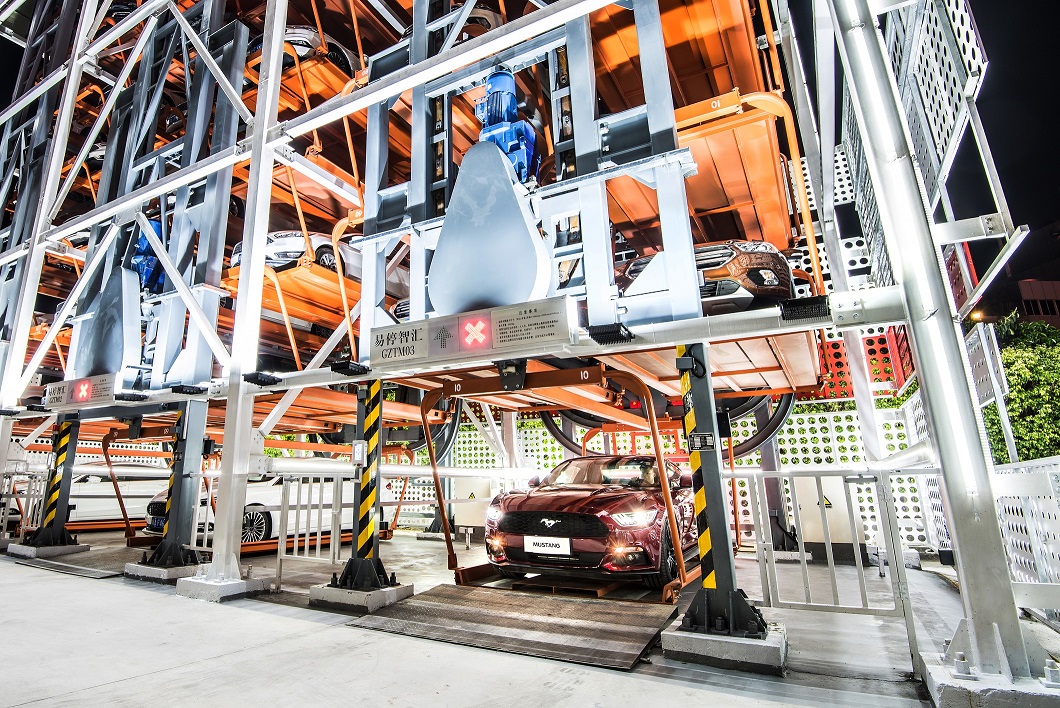
Car shoppers in Guangzhou, China now have the ability to buy or try a car using a smartphone app and a car vending machine. The facility came out of a partnership signed two years ago between Ford and Alibaba .

Called the Super Test-Drive Center the center houses dozens of Ford vehicles in the multi-story building. Users just select the car they want through the Tmail app and have the option of taking it on a three day test ride.

Apparently, the service taps Alibaba’s services and providers potential buyers with with discounts and incentives based on their usage on Alibaba’s ecosystem.

The concept of storing cars in mechanical facilities is nearly as old as the car itself. The first system appeared in 1905 and evolved to house thousands of cars though early mechanical faults caused interest to wain. Storing cars in such a fashion has its benefits as it nearly eliminates theft, damage and often results in storing more cars in less space.

Carvana operates similar car vending machines across the United States. The Tempe, AZ-based startup even lets users insert a car to have their car delivered from the machine. It’s cute and sometimes you need cute to have an edge.

It seems the Super Test-Drive Center’s edge will come from its deep understander of potential buyers. The data provided by Alibaba should make for an interesting shopping experience especially, if as advertised, it gives deals based on a person’s perceived lifestyle. If nothing else, it should be a fun advertising tactic because there’s nothing like a car vending machine with giant cat ears.

25 Mar 2018

Regulation could protect Facebook, not punish it

You know what tech startups hate? Complicated legal compliance. The problem is, Facebook isn’t a startup any more, but its competitors are.

There have been plenty of calls from congress and critics to regulate Facebook following the election interference scandal and now the Cambridge Analytica debacle. The government could require extensive ads transparency reporting or data privacy protections. That could cost Facebook a lot of money, slow down its operations, or inhibit its ability to build new products.

But the danger is that those same requirements could be much more onerous for a tiny upstart company to uphold. Without much cash or enough employees, and with product-market fit still to nail down, young startups might be anchored by the weight of regulation. It could prevent them from ever rising to become a true alternative to Facebook. Venture capitalists choosing whether to fund the next Facebook killer might look at the regulations as too high of a price of entry.

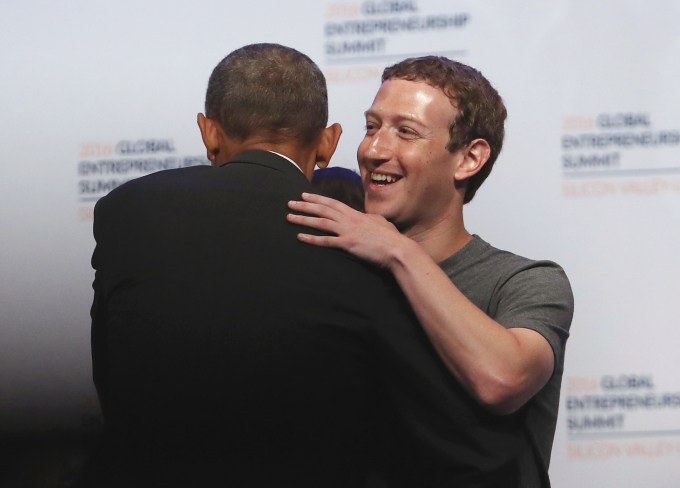
STANFORD, CA – JUNE 24: Facebook CEO Mark Zuckerberg (R) hugs U.S. President Barack Obama during the 2016 Global Entrepeneurship Summit at Stanford University on June 24, 2016 in Stanford, California. President Obama joined Silicon Valley leaders on the final day of the Global Entrepreneurship Summit. (Photo by Justin Sullivan/Getty Images)

The lack of viable alternatives has made the #DeleteFacebook movement toothless. Where are people going to go? Instagram? WhatsApp? The government already missed its chances to stop Facebook from acquiring these companies that are massive social networks in their own right.

The only social networks to carve out communities since Facebook’s rise did so largely by being completely different, like the ephemeral Snapchat that purposefully doesn’t serve as a web identity platform, and the mostly-public Twitter that caters to thought leaders and celebrities more than normal people sharing their personal lives. Blockchain-based decentralized social networks sound nice but may be impossible to spin up.

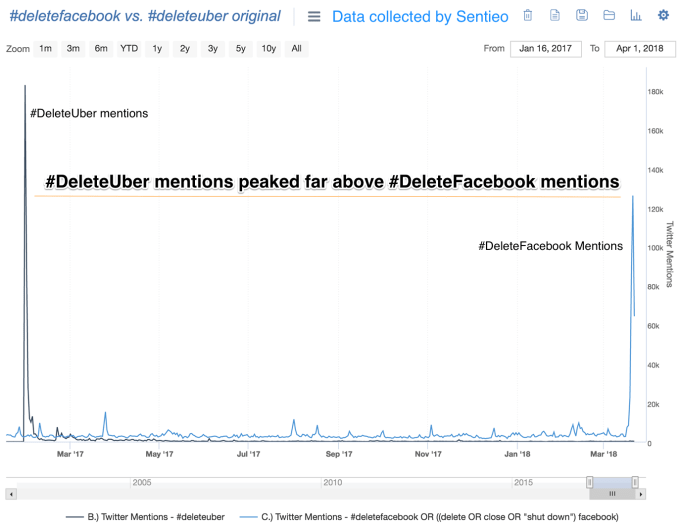
That’s left few places for Facebook haters to migrate. This might explain why despite having so many more users, #DeleteFacebook peaked last week at substantially fewer Twitter mentions than the big #DeleteUber campaign from last January, according to financial data dashboard Sentieo. Lyft’s existence makes #DeleteUber a tenable stance, because you don’t have to change your behavior pattern, just your brand of choice.

If the government actually wants to protect the public against Facebook abusing its power, it would need to go harder than the Honest Ads Act that would put political advertising on Internet platforms under the same scrutiny regarding disclosure of buyers as the rules for TV and radio advertising. That’s basically just extra paperwork for Facebook. We’ve seen regulatory expenses deter competition amongst broadband internet service providers and in other industries. Real change would necessitate regulation that either creates alternatives to Facebook or at least doesn’t inhibit their creation.

That could mean only requiring certain transparency and privacy protections from apps over a certain size, like 200 million daily users. This would put the cap a bit above Twitter and Snapchat’s size today, giving them time to prepare for compliance, while immediately regulating Facebook, Messenger, Instagram, WhatsApp, and Google’s social problem child YouTube.

Still, with Facebook earning billions in profit per quarter and a massive war chest built up, Mark Zuckerberg could effectively pay his way out of the problem. That’s why it makes perfect sense for him to have told CNN “I’m not sure we shouldn’t be regulated” and that “There are things like ad transparency regulation that I would love to see.” Particular regulatory hurdles amount to just tiny speed bumps for Facebook. Courting this level of regulation could bat down the question of whether it should be broken up or its News Feed algorithm needs to change.

Meanwhile, if the government instituted new rules for tech platforms collecting persona information going forward, it could effectively lock in Facebook’s lead in the data race. If it becomes more cumbersome to gather this kind of data, no competitor might ever amass an index of psychographic profiles and social graphs able to rival Facebook’s.

A much more consequential approach would be to break up Facebook, Instagram, and WhatsApp. Facebook is trying to preempt these drastic measures with Zuckerberg’s recent apology tour and its purchase of full-page ads in nine newspapers today claiming it understands its responsibility.

Establishing them as truly independent companies that compete would create meaningful alternatives to Facebook. Instagram and WhatsApp would have to concern themselves with actually becoming sustainable businesses. They’d all lose some economies of data scale, forfeiting the ability to share engineering, anti-spam, localization, ad sales, and other resources that a source close to Instagram told me it gained by being acquired in 2012, and that Facebook later applied to WhatsApp too.

Both permanent photo sharing and messaging would become two-horse races again. That could lead to the consumer-benefiting competition and innovation the government hopes for from regulation.

Yet with strong regulation like dismantling Facebook seeming beyond the resolve of congress, and weak regulation potentially protecting Facebook, perhaps it’s losing the moral high ground that will be Facebook’s real punishment.

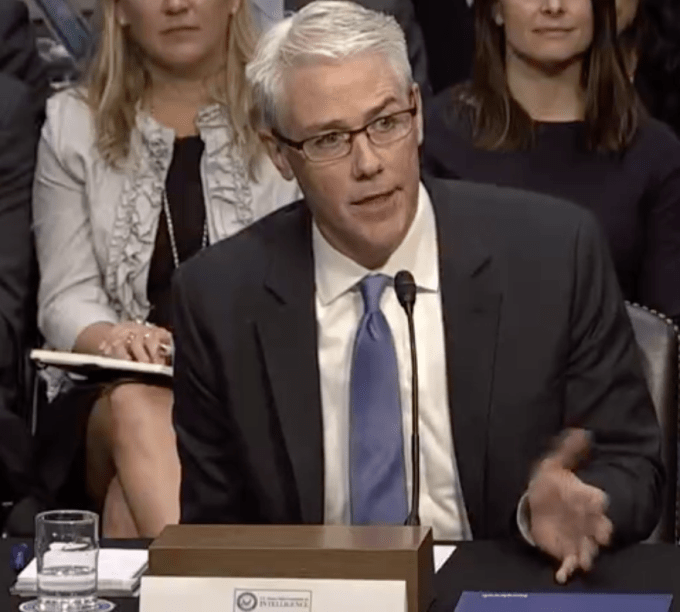
Facebook chief legal officer Colin Stretch testifies before congress regarding Russian election interference

We’ve already seen that first-time download rates aren’t plummeting for Facebook, its App Store ranking has actually increased since the Cambridge Analytica scandal broke, and blue chip advertisers aren’t bailing, according to BuzzFeed. But Facebook relies on the perception of its benevolent mission to recruit top talent in Silicon Valley and beyond.

Techies take the job because they wake up each day believing that they’re having a massive positive influence by connecting the world. These people could have founded or worked at a new startup where they’d have discernible input on the direction of the product, and a chance to earn huge return multiples on their stock. Many have historically worked at Facebook because its ads say it’s the “Best place to build and make an impact”.

But if workers start to see that impact as negative, they might not enlist. This is what could achieve that which surface-level regulation can’t. It’s perhaps the most important repercussion of all the backlash about fake news, election interference, well-being, and data privacy: that losing talent could lead to a slow-down of innovation at Facebook that might  leave the door open for a new challenger.

For more on Facebook’s Cambridge Analytica scandal, read our feature pieces: