23 Mar 2018

How Raya’s $8/month dating app turned exclusivity into trust

The swipe is where the similarity ends. Raya is less like Tinder and more like a secret society. You need a member’s recommendations or a lot of friends inside to join, and you have to apply with an essay question. It costs a flat $7.99 for everyone, women and celebrities included. You show yourself off with a video slideshow set to music of your choice. And it’s for professional networking as well as dating, with parallel profiles for each.

Launched in March 2015, Raya has purposefully flown under the radar. No interviews. Little info about the founders. Not even a profile on Crunchbase’s startup index. In fact, in late 2016 it quietly acquired video messaging startup Chime, led by early Facebooker Jared Morgenstern, without anyone noticing. He’d become Raya’s first investor a year earlier. But Chime was fizzling out after raising $1.2 million. “I learned that not everyone who leaves Facebook, their next thing turns to gold” Morgenstern laughs. So he sold it to Raya for equity and brought four of his employees to build new experiences for the app.
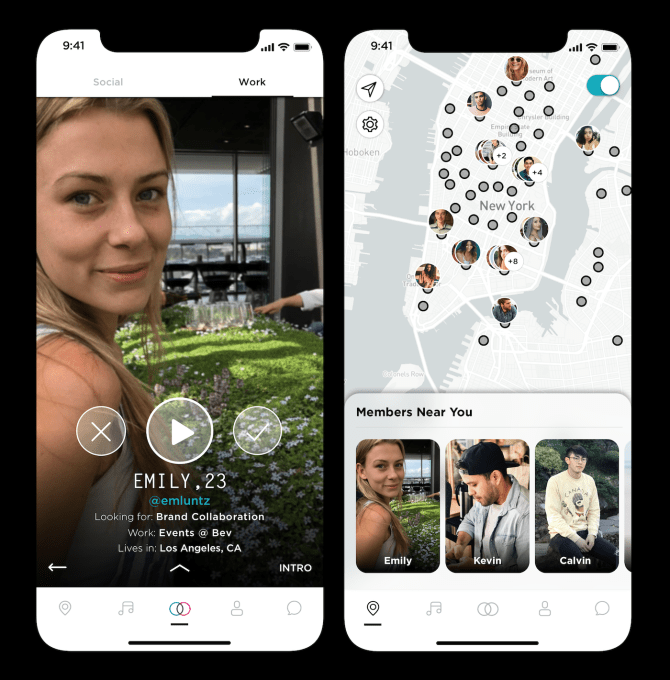
Now the startup’s COO, Morgenstern has agreed to give TechCrunch the deepest look yet at Raya, where the pretty, popular, and powerful meet each other.

Temptation Via Trust

Raya COO Jared Morgenstern

“Raya is a utility for introducing you to people who can change your life. Soho House uses physical space, we’re trying to use software” says Morgenstern, referencing the global network of members-only venues.

We’re chatting in a coffee shop in San Francisco. It’s an odd place to discuss Raya, given the company has largely shunned Silicon Valley in favor of building a less nerdy community in LA, New York, London, and Paris. The exclusivity might feel discriminatory for some, even if you’re chosen based on your connections rather than your wealth or race. Though people already self-segregate based on where they go to socialize. You could argue Raya just does the same digitally

Morgenstern refuses to tell me how much Raya has raised, how it started, or anything about its the founding team beyond that they’re a “Humble, focused group that prefers not to be part of the story.” But he did reveal some of the core tenets that have reportedly attracted celebrities like DJs Diplo and Skrillex, actors Elijah Wood and Amy Schumer, and musicians Demi Lovato and John Mayer, plus scores of Instagram models and tattooed creative directors.

Raya’s iOS-only app isn’t a swiping game for fun and personal validation. Its interface and curated community are designed to get you from discovering someone to texting if you’re both interested to actually meeting in person as soon as possible. Like at a top-tier university or night club, there’s supposed to be an in-group sense of camaraderie that makes people more open to each other.
Then there are the rules.

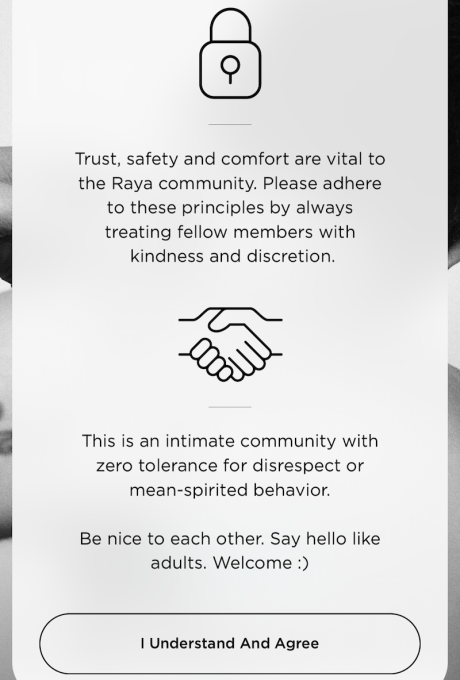
“This is an intimate community with zero-tolerance for disrespect or mean-spirited behavior. Be nice to each other. Say hello like adults” says an interstitial screen that blocks use until you confirm you understand and agree every time you open the app. That means no sleazy pick-up lines or objectifying language. You’re also not allowed to screenshot, and you’ll be chastized with a numbered and filed warning if you do.

It all makes Raya feel consequential. You’re not swiping through infinite anybodies and sorting through reams of annoying messages. People act right because they don’t want to lose access. Raya recreates the feel of dating or networking in a small town, where your reputation follows you. And that sense of trust has opened a big opportunity where competitors like Tinder or LinkedIn can’t follow.

Self-Expression To First Impression

Until now, Raya showed you people in your city as well as around the world — which is a bit weird since it would be hard to ever run into each other. But to achieve its mission of getting you offline to meet people in-person, it’s now letting you see nearby people on a map when GPS says they’re at hotspots like bars, dancehalls, and cafes. The idea is that if you both swipe right, you could skip the texting and just walk up to each other.

“I’m not sure why Tinder and the other big meeting people apps aren’t doing this” says Morgenstern. But the answer seems obvious. It would be creepy on a big public dating app. Even other exclusive dating apps like The League that induct people due to their resume more than their personality might feel too unsavory for a map, since having gone to an Ivy League college doesn’t mean you’re not a jerk. Hell, it might make that more likely.
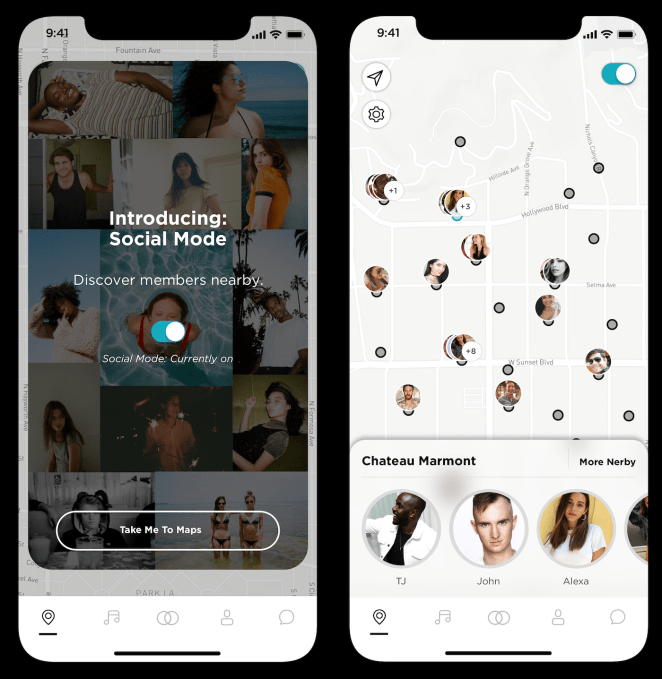
But this startup is betting that its vetted, interconnected, “cool” community will be excited to pick fellow Raya members out of the crowd to see if they have a spark or business synergy.

That brings Raya closer to the holy grail of networking apps where you can discover who you’re compatible with in the same room without risking the crash-and-burn failed come-ons. You can filter by age and gender when browsing social connections, or by “Entertainment & Culture”, “Art & Design”, and “Business & Tech” buckets for work. And through their bio and extended slideshows of photos set to their favorite song, you get a better understanding of someone than from just a few profile pics on other apps.

Users can always report people they’ve connected with if they act sketchy, though with the new map feature I was dismayed to learn they can’t yet report people they haven’t seen or rejected in the app. That could lower the consequences for finding someone you want to meet, learning a bit about them, but then approaching without prior consent. However, Morgenstern insists.”The real risk is the density challenge”.

Finding Your Tribe

Raya’s map doesn’t help much if there are no other members for 100 miles. The company doesn’t restrict the app to certain cities, or schools like Facebook originally did to beat the density problem. Instead it relies on the fact that if you’re in the middle of nowhere you probably don’t have friends on it to pull you in. Still, that makes it tough for Raya to break into new locales.

But the beauty of the business is that since all users pay $7.99 per month, it doesn’t need that many to earn plenty of money. And at less than the price of a cocktail, the subscription deters trolls without being unaffordable. Morgenstern says “The most common reason to stop your subscription: I found somebody.” That ‘success = churn’ equation drags on most dating apps. Since Raya has professional networking as well though, he says some people still continue the subscription even after they find their sweetheart.

“I’m happily in a relationship and I’m excited to use maps” Morgenstern declares. In that sense, Raya wants to expand those moments in life when you’re eager and open to meet people, like the first days of college. “At Raya we don’t think that’s something that should only happen when you’re single or when you’re twenty or when you move to a new city.”

The bottomless pits of Tinder and LinkedIn can make meeting people online feel haphazard to the point of exhaustion. We’re tribal creatures who haven’t evolved ways to deal with the decision paralysis and the anxiety caused by the paradox of choice. When there’s infinite people to choose from, we freeze up, or always wonder if the next one would have been better than the one we picked. Maybe we need Raya-like apps for all sorts of different subcultures beyond the hipsters that dominate its community, as I wrote in my 2015’s piece “Rise Of The Micro-Tinders”. But if Raya’s price and exclusivity lets people be both vulnerable and accountable, it could forge a more civil way to make a connection.
23 Mar 2018

How Raya’s $8/month dating app turned exclusivity into trust

The swipe is where the similarity ends. Raya is less like Tinder and more like a secret society. You need a member’s recommendations or a lot of friends inside to join, and you have to apply with an essay question. It costs a flat $7.99 for everyone, women and celebrities included. You show yourself off with a video slideshow set to music of your choice. And it’s for professional networking as well as dating, with parallel profiles for each.

Launched in March 2015, Raya has purposefully flown under the radar. No interviews. Little info about the founders. Not even a profile on Crunchbase’s startup index. In fact, in late 2016 it quietly acquired video messaging startup Chime, led by early Facebooker Jared Morgenstern, without anyone noticing. He’d become Raya’s first investor a year earlier. But Chime was fizzling out after raising $1.2 million. “I learned that not everyone who leaves Facebook, their next thing turns to gold” Morgenstern laughs. So he sold it to Raya for equity and brought four of his employees to build new experiences for the app.

Now the startup’s COO, Morgenstern has agreed to give TechCrunch the deepest look yet at Raya, where the pretty, popular, and powerful meet each other.

Temptation Via Trust

Raya COO Jared Morgenstern

“Raya is a utility for introducing you to people who can change your life. Soho House uses physical space, we’re trying to use software” says Morgenstern, referencing the global network of members-only venues.

We’re chatting in a coffee shop in San Francisco. It’s an odd place to discuss Raya, given the company has largely shunned Silicon Valley in favor of building a less nerdy community in LA, New York, London, and Paris. The exclusivity might feel discriminatory for some, even if you’re chosen based on your connections rather than your wealth or race. Though people already self-segregate based on where they go to socialize. You could argue Raya just does the same digitally

Morgenstern refuses to tell me how much Raya has raised, how it started, or anything about its the founding team beyond that they’re a “Humble, focused group that prefers not to be part of the story.” But he did reveal some of the core tenets that have reportedly attracted celebrities like DJs Diplo and Skrillex, actors Elijah Wood and Amy Schumer, and musicians Demi Lovato and John Mayer, plus scores of Instagram models and tattooed creative directors.

Raya’s iOS-only app isn’t a swiping game for fun and personal validation. Its interface and curated community are designed to get you from discovering someone to texting if you’re both interested to actually meeting in person as soon as possible. Like at a top-tier university or night club, there’s supposed to be an in-group sense of camaraderie that makes people more open to each other.

Then there are the rules.

“This is an intimate community with zero-tolerance for disrespect or mean-spirited behavior. Be nice to each other. Say hello like adults” says an interstitial screen that blocks use until you confirm you understand and agree every time you open the app. That means no sleazy pick-up lines or objectifying language. You’re also not allowed to screenshot, and you’ll be chastized with a numbered and filed warning if you do.

It all makes Raya feel consequential. You’re not swiping through infinite anybodies and sorting through reams of annoying messages. People act right because they don’t want to lose access. Raya recreates the feel of dating or networking in a small town, where your reputation follows you. And that sense of trust has opened a big opportunity where competitors like Tinder or LinkedIn can’t follow.

Self-Expression To First Impression

Until now, Raya showed you people in your city as well as around the world — which is a bit weird since it would be hard to ever run into each other. But to achieve its mission of getting you offline to meet people in-person, it’s now letting you see nearby people on a map when GPS says they’re at hotspots like bars, dancehalls, and cafes. The idea is that if you both swipe right, you could skip the texting and just walk up to each other.

“I’m not sure why Tinder and the other big meeting people apps aren’t doing this” says Morgenstern. But the answer seems obvious. It would be creepy on a big public dating app. Even other exclusive dating apps like The League that induct people due to their resume more than their personality might feel too unsavory for a map, since having gone to an Ivy League college doesn’t mean you’re not a jerk. Hell, it might make that more likely.

But this startup is betting that its vetted, interconnected, “cool” community will be excited to pick fellow Raya members out of the crowd to see if they have a spark or business synergy.

That brings Raya closer to the holy grail of networking apps where you can discover who you’re compatible with in the same room without risking the crash-and-burn failed come-ons. You can filter by age and gender when browsing social connections, or by “Entertainment & Culture”, “Art & Design”, and “Business & Tech” buckets for work. And through their bio and extended slideshows of photos set to their favorite song, you get a better understanding of someone than from just a few profile pics on other apps.

Users can always report people they’ve connected with if they act sketchy, though with the new map feature I was dismayed to learn they can’t yet report people they haven’t seen or rejected in the app. That could lower the consequences for finding someone you want to meet, learning a bit about them, but then approaching without prior consent. However, Morgenstern insists.”The real risk is the density challenge”.

Finding Your Tribe

Raya’s map doesn’t help much if there are no other members for 100 miles. The company doesn’t restrict the app to certain cities, or schools like Facebook originally did to beat the density problem. Instead it relies on the fact that if you’re in the middle of nowhere you probably don’t have friends on it to pull you in. Still, that makes it tough for Raya to break into new locales.

But the beauty of the business is that since all users pay $7.99 per month, it doesn’t need that many to earn plenty of money. And at less than the price of a cocktail, the subscription deters trolls without being unaffordable. Morgenstern says “The most common reason to stop your subscription: I found somebody.” That ‘success = churn’ equation drags on most dating apps. Since Raya has professional networking as well though, he says some people still continue the subscription even after they find their sweetheart.

“I’m happily in a relationship and I’m excited to use maps” Morgenstern declares. In that sense, Raya wants to expand those moments in life when you’re eager and open to meet people, like the first days of college. “At Raya we don’t think that’s something that should only happen when you’re single or when you’re twenty or when you move to a new city.”

The bottomless pits of Tinder and LinkedIn can make meeting people online feel haphazard to the point of exhaustion. We’re tribal creatures who haven’t evolved ways to deal with the decision paralysis and the anxiety caused by the paradox of choice. When there’s infinite people to choose from, we freeze up, or always wonder if the next one would have been better than the one we picked. Maybe we need Raya-like apps for all sorts of different subcultures beyond the hipsters that dominate its community, as I wrote in my 2015’s piece “Rise Of The Micro-Tinders”. But if Raya’s price and exclusivity lets people be both vulnerable and accountable, it could forge a more civil way to make a connection.

23 Mar 2018

Rainforest Connection enlists machine learning to listen for loggers and jaguars in the Amazon

The vastness that makes the Amazon rainforest so diverse and fertile also makes it extremely difficult to protect. Rainforest Connection is a project started back in 2014 that used solar-powered second-hand phones as listening stations that could alert authorities to sounds of illegal logging. And applying machine learning has supercharged the network’s capabilities.

The original idea is still in play: modern smartphones are powerful and versatile tools, and work well as wireless sound detectors. But as founder Topher White explained in an interview, the approach is limited to what you can get the phones to detect.

Originally, he said, the phones just listened for certain harmonics indicating, for example, a chainsaw. But bringing machine learning into the mix wrings much more out of the audio stream.

“Now we’re talking about detecting species, gunshots, voices, things that are more subtle,” he said. “And these models can improve over time. We can go back into years of recordings to figure out what patterns we can pull out of this. We’re turning this into a big data problem.”

White said he realized early on that the phones couldn’t do that kind of calculation, though — even if their efficiency-focused CPUs could do it, the effort would probably drain the battery. So he began working with Google’s TensorFlow platform to perform the training and integration of new data in the cloud.

Google also helped produce a nice little documentary about one situation where Guardians could help native populations deter loggers and poachers:

That’s in the Amazon, obviously, but Rainforest Connection has also set up stations in Cameroon and Sumatra, with others on the way.

Machine learning models are particularly good at finding patterns in noisy data that sound logical but defy easy identification through other means.

For instance, White said, “We should be able to detect animals that don’t make sounds. Jaguars might not always be vocalizing, but the animals around them are, birds and things.” The presence of a big cat then, might be easier to detect by listening for alarmed bird calls than for its near-silent movement through the forest.

The listening stations can be placed as far as 25 kilometers (about 15 miles) from the nearest cell tower. And because a device can detect chainsaws a kilometer away and some species half a kilometer away, it’s not like they need to be on every tree.

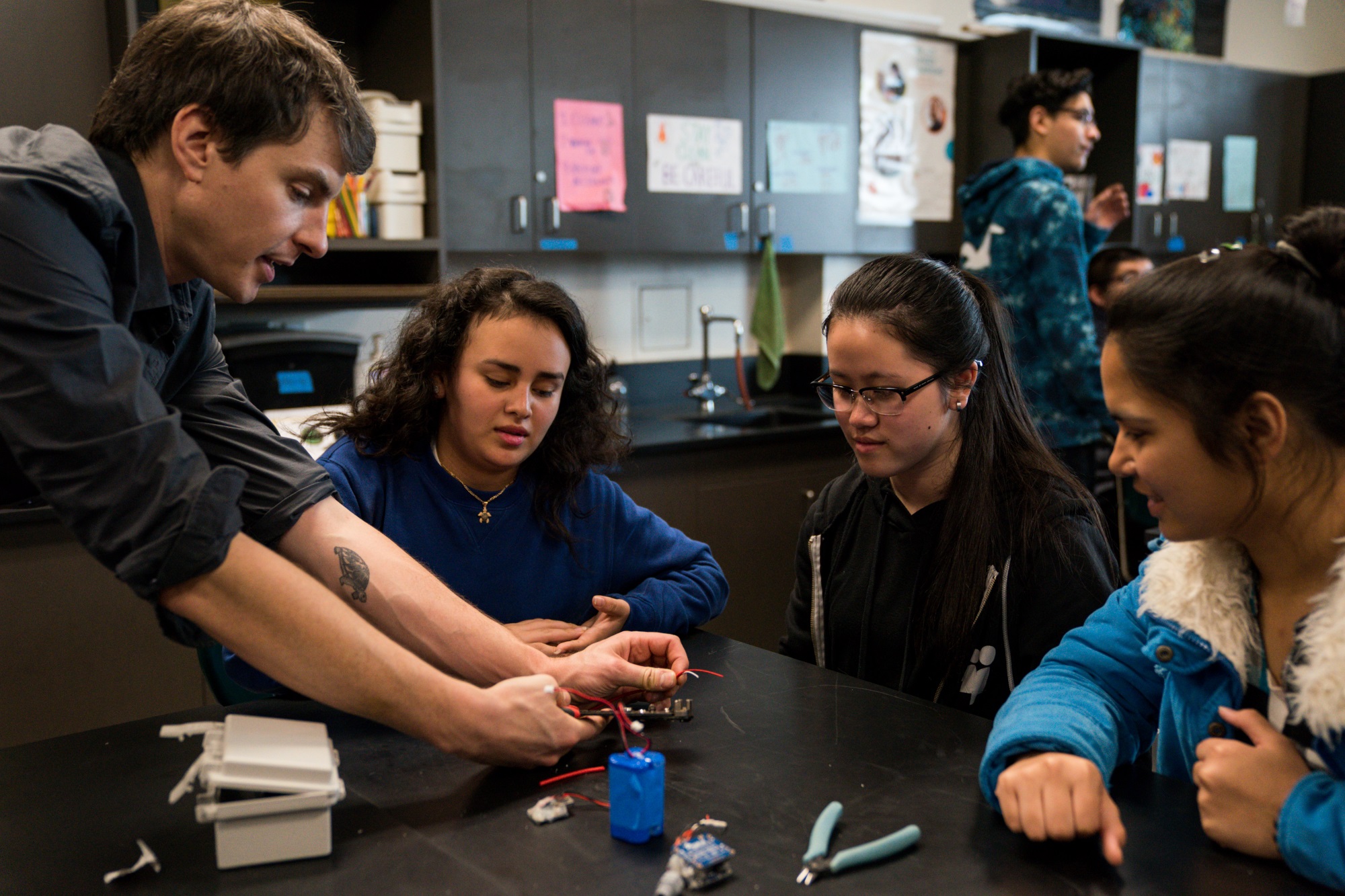
But, as you may know, the Amazon is rather a big forest. He wants more people to get involved, especially students. White partnered with Google to launch a pilot program where kids can build their own “Guardian,” as the augmented phone kits are called. When I talked with him it was moments before one such workshop in LA.

Topher White and students at one of the Guardian building workshops.

“We’ve already done three schools and I think a couple hundred students, plus three more in about half an hour,” he told me. “And all these devices will be deployed in the Amazon over the next three weeks. On Earth day they’ll be able to see them, and download the app to stream the sounds. It’s to show these kids that what they do can have an immediate effect.”

“An important part is making it inclusive, proving these things can be built by anyone in the world, and showing how anyone can access the data and do something cool with it. You don’t need to be a data scientist to do it,” he continued.

Getting more people involved is the key to the project, and to that end Rainforest Connection is working on a few new tricks. One is an app you’ll be able to download this summer “where people can put their phone on their windowsill and get alerts when there’s a species in the back yard.”

The other is a more public API; currently only partners like companies and researchers can access it. But with a little help, all the streams from the many online Guardians will be available for anyone to listen to, monitor and analyze. But that’s all contingent on having money.

“If we want to keep this program going, we need to find some funding,” White said. “We’re looking at grants and at corporate sponsorship — it’s a great way to get kids involved too, in both technology and ecology.”

Donations help, but partnerships with hardware makers and local businesses are more valuable. Want to join up? You can get at Rainforest Connection here.

23 Mar 2018

Rainforest Connection enlists machine learning to listen for loggers and jaguars in the Amazon

The vastness that makes the Amazon rainforest so diverse and fertile also makes it extremely difficult to protect. Rainforest Connection is a project started back in 2014 that used solar-powered second-hand phones as listening stations that could alert authorities to sounds of illegal logging. And applying machine learning has supercharged the network’s capabilities.

The original idea is still in play: modern smartphones are powerful and versatile tools, and work well as wireless sound detectors. But as founder Topher White explained in an interview, the approach is limited to what you can get the phones to detect.

Originally, he said, the phones just listened for certain harmonics indicating, for example, a chainsaw. But bringing machine learning into the mix wrings much more out of the audio stream.

“Now we’re talking about detecting species, gunshots, voices, things that are more subtle,” he said. “And these models can improve over time. We can go back into years of recordings to figure out what patterns we can pull out of this. We’re turning this into a big data problem.”

White said he realized early on that the phones couldn’t do that kind of calculation, though — even if their efficiency-focused CPUs could do it, the effort would probably drain the battery. So he began working with Google’s TensorFlow platform to perform the training and integration of new data in the cloud.

Google also helped produce a nice little documentary about one situation where Guardians could help native populations deter loggers and poachers:

That’s in the Amazon, obviously, but Rainforest Connection has also set up stations in Cameroon and Sumatra, with others on the way.

Machine learning models are particularly good at finding patterns in noisy data that sound logical but defy easy identification through other means.

For instance, White said, “We should be able to detect animals that don’t make sounds. Jaguars might not always be vocalizing, but the animals around them are, birds and things.” The presence of a big cat then, might be easier to detect by listening for alarmed bird calls than for its near-silent movement through the forest.

The listening stations can be placed as far as 25 kilometers (about 15 miles) from the nearest cell tower. And because a device can detect chainsaws a kilometer away and some species half a kilometer away, it’s not like they need to be on every tree.

But, as you may know, the Amazon is rather a big forest. He wants more people to get involved, especially students. White partnered with Google to launch a pilot program where kids can build their own “Guardian,” as the augmented phone kits are called. When I talked with him it was moments before one such workshop in LA.

Topher White and students at one of the Guardian building workshops.

“We’ve already done three schools and I think a couple hundred students, plus three more in about half an hour,” he told me. “And all these devices will be deployed in the Amazon over the next three weeks. On Earth day they’ll be able to see them, and download the app to stream the sounds. It’s to show these kids that what they do can have an immediate effect.”

“An important part is making it inclusive, proving these things can be built by anyone in the world, and showing how anyone can access the data and do something cool with it. You don’t need to be a data scientist to do it,” he continued.

Getting more people involved is the key to the project, and to that end Rainforest Connection is working on a few new tricks. One is an app you’ll be able to download this summer “where people can put their phone on their windowsill and get alerts when there’s a species in the back yard.”

The other is a more public API; currently only partners like companies and researchers can access it. But with a little help, all the streams from the many online Guardians will be available for anyone to listen to, monitor and analyze. But that’s all contingent on having money.

“If we want to keep this program going, we need to find some funding,” White said. “We’re looking at grants and at corporate sponsorship — it’s a great way to get kids involved too, in both technology and ecology.”

Donations help, but partnerships with hardware makers and local businesses are more valuable. Want to join up? You can get at Rainforest Connection here.

23 Mar 2018

Dropbox and Box were never competitors

As Dropbox had its IPO moment this morning, more than 10 years after launching, we can finally put one myth to rest. Dropbox and Box were never targeting the same customers.

As Anshu Sharma, founder at Prekari, a stealth startup and former partner at Storm Venture tweeted earlier today:

Same goes for investors, analysts and journalists. If you don’t believe they’re different, consider that in Dropbox’s S-1 paperwork they filed with SEC, you will note they didn’t even list Box as a primary competitor: “We compete with Box on a more limited basis in the cloud storage market for deployments by large enterprises,” the company wrote.

They had something in common, of course, but Dropbox has always been about managing files in the cloud, while Box has been focused on enterprise content use case cases in the cloud — and that’s a very different approach.

As Shria Ovide pointed out in her analysis on Bloomberg after the filing, the S-1 also proved that Dropbox has always been a “a consumer software company with a side hustle.” That side hustle was the enterprise business. (She also pointed out on Twitter that they may be the first company to use a cupcake emoji in their S-1, which is actually kind of cool).

Consumer with a dash of enterprise

It turns out that vast majority of Dropbox’s combined business and consumer revenue of more than a $1 billion came from consumers.  Dropbox has always offered an attractive consumer storage tool. It’s well integrated into desktop OSs and it has a nice mobile tool.

I use it and for $10 a month I get a terabyte of storage. I can back up my life there and it incorporates neatly into Finder on my Mac. When I capture screens they go automatically to Dropbox. It provides a place to back up my photos from my phone. It’s convenient and easy and it works.

It seemed that such a tool would translate nicely to business, but Alan Pelz-Sharpe, founder and principal analyst at Deep Analysis, who has been following this space for years, says Dropbox has always primarily been confined to teams on the business side. “Dropbox is primarily a consumer company with 500 million users, [with] only about 300,000 teams using their business offering,” he told TechCrunch.
That’s not to say they aren’t trying to capture more of the enterprise. In the weeks prior to the IPO, they made a pair of announcements designed to increase their enterprise credibility including one with Google to store G Suite documents natively in Dropbox and one with Salesforce to embed Dropbox folders in Salesforce Sales and Marketing clouds.

For now though, even with this business push, Pelz-Sharpe points out that most of Dropbox’s business customers are small teams of 3 or more people with a dash of larger implementations. “Nor are people building much on top of Dropbox in the way of business applications – it remains primarily a very efficient file sharing system,” he explained.

Differences with Box

This in contrast to Box, which has been working primarily with large enterprise companies for years to solve much more complex problems around content. Aaron Levie from Box said he’s absolutely rooting for Dropbox, but they have always been going after different markets, since Box decide to go enterprise about two years into its existence.

“We are fundamentally building two very different companies. Both are large markets. While there is no limit to the scale they could become, we have built a very different business around how do you serve [large companies] and deal with unstructured company data — and it’s a very different product set [from Dropbox],” Levie told TechCrunch.

Dropbox was off to a great start today with stock soaring, up nearly 40 percent in early trading, but however Dropbox ends up doing in the days and months ahead, they will do it having made their mark mostly as a consumer company — and that’s fine. If they continue to build their enterprise business over time, it will be all the better for them, but it turns out up until now, the only thing Box and Dropbox had in common was both had “box” in their names.

__

Have a look at Dropbox’s debut at TechCrunch Disrupt (known back then as the TechCrunch 50) in 2008:

23 Mar 2018

Dropbox and Box were never competitors

As Dropbox had its IPO moment this morning, more than 10 years after launching, we can finally put one myth to rest. Dropbox and Box were never targeting the same customers.

As Anshu Sharma, founder at Prekari, a stealth startup and former partner at Storm Venture tweeted earlier today:

Same goes for investors, analysts and journalists. If you don’t believe they’re different, consider that in Dropbox’s S-1 paperwork they filed with SEC, you will note they didn’t even list Box as a primary competitor: “We compete with Box on a more limited basis in the cloud storage market for deployments by large enterprises,” the company wrote.

They had something in common, of course, but Dropbox has always been about managing files in the cloud, while Box has been focused on enterprise content use case cases in the cloud — and that’s a very different approach.

As Shria Ovide pointed out in her analysis on Bloomberg after the filing, the S-1 also proved that Dropbox has always been a “a consumer software company with a side hustle.” That side hustle was the enterprise business. (She also pointed out on Twitter that they may be the first company to use a cupcake emoji in their S-1, which is actually kind of cool).

Consumer with a dash of enterprise

It turns out that vast majority of Dropbox’s combined business and consumer revenue of more than a $1 billion came from consumers.  Dropbox has always offered an attractive consumer storage tool. It’s well integrated into desktop OSs and it has a nice mobile tool.

I use it and for $10 a month I get a terabyte of storage. I can back up my life there and it incorporates neatly into Finder on my Mac. When I capture screens they go automatically to Dropbox. It provides a place to back up my photos from my phone. It’s convenient and easy and it works.

It seemed that such a tool would translate nicely to business, but Alan Pelz-Sharpe, founder and principal analyst at Deep Analysis, who has been following this space for years, says Dropbox has always primarily been confined to teams on the business side. “Dropbox is primarily a consumer company with 500 million users, [with] only about 300,000 teams using their business offering,” he told TechCrunch.

That’s not to say they aren’t trying to capture more of the enterprise. In the weeks prior to the IPO, they made a pair of announcements designed to increase their enterprise credibility including one with Google to store G Suite documents natively in Dropbox and one with Salesforce to embed Dropbox folders in Salesforce Sales and Marketing clouds.

For now though, even with this business push, Pelz-Sharpe points out that most of Dropbox’s business customers are small teams of 3 or more people with a dash of larger implementations. “Nor are people building much on top of Dropbox in the way of business applications – it remains primarily a very efficient file sharing system,” he explained.

Differences with Box

This in contrast to Box, which has been working primarily with large enterprise companies for years to solve much more complex problems around content. Aaron Levie from Box said he’s absolutely rooting for Dropbox, but they have always been going after different markets, since Box decide to go enterprise about two years into its existence.

“We are fundamentally building two very different companies. Both are large markets. While there is no limit to the scale they could become, we have built a very different business around how do you serve [large companies] and deal with unstructured company data — and it’s a very different product set [from Dropbox],” Levie told TechCrunch.

Dropbox was off to a great start today with stock soaring, up nearly 40 percent in early trading, but however Dropbox ends up doing in the days and months ahead, they will do it having made their mark mostly as a consumer company — and that’s fine. If they continue to build their enterprise business over time, it will be all the better for them, but it turns out up until now, the only thing Box and Dropbox had in common was both had “box” in their names.

__

Have a look at Dropbox’s debut at TechCrunch Disrupt (known back then as the TechCrunch 50) in 2008:

23 Mar 2018

Trump’s new national security advisor has ties to Cambridge Analytica

Trump’s third national security advisor John Bolton shares at least one thing in common with his first one, Michael Flynn: both men have ties to Cambridge Analytica, a political data firm at the center of a new Facebook privacy firestorm.

In a new story, The New York Times reports that John Bolton’s political action committee The John Bolton Super PAC hired Cambridge Analytica in August 2014, “months after the political data firm was founded and while it was still harvesting the Facebook data.”

In Cambridge Analytica’s early days, Bolton’s PAC funneled $1.2 million toward polling and “behavioral microtargeting with psychographic messaging” over the course of two years.

“To do that work, Cambridge used Facebook data, according to the documents and two former employees familiar with the work,” The New York Times reports.

That research supported candidates on the right, including Republican Thom Tillis’s 2014 bid for the Senate. According to the report, Bolton’s PAC was aware that the data came from Facebook users, though it’s not clear if Bolton knew that the data was obtained through a Facebook developer without consent.

Cambridge Analytica continues to challenge reports that it held onto data improperly obtained. In a new statement, the company’s acting CEO Alexander Tayler maintains the company’s ignorance about the apparently unlawfully obtained data its parent company licensed from a Facebook developer.

“The company believed that the data had been obtained in line with Facebook’s terms of service and data protection laws…

I became Chief Data Officer for Cambridge Analytica in October 2015. Shortly after, Facebook requested that we delete the data. We immediately deleted the raw data from our file server, and began the process of searching for and removing any of its derivatives in our system. When Facebook sought further assurances a year ago, we carried out an internal audit to make sure that all the data, all derivatives and backups had been deleted, and gave Facebook a certificate to this effect. Please can I be absolutely clear: we did not use any GSR data in the work we did in the 2016 US presidential election.”

Like Cambridge Analytica, Bolton’s PAC was a financial beneficiary of Robert Mercer, a conservative financier with considerable influence in the Trump administration.

23 Mar 2018

Facebook knows literally everything about you

Cambridge Analytica may have used Facebook’s data to influence your political opinions. But why does least-liked tech company Facebook have all this data about its users in the first place?

Let’s put aside Instagram, WhatsApp and other Facebook products for a minute. Facebook has built the world’s biggest social network. But that’s not what they sell. You’ve probably heard the internet saying “if a product is free, it means that you are the product.”

And it’s particularly true in that case because Facebook is the world’s second biggest advertising company in the world behind Google. During the last quarter of 2017, Facebook reported $12.97 billion in revenue, including $12.78 billion from ads.

That’s 98.5 percent of Facebook’s revenue coming from ads.

Ads aren’t necessarily a bad thing. But Facebook has reached ad saturation in the newsfeed. So the company has two options — creating new products and ad formats, or optimizing those sponsored posts.

Facebook has reached ad saturation in the newsfeed

This isn’t a zero-sum game — Facebook has been doing both at the same time. That’s why you’re seeing more ads on Instagram and Messenger. And that’s also why ads on Facebook seem more relevant than ever.

If Facebook can show you relevant ads and you end up clicking more often on those ads, then advertisers will pay Facebook more money.

So Facebook has been collecting as much personal data about you as possible — it’s all about showing you the best ad. The company knows your interests, what you buy, where you go and who you’re sleeping with.

You can’t hide from Facebook

Facebook’s terms and conditions are a giant lie. They are purposely misleading, too long and too broad. So you can’t just read the company’s terms of service and understand what it knows about you.

That’s why some people have been downloading their Facebook data. You can do it too, it’s quite easy. Just head over to your Facebook settings and click the tiny link that says “Download a copy of your Facebook data.”

In that archive file, you’ll find your photos, your posts, your events, etc. But if you keep digging, you’ll also find your private messages on Messenger (by default, nothing is encrypted).

And if you keep digging a bit more, chances are you’ll also find your entire address book and even metadata about your SMS messages and phone calls.

All of this is by design and you agreed to it. Facebook has unified terms of service and share user data across all its apps and services (except WhatsApp data in Europe for now). So if you follow a clothing brand on Instagram, you could see an ad from this brand on Facebook.com.

Messaging apps are privacy traps

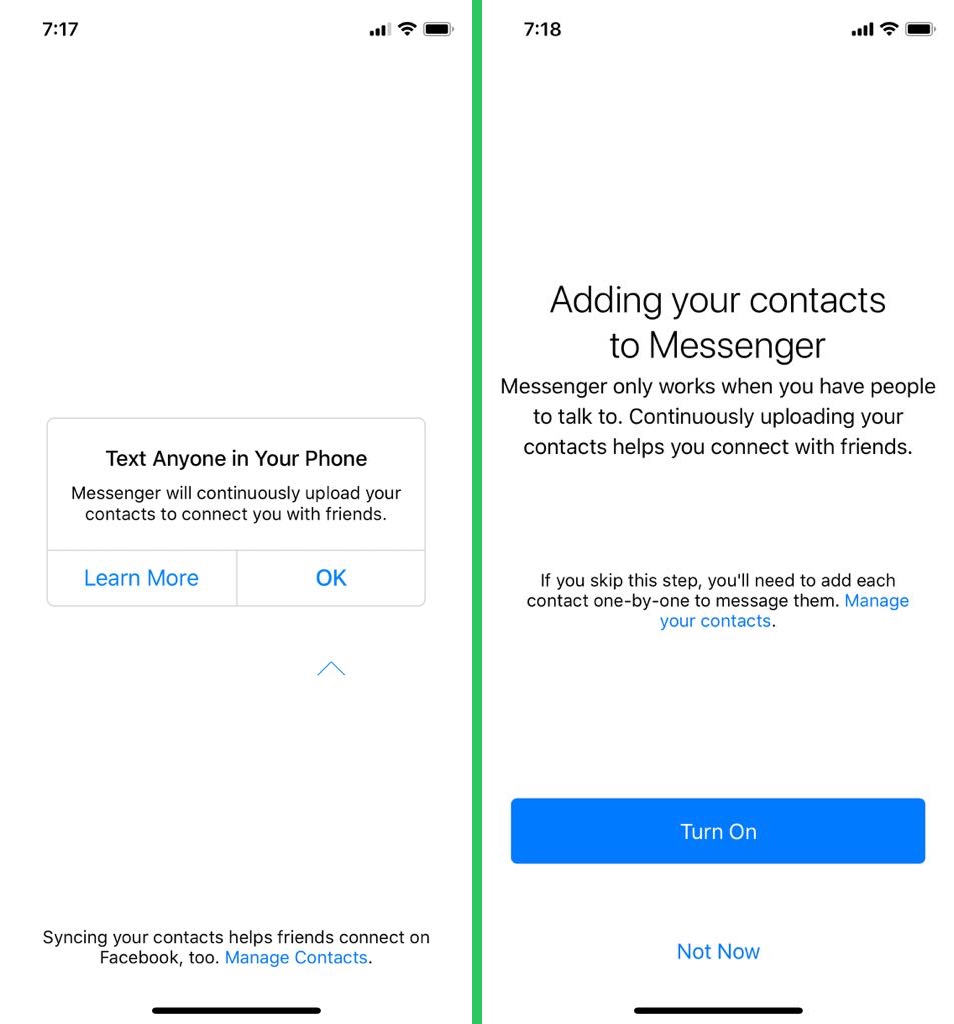
But Facebook has also been using this trick quite a lot with Messenger. You might not remember, but the on-boarding experience on Messenger is really aggressive.

On iOS, the app shows you a fake permission popup to access your address book that says “Ok” or “Learn More”. The company is using a fake popup because you can’t ask for permission twice.

There’s a blinking arrow below the OK button.

If you click on “Learn More”, you get a giant blue button that says “Turn On”. Everything about this screen is misleading and Messenger tries to manipulate your emotions.

“Messenger only works when you have people to talk to,” it says. Nobody wants to be lonely, that’s why Facebook implies that turning on this option will give you friends.

Even worse, it says “if you skip this step, you’ll need to add each contact one-by-one to message them.” This is simply a lie as you can automatically talk to your Facebook friends using Messenger without adding them one-by-one.

The next time you pay for a burrito with your credit card, Facebook will learn about this transaction and match this credit card number with the one you added in Messenger

If you tap on “Not Now”, Messenger will show you a fake notification every now and then to push you to enable contact syncing. If you tap on yes and disable it later, Facebook still keeps all your contacts on its servers.

On Android, you can let Messenger manage your SMS messages. Of course, you guessed it, Facebook uploads all your metadata. Facebook knows who you’re texting, when, how often.

Even if you disable it later, Facebook will keep this data for later reference.

But Facebook doesn’t stop there. The company knows a lot more about you than what you can find in your downloaded archive. The company asks you to share your location with your friends. The company tracks your web history on nearly every website on earth using embedded Javascript.

But my favorite thing is probably peer-to-peer payments. In some countries, you can pay back your friends using Messenger. It’s free! You just have to add your card to the app.

It turns out that Facebook also buys data about your offline purchases. The next time you pay for a burrito with your credit card, Facebook will learn about this transaction and match this credit card number with the one you added in Messenger.

In other words, Messenger is a great Trojan horse to learn everything about you.

And the next time an app asks you to share your address book, there’s a 99-percent chance that this app is going to mine your address book to get new users, spam your friends, improve ad targeting and sell email addresses to marketing companies.

I could say the same thing about all the other permission popups on your phone. Be careful when you install an app from the Play Store or open an app for the first time on iOS. It’s easier to enable something if a feature doesn’t work without it than to find out that Facebook knows everything about you.

GDPR to the rescue

There’s one last hope. And that hope is GDPR. I encourage you to read TechCrunch’s Natasha Lomas excellent explanation of GDPR to understand what the European regulation is all about.

Many of the misleading things that are currently happening at Facebook will have to change. You can’t force people to opt in like in Messenger. Data collection should be minimized to essential features. And Facebook will have to explain why it needs all this data to its users.

If Facebook doesn’t comply, the company will have to pay up to 4 percent of its global annual turnover. But that doesn’t stop you from actively reclaiming your online privacy right now.

You can’t be invisible on the internet, but you have to be conscious about what’s happening behind your back. Every time a company asks you to tap OK, think about what’s behind this popup. You can’t say that nobody told you.

23 Mar 2018

Kids Court, the grand prize winner from Amazon’s developer contest, disappears from the Alexa Skills Store

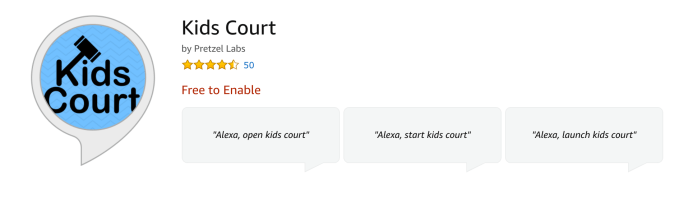
What does winning the Alexa Skills Challenge earn you from Amazon? Apparently, in addition to the $20,000 Grand Prize, you might also have your skill yanked from the Amazon Skill Store without warning. At least, that’s what seems to have happened to the grand prize winner from the recent Alexa’s kids competition, Pretzel Labs. Its winning submission, a fun skill called “Kids Court” where parents and kids settle arguments together using Alexa, has disappeared from Amazon’s Skills store.

There’s no update provided on the developer’s website or social media about the removal – and as a recent grand prize winner, one would have to assume a removal was unplanned.

Above: The Amazon.com-hosted page for the Kids Court skill

The problem also doesn’t appear to be one with the developer’s account, as other skills by Pretzel Labs – like “Freeze Dancers” – are still available, as of the time of writing.

That seems to indicate the skill was pulled for some other reason – like a content violation, a violation of terms, or just an accident. It’s not clear what would have triggered this, however, as the skill had not been substantially updated since it won Amazon’s contest.

Amazon is looking into the matter, but has not yet provided a comment.

Above: The Kids Court skill, from Google’s cache

Thousands of developers from 30 countries had registered for the Alexa Skills kid’s challenge, where they competed for a grand prize of $20,000, five bonus prizes ranging from $7,500 to $10,000, and a $5,000 prize for each of the 20 finalists. The competition was meant to help seed Alexa’s ecosystem with skills that would be popular with children and families, now that Alexa supports parental consent and COPPA compliance for skills.

Kids Court won the competition for its silly, family-friendly skill that helps kids get over their disagreements.

“I decided to address one of the most agonizing parts of family life – kids fighting – and created Judge Lexy, which is an objective, quirky judge that helps kids settle their battles,” explained Pretzel Labs founder Adva Levin, in Amazon’s blog post about the winners.

The Alexa skill puts the dispute through a mock trial process and renders a verdict. (Kids might not fully understand words it uses like “plaintiff” and “defendant,” however, so it might be a better skill to use with mom or dad present.) The “judge” then issues a goofy punishment, like “try to stand on your hands.”

While it’s not unusual for an app of any kind – including a voice app – to get pulled from the app store when in violation of the store’s terms, it is odd that Amazon would pull a Grand Prize winner without at least trying to work out the problem in question with the developer first.

Otherwise, it could just look…you know…embarrassing for Amazon.

Pretzel Labs says Amazon told them today the removal was a “misunderstanding” and Amazon is working to get the skill returned to the Alexa Skill Store.

A source close to the matter at Amazon said the company monitors live skills for quality, and it found it needed improvements. Amazon is working with the developer to make those improvements and the skill should return shortly*. [See update below.]

Amazon has declined to comment.

Regardless of what issues were present, this was surely a ham-fisted way of getting them addressed. It signals there’s a disconnect between Amazon’s ability to grow its voice app marketplace to now over 30,000 skills in the U.S. and the abilities of its app review team to properly handle the problems that arise.

*Update, 3/23/18 3:10 PM ET: Amazon reinstated the skill after this article was published; it’s live here.


23 Mar 2018

Pivotal Software files for IPO

While everyone was looking at Dropbox’s debut, Pivotal Software dropped its IPO filing. 

The enterprise cloud computing company is majority-owned by Dell, which came about after its merger with EMC in 2016. It was spun off from Dell, EMC and VMWare in April 2013.

Since then, it raised $1.7 billion in funding from Microsoft, Ford and General Electric.

Here’s how it describes its business:

Pivotal looks to “provide a leading cloud-native platform that makes software development and IT operations a strategic advantage for our customers. Our cloud-native platform, Pivotal Cloud Foundry (“PCF”), accelerates and streamlines software development by reducing the complexity of building, deploying and operating new cloud-native applications and modernizing legacy applications.”

According to the filing, Pivotal brought in $509.4 million in revenue for its fiscal year ending in February 2018. This compares to $416.3 million in revenue for 2017 and $280.9 million in revenue the year before.

The company is losing a lot of money, however. Losses for fiscal 2018 stood at $163.5 million, better than the negative $232.5 million seen in 2017 and $282.5 million in 2016.

“We have incurred substantial losses and may not be able to generate sufficient revenue to achieve and sustain profitability,” the company warned in the “risk factors” section of its IPO filing.

Pivotal also acknowledges that it faces competition from “legacy application infrastructure and middleware form vendors” like IBM and Oracle. It says it additionally competes with “open-source based offerings supported by vendors” like RedHat. It also faces challenges from SAP Cloud Platform, Amazon Web Services and Microsoft Azure.

Pivotal says it believes it will stand out from the pack because of its security and ease of use. It also says it has strong brand awareness and a good reputation. It says it is innovative with 118 U.S. patents and 73 more pending.

The company says it has filed for a $100 million IPO, but this is just a placeholder that is subject to change.

Morgan Stanley and Goldman Sachs are serving as lead underwriters. Davis Polk and Fenwick & West are serving as counsel.

Pivotal has not yet indicated which ticker symbol or stock exchange it intends to list on. But given the timing of the filing, we should expect the company to debut in April.

The year was off to a slow start for tech IPOs with just Cardlytics and Zscaler debuting, but now we’re seeing a flurry with Dropbox, Spotify, Zuora and Pivotal.

Strong performance of both Dropbox and Zscaler has been seen as a favorable sign for tech IPOs.