
Blog

23 Mar 2018

Storytelling for B2B startups: Avoiding ‘buzzword bingo’ to make your wonky enterprise company worth talking about

If there’s one thing I learned from my time as both a journalist at The Wall Street Journal and Forbes and, now, advising a global venture capital firm on communications, it’s that storytelling can make or break a company.

This is especially true the more complicated and arcane a company’s technology is. Stories about online-dating and burrito-delivery apps are easily understood by most people. But if a company specializes in making technology for hybrid-cloud data centers, or parsing specialized IT alerts and cybersecurity warnings, the storytelling task becomes much harder — but, I would argue, even more important.

Sure, a wonky company will still be able to talk easily to its customers and chat up nerdy CIOs at trade shows. But what happens when they raise a Series C or D round of financing and actually need to reach a broader audience — like really big, potential business partners, potential acquirers, public investors or high-level business reporters? Often, they’re stuck.

It can be painful to watch. When I was a reporter, I was amazed at the buzzwords thrown at me by some technology companies trying to get me to write about them. For fun, my colleagues and I would put some of these terms into online “buzzword bingo” websites just to see what indecipherable company descriptions they would spit out. (Example: “An online, cloud-based, open-source hyperconverged Kubernetes solution.”) Often, when pressed, PR representatives couldn’t explain to me what these companies actually did.

These companies obviously never made it into my stories. And I would argue that many of them suffered more broadly from their overall lack of high-profile press coverage; large business publications like the ones for which I worked target the very big-company executives and investors these later-stage startups were trying to reach.

Now, of course, I’m on the other side of that reporter/company equation — and I often feel like a big chunk of my job is working as a technology translator.

A natural-born storyteller

So why is this B2B storytelling problem so common, and arguably getting worse? Lots of reasons. Many of these hard-to-understand companies are founded by highly technical engineers for whom storytelling is (not surprisingly) not a natural skill. In many cases, their marketing departments are purely data-driven, focused on demand generation, ROI and driving prospects to an online sales funnel — not branding and high-level communications. As marketing technology has gotten more and more advanced and specialized, so have marketing departments.

As a result, many B2B and enterprise-IT companies are often laser-focused on talking about their products’ specific bells and whistles, staying in “sell mode” for a technical audience and cranking out wonky whitepapers and often-boring product press releases. They’re less adept at taking a step back to address the actual business benefits their product enables. Increasingly, this tech-talk also plays well with the legions of hyper-specialized, tech-news websites that have proliferated to serve every corner of the technology market, making some executives think there’s no need to target higher-level press.

Everyone has a story to tell. It’s up you to figure out what your company’s is, and how to tell that story in a compelling, understandable fashion.

One prominent marketing and PR consultant I know, who has worked with hundreds of Silicon Valley startups since the 1980s, says she is “shocked” by how poorly many senior tech industry CEOs today communicate their companies’ stories. Many tend to “shun” communications, considering it too “soft” in this new era of data-obsessed marketing, the consultant Jennifer Jones, recently told me. But in the end, poor communications and storytelling can create or exacerbate business problems, and often affect a company’s valuation.

So how do you get to a point where you can talk about your company in plain terms, and reach the high-level audiences you’re targeting?

One tactic, obviously, is to ditch the jargon when you need to. The pitch you use on potential customers — who likely already have an intimate understanding of your market and the specific problems you’re trying to solve — is not as relevant for other audiences.

A big fund manager at Fidelity or T. Rowe Price, or a national business journalist, probably knows, for example, that cloud computing is a big trend now, or that companies are buying more technology to battle complex cybersecurity attacks. But do they really understand the intricacies of “hybrid-cloud” data center setups? Or what a “behavioral attack detection solution” does? Probably not.

The David versus Goliath angle

Another tip is to put your company story in a larger, thematic context. People can better understand what you do if you can explain how you fit into larger technology and societal trends. These might include the rise of free, open-source software, or the growing importance of mobile computing.

It’s also helpful to talk about what you do in relation to larger, more established players. Are you nipping away at the slow-growing, legacy business of Oracle/EMC/Dell/Cisco? As a journalist, I once wrote a story about a small public networking company called F5 Networks that specialized in making “application delivery controllers.” But the story mostly focused on F5’s battle with a much larger competitor; in fact, the editors titled the story “One-Upping Cisco.” That’s the angle most readers were likely to care about. Journalists, particularly, love these David versus Goliath type stories, and national business publications are full of them.

Start focusing on high-level storytelling earlier, not when you’ve already raised $100 million in venture funding and have several hundred employees.

Another key storytelling strategy is leveraging your customers. If your business is boring to the average person, try to get one of your household-name customers to talk publicly about how they use your technology. Does your supply-chain software help L’Oréal sell more lipstick, or UPS make faster package deliveries?

One of our portfolio companies had a nice business-press hit a few years ago by talking about how their software helped HBO stream “Game of Thrones” episodes. (The service had previously crashed because too many people were trying to watch the show.) You can leverage these highly visible customers for case studies on your website. These can be great fodder for your sales team as well as later press interviews, as long as they’re well-written and understandable. Try to get more customers to agree to this type of content when you sign the contract with them.

From “Mad Men” to math men

Finally, there’s the issue of marketing leadership inside tech companies. In my experience, most smaller, B2B or enterprise IT-focused startups have CMOs or VPs of marketing who are more focused on data and analytics than brand communications — more “math men” than “Mad Men.” This isn’t surprising, as these companies often sell data-rich products and have business models where PR and general advertising don’t directly drive sales (unlike, say, a company making a food-delivery app). The CEOs of these companies value data and analytics, too.

I encourage B2B tech CEOs to focus on hiring CMOs with some brand/communications experience, or at least a willingness to outsource it to competent partners who are experts in that area. After a couple of early rounds of funding, you should be outgrowing your highly specialized PR firm (if you even have one) that focuses on a narrow brand of trade publications, for example. These firms usually don’t have contacts at the bigger, national business and technology outlets that are read by big mutual fund managers, and the business development folks at Cisco or Oracle. Hiring ex-journalists — not technical experts — to write content and develop messaging can be a good idea, too.

In other words, start focusing on high-level storytelling earlier, not when you’ve already raised $100 million in venture funding and have several hundred employees. By that point, it can simply be too late: Your company has already been typecast by the trade press and written off by higher-level reporters, and sometimes even potential business partners, as too niche-y and hard to understand.

As a journalist, I learned that everyone has a story to tell. It’s up you to figure out what your company’s is, and how to tell that story in a compelling, understandable fashion. If you do, I’m pretty sure the business benefits will follow.
23 Mar 2018

Lawyaw uses AI to help lawyers draft documents faster

It’s no secret that much of the legal industry is build on reusable content. Most law firms have their own customized set of standard documents (like NDAs or Wills), but lawyers or associates still have to customize these documents by hand each time a client needs them drafted.

Lawyaw, part of YC’s Winter ’18 class, is building software to automate this process by letting lawyers turn previously completed documents into smart templates.

Here’s how it works: Lawyers can drag an already customized world document into Lawyaw’s platform and it will automatically use natural language processing to first figure out what sections need to be replaced, then actually fill in those sections with the correct personalized phrases and variables. For example, software will automatically detect and replace a client’s name, contact information, location, and even more complicated things like scope of engagement.

If a variable isn’t automatically detected Lawyaw lets users manually select it, which the software will remember for future uses. Currently the platform only identifies about 50% of all variables in a document (up from 10% when it launched), but of those detected the accuracy rate for autofilling correct information is 99%. So essentially the algorithm is optimizing for quality over quantity right now, but that should equalize as the natural language processing gets better over time.

Of course Lawyaw isn’t the only solution for automatically populating legal documents. But most other solutions use complex document customization that requires knowledge of conditionals, tags and syntax. Plus, the platform has a few other useful features like integrated e-signing and a directory of over 5,000 standard court forms that can be customized.

Lawyaw charges each user $59 per month or $39 if paid annually. Interested users can just sign ups themselves instead of having to be subjected to firm-wide demos or annoying sales reps, both of which are still the status quo for legal software.

So far over 1,000 law firms have signed up, with 900 lawyers actively drafting over 24,000 total documents to date.

23 Mar 2018

Apple proposes new emojis to represent people with disabilities

Apple has proposed a number of emojis to the Unicode Consortium, the emoji gatekeeper of sorts, to better represent people with disabilities and depict accessibility-related tools like hearing aids, guide dogs and prosthetic limbs. That’s because Apple is unable to include these emojis in iOS and Mac OS until the Consortium adopts them.

The proposed emojis depict people who experience blindness or low-vision, those who experience deafness or have trouble hearing, those with physical disabilities, as well as those with hidden disabilities like Autism, anxiety and PTSD.

Here are the proposed emojis:

[gallery ids="1611289,1611290,1611291,1611292,1611293,1611294,1611295,1611296,1611297,1611298,1611299,1611300,1611301"]

“At Apple, we believe that technology should be accessible to everyone and should provide an experience that serves individual needs,” the company wrote in a proposal to the Unicode Consortium. “Adding emoji emblematic to users’ life experiences helps foster a diverse culture that is inclusive of disability. Emoji are a universal language and a powerful tool for communication, as well as a form of self-expression, and can be used not only to represent one’s own personal experience, but also to show support for a loved one.”

In order to develop these proposed emojis, Apple worked with the American Council of the Blind, Cerebral Palsy Foundation and National Association for the Deaf. What Apple put forward is not a comprehensive list of all the possible depictions of people with disabilities, the company noted in its proposal, but it could serve as a starting point.

The next step is for the Unicode Technical Committee to meet up and vote on whether to approve these new emojis. That meeting happens next month. If approved, those characters would get shortlisted for Emoji 12.0, which is scheduled for a March 2019 release. If you want to hear more about what goes into emoji approval, be sure to check out this interview with Jeremy Burge, vice-chair of the Unicode Emoji Subcommittee.

23 Mar 2018

American Express quietly acquired UK fintech startup Cake for $13.3M

Cake Technologies, the U.K. fintech startup that wanted to make it more convenient to pay your restaurant or bar bill, has been acquired by American Express — as the credit card behemoth plans to beef up its payment options for Amex members.

According to sources the deal quietly completed in October last year for a final price of $13.3 million (approx. £10.1m). However, due to an eleventh-hour preferential debt round and after fees, only some shareholders made a profit. I also understand from one source that Cake had raised a total of £4.5 million in equity and £1.4 million in debt. Part of the equity funding was a £1 million crowdfunding round on Crowdcube in 2015.

Confirming the acquisition, American Express gave TechCrunch the following statement:

Last year American Express acquired Cake Technologies. This year, we will be on-boarding Cake and their technologies to collaborate on ways to provide our Card Members with enhanced service and value in the dining space, which is an area many of our Card Members are passionate about.

A spokesperson for American Express declined to comment on the exact financial terms of the deal, but said that it was a “good outcome for Cake employees, previous investors and American Express”. They did confirm, however, that Cake employees are now employees of American Express.

This includes Cake founders Charlotte Kohlmann and Michelle Songy, who hold the positions of Vice President Global Dining Platform Solutions at American Express, and Director Global Platform Dining Solutions at American Express, respectively.

“We are excited to have Cake on board with us and look forward to collaborating on bringing our Card Members exciting new capabilities in the dining space soon,” adds the American Express spokesperson.

The back story to Cake’s eventual exit makes for interesting reading. According to a source with knowledge of the startup’s path to a sale, who spoke to TechCrunch on the condition of anonymity, it was very close to raising a £5 million Series A in the fall of 2016 before the company’s founders walked away for “ethical reasons,” although the source declined to diverge what these were. This then left Cake in a precarious situation financially as the company could not find another VC to step in quickly enough before running out of cash.

In the holidays/early 2017, the board of Cake put together a rescue round that was structured in the form of debt and designed to give the startup more runway to try to achieve a trade sale. All existing shareholders were given the chance to participate on a pro rata basis, although some declined due to the substantial risk of doubling down.

The loan was also structured so that, should the company get acquired, these eleventh hour investors would get a multiple preferential return. This, I’m told, explains why some investors made money from the exit, while others, including some Crowdcube backers, lost money, even possibly after factoring in EIS tax breaks.

In May 2017, American Express first made an offer to acquire Cake. The startup passed due diligence in late June, but American Express pulled the deal in mid-July for unknown reasons. Determined to get the sale back on track, Cake co-founder Kohlmann flew to New York unannounced and the deal eventually closed in October.

“Despite the complications and lengthy process, Amex did a really good deal here,” says my source. “It is clear that Cake is now a very important part of their digital strategy and the purchase price looks like good value in that context. Cake’s user experience will be a benefit to users of the Amex app once fully integrated and Cake’s basket level POS integrations will give Amex better insight into exactly what products their customers are buying rather than just where they go and how much they spend”.

23 Mar 2018

Y Combinator’s Jessica Livingston on Dropbox IPO: “It was just a dream of ours”

Dropbox, after more than a decade, finally went public this morning — and the stock soared more than 40% in its initial trading, making it a marquee success for one of the original Web 2.0 companies (at least for now).

While we still have to wait for the dust to settle, it’s been a very long road for Dropbox. From starting off as a file-sharing service, to hitting a $10 billion valuation in the middle of a massive hype cycle, to expectations dropping and then the announcement of a $1 billion revenue run rate. Dropbox has been a rollercoaster, but it’s another big moment this afternoon: it’s Y Combinator’s first big IPO. And Y Combinator still has a very deep bench of startups that are, thus far, obvious IPO candidates down the line like Airbnb and Stripe.

That isn’t to take away anything from the work of CEO Drew Houston and the rest of Dropbox’s team, but Y Combinator’s job is to basically take a bunch of shots in the dark based on good ideas and potentially savvy founders. Houston was one of the first of a firm that now takes in a hundred-odd founders per class. Y Combinator Founder and partner Jessica Livingston was there for the start of it, recalling back to the day that Houston rushed to her and Paul Graham to show him his little side project.

We caught up with Livingston this morning ahead of the IPO for a short interview. Here’s the conversation, which was lightly edited for clarity:

TC: Can you tell us a little bit about what it’s like to finally see the first Y Combinator company to go public?

JL: I feel like 13 years ago, it was just this dream of ours. It was this seemingly unattainable dream that goes, ‘maybe one of the startups we fund could go public someday.’ That was the holy grail. It’s an exciting day for Y Combinator. It shows what a long game investing is in early-stage startups. I do feel kind of validated.

TC: How did Y Combinator first end up in touch with Houston?

JL: He applied as a solo founder. We had met Drew the summer before. Back then, we were so small that we always encouraged people to bring friends to a Y Combinator dinner. [Xobni founder Adam Smith] brought [Houston], and we met him then and talked it through. When he applied, we invited him to come to an interview, and Paul [Graham] before the interview reached out to [Houston]. He said, “I see you’re a solo founder, and you should find a cofounder.” Three weeks later Drew showed up with [co-founder Arash Ferdowsi]. It was a great match that worked well.

TC: As Dropbox has grown, what’s stood out to you the most during changes in the market?

JL: They’re a classic example of founders who are programmers who built something to solve their own problem. Clearly, this is a perfect example of that. Drew gets on the bus, he forgets his files, and he can’t work on the whole trip down. He then creates something that will allow him to access files from everywhere. At the time, when he came on the scene with that, there were a lot of companies doing it but none were very good. I feel like Dropbox, regardless of market dynamics, from the very beginning was always dedicated to wanting to do well by building a better solution. They wanted to build one that actually works. I feel like they’ve stuck to that and that’s been driving them since. That’s been their guidepost.

TC: What was your first meeting with Houston like, and do you think he has changed in the past 10 years?

JL: When I first met him, he was young — he was very young — and he was always a good hacker, and very earnest. During Y Combinator he was very focused on building this product and was not distracted by other things. That’s when there were just two people. He’s really evolved over the years as an incredible leader. He’s grown this company and he’s navigated through all different parts of his life cycle. I’ve witnessed his growth as a leader and as a human being. He’s always been a great person. It’s sort of exciting to see where he is now that he’s come a long way, it’s really cool.

TC: Houston and Ferdowsi still own significant portions of the company even after raising a lot of venture capital. Do you think Y Combinator had any effect on companies looking for more founder friendly deals?

JL: I think when Y Combinator started, our goal in many ways was to empower founders. It was to level the playing field. You don’t have to have a connection in Silicon Valley to get funding. You just have to apply on our website. You don’t have to have gone to an Ivy League school. We [try to tell them], don’t let investors take advantage of you because you’re young and have never done this before. In general, times have changed over the past 15 years. Hopefully Y Combinator played a small role in some of those changes in making things a little more found friendly.

TC: What’s one of your favorite stories about Houston?

JL: He was always very calm, cool, and collected under pressure. I remember that was definitely a quality about him. His feathers didn’t get ruffled easily. One of the things I remember most clearly is from that summer when we had demo day. Back then it was, like, 40 people tops. Still, there was a lot of pressure. I remember Paul [Graham] came up with this idea that, ‘hey, Drew, during your demo day you should show people how well Dropbox actually works by deleting your presentation live and restoring it through Dropbox.’ That’s kind of risky, right? To delete your presentation. You’re just standing up there without anything. And he did it and he nailed the presentation. It sounds a little gimmicky, but it really worked and showed his product worked. I remember thinking, like, wow, he’s pretty calm. If it were me I don’t think I could hit the delete button in front of these people. That’s an important quality in someone, not to get flustered.

By the way, we funded them in 2007. If you asked me in 2008 how were they doing, I would say, well, they’re making progress. But it wasn’t like we funded them and we could say, ‘this is gonna be a great one.’ We just knew, yeah they’re making progress, but it’s always hard to know there.

TC: Back then, what were you just expecting? M&A? Did you even anticipate an IPO?

JL:  As we were formulating the idea, the hope was rather than going to work at Microsoft — I use them as an example because that was the company back then — and rather than going to get a job out of college, why not build a company and make Microsoft acquire you to get you to work for them? We had low expectations back then. We were hoping there’d be some small acquisitions. But yes, the hope was always acquisitions, but maybe someday in our wildest dreams there’d be an IPO. We didn’t even think YC would work when we started, people didn’t believe in YC’s models for many years.

TC: Looking back, what would you say is one of the biggest things you’ve learned throughout this experience?

JL: What a long road it is for startups. When we started YC back then, it wasn’t a popular thing to do a startup. Now, thank goodness, more people are starting them, and more types of people are starting them. It’s not just super high-tech companies. That’s exciting, but what I think a lot of people don’t realize is how hard startups are. You say, yeah, I know how hard, but people don’t realize how difficult they are and how long the commitment is. If you’re successful, it takes such a long time. For [someone like Houston] to make it to that point, they’ve committed a lot of their life and energy and all their intellectual capacity to making this work. To me, that’s so exciting, but I think it would surprise people to know realistically how long that could take.

TC: What would you tell startups with the hindsight of what happened with Dropbox’s valuation hype cycle?

JL: I will say, with startups, sometimes you just have to stick to what you’re doing. There’s a lot of stuff going on around you, especially now with social media and things like that. With a startup, you just have to keep moving forward with building a company and building a great product.

23 Mar 2018

Tumblr confirms 84 accounts linked to Kremlin trolls

Tumblr has confirmed that Kremlin trolls were active on its platform during the 2016 US presidential elections.

In a blog post today the social platform writes that it is “taking steps to protect against future interference in our political conversation by state-sponsored propaganda campaigns”.

The company has also started emailing users who interacted with 84 accounts it now says it has linked to the Russian trollfarm, the Internet Research Agency (IRA).

In the blog post it says it identified the accounts last fall — and “notified law enforcement, terminated the accounts, and deleted their original posts”.

“Behind the scenes, we worked with the Department of Justice, and the information we provided helped indict 13 people who worked for the IRA,” it adds.

In an email sent to a user, which was passed to TechCrunch to review, the company informs the individual they “either followed one of [11] accounts linked to the IRA, or liked or reblogged one of their posts”.

“As part of our commitment to transparency, we want you to know that we uncovered and terminated 84 accounts linked to Internet Research Agency or IRA (a group closely tied to the the Russian government) posing as members of the Tumblr community,” the email begins.

“The IRA engages in electronic disinformation and propaganda campaigns around the world using phony social media accounts. When we uncovered these accounts, we notified law enforcement, terminated the accounts, and deleted their original posts.”

Last month Buzzfeed News — working with researcher, Jonathan Albright, from the Tow Center for Digital Journalism at Columbia University — claimed to have unearthed substantial Kremlin troll activity on Tumblr’s meme-laden platform — identifying what they dubbed as “a powerful, largely unrevealed network of Russian trolls focused on black issues and activism” which they said dated back to early 2015.

The trolls were reported to be using Tumblr to push anti-Clinton messages, including by actively promoting Democrat rival Bernie Sanders.

Decrying racial injustice and police violence in the US was another theme of the Russian-linked content.

Since then The Daily Beast has also reported on leaked data from the IRA which also implied agents at the trollfarm had used Tumblr — and also Reddit — to spread political propaganda to target the 2016 US election.

Those IRA leaks suggested the IRA had created at least 21 Tumblr accounts — and included names replete with slang terms, including some accounts listed in the user email we’ve reviewed.

Tumblr, which is owned by TechCrunch’s parent company Oath, did not respond to an email we sent to their press office last month asking about possible Kremlin activity on its platform.

In today’s public post, the company writes: “As far as we can tell, the IRA-linked accounts were only focused on spreading disinformation in the U.S., and they only posted organic content. We didn’t find any indication that they ran ads.”

As well as emailing affected users, Tumblr says it will be keeping a public record of usernames linked to the IRA or “other state-sponsored disinformation campaigns”.

The full list of 84 Kremlin accounts on its public page is as follows:

It also suggests users step in and “correct the record” when they see others spreading misinformation, regardless of whether they believe it’s being done intentionally or not.

Concluding its email to the user who had unwittingly engaged with 11 of the identified IRA accounts, Tumblr adds: “We deleted the accounts but decided to leave up any reblog chains so that you can curate your own Tumblr to reflect your own personal views and perspectives.

“Democracy requires transparency and an informed electorate and we take our disclosure responsibility very seriously. We’ll be aggressively watching for disinformation campaigns in the future, take the appropriate action, and make sure you know about it.”

Asked how he feels to learn Kremlin trolls had unknowingly infiltrated his Tumblr feeds, the user told us: “It’s unsettling, although maybe not surprising, that we legitimize and signal boost bad actors on social platforms by ‘liking’ or reposting content that doesn’t appear to have any political agenda at first glance.”

23 Mar 2018

Elon Musk deletes own, SpaceX and Tesla Facebook pages after #deletefacebook

Elon Musk apparently wasn’t aware that his company SpaceX had a Facebook page. The SpaceX and Tesla CEO has responded to a comment on Twitter calling for him to take down the SpaceX, Tesla and Elon Musk official pages in support of the #deletefacebook movement by first acknowledging he didn’t know one existed, and then following up with promises that he would indeed take them down.

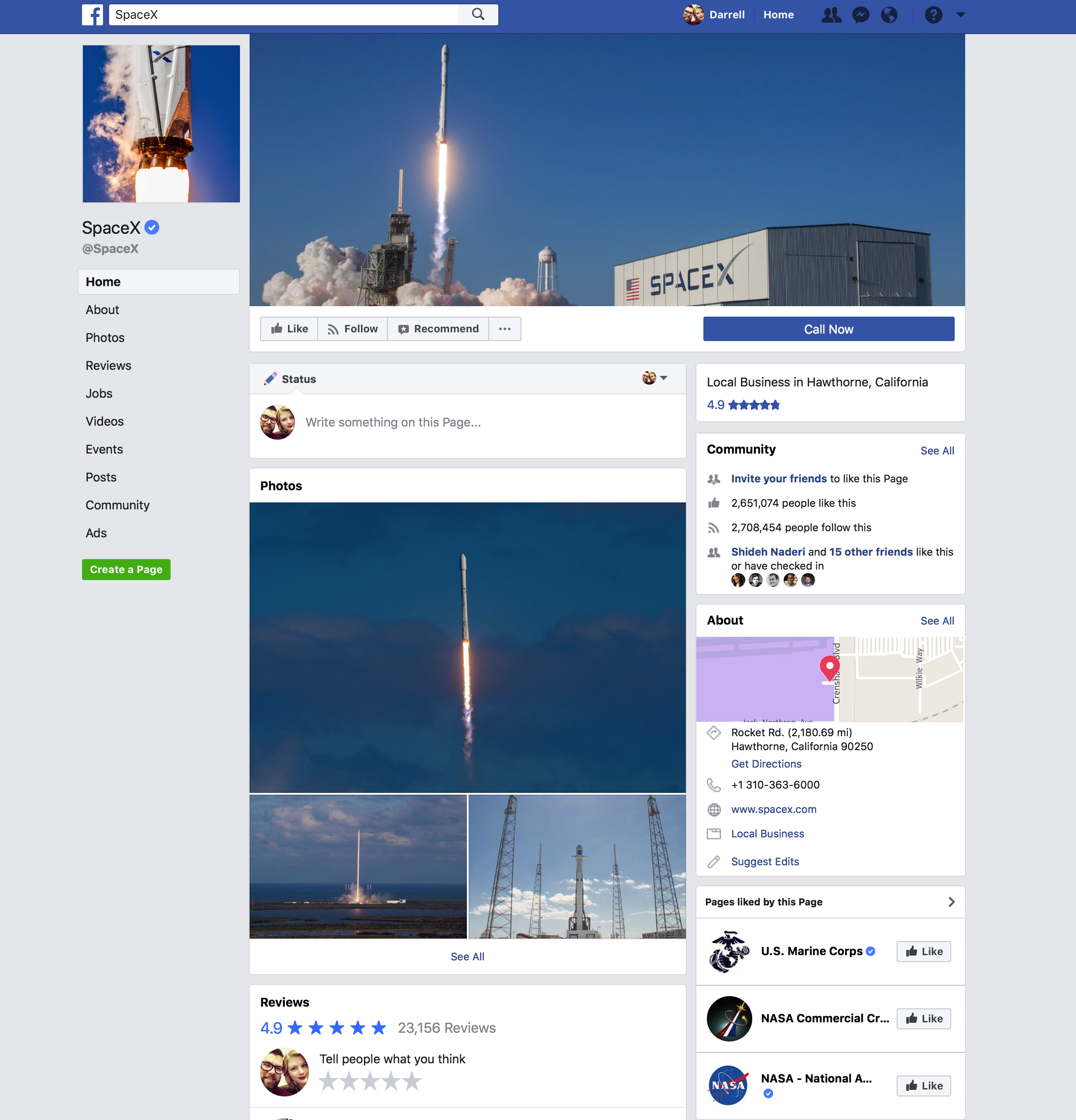
He’s done just that, as the SpaceX Facebook page is now gone, after having been live earlier today (as you can see from the screenshot included taken at around 12:10 PM ET).

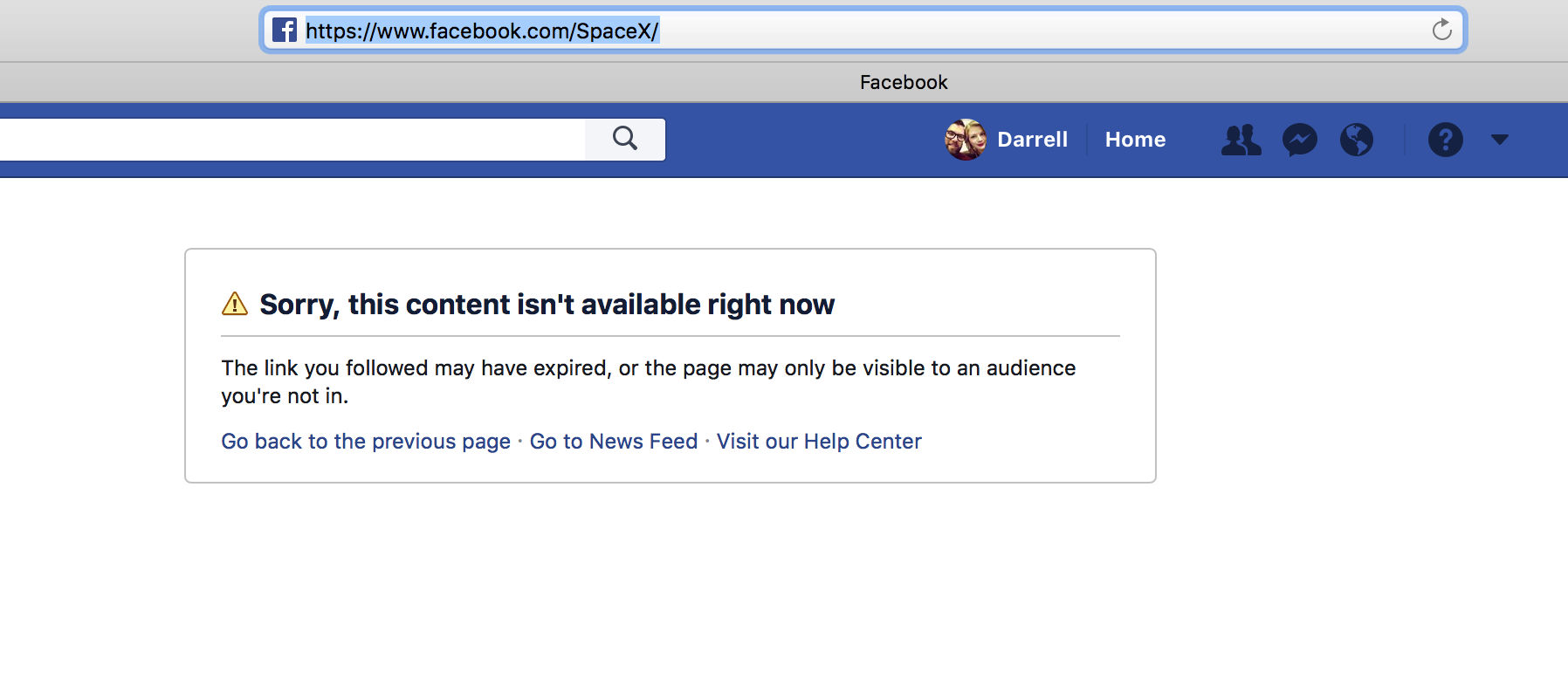
As of this publishing, going to any of the above pages directs you to a message saying “Sorry, this content isn’t available right now” instead. That’s a quick turnaround, since Musk seems only to have found out these pages existed about 20 minutes prior to his taking them all offline.

Musk also responded to another comment on Twitter regarding his own and his companies’ prolific use of Instagram, which is of course owned by Facebook. The prolific entrepreneur noted that Instagram was “borderline,” since FB’s “influence is slowly creeping in,” but it seems like he’s okay with maintaining that presence for now.

Prior to their deletion, both the SpaceX and Tesla pages had over 2.6 million Likes and Follows, and super high engagement rates. You have to wonder whether Musk’s social media management employees cried a little when these went down.

Developing…

23 Mar 2018

Craigslist kills personal ads after Senate sex trafficking vote

Craigslist has put the kibosh on one of its most iconic sections this week, following the passage of the Senate’s Stop Enabling Sex Traffickers Act. The controversial bill, which passed with a 97-2 vote, essentially holds sites accountable for hosting content related to sex trafficking.

While Craigslist has maintained the links to sections on its homepages, clicking on them will bring up a statement alerting users that the content is no longer available for fear of putting the entire site at risk.

US Congress just passed HR 1865, “FOSTA”, seeking to subject websites to criminal and civil liability when third parties (users) misuse online personals unlawfully.

Any tool or service can be misused. We can’t take such risk without jeopardizing all our other services, so we are regretfully taking craigslist personals offline. Hopefully we can bring them back some day.

The statement goes on wish happiness to those who’ve found love through the service.

In spite of having passed the Senate with an overwhelming majority, the bill has still met with sharp criticism among both sex workers and internet rights activists, who’ve called it out for putting the onus of the user submitted content on the hosting sites.

The Electronic Frontier Foundation called the FOSTA vote, “a dark day for the Internet,” adding, “As lobbyists and members of Congress applaud themselves for enacting a law tackling the problem of trafficking, let’s be clear: Congress just made trafficking victims less safe, not more.”

23 Mar 2018

Jeff Vinik invests $12 million into Dreamit Ventures, joins board

Real estate investor and Tampa Bay Lightning owner Jeff Vinik has expanded his relationship with Dreamit Ventures through a new $12 million investment into the early stage fund and accelerator, announced earlier this week. The deal will also see Vinik joining Dreamit as a Partner and a member of the Board of Directors.

Vinik was already partnered with Dreamit in a formal capacity prior to this investment. In 2016, he worked with Dreamit to launch its UrbanTech hybrid accelerator in Tampa. Unlike some startup incubators, the “hybrid” means startups aren’t required to relocate to Tampa during the entire 14-week program. Instead, it offers a briefer period where companies can get familiar with the area, and pitch their startup to local companies.

The debut cohort included companies focused on diverse areas ranging from water sensors to smart speed bumps to electric bikes to micro wind turbines and more.

Vinik had already invested an undisclosed, smaller amount in Dreamit to aid with the launch of UrbanTech, according to the Tampa Bay Times.

The accelerator is also tied to the $3 billion Water Street Tampa redevelopment project backed by both Vinik and Cascade Investment, Bill Gates’ private investment fund. While the 50-acre waterfront redevelopment project aims to bring in new residences, businesses, restaurants, hotels, shops, and more, a big part of Vinik’s vision for the Tampa Bay area includes attracting new technology investment and entrepreneurship to the area, too. 

“Over the last year, my partnership with Dreamit has helped us identify emerging technologies and bridge the funding and resource gap between Tampa Bay and larger startup ecosystems like New York and San Francisco. I’ve been highly impressed by Dreamit’s team, the caliber of Dreamit startups, and the large percentage of companies that continue growing with follow-on funding after the program,” said Vinik, in reference to his Dreamit investment.

Of course, Vinik aslo sees an opportunity in connecting the UrbanTech startups with the bigger companies who will be building in Tampa as a result of the real estate project; so investing into Dreamit makes sense, given those aligned goals.

Vinik’s involvement in Dreamit could be a boost for the accelerator, as well, thanks to Vinik’s connections not only as a result of his real estate investments, but also those forged in his earlier days managing the Fidelity Magellan Fund and his own hedge fund, Vinik Asset Management.

Since its founding in 2008, Dreamit has backed nearly 300 startups including SeatGeek, HouseParty, LevelUp, Adaptly, Wellth, Biomeme, Tissue Analytics, Redox, Eko Devices, Raxar, and Elevate. Its portfolio companies have gone on to raise around $800 million in follow-on funding, and have a combined value of nearly $2 billion. Dreamit is now investing in urban tech and healthcare – both areas where Tampa could play a role.

In urban tech specifically, the city is currently home to a connected vehicle technology project that allows cars to communicate with roadways and other vehicles to receive warnings about roadway conditions, speed limit changes, dangers and more.

An autonomous shuttle project was also in the works in Tampa, but has been put on hold.

Another project in development is SunTrax, a testing ground for new toll technology and self-driving cars. Test tracks like the 2.25-mile long SunTrax facility, may be increasingly needed to trial autonomous cars in the future, given the death of the pedestrian caused by an Uber autonomous car. It’s likely we’ll see more driverless cars pulled from roads and projects put on hold, then only allowed to test on closed tracks until the technology is safer.

“Jeff is a visionary business leader who drives results. He built a track record of legendary returns in his investment career and produced a new model of how urban areas can work in the 21st century,” said Steve Barsh, Managing Partner at Dreamit, in a statement about the new investment. “We back startups operating in large and important verticals that are ripe for innovation with more verticals to come. Vinik’s investment and participation is an exciting evolution for Dreamit and the startup community, and we look forward to working with Jeff as we continue to build and expand Dreamit.”

23 Mar 2018

Dropbox pops more than 40% in its public debut as a publicly-traded company

It’s a big day for Dropbox — the first marquee Web 2.0 name to go public this year and one of the biggest since Snap last year — which made its public debut today, with the stock soaring nearly 43% to around $30 in the first moments of trading.

Today’s debut for the enterprise-slash-consumer company is the culmination of plenty of headwinds — and tailwinds — that first dropped questioned the valuation it got during the crazy Silicon Valley hype cycle Dropbox before building up the confidence to bring it right back up. Dropbox’s last private valuation was around $10 billion, but throughout the IPO pricing process that companies use to essentially discover what investors are willing to pay, Dropbox’s valuation largely remained below that. But that price, starting at a range between $16 and $18, slowly ticked up before settling on $21 per share last night. Now, it’s gone well above that.

Dropbox first rode a wave of consumers increasingly adopting the cloud and storing their files online where they could access them anywhere, where its growth and emerging businesses sent it to a $10 billion valuation. Then, it rode a second wave of small teams in businesses that decided to adopt tools like Dropbox, which may have not yet been tuned for massive companies, simply because they were easier to use than existing ones. And finally, that playbook turned out to be wildly successful for many companies, which used that as a jumping point to get full company adoption and eventually get the C-suite on board with it and other collaboration products.

Since that hyped-up valuation, Dropbox has hit a number of milestones, including hitting a $1 billion revenue run rate (it generated $1.1 billion in revenue last year), picking up 500 million registered users, and having 11 million paying customers. Over the past few years it’s tried to go beyond just file-sharing in the enterprise with tools like Dropbox Paper, a Quip or Google Docs competitor that’s designed to be a kind of continuous document for coming up with ideas like a product spec or marketing roadmap, among a lot of updates to its mobile application.

Amid all of this, Dropbox founder Drew Houston — who will be one of Y Combinator’s first major IPO success stories — still owned nearly 30% of the company, and co-founder Arash Ferdowsi owned around 12.2% of the company. Y Combinator has a deep bench of companies that all look like good IPO candidates like Airbnb or Stripe, but Dropbox was one of the earliest startups to go through back in 2007. The IPO will, too, be a massive windfall for Sequoia Capital which continues to own 25% of the company.

“Houston has] really evolved over the years as an incredible leader, he’s grown this company, he’s navigated through all different parts of this life cycle,” Y Combinator founder and partner Jessica Livingston said. “Our goal in many ways was to empower founders. It was to level the playing field, you don’t have to have a connection in Silicon Valley to get funding. I feel like, 13 years ago, [having a YC company go public] was just this dream of ours. It was almost seemingly unattainable dream — maybe one of the startups we fund could go public someday. That was the holy grail. It’s an exciting day for YC. It shows what a long game investing in early-stage startups is.”

There’s already been a wave of activity on the enterprise market, with Salesforce acquiring Mulesoft for $6.5 billion being the exclamation point of 2018 thus far. But enterprise security company Zscalar already had a massively successful IPO with the price nearly doubling, and subscription billing tools service Zuora is also set to go public. These kinds of tools serve as the backbones of modern Web companies, and whether they’re household names or not, they have the capacity to go public due to the sheer scale of the market opportunity — even if it takes a while to get there.

Enterprise IPOs are usually the kind of backbone of a lot of venture firms because they’re predictable. The buying cycles are long, the path to profitability is a little more obvious, and the business model comes more down to execution than the whims of consumers. But in recent years, Dropbox has occupied a kind of weird spot in that spectrum as a company looking to share a big slice of the enterprise collaboration market with something that was born for, and still very much in service to, the average consumer. Dropbox will serve not only as a barometer for enterprise IPOs coming through the door over the next few months, but likely IPOs across the board.