
23 Mar 2018

Facebook hit with shareholder lawsuits over data misuse crisis

The lawsuits are piling up against Facebook in the wake of the Cambridge Analytica data misuse and political ad targeting scandal.

According to SF Gate the company has been hit with four suits in federal courts so far this week following fresh revelations about how Facebook’s app permissions were abused to surreptitiously suck out vast amounts of user data.

One lawsuit filed yesterday in Northern California on behalf of a Facebook shareholder, Jeremiah Hallisey, alleges the company’s senior management “breached their fiduciary duties by failing to prevent the initial misappropriation [of user data by CA] and, after learning of it in 2015, failing to inform affected Facebook users or the public markets”.

The complaint names Facebook founder and CEO Mark Zuckerberg; COO Sheryl Sandberg; and board members Marc Andreessen, Peter Thiel, Reed Hastings, Erskine Bowles, Susan Desmond-Hellman and Jan Koum as defendants.

It notes Facebook has lost $50 billion in market capitalization since the data leak was disclosed, and flags reports that the FTC has launched an inquiry into Facebook’s conduct and whether it violated the terms of a 2011 consent decree that requires the company to notify users before sharing their data with third parties.

We’ve reached out to Facebook for comment but at the time of writing the company had not responded.

Last week the New York Times and the Observer of London reported revelations from former CA employee Chris Wylie, who detailed how working with a University of Cambridge psychology professor who had developed a survey app to run on Facebook, the political consultancy had been able to obtain vast amounts of user information — as many as 50 million US Facebook users’ profiles — without the vast majority of the users being aware their data had been harvested nor what it would be used for. The firm had been working for the Trump presidential campaign.

After the newspaper reports Facebook acknowledged that 270,000 people had downloaded the survey app.

CEO Mark Zuckerberg has also since gone on CNN to apologize. But the scope and scale of the data mishandling, coupled with Facebook’s failure to inform users when it found about the policy breach in 2015 have played very badly with markets and users alike…
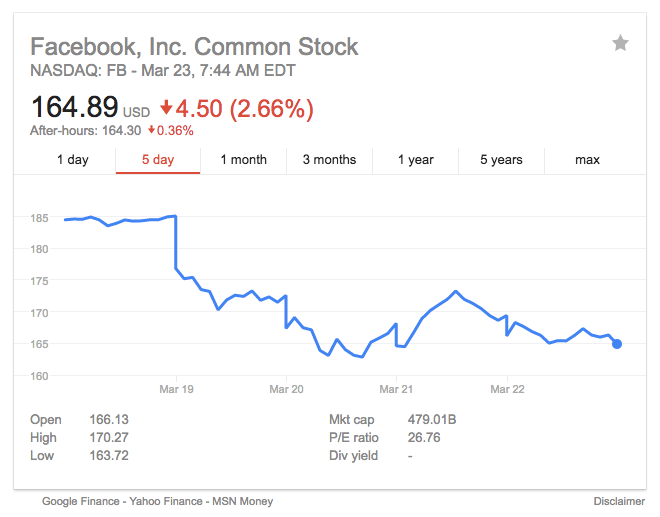
“The recent revelations regarding Facebook’s actual practices with respect to user privacy and data security have severely damaged the Company’s reputation and imposed significant costs on it, including regulatory investigations, lost business, exposure to litigation, and other damages,” the complaint runs, before going on to allege that Facebook sought to “downplay concerns about access to user information” and “continued to assure investors that Facebook maintained effective” internal controls and systems that automatically detected ‘suspicious activity'”.

In a statement, Mark Molumphy, a partner with Cotchett, Pitre & McCarthy — the firm representing Hallisey — said: “Facebook’s apology doesn’t do much for the millions of Americans impacted by this conduct. It also doesn’t explain why Facebook executives waited three years to inform their loyal users and shareholders of the massive breach, especially on the heels of the FTC consent decree in 2011.  This action seeks accountability from those entrusted to safeguard our personal information and who seem to pay only lip service to the privacy concerns of their users.”

Also adding to the awkward questions for Facebook: Board member, Thiel, who supported Trump’s presidential bid, made a $1M financial donation to a Trump-supporting Super PAC, called Make America Number 1, in 2016 — which Mashable reports subsequently paid Cambridge Analytica $231,352 toward the end of the same year, per an FEC filing

Earlier this week, a proposed class action was also filed in California by a group of Facebook users seeking damages from the company for failing to protect their data.

On Tuesday, another shareholder lawsuit was filed. Gizmodo reports that complaint shareholder Fan Yuan has accused the company of making “materially false and/or misleading” claims about its handling of user data, and failing to disclose the ongoing situation has reduced the value of Facebook shares.

A fourth suit has been filed by another shareholder, Robert Casey. And Facebook will surely face more before the outrage over this epic fail privacy scandal burns out.

It also seems very likely that additional app permissions problems will come to light as Facebook has committed to a historical audit of any apps that were accessing large amounts of user data around the same time as CA was. Safe to say, it would be very unusual if the app used by CA to suck out Facebook profiles en mass was the only third party app to be acting out before Facebook acted on regulatory recommendations to tighten its app permissions, starting in 2014.


23 Mar 2018

Southern California needs to find its hub for it to develop its own tech ecosystem

Recognizing the tens of billions of dollars that the Southern Californian region leaves on the table, because it hasn’t taken its rightful place in the American technology industry, a new group called  the Alliance for Southern California Innovation has just released a report to analyze how SoCal can work to assume its pole position.

Through interviews with 100 leaders of the technology ecosystem and an analysis of venture capital funding for the region, the organization has concluded (with the help of the Boston Consulting Group) that the promise of a regional rival to Northern California’s silicon valley won’t be fulfilled without the establishment of a geographic hub and a willingness to overcome regional differences.

Founded by Steve Poizner last year to accelerate the growth of a startup entrepreneurial ecosystem in Southern California, The Alliance is building a network of investors, entrepreneurs and universities to provide ballast in the south to the dominance of the Northern California tech industry.

The Alliance estimates that Southern California’s tech community could be one-third the size of Silicon Valley’s by supporting or further developing the six pillars it already has for innovation to occur.

The potential impact making these changes could have is an added 200,000 new jobs and growth of $100 billion for the whole economic region.

“Over the past several years we have observed a significant decrease in startups leaving SoCal,” said Greg Becker, CEO of Silicon Valley Bank . “We’ve also seen a substantial inflow of venture capital from all over the world.”

In fact, as is well-reported, the luster of Silicon Valley is fading. As BCG writes in its report:

The good news for SoCal and any region with tech ambitions is that the Bay Area has in some ways been too successful. Our research revealed a saturation level causing unprecedented challenges, starting with exorbitant housing prices and runaway operating costs that accelerate a startup’s “burn rate”—its monthly spending.

Los Angeles investor Mark Suster, a general partner with Upfront Ventures, has been beating the drum for Los Angeles as a new tech hub for a while — and billion dollar exits for Ring and Dollar Shave Club, in addition to the public offering for Snap, lend credence to his position.

Suster has also noted for years that the region produces more technology doctorates than any other geography in the United States. Caltech generates more patents than any other university while UCLA boasts more startups founded by its graduate than any other school in the nation. Meanwhile, UCSD in San Diego has a deep bench of biotechnology expertise stemming from its proximity to the Sanford Consortium for Regenerative Medicine, the Salk Institute, and the Scripps Research Institute.

However, to thrive, BCG recommends taking six steps to bolster the the ecosystem and its chances to begin to catch up to Silicon Valley.

The consulting firm says that Southern California needs more local venture capital; the individual geographies need to work to promote their regional strengths; regions need to collaborate more closely with each other; founders need to start gunning for that IPO slot instead of taking acquisition offers; the region’s commitment to diversity needs to be emphasized; and finally the embarrassment of entrepreneurial riches needs to be promoted abroad.

“Southern California is a region of extreme innovation; however, it is so spread-out, making it hard to navigate,” said Steve Poizner founder and board chair of the Alliance, in a statement. “We believe by finding, filtering and aggregating exciting startups from top universities, research institutes, and incubators/accelerators, we can demonstrate the combined strength of SoCal in a compelling way to top investors and thought leaders.”

23 Mar 2018

John Bolton is Trump’s new National Security Advisor

With one fell swoop, President Trump just swapped out the “warrior scholar” for the warmonger.

Today Trump tweeted that General H.R. McMaster will step down as John Bolton, a deeply controversial former U.S. ambassador, steps into the role of national security advisor. Bolton will move into the high-ranking foreign policy advisor position just as the U.S. is approaching talks with North Korea, an extremely delicate diplomatic maneuver between two volatile leaders. 

Last month, Bolton argued the legal case for a pre-emptive strike on North Korea — an extreme position in which even the best case scenario could result in broad carnage for the U.S. and its allies.

Bolton established his extreme and hawkish reputation during his tenure as the undersecretary of state for arms control during the Bush administration. In that advisory position, Bolton argued strongly in favor of the Iraq war, tying his justification to the supposed presence of weapons of mass destruction.

If most people could agree that McMaster was a respectable choice for national security advisor, just as many seem to oppose Bolton becoming a prominent figure in shaping Trump’s foreign policy. When Bolton’s name was floated just after the election, Republican Senator Rand Paul penned an op-ed denouncing Bolton as “hell-bent on repeating virtually every foreign policy mistake the US has made in the last 15 years.”

While McMaster was sometimes characterized as a cautious futurist, Bolton’s record on tech is less clear. We’re sure to learn more about the new advisor’s various postures quickly, as Bolton stirs up bipartisan anxiety around U.S. foreign policy, particularly in Iran and North Korea.

After the swift fall of Michael Flynn in early 2017 and the quick appointment of McMaster, Bolton will become Trump’s third national security advisor in less than two years.

23 Mar 2018

More evidence ties alleged DNC hacker Guccifer 2.0 to Russian intelligence

It may be a while since you’ve heard the handle “Guccifer 2.0,” the hacker who took responsibility for the infamous DNC hack of 2016. Reports from the intelligence community at the time, as well as common sense, pegged Guccifer 2.0 not as the Romanian activist he claimed to be, but a Russian operative. Evidence has been scarce, but one slip-up may have given the game away.

An anonymous source close to the U.S. government investigation of the hacker told the Daily Beast that on one single occasion, Guccifer 2.0 failed to log into the usual VPN that disguised their traffic. As a result, they left one honest IP trace at an unnamed social media site.

That IP address, “identified Guccifer 2.0 as a particular GRU officer working out of the agency’s headquarters on Grizodubovoy Street in Moscow,” the Daily Beast reported. (The GRU is one of the Russia’s security and intelligence organs.)

Previous work by security researchers had suggested this, but it’s the first I’ve heard of evidence this direct. Assuming it’s genuine, it’s a sobering reminder of how fragile anonymity is on the internet — one click and the whole thing comes crashing down.

It’s a bit of a foregone conclusion now, since in the time since the hack the notion of Russian interference with the election has gone from unnerving possibility to banal fact. And while a single impression like that may sound a bit flimsy, investigators would of course be putting it together with all kinds of other activity and patterns to be clear this wasn’t just a random intern checking his feeds at an open terminal.

23 Mar 2018

As the CLOUD Act sneaks into the omnibus, big tech butts heads with privacy advocates

As the House advances a 2,232-page spending bill meant to avert a government shutdown, privacy advocates and big tech companies aren’t seeing eye to eye about a small piece of legislation tucked away on page 2,212.

The Clarifying Lawful Overseas Use of Data Act, a.k.a. the CLOUD Act (H.R.4943S.2383) aims to simplify the way that international law enforcement groups obtain personal data stored by U.S.-based tech platforms — but the changes to that process are controversial.

As it stands, if a foreign government wants to obtain that data in the course of an investigation, a series of steps are necessary. First, that government must have a Mutual Legal Assistant Treaty (MLAT) with the U.S. government in place, and those treaties are ratified by the Senate. Then it can send a request to the U.S. Department of Justice, but first the DOJ needs to seek approval from a judge. After those requirements are met, the request can move along to the tech company hosting the data that the foreign government is seeking.

The debate around the CLOUD Act also taps into tech company concerns that foreign nations may move to pass laws in favor of data localization, or the process of storing users’ personal data within the borders of the country of which they are a citizen. That trend would prove both costly for cloud data giants and difficult, upending the established model of cloud data storage that optimizes for efficiency rather than carefully sorting out what data is stored within the borders of which country.

In a February 6 letter, Microsoft, Apple, Google, Facebook and Oath (TechCrunch’s parent company) co-authored a letter calling the CLOUD Act “notable progress to protect consumers’ rights.”

In a late February blog post, Microsoft Chief Legal Officer Brad Smith addressed the issue. “The CLOUD Act creates both the incentive and the framework for governments to sit down and negotiate modern bi-lateral agreements that will define how law enforcement agencies can access data across borders to investigate crimes,” Smith wrote. “It ensures these agreements have appropriate protections for privacy and human rights and gives the technology companies that host customer data new statutory rights to stand up for the privacy rights of their customers around the world.”

In a recent opinion piece, ACLU legislative counsel Neema Singh Guliani argues that the CLOUD Act sidesteps oversight from both the legislative and judicial branches, granting the attorney general and the state department too much discretion in choosing which governments the U.S. will enter into a data exchange agreement with.

The Center for Democracy and Technology also opposes the CLOUD Act on the grounds that it fails to protect the digital privacy of American citizens and the Electronic Frontier Foundation dismissed the legislation as “a new backdoor around the Fourth Amendment.” The Open Technology Institute also denounced the CLOUD Act’s provision to “allow qualifying foreign governments to enter into an executive agreement to bypass the human rights protective Mutual Legal Assistance Treaty (MLAT) process when seeking data in criminal investigations and to seek data directly from U.S. technology companies.”

Both organizations acknowledge that improvements to the bill do partially address some of the human rights concerns associated with not requiring an MLAT in a data sharing agreement.

“While this version of the CLOUD Act includes some new safeguards, it is still woefully inadequate to protect individual rights,” OTI Director of Surveillance & Cybersecurity Policy Sharon Bradford Franklin said of the changes.

“Critically, the bill still would permit foreign governments to obtain communications data held in the United States without any prior judicial review, and it would allow foreign governments to obtain U.S.-held communications in real time without applying the safeguards required for wiretapping by the U.S. government. ”

The Consumer Technology Association voiced its support of the altered bill in a press release issued Thursday. “CTA thanks the House of Representatives for taking steps to empower America’s digital infrastructure for the 21st century. The inclusion of the CLOUD Act and RAY BAUM’S Act in today’s legislation ensures Americans can safely create, share and collect electronic data while providing them the resources to do so.”

While some changes made aspects of the bill more palatable to digital privacy watchdogs, some are objecting to the choice to tack it onto the omnibus spending bill.

Oregon Senator Ron Wyden and Kentucky Senator Rand Paul spoke out Thursday against passing the CLOUD Act by attaching it to the spending bill.

“Tucked away in the omnibus spending bill is a provision that allows Trump, and any future president, to share Americans’ private emails and other information with countries he personally likes. That means he can strike deals with Russia or Turkey with nearly zero congressional involvement and no oversight by U.S. courts,” Wyden said. “This bill contains only toothless provisions on human rights that Trump’s cronies can meet by merely checking a box. It is legislative malpractice that Congress, without a minute of Senate debate, is rushing through the CLOUD Act on this must-pass spending bill.”

While the content of the CLOUD Act has evolved away from controversy with some modifications, the choice to pass it as part of the omnibus plan without further opportunity for public debate to examine its potential far-reaching implications is proving just as controversial as earlier forms of the legislation.

22 Mar 2018

Tapas Media aims to turn digital comics into the next big entertainment franchise

Tapas Media has its own platform for digital comics — but like a lot of publishers, CEO Chang Kim has ambitions beyond the comics world.

Comixology is the big name in digital comics. The company, which was acquired by Amazon in 2014, is focused on selling print comics from major publishers in web- and mobile-friendly formats. (It’s also working with publishers like Marvel to create exclusively digital content.)

That’s a very different approach from Tapas, which Kim compared to YouTube — it allows individual creators to publish their work and (hopefully) reach an audience. And unlike the superhero-dominated world of American comics, the most popular titles on Tapas seem to be more romance and fantasy themed, and are usually drawn in a style that’s closer to Japanese manga.

Tapas was founded in 2013, and it now says the platform has more than 32,000 creators who have created more than 48,000 titles. And it’s reaching an audience of 2.1 million monthly visitors.

The comics themselves are monetized through micropayments. Usually, the first few chapters of a title are free, then you have to pay to keep going.

Chang said his team is also working with some of the most popular creators on the platform to develop new intellectual property, which could be translated into movies or TV or other media. Eventually, he said he’s hoping that Tapas could launch the next Harry Potter.

Dungeon Construction Co game

That level of success is a long way off, but Tapas is already exploring ways to adapt its IP. For example, it’s announcing a partnership with Red Kraken Apps to develop a mobile puzzle game based on its Dungeon Construction Co. comic.

In addition, the company has partnered with Hachette Book Group and Ten Speed Press on titles, and it’s signed distribution deals with Tencent and Kakao.

Tapas announced earlier this month that it has raised $5 million in additional Series A funding. (The company has raised $10.8 million total.) Now it’s revealing more details about the round, which comes from ID Ventures, SBI Investment Korea, Medici Investment and EN Investment. Sean Park of ID Ventures is joining the board of directors.

“ID Ventures invested in Tapas Media because we believe in the impact their platform has on the digital and mobile publishing industries,” Park said in a statement. “Their remarkable extension into licensed content and co-development will see their continued dominance, as ID Ventures’ investment looks to help Tapas Media capitalize on their platform’s adoption and innovation as well.”

22 Mar 2018

Hold this beam for me, friend robot, and let us construct a house together

Being a neophyte in the world of woodworking — I’ve made a shabby but sturdy shed — I can appreciate the value of a good partner who can help measure, cut, hold stuff and generally be a second pair of hands. The usual drawback with humans is you have to pay them or feed them in return for this duty. So imagine my delight in finding that ETH Zürich is pioneering the art of robot-assisted woodworking!

The multi-institutional Spatial Timber Assemblies DFAB House project is an effort to increase the efficiency not just of the process of framing a home, but also of the design itself.

The robot part is as you might expect, though more easily said than created. A pair of ceiling-mounted robot arms in the work area pluck and cut beams to length, put them in position and drill holes where they will later be attached.

Most of this can be accomplished without any human intervention, and what’s more, without reinforcement plates or scaffolding. The designs of these modules (room-size variations that can be mixed and matched) are generated specifically to be essentially freestanding; load and rigidity are handled by the arrangement of beams.

The CAD work is done ahead of time and the robots follow the blueprint, carefully avoiding one another and working slowly but efficiently.

“If any change is made to the project overall, the computer model can be constantly adjusted to meet the new requirements,” explained Matthias Kohler, who heads the project, in an ETHZ news release. “This kind of integrated digital architecture is closing the gap between design, planning and execution.”

Human workers have to do the bolting step, but that step too seems like it could be automated; the robots may not have the sensors or tools available to undertake it at present.

Eventually the beams will also be reinforced by similarly prefabbed concrete posts and slot into a “smart slab,” optimized for exactly these layouts and created by sand-based 3D printing. The full three-story structure should be complete and open to explore this fall. You can learn more at the project’s website.

22 Mar 2018

Hold this beam for me, friend robot, and let us construct a house together

Being a neophyte in the world of woodworking — I’ve made a shabby but sturdy shed — I can appreciate the value of a good partner who can help measure, cut, hold stuff and generally be a second pair of hands. The usual drawback with humans is you have to pay them or feed them in return for this duty. So imagine my delight in finding that ETH Zürich is pioneering the art of robot-assisted woodworking!

The multi-institutional Spatial Timber Assemblies DFAB House project is an effort to increase the efficiency not just of the process of framing a home, but also of the design itself.

The robot part is as you might expect, though more easily said than created. A pair of ceiling-mounted robot arms in the work area pluck and cut beams to length, put them in position and drill holes where they will later be attached.

Most of this can be accomplished without any human intervention, and what’s more, without reinforcement plates or scaffolding. The designs of these modules (room-size variations that can be mixed and matched) are generated specifically to be essentially freestanding; load and rigidity are handled by the arrangement of beams.

The CAD work is done ahead of time and the robots follow the blueprint, carefully avoiding one another and working slowly but efficiently.

“If any change is made to the project overall, the computer model can be constantly adjusted to meet the new requirements,” explained Matthias Kohler, who heads the project, in an ETHZ news release. “This kind of integrated digital architecture is closing the gap between design, planning and execution.”

Human workers have to do the bolting step, but that step too seems like it could be automated; the robots may not have the sensors or tools available to undertake it at present.

Eventually the beams will also be reinforced by similarly prefabbed concrete posts and slot into a “smart slab,” optimized for exactly these layouts and created by sand-based 3D printing. The full three-story structure should be complete and open to explore this fall. You can learn more at the project’s website.

22 Mar 2018

Snapchat’s new feature is aiming to turn Snap Map into a next-gen newsfeed

Snapchat may still be getting a lot of heat for their redesign, but the company is continuing to devote resources to build out Snap Map, the map-based feature it introduced last year.

A new feature called Map Explore will let you thumb through Snap Map updates in a more methodical way, so that you can see where your friends are and where they’re traveling. These statuses are generated by your friends movements rather than them physically typing out something on their own. Snap Map is importantly an opt-in feature so if you’re understandably creeped out by the privacy implications, carry on.

The feature, first noted by The Verge, is furthering Snapchat’s idea of a map-based feed in Snap Map, but Map Explore integrates some more conventional UI elements and notifications to call users’ attention items of interest that might otherwise get lost in the expanse. It’s just a start but it’s definitely a necessary move. Expecting users to pan around a map is daunting enough for the immediate surrounding area, but when you’re trying to get users to see where your friends are vacationing or doing other cool stuff, it’s a lot more difficult.

The feed can give updates on the jet-setting habits of friends who are going on trips, it can also give location updates when they’re off to the beach or at another noteworthy spot. What’s perhaps most interesting is that Snapchat says they’ll be using the feature to push updates our breaking news updates to users based on areas of the Snap Map that are seeing a lot of traffic tied to news events.

The feature is going to be rolling out globally in the next few weeks.

22 Mar 2018

Snapchat’s new feature is aiming to turn Snap Map into a next-gen newsfeed

Snapchat may still be getting a lot of heat for their redesign, but the company is continuing to devote resources to build out Snap Map, the map-based feature it introduced last year.

A new feature called Map Explore will let you thumb through Snap Map updates in a more methodical way, so that you can see where your friends are and where they’re traveling. These statuses are generated by your friends movements rather than them physically typing out something on their own. Snap Map is importantly an opt-in feature so if you’re understandably creeped out by the privacy implications, carry on.

The feature, first noted by The Verge, is furthering Snapchat’s idea of a map-based feed in Snap Map, but Map Explore integrates some more conventional UI elements and notifications to call users’ attention items of interest that might otherwise get lost in the expanse. It’s just a start but it’s definitely a necessary move. Expecting users to pan around a map is daunting enough for the immediate surrounding area, but when you’re trying to get users to see where your friends are vacationing or doing other cool stuff, it’s a lot more difficult.

The feed can give updates on the jet-setting habits of friends who are going on trips, it can also give location updates when they’re off to the beach or at another noteworthy spot. What’s perhaps most interesting is that Snapchat says they’ll be using the feature to push updates our breaking news updates to users based on areas of the Snap Map that are seeing a lot of traffic tied to news events.

The feature is going to be rolling out globally in the next few weeks.