22 Mar 2018

Sheryl Sandberg says Facebook leadership should have spoken sooner, is open to regulation

The days of silence from Facebook’s top executives after the company banned the political advisory service Cambridge Analytica from its platform were a mistake, according to Sheryl Sandberg.

In a brief interview on CNBC, Sandberg said that the decision for her and company chief executive and founder Mark Zuckerberg to wait before speaking publicly about the evolving crisis was a mistake.

“Sometimes we speak too slowly,” says Sandberg. “If I look back I would have had Mark and myself speak sooner.”

It was the only significant new word from the top level of leadership at Facebook following the full-court press made by Mark Zuckerberg yesterday.

The firestorm that erupted over Facebook’s decision to ban Cambridge Analytica — and the ensuing revelations that the user data of 50 million Facebook users were accessed by the political consulting and marketing firm without those users’ permission — has slashed Facebook stock and brought calls for regulation for social media companies.

Even as $60 billion of shareholder value disappeared, Zuckerberg and Sandberg remained quiet.

The other piece of information from Sandberg’s CNBC interview was her admission that the company is “open” to government regulation. But even that formulation suggests what is a basic misunderstanding at best and cynical contempt at worst for the role of government in the process of protecting Facebook’s users.

Ultimately, it doesn’t matter whether Facebook is open to regulation or not. If the government and U.S. citizens want more controls, the regulations will come.

And it looks like Facebook’s proposed solution will end up costing the company a pretty penny as well, as it brings in forensic auditors to track who else might have abused the data harvesting permissions that the company had put in place in 2007 and only sunset in 2015. 

Before the policy change, companies that aggressively acquired data from Facebook would come in for meetings with the social media company and discuss how the data was being used. One company founder — who was a power user of Facebook data — said that the company’s representatives had told him “If you weren’t pushing the envelope, we wouldn’t respect you.”

Collecting user data before 2015 was actually something the company encouraged, under the banner of increased utility for Facebook users — so that calendars could bring in information about the birthdays of friends, for instance.

Indeed, the Obama campaign used Facebook data from friends in much the same way as Cambridge Analytica, albeit with a far greater degree of transparency.

The issue is that users don’t know where their data went in the years before Facebook shut the door on collection of data from a users’ network of friends in 2015.

That’s what Facebook — and the government is trying to find out.

 

22 Mar 2018

Sheryl Sandberg says Facebook leadership should have spoken sooner, is open to regulation

The days of silence from Facebook’s top executives after the company banned the political advisory service Cambridge Analytica from its platform were a mistake, according to Sheryl Sandberg.

In a brief interview on CNBC, Sandberg said that the decision for her and company chief executive and founder Mark Zuckerberg to wait before speaking publicly about the evolving crisis was a mistake.

“Sometimes we speak too slowly,” says Sandberg. “If I look back I would have had Mark and myself speak sooner.”

It was the only significant new word from the top level of leadership at Facebook following the full-court press made by Mark Zuckerberg yesterday.

The firestorm that erupted over Facebook’s decision to ban Cambridge Analytica — and the ensuing revelations that the user data of 50 million Facebook users were accessed by the political consulting and marketing firm without those users’ permission — has slashed Facebook stock and brought calls for regulation for social media companies.

Even as $60 billion of shareholder value disappeared, Zuckerberg and Sandberg remained quiet.

The other piece of information from Sandberg’s CNBC interview was her admission that the company is “open” to government regulation. But even that formulation suggests what is a basic misunderstanding at best and cynical contempt at worst for the role of government in the process of protecting Facebook’s users.

Ultimately, it doesn’t matter whether Facebook is open to regulation or not. If the government and U.S. citizens want more controls, the regulations will come.

And it looks like Facebook’s proposed solution will end up costing the company a pretty penny as well, as it brings in forensic auditors to track who else might have abused the data harvesting permissions that the company had put in place in 2007 and only sunset in 2015. 

Before the policy change, companies that aggressively acquired data from Facebook would come in for meetings with the social media company and discuss how the data was being used. One company founder — who was a power user of Facebook data — said that the company’s representatives had told him “If you weren’t pushing the envelope, we wouldn’t respect you.”

Collecting user data before 2015 was actually something the company encouraged, under the banner of increased utility for Facebook users — so that calendars could bring in information about the birthdays of friends, for instance.

Indeed, the Obama campaign used Facebook data from friends in much the same way as Cambridge Analytica, albeit with a far greater degree of transparency.

The issue is that users don’t know where their data went in the years before Facebook shut the door on collection of data from a users’ network of friends in 2015.

That’s what Facebook — and the government is trying to find out.


22 Mar 2018

Dropbox prices above its original range at $21 as it heads toward an IPO

Dropbox is pricing above the range it originally set ahead of its public listing tomorrow, handing the company a valuation inching ever-closer to its original $10 billion valuation, according to a report by CNBC.

Dropbox earlier this week said it would price its initial public offering in a range between $18 and $20 per share, settling on a valuation near $8 billion at the high end of the range (or closer to $8.75 billion, based on its fully-diluted share count). With the new pricing, Dropbox will be valuing itself at around $8.4 billion — or a hair above $9 billion based on its fully-diluted share count. That $18 to $20 range, too, was a step up from its original proposed range, which fell between $16 and $18. Dropbox will be raising more than $700 million in the IPO, in addition to existing shareholders selling more than 9 million shares as part of the process.

What all this means is that Dropbox initially tested the waters to gauge interest, and clearly there was a lot. Companies sometimes set conservative price ranges (though this isn’t always the case) and then revise upwards as they see how much interest there is in potential investors buying shares at that price. Dropbox will make its public debut tomorrow, and the usual process here aims to get as much value for the company as possible while still ensuring the so-called IPO “pop” — usually a jump of around 20%. We’ll probably get the formal price in the form of an SEC filing this evening as it gets ready to list tomorrow.

Should that be successful, Dropbox would fall above the valuation of its last financing round, which gave the company a $10 billion valuation amid a hype wave of consumer startups. Dropbox, one of the original pioneers of online storage, in recent years has found itself looking to slowly scoop up more and more enterprise customers as it tries to create a second lucrative line of business. The company deploys a classic playbook of attracting initial customers within teams and then growing up to the point it reaches the C-Suite of companies, though the reverse is certainly possible as Dropbox matures over time.

We reached out to Dropbox to get a comment on the pricing, and will update the story when we hear back.

22 Mar 2018

Water Abundance XPRIZE finalists compete in gathering water from thin air

Despite being a necessity for life, clean, drinkable water can be extremely hard to come by in some places where war has destroyed infrastructure or climate change has dried up rivers and aquifers. The Water Abundance XPRIZE is up for grabs to teams who can suck fresh water straight out of the air, and it just announced its five finalists.

The requirements for the program are steep enough to sound almost like science fiction: the device must extract “a minimum of 2,000 liters of water per day from the atmosphere using 100 percent renewable energy, at a cost of no more than 2 cents per liter.” Is that even possible?!

For a million bucks, people will try anything. But only five teams have made it to the finals, taking equal shares of a $250K “milestone prize” to further their work. There isn’t a lot of technical info on them yet, but here they are, in alphabetical order:

Hydro Harvest: This Australian team based out of the University of Newcastle is “going back to basics,” probably smart if you want to keep costs down. The team has worked together before on an emission-free engine that turns waste heat into electricity.

JMCC Wing: This Hawaiian team’s leader has been working on solar and wind power for many years, so it’s no surprise their solution involves the “marriage” of a super-high-efficiency, scalable wind energy harvester with a commercial water condenser. The bigger the generator, the cheaper the energy.

Skydra: Very little information is available for this Chicago team, except that they have created “a hybrid solution that utilizes both natural and engineered systems.”

The Veragon & Thinair: Alphabetically this collaboration comes on both sides of U, but I’m putting it here. UK collaboration has developed a material that “rapidly enhances the process of water condensation,” and are planning not only to produce fresh water but also to pack it with minerals.

Uravu: Out of Hyderabad in India, this team is also going back to basics with a solar-powered solution that doesn’t appear to actually use solar cells — the rays of the sun and design of the device do it all. The water probably comes out pretty warm, though.

The first round of testing took place in January, and round 2 comes in July, at which point the teams’ business plans are also due. In August there should be an announcement of the $1M grand prize winner. Good luck to all involved and regardless of who takes home the prize, here’s hoping this tech gets deployed to good purpose where it’s needed.

22 Mar 2018

Medium is now paying partners cash bonuses for quality work

A year ago, publishing platform Medium debuted a new business model where readers could pay a monthly fee to access exclusive, curated content, and would reward participating partners by offering a revenue share based on a metrics like time spent reading and the more explicit “claps” – Medium’s form of the “Like.” Now, Medium will reward select partners with direct cash bonuses as well, doled out at the company’s discretion.

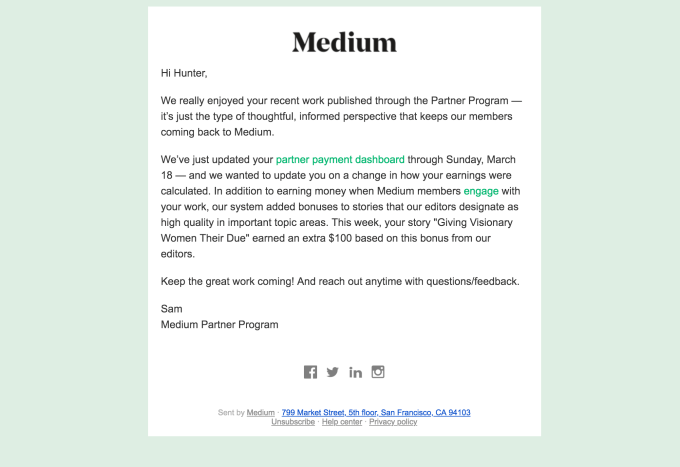
The update was first noticed by Hunter Walk, who tweeted about the change after receiving a cash bonus of $100 for his Medium story, “Giving Visionary Women Their Due.”

In an email sent to him by Medium, the company said it wanted to offer an update on how his earnings were calculated.

“In addition to earning money when Medium members engage with your work, our system added bonuses to stories that our editors designate as high quality in important topic areas,” the email read.

Until now, Medium rewarded partners based on engagement with the story from each individual subscriber. The $5 per month subscription fee is distributed to each partner who had a story or stories the individual subscriber read during the month.

It’s worth noting the stark contrast between this model and traditional social media, where publishers are rewarded on clicks and shares – something which encourages clickbait and sensational posts. Not only was Medium already rewarding time spent reading – typically, one of the ways to measure content quality – it’s now directly seeding its network by paying for the kind of work it wants to see.

Quality is something Medium has been thinking a lot about, which is why it introduced the subscription model. Without advertising, there’s less of a commercial incentive to publish and spread misinformation, Medium CEO Ev Williams (pictured above) had previously said.

While originally open only to publishers, Medium last fall expanded the partner program to any author on its platform. That means, anyone would be eligible to receive these cash rewards. Payments are deposited into partners’ bank account monthly, and can be tracked on the Partner Dashboard.

Reached for comment (as there had been no formal announcement), Meidum confirmed this is the first week the cash bonuses have been added to its partner payouts.

The subject matter Medium is looking for will vary, we’re told, but will include “deep, insightful, expert stories” that the company believes its members will enjoy. (A sample selection is here.)

To determine which stories receive a bonus, Medium curators will read all content published for members, then mark those they believe to be high-quality in an important topic area in order to reward the author.

The bonus level is currently set at $100, but that could change in the future.

“Medium Editor’s bonuses are part of our continuing effort to build a system that pays writers based on value to readers, not click value to advertisers,” a Medium spokesperson told TechCrunch. “We’re focused on quality, and on building the best subscription-based platform for reading and writing, where people can discover unique ideas and perspectives all in one place. We want to help create a path for writers that hasn’t existed before.”

22 Mar 2018

Introducing the TechCrunch Disrupt SF ’18 Virtual Hackathon

We’ve told you that TechCrunch Disrupt San Francisco 2018 is going to be the biggest, most ambitious Disrupt ever — and we’re serious. So serious, in fact, that we’re super-sizing the Hackathon, taking it online and making it global. Now thousands of the world’s most talented developers, programmers, hackers and tech makers can participate and submit their hacks from anywhere in the world.

If you know Disrupt, you know the Hackathon. It’s where hundreds of talented tech creators enter a 24-hour frenzied sprint to develop amazing products. Products like Quick Insurance — the easiest way to purchase an insurance product for all your valuable stuff (Disrupt Berlin ’17); Alexa Shop Assist — lets you ask Alexa where to find products in a store (Disrupt SF ’17) and reVIVE — a VR solution that provides both a diagnostic and treatment mechanism for ADHD (Disrupt NY ’17) — all previous Hackathon winners.

Now imagine the possibilities when thousands of highly motivated coders, hackers and programmers around the world focus their talents in a global Hackathon. “Epic” doesn’t even begin to describe it.

As you can imagine, an event this size requires substantially more time than 24-hours. More details will be unveiled in the coming weeks, but here’s the basic gist of how it’s all going to work. But before you read any further, be sure to sign up for any virtual Hackathon updates so you won’t miss a thing.

We’re going to ask you to show us how you’d creatively produce and apply technology to solve various challenges. A panel of judges will review all eligible submitted hacks and rate them on a scale of 1-5. The members of every team that scores a three or higher will receive Innovator Passes to TechCrunch Disrupt SF 2018.

The 30 highest-scoring teams make it to the semi-finals, where they get to demo their hack at Disrupt SF. From there, we’ll choose 10 of those teams to pitch their hack on The Next Stage in front of thousands of Disrupt SF attendees. One of those 10 teams will win the $10,000 grand prize and be the first-ever TechCrunch Disrupt Virtual Hackathon champ.

While this Hackathon is virtual, the sponsored prizes are very real — and plentiful. Be sure to sign up for updates and announcements. You’ll get the details as they become available, and we’ll let you know when you can register to participate. Hope to “see” you there!

22 Mar 2018

Bird adds a former Lyft VP of Government Relations as chief legal officer

Bird has made another key hire as it looks to spread its electric scooter rental business across the nation.

The company has brought on former Lyft vice president of government relations, David Estrada, to be its chief legal officer.

He’s going to take over the company’s compliance and government relations efforts just as Bird seems poised for a big, nationwide rollout following its huge $100 million raise.

Estrada will be facing similar challenges to the ones he had to deal with at Lyft as he helped grow the nation’s second largest ride-hailing service.

Bird has some unique hurdles to overcome — including pushback from local businesses that find the scooters to be more nuisance than last-mile transportation savior; local governments worried about both the traffic and safety risks that scooters may pose on streets and sidewalks; and competition from other services like LimeBike, which has rolled out a scooter service of its own.

Estrada most recently served as the chief legal officer and head of public policy for the electric aircraft company, Kitty Hawk. He served as the CLO at Lyft from 2014 to 2015 and had also worked as the legal director for Google X, working with states on legislation around autonomous vehicles, Google Glass and drone delivery.

David Estrada

22 Mar 2018

Ben is a chatbot that lets you learn about and buy Bitcoin

It’s generally a given that whenever a new technology takes off people rush into the space to build everything under the sun, and eventually natural selection kicks in and only the truly useful remain. For example, chatbots became trendy last year and we quickly began seeing chatbots for weather, movie recommendations, personal finance, etc. Some of these are useful, but until natural language processing improves you’re probably better just doing the task yourself.

But there are a few exceptions, with one in particular being chatbots designed for the purpose of making a very complex topic or task approachable to the average person.

Like cryptocurrencies.

Ben is a chatbot that lets anyone become familiar with cryptocurrencies via a recognizable chat interface. By talking with “Ben”, users can do things like take lessons and learn about cryptocurrency, read the latest industry news, and of course buy and sell Bitcoin.

By focusing on an underserved market (i.e people who have no idea what Bitcoin is or how to buy it) Ben has the unique advantage of not having to go head to head with established crypto titans like Coinbase or Circle.

The startup is part of Y Combinator’s Winter ’18 batch, and previously raised a $580K pre-seed from Third Kind Venture Capital and various angel investors.

After completing a KYC check (which is also done via chat) users in 21 states can buy and sell Bitcoin, with other states and support for Ethereum, Ripple, and Bitcoin Cash rolling out in the coming months. The startup charges 1% for buys and sells, which is in line or lower than most major exchanges.

The app also has a social feature where you can link with friends to see their returns (only on a percentage basis) to see who is a better investor.

User’s cryptocurrency is stored in the cloud but their private keys live only on their own personal device, which isn’t as secure as complete cold storage but does ensure that your bitcoin can’t be spent without someone having access to your phone. Ben also gives new users a backup seed to write down in case they lose their phone.

But Ben isn’t necessarily meant to support an experienced crypto user who has a high-value portfolio and needs advanced features and security.

Instead, the startup’s goal is to make buying and learning about cryptocurrency accessible to anyone, especially those without the technical knowledge or desire to spend the time learning how an exchange world. And as natural language technology evolves Ben will be able to answer more and more questions over time, making it a perfect on-ramp for people who need a little more hand holding before they open their wallet and trade their (actual) benjamins for a string of ones and zeros.

22 Mar 2018

Meet the startups that pitched at EF’s 9th Demo Day in London

Entrepreneur First (EF), the company builder and “talent first” investor, held its ninth London Demo Day this afternoon. Once again, the pitches took place in front of a packed crowd at King’s Place in London’s King Cross area, seeing 19 startups pitch their wares to investors, press and other actors in the European tech scene.

EF stands out from the plethora of demo days that the U.K. capital city hosts because of the way the investor backs individuals “pre-team, pre-idea” — meaning that the companies pitching only came into existence over the last 6 months and perhaps may never have done so without the founders entering the programme.

As is now a tradition, prior to the pitches, EF co-founder Matt Clifford took the chance to announce some EF news of its own. Already operating in London, Singapore and Berlin, the company builder — which last year picked up backing in a $12.4 million round led by Silicon Valley’s Greylock Partners — is expanding to Hong Kong to double down on its Asia ambitions, kicking off with a local programme in July. Heading up EF’s Hong Kong office is former Airbnb and Google exec Lavina Tien — you can read my full report here.

The themes for EF’s ninth London Demo Day continued to reflect the company builder’s focus on recruiting the best technical and domain expert talent — both recent graduates and also people already working at tech companies — where they are encouraged to try their hand at entrepreneurship. The pitches spanned AI/machine learning, automation, healthtech, legal tech, financial services, new interfaces and input devices. And, being that this is 2018, the blockchain and cryptocurrency, although, thankfully, there wasn’t an ICO in sight.

Low on sleep and therefore particularly prone to pitch-lash, my picks this time around were Limbic, which wants to bring emotional intelligence to software (and therefore hardware) by measuring changes to a part of your brain called the ‘limbic system’ via your heartbeat; nPlan, which wants to use machine learning to enable major construction work schedules to be more accurate and run on or ahead of time; and Inoviv, which is developing technology based on unique insights into proteomics to help match patients with the right drugs.

The full list of presenting teams (in their own words)

Papercup translates the voice track on videos so every creator can expand their reach to seven billion people.
CreditMint is decentralising corporate lending.
nPlan accelerates the global construction industry.
Nivoda aggregates the world’s diamonds.
Headlight AI provides intelligent sensing and mapping software for harsh environments.
Octeract solves today’s unsolvable optimization problems.
Beneficiary maps the impact of the world’s philanthropic efforts and helps charities identify the most effective ways to improve lives.
Ginie AI turns term sheets into contracts.
Prime Factor Capital is a crypto asset manager.
Panopy is a performance management platform that removes workplace bias.
Mimica builds self-learning automations for digital work.
Inoviv matches patients with the right drugs.
PolyAI is democratising conversational AI to give machines a voice.
Plural AI is building a new kind of search engine: a knowledge engine.
ArrayStream Technologies helps fund providers launch next generation AI-powered mutual funds.
Limbic provides computers with vital emotional input.
Plumerai is making small machines intelligent.
TokenAnalyst is bringing transparency to the decentralized economy.
Massless is the future of three-dimensional immersive design.

22 Mar 2018

Why achieving diversity in tech requires firing the industry’s ‘cultural fit’ mentality

If you have interviewed for a technology job, there’s a good chance the words “culture” and “fit” made an appearance during the phone-screen phase, or in early rounds of interviews. It is no longer enough for a candidate — especially early to mid-career — to arrive to job interviews with a stellar resume and relevant technical skills. They might also have to come with their best “I’m normal and will fit into the overall team culture of this company” outfit on.

Over the past decade, the idea of hiring for “cultural fit” has become as important as, and at times superseded, hiring to fit a job description across forward-looking industries, from tech to transportation. The nuance of this shift may be a cause for concern — especially for a global tech sector in search of a clear route to workforce diversity.

Many of today’s tech human resources teams are tasked with recruiting a diverse group of people and retaining star employees. However, they still tend to supplement those pursuits with cultivating a unified office culture. While the industry has largely moved on from using ping pong tables as a recruiting tool, hiring people who pass the Beer Test — an applicant that hiring managers could work with in the office and hang with at happy hour — remains commonplace.

Further, hiring based on a hiring manager’s own narrow set of requirements needed to fit their idea of a relatable person opens the door to all sorts of unconscious biases. Taking this recruiting shortcut also raises the bar for candidates from already under-represented groups, including minorities and women. The main casualties: the pursuit of diversity and business bottom lines.

Separation of work and play

It is true that research-backed conventional wisdom suggests happy workplaces are productive workplaces. What that line of thinking doesn’t account for is the fact that exclusively hiring talent for interpersonal compatibility can negatively impact the quality of work and focus of employees. In other words, employee camaraderie does not equal workplace compatibility. It definitely does not equal workforce diversity. And while a company may benefit from a general aspect of like-mindedness, there’s a great chance that the actual work is suffering due to the lack of diversity — both in people and ideas.

Here in Toronto, hiring managers still focus heavily on likeability, which at times can be seen as more important than technical skills. My team and I recently began to see to potential impacts of “cultural fit” as we started to dive into the findings of our new report on the state of talent in Toronto’s emerging tech sector.

So, how did we get here? While academic and real-world evidence is piling up supporting the claim that diverse teams outperform homogeneous ones, some hiring managers may be taking mental shortcuts when considering candidates for open posts. These interviewers are interpreting personnel alignment with the company’s needs to mean sharp alignment with their own personalities; and there are real opportunity costs to this assumption.

People from different ethnic and cultural backgrounds bring new ideas to the table. In the fast-paced world of tech, they can deliver fresh thinking that helps companies locate, prioritize and capitalize on new market opportunities. Hiring people from different backgrounds and disciplines to tackle startup and product scaling challenges also helps tech-focused ventures in export-focused countries like Canada stand out from competitors.

Moving away from one culture fits all mentality

Research conducted at Northwestern University’s Kellogg School of Management suggests diversity boosts creative debate that prevents teams from falling into the groupthink trap and leads to more explored, informed decisions. Equally as important, a diverse workforce can quickly flag when a company does something culturally insensitive — and, honestly, prevent the company from nearing those situations entirely. Why do you think H&M appointed a global diversity manager to drive inclusivity in its workforce following its recent monkey-hoodie debacle? While some may see the move as too little and/or too late, hiring a diverse workforce can contribute significantly to a company’s growth and scale, maintaining a company’s social conscience and, more importantly, demanding accountability from the organization.

The pursuit of diversity in tech is not all doom and gloom. There are some technology companies beginning to emerge from the syndrome of overemphasizing cultural fit. Facebook has banned the term ”cultural fit” from the company’s interview process entirely. Shopify, a growing e-commerce company, openly talks about the company’s efforts to incorporate diversity into hiring practices and ongoing career development within the organization.

Here in Canada, artificial intelligence-oriented companies like Plum and Knockri develop talent recruitment products that screen job applicants objectively. These platforms are built without the often bias-heavy elements of gender, culture and ethnic background entering the picture until final stages of interviewing. Their ultimate goal: to boost representation of minorities, women and people from diverse backgrounds on interview shortlists for tech jobs and in workforces fueling the global economy.

After all, the best person for a tech job may be the candidate who stands the farthest out from a tech company’s crowd.