22 Mar 2018

MIT’s new device can pull water from desert air

When it comes to Star Wars Universe-style tech breakthroughs, lightsabers, holograms and hyperdrive get all the love. But spare a thought, if you will, for the poor moisture farmers of Tatooine. Granted *spoiler* it didn’t end to well for Aunt Beru and Uncle Owen, but the idea of pulling water from the desert air was always a compelling one.

A team at MIT is showing off a new device it’s been field testing in Tempe, Arizona that it says is capable of doing precisely that. The solar-powered system utilizes metal-organic frameworks (MOFs) that are able to pull water out of extremely dry desert air as low as 10-percent humidity — an impressive feat, given that most similar technologies require more than 50-percent. 

The system, which the school is regarding as a proof-of-concept, was positioned on a Arizona State University roof. It’s still early stages, and the water only measured in the millimeters. But what was collected was devoid of impurities, and served as a promising start.

“There’s nothing from the MOF that leaches into the water,” the paper’s senior author, Evelyn Wang, said in a release announcing the research. “It shows the material is indeed very stable, and we can get high-quality water.”

The device has no moving parts, and can be set and forgotten about for some time, while it goes to work. The key to producing legitimately useful quantities of water, however, is going to be a matter of a fairly massive scale. 

22 Mar 2018

IBM can’t stop milking the Watson brand

More than seven years after IBM Watson beat a couple of human Jeopardy champions, the company has continued to make hay with the brand. Watson, at its core, is simply an artificial intelligence engine and while that’s not trivial by any means, neither is it the personified intelligence that their TV commercials would have the less technically savvy believe.

These commercials contribute to this unrealistic idea that humans can talk to machines in this natural fashion. You’ve probably seen some. They show this symbol talking to humans in a robotic voice explaining its capabilities. Some of the humans include Bob Dylan, Serena Williams and Stephen King.

In spite of devices like Alexa and Google Home, we certainly don’t have machines giving us detailed explanations, at least not yet.

IBM would probably be better served aiming its commercials at the enterprises it sells to, rather than the general public, who may be impressed by a talking box having a conversation with a star. However, those of us who have at least some understanding of the capabilities of such tech, and those who buy it, don’t need such bells and whistles. We need much more practical applications. While chatting with Serena Williams about competitiveness may be entertaining, it isn’t really driving home the actual value proposition of this tech for business.

The trouble with using Watson as a catch-all phrase is that it reduces the authenticity of the core technology behind it. It’s not as though IBM is alone in trying to personify its AI though. We’ve seen the same thing from Salesforce with Einstein, Microsoft with Cortana and Adobe with Sensei. It seems that these large companies can’t deliver artificial intelligence without hiding it behind a brand.

The thing is this though, this is not a consumer device like the Amazon Echo or Google Home. It’s a set of technologies like deep learning, computer vision and natural language processing, but that’s hard to sell, so these companies try to put a brand on it like it’s a single entity.

Just this week, at the IBM Think Conference in Las Vegas, we saw a slew of announcements from IBM that took on the Watson brand. That included Watson Studio, Watson Knowledge Catalog, Watson Data Kits and Watson Assistant. While they were at it, they also announced they were beefing up their partnership Apple with — you guessed it — Watson and Apple Core ML. (Do you have anything without quite so much Watson in it?)

Marketers gonna market and there is little we can do, but when you overplay your brand, you may be doing your company more harm than good. IBM has saturated the Watson brand, and might not be reaching the intended audience as a result.

22 Mar 2018

Cambridge Analytica’s Nix recalled by fake news probe

Stock up on the popcorn — the currently suspended CEO of the firm at the center of a data handling storm currently embroiling Facebook, Cambridge Analytica, has been recalled by a UK parliamentary committee that’s running a probe into the impact of fake news because it’s unhappy with the quality of his prior answers.

The committee also says it has fresh questions for Alexander Nix in light of revelations that hit the headlines at the weekend about how a researcher’s app was used to gather personal information on about 270,000 Facebookers and 50 million of their friends, back in 2015 — data that was passed to CA in violation of Facebook’s policies.

Nix gave evidence to the DCMS committee on February 27, when he claimed: “We do not work with Facebook data, and we do not have Facebook data. We do use Facebook as a platform to advertise, as do all brands and most agencies, or all agencies, I should say. We use Facebook as a means to gather data. We roll out surveys on Facebook that the public can engage with if they elect to.”

That line is one of the claims the committee says it’s keen to press him on now. In a letter to Nix, it writes: “[T]here are a number of inconsistencies in your evidence to us of 27 February, notably your denial that your company received data from the Global Science Research company [aka the firm behind the survey app used by CA to harvest data on 50M Facebook users, according to The Observer].”

“We are also interested in asking you again about your claim that you “do not work with Facebook data, and […] do not have Facebook data,” it continues, warning: “Giving false statements to a Select Committee is a very serious matter.”

The self-styled ‘not a political consultancy’ but “technology-driven marketing firm” (and sometime “campaign consultancy and communication services” company) — which Nix also described in his last evidence session as “not a data miner… a data analytics company” — had its Facebook account suspended late last week for violating Facebook’s platform policies.

The UK’s data protection watchdog, the ICO, has also applied for a warrant to gain access to CA’s offices and servers — accusing the company of failing to hand over information the regulator had requested as part of a wider investigation it’s carrying out into the use of data analytics for political purposes.

CA is also now facing several legal challenges from Facebook users angry about how their data appears to have been misused.

We reached out to the company for comment on the DCMS recall. At the time of writing it had not responded.

Below are a few choice segments from Nix’s last evidence session in from of the committee — which we expect he will be asked to revisit should he agree to make a repeat appearance…

Q698       Rebecca Pow:… Could you expand a bit more on what those surveys are, what you are asking people and how you are gathering the data? Do you keep that data on surveys carried out on Facebook or does Facebook keep it?

Alexander Nix: I cannot speak to Facebook, but as far as I am aware the process works a bit like an opinion survey. If I want to find out how many people prefer red cars or yellow cars, I can post that question on Facebook and people can agree. They can opt in to answer a survey and they give their consent and they say, “I prefer a yellow car” and then we can collect that data. That is no different to running a telephone poll or a digital poll or a mail poll or any other form of poll. It is just a platform that allows you to engage with communities.

Q699       Rebecca Pow: Are they a big part of your data-gathering service?

Alexander Nix: When we work for brands, whether it is in the UK or in the US or elsewhere, we often feel the need to probe their customers and find out what they think about particular products or services. We might use Facebook as a means to engage with the general public to gather this data.

Q700       Simon Hart: Let me ask a very quick question on the Facebook survey opt-in option that you were describing. If you are asking somebody what kind of car they prefer and they opt in, does that facilitate access to other data that may be held by Facebook, which is irrelevant to car colour, or is it only the data you collect on car colour that is relevant?Nothing else that is part of the data held by Facebook would be available to you.

Alexander Nix: You are absolutely right—no other data. As far as I am aware, Facebook does not share any of its data. It is what is known as a walled garden, which keep its data—

Q701       Simon Hart: People are not in any way accidently giving you consent to access data other than that that you specifically asked for.

Alexander Nix: That is correct. People are not giving us consent and Facebook does not have a mechanism that allows third parties such as us to access its data on its customers.

Q702       Simon Hart: Even with its customers’ consent.

Alexander Nix: Even with its customers’ consent.

Chair: You said in your letter to me that, “Cambridge Analytica does not gather” data from Facebook.

Alexander Nix: From Facebook?

Chair: Yes.

Alexander Nix: That is correct.

*

Q718       Chair: The actual quote from the letter is: “On 8 February 2018 Mr Matheson implied that Cambridge Analytica ‘gathers data from users on Facebook.’ Cambridge Analytica does not gather such data.” But from what you said you do, do you not, through the surveys?

Alexander Nix: Yes, I think I can see what has happened here. What we were trying to say in our letter is that we do not gather Facebook data from Facebook users. We can use Facebook as an instrument to go out and run large-scale surveys of the users, but we do not gather Facebook data.

Q719       Chair: By that do you mean that you do not have access to data that is owned by Facebook?

Alexander Nix: Exactly.

Q720       Chair: You acquire data from Facebook users through them engaging with surveys and other things.

Alexander Nix: Exactly right.

Q721       Chair: Is your engagement, either directly or through any associate companies you may have, just through the placing of surveys or are there other tools or games or thingsthat are on Facebook that you use to gather data from Facebook users?

Alexander Nix: No, simply through surveys.

*

Q729       Chair: In that presentation I think there is a slide on data analytics where you describe that data is sourced from multiple sources and any marketing company will know that there are companies that specialise in data analytics to analyse consumer behaviour. I think on your chart you had logos of different companies. I think Experian was one and Nielsen was one. You had Facebook on there as well. Again, just to confirm on this, is that because you are highlighting the fact that you can gather data from Facebook?

Alexander Nix: Collect data through Facebook—that is exactly right, yes.

Q730       Chair: Does any of your data comes from Global Science Research company?

Alexander Nix: GSR?

Chair: Yes.

Alexander Nix: We had a relationship with GSR. They did some research for us back in 2014. That research proved to be fruitless and so the answer is no.

Q731       Chair: They have not supplied you with data or information?

Alexander Nix: No.

Q732       Chair: Your datasets are not based with information you have received from them?

Alexander Nix: No.

Chair: At all?

Alexander Nix: At all.

22 Mar 2018

Gwynnie Bee is bringing subscription clothing rental to traditional retailers with launch of ‘CaaStle’

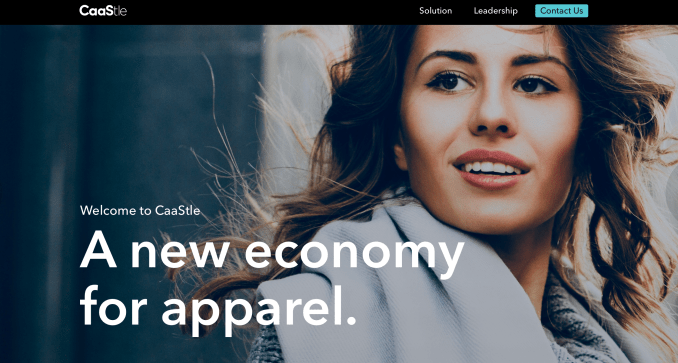
Gwynnie Bee, a subscription service offering women an “unlimited closet” of clothing for rent, believes its model is one that can be expanded to traditional retailers, too. And today, it’s officially taking the wraps off a new technology platform which will allow retailers to offer a subscription clothing rental business alongside their existing channels. The platform is cleverly dubbed “CaaStle” – the name referencing “Clothing as a Service” (itself a play on subscription-as-a-service, or SaaS). It offers retailers a turnkey solution where all aspects of the subscription business – including the website, the databases, the logistics, the cleaning, returns, packing, shipping, and more – are handled.

CaaStle is actually something founder and CEO Christine Hunsicker had envisioned from the beginning, she says.

“When we first started the company, this was the goal – build the platform and the technology that would power a new economy for retail,” Hunsicker says. “From day one, we were building this, but we had to prove the model would work. We also had to have a way to prove that we could do it right – that we could ship boxes and process inventory – so we brought up Gwynnie Bee as our first service on top of CaaStle,” she explains.

Founded in 2011, Gwynnie Bee is a clothing rental service that originally served the plus-sized women’s clothing market, but expanded at the end of January 2018 to include sizes 0 through 8, as well. (It does so in a different way than most, however – it only adds the smaller sizes for items that are available from 0 through 24, as a means of encouraging brands to make more plus-sized apparel.)

The company plays in a larger market of clothing rental businesses, several of which are on the upswing. Rent the Runway, for example, just raised $20 million from Alibaba’s Jack Ma and Joe Tsai; Le Tote just became the first U.S. subscription service to enter China.

Gwynnie Bee doesn’t share its subscriber numbers or other metrics publicly, but says it’s doing better in terms of that ideal 3:1 ratio for SaaS companies – the Customer Lifetime Value to Customer Acquisition Ratio, that is – which is a crucial measure of a successful subscription business.

Above: CaaStle homepage

With CaaStle, retailers simply send Gwynnie Bee their inventory, and the rest is handled.

Gwynnie Bee builds the front-end site under the retailer’s name. It handle all the logistics – the processing of returns, the cleaning, the inspecting, the restocking, the pick-pack-ship – all out of its own multi-tenant warehouses in Columbus and Phoenix.

The retailers pay Gwynnie Bee on a per customer basis when they use CaaStle, which can be customized for their specific goals.

There are basic, premium and enterprise tiers available, with optional add-ons that offer things like fit and size recommendations, personalization technology, algorithms that price the clothes the customer wants to keep, and more. CaaStle collects the customers’ credit card transactions, so it pays out to the retailer, based on their package.

In some cases, the retailers are looking to acquire new customers. Other times, they may want current customers to spend more money. Or they may be looking for inventory monetization.

On that latter front, the retailer could use CaaStle as an alternative to moving excess inventory to an outlet, for example. Or if they’re looking for new customers, they’ll put their best clothing on subscription instead.

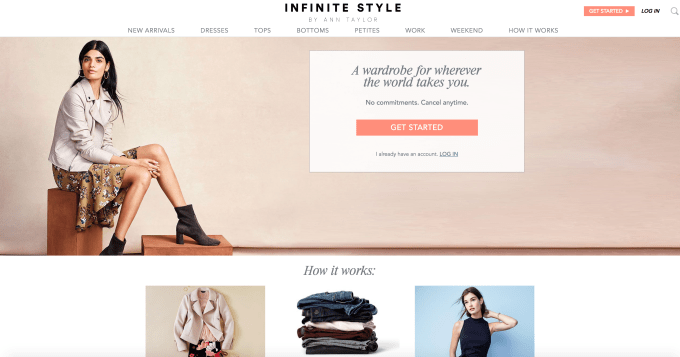
Above: Ann Taylor’s clothing subscription business, Infinite Style, powered by CaaStle

“But the best stuff is not the top sellers,” Hunsicker points out. “I think this is probably one of the most interesting pieces of this model – what sells well tends to not rent well, because what sells well are the basics, the staple items…what rents well is all of the fashion,” she says. “What people actually want to rent is an amazing complement to traditional retail, which is why we’re so excited about it.”

That is, people often rent the trendy, fashionable items they didn’t want to buy because they knew they wouldn’t wear it more than a couple of times.

CaaStle has already been quietly powering the subscription clothing rental businesses from Ann Taylor (Infinite Style) and New York & Company (NY&C Closet) since last year – well ahead of this week’s public unveiling during a keynote at the Shoptalk conference.

While Hunsicker can’t share their specific metrics, she could speak to the three businesses – including Gwynnie Bee – in aggregate.

Above: CEO Christine Hunsicker

“What we’ve seen is a really large increase in new customers – a substantial portion of the people signing up for the services are new-to-file. We’ve also seen a meaningful share of wallet increase, and a really good operating profit,” she notes. “If you look across all three tenants…we’re seeing a 50-plus percent new-to-file, a 60 percent share-of-wallet increase, and 25 to 45 percent operating margin on the business.”

The company has several more retailers coming on board in 2018, including expansions beyond women’s apparel.

Gwynnie Bee itself has operated fairly quietly, too, despite raising over $100 million in outside capital. Its investors include only a little bit of traditional VC, along with individual investors from retail and finance, as well as specific VCs investing independently. The company is not in need of raising again soon, because CaaStle is a less cash-intensive business than Gwynnie Bee, the founder notes.

“We’re super well-funded and have a bunch of cash in the bank. We’ll figure out if we want to do a big expansion round in the next year, but no specific plans,” says Hunsicker.

CaaStle is open to any retailer today who wants to reach out through its website.

22 Mar 2018

Trump announces $60 billion tariff on Chinese high-tech and other goods

Following months of investigations by the U.S. Trade Representative Robert Lighthizer, the Trump administration announced today at a White House briefing that the administration intends to place about $60 billion of tariffs on Chinese goods, with the bulk of them likely to be focused on the high-tech industry. The White House will announce a final list of goods subject to the tariffs in the next few weeks.

“We’ve lost over a fairly short period of time, 60,000 factories in our country. Closed, shuttered, gone. 6 million jobs at least, gone. And now they are starting to come back,” President Trump said during the briefing. “The word that I want to use is reciprocal – when they charge 25% for a car to go in, and we charge 2% for their car to come into the United States, that’s not good. That’s how China rebuilt itself.”

Vice President Mike Pence was even more blunt, saying that “the era of economic surrender is over.”

The final size of the tariffs was higher than numbers circulated this morning by the New York Times and Bloomberg, which had indicated about $50 billion in tariffs. Previously circulated numbers ranged from a low of $30 billion to a high of $100 billion, so the number that the White House seems to have settled on is in the middle of the hypothetical range.

The United States is a major importer of goods from China, hitting an all-time high trade deficit of $375.2 billion in 2017. Tariffs on electronics and other high-tech goods portends both potentially higher prices for consumers as well as assemblers, and would also likely encourage at least some Silicon Valley tech companies to move their manufacturing and assembly work out of China to other countries and possibly even on-shored back to the U.S.

In addition to the tariffs, the White House announced that the Treasury Department will put in place restrictions on Chinese investment in tech companies based in the United States. There are not comprehensive details at time of publishing on exactly what those restrictions are, but we will report them when we have more information.

Visa restrictions, which had been floated as another tactic to fight China, were not included in the announcements so far, but more action is possible by the White House.

22 Mar 2018

Alphabet’s Outline lets you build your own VPN

Alphabet’s cybersecurity division Jigsaw released an interesting new project called Outline. If I simplify things quite a lot, it lets anyone create and run a VPN server on DigitalOcean, and then grant your team access to this server.

I played a bit with Outline and it’s an interesting product. There are two components, a managing app and a client. Let’s start with the manager.

Right now, the manager is available on Windows and Linux, with a macOS version coming soon. It’s an Electron app so it feels like using a web app. By default, Outline recommends that you use DigitalOcean, a well-known cloud hosting provider.

You can also create your VPN server on another server, but that’s not really the point of Outline. Outline is all about making it as easy as possible to run your own server. Otherwise you’d already be using Algo VPN or Streisand.

If you choose DigitalOcean, the app opens a web view and asks you to enter your login, password and one-time password. After that, you need to let Outline use the DigitalOcean API. And that’s all you need to do during the initial setup process.

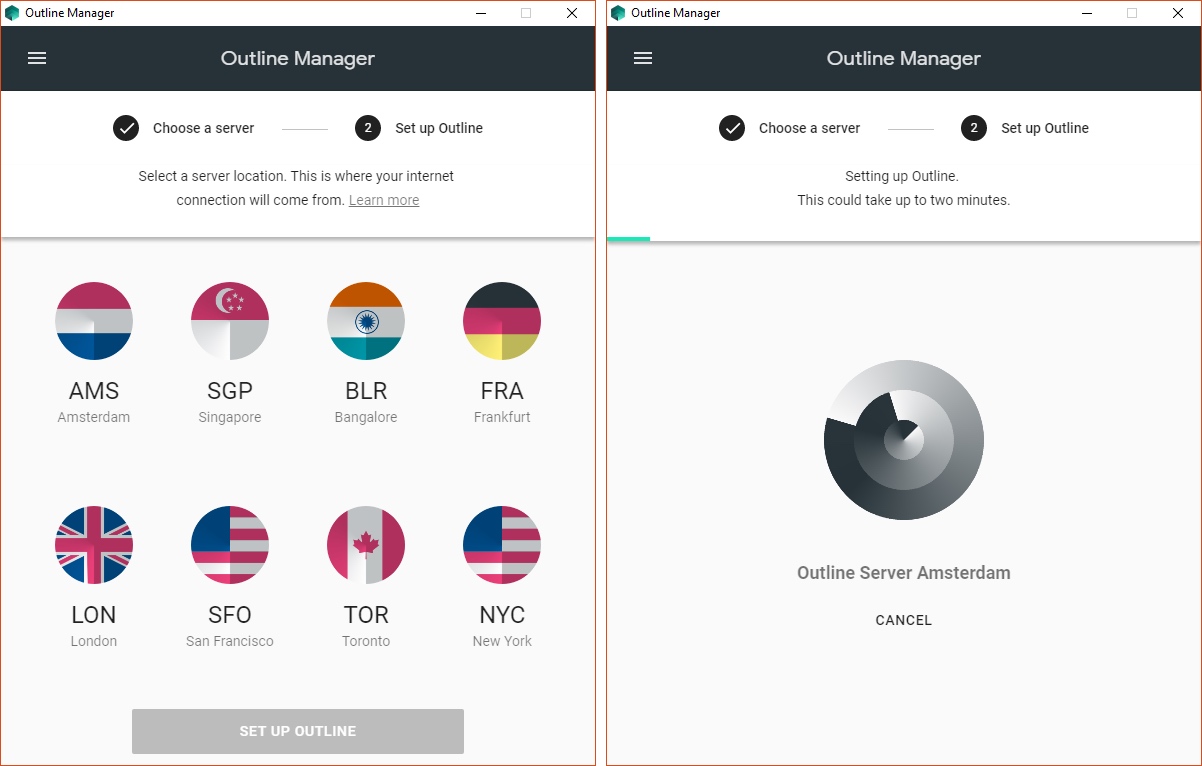
Now let’s create a VPN server. Outline automatically chooses the cheapest droplet on DigitalOcean, which costs $5 per month for 1TB of transfer data (somehow, Outline says you get 500GB). DigitalOcean currently has data centers in 8 different cities — Amsterdam, Singapore, Bangalore, Frankfurt, London, San Francisco, Toronto and New York.

After selecting a city, the managing app automatically downloads a Docker image and creates a server on DigitalOcean based on this Docker image. Software on the server will be automatically updated every hour. Your DigitalOcean server will also automatically perform security updates for the operating system and reboot the server if necessary.
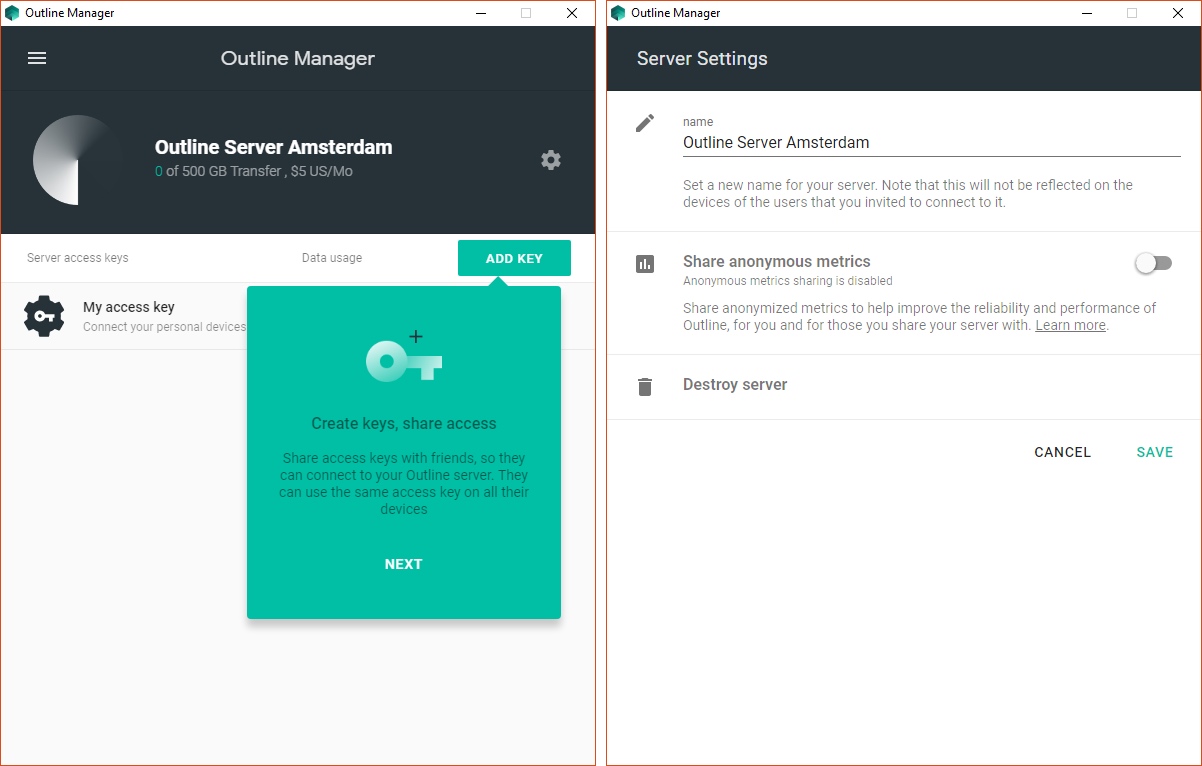
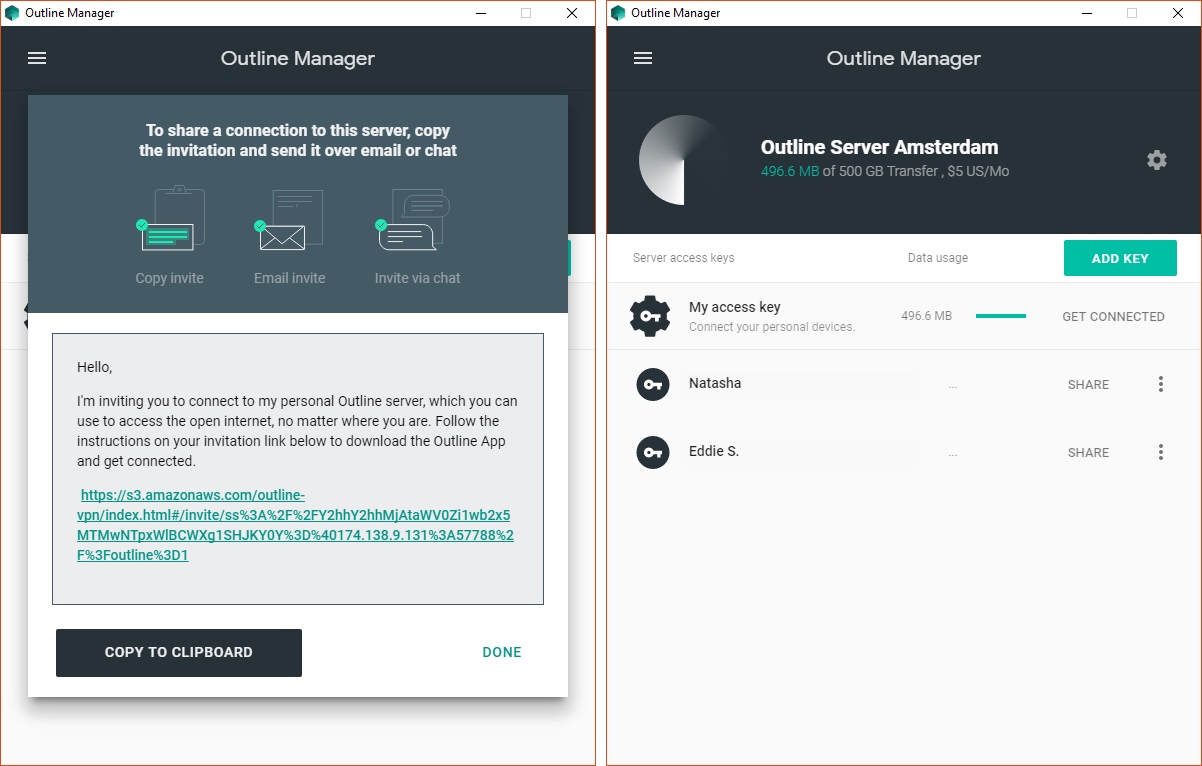
Now let’s go back to the computer you’re currently using. You can now control your VPN server from the managing app. By default, Outline only generates one key for you. But you can add more users and invite your coworkers to use your server.

You can use the managing app to create more servers, delete a server or delete users if they don’t need access to your server anymore. The app also tells you how much bandwidth each user has used.

The invite page is just a static webpage hosted on Amazon S3 with two things. First, the page invites you to download the Outline client on your phone or computer. Second, the key is in the URL. Your browser displays the key when you load the page.

That’s why you shouldn’t invite your friends using an unencrypted method — don’t use Facebook, don’t use emails. Remember that the key will also be stored in your browser history.

But connecting to the VPN server is as easy as installing an app and clicking on an invitation link. It’s a great experience for non-tech-savvy users.

Let’s talk about the client for a minute. The app that you use to connect to the VPN server is currently available on Windows, Android and Chrome OS. Jigsaw is working on macOS and iOS clients. It features a single screen that lets you connect and disconnect from a server — quite straightforward.

Outline isn’t a VPN

Under the hood, Outline relies on the Shadowsocks protocol. And if you’re familiar with VPN protocols, Shadowsocks is nothing like OpenVPN, IPSec or WireGuard. In fact, Shadowsocks isn’t a VPN protocol at all.

Shadowsocks is an open-source project to create an encrypted socks5 proxy to redirect internet traffic. This is a bit technical, but a VPN is like an encrypted tunnel between your device and a server. All your network traffic goes through this tunnel and the VPN server (not your phone or computer) is the device talking to the internet.

It’s great because you know for sure that your ISP and other users on your WiFi network can’t look at your traffic (except if there are DNS leaks). You can also pretend you’re in another country.

But it’s also awful because anybody who has access to your VPN server can see your internet traffic. That’s why you should never rely on a VPN company, even if they promise that they respect your privacy. They’ll analyze your browsing habits, sell them to advertisers, inject their own ads on non-secure pages or steal your identity. And you can’t know for sure if you can trust them.

Traditional VPN protocols can also be blocked because they use specific ports and they look like VPN traffic if authorities and ISPs use deep packet inspection. That’s why countries can block VPNs altogether.

And yet, a socks5 proxy looks like normal internet traffic. Shadowsocks is taking advantage of that and combining the advantage of a proxy with traffic encryption. It’s supposed to work great in China for instance.

But you can’t guarantee that all internet traffic goes through a proxy server — it depends on each app. A proxy adds a level of granularity that can be convenient but also a security issue. For instance, the Outline client doesn’t redirect all your Windows traffic to the Outline server right now.

So Outline can be the perfect tool if you want to access censored websites with your web browser. But you won’t disappear from the network with an Outline connection.
Trusting Google

It’s hard to forget that Outline is a Jigsaw project. People working on this project are paid by Alphabet, Google’s parent company. In other words, it’s hard to trust a Google project when it comes to privacy.

But Jigsaw really wants you to trust them with this one. Outline is an open-source project. This way, experts can have a look at the code to see if there’s anything shady. The service has also been audited by a third-party security firm.

Jigsaw collects crash logs with non-identifiable data. They also collects all server IPs but can’t access those servers — I’m not sure why Jigsaw wants to see all IPs. You can also opt in to share more usage data.

Your Outline servers don’t keep any log of your internet traffic. So even if the NSA has a warrant to access an Outline server, it’ll only find out how much bandwidth each user has used with this server. But there’s no way to connect the dots and find out who’s behind this Outline server.

The biggest risk might be DigitalOcean. You have to enter your name, email and credit card to create a DigitalOcean account. Authorities could just ask DigitalOcean to find out who’s paying for your Outline server and get back to you.

Security vs. accessibility

Outline isn’t the most secure (sort of) VPN out there. It’s always better to build your own hardware server, connect it to the internet using a connection that you don’t pay under your own name and installing VPN software yourself.

But nobody is going to do that.

Privacy is always a balance between security and accessibility. The most secure tools out there are also the most difficult tools to use.

Many projects are now trying to make security more accessible. And it’s a breath of fresh air. Algo VPN lets you build your own IPSec VPN server with just a few command lines. Streisand also lets you build a server with all sorts of protocols with little technical knowledge.

These are great projects and I would recommend looking at them if you want to build your own VPN. But Outline goes one step further. You don’t need to type a single command line to create a Shadowsocks server.

Jigsaw says it’s the perfect tool for news organizations. And it’s true that most journalists know how to install an app. It’s not as scary as adding a VPN certificate. I would say it’s a great way to access censored websites if you live in China or another country with restrictions, even if you’re not a journalist.

You have to evaluate your level of risk and choose the technical solution that is right for you. If you’re not doing anything illegal and you just want to access blocked website, you can make some concessions.

And there’s one thing for sure, Outline is much better than any free or commercial VPN service out there.
22 Mar 2018

Discounted tix to Disrupt SF ’18 for students, nonprofits, government & military

TechCrunch Disrupt ranks as the premier event in the startup landscape, and our flagship event, Disrupt San Francisco 2018, which takes place September 5-7, will be our biggest and best Disrupt ever. If you haven’t heard, we’re moving to the Moscone Center West, tripling the floor space and featuring four stages of unique programming — and that’s just for starters. Of course, we want to make Disrupt SF ’18 as financially accessible as possible, which is why we’re offering students, nonprofit organizations, government employees and active military personnel steep discounts on Innovator passes.

An Innovator pass will keep you plenty busy for all three days of DSF ’18. You’ll be able to check out what’s happening on all four stages: the Main Stage, the Next Stage, Q&A Sessions and the Showcase Stage. The pass also grants you access to Startup Alley, the very heartbeat of Disrupt, where hundreds of early-stage startups showcase their cutting-edge tech to attendees, investors and the media.

Of course, there’s tons more, including Startup Battlefield, where you’ll see some of the world’s most exciting tech startups pitch in front of a panel of judges and vie for an equity-free cash prize. Who knows? You might even witness the birth of a new tech powerhouse.

You can participate in interactive workshops, use the Disrupt Mobile App to contact other attendees (we’re talking the full list, people) and you’ll get to relax and have fun at the TechCrunch After Party.

That’s a lot to digest in just three short days, so if you missed anything, don’t worry. Your Innovator pass gives you access to our library of event video content post-Disrupt.

We also realize that visiting the City by the Bay ain’t cheap, which is why the Innovator pass also includes access to discounted hotel rooms. As Kojak said, who loves ya, baby?

So, let’s get down to it. How much do these discounted tickets cost and how do they work?

Students currently enrolled in a college or university program can purchase an Innovator Pass for $295 (right now that’s a $700 savings). Note that you must present a valid student ID, proof of current enrollment or transcripts when you check in at Disrupt SF ’18 registration — otherwise, you’ll pay the full on-site pass price ($1,995).

Also, if you’re under 21 years old, you may not be able to access certain venues, like the After Party. Sorry kids, them’s the rules.

If you work for a nonprofit organization, you can buy an Innovator Pass for $495 (a savings of $500). You must provide your employee email address during the online registration process. When you check in at the Disrupt SF ’18 registration desk, you must provide proof of your organization’s 501(c) 3 designation — otherwise, you’ll pay the full on-site pass price ($1,995).

If you’re currently employed full-time by a federal, state or local government agency, if you’re an active military employee or you work for an international government agency, you can buy an Innovator Pass for $495 (a savings of $500). You must provide your valid .gov email address during the online registration process, and when you arrive at the Disrupt SF ’18 registration check-in you must present your current, valid government identification card — otherwise, you’ll pay the full on-site pass price ($1,995).

Bear in mind that you can’t combine any student, nonprofit, government and military discounts with any other discount offers, and this only applies for an Innovator Pass.

Disrupt San Francisco 2018 takes place September 5-7. Word to the wise — don’t dilly-dally around folks. The number of discounted tickets is limited. Go score your cheap tickets now, while you still can.

22 Mar 2018

Airbnb hosts can kick you out after you’ve checked in

Last month, Logan Kugler checked into the home of a Los Angeles-based Airbnb host. The plan was to stay there for about one month, but Kugler found himself checking out just three days after checking in. That’s not because he wanted to, but because the host cancelled his reservation.

This story is not about any one party being right or wrong. Instead, let this serve as a reminder that we are living in an age of non-traditional services — be that via rideshare, home sharing, bike sharing and so forth. That means, as it stands now, anyone has the right to kick you out of their car, house or apartment if they feel so inclined. That’s essentially what happened with Kugler when he used Airbnb to rent a home in LA last month.

“I woke up to a message on my phone that said Airbnb had changed my reservation and that it ended in 36 hours and I was to leave,” Kugler told TechCrunch. “This was a 31-day rental.”

The host asked Kugler to leave because she felt uncomfortable with the amount of requests he was making, such as to change the layout of the refrigerator and install different lights, she told TechCrunch. That’s when she contacted Airbnb to let the company know she wasn’t going to be able to let him stay there anymore.

The host gave Kugler 48 hours’ notice to leave the premises. Kugler, however, said he wouldn’t be able to pack up and leave that soon. So he asked for a couple of extra days, which the host declined.

Meanwhile, Kugler was in contact with Airbnb over the course of a couple of days to find a new place to stay with the same nightly rate, according to messages reviewed by TechCrunch. Before Kugler was able to find a new place to stay, the time ran out on his original reservation. Because he hadn’t left yet, the host called the police to help her get him off her property. Part of her rationale for calling the police, she said, was because Airbnb wasn’t helping her to get him to leave.

“I felt uncomfortable,” she said. “I lived in the main house and I wasn’t comfortable having this man on my property.”

Kugler, after being evicted by the police, left the premises. While Airbnb did reimburse Kugler for his stay, offer him assistance in finding another Airbnb and pay for a hotel for the nights he couldn’t find an appropriate place via Airbnb, Kugler said that didn’t matter to him because he’s a pretty particular person. So particular that he spent hours looking at options before landing on this one.

“As it stands right now, if you book an Airbnb you could be homeless at any second and thrown out on the street,” he said. “If this remains, I think they may lose some customers as awareness grows about this.”

While canceling a guest’s reservation is technically acceptable behavior, according to Airbnb’s terms of service, it’s certainly rare. This means guests are at risk of being cancelled on mid-stay, but Airbnb says it is ready to work to rebook anyone to whom this happens.

“There have been over 300 million guest arrivals on Airbnb to date and negative experiences are extremely rare,” Airbnb spokesperson Nick Papas told TechCrunch. “We have re-booked our guest and followed up with our host regarding this reservation. We work hard to make sure every guest has a great experience and want to make it right when things don’t go as expected.”

What Kugler ultimately wants is for Airbnb to change its terms of service. But Airbnb, which is simply a facilitator for home rentals, said in a message to Kugler reviewed by TechCrunch that it can’t force people to make their places available no matter what.

“The listings on our platform are owned and controlled by the host themselves,” an Airbnb representative told Kugler. “Airbnb cannot force a host to further accommodate a guest if they do not want to or are not able to for whatever reason.”

Also, sometimes life happens, as Airbnb outlines in its policy on emergency situations and other unavoidable circumstances. In a help article, Airbnb says it “empowers hosts to set and manage their cancellation policies,” and that if either a host or guest needs to cancel a reservation, they are responsible for cancelling as soon as possible.

“At times, certain circumstances outside of a host or guest’s control can impact their ability to meet the terms of a reservation,” the help page states.

According to the terms of service, if a host cancels on the day of check-in or later, guests can leave a public review on the host’s listing profile. Kugler did that, which prompted a response from the host. Again, it’s not necessary to get into the details. Instead, this is meant to serve as a public service reminder that Airbnb, along with many other startups in this sharing economy, are not solely on the side of the customer.

Unlike hotels and taxis, the ethos that the customer is always right doesn’t fly in this type of economy. Airbnb, along with its peers like Uber and Lyft, are intermediaries, which means it’s in their best interest to ensure both hosts and guests are happy, and drivers and riders, respectively. In this case, however, neither the host nor the guest ended up happy.

22 Mar 2018

YouTube Red’s Karate Kid sequel ‘Cobra Kai’ drops new trailer

Cobra Kai never dies, and the resurgence of the rogue karate dojo in the upcoming YouTube Red original series reboot of The Karate Kid shows former sensei John Kreese was true to his mantra in the 1984 classic.

The series, set to air May 2 on YouTube’s paid subscription service, YouTube Red, will see Ralph Macchio and William Zabka reprise their roles as Daniel LaRusso and Johnny Lawrence, 34 years after the events of the original theatrical release. But a new trailer released this week shows both actors have scarcely lost a step, or a karate kick, even decades later, with both actors now in their 50s.

The trailer opens with a scruffy-looking Johnny passed out on the floor surrounded by beer cans, and contrasts with a clean-cut, chipper Daniel in a rather funny commercial for a car dealership bearing the LaRusso name, perfectly setting up the arcs each character’s life followed after the original film’s All Valley Karate Tournament, in which young underdog Daniel resoundingly defeated the seemingly unbeatable Johnny with a now-iconic crane kick to the face. After visiting Daniel at his dealership and experiencing an unexpected humiliation, Johnny decides to restart the notorious Cobra Kai dojo, and train a new generation of kids in its misguided mold.

The trailer is fairly violent and profanity laden, a stark departure from the decidedly more family friendly original film series. The new series is written and executive produced by Josh Heald, Jon Hurwitz, and Hayden Schlossberg, and will get its debut at the Tribeca Film Festival on April 24 before its YouTube Red release.

22 Mar 2018

Marc Raibert, Melonee Wise and more will be speaking at TC Sessions: Robotics May 11 at UC Berkeley

We’re gearing up for our big upcoming TC Sessions: Robotics event May 11 on the UC Berkeley campus, and we’ve got a lot to talk about. We’ve already announced Berkeley professors Pieter Abbeel and Robert Full, Android/Playground Global founder Andy Rubin and VCs Chrissy Meyer, Renata Quintini and Rob Coneybeer.

Here are a few more names we’re excited to tell you about.

Behind the big dog

Boston Dynamics may well be the buzziest robotics company of the last decade, courtesy of some viral videos and truly amazing machines. The MIT spin-off is best known for BigDog, the DARPA-funded robotic pack mule that captured the internet’s imagination with its ability to traverse rocky terrain and avoid being kicked over by even the most tenacious roboticist.

Marc Raibert, the company’s founder and president, will join us to talk about the company’s impressive army of ‘bots, including the bipedal Atlas, the agile Cheetah and the company’s most recent breakthrough, SpotMini, a lightweight electric robot capable of opening doors.

Raibert will be on-hand to demo one of the company’s ‘bots and discuss the creation of the company’s iconic robots.

Operating systems and agriculture

Of course, hardware is nothing without a good piece of software. Fetch Robotics CEO Melonee Wise will be sitting with Brian Gerkey and Morgan Quigley of Open Robotics to discuss their company’s work to build an open-source operating system for robotics.

We’ve also got a great panel featuring some of the biggest names the world of robotic agriculture. Dan Steere of Abundant, John Binney of Iron Ox, Sebastian Boyer of Farmwise and Willy Pell of Blue River will join us to discuss the ways in which robotics will transform the global food system.

We want to hear from your robotics company

And don’t forget, if you’ve got a robotics company, we’ll have plenty of opportunities to showcase it on our stage. If you’d like to be one of four early-stage robotics companies competing in our pitch-off, let us know here. We’re also looking for some cool robots for demos and some upcoming TechCrunch videos. If that sounds like a good fit, fill out this form here.

Early-bird tickets are on sale now. (Special 90 percent discount for students when you book here!)

If you’re interested in a sponsorship, contact us.