22 Mar 2018

Instagram will show more recent posts due to algorithm backlash

Instagram isn’t quite bringing back the chronological feed but it will show more new posts and stop suddenly bumping you to the top of the feed while you’re scrolling. “With these changes, your feed will feel more fresh, and you won’t miss the moments you care about” Instagram writes. It should be more coherent to browse the app now that you won’t get bumped to to the top of your feed and lose your place because your feed randomly refreshes, and there shouldn’t be as many disparate time stamps to juggle. Instead, you’ll be able to manually push a “New Posts” button when you want to purposefully refresh the feed.

Instagram switched from a reverse chronological feed to a relevancy-sorted feed in June 2016, leading to lots of grumbling from hardcore users. While it made sure you wouldn’t miss the most popular posts from your close friends, showing days-old posts made Instagram feel stale.

And for certain types of professional content creators and merchants, cutting their less likeable posts out of the feed — like their calls to buy their products or follow their other social accounts — was detrimental to their business. Instagram and Facebook moved to hide these posts over time because they can feel spammy. But at least since it’s just images and videos, Instagram they’re easier to scroll by if you now see more of them.

“Based on your feedback, we’re also making changes to ensure that newer posts are more likely to appear first in feed” the company writes. Instagram’s VP of product Kevin Weil’s tweet indicates Instagram really is listening to all the complaints about the algorithmic feed:

Interestingly, despite all the anger about Facebook’s Cambridge Analytica scandal and the #DeleteFacebook movement, we haven’t seen nearly as many calls to #DeleteInstagram. In fact, the #DeleteFacebook trend seems to overlook the corporate parent company that owns Instagram, WhatsApp, and Oculus. Instead it focuses on just Facebook’s app, indicating that the scandal blowback might not be as much of an existential crisis.

If anything, the shift to the algorithmic feed caused much more of an uproar that any political issue or privacy scandal. While Facebook has become a core utility by bringing your real world identity to the Internet, Instagram is the pleasureful escape from that real world. And people get a lot more angry when you mess with their behavior patterns than when you highlight some abstract threat like misused personal data.


22 Mar 2018

Internet Association wants in on the lawsuit challenging Net Neutrality repeal

The Internet Association has filed to intervene in the ongoing lawsuit against the FCC challenging the repeal of net neutrality protections.

The Internet Association is a trade association that represents some of the world’s biggest internet companies, including Google, Facebook, Amazon, Dropbox, and Netflix. The IA’s motion focuses primarily on why the IA, and the companies it represents, should be able to participate in the lawsuit.

But let’s take a step back.

In December, the FCC voted 3-2 in favor of gutting Obama Administration-era protections against data throttling and blocking by ISPs. In other words, FCC Chairman Ajit Pai, a former Verizon employee, and others at the FCC, believed that ISPs should be allowed to charge extra for a fast lane, which would stifle competition.

The order became official in February of this year, opening the door for the fight against the repeal to begin.

Between the vote and the official order, a lawsuit was filed by 22 state attorney generals, seeking to block the net neutrality repeal.

In March, the 9th Circuit consolidated these various challenges (15, in total) to the FCC’s repeal. The IA said earlier this year that it wouldn’t file a lawsuit as a plaintiff, but did plan to participate in the lawsuit.

According to the filing, the IA is focusing on three major areas: the removal of rules against blocking, throttling and paid prioritization distort competition and places the burden on consumers, the removal of well-established, bright line net neutrality rules harms internet companies’ ability to reach customers across the country, and the new rules harm future growth in the internet ecosystem as a whole.

Here’s what Internet Association President and CEO Michael Beckerman had to say in a prepared statement:

The internet industry will continue to fight for net neutrality protections that help consumers, foster innovation, and promote competition for the entire online ecosystem. The entire sector is committed to preserving an open internet and will continue to defend these protections in every venue available. This is also an issue that unites Republicans and Democrats in all 50 states.

On the other side of the coin, some industry groups that support the FCC’s repeal of Net Neutrality have also filed to intervene.

22 Mar 2018

Bell & Ross creates a transparent tourbillon

It’s spring and that means it’s time for Basel, the definitive international watch show. Around this time every year all of your favorite brands – and brands you’ve never heard of – launch unique timepieces that cost more than a few dozen Honda Accords and look like something made by Doctor Manhattan during one of his less melancholy moments.

Today’s wild timepiece comes to use from Bell & Ross, makers of big square watches that look like aircraft dials. This new piece, called the BR-X1-Skeleton-Tourbillon-Sapphire, maintains the traditional B&R shape but is almost completely clear with a case made of sapphire and held together by pins and screws. The movement, which comes in three colors, is a complete hand-wound tourbillon system and is beautifully visible from all angles.

A tourbillon, for the uninitiated, is a system for rotating the watch’s balance wheel 360 degrees. This system, originally created by Breguet, ensured that a watch didn’t slow down when subjected to odd gravitational forces. Now, however, it’s a wildly expensive conversation starter.

This is a beautiful update to B&R’s original see-through watch and, while the vast majority of us will never own something like this, it’s nice to know that someone still cares about horological complexity paired with wild design. How much does it cost to own the watch equivalent of Wonder Woman’s Invisible Jet? About $500,000. The piece, for those interested in picking one up, will be available online.

22 Mar 2018

Twitch’s extensions come to mobile

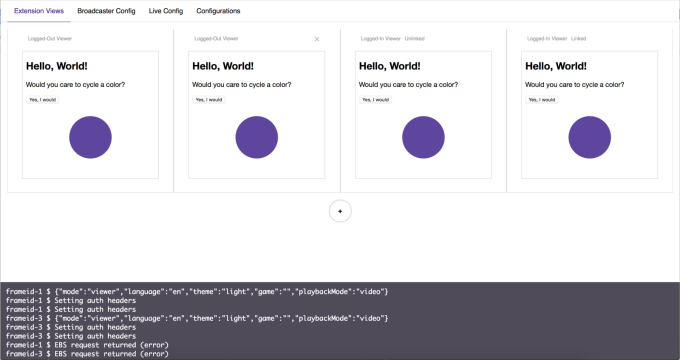
Twitch’s extensions – the tools that allows streamers to customize their channel pages with interactive experiences, including leaderboards, polls, schedules, and more – are now available on mobile. The game streaming company announced this highly requested feature at the Game Developers Conference this week, along with the launch of a web app for developers that will allow them to test extensions against production APIs across a variety of views – like the broadcaster’s live view, for example.

Extensions were first introduced to Twitch in August 2017 as a means of adding more excitement and interest to channel pages to keep fans engaged and, in some cases, to help streamers make more money. For instance, there’s an extension call “Gear on Amazon” that allow creators to point fans to their favorite products on the retailer’s website. When the viewer clicks through and purchases, the creator earns a commission.

That extension, not surprisingly, is today in the top five. The other top extensions include leaderboards from Streamlabs and Muxy, Streamlabs’ Stream Schedule and Countdown, and Twitch’s own Prime Subscription and Loot Reminder, which reminds viewers to use their free Channel Subscriptions on their pages to claim their loot.

However, not all extensions are immediately mobile -friendly, notes Twitch.

Instead, only a small handful have made the jump to mobile at this time.

This includes the all-in-one extension Streamlabs Loyalty, Music, Polls, and GamesSchedule (by LayerOne) which tells viewers when a channel is live; and World of Warcraft Armory (by Altoar), which shares World of Warcraft game and character progression with viewers.

In total, around a dozen-plus are available on mobile at this time, Twitch says.

Viewers can visit the Twitch feedback forums to request extensions’ mobile compatibility – something that’s up to the developer, not Twitch, as extensions are generally a third-party effort.

Since the launch last summer, the number of available extensions has grown to over 150, with over 2,000 developers signed up – but Twitch thinks more developers would build if the process wasn’t so difficult.

On that front, Twitch also announced a new tool for developers building extensions with the launch of its developer rig. The company said it heard from developers that it was hard to get started building extensions, and extensions were difficult to test. The developer rig is essentially a web app that lets developers test extensions locally. The rig includes the new “Hello World” sample code, with a basic backend in place, so developers can focus on building out their unique experience instead.

A thriving developer community that can help make Twitch’s experience better for streamers and fans alike is one of Twitch’s competitive advantages versus rivals like YouTube Gaming and Microsoft Mixer. Though YouTube’s streamer base has been growing, any Twitch rival has a long way to go to catch up.

The mobile-friendly extensions are available across both iOS and Android, in the Twitch mobile app, version 6.0 or higher. The developer rig is open sourced on Github.

22 Mar 2018

Huawei’s U.S. plans hit major setback as Best Buy said to stop sales

Huawei can’t catch a break in the States. Just at the company was set to announce a big carrier deal at CES, AT&T reportedly switch gears last minute. Now, a week before the company is set reveal its next big flagship at an event in Paris, Best Buy is reportedly planning to stop sales of the company’s products “over the next few weeks.”

That news comes courtesy of a report from Reuters, based on a “person with knowledge of the matter.” The Chinese smartphone maker was clearly banking on 2018 to be the year it finally expanded sales to the world’s third largest smartphone market. The AT&T deal was reportedly all but finalized ahead of the company’s big CES push.

The last minute nature of the news clearly left the company in a lurch, with consumer CEO Richard Yu going off-script to excoriate carriers and U.S. officials that have repeatedly raised concerns over the company’s perceived ties to the Chinese government.

Huawei offered a non-comment to TechCrunch in the wake of the report. “Huawei values the relationship it has with Best Buy and all our other retail partners,” the company writes in the statement. “As a policy, we do not discuss the details of our partner relationships.”

The statement goes on to offer the standard sort of defense of the company’s position.

Huawei currently sells its products through a range of leading consumer electronics retailers in the U.S.  We have a proven history of delivering products that meet the highest security, privacy and engineering standards in the industry and are certified by the Federal Communications Commission for sale in the U.S.  Our smartphones are widely acclaimed – both among critics and consumers – for their innovation in areas like battery life, processing power, build quality, and camera capabilities. Our products are sold by 46 of the top 50 global operators, and we have won the trust and confidence of individuals and organizations in 170 countries around the world.  We are committed to earning that same trust with U.S. consumers and making our products accessible in as many ways as possible.

A Best Buy spokesperson told TechCrunch, “We don’t comment on specific contracts with vendors, and we make decisions to change what we sell for a variety of reasons.” Noncommittal, sure, but it does appear to acknowledge a shift in the company’s relationship with the smartphone maker.

Until now, Best Buy has been a saving grace in the company’s U.S. plans. While it’s true that most smartphone purchases occur through carriers in the States, the chain is still the largest consumer electronics retailer in the U.S., marking another major setback for the company’s plans.

22 Mar 2018

Entrepreneur First, the London-based company builder backed by Greylock, expands to Hong Kong

When Silicon Valley’s Greylock Partners led Entrepreneur First‘s $12.4 million funding round in September, Greylock’s Reid Hoffman said he could see the company builder expanding to “20 or 30 or 40 cities, maybe even 50“. Since then, EF has expanded to Berlin, in addition to existing programmes in London and Singapore, and today the so-called ‘talent first’ investor is adding Hong Kong to the list.

Heading up EF’s Hong Kong office is former Airbnb and Google exec Lavina Tien, while the Hong Kong programme, which kicks off in July, will copy the Berlin format, meaning that it will run for 3 months per cohort, not 6 months as in London and Singapore. In addition, teams formed at EF Hong Kong will be eligible to participate in its Singapore demo day.

This is part of a new EF format that aims to make the company builder’s secret sauce, which sees it recruit founders ‘pre-team, pre-idea,’ a lot more scalable. So far, EF co-founder Matt Clifford tells me, it’s working out well.

He says the Berlin program was able to set up and recruit its first cohort in 9 weeks compared to the 9 months it took to get fully operational in Singapore, sounding extremely bullish about the future potential for more expansion.

That’s because the new shorter formula is designed to let EF focus locally on the part most unique to the organisation — persuading the best technical and domain talent to try their hand at entrepreneurship and in turn matching them with a complementary co-founder so that they can form a startup that might otherwise never exist.

Clifford also says this is about doubling down on EF’s Asia ambitions. He notes that, similar to other EF outposts, Hong Kong is a burgeoning but perhaps latent tech ecosystem with good education — such as Hong Kong University for Science and Technology, the University of Hong Kong, and the Chinese University of Hong Kong — and access to capital that is beginning to turn its attention locally rather than simply investing abroad.

Adds EF co-founder Alice Bentinck: “We believe that there are a handful of exceptional technologists globally who have the skills and ambition to build the next generation of breakout technology companies. We know that we will find some of them in Hong Kong, just as we have in London, Singapore and Berlin”.

Meanwhile, Clifford won’t be drawn into where EF might expand next, although he doesn’t rule out adding a further programme this year. If I had to guess, I’d say Paris is a good bet, but in all honestly there are quite a number of cities that could tick the EF box.

Separately, I’m hearing that the company builder is raising a new investment fund so that it can continue the strategy of doing follow-on investments at seed and Series A into the most promising companies it helps build, across all of the locations it now operates. As always, watch this space.

22 Mar 2018

Watch Deadpool introduce the X-Force in new Deadpool 2 trailer

It’s the most anticipated Josh Brolin-starring Marvel movie coming out this year – no, not that one. The one with the dick jokes.

Deadpool 2 arrives in theaters on May 18, and you can check out the longest look we’ve had yet at what’s in store for the highly anticipated sequel above. Looks like it’s not deviating far from the formula of the first, with the exception of Josh Brolin’s Cable messing stuff up with time traveling and Deadpool assembling a team of B heroes to protect a powered kid.

The question is, now that Deadpool’s under the Disney/Marvel umbrella, will anyone address the Thanos/Cable same Brolin thing?

22 Mar 2018

Skyline AI raises $3M from Sequoia Capital to help real estate investors make better decisions

Skyline AI, an Israeli startup that uses machine learning to help real estate investors identify promising properties, announced today that it has raised $3 million in seed funding from Sequoia Capital. The round will be used to build its tech platform and hire experts in data science and machine learning.

Founded in 2017 and headquartered in Tel Aviv, Skyline AI predicts future property values and also analyzes the real estate market to help investors make important decisions such as when to raise rents, renovate or sell. Co-founder and chief executive officer Guy Zipori told TechCrunch that Skyline AI’s founding team (who also includes chief technology officer Or Hiltch, chief revenue officer Iri Amirav and executive chairman Amir Leitersdorf) worked together for years at various artificial intelligence-based startups in sectors including security, healthcare and online video. After several of their companies exited, the four were in a position to find investment opportunities. They wanted to explore commercial real estate, but Zipori “were surprised by how limited the technology is in this space.”

Though more industries are turning to data science and artificial intelligence to save time while making complex decisions, many veteran investors still depend on Excel spreadsheets, outdated market data and their “gut feelings,” added Zipori.

Skyline AI wants to take the guesswork out of investment decisions by training its technology on what it claims is the most comprehensive dataset in the industry, drawing on more than 130 sources and analyzing over 10,000 attributes on each data asset for the last 50 years. Skyline AI’s tech then compiles all information into a data lake and cross-references everything to find discrepancies and figure out what information is the most accurate.

“As a side note, we were surprised to learn that asset data sampled from different sources is often dissimiliar, meaning that in some cases decisions regarding large deals were made based on bad data,” Zipori said.

One benefit of Skyline AI’s system is that it is able to consider variables that would be difficult to include in Excel spreadsheets and other traditional methods for aggregating data, which is important in real estate because there are so many factors that can impact a property’s value and impact its rents, occupancy levels, maintenance costs and future worth.

In a statement, Sequoia Capital partner Haim Sadger said “The promise of AI to transform commercial real estate investments cannot be understated. Over the last few years, we’ve seen AI disrupt a number of traditional industries and the real estate market should be no different. The power of Skyline AI technology to understand vast amounts of data that affect real estate transactions, will unlock billions of dollars in untapped value.”

22 Mar 2018

Samsung’s Galaxy S9 is the way to wean yourself off of DSLRs

Samsung has a new smartphone out, the Galaxy S9 (and S9+). It’s the latest flagship from one of the top smartphone makers in the world, but this year’s version has a lot in common with last year’s model, at least on the surface. The big focus (lol) this year was on the camera, and for good reason: Samsung stepped up its game significantly in this department with this update, and it comes closest to any smartphone camera I’ve tried yet to replicating some of the aspects of traditional photography that I love.

Arguably, other smartphone cameras, and the Pixel 2 in particular, can produce better photos. The Samsung Galaxy S9 is basically on par with that industry leader when it comes to quality of photos when shot in automatic mode – in some situations, including a lot of low-light scenarios, the S9 is better, but in others, like when there are big lightning differences across the scene, Google’s smartphone edges the Samsung. But either device (and the latest iPhones, if you’re going beyond Android) is going to be a fantastic photographic choice for most smartphone buyers, and that shouldn’t be a major concern when making a buying decision.

Where the Samsung Galaxy S9 really takes a leap forward is in bringing some of what has been so appealing about manual-friendly retro camera designs like those favoured by Fujifilm to the mobile realm. There are plenty of manual photography apps that do similar things, but the Galaxy S9 has its crucial dual aperture camera lens, which can manually switch from F/1.5 to F/2.4 in pro shooting mode. This gives you a noticeable degree of control over depth of field, or the effect of subtly blurring either background or foreground details depending on where you want to draw attention in the frame.

[gallery ids="1610658,1610659,1610660,1610661,1610662,1610663,1610664,1610665,1610666,1610667,1610668,1610669,1610670,1610671,1610672,1610673,1610674,1610675,1610676,1610677"]

It’s this small, but crucial detail that really drives the appeal of the S9 for me. Without it, it’d be difficult to roundly recommend it as a major upgrade from last year’s model, and hard to say that it can stand apart from the rest of the crowd, most of which now feature magnificent cameras.

The Galaxy S9 also produces pretty fantastic results with full-light photos outdoors, as you can see from the gallery, with vibrant, rich color that might be a bit artificial, but ultimately comes off looking like it includes the kind of minor boosts and tweaks I’d do while editing in post anyway. The video shooting is good, as well, though it lacks the degree of stabilization that Google’s Pixel 2 can provide when filming while in motion.

On the Galaxy S9+ (which I didn’t test, but spent a bit of time with ahead of launch), the dual-camera design provides even more balm for DSLR and mirrorless addicts, since it gives you access to that 2x manual zoom. But the standard S9 strikes a great balance in terms of portability, design and features, and honestly most people won’t often use the zoom lens anyway.

Another key feature of the S9 is its new super slow motion mode, which captures brief clips at 960 fps at 720p resolution. I had fun with this, but found its automatic mode frustrating (it rarely detected motion when I wanted it to, and often went either too early or too late to get the moment). Turning that to manual was again more fun, for many of the reasons described above, and more interesting in terms of results produced, like the clip below.

Other new features, including the AR Emoji, are less well-executed and will probably enter the dustbin of history with a lot of other Samsung exclusive features. That’s not necessarily a criticism however: Samsung trying a bunch of stuff and then introducing it into the wild for hundreds of millions of customers isn’t hurting anyone (though mode switching on the S9 is super sensitive to casual left and right swipes, meaning AR emoji could come up accidentally) and sometimes crazy stuff they try actually works. AR emojis is not one of those.


22 Mar 2018

Cloudflare introduces free network monitoring tool for mobile app developers

When Cloudflare acquired Neumob, a mobile performance startup last fall, it was a sign that the company wanted to move beyond web performance into helping mobile app developers understand what’s happening at the network level. Today, the company introduced Cloudflare Mobile SDK, a free tool which could help developers understand network-level performance problems.

Cloudflare’s co-founder and CEO Matthew Prince says developers have had tools at their disposal to understand why apps crash on the device itself, but they have lacked visibility into the network, which can be a major contributor to app instability.

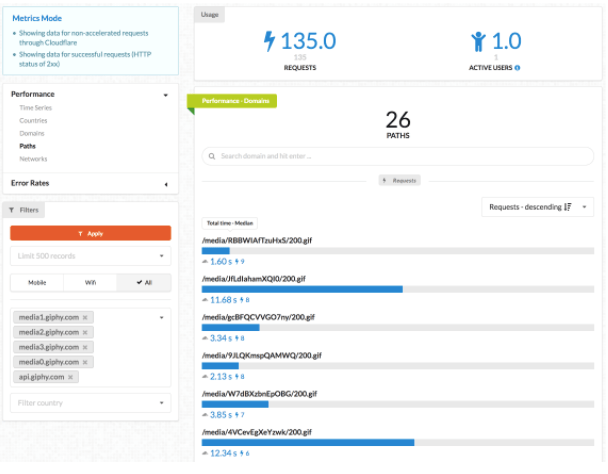
Developers access the monitoring capability by adding a couple of lines of code to their iOS or Android apps. After that,they can log into a web console to see network performance metrics. The tool is designed to surface problems like dropping packets because of a poor signal or moving from WiFi to a mobile a network, each of which can cause an app to hang or otherwise misbehave.

Screenshot: Cloudflare

The tool gives you the ability to see how the network is performing in various parts of the world and where you are seeing issues and as it gathers and display information, it should help correlate performance issues with a flaky network and the impact that could be having on app performance.

Over time, he says they will be partnering with other monitoring tools to give developers a single place to check their performance issues. “Our goal is how can we get networks to perform better and give app developers better insight about network behavior.” Prince said.

Prince says, for starters they are providing some basic suggestions on how to improve performance, but in the future, they plan to integrate the network monitoring tool more deeply with the rest of the Cloudflare toolkit to make it easier to tweak performance problems.

Cloudflare also sees this as a way to build a better understanding of how networks are performing in general, and as they pull this data together, they plan to publish a mobile network reliability report. “We expect as this gets built into [more apps], and gives us visibility into mobile network providers, we will able to see who is providing the highest level of service and who has spotty or bad data services,” he explained.