Year: 2018

01 May 2018

ZeroCater raises $12M to rule the fridges and pantries of an office

ZeroCater may have made its name in bringing restaurant food to offices for lunch (or other meals), but it has now raised a new fresh round of funding for the next perk it hopes to bring to companies: snacks.

While ZeroCater continues to expand from city to city with new restaurants as it tries to grow beyond just bringing lunch to startups in the Bay Area, it’s now looking to compete with the likes of Aramark to make sure it gains control of the fridges and pantries in offices as its next big line of business. And while it may seem like a perk, as competition for talent continues to heat up regardless of city, those perks are increasingly becoming table stakes to keeping the best people around. To do that, the company today said it has raised a new $12 million financing round led by Cleveland Avenue, with participation by Justin Kan, Romulus Capital and Struck Capital.

“You have more companies trying to compete for the same talent,” co-founder Arram Sabeti said. “When you’re looking at the cost of labor and recruiting great talent, all this stuff is a rounding error. When you’re looking at lunch, for example, the economic argument is pretty obvious.”

As such, getting into that market will be a tricky one — hence the new financing. ZeroCater increasingly has to ingest a lot of new data and form those partnerships, which requires talent. The company already has more than 1,000 SKUs (or options, really) for products it can stock as snacks. ZeroCater is looking to create a suite of tools for managers to help give employees a level of granularity they might be used to when it comes to procuring office equipment, giving them the ability to give specific feedback as to what kind of drinks they might want in their fridge. Those options may even vary from floor to floor, and the goal is to keep track of all of this in a consistent way.

The theory of owning snacks is pretty similar to its goal with restaurants: figure out what employees actually want, and help those businesses get the right products in the building based on employee feedback. Rather than burying a line item in a spreadsheet somewhere, ZeroCater wants to help employers understand what they are buying, and why they are buying it. The goal in the end is to keep their employees happy.

ZeroCater got its start working with restaurants that were trying to either expand their business, or even get off the ground. The company offers an opportunity for restaurants to run a kind of test for their meals and businesses with companies, which get access to good food while enabling those restaurants to run a trial before either introducing new dishes, or even opening up an actual restaurant. The whole point is to create a feedback loop where employees can help inform businesses on what’s good, and what isn’t.

“[Managers] really don’t feel like employees get to participate [in the picking process],” Sabeti said. “They want a mechanism for employees to give feedback and tell the provider what they want to receive. The most feedback [vendors] get is from sending someone to sit with a facilities manager once a quarter. With our product, we have a dashboard where employees can see what’s coming, vote on different items, and then we can collect that feedback.”

Snacks may, indeed, serve as an interesting differentiator in a market that is increasingly complex. Square earlier this month acquired office-ordering startup Zesty as it looks to continue to expand its Caviar service. While that’s one example, it may indeed be a sort of harbinger of increased competition when it comes to office catering — and an example of having to move beyond just restaurants in order to remain competitive.


01 May 2018

Yossi Matias is coming to TechCrunch Tel Aviv… and you should too

As TechCrunch launches our first day-long event in Tel Aviv, there could be no better person to help us discuss the Israeli technology scene than Yossi Matias.

The founder of Google’s research and development center in Israel, Matias has had a long and storied career as a technologist going back decades.

He’s a recipient of the Gödel Prize and an ACM Fellow for his contributions to computer science and the field of search.

At Google, Matias was instrumental in the creation of a slew of key products including Google Trends, Google Insights for Search, Google’s Visualization API, ephemeral identities for the internet of things and Google Suggest.

Matias has also made tremendous contributions to the digital preservation of historical artifacts — from the Dead Sea Scrolls and the Nelson Mandela Archive to the Yad Vashem Holocaust Memorial Museum.

Hear the executive lead and founder of Google’s campus in Tel Aviv (and one of the living legends of tech) talk about the future of mobility and the world that it will shape at TechCrunch Tel Aviv.

Tickets are available here.

01 May 2018

ScienceLogic release gives IT view across entire stack

It’s tough being part of IT Ops these days. Your company could be operating across public and private clouds, and in many cases, an internal datacenter too. Meanwhile your developers are generating more code ever faster. ScienceLogic wants to help with it latest release, ScienceLogic SL1.

As company CEO Dave Link sees, we are seeing this vast confluence of technology influences coming together very quickly. He says the goal with this release is nothing less than a comprehensive, full-stack view of how an application is behaving, and how the different pieces that make up and connect to that application could be affecting its performance.

“Every CIO wants to know the health of their mission critical business services and only way to see that is to see through the entire stack,” Link said.

Part of the problem of course is the sheer volume of information. As that increases, it becomes nearly impossible for humans, even the most highly skilled among us, to keep up and understand what particular element may be causing an application to misbehave.  That problem is exacerbated further by the speed at which developers are generating new code.

Murali Nemani, CMO at ScienceLogic, says that’s where artificial intelligence and machine learning come into play. “Part of the problem is that if businesses are moving at machine speed in terms of their capability to innovate, the big challenge is how do you get operations to keep up with what developers are creating,” Nemani asked.

The machine learning aspect of the platform enables companies to begin automating solutions for some of the more common problems, while directing the more unusual ones to humans on the operations team. They rely on the AI tools produced by others, rather than trying to develop that part of the solution themselves. “If an application is performing poorly, we can diagnose which part is the problem child, then feed this information to AI/ML engines like Google TensorFlow or IBM Watson and see pattern recognition. That’s the way we achieve machine speed,” Nemani explained.

Link says they do this by looking at the problem holistically and giving operations a full view of the application to track down the problem behavior and fix it. “We look at all the layers when we think of a service view: security, systems, network, OS, infrastructure then the application layer (database and application tier). We then contextualize all of those elements into one service view, so [the customer has] the most efficient view of what’s happening in real time,” Link said.

The product being announced publicly today has been early Beta up to now and will be generally available on July 25th.

01 May 2018

CoinMarketCap releases its first mobile app for tracking cryptocurrency prices

CoinMarketCap seemed to appear out of nowhere last year during the rise of bitcoin and cryptocurrencies, establishing itself as the de facto source for tracking the rise and fall of valuations.

That’s brought incredible amounts of traffic and attention. Alexa ranks it as the world’s 174 most popular website, and it enjoys more traffic than the likes of the Wall Street Journal, Bloomberg and other media. Yet despite that power, precious little is known of the company, as the Journal wrote earlier this year.

CoinMarketCap has also done nothing to expand out and take advantage of its position at the center of the rise of cryptocurrencies, which are collectively worth over $400 billion. But today — its fifth anniversary since starting the website — it has released its first mobile app for iOS, rebranded its website and prepared to launch more new services.

The app itself is long-awaited, but the truth is that most crypto enthusiasts already have a go-to app for checking prices or keeping an eye on their tokens.

The app does what you’d imagine. It lets users sort by coin market cap ranking, name, price or price percentage change within 24 hours, and you can switch between all tokens, the top 100 or a ‘watchlist’ for specific tokens. There’s a single banner ad at the bottom of the app, and at the moment — somewhat annoyingly — no way to pay for an ad-free version.

Token prices themselves can be tracked across 24 hours, seven days or 30 days. There’s currently no way to track the value of specific numbers of tokens, so the app doesn’t replace portfolio trackers.

The irony is that nearly all crypto tracking apps use CoinMarketCap’s API to get their data. But the company’s sees two opportunities there. First that it has a strong brand.

“Are there other places where people can get the data and do we have copycats? Sure. However, we are the only site that you can guarantee is sourcing, gathering, and verifying the data itself and we pride ourselves in being the first and best regarded within the industry,” a spokesperson told TechCrunch via email.

Secondly, there’s a monetization opportunity.

In addition to the app launch, CoinMarketCap said redesigned its website and upgraded its API. It said a new commercial API, which will be include historical data, is planned with more to come. So, while the app doesn’t break new ground for consumers, it is a starting point to build a fuller experience and develop beyond a popular website that monetizes via advertising. (The company said it gets 15 million unique visitors per month.)

“We keep our eyes on incoming requests from users, paying close attention to what people want to see and how they can get the most out of our data. We’re excited to deliver on many of those requests today,” CoinMarketCap CEO Brandon Chez said in a statement.

You can get the CoinMarketCap app here.

Note: The author owns a small amount of cryptocurrency. Enough to gain an understanding, not enough to change a life

01 May 2018

Cambridge Uni graphene spin-out Paragraf gets $3.9M

Paragraf, a Cambridge University graphene spin-out, has closed a £2.9M (~$3.9M) seed round. The funding is led by the university’s commercialization arm, Cambridge Enterprise, with Parkwalk Advisors, Amadeus Capital Partners, IQ Capital Partners and angel investors also participating.

Graphene refers to the one atom-thick latticed carbon material that’s been exciting scientists with its potential for more than a decade. Although turning a nanomaterial with transformative promise into practical and robust commercial products has not turned out to be a cake walk.

Paragraf reckons it’s onto something that can help accelerate developments though, having come up with what it says is a novel (and patent-protected) approach to manufacturing graphene for commercial use-cases — so in larger and better quantities and qualities than the small flakes that have typically been the production rule so far.

The team claims their technique overcomes a raft of problems which have stymied graphene developments to date, such as poor uniformity, reproducibility, limited size and material contamination.

Their wider focus is on producing atom-layer thick 2D materials — with graphene their starting points — for the development of a new generation of electronic devices. And early claims for the nanomaterial included suggestions that it could enable a new generation of flexible, transparent electronics.

“Harnessing the extremely high conductivity, superb strength, very low weight and ultimate flexibility of graphene, Paragraf’s technology is the first ever commercial-scale method validated to reproducibly deliver functionally active graphene with properties targeted to its final device-specific application, with both high quality and high throughput,” is the team’s claim for their approach.

The business has been spun out of the Centre for Gallium Nitride group of Professor Sir Colin Humphreys in the university’s department of materials science. According to Crunchbase Paragraf was founded in 2015.

So far they say they’ve produced layers of graphene with electrical characteristics optimized for producing “very sensitive detectors at commercial scale”, as well as “improved efficiency contact layers for common technologies such as LEDs”.

Among their targets for graphene devices are transistors, where they reckon the nanomaterial could deliver clock speeds several orders of magnitude faster than silicon-based devices; chemical and electrical sensors, where they say it could increase sensitivity by a factor of >1,000; and novel energy generation devices — arguing graphene could tap into “kinetic and chemical green energy sources yet to be exploited by any other technology” (so chalk up another wonder claim).

Of course those are all yet more miraculous sounding claims being made for graphene — the likes of which have been liberally attached to the substance for years. And Paragraf still faces the hard graft of proving out their claims. So it’s a pretty safe bet that multiple years of R&D are still needed before mass market graphene based devices are within the average consumer’s grasp.

Commenting on the funding in a statement, Hermann Hauser, co-founder of Amadeus Capital Partners, said: “Graphene has demonstrated some remarkable achievements in the lab, showing great promise for many future electronic technologies. However, without a pathway to commercial viability, scaling from proof of concept to end user accessible products remains beyond the horizon. Paragraf’s novel approach to two-dimensional materials fabrication brings the possibility of mass market graphene based devices a step closer to reality.”

In another supporting statement, Dr Simon Thomas, CEO and co-founder of Paragraf, added: “There’s no doubt that the electronic, mechanical and optical properties of two-dimensional materials such as graphene have the potential to significantly increase performance in a multitude of state of the art technologies. However, until materials like graphene can be delivered in commercially viable, device compatible, functionally targeted forms, the achievements demonstrated at lab scale will not be transferred to real-world products. At Paragraf we have developed the first production technique that allows true scaling of graphene based devices.”

01 May 2018

Cisco sells part of its NDS video assets, acquired for $5B, to Permira to build a new business

In 2012, Cisco made one of its biggest-ever acquisitions — and a major step into the Israeli tech world — when it acquired video and security specialist NDS for $5 billion. Now, the company is selling part of that business to one of its previous owners, the private equity firm Permira, as it looks to refocus itself and boost growth in networking, multi-cloud, security, data, and collaboration services.

Permira says it is acquiring selected video technology assets, along with other cloud technology services, which it plans to launch as a new, standalone business.

The new, rebranded company will be “focused on developing and delivering video solutions for the Pay-TV industry,” and it will unveil its new name and more details after the transaction is closed. The board of Cisco has already approved the deal, and it is expected to close in Q1 of the 2019 fiscal year.

Abe Peled, the former chairman and CEO of NDS and a Permira advisor, will be leading the new company (the CEO as yet is unnamed). He said in a statement that the business had been profitable under Cisco.

“We are proud of our innovation in video and the customer momentum that the Service Provider Video group has built,” said Chuck Robbins, Chairman and CEO, Cisco, in a statement.

“With the leadership team and Abe as Chairman, the new company is well-positioned to drive this work forward and continue to deliver the solutions that meet the current and future needs of service provider video customers. Service providers remain a key customer segment for Cisco, and we look forward to continuing to partner with them to deliver new revenue-generating services and experiences.”

More from Cisco on the divestment here, and there may be yet more detail when the company reports its quarterly earnings in two weeks.

Terms of the deal are not being disclosed. There are reports in the Israeli press of a $1 billion price tag, but I’ve been told by a source that this is “way off.” I’ll add more detail as and when I get it. There have been reports swirling since November 2017 that Cisco was looking to divest its Videoscape business and that Permira would be the buyer.

From what we understand, the assets represent a significant chunk of Cisco’s service provider video business. The include the following:

Among the assets that were part of the original NDS business, Permira is buying Cisco’s video security services, including smartcards and software solutions associated with conditional access security; video middleware, or software solutions that provide advanced user experiences on any underlying set-top box hardware; and software for video services.

Among the assets that were a part of Cisco’s Infinite Video Platform (IVP), Permira is acquiring Cisco’s cloud video recording solutions for managing, storing, and playing recordings; cloud platform solutions for video consumption on any device on any network; and video processing solutions covering encryption, management and distribution of live and on-demand content.

Permira is not acquiring video and media technology that Cisco is using related to its existing networking, multi-cloud, security, data and collaboration services. In other words, WebEx and things like that are not a part of this deal.

The divestment is key development for Cisco.

Across much of 2017, the company reported little growth in its major segments and has more generally been facing a lot of pricing pressure around its hardware and networking businesses. “Other products”, meanwhile, have seen their revenues shrinking (see here and here).

In that context, the NDS business and related solutions may have been seen by some as legacy assets that needed to be cut away so that Cisco could focus more on trying to grow other parts of its business. Those that were called out in a blog post by Yvette Kanouff, SVP of Cisco’s service provider business, include mass-scale networking, automation, optical, optics, cable access, and mobility, security, collaboration, IoT, and professional services.

Created to serve Pay-TV companies as they existed in the late 80s-2000s — it was originally founded in 1988 — NDS at one point was even co-owned by one of them, News Corp, which had a 49 percent stake in NDS, with Permira holding 51 percent, when it was sold to Cisco for $5 billion in 2012. (For some extra context, News Corp and Permira originally paid $3.7 billion for NDS when they took it private in 2009.)

Times have moved on, though. The development of cloud-based video and streaming have led to a different class of set-top boxes. And more importantly, a growing number of consumers now choose to bypass traditional PayTV providers altogether, either opting for something like an Apple TV or Amazon Fire TV solution, or going the direct to Internet route and using YouTube and other services. That also means a lot of pricing pressure for those who are still working with these providers.

The theory behind divesting the Cisco assets and rebuilding them is that many of these Pay-TV providers are still very much in business and want to stay that way, so there is an opportunity to both service them as is, but also come up with new products and services to help bring them into the 21st century.

“This is a unique opportunity to lead and shape the video industry during its transition with the flexibility as a private company,” said Dr. Peled in a statement. “The new company will have the scale, technology innovation, and world-class team to deliver outstanding go-to-market execution, customer engagement, and new end-user experiences.  Cisco has built a profitable business in the video space with innovations to capitalize on IP distribution and cloud-based services. These combined assets provide a significant new opportunity for the new company. I am thrilled to be working again in this area with Permira who is committed to innovation and support for our Pay-TV customers, and look forward to the ongoing working relationship with Cisco in support of our mutual customers.”


01 May 2018

Parallel Domain wants to train self-driving cars in virtual worlds

Kevin McNamara, a former Apple and Pixar employee, is bringing his virtual world creation expertise to the domain of self-driving cars. And he has $2.5 million from Costanoa Ventures, Ubiquity Ventures and others to do so.

At Apple, McNamara says he worked on an autonomous systems project, where he explored automatic content generation of simulated virtual environments. The idea was to figure out how to use that type of technology to train, test, validate and develop artificial intelligence in autonomous systems, he told me.

Since leaving Apple, McNamara has gone on to start Parallel Domain. The platform generates virtual worlds to enable large-scale training and testing of driverless cars.

“What we do is use computer graphics to try to accelerate the development of safe autonomous vehicles,” McNamara told me. “The idea being that, in a simulation, you can safely make a mistake and then learn from those mistakes. In a virtual world, you’re not going to hurt anyone in this simulation.”

Using real-world map data, procedural growth algorithms and generative models, the platform can teach cars how to drive and make sure the car’s software is learning how to drive properly, he said. All elements of the world are adjustable and programmable — be that the number of lanes, type of terrain, location of mountains, road curvature and so forth.

Initially, the plan is to sell this platform to autonomous vehicle companies. From there, an autonomous vehicle company could use Parallel Domain to generate 3D, virtual worlds in which to test their cars.

“It’s essentially like making a big video game for a car to drive through,” McNamara said.

Parallel Domain’s first customer is NIO, an autonomous vehicle startup focused on the Chinese market. With Parallel Domain, NIO can request a city-like interface with 20 blocks of bike lanes, buildings, pedestrians and so forth. Within “a matter of seconds,” Parallel Domain can generate that world.

NIO’s electric self-driving car concept

To be clear, McNamara is not anti-real world data. He recognizes it’s very valuable and the best way to ensure a car knows what it’s doing, but it’s also really expensive. That’s why McNamara envisions AV companies using Parallel Domain in conjunction with real-world testing. Simulation, he said, can be a massive accelerator that enables cars to drive a billion miles.

A lot of companies, he said, are interested in using tech to turn map data into a rich, simulated world.

“We also do think there’s a lot of value in offering a starter pack of content” — like one million free miles of interesting roads to drive on, he said.

The big-picture goal, McNamara said, is to remove the barrier that companies have in doing large-scale simulation. Then, companies should theoretically be better equipped to develop their products more quickly and more safely.

“Every day, we see headlines questioning the safety of autonomous vehicles,” Costanoa Ventures Partner Mark Selcow said in a statement. “But Parallel Domain’s approach can help eliminate many of those concerns in virtual worlds before those vehicles reach public roads.”

01 May 2018

It’s time to enter, pitch, party and network @TheEuropas, July 3rd

Yes, it’s that time of year again! It’s time to grab tickets for The Europas, the annual gathering of Europe’s hottest startups in London, in partnership with TechCrunch. On 3rd July, The Europas will feature an afternoon of awesome networking with its famous Unconference, a series of great speakers leading deep-dive discussion, a fantastic opportunity to pitch your startup and a new “Crypto Zone” featuring Europe’s hottest Blockchain and Crypto projects. Combine that with a fantastic awards ceremony and afterparty, and a heady mix of founders, investors and the media, and you have an incredible event. So grab your tickets.

TechCrunch is once again the main media partner for the event, and will be joined by The Pathfounder.

The ‘special sauce’ of The Europas is the small, intimate breakout sessions where delegates can deep-dive into vertical topics with expert speakers. Plus the more fun stuff in the programme, like the music and cultural side events. Too early to remember? Remind yourself with the Facebook event, the newsletter or follow on Twitter.

Speakers will be announced soon, but to give you a flavour, previous year’s speakers have included:

Alex Klein, Kano
Alicia Navarro, Skimlinks
Audrey Soussan, Ventech Capital
Azeem Azhar, The Exponential View
Barbara Belvisi, Hardware Club
Ben Tompkins, Eden Ventures
Bindi Karia, advisor
Chris Blackford, Sky Futures
Chrysanthos Chrysanthou, Notion Capital
Ciaran O’Leary, Early Bird Capital
Daniel Murray, Grabble
David Hanson, Hanson Robotics
Dmitri Sarle, Arctic Startups
Edward Saperia, NWSPK
Eileen Burbidge, Passion Capital
Fred Destin, Accel Partners
Haakon Overli, Dawn Capital
James Mayes, Mind The Product
Janne Kyttanen, WTF VC
Jason Bates, Mondo
Jeff Lynn, Seedrs
Jon Bradford, Dubai Future Accelerators
Karen McCormick, Beringea
Limor Schweitzer, Robosavvy
Marie Ekeland, France Digitale
Mat Morrisson, Magicbeanlab.com
Megan Quinn, Kleiner Perkins
Meryl Job Founder, Videdressing
Michael Jackson, Mangrove Capital
Michiel Kotting, Accel Partners
Nic Brisbourne, Forward Partners
Patrick Drake, Hello Fresh
Peter Smith, Blockchain.com
Reshma Sohoni, Seedcamp
Robin Wauters, Tech.eu
Rory Sterling, MMC Ventures
Sandy Mckinnon, Pentech Ventures
Sarah Wood, Unruly
Saul Klein, Index Ventures
Sherry Coutu, Scaleup Institute
Simon Levene, Mosaic Ventures
Simon Murdoch, Episode1 Partners
Sitar Teli, Connect Ventures
Stephane Gantchev, LAUNCHub
Stephanie Hospital, One Ragtime VC
Thomas Davies, Seedrs
Tim Jackson, Lean Investments
Tracy Doree, Kindred Capital
Yossi Vardi, Angel Investor
Zoe Adamovicz, Neufund

europas6

europas10

Instead of thousands of people, think of a great summer event with just over 1,000 of the most interesting and useful people you could hope to meet.

• No secret VIP rooms, which means you get to interact with the Speakers

• Key founders and investors speaking; featured attendees invited to just network

• Expert discussions, and Q&A

• Intimate “breakout” sessions with key players on vertical topics

• The opportunity to meet almost everyone in those small groups, super-charging your networking

• Journalists from major tech titles, newspapers and business broadcasters

• A parallel and exclusive “Pathfounder” track geared towards fund-raising and hyper-networking

• A stunning awards dinner and party which honors both the hottest startups and the leading lights in the European startup scene

• All on one day to maximise your time in London

europas8

That’s what The Europas aims to achieve. A great group of people from all over Europe, with key investors, founders and ecosystem-players.

Plenty of pitching, but more fun interactions as well!

And what better way to do that in the summer sun, in London’s coolest part of town, with a drink in your hand, the prospect of some great conversations, and a fantastic party and celebration of the European startup scene in the evening.

This year the event is also moving to Shoreditch, the heart of London’s tech scene.

That’s just the beginning. There’s more to come…

GENERAL ENQUIRIES/SPEAKERS: dianne@theeuropas.com

SPONSORSHIP AND TICKETING: petra@theeuropas.com

europas12

europas13

01 May 2018

Facebook expands downvote tests on comments

Mark Twain had it right: There’s no such thing as a new idea. To wit: Facebook is currently testing arrows to let users ‘up’ vote or ‘down’ vote individual comments in some of its international markets. Digg eat your heart out. Reddit roll over.

This particular trial of upvoting/downvoting buttons is limited to New Zealand and Australia for now, according to Facebook (via The Guardian).

The latest test is a bit different to a downvote test Facebook ran in the US back in February — when it just offered a downvote option. (And if clicked it hid the comment and gave users additional reporting options such as: “Offensive”, “Misleading”, and “Off Topic”.)

The latest international test looks a bit less negative — with an overall score being recorded next to the arrows which could at least reward users with some positive feels if their comment gets lots of upvotes. Negative scores could do the opposite though.

It’s not certain whether the company will commit to rolling out the feature in this form — a spokesman told us this is an early test, with no decision made on whether to roll it out for Facebook’s 2.2BN+ user base — but its various tests in this area suggest it’s interested in having another signal for rating or ranking comments.

In a statement attributed to a spokesperson it told us: “People have told us they would like to see better public discussions on Facebook, and want spaces where people with different opinions can have more constructive dialogue.  To that end, we’re running a small test in New Zealand which allows people to upvote or downvote comments on public Page posts. Our hope is that this feature will make it easier for us to create such spaces, by ranking the comments that readers believe deserve to rank highest, rather than the comments that get the strongest emotional reaction.”

The test looks to have been going on for a couple of weeks at least at this point — a reader emailed TC on April 14 with screengrabs of the trial on comments for New Zealand Commonwealth Games content…


Facebook emphasized the feature is not an official dislike button. If rolled out a spokesman said it would not replace the suite of emoji reactions the platform already offers so people can record how they feel about an individual Facebook post (and reactions already include thumbs up/thumbs down emoji options).

Rather its focus is on giving users more granular controls to rate comments on Facebook posts.

The spokesman told us the feature test is intended to see if users find the upvote/downvote buttons a productive option to give feedback about how informative or constructive a comment is.

Facebook users with access to the trial who hover over a comment will see a pop-up box that explains how to use the feature, according to the Guardian — with usage of the up arrow encouraged via text telling them to “support better comments” and “press the comment up if you think the comment is helpful or insightful”; while the down arrow is explained as a way to “stop bad comments” and the further instruction to: “Press the down button if a comment has bad intentions or is disrespectful. It’s still ok to disagree in a respectful way.”

It’s likely Facebook is toying with using comment rating buttons to encourage a more broad crowdsourcing effort to help it with the myriad, complex content moderation challenges associated with its platform.

Responding quickly enough to hate speech remains a particular problem for it — and a hugely serious one in certain regions and markets.

In Myanmar, for example, the UN has accused the platform of accelerating ethnic violence by failing to prevent the spread of violent hate speech. Local groups have also blasted Facebook for failing to be responsive enough to the problem.

In a statement responding to a critical letter sent last month by Myanmar civil society organizations, Facebook conceded: “We should have been faster and are working hard to improve our technology and tools to detect and prevent abusive, hateful or false content.”

And while the company has said it will double the headcount of staff who work on safety and security issues, to 20,000 by the end of this year, that’s still a tiny drop in the ocean of content shared daily over its social platforms — so it’s likely looking at how it can co-opt more of the 2.2BN+ humans who use its platform to help it with the hard problems of sifting good comments from bad: A nuanced task which can baffle AI — so, tl;dr, the more human signals you can get the better.

01 May 2018

Suki raises $20M to create a voice assistant for doctors

When trying to figure out what to do after an extensive career at Google, Motorola, and Flipkart, Punit Soni decided to spend a lot of time sitting in doctors’ offices to figure out what to do next.

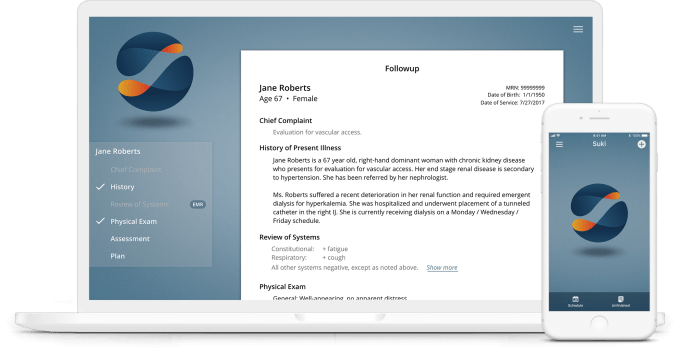
It was there that Soni said he figured out one of the most annoying pain points for doctors in any office: writing down notes and documentation. That’s why he decided to start Suki — previously Robin AI — to create a way for doctors to simply start talking aloud to take notes when working with patients, rather than having to put everything into a medical record system, or even writing those notes down by hand. That seemed like the lowest hanging fruit, offering an opportunity to make it easier for doctors that see dozens of patients to make their lives significantly easier, he said.

“We decided we had found a powerful constituency who were burning out because of just documentation,” Soni said. “They have underlying EMR systems that are much older in design. The solution aligns with the commoditization of voice and machine learning. If you put it all together, if we can build a system for doctors and allow doctors to use it in a relatively easy way, they’ll use it to document all the interactions they do with patients. If you have access to all data right from a horse’s mouth, you can use that to solve all the other problems on the health stack.”

The company said it has raised a $15 million funding round led by Venrock, with First Round, Social+Capital, Nat Turner of Flatiron Health, Marc Benioff, and other individual Googlers and angels. Venrock also previously led a $5 million seed financing round, bringing the company’s total funding to around $20 million. It’s also changing its name from Robin AI to Suki, though the reason is actually a pretty simple one: “Suki” is a better wake word for a voice assistant than “Robin” because odds are there’s someone named Robin in the office.

The challenge for a company like Suki is not actually the voice recognition part. Indeed, that’s why Soni said they are actually starting a company like this today: voice recognition is commoditized. Trying to start a company like Suki four years ago would have meant having to build that kind of technology from scratch, but thanks to incredible advances in machine learning over just the past few years, startups can quickly move on to the core business problems they hope to solve rather than focusing on early technical challenges.

Instead, Suki’s problem is one of understanding language. It has to ingest everything that a doctor is saying, parse it, and figure out what goes where in a patient’s documentation. That problem is even more complex because each doctor has a different way of documenting their work with a patient, meaning it has to take extra care in building a system that can scale to any number of doctors. As with any company, the more data it collects over time, the better those results get — and the more defensible the business becomes, because it can be the best product.

“Whether you bring up the iOS app or want to bring it in a website, doctors have it in the exam room,” Soni said. “You can say, ‘Suki, make sure you document this, prescribe this drug, and make sure this person comes back to me for a follow-up visit.’ It takes all that, it captures it into a clinically comprehensive note and then pushes it to the underlying electronic medical record. [Those EMRs] are the system of record, it is not our job to day-one replace these guys. Our job is to make sure doctors and the burnout they are having is relieved.”

Given that voice recognition is commoditized, there will likely be others looking to build a scribe for doctors as well. There are startups like Saykara looking to do something similar, and in these situations it often seems like the companies that are able to capture the most data first are able to become the market leaders. And there’s also a chance that a larger company — like Amazon, which has made its interest in healthcare already known — may step in with its comprehensive understanding of language and find its way into the doctors’ office. Over time, Soni hopes that as it gets more and more data, Suki can become more intelligent and more than just a simple transcription service.

“You can see this arc where you’re going from an Alexa, to a smarter form of a digital assistant, to a device that’s a little bit like a chief resident of a doctor,” Soni said. “You’ll be able to say things like, ‘Suki, pay attention,’ and all it needs to do is listen to your conversation with the patient. I’m, not building a medical transcription company. I’m basically trying to build a digital assistant for doctors.”