Year: 2018

01 May 2018

TransferWise founder Taavet Hinrikus invests in fintech chatbot Cleo

Cleo, the London-based fintech that offers an AI-powered chatbot as a replacement for your banking apps, continues to put together an impressive list of backers. The startup’s early investors already include Entrepreneur First, Skype founder Niklas Zennström, Wonga founder Errol Damelin, and LocalGlobe, the seed VC firm founded by father and son duo Robin and Saul Klein, amongst others. Now TechCrunch can reveal that TransferWise founder Taavet Hinrikus has become a Cleo investor and advisor.

In a call with Hinrikus last week, he explained that the investment came about after he kept hearing of Cleo and its co-founder and CEO Barney Hussey-Yeo from various contacts in the London startup scene. The pair met up around 6 months ago and after learning more about the company’s vision, the TransferWise founder wanted in. “The guy is very low-key, hands on building, [and] focussed on solving a customer problem,” says Hinrikus, “so I was really impressed with that and said, ‘hey, if I can join the party, I’d love to’. And he said, ‘sure, come onboard’.

It’s a proactive bank, it’s a bank that talks to you. Taavet Hinrikus
The customer problem Cleo has set out to solve, as articulated by the TransferWise founder, is helping millennials “live with their money”. The Facebook Messenger chatbot gives insights into your spending across multiple accounts and credit cards, broken down by transaction, category or merchant. In addition, Cleo lets you take a number of actions based on the financial data it has gleaned. You can choose to put money aside for a rainy day or specific goal, send money to your Facebook Messenger contacts, donate to charity, set spending and alerts, and more.

“It’s a proactive bank, it’s a bank that talks to you, and tells you on a Monday morning, ‘hey, you know, you can spend £100 this week’. And that’s really valuable for these people,” says Hinrikus. “I think there are a lot of millennials that are super happy with the product. What’s going to come of it, who the hell knows? It’s a long journey ahead, but it’s exciting. Starting by solving one pain-point for these people, there’s a ton of things you can do”.

Cleo’s recent (albeit tentative) U.S. launch hasn’t gone unnoticed, either, with Hinrikus describing growth across the pond as “super impressive”. I understand that Cleo hit 200,000 users in April, and is growing by 3,000 users a day, with the U.S. driving over half of that growth. The company is eyeing up further international moves, too, something the TransferWise founder is well-positioned to help with as one of the few European founders that has scaled a consumer-facing technology company globally.

Maybe I think too highly of myself, but I think maybe sometimes I can give some good advice. Taavet Hinrikus
“I get a kick out of helping the next generation of founders,” he says, citing recent investments in Juro, and Open Cosmos, along with Cleo. “There are lots of people building the next TransferWise, not in a sense of competing with us, but in a sense of building large successful companies that are doing something important. I just enjoy helping these founders navigate the journey. Maybe I think too highly of myself, but I think maybe sometimes I can give some good advice — sometimes bad advice, I’m sure — and I think that’s a way of giving back”.

One interesting aspect to Cleo’s global ambitions is the potential speed the U.K. startup can move at because of the decision not to become a bank in its own right, which would otherwise bring significant capital and regulatory friction. Cleo co-founder Barney Hussey-Yeo has always said that “nobody needs to be a bank to replace your banking app,” especially in light of Open Banking/PSD2 regulation, which is forcing banks to let customers share their data with third-party apps of their choosing.

“I think you can do a lot in the Open Banking way. I think the tools out there are still a couple of years away… [but] PayPal is not a bank, TransferWise is not a bank, Revolut is not a bank, and Cleo is not a bank. Yet you can still do a lot of great stuff,” says Hinrikus.

Meanwhile, although Cleo has begun to experiment with monetisation, including earning affiliate revenue when persuading users to switch gas and electricity providers, the startup’s latest investor describes those efforts as “peanuts” and says it is barely scratching the surface of what’s possible. “There’s a gazillion opportunities,” he says. “If you think about insurance, if you think about investing, if you think about credit, there’s so much you can do. It’s really about being smart and choosing which ones to double down on… If you want to build a really big business, then credit may be the most important”.

01 May 2018

Chinese authorities dish out $5M in fines for developers of PUBG hack software

There has long been speculation and evidence of cheating software for PlayerUnknown’s Battlegrounds (PUBG), but action is being taken to stamp it out. The makers of the smash-hit game have confirmed that they have worked with authorities in China who have dished out over $5 million in fines to at least 15 people caught developing hacks that help players cheat.

PUBG, in case you missed it, is one of the top-grossing games in the world this year. A shoot-up battle royale game that sees players battle to survive to the end, PUBG grossed $700 million in revenue via PC sales last year and that’s only increased in 2018 as the title landed on mobile. It’s particularly big in China where internet giant Tencent is the publishing partner.

That Tencent link might have proved useful, as Bluehole — the company behind PUBG — revealed in a statement that Chinese authorities have helped it clamp down on hacking programs, handing out the huge number of fines in the process:

Here’s some translated information from the local authorities we worked with on this case:

“15 major suspects including “OMG”, “FL”, “火狐”, “须弥” and “炎黄” were arrested for developing hack programs, hosting marketplaces for hack programs, and brokering transactions. Currently the suspects have been fined approximately 30mil RNB ($5.1mil USD). Other suspects related to this case are still being investigated.

While the programs were being developed in China and there were users there too, it isn’t clear whether that reach extended to gamers in the U.S. and other countries.

Beyond just cheating, there is also a significant risk for those who use the hacked software.

Bluehole said it found evidence that the programs were used by their developers to infect host PCs in order to “control users’ PC, scan their data, and extract information illegally.” Some, it is said, used Trojan Horse software to steal user information — that could mean information from when they shop online (like credit card numbers), the content of emails, and more.

01 May 2018

Telegram blocked in Iran as the government orders telecoms to cut off access

As Moscow erupts in protests over its own ban, Iran’s judiciary has just ordered the nation’s telecommunications providers to block Telegram . According to the Wall Street Journal, Iran’s Islamic Republic News Agency stated that the decision was issued via a court ruling in Tehran. An estimated 40 million Iranians — half of the country’s population — use Telegram to communicate.

“Considering various complaints against Telegram social networking app by Iranian citizens, and based on the demand of security organisations for confronting the illegal activities of Telegram, the judiciary has banned its usage in Iran,” Iranian state TV reported, according to Reuters.

As of Monday, Telegram appears to still be functioning in the country following the court order. When the ban is executed, the popular messaging app will join the ranks of Facebook and Twitter, two other social media platforms banned in Iran. Government employees were ordered to quit the app earlier this month and the Iranian government launched its own Telegram competitor, a messaging app called Soroush, last week.

In January, Iran temporarily restricted Telegram access, ostensibly to quell anti-government demonstrations. When bans have occurred in the past, tech-savvy Iranians have turned to proxy services and other tools to keep connected.

In the past, Iran has suggested that it would allow Telegram and other messaging apps to operate domestically if they transferred their data servers into the country rather than storing data abroad. Given that such a move would meaningfully compromise a messaging app’s privacy in such a restrictive country — something Telegram’s founder Pavel Durov isn’t keen on — Iran will pursue control of the  messaging service with an outright ban instead.

01 May 2018

DARPA is funding new tech that can identify manipulated videos and ‘deepfakes’

The Menlo Park-based nonprofit research group SRI International has been awarded three contracts by the Pentagon’s Defense Advanced Research Projects Agency (DARPA) to wage war on the newest front in fake news. Specifically, DARPA’s Media Forensics program is developing tools capable of identifying when videos and photos have been meaningfully altered from their original state in order to misrepresent their content.

The most infamous form of this kind of content is the category called “deepfakes” — usually pornographic video that superimposes a celebrity or public figure’s likeness into a compromising scene. Though software that makes that makes deepfakes possible is inexpensive and easy to use, existing video analysis tools aren’t yet up to the task of identifying what’s real and what’s been cooked up.

As articulated by its mission statement, that’s where the Media Forensics group comes in:

“DARPA’s MediFor program brings together world-class researchers to attempt to level the digital imagery playing field, which currently favors the manipulator, by developing technologies for the automated assessment of the integrity of an image or video and integrating these in an end-to-end media forensics platform.

If successful, the MediFor platform will automatically detect manipulations, provide detailed information about how these manipulations were performed, and reason about the overall integrity of visual media to facilitate decisions regarding the use of any questionable image or video.”

While video is a particularly alarming application, manipulation even poses a detection challenge for still images and DARPA is researching those challenges as well.

DARPA’s Media Forensics group, also known as MediFor, began soliciting applications in 2015, launched in 2016 and is funded through 2020. For the project, SRI International will work closely with researchers at the University of Amsterdam (see their paper “Spotting Audio-Visual Inconsistencies (SAVI) in Manipulated Video” for more details) and the Biometrics Security & Privacy group of the Idiap Research Institute in Switzerland. The research group is focusing on four techniques to identify the kind of audiovisual discrepancies present in a video that has been tampered with, including lip sync analysis, speaker inconsistency detection, scene inconsistency detection (room size and acoustics) and identifying frame drops or content insertions.

Research awarded through the program is showing promise. In an initial round of testing last June, researchers were able to identify “speaker inconsistencies and scene inconsistencies,” two markers of video that’s been tampered with, with 75% accuracy in a set of hundreds of test videos. In May 2018, the group will be conducting a similar test on a larger scale, honing its technique in order to examine a much larger sample of test videos.

While the project does have potential defense applications, the research team believes that the aims of the program will become “front-and-center” in the near future as regulators, the media and the public alike reckon with the even more insidious strain of fake news.

“We expect techniques for tampering with and generating whole synthetic videos to improve dramatically in the near term,” a representative of SRI International told TechCrunch.

“These techniques will make it possible for both hobbyists and hackers to generate very realistic-looking videos of people doing and saying things they never did.”

30 Apr 2018

Twitter announces new video partnerships with NBCUniversal and ESPN

Twitter is hosting its Digital Content NewFronts tonight, where it’s unveiling 30 renewals and new content deals — the company says that’s nearly twice as many as it announced last year.

Those include partnerships with the big players in media — starting with NBCUniversal, which will be sharing live video and clips from properties including NBC News, MSNBC, CNBC and Telemundo.

Twitter also announced some of the shows it will be airing as part of the ESPN deal announced earlier today: SportsCenter Live (a Twitter version of the network’s flagship) and Fantasy Focus Live (a live stream of the fantasy sports podcast).

Plus, the company said it’s expanding its existing partnership with Viacom with shows like Comedy Central’s Creator’s Room, BET Breaks and MTV News.

During the NewFronts event, Twitter’s head of video Kayvon Beykpour said daily video views on the platform have nearly doubled in the past year. And Kay Madati (pictured above), the company’s head of content partnerships, described the company as “the ultimate mobile platform where video and conversation share the same screen.”

As Twitter continues to invest in video content, it’s been emphasizing its advantage in live video, a theme that continued in this year’s announcement.

“Twitter is the only place where conversation is tied to video and the biggest live moments, giving brands the unique ability to connect with leaned in consumers who are shaping culture,” said Twitter Global VP of Revenue and Content Partnerships Matthew Derella in a statement. “That’s our superpower.”

During the event, Derella also (implicitly) contrasted Twitter with other digital platforms that have struggled with questions about transparency and whether ads are running in an appropriate environment. Tonight, he said marketers could say goodbye to unsafe brand environments and a lack of transparency: “And we say hello to you being in control of where your video aligns … we say hello to a higher measure of transparency, we say hello to new premium inventory and a break from the same old choices.”

On top of all the new content, Twitter is also announcing new ad programs. There are Creator Originals, a set of scripted series from influencers who will be paired up with sponsored brands. (The program is powered by Niche, the influencer marketing startup that Twitter acquired a few years ago.) And there’s a new Live Brand Studio — as the name suggests, it’s a team that works with marketers to create live video.

AM to DM

Here are some other highlights from the content announcements:

  • CELEBrate, a series where people get heartwarming messages from their idols from Ellen Digital Studios.
  • Delish Food Day and IRL from Hearst Magazines Digital Media.
  • Power Star Live, which is “inspired by the cultural phenomenon of Black Twitter” and live streamed from the Atlanta University Center, from Will Packer Media.
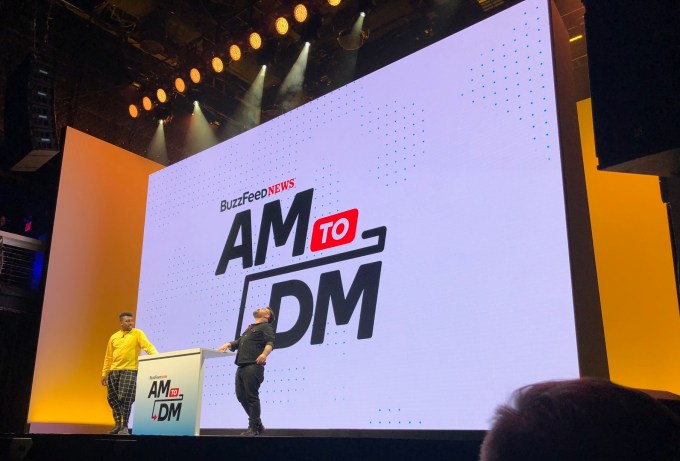
  • BuzzFeed News is renewing AM to DM until the end of 2018.
  • Vice News is launching a new series called The New Space Race.
  • Pattern, a new brand focused on weather- and science-related news.
  • #HereWeAre programming from the Huffington Post (which, like TechCrunch, is owned by Verizon/Oath), History, Vox and BuzzFeed News that highlights women around the world.
  • The Call of Duty World League will air highlights and Championship Sunday for the rest of the season.

Developing

30 Apr 2018

Video: Larry Harvey and JP Barlow on Burning Man and tech culture

Larry Harvey, founder of the counterculture festival Burning Man, passed away this weekend. He was 70.

Harvey created a movement and contributed to the flowering both of counter-culture and, ultimately, of tech culture.

Both he and John Perry Barlow, who also passed in February this year after a long period of ill health, were huge advocates of free speech. Barlow wrote lyrics for the Grateful Dead, and then became a digital rights activist in later life.

In 2013 I caught up with both of them and recorded a joint 24-minute interview, just a short walk from the venue for the Le Web London conference.

Amid the street noise and the traffic, they discussed some of the intellectual underpinnings of startup entrepreneurship and its parallels with Burning Man, in what might have been their first-ever joint interview.

We went over early computer culture, and how there was a “revolutionary zeal in the notion of intellectual empowerment” in Psychedelia, which found common cause in tech culture.

We present for you once again, this iconic interview, in memory of these great men.

30 Apr 2018

WhatsApp CEO Jan Koum quits Facebook due to privacy intrusions

“It is time for me to move on . . . I’m taking some time off to do things I enjoy outside of technology, such as collecting rare air-cooled Porsches, working on my cars and playing ultimate frisbee” WhatsApp co-founder, CEO, and Facebook board member Jan Koum wrote today. The announcement followed shortly after The Washington Post reported that Koum would leave due to disagreements with Facebook management about WhatsApp user data privacy and weakened encryption. Koum obscured that motive in his note that says “I’ll still be cheering WhatsApp on – just from the outside.”

Facebook CEO Mark Zuckerberg quickly commented on Koum’s Facebook post about his departure, writing “Jan: I will miss working so closely with you. I’m grateful for everything you’ve done to help connect the world, and for everything you’ve taught me, including about encryption and its ability to take power from centralized systems and put it back in people’s hands. Those values will always be at the heart of WhatsApp.” That comment further tries to downplay the idea that Facebook pushed Koum away by trying to erode encryption.

It’s currently unclear who will replace Koum as WhatsApp’s CEO, and what will happen to his Facebook board seat.

Values Misaligned

Koum sold WhatsApp to Facebook for in 2014 for a jaw-dropping $19 billion. But since then it’s more than tripled its user count to 1.5 billion, making the price to turn messaging into a one-horse race seem like a steal. But at the time, Koum and co-founder Brian Acton were assured that WhatsApp wouldn’t have to run ads or merge its data with Facebook’s. So were regulators in Europe where WhatsApp is most popular.

A year and a half later, though, Facebook pressured WhatsApp to change its terms of service and give users’ phone numbers to its parent company. That let Facebook target those users with more precise advertising, such as by letting businesses upload list of phone numbers to hit those people with promotions. Facebook was eventually fined $122 million by the European Union in 2017 — a paltrey sum for a company earning over $4 billion in profit per quarter.

But the perceived invasion of WhatsApp user privacy drove a wedge between Koum and the parent company. Acton left Facebook in November, and has publicly supported the #DeleteFacebook movement since.

WashPo writes that Koum was also angered by Facebook executives pushing for a weakening of WhatsApp’s end-to-end encryption in order to facilitate its new WhatsApp For Business program. It’s possible that letting multiple team members from a business all interact with its WhatsApp account could be incompatible with strong encryption. Facebook plans to finally make money off WhatsApp by offering bonus services to big companies like airlines, e-commerce sites, and banks that want to conduct commerce over the chat app.

Jan Koum, the CEO and co-founder of WhatsApp speaks at the Digital Life Design conference on January 18, 2016, in Munich, south Germany.
On the Innovation Conference high-profile guests discuss for three days on trends and developments relating to the digitization. (Photo: TOBIAS HASE/AFP/Getty Images)

Koum was heavily critical of advertising in apps, once teling Forbes that “Dealing with ads is depressing . . . You don’t make anyone’s life better by making advertisements work better.” He vowed to keep them out of WhatsApp. But over the past year, Facebook has rolled out display ads in the Messenger inbox. Without Koum around, Facebook might push to expand those obtrusive ads to WhatsApp as well.

The high-profile departure comes at a vulnerable time for Facebook, with its big F8 developer conference starting tomorrow despite Facebook simultaneously shutting down parts of its dev platform as penance for the Cambridge Analytica scandal. Meanwhile, Google is trying to fix its fragmented messaging strategy, ditching apps like Allo to focus on a mobile carrier-backed alternative to SMS it’s building into Android Messages.

While the News Feed made Facebook rich, it also made it the villain. Messaging has become its strongest suit thanks to the dual dominance of Messenger and WhatsApp. Considering many users surely don’t even realize WhatsApp is own by Facebook, Koum’s departure over policy concerns isn’t likely to change that. But it’s one more point in what’s becoming a thick line connecting Facebook’s business ambitions to its cavalier approach to privacy.

You can read Koum’s full post below.

It's been almost a decade since Brian and I started WhatsApp, and it's been an amazing journey with some of the best…

Posted by Jan Koum on Monday, April 30, 2018

30 Apr 2018

Covee uses blockchain to allow experts worldwide to collaborate

Solving complex data-driven problems requires a lot of teamwork. But, of course, teamwork is typically restricted to companies where everyone is working under the same roof. While distributed teams have become commonplace in tech startups, taking that to the next level by linking up disparate groups of people all working on the same problem (but not in the same company) has been all but impossible. However, in theory, you could use a blockchain to do such a thing, where the work generated was constantly accounted for on-chain.

That’s in theory. In practice, there’s now a startup that claims to have come up with this model. And it’s raised funding.

Covee, a startup out of Berlin, has raised a modest €1.35 million in a round led by LocalGlobe in London, with Atlantic Labs in Berlin and a selection of angels. Prior to this, the company was bootstrapped by CEO Dr. Marcel Dietsch, who left his job at a London-based hedge fund, and his long-time friend, Dr. Raphael Schoettler, COO, who had previously worked for Deutsche Bank. They are joined by Dr. Jochen Krause, CTO, an early blockchain investor and bitcoin miner, and former quant developer and data scientist, respectively, at Scalable Capital and Valora.

What sort of things could this platform be used for? Well, it could be used to bring together people to use machine learning algorithms to improve cancer diagnosis through tumor detection, or perhaps develop a crypto trading algorithm.

There are obvious benefits to the work of scientists. They could work more flexibly, access a more diverse range of projects, choose their teammates and have their work reviewed by peers.

The platform also means you could be rewarded fairly for your contribution.

The upside for corporates is that they can use distributed workers where there is no middleman platform to pay and no management consultancy fees, and access a talent pool (data engineers, statisticians, domain experts), which is difficult to bring inside the firm.

Now, there are indeed others doing this, including Aragon (decentralized governance for everything), Colony (teamwork for everything) and Upwork (freelance jobs platform for individuals). All are different and have their limitations, of course.

Covee plans to make money by having users pay a transaction fee for using the network infrastructure. They plan to turn this into a fully open-source decentralized network, with this transaction fee attached. But Covee will also offer this as a service if clients prefer not to deal with blockchain tokens and the platform directly.

Dietsch says: “Covee was founded in the first half of 2017 in Berlin and relocated to Zurich, Switzerland late 2017 where we incorporated Covee Network. Moving to Switzerland was important for us because it has one of the oldest and strongest blockchain ecosystems in the world and an excellent pipeline of talent from institutions such as ETH Zurich and the University of Zurich. The crypto-friendly stance of the country means it has all the necessary infrastructure as well as clear regulations for token economies.”

30 Apr 2018

Senate Democrats plan to push rollback of FCC’s new net neutrality rules in May

One of the several ways opponents of the FCC’s new net neutrality rules plan to push back is to use the Congressional Review Act to nix the Commission’s order before it has a chance to take effect. Although Democrats in the Senate are currently one vote short of success, they plan to force the vote soon anyway, perhaps as early as mid-May.

As explained in other posts about the steps that can be taken to combat the unpopular Restoring Internet Freedom order, the CRA allows for a quick vote on whether to roll back a recently established regulation. The current administration used it a great deal to undo later Obama-era rules, but now the shoe is on the other foot — partially, anyway.

So far Senate Democrats have a total of 50 votes, including that of Republican Susan Collins — much more than required to force a vote but one short of the 51 needed to pass the resolution. And even if it did passed, its chances of passing in the House are even smaller, and after that, it would be DOA on the President’s desk.

But as many have pointed out, the goal isn’t just to roll back the rules, but to get everyone on Congress to weigh in on the record whether they support the new rules or not. This will be critical to making net neutrality an issue in the 2018 midterms.

Hopes that another Republican Senator will voluntarily cross the aisle seem to have petered out, and so Democrats are reportedly planning to press the button on May 9, after which procedural step it could be as little as a week before the vote actually takes place. Politico and Fight for the Future reported the date, which was not disputed by a Senator’s aide I contacted. The latter is organizing a bit of online activism around the CRA, which you can follow here.

As for the rules themselves, it’s not clear when they’ll actually take effect — they did not, as I erroneously wrote a week ago and as some regulations would have, come into play on April 23. They are under consideration by the Office of Budget and Management and won’t be official until it has provided its stamp of approval.

30 Apr 2018

Discovering that deckhands make great waiters — and why this matters

Breakthroughs in HR tech are not only giving employers game-changing tools with which to enhance processes and attract the best talent, they’re also solving longstanding labor gremlins, such as gender pay parity and blind hiring. At the same time, they’re giving employees novel means by which to accrue and auto-tag prequalifying skill sets for job scenarios far beyond their current positions. But there are opportunities in matching current/future employee needs with what employers can offer.

In January, Gartner projected that HR tech would drive growth in worldwide IT spending in 2018. I’ve spent the last few months better understanding the landscape, so I’m better-positioned to gauge how the cards will fall. I interviewed 10 leaders in human resources — thanks to people like Jan Fiegel (SideWalk Labs), Parker Barille (former VP Product LinkedIn), Cindy Cordon (Policy Genius). Here’s what I gleaned.

First, let’s clarify misconceptions

HR tech is a huge space

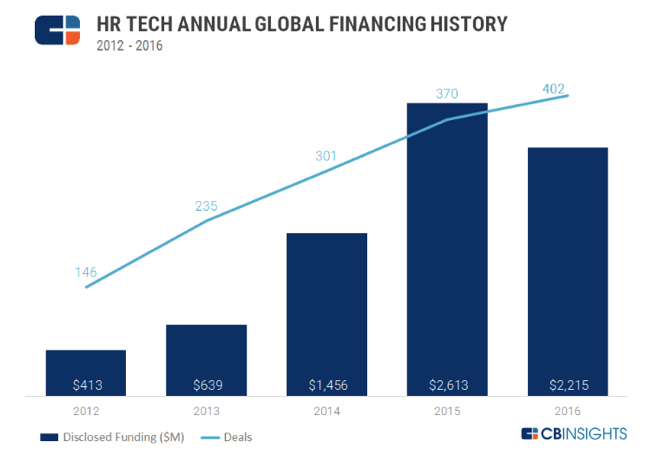
Yes. It will be, but it is still not that big today. The global HR tech industry is estimated at $400 billion, but investments are sensitive to economic shifts. Deal activity in HR tech has increased steadily since 2012, or 175 percent from 2012 to 2016, as shown in the chart below. But investment dollars peaked at $2.4 billion in 2015. In 2016, there were 402 deals worth approximately $2.2 billion in funding, and 2017 closed out with about $1.1 billion in funding for HR tech companies.
Source: CB Insights

Diving in deeper, current spend on HR is small compared to most other functions within a company. For example, while the global HR software market is forecast to grow at a compound annual growth rate (CAGR) of 2.4 percent, reaching $9.2 billion by 2022, Gartner shows Customer Relationship Management (CRM) at a $36.5 billion worldwide market in 2017.

But, the venture opportunity with HR tech will grow over time, fueled by social pressures, by industry need for data and efficiency, and to rise above in a competition for top talent.

HR benefits platforms are the next big thing

A new workforce generation is driving exciting use cases for HR benefits platforms. Companies are hatching creative perks for employees, such as adopting progressive health plan “plus” platforms like Robin Care or LUCY, a service for employees with families, whose motto proclaims that it “helps employees love the family they grow and grow the career they love.”

But platforms like these could potentially be on the chopping block if recessions strike. A change of mindset and a saturation threshold will need to be reached for employers to accept these as “indispensable” employee needs and not just exotic perks for the millennial crowd. That said, I’m cautiously bullish on these platforms and would love to see them succeed.

We have some ways to go before HR benefits platforms prove sticky in the post-recession era. According to a Bloomberg BNA report, HR department budgets grew ~4-7 percent annually before the Great Recession, just 2 percent in 2009 and have only semi recovered to a 4 percent annual growth rate. Sustained market growth will be key to ensuring that value-added platforms become the new normal.

What still rings true

Companies still want better candidate assessment tools

LinkedIn only works for mid to senior-level hires. For fresh college grads and junior white-collar workers, it is hard to go off a traditional resumé because experience can be unconventional at best. It’s why companies like Portfolium and Strive Talent are finding creative ways to showcase skills and are boycotting traditional experience-based resumés. HireVue has a video-based assessment system that can literally read candidates’ faces and assess their honesty and the quality of their answers.

HR by VR (and AR) combines immersive experiences with efficiency, and there have already been significant investments in the space this year. Israeli startup ActiView, which has developed VR technology for assessing job applicants, raised $6.5 million in a Series A financing round from Teddy Sagi Group. AllyO, a provider of AI recruiting technology, raised a $14 million round.

Companies want to know what software to use

As the number of HR tech companies grows — just take a look at this HR tech landscape by Silicon & Salsa — companies at times struggle with the overabundance of choice. A platform to find your best tech solution, like the Salesforce AppExchange, is a gap in the market to help companies navigate options. TechnologyAdvice is a good start, but the UI is not friendly or intuitive.

Imagine an enviable world in which employees have all the support they need to achieve the pipe dream of work/life balance. 

Beyond just picking the best-in-class app, there needs to be a data sync across different platforms to improve predictors around candidate attributes and future churn. With companies targeting segments of HR tech, there’s a clear need for an overarching data record system that can enable big data analysis across platforms.

HR staff spend too much time recruiting new employees

On average, the interview process spans 24 days in the U.S. Automation is key to decreasing the amount of time existing employees spend courting a candidate and interviewing, and there are platforms addressing these time-intensive tasks, as well as others.

The recruiting landscape is crowded, but ripe for experimentation with feature/benefit creep. Companies like LearnUp are not only helping companies schedule interviews and prep for them, they’re also adding to their platform skills-building lessons and job-coaching resources. Taking it one step further, companies like madeBOS are creating economic mobility for entry-level workers in retail and adjacent sectors by empowering employees to drive their own development, saving valuable HR staff time.

Matching skills to jobs for blue-collar workers enables high performance

When a restaurant recruits wait staff, they typically look for people who have worked at other restaurants. The same is true in retail. In finance, we always caveat previous performance or experience by indicating that it is not indicative of future performance. And this reliance on the past couldn’t be more misguided in hiring hourly employees, because it is the skills that matter — speed, good interpersonal skills, memory (for orders), etc.

If you were able to match skill sets only, a deckhand makes a great waiter. LA-based Talytica boasts an ability to assess cognitive ability, personality, strong career interests and specific job skills in the hourly talent management space, theoretically resolving this critical disconnect.

Imagine an enviable world in which employees have all the support they need to achieve the pipe dream of work/life balance. Or one in which candidates are sifted by skill and not the biases associated with background, gender or ethnicity. These are just two of the tectonic benefits HR tech can deliver across the board, connecting dots and leaving bare why certain deckhands could make exquisite waiters. Having explored this vertical, it’s clear to me that HR tech platforms are the surest way to yield the unquestioned must-haves the market now demands on both sides. It now remains to be seen which companies can deliver on engagement and codify this season’s visionary investment choice into the industry’s “new normal.”

Are you an entrepreneur with a fresh take on HR tech? Reach out and tell me more.