Year: 2018

30 Apr 2018

Spam filters and AI help figure out what animals do all day

The pond-dwelling Hydra is not a very complex little animal but it does have a complex repertoire of moves that aren’t clear until after extensive human observation. Examining these moves took a long time and scientists were never sure that they had seen all of them. Now, thanks to an algorithm used to catch spam, researchers have been able to catalog all of the Hydra’s various moves, allowing them to map those moves to the neurons firing in its weird little head.

“People have used machine learning algorithms to partly analyze how a fruit fly flies, and how a worm crawls, but this is the first systematic description of an animal’s behavior,” said Rafael Yuste, a neuroscientist at Columbia University . “Now that we can measure the entirety of Hydra’s behavior in real-time, we can see if it can learn, and if so, how its neurons respond.”

Luckily, the little Hydra was pretty predictable. From the report:

In the current study, the team went a step further by attempting to catalog Hydra’s complete set of behaviors. To do so, they applied the popular “bag of words” classification algorithm to hours of footage tracking Hydra’s every move. Just as the algorithm analyzes how often words appear in a body of text to pick out topics (and flag, for example, patterns resembling spam), it cycled through the Hydra video and identified repetitive movements.

Their algorithm recognized 10 previously described behaviors, and measured how six of those behaviors responded to varying environmental conditions. To the researchers’ surprise, Hydra’s behavior barely changed. “Whether you fed it or not, turned the light on or off, it did the same thing over and over again like an Energizer bunny,” said Yuste.

The system used to map the Hydra’s reactions can be used to map more complicated systems. The researchers essentially “reverse-engineered” the Hydra and may be able to use the technique to “maintain stability and precise control in machines, from ships to planes, navigating in highly variable conditions.”

“Reverse engineering Hydra has the potential to teach us so many things,” said Shuting Han, a graduate student at Columbia.

30 Apr 2018

DNC launches tech marketplace for Democratic candidates

The Democratic National Committee is trying to help Democrats regain the pole position as the tech-savviest political party in the U.S.

After getting Trumped in the 2016 election (pwned on security, data analysis and at the polls), the DNC is launching I Will Run, a marketplace for software, services and training to upgrade the campaigns of Democratic candidates.

Announced today by Sally Marx, the tech program manager for the DNC, the new marketplace will have a host of tech tools that campaigns can use to get off the ground, manage their progress and ensure easy outreach to voters.

A profusion of political services have sprung up in the months since Donald Trump took the presidency. Energized technology developers (on the whole a pretty left-leaning bunch) tuned in to politics, turned on new services and (in some cases) dropped out of their careers at high-profile shops like Google, Facebook and other Bay Are behemoths to join the political circus — or at least build tools for it.

“[We’ve] heard repeatedly from candidates and campaign staff that they are unsure what tools are out there, and simultaneously feel as if they are being fed too much information by vendors,” says Marx. “On the other hand, many of these innovators are not always reaching campaigns effectively  –  some state parties and campaigns, therefore, are in the dark about some of the innovative new technology that they should know about. And, finally, we’ve been in touch with funders and supporters who want to boost the progressive tech ecosystem, but aren’t clear on where those opportunities are.”

The marketplace, which Marx writes is explicitly for Democratic campaigns, is a curated compilation of tools used by campaigns and tools tested by DNC-funded case studies.

[gallery ids="1630973,1630974,1630975,1630976,1630977,1630979"]

One of the companies already on the platform is the secure messaging service, Wickr, which has been working with campaigns from both parties to secure their communications. Wickr’s one of around 56 companies and nonprofits that are listed on the site in one of six categories: digital (which is crazy general), finance, research, security, training organizations and voter outreach.

The DNC tech team will also use the site to coordinate training, volunteers and pricing for Democratic campaigns. They’re piloting the program in states like Nevada, Arizona, Washington, Texas, Florida, Massachusetts and Iowa.

For campaigns interested in seeing what wares I Will Run has on offer, the DNC tech team is taking its show on the road with a whistle-stop tour at DNC events so state parties and campaigns can demo the tech.

30 Apr 2018

There’s something called Bacoin now

To paraphrase a saying popularized by countless dorm room stoners: “First they ignore you, then they laugh at you, then they fight you, then you use the hype around decentralized crypto economies to sell bacon.” The latest example of this age-old adage comes to us from Oscar Meyer and involves their exciting new cryp-faux-currency, Bacoin.

The currency can be redeemed for bacon and you “mine” it by sharing the good news of bacoin with your friends. Instead of taking up massive amounts of electricity, the production of the final store of value – pig parts – requires only a massive agricultural system dedicated to the wholesale destruction of mammals that are as smart as dogs and, in the right context, quite cute. The end product, bacon, is considered by many to be far more interesting than anything Vitalik created. In short, it’s a win-win.

How does it work? It’s basically a sweepstakes. From the rules and regulations:

The value of the Bacoin is tied to overall sharing meaning that the more people who share via the Website (as outlined above), the higher the value of the Bacoin. If overall sharing is slow, the value of the Bacoin will decrease. If sharing is slow and the value of the Bacoin is low, Sponsor may increase value of Bacoin in its sole discretion. The current value of the Bacoin will be displayed on the Website. Once the Bacoin is at a value you want, follow the instructions to “cash out” and you will receive a coupon with the corresponding value (all possible values of the Bacoin coupon are outlined in Section 4 below).

The current value of a single mined bacoin is about 28 slices of bacon and the more you share the more you mine. Given that it is in no way a decentralized cryptocurrency and has nothing to do with anything technical at all I’m hard pressed to find a reason to post this here except to admire the sheer chutzpah of a company who knows exactly what breed of Reddit-loving bacon eater will jump at a chance to Tweet about pork products. To paraphrase another saying by my friend Nicholas Deleon: I hope the asteroid they promised comes for us all soon.

Bacoin. Yeah.

30 Apr 2018

Chinese government admits collection of deleted WeChat messages

Chinese authorities revealed over the weekend that they have the capability of retrieving deleted messages from the almost universally used WeChat app. The admission doesn’t come as a surprise to many, but it’s rare for this type of questionable data collection tactic to be acknowledged publicly.

As noted by the South China Morning Post, an anti-corruption commission in Hefei province posted Saturday to social media that it has “retrieved a series of deleted WeChat conversations from a subject” as part of an investigation.

The post was deleted Sunday, but not before many had seen it and understood the ramifications. Tencent, which operates the WeChat service used by nearly a billion people (including myself), explained in a statement that “WeChat does not store any chat histories — they are only stored on users’ phones and computers.”

The technical details of this storage were not disclosed, but it seems clear from the commission’s post that they are accessible in some way to interested authorities, as many have suspected for years. The app does, of course, comply with other government requirements, such as censoring certain topics.

There are still plenty of questions, the answers to which would help explain user vulnerability: Are messages effectively encrypted at rest? Does retrieval require the user’s password and login, or can it be forced with a “master key” or backdoor? Can users permanently and totally delete messages on the WeChat platform at all?

Fears over Chinese government access to data held or handled by Chinese companies has led to a global backlash against those companies, including some countries (including the U.S.) banning Chinese-made devices and services from sensitive applications or official use altogether.

30 Apr 2018

Majority of U.S. adults still think the internet is ‘mostly’ good for society – but that number is falling

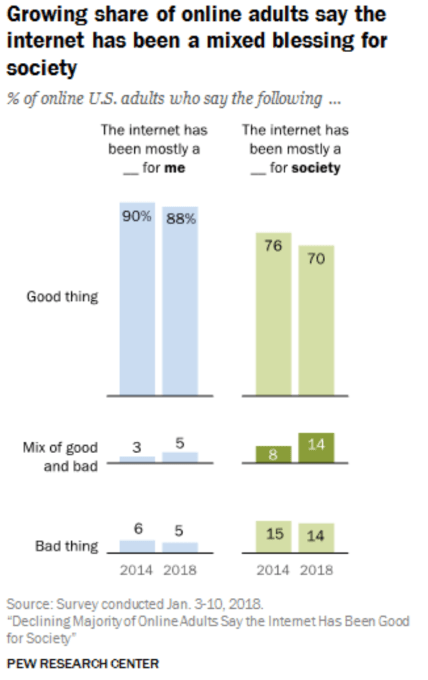
A growing number of U.S. adults no longer view the internet as a largely “good thing” for society, according to a new report from Pew Research Center out today. To be clear, a sizable majority –  70 percent – continue to believe the internet’s development has been mostly good. But that number has dropped by 6 percentage points since 2014, the study finds. Meanwhile, more adults now perceive the internet – perhaps more accurately – as something of a mixed bag. That number has climbed from 8 percent in 2014 to now 14 percent, Pew says.

However, the group of those who believe the internet is mostly a “bad thing” for society hasn’t changed much over the years. Those who can’t see the upside to global connectivity, has gone from 15 percent in 2014 down to 14 percent in 2018, which isn’t a notable difference, statistically.

Pew attributes the decline in the positive sentiment to the reactions from older Americans, and particularly seniors who have come online in growing numbers in recent years. According to data released by Pew last May, for example, Americans 65 and older now account for 15 percent of the overall U.S. population. And by 2050, 22 percent of those 65 and older will be online.

Like most Americans, the large majority of the senior group still feels the internet is mostly a good thing – but that number has dropped 14 points from 78 percent in 2014 to 64 percent today.

In addition to seniors, a smaller number of younger U.S. adults today believe that the internet is “mostly good.” While again, that sentiment is still held by the large majority by far – 74 percent say this is their opinion – that number has fallen from 79 percent in 2014.
 

Pew’s report didn’t detail why more U.S. adults are increasingly ambivalent about the internet. Instead, it focused on the reasons cited by the group who claims it’s “mostly bad.” (Presumably, these sentiments are shared by those who now believe the internet isn’t mostly good.)

The adults who think the internet is “mostly bad” had a large list of grievances, as it turned out. And their top concerns are somewhat surprising.

A quarter of the internet’s naysayers cited its paradoxical ability to isolate people even as it connects them – saying it leads to people spending more time with devices instead of with other people.

16 percent mentioned the problems related to the spread of misinformation and fake news, and 14 percent were concerned about the effect the internet has on children. Another 13 percent said it encourages illegal activity.

Only a small share – 5 percent – were worried about their privacy and their personal information being shared online.

That small percentage focused data privacy concerns is interesting – especially in the wake of the Cambridge Analytica data privacy scandal, where the personal data of some 87 million Facebook users was hijacked without their knowledge or consent. Instead, Pew’s data seems to imply that people are generally more upset about the cultural and emotional impacts attributed to the internet, rather than having their personal data stolen or misused.

Maybe that’s because personal data has already been stolen time and time again, through security breaches at places like Yahoo, Equifax, Target, Home Depot, JP Morgan Chase, Anthem, and others. Or maybe it’s because users have a hard time identifying or understanding the real-world impacts of personal data breaches, unless it leads to some concrete changes – like identity theft or targeted harassment. Or maybe people already assume the days of personal privacy online are long dead, and just shrug their shoulders at new reports of yet another breach of trust with a fatalistic, “oh, who was it this time?”

In any event, it’s already been observed that the fallout from the Facebook scandal has been minimal, in terms of user behavior. There have been no sizable changes on that front, including user-initiated changes to privacy settings and sharing, The Wall Street Journal recently reported. In addition, Facebook just surprised investors by reporting continued user growth and beating earnings expectations.

Pew’s data supports the idea that more users seem to think – despite everything that’s happened – the internet is still mostly a good thing. And if there are concerns, they’re around its ability to lessen our connections to others – because we’re spending too much time online, fighting about information because we read different sources, or because we’re worried how it’s impacting our kids.

Meanwhile, those with a more positive take on the internet cited reasons like how it makes information much easier and faster to access (62% said this). 23 percent saw its networking benefits as a largely good thing – including connecting with others, and keeping up with friends and family.

Unrelated to perceptions about the internet, Pew also reported today that one-in-five Americans (20%) are now “smartphone only” internet users at home – meaning, they don’t subscribe to broadband. This is up 7 percent from 2015.

The figure is associated with those living in low-income (<$30K/year) households and those who are less likely to have attended college – it’s not some sort of reaction to concerns about the internet’s impact.


30 Apr 2018

The Pentagon is working on a radio wave weapon that stops a speeding car in its tracks

Vehicular terrorism is on the rise, but technology under development by the U.S. Department of Defense could save lives by disabling a weaponized car before it ever reaches its target. The Pentagon’s Joint Non-Lethal Weapons Program (JNLWD) is working on a device called a Radio Frequency Vehicle Stopper to address the prevalence of vehicle-based attacks targeting civilians, Defense One reports.

To prevent this kind of violence and other kinds of vehicular attacks (an unauthorized car rushing behind a military security gate, for instance), the Pentagon’s Radio Frequency Vehicle Stopper points high powered microwaves at a vehicle, disabling its electrical components via the engine control unit and making the engine stall out. You can watch the technology in action in the Department of Defense video below.

As Defense One reports, the group is developing two version of its technology, one with a 50-meter range small enough to fit in a truck bed and another larger version with a range of more than a hundred meters designed to remain in place. The latter would particularly be useful in the kind of open public spaces that lend themselves to violent vehicular attacks in popular urban areas like markets and shopping hubs. This kind of technology is only becoming possible now due to breakthroughs in powering the concentrated beams emitted in these kind of notoriously energy-hungry weapons.

While vehicle-based attacks were once rarely observed outside of war-zones, they’ve occurred with increasing frequency in high-density urban areas and tourist destinations in recent years. As the attack in Toronto last week proved, the results are effortlessly deadly to unsuspecting pedestrians. It’s unfortunate that such a device is necessary at all, but if they were to become readily available, these Radio Frequency Vehicle Stoppers could discourage the rising trend of vehicular attacks, protect victims when they do occur and help law enforcement obtain additional intelligence by apprehending suspects without resorting to lethal violence.

30 Apr 2018

Amazon exec Charlie Kindel says he’s leaving to take a serious break from ‘work’

Amazon is famous for its hard-charging work culture, and Charlie Kindel, an Amazon executive who helped shape the rise of Alexa, is ready to hit the pause button after a five-year stint with the company and three years with the team at work on the company’s smart home division.

Writing on his personal blog earlier today, Kindel shared the memo that his colleagues received last week to explain his decision. In a nutshell, Kindel told them, he’s burnt:

The pace of the past 5 years has finally gotten to me and I simply need to catch my breath. I’ve recently been joking with folks that “I used to get my adrenaline rush going heli-skiing. Now I just go into work.” I have a car restoration project that is two years behind schedule. My home automation system needs a complete revamp (it’s gotten a bit crusty since it was installed in 2001).

I was originally just going to take a temporary leave, but I like the idea of having total freedom of thought to decide what’s next in my life. By making a clean break from Amazon all options (including coming back to Amazon) are still on the table.

Kindel, who held a director level role at Amazon, said on his blog that his last day with the e-commerce juggernaut was Friday.

Before joining Amazon, Kindel had held the role Microsoft Windows Phone general manager. He has also dabbled in the world of startups, including starting a company called FreeBusy whose tool used artificial intelligence to generate mileage logs using users’ cloud-based calendars. That outfit has more recently evolved to center around an AI scheduling assistant.

30 Apr 2018

Check out the latest featurette for Star Wars: A Solo Story

On May 25, the latest installment of the Star Wars theatrical franchise will drop in theaters.

Shooting Star Wars: A Solo Story hasn’t been all roses, with Ron Howard stepping in to take over for directors Phil Lord and Chris Miller and reshooting many scenes. But the show must go on!

Yesterday, Lucasfilm released a featurette with interviews from the cast and crew talking about the making of the film and Han Solo as a character.

The featurette also includes some new footage beyond what we’ve seen in the trailers, such as Han fighting alongside Tobias Beckett (Woody Harrelson) and Val (Thandie Newton), alongside previously teased scenes like the train heist on Vandor and the scene where Han Solo wins the Millenium Falcon from Lando (Donald Glover).

Central to the featurette, and the film in general, is that the story takes place in a type of world we haven’t seen yet on Star Wars, where the galaxy is completely under the control of the Empire, Howard reminds us. These circumstances push Han Solo, already a free spirit, to become the character we’ve come to know and love.

Check out the featurette below:

30 Apr 2018

SoFi founder Mike Cagney is back with a new startup and $50 million in funding, too

Mike Cagney, who was ousted last summer from the lending company he founded, is back with a new startup and a whole lot of funding from at least one of his previous investors.

According to a new report in Bloomberg, Cagney, who earlier this year formed a new lending startup called Figure, has raised $50 million to grow the company, which plans to use the blockchain to facilitate loan approvals in minutes instead of days.

According to the company’s site, its lending products will include home equity lines of credit, home improvement loans and home buy-lease back offerings for retirement.

The round was led by DCM Ventures and Ribbit Capital and included participation from Mithril Capital Management, Cagney confirmed to Bloomberg.

Ribbit Capital in Palo Alto, Calif., has been leading investments in the world of fintech and digital currencies from its founding nearly six years ago. Others of its many bets include the online consumer lending company Affirm and Point, a startup that buys equity in U.S. homes.

Mithril, co-founded by Peter Thiel, prides itself on funding companies that take time to build, with funds that have longer investing timelines than do most traditional venture vehicles.

The cross-border firm DCM Ventures, meanwhile, is perhaps the most interesting participant in this round. The reason: Back in 2012, DMC began investing in Social Finance, or SoFi, the company that Cagney founded previously.

It isn’t uncommon for VCs to invest in founders with whom they’ve worked before, of course. And SoFi — which initially focused on refinancing student loans, today provides personal and mortgage loans and wealth management services, and appears to be pushing further into bank-like services — has grown by leaps and bounds since its August 2011 launch.

But Cagney was forced out of the company last summer, not long after a sexual harassment lawsuit was filed by a former employee who claimed he’d witnessed female employees being harassed by managers and was fired after he reported it.

Another former employer who’d worked at the company’s office in Healdsburg, Calif., told The New York Times that her work environment had been akin to a “frat house,” with employees “having sex in their cars and in the parking lot.” That same story, based on conversations with 30 then-current and former employees, also reported that Cagney himself had raised questions with staff because of his own behavior, including bragging about his sexual conquests.

Evidently, DCM and Figure’s other backers were able to brush aside concerns about anything of the sort happening again at Figure. (We’ve reached out to Cagney and Figure’s investors for more information and hope to have more for you soon.)

Employees are also signing up for Figure with the belief, ostensibly, that Cagney is well-positioned to create another financial services juggernaut. According to Bloomberg, Figure has already quietly assembled a team of 56 people. Among its new hires is the former chief risk officer of LendingHome, Cynthia Chen, and the former chief legal counsel of PeerStreet, Sara Priola.

30 Apr 2018

Google teams with NBC to build VR content for its TV shows

Virtual reality has yet to hit the big time with the vast majority of consumers — headset sales are still in the single-digit millions — but today Google and NBC announced a deal to make programming that could help the medium pick up some more mainstream appeal. The two said that they will be working together to produce at least 10 multi-episode VR productions that will run as extra content alongside core programming on NBC itself and its network of other channels.

Users can watch in VR on Google Cardboard or Daydream View, and it will also be hosted on YouTube for those not immersively inclined. Google said that it will also down the line make some of the content available on the VR180 format for 4K, three-dimensional video.

Initial programs that will get the VR treatment include NBC’s “Saturday Night Live” (which has already produced a selection of VR productions here, here, and here); reality show “Vanderpump Rules” from Bravo; and content from SYFY WIRE, the website for the Syfy TV channel.

With VR still a relatively young industry, and Google continuing to develop its own internal capabilities, there are a number of routes that can be taken to capture the experience. In this case, it looks like Google will be using the deal with NBC to promote and use Jump, its own platform for VR video capture that it first launched back in 2015.

We’ve asked Google if it can give more details regarding the business relationship with NBC, and we will update this post as we learn more. For now, it’s another opportunity for Google to develop more premium content — creating a new set of videos against which to sell advertising — and working alongside NBC Universal to help it also update its content for new and different audiences.

This is not the first time that NBC Universal has tried out content on VR: as one example it also worked with Intel and Oculus to bring Olympic content to headsets.

It’s also become a very standard part of TV programming to develop additional content that can be watched by fans alongside the core TV show, to help extend touch-points with an audience who may otherwise only be seen for 22 minutes each week, at best. VR presents another opportunity for that, too.

“We are constantly looking for opportunities to bring consumers new ways to experience content from across the NBCUniversal portfolio,” said Ron Lamprecht, Executive Vice President, NBCUniversal Digital Enterprises, in a statement. “This partnership combines the creative expertise of NBCUniversal with Google’s VR capabilities to create these engaging experiences. We look forward to working with Google and YouTube on more collaborations like this in the future.”

Google has also been looking for more ways to cosy up to premium content companies to develop content for its platforms, partly to secure those relationships for a future where it might find itself competing for a content-hungry VR audience, and partly to help try to create that audience today. Other partnerships have included deals with HBO and Netflix.

“NBCUniversal’s networks and shows have a proven track record of high-quality storytelling that audiences can’t get enough of. Bringing them to VR lets fans connect with that content in a whole new way,” said Amit Singh, VP of business and operations for VR and AR at Google, in a statement. “NBCU’s teams were able to easily capture engaging VR content using the latest VR Jump cameras. And with YouTube, audiences can experience it on any device, bringing them closer to their favorite series.”