
Year: 2018

25 Apr 2018

For the first time, parents can limit YouTube Kids to human-reviewed videos and recommendations

To address parents’ concerns over inappropriate content on YouTube being seen by children, Google today is announcing an expanded series of parental controls for its YouTube Kids application. The new features will allow parents to lock down the YouTube Kids app so it only displays those videos that have been reviewed by humans, not just algorithms. And this includes both the content displayed within the app itself, as well as the recommended videos.

The controls will be opt-in – meaning parents will have to explicitly turn on the various settings within each child’s profile in YouTube Kids’ settings.

Launched under three years ago, YouTube Kids has been a breakout hit – at least  in terms of usage metrics. Over 11 million children launch the app weekly, and over 70 billion videos have been viewed in the app to date. However, from a public relations standpoint, the app has been a nightmare – inappropriate, and sometimes horrific, videos have slipped past the algorithms, leading to outrage.

The issue has to do with how the YouTube Kids app works. First, videos are uploaded to YouTube’s main site. They’re then filtered using machine learning techniques through a series of algorithms that determine if they should be added to YouTube Kids’ catalog.

But algorithms are not people, and they make mistakes. To fill in the gaps in this imperfect system, YouTube Kids relied on parents to flag suspect videos for reviews.

YouTube employs a dedicated team of reviewers for YouTube Kids, but it doesn’t say how many people are tasked with this job. (That’s a bit concerning, as it could mean it’s fewer than we’d like to see.)

This system, parents have felt for some time, just wasn’t good enough.

But instead of turning YouTube Kids into a hand-curated collection of “safe” content, the company has steadily added more controls to limit kids’ access to videos, in response to parents’ concerns.

For instance, it added a setting to disable search. But even with this on, kids would be recommended videos that only an algorithm had “reviewed.”

And, as any parent will tell you, even one bad video is one too many.

A single viewing of a scary video can lead to weeks of nightmares; and videos with bad language or mature subject matter are just as awful, from a parent’s perspective.

One high profile example of the horrors on YouTube were those videos that took a child’s favorite characters and showed them in violent situations – like “Peppa the Pig” drinking bleach or eating her father. These are offensive to not just to parents, but to many people who don’t think cruel parodies are funny. And yet they kept getting uploaded to YouTube, where they’ve confused its algorithms, much to parents’ disgust and dread.

Even beyond these extreme examples, some parents are uncomfortable with the nature of many YouTube videos themselves. We’ve found our kids watching barely disguised commercials when they’re too young to know the difference between product placements and content. We cringe as prepubescent YouTube stars sass their moms and dads and whine about doing homework. We’re sick of YouTube dictating house-ruining trends like the DIY slime craze. And sometimes, we just can’t stand to hear Jojo Siwa sing.

The updated version of YouTube Kids will let parents turn all that crap off.
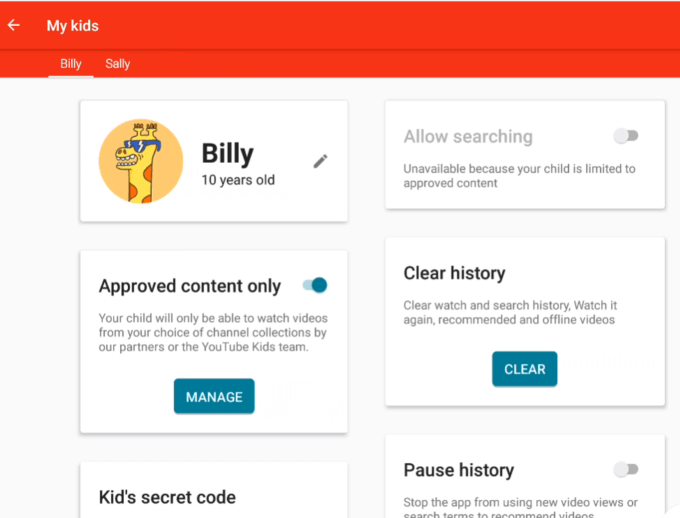
Now, when parents disable the search function on a child’s profile, a new toggle for “Approved content only” turns on.

This is different from how disabling search used to work. Before, this removed the search box from the app, but any video from YouTube Kids’ larger catalog could still appear in recommendations. Going forward, when parents make the choice to turn off search, they’re also limiting recommendations to human-approved content as well.

At last.

What took you so long, YouTube?

Meanwhile, within the new “Approved Content Only” section, parents can drill down even further to pick what human-reviewed content gets shown. They can choose from collections of videos built by YouTube and trusted partners including Sesame Workshop, PBS Kids, and Kidz Bop. The collections span categories like “arts, crafts & DIY,” “gaming,” “learning,” “music,” and more.
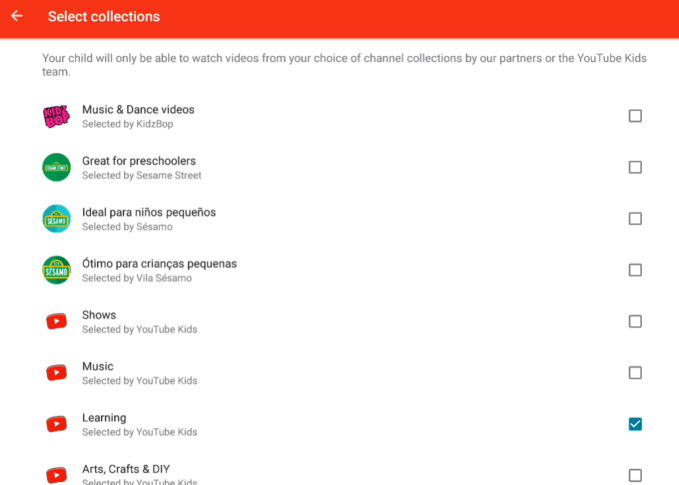
By default, none of these collections are selected, so parents have to make explicit choices about what kids can watch.

A later version of YouTube Kids will go even further – allowing parents to select individual videos or channels they approve of, for a truly handpicked selection.

“Over the last three years, we’ve worked hard to create a YouTube Kids experience that allows kids to access videos that are enriching, engaging and allows them to explore their endless interests,” says Malik Ducard, Global Head of Family and Learning Content for YouTube.

“Along the way, we’ve never stopped listening to feedback and we’re continuing to improve the app. In addition to all the work our teams are doing behind the scenes to make the experience the best it can be, we’re also offering parents even more options to make the right choice for their family and for each child within their family,” he adds.

Parents should probably just enable all the settings to narrow YouTube Kids down to only human-reviewed selections as soon as the settings option appears. (Just be prepared for the whining and begging that will result when you turn off access to favorite videos and annoying channels. My suggestion? Threaten to delete the app entirely.)

Kids never should have had unfettered access to YouTube, or even semi-filtered access like the YouTube Kids catalog in the first place. It should have begun as a human-reviewed catalog by default, then slowly added options to expand access over time, including the manual whitelisting of channels.

After all, this isn’t Netflix Kids over here – it’s the weird, unpredictable and sometimes scary internet…in video format.

The new features in YouTube Kids will roll out over the course of the year, the company says, with everything but the explicit whitelisting option arriving this week.


25 Apr 2018

Netflix picks up ‘Follow This’, a weekly series about BuzzFeed reporters

Netflix and BuzzFeed News are teaming up for a 20-episode documentary series called Follow This.

According to Variety, the show will be less focused on breaking news and more on taking us behind the scenes to show how BuzzFeed News reporters put together specific stories. For example, in the clip below, BuzzFeed’s Scaachi Koul talks about her reporting around ASMR.

Follow This will be produced by BuzzFeed News, with Jessica Harrop serving as showrunner and one of its executive producers. When it premieres on July 9, it won’t follow Netflix standard release strategy. Instead, a new 15-minute episode will come out every week.

Netflix executives have been emphatic about wanting to stay out of the live news business, but the streaming service has introduced more news-and reality-based programming over the past few years, including documentaries (like an upcoming film from Vice Media’s Motherboard) and talk shows.

BuzzFeed, meanwhile, has been creating video series for a variety of channels, including its AM to DM series for Twitter. The company told Variety it’s also pitching cable networks on a nightly news show.

25 Apr 2018

Rocketrip raises $15 million to reward cost-saving employees

If your company lets you expense the nicest hotel when you travel, why wouldn’t you?

But what if you got to split the savings with your employer by selecting a less expensive hotel?

A New York-based startup called Rocketrip believes most employees will opt to save companies money if they are incentivized to do so. It’s built an enterprise platform that rewards employees with gift cards if they go under budget on travel and transportation.

After five years of signing up business clients like Twitter and Pandora, Rocketrip is raising $15 million in Series C funding led by GV (Google Ventures) to keep expanding. Existing investors Bessemer Venture Partners and Canaan Partners are also in the round.

Inspired by Google’s internal travel system, Rocketrip CEO Dan Ruch calls his solution a “behavioral change platform.”  Employees “always optimize for self preservation, self interest” and are likely to book a cheaper flight if it means a gift card at a place like Amazon, Bloomingdale’s, or Home Depot, Ruch claims. He said that the average business trip booked by Rocketrip saves companies $208.

Ruch believes that Rocketrip has built a currency that motivates teams. He says some employees even gift Rocketrip points to congratulate colleagues on birthdays and promotions.

When it comes to enterprise platforms, Rocketrip is “one of those unique situations where everyone is really excited to use it,” said Canaan Partners’ Michael Gilroy, who holds a board seat.

Yet Rocketrip is not the only startup looking to help employees make money by cutting on costs. TripActions and TravelBank have also created similar businesses. 

Gilroy insists that “Rocketrip was first” and that he views the others a “validation of the model.”

Rocketrip hopes to someday expand beyond travel to incentivize healthcare choices like quitting smoking. It also thinks companies will use Rocketrip points to reward employees for community service. “Any time we can motivate an employee,” there’s an opportunity for Rocketrip, Ruch believes.

25 Apr 2018

Netflix has a lot of original content coming in May

Get outside and enjoy the next few days of spring while you still can, because Netflix has plans to keep you on the couch throughout next month. The streaming giant is releasing 36 original titles over the course of May, including some notable series such as a new season of Unbreakable Kimmy Schmidt and Dear White People: Volume 2.

The May schedule comes fresh on the heels of Netflix announcing its intention to raise another $1.5 billion in debt financing to fund its original content push.

And so the binge-viewing continues…

If you’re looking for some new movies and series to watch, look no further than the schedule below:

May 1

May 4

May 6

May 8

  • Hari Kondabolu: Warn Your Relatives

May 11

May 13

May 18

May 22

May 23

  • Explained

May 24

May 25

May 26

  • Sara’s Notebook

May 27

May 30

May 31

Of course, we’ll be discussing all of this on the Original Content Podcast each week, so be sure to check that out, too.

25 Apr 2018

Gfycat ramps up its focus on game clips and highlights as it hits 180M monthly users

Gfycat is already a pretty popular host for lots of content like short clips from shows and movies, but there’s also a pretty substantial store of content centered around gaming — which is why the company is starting to put some extra focus on it.

Gfycat, which is centered around creator tools to make those short-form video clips and GIFs, said it’s going to create an interface specifically designed for gamers. Called “Gfycat for gaming,” the startup hopes to ride both the wave of ever-omnipresent GIFs getting shared around the internet and popular, highly shareable game titles like PlayerUnknown’s Battlegrounds and Rocket League. GIFs serve as a pretty good vehicle for delivering highlight reel clips for those games, which is why it’s going to be putting some extra focus on that audience. Gaming is one of the most popular verticals on Gfycat, CEO Richard Rabbat said.

“As we were looking at different verticals, gaming is such a strong vertical, and we wanted gamers to get an experience that just really speaks to what they’re looking for,” he said. “We wanted to just focus on that as opposed to content that was much more mixed. You see a lot of teams or players that will play for hours, but that exciting moment was like 10 seconds or 20 seconds. They want to capture them and keep them, to chat about them, and share them.”

While the platforms are certainly a big component of this, creator tools for getting that content onto the Internet is also a pretty big segment. That’s what Gfycat focuses on, and the company says it has 180 million monthly active users, which is up from 130 million monthly active users in October last year. The service has more than 500 million page views every month, Rabbat said.

There are two changes that are coming with this update: first, there will be a direct home for gaming highlights on Gfycat, where users can follow creators in that area; second, the time limit for Gfycat clips is growing to around 60 seconds instead of just 15, which is a soft change the company made in the past few months. Both are geared toward making content more shareable in order to grab those highlights, which might not just fall into 15 second buckets. Down the line, the company will start working on subscribing to specific channel.

“A lot of gaming moments are created in 10 or 15 seconds,” Rabbat said. “Some of the gamers have been asking us for a longer period. We moved from 15 seconds to 60 seconds so people can share exciting experiences that take a little more time. GIFs are not only just a moment but also it’s a bit of storytelling. We wanted people to have the ability to do that storytelling.”

GIFs are already a big market, and there has even been some activity from the major players looking to dive further into that type of content. Earlier this month, Google acquired Tenor, a GIF platform that has its own keyboard and integrates with a variety of messenger services — even ones like LinkedIn. That a tool like Tenor or Giphy has grown to encompass all those messaging tools is just a further example of how much of an opportunity platforms centered around GIFs have.

The short-form video clips, as Gfycat likes to label them, are a good form factor for compressing a lot of information into a unit of content that’s easy to share among friends or an audience on the Internet. Rather than just sending a text message, a GIF can convey some element of emotion alongside just the typical information or response some user is trying to achieve. That’s led to a big boom for those companies, with Tenor hitting 12 billion GIF searches every month as an example.

25 Apr 2018

Apple TV and Android see increase in streaming video viewership in Q1

Conviva, a video AI platform with visibility into the streaming market through clients like HBO, Turner, Hulu, CBS, NBC, ESPN, BT and Sky, is reporting today 114 percent year-over-year growth in streaming video hours in Q1 2018 to reach nearly 5 billion hours of video viewing. Even though streaming is growing worldwide, North America saw the largest growth in viewing hours, with a 174 percent increase quarter-over-quarter. Other platforms seeing notable increases included Apple TV and Android, the report found.

Much of today’s streaming takes place in apps on mobile devices and internet-connected TVs, as opposed to the web. That led to these platforms seeing significant growth in the quarter, with app-based viewing up 136 percent since last year.

Device makers which provide the apps, including Apple and Roku, also benefited from the growth in streaming, the report found. Apple TV, for example saw 709 percent growth in viewing hours over last year, while viewing hours on Roku grew by 87 percent.

Keep in mind that growth is not the same as popularity – that is, it’s not about how many total hours are being viewing on those platforms. Roku is still far in the lead on that metric, with over a billion hours streamed versus Apple TV’s 256 million. (Conviva’s numbers, because of the source of its data, are only a window into the market, we should note. Roku users streamed a little under 15 billion hours last year, so they’re streaming more than a billion per quarter. But Conviva’s report does speak to the bigger picture where Roku is outpacing rivals on streaming hours, including Apple TV, Chromecast, Fire TV, and others.)

Another interesting finding for the quarter was the growth in streaming on Android devices. On Android, device plays were up 168 percent quarter-over-quarter, versus iOS’s 138 percent increase.

More details are below:

25 Apr 2018

Check out these amazing demos at TC Sessions: Robotics May 11 at UC Berkeley

We’re a mere two and a half weeks out from TC Sessions: Robotics, and we couldn’t be more excited. We’ve got a full day schedule packed to brim with some of the greatest minds and machines the robotics industry has to offer.

On the human side, we’ve already announced Andy Rubin, Laura Tyson, Marc Raibert, Robert Full, Melonee Wise, Ayanna Howard, Pieter Abbeel, Chris Urmson and more. As for robots — well, we’ve got plenty of awesomeness to offer on that front, too.

UCLA professor Dennis Hong will be joining us on-stage to present the latest work from his lab’s work int the fields of bipedal and humanoid robots. The team has promised a packed demo featuring a number of  its robots including the sideways walking NABi: Non Anthropomorphic Biped, along with some other surprises.

We’re also excited to take the stage with the latest version of Boston Dynamics amazing electric SpotMini quadruped. The robot has already shown off its ability to open doors and pal around with Jeff Bezos, and now Boston Dynamics founder Marc Raibert will be putting it through its paces on stage at the event.

Oregon-based Agility Robotics will also be on hand at the event, showing off its bipedal robot, Cassie in rare public demo. The ostrich-esque robot could one day be used for package deliveries or other service jobs.

U.C. Berkeley professor and SuitX cofounder Homayoon Kazerooni will be on-hand to present his startup’s work in the field of robotic exoskeletons. SuitX is building low-cost, wearable devices designed for industrial works and rehab patients.

Professor Ken Goldberg, meanwhile, will be demonstrating his lab’s Dex-Net system, which utilizes an off-the-shelf industrial robotic gripper trained on a deep neural network. The system is capable of performing extremely dexterous pick and place functions that could prove extremely useful in an industrial setting.

Click here to see the full agenda, workshop schedule and to check out more speakers.

Buy your ticket today.

Student tickets are just $45 — you can book those here.

We’re always on the lookout for great sponsors; connect with us here about sponsorship opportunities for this landmark event.


25 Apr 2018

The DOJ is investigating potential Huawei violations of Iran sanctions

Another shoe, so to speak, may be about about to drop for Huawei. According to new reporting from The Wall Street Journal, the Justice Department has been investigating a potential violation of U.S. sanctions on Iran by the Chinese smartphone maker.

The probe reflects a similar one into ZTE that landed that device maker in serious hot water. The company was hit with an $892 million fine last year. Earlier this month, the DOJ imposed an even harsher penalty after it deemed ZTE guilty of violating the terms of that agreement, ultimately barring U.S. tech companies from selling to it, a move smartphone manufacturer said would “severely impact” its survival.

Of course, this isn’t the first time Huawei and ZTE have been on the same side of U.S. government scrutiny. Intelligence agencies have lodged harsh criticism at both over perceived ties to the Chinese government. Huawei, however, has long gotten the short end of that stick, with U.S. carriers and retailers refusing to stock the company’s products, significantly derailing its hopes of tackling the American market.

Details of this new probe are pretty scant at the moment. We’ve reached out to Huawei for comment, but I don’t anticipate much in the way of insight there. It’s probably in the company’s best interest to wait this one out. Of course, in the past, Huawei has made it clear that it feels unfairly targeted by the U.S. government — and there is the broader context of what appears to be a looming trade war between the U.S. and China.

Was does seem clear, however, is that things aren’t likely to get much better for Huawei anytime soon with regard to the U.S. market. The company has, understandably, been shifting its global plans, accordingly.

25 Apr 2018

Didi appoints one of its execs to lead ride-hailing service 99

Didi, the Chinese transportation behemoth that acquired Brazilian ride-hailing service 99 back in January, has replaced 99’s chief executive with one of its own, Recode first reported.

Stepping in to replace Peter Fernandez is Tony Qiu, who most recently oversaw Didi’s luxury business. Before joining Didi, Qiu had stints at Morgan Stanley and Bain Capital. Fernandez will remain on board as a strategic advisor for 99.

“99 stands at an extraordinary moment for future growth,” Qiu said in a press release. “Our 99 team has unrivaled commitment and experience in serving local communities and their transportation needs. With the solid support and resources of DiDi, we will continue to innovate and improve the lives of millions of Brazilians with faster, safer and more affordable transportation options.”

99’s head of policy, legal and communications, Matheus Moraes, will also become president of 99 to oversee the service’s daily operations. This leadership change comes just a couple of days after Didi launched its ride-hailing service in Mexico. As TechCrunch’s Jon Russell noted, Mexico is Didi’s first organic expansion into other markets. In Brazil, Didi acquired 99 and in Taiwan, Didi used a franchise-based model.

Prior to becoming chief executive at 99, Fernandez served as the company’s chief product officer for nearly one year. He had previously spent about five years at Google, where he was head of YouTube and, at one point, head of mobile and social for Latin America.

25 Apr 2018

Zume looks to life beyond pizza

Launch a fleet of robotic pizza vans and you’re going to get painted as the robotic pizza company. It’s a hard label to shake off — but as far as labels go, it’s a pretty cool one. Even so, Zume Pizza has long made it clear that has broader plans to move beyond pizza delivery, in order to serve the broader food industry as a whole.

The first step toward that more ambitious approach is today’s news that company is forming Zume Inc., a larger umbrella under which the Zume Pizza brand will continue to exist, and focus on that titular foodstuff. The broader company, on the other hand, will provide its technological know-how to any restaurants that want to get into the food truck game.

In an conversation with TechCrunch, CEO Alex Garden floated coffee, steamed buns and frozen yogurt as possibilities — though specific restaurants have yet to be announced. What is clear, however, is that Zume is now positioning itself as more of a platform, rather than any specific individual food or piece of kitchen hardware.

“Pizza was our prototype,” says Garden. “There’s no reason why this technology wouldn’t work for any restaurant or any food category. Any restaurant who wants to adopt our system can now easily do that. They don’t have to be experts in technology or appliance manufacturing. They can just be restauranteurs, who have a more flexible offering for customers.”

The company’s primary play is utilizing AI, automation and a host mobile kitchen technologies designed to predict food trends, in order to meet customers where they are, and offer them freshly cooked foodstuffs ready before they order them.

“The Zume magic is its ability to predict what people order before they do,” Garden explains. “And then, based on those signals, you can make and locate that inventory. Havig located it, you can bake it just in time without using any chemical tricks or processed foods. It’s about prediction and forward deployment.”

The startup is also announcing a partnership with Welbilt. The Tampa-based industrial appliance conglomerate will be designing hardware for version 2.0 of Zume’s trucks, designed to service a broader assortment of foods, moving forward. The company’s new version of the oven is cheaper and more versatile than the proprietary appliances Zume’s pizza trucks have been cruising around with, thus far.

All of this also comes with some key new hires. Former Comcast/Nike executive Chris Satchell will be coming on as CTO, Kira Druyan, who was previously at Starbucks, will be the company’s new General Counsel, and Tracey Forster, formerly of Johnson and Johnson is the new VP of marketing.