Year: 2018

25 Apr 2018

The FDA is cracking down on Juul e-cig sales to minors

The FDA has its eye on Juul Labs, the e-cigarette company that has captured nearly half of the $2 billion e-cig market.

Yesterday, the U.S. Food and Drug Administration Commissioner Scott Gottlieb announced a new initiative called the Youth Tobacco Prevention Plan. While the agency is focused on making sure kids don’t have easy access to any e-cigs, the Juul vaporizer seems to be of particular concern to them.

As part of the initiative, the FDA has sent a request for information to Juul Labs in an effort to understand why young people are so attracted to the product.

Over the past year, a number of reports have suggested that teen vape use, especially with the Juul, is steeply on the rise.

The request is for documents related to “product marketing; research on the health, toxicological, behavioral or physiologic effects of the products, including youth initiation and use; whether certain product design features, ingredients or specifications appeal to different age groups; and youth-related adverse events and consumer complaints associated with the products.”

In response, Juul Labs issued a press release announcing its plan to combat underage use. The strategy includes an initial investment of $30 million over the next three years going towards independent research, youth and parent education and community engagement efforts. Juul Labs also said it will support federal and state initiatives to raise the legal minimum purchase age to 21+. The company website has required that purchasers be 21 or older since August 2017.

Here’s what Juul CEO Kevin Burns had to say about it:

Our company’s mission is to eliminate cigarettes and help the more than one billion smokers worldwide switch to a better alternative. We are already seeing success in our efforts to enable adult smokers to transition away from cigarettes and believe our products have the potential over the long-term to contribute meaningfully to public health in the U.S. and around the world. At the same time, we are committed to deterring young people, as well as adults who do not currently smoke, from using our products. We cannot be more emphatic on this point: No young person or non-nicotine user should ever try JUUL.

Juul Labs is not the only organization that the FDA is cracking down on. The agency said it had sent out 40 warning letters to retailers selling e-cigs, including the Juul, to minors. Some of those retailers were caught as the result of a ‘blitz’ that has been underway since the beginning of April.

The agency has also asked eBay to take down all listings of Juul vaporizers, which run the risk of being sold to minors.

Alongside the FDA’s request for information from Juul Labs, the agency is also sending out similar letters to other e-cig manufacturers.
25 Apr 2018

Facebook warns GDPR could flatten or reduce European user count

Europe’s sweeping privacy law GDPR goes into effect May 25th, and Facebook is being forced to push users through new agreements to terms of service changes required to comply with the law. That’s why during today’s successful Q1 2018 earnings report call, Facebook CFO David Wehner warned that “we believe MAU or DAU might be flat or down in Q2 due to the GDPR rollout.” He also said that while Facebook doesn’t expect a significant impact on ads from GDPR, there may be a slight impact and it will be monitoring for that. Wehner notes that GDPR will impact the global online advertising industry so it may be hard to tell what the exact repercussions are for Facebook.

“Fundamentally we believe we can continue to build a great ads business” while continuing to protect people’s privacy, Wehner explained. He said what’s important is Facebook’s relative value to advertisers, which theoretically shouldn’t change since all ad platforms are impacted by GDPR.

Facebook unveiled its GDPR-related changes and how users will be asked to consent to them last week, and drew heavy criticism. Facebook employed “dark patterns” in the design of the consent flow, coercing users to agree to the changes without fully considering them. Meanwhile, it minimized the size and visual prominence of the buttons to revoke permissions from Facebook or reject the changes outright and terminate their account.

Facebook was likely trying to minimize the disruption to the user experience and thereby its user count with this shady design methodology.

Read our full story on Facebook’s Q1 2018 earnings:

25 Apr 2018

Facebook’s Internet.org has connected almost 100M to the “Internet”

Facebook is getting the developing world online, even as the developed world criticizes its privacy practices. Mark Zuckerberg said today on Facebook’s Q1 2018 earnings call that “our Internet.org efforts have helped almost 100 million peopel get access to the internet who may not have had it otherwise”. That’s up from 40 million in November 2016.

Internet.org uses its Free Basics app with access to low-bandwidth services and Express Wi-fi hotspots operated by local merchants to give people connectivity. Facebook is also testing its Aquila solar powered drone which will be able to beam bandwidth down to users in remote areas.

Most recently, Facebook is reported to be seeking government approval to test Aquila for delivering LTE access in New Mexico.

However, Facebook has received backlash from some who believe that Free Basics violates net neutrality because it doesn’t give completely unfettered access to the open web. That led the app to be banned in India. Yet others believe that some Internet is better than none for those who wouldn’t otherwise be able to afford it. Facebook not only needs to build out the technology, but also the trust of the community if it wants to achieve its mission to get everyone online.

For more from today’s earnings, check out our full piece:

25 Apr 2018

PayPal shares tick up after surpassing expectations for the quarter

PayPal reported its first-quarter results after the bell on Wednesday, sending shares up about 3% in after-hours trading, due to better-than-expected numbers.

Adjusted earnings per share were 57 cents, above analyst estimates of 54 cents. Revenue for the quarter was $3.69 billion, up 24% from last year. Analysts surveyed by Yahoo Finance had been expecting $3.59 billion.

This comes from $132 billion in total payment volume, with $49 billion coming from mobile transactions. The company touted four consecutive quarters of accelerating revenue growth.

PayPal also raised guidance, expecting revenue for the quarter to be between $3.78 and $3.83 billion. For the year, it is expected to be between $15.2 billion and $15.4 billion.

PayPal broke out results for Venmo, its popular peer-to-peer payments app. It processed $40 billion in payments over the last year and $12 billion in the first quarter.

PayPal added 8.1 million active accounts. Its average customer makes 34.7 transactions per year, an 8% increase from prior years.

PayPal repurchased 23.6 million shares of common stock last quarter, returning $1.83 billion to shareholders.

PayPal shares have doubled in the past year, but at $74, shares are beneath the high of $85 we saw last quarter. The company dipped following its last earnings report on news that eBay is looking to partner with competitor Adyen. 

PayPal and eBay were previously the same company, but the two separated in 2015. PayPal is the larger of the two businesses, with a market cap of nearly $88 billion. eBay is worth under $42 billion.


25 Apr 2018

Ford to stop selling every car in North America but the Mustang and Focus Active

Ford today announced it will phase out most cars it sells in North America. According to its latest financial release, the auto giant “will transition to two vehicles” — the Mustang and an unannounced vehicle, the Focus Active, being the only traditional cars it sells in the region. Ford sees 90 percent of its North America portfolio in trucks, utilities and commercial vehicles. Citing a reduction in consumer demand and product profitability, Ford is in turn not investing in the next generation of sedans. The Taurus is no more.

The press release also talks about a new type of vehicle, though it sounds like a crossover. This so-called white space vehicle will “combine the best attributes of cars and utilities, such as higher ride height, space and versatility.”

Currently, Ford sells six sedans and coupes in North America: the Fiesta, Focus, Fusion, C-Max, Mustang and Taurus. This lineup hits multiple segments, from the compact Fiesta to the mid-size Focus, C-Max and Fusion to the full-size Taurus. The Mustang stands alone as the lone coupe.

It’s likely Lincoln’s sedans will also disappear, though this was not explicitly stated in today’s press release. Lincoln currently sells the mid-size MKZ and full-size Continental — both share platforms with Ford counterparts. If Ford is phasing out development of sedan platforms, Lincoln will likely suffer, too.

This reduction in traditional cars was a long time coming. North America consumers have increasingly turned to crossovers, trucks and SUVs over sedans and small cars. A trip to any parking lot will likely produce more evidence to this movement. There are several factors involved, from more fuel-efficient and better-equipped trucks and SUVs to improved safety ratings and ride qualities of these vehicles.

Ford also today reaffirmed its commitment to bringing hybrid-electric powertrains to the F-150, Mustang, Explorer, Escape and upcoming Bronco.

This announcement comes several weeks after Ford explained in broad terms its love affair of trucks and SUVs. Ford estimates that SUVs could make up as much as half the entire U.S. industry’s retail market by 2020, and that’s why it’s shifting $7 billion in investment capital from its cars business over to the SUV segment. By 2020, Ford also aims to have high-performance SUVs in market, including five with hybrid powertrains and one fully battery-electric model.

With this big hybrid push on the SUV side, Ford expects to go from second to first-place in the U.S. hybrid vehicles market by sales, surpassing current leader Toyota by 2021, thanks also to the forthcoming hybrid Mustang and F-150.

The sedan was long a staple for Ford. The Lincoln Continental defined the ’60s. And then there was the Ford Galaxy, which was available in countless variations for nearly 20 years. Then in the ’80s came the LTD, Crown Victoria and Taurus. Ford even went rally racing with its cars, namely the Escort and later Focus. But while all these nameplates rose and fell, there was another always present: The Mustang.

Ford’s little pony turned 54 in April 2018. The Mustang has been in production since 1964 and seems ready for yet another generation of drivers. The car has been reinvented several times and will likely be reinvented several more before its nameplate is retired. For now, though, the Mustang is here to stay.

25 Apr 2018

Will Elon Musk give us the cyborg dragon we want, or the one we need?

It’s 2018. We need a stupid cyborg dragon. You know it, I know it. But only one borderline super villain billionaire is brave enough to actually build the damn thing. Elon Musk, who definitely doesn’t have too much time on his hands and more money than he can possibly spend in a lifetime, is finally building the damn thing. The thing that we definitely need and want. The cyborg dragon thing.

Kanye West may be messing about cruising around his Tesla with the Dilbert guy and taking meetings with some dude name Peter Teal, who made his mint creating the perfect blue/green hybrid, but Elon Musk is a man of action. Just look at all the hats and flame throwers he’s contributed to society.

Sure, Elon Musk saying he’s going to make a cyborg dragon could well be some Manchurian Candidate-style code phrase that transforms all of the world’s Model Xs into Geo Metros. More likely, it’s something to do with this Dragon. Or more likely, some Burning Man dealie. But listen, it’s been a tough week.

The only this thing that gets me out of bed anymore is the idea that somewhere, deep below the Atlantic Ocean, he’s creating some sort of robot dragon hybrid that will eventually befriend Dwayne Johnson. I really need this one, guys.

25 Apr 2018

Qualcomm delivers a better-than-expected second quarter amid its chaotic year

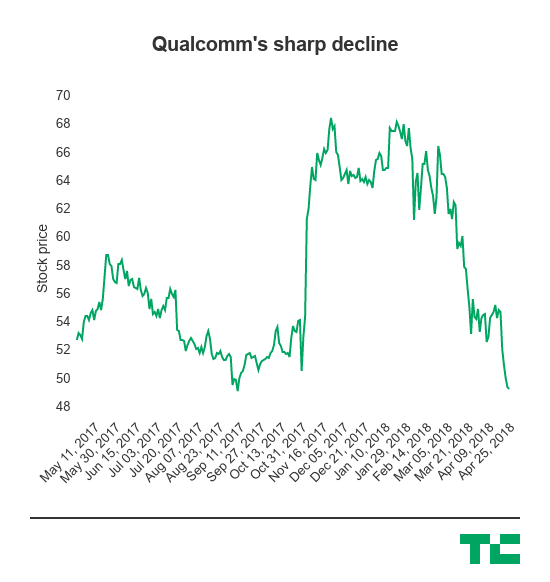
Fresh off a massive cascading series of fiascos that has thrown the future of Qualcomm into doubt, the company managed to report a mostly positive first quarter and keep the stock from going into a further tailspin.

Qualcomm has been under considerable pressure for a wide variety of reasons, the most obvious one of which is a massive takeover attempt by Broadcom falling apart. But beyond that, Qualcomm is facing issues trying to close its acquisition of NXP, faces a continued public spat with Apple, and is looking to cut costs as it tries to appeal to Wall Street amid tension over its future as next-generation wireless technology begins to roll out. The company’s operating income fell 40% year-over-year amid its continued sparring with Apple over royalties.

The company ended up finishing with an earnings beat, reporting earnings of 80 cents per share compared to 70 cents per share expected by analysts. The company said it generated $5.23 billion in revenue, compared to $5.19 billion expected by analysts. Qualcomm, beyond just its own specific issues, is heavily dependent on the health of the smartphone supply chain. Apple missed targets expected by Wall Street when it came to iPhone sales, as one potential signal for example.

Following the BroadQualm collapse, the company said it would work to reduce its annual costs and cut around 1,500 jobs. This, too, comes at a time when its former chair Paul Jacobs stepped down after he said he would be exploring the possibility of a proposal to acquire Qualcomm and take it private. This, beyond just its fighting with Apple and its attempts to finish off its acquisition of NXP, has ended up shedding a ton of uncertainty as to what will happen to the chip designer.

Broadcom acquiring Qualcomm, in a very tense deal that came down to the White House eventually putting the brakes on the deal, would have consolidated two of the largest fabless chip firms into a single unit — but it’s not clear what Broadcom CEO Hock Tan would have done with Qualcomm, which is currently embroiled in a series of quarrels with Apple over royalty payments. The Trump administration proposed tariffs on Chinese products, adding another layer of uncertainty to the situation.

25 Apr 2018

Facebook beats in Q1 and boosts daily user growth to 1.45B amidst backlash

Amongst massive criticism over data privacy, Facebook showed the resiliency of its advertising machine by beating Wall Street’s $11.41 billion revenue estimate in its Q1 2018 earnings report by raking in $11.97 billion in revenue with $1.69 EPS compared to $1.35 estimate. Daily active users hit 1.45 billion, up 3.57% to revive Facebook’s growth after slower 2.18% growth last quarter. But Facebook only reached 2.2 billion monthly users, a 3.28 percent growth rate that was a little slower than last quarter’s 3.39% growth. Both daily and monthly users are up 13% year-over-year, showing Facebook’s troubles haven’t paralyzed its growth.

This was perhaps the most tumultuous quarter since Facebook went public. Last quarter saw Facebook’s first ever decline in users in a market, with a 700,000 user drop in the US & Canada market following changes to promote well being that reduced the prevalence of viral videos. Meanwhile, Facebook faced intense criticism regarding the Cambridge Analytica scandal and its data privacy practices, leading a massive pull-back of developer capabilities as Zuckerberg headed to testify before congress.

Facebook was able to revive its US & Canada user growth this quarter, perking back up to 185 million, from 184 million last quarter — though that’s just a return to where it was in Q3 2017.

Demonstrating Facebook’s declining web presence, mobile made up $10.7 billion, or 91% of all ad revenue, up from 89% last quarter. Facebook reached $4.98 billion in profit, up from a weak $4.26 billion last quarter.

The recent scandals’ have put a lot of downward pressure on its share price, but apparently the company think it’s a good buy. It’s increased the amount authorized under a share repurchase program by an additional $9 billion, on top of an original $6 billion plan. Wall Street apparently liked the earnings report as shares are up over 4.2% to $166.43 in after-hours trading.

CEO Mark Zuckerberg wrote that “Despite facing important challenges, our community and business are off to a strong start in 2018. We are taking a broader view of our responsibility and investing to make sure our services are used for good. But we also need to keep building new tools to help people connect, strengthen our communities, and bring the world closer together.”


25 Apr 2018

Dolo delivers on the Foursquare prophecy of hyper-local tips

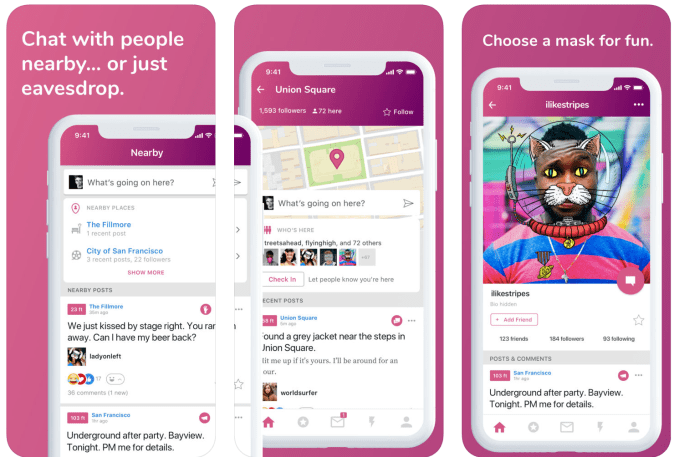
Dolo is the kindness of strangers as an app. Where’s the prettiest place in the park? What’s the best thing on the menu? How do I skip the line? Dolo lets you leave helpful suggestions for anyone nearby. The new social app launches out of beta today to augment the world with serendipitous tips from strangers. Built by two ex-Apple employees and backed with pre-seed funding from Floodgate, Dolo could reveal the secrets and potential friends hidden in the ether around us.

Like any new social app, Dolo will have a steep uphill climb to user growth. There are also apps like Foursquare, guide books like Lonely Planet, and social networks like Facebook and its Recommendations feature to compete with. But they’re often bloated, outdated, or unfocused. Dolo hopes to build a new community around turning the whole world into a bulletin board.

“If you take the construct of a cocktail party or a neighborhood bar, people feel more naturally ‘allowed’ to just mingle, eavesdrop, start a conversation, or even meet someone new” says Dolo co-founder and CEO Raja Haddad. “In larger spaces (a park, a neighborhood, a city), there are no vehicles today that allow such frictionless, comfortable, fun socializing.” That means a local expert’s knowledge ends up trapped while tourists and first-timers wander aimlessly.

Haddad and co-founder Benjamin Vigier met when they joined Apple in 2010 and worked on its Apple Store App before Haddad move on to Apple Watch marketing and Vigier helped develop Apple Pay. They later met Andy Mai at Coachella, who grew the Men’s Fashion Advice subreddit to over a million users. Together they set out “to enable serendipitous ways for people to socialize with other people around them, regardless of their pre-existing social bubbles.”

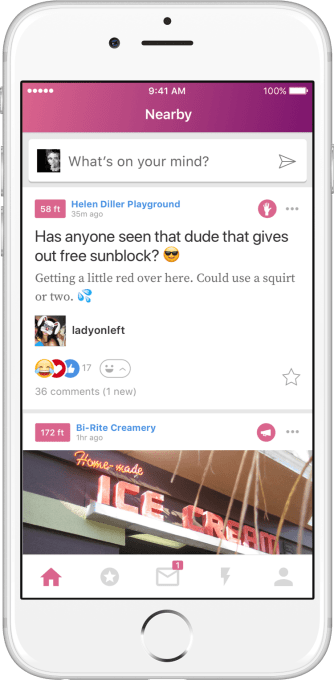
Dolo’s iOS and Android apps are now open everywhere, but it’s currently focusing on the San Francisco Bay Area where it centered its 4000 user beta. The app start with a feed of the closest tips that automatically re-sort as you move around. Anyone can post that “I need some info or a favor”, “folks need to know this!”, “I’m proposing an event”, or “just chatter and banter”. For example, my first contribution was that you can skip the line at famously overpopulated ice cream shop Bi-Rite Creamery by walking down the block to its soft-serve froyo window near SF’s Dolores Park.

That popular hipster picnic spot is actually where Dolo gets its name. And no, it’s not the same as the now defunct “bespoke app” called Dolo from 2013 that just helped you locate your friends in that park.

I was impressed by Dolo’s approach to safety and moderation that other anonymous and hyper-local apps like Yik Yak and Secret neglected until bullying led to their demise. You can use your real name or a pseudonym on Dolo, and choose a pixelated filter or mask sticker to obscure your face from the public. But then if you connect as friends with someone on the app, “the masks come off” Haddad says, and your profile’s bio is revealed. Meanwhile, users are empowered to moderate comments on their own posts by getting alerted to flags that Dolo reviews too. And all photos get reviewed by a crowdsourced moderation service.

Dolo smartly plans to “focus on achieving density vs. going directly for top-line scale” Haddad explains. That mirrors Facebook’s growth strategy that tried to get lots of users at specific colleges or locations so they don’t enter a ghost town, rather than immediately striving for global scale. It’s already raised $680,000 in a pre-seed round a year ago, but will try to raise a seed round early this summer. It hopes to put that cash into product development, and marketing activations at colleges and public places in the fall. 

Advertisers might be keen to reach potential customers when they’re super close-by and looking for local information. But that will require plenty of users as well as a tough-to-scale local ads sales team. Haddad admits “It’s obviously very challenging to get a social platform off the ground, particularly one that relies on location and density.”

NextDoor has at least proven that people are interested in local info, given it’s active in 160,000 neighborhoods. The question is if an app designed to alert you to what’s around you anywhere, rather than just close to home, will have the same legs. Dolo will also have to outlast specialized apps like Wildfire for celebrity sightings and safety alerts, Citizen for crime mapping, and Hive Social for interest-based communities.

It’s somewhat depressing, but an app like Facebook that already has ubiquity, frequent use, and local ad relationships might be better equipped to build this product than a startup. Dolo will have to figure out how to make adding and observing tips a constant enough behavior that users don’t forget about it.

But at least Dolo isn’t burdened by a hundred other features crowding out the local recommendations for attention, nor is it constrained by relying on your existing friend graph. A dedicated app for the insights of passersby holds the promise of not only illuminating what’s around us, but also mending our polarized society.

25 Apr 2018

Alexa integration comes to Meural Canvas letting you use your voice to navigate the art world

Alexa can do just about everything if you ask it the right question in the right way. Today, it’s gaining a new skill, letting you move through artwork on the Meural Canvas digital artwork frame.

The company’s $595 device lets you browse artwork from new and emerging artists as well as publicly available classics.

One of the cool elements of the product has been the device’s gesture controls which let people wave their hands in front of the frame to swipe through pieces of artwork. It makes a lot of sense to have a tactile control system when you’re showing something to guests or the device is in an easily accessible spot. If you’ve opted to hanging your device on a spot on the wall that’s a little bit tougher to reach, your best move has been to switch artwork with Meural’s mobile app or desktop site.

This update makes things a bit more seamless for smart home enthusiasts and chances are that if you’re buying a smart painting, the rest of your house or apartment might have a voice assistant hub or two as well. It’s just Alexa integration for now so Google Assistant or HomeKit users will have to wait, but for those in the Amazon ecosystem, you’ll be able to swipe through artwork by querying your Echo product.

Meural is one of the more notable startups in the digital art subscription space. For hardware that is ultimately just a high-end digital photo frame, the companies are more focused on the idea that a certain type of consumer is interested in a monthly subscription to digital art. It’s a wild idea that has been a tough one to chase. Another startup in the space, Electric Objects, shut down its hardware business and had its assets bought by Giphy last year.