Year: 2018

26 Apr 2018

Digital banking startup Revolut raises $250M at a valuation of $1.7B

Revolut, the London-based fintech that offers a digital banking account and sprawling set of other financial services, is disclosing that it has raised a whopping $250 million in Series C funding, less than three years since launching.

The new round, which gives the company a $1.7 billion post-money valuation — a five-fold increase in under a year, we’re told — was led by Hong Kong based DST Global, along with a group of new and existing investors that includes Index Ventures, and Ribbit Capital. In case you aren’t keeping up, it brings the total amount raised by Revolut to $340 million in less than 36 months.

To put this into context, TransferWise — London’s undisputed fintech darling and on some features a direct competitor to Revolut — recently announced $280 million in Series D investment, giving the company a reported post-money valuation of $1.6 billion. The difference? It took TransferWise seven years compared to Revolut’s three.

That’s testament to how much value investors are now placing on bank-disrupting fintech or perhaps signs of a fintech bubble. Or both. It is also worth remembering that these are private valuations with neither company yet to float on the public markets, even if TranserWise looks increasingly a candidate to do so.

Meanwhile, Revolut says the new round of funding and surge in valuation follows “incredible growth figures to date,” with the fintech now processing $1.8 billion through the platform each month and signing up between 6,000 and 8,000 new customers every day.

It claims nearly 2 million customers in total, of which 250,000 are daily active users, roughly 400,000 are weekly active users and 900,000 are monthly active users. The company says the target is 100 million customers in the next five years.

For a little more context, TransferWise has 3 million customers. I’m also told U.K. challenger bank Monzo now has 630,000 current account customers, of which 200,000 are daily active users, 360,000 are weekly active users and 500,000 are monthly active users. (In both Revolut and Monzo’s case, active users are defined as making at least one financial transaction.)

With the aim of persuading both consumers and businesses to ditch their traditional bank, Revolut offers most of the features you’d expect of a current account, including physical and virtual debit cards, direct debits and money transfer. Its “attack vector” (to borrow Monzo’s Tom Blomfield’s phrase) was originally low exchange fees when spending in a foreign currency, which undoubtedly fuelled much of the startup’s early growth and mindshare, but new features and products are being added at an increasingly fast pace.

Many of these are through partnerships with other fintech companies, and include travel insurance, phone insurance, credit, savings, and cryptocurrency. The latter looks like riding the hype cycle almost perfectly. Revolut is also applying for a European banking license, which would enable it to begin balance sheet lending, too.

To that end, Revolut says the Series C funding will be used to go beyond Europe and expand worldwide, starting with the U.S., Canada, Singapore, Hong Kong, and Australia this year. The company also expects to increase its workforce from 350 to around 800 employees in 2018.

26 Apr 2018

Y Combinator is going after Chinese startups with its first official event in China

High-profile U.S. startup accelerator Y Combinator is making a push to bring more China-based startups into its program after it announced its first official event in the country.

YC has made a push to include startups from outside of North America in recent years. That has seen it bring in companies from the likes of India, Southeast Asia and Africa, but China remains underrepresented. According to YC’s own data, fewer than 10 Chinese companies have passed through its corridors. YC counts over 1,400 graduates.

“Startup School Beijing” is scheduled for May 19 in the Chinese capital at Tsinghua University. The event will be free to attend — though attendees might apply for a ticket — with the goal of showing the benefits of participation in its U.S. program.

To help make its case, the organization has pulled in star graduates like Airbnb and Stripe while its president Sam Altman himself is scheduled to appear.

The event will include sessions with graduates, YC partners and “live on-stage office hours.” That’ll see three companies picked from the audience to get advice and tips from the attending partners, as happens in the program. Sessions will be in both English and Chinese with live translations available.

YC partner Eric Migicovsky, who founded Pebble, is leading the event, which will include the following speakers:

In addition to helping U.S. hardware founders, Migicovsky was brought on specifically to make inroads into China and he is optimistic that there is strong demand.

“We’re hosting Startup School in Beijing to meet local entrepreneurs and start a dialogue about how YC can help,” he told TechCrunch. “The event and the founders we meet will help to inform our strategy going forward. Naturally, we hope to find Chinese startups to apply to our core Y Combinator program in Silicon Valley.”

Migicovsky added that he sees particular value for China-based startups that seek access to global markets for customers, partners, hiring and more.

YC officially announced the event today but the organization’s brand is so strong that word already got out in local media once it began sending out invitations, as our Chinese partner Technode reported.

You can find full details on the Beijing event at conference.startupschool.org.

26 Apr 2018

Early Go-Jek investor NSI Ventures goes independent and rebrands to Openspace

NSI Ventures, the Singapore-based VC firm affiliated with PE firm Northstar Group that invested early in ride-sharing unicorn Go-Jek, is going independent after it announced it has rebranded to Openspace Ventures.

NSI Ventures was started by Hian Goh, an entrepreneur who sold his startup Asia Food Channel in 2013, and finance exec Shane Chesson in 2014. The firm was initially conceived as the venture capital arm of Northstar, which manages some $2 billion in assets with a focus on Indonesia.

In a statement, Goh paid tribute to Northstar’s support but said that “the moment has come for us to bring Openspace Ventures to the next stage, as an independent, Southeast Asia-focused venture fund manager.”

Following its spin-out, Northstar Group co-founder and managing partner Patrick Walujo will become a senior advisor to the firm, providing “strategic advice” on investments in Indonesia.

Openspace is best known in Southeast Asia for its early investment in Go-Jek, the Indonesian ride-sharing company that is valued at over $4 billion and in the process of expanding across Southeast Asia. To date it has invested in 19 companies, including online fashion brand Love Bonito, roti bread maker Zimplistic, restaurant discovery service Chope, and digital insurance startup Axinan. It announced its second $125 million fund last December, a final close for which is expected this year.

The firm said that 12 of its 15 investment deals have since secured follow-on funding, with a total of $2.2 billion poured in. Much of that comes from Go-Jek, but even removing two recent rounds that total around $2 billion, leaves good numbers for the rest of its portfolio.

In fact, a recent report from investment tracker Prequin listed the firm as the third highest performing investment fund worldwide for those created between 2003-2015. That shows progress but the proof is in the pudding, and for VCs that means LP returns. Opensauce, like others in exit-starved Southeast Asia, is yet to have a liquidation event despite making promising progress.

26 Apr 2018

TechCrunch 2018-04-26 01:45:58

Business APIs in Africa are getting a boost from global venture capital thanks to a new $8.6 million round for Africa’s Talking—a Kenyan based enterprise software company.

The new financing was led by IFC Venture Capital, with participation from Orange Digital Ventures and the investor that’s upending most Silicon Valley mores, Social Capital, led by former Facebook exec Chamath Palihapitiya.

Capital from the round will be used to hire and build capacity at the company’s Nairobi headquarters; expand its presence in other geographies around Africa; and invest in research and development in IoT, analytics, payments, and cloud offerings, according to chief executive Samuel Gikandi.

The company will open a tech studio for “engineers and developers to collocate with Africa’s Talking for 12-18 months…to build new products and companies,” Gikandi said.

Africa’s Talking operates in Kenya, Uganda, Rwanda, Malawi, Nigeria, Ethiopia, and Tanzania and maintains a private cloud space in London through Rackspace. The company works with developers to create solution focused APIs across SMS, voice, payment, and airtime services.

“We’re helping software developers in Africa connect to local infrastructure,” said Gikandi. “We find companies that have local infrastructure, whether its mobile operators, banks, or data-centers, then we partner with them and build a platform that simplifies access to that local infrastructure and open it up to software developers.”

Africa’s Talking has a network of 20,000 software developers and 1000 clients  including fintech lending startup Talasolar power financier and retailer M-Kopa; and financial services giant Ecobank, according to Gikandi.

The company gets paid through mobile wallets, earning fees on portion of the transactional business its solutions generate.

Founded in 2010, the Series A round represents the company’s first significant venture capital investment for company. “We’ve primarily bootstrapped the business and became profitable in 2012,” said Gikandi.

The private company does not release financials or confirm net revenues, but Gikandi said that the company’s profitability was a stipulation for investment from its new backers (unlike the requirements for startups coming from Silicon Valley).

As the company looks to expand geographically in the African continent, observers can likely expect Africa’s Talking services to begin cropping up in francophone countries, othrwise, why else would Orange Digital Ventures’ invest in the round?

Orange has a presence in over 20 French speaking African nations.

IFC Ventures will be an active investor, with Africa Regional Head Wale Ayeni joining the board.

“The caliber of the tech team was a reason [to invest],” says Ayeni. “They’ve been able to build a cloud based digital platform and produce a product that people are willing to pay for. It’s rare to see that kind of high caliber tech talent create something that can scale that rapidly…and we’re looking forward to what they’ll build in the future.”

26 Apr 2018

In the age of Cambridge Analytica what are reasonable data norms?

Things really escalated quickly in this month’s Facebook-Cambridge Analytica scandal.

While it’s usually best to just sit back with a bucket of popcorn and watch reality business drama unfold, I was surprised by the severe reactions insinuating Facebook’s eagerness to profit at the expense of its users’ data, creating paranoia around data analytics and equating data driven targeting to an underhanded practice of mind control.

Perhaps this is because it’s being bundled up with the clearly unethical issues of fake news and foreign interference, both of which are distinct from the issue of data harvesting through Facebook’s API.

The scandal surrounding Facebook’s graph API 1.0 and 2.0 might not have been rooted in malicious intent. In fact, a key component of the solution lies in forming a shared understanding amongst platforms, regulators and users, of what data can reasonably be considered private.

“Facebook gave out its users data!”

Indeed it did. But it is important to gauge the motivation and intent behind doing this. For starters, this wasn’t a “leak” as many have called it. Graph API 1.0 was a conscious feature Facebook rolled out under its Platform vision to allow other developers to utilize Facebook data to give rise to presumably useful new apps and use-cases.

Core features of popular apps like Tinder, Timehop and various Zynga social games are powered by their ability to access users’ preexisting Facebook content, social connections and information, instead of having users build up that information from scratch for each app they use.

It was also not a “loophole”. Limitations and procedures for accessing data were clearly stated in the API’s documentation, available publicly for everyone to read. It did not hide the fact that a user’s friends’ data could also be accessed.

This was a product and architectural decision; and a bad decision in hindsight, because it lacked basic precautions against bad actors. But after all, this was API 1.0 and as with all first versions in the new agile world, there is always going to be significant learnings and course correction.

importantly, Facebook did not make any money from developers accessing data through the API. Therefore, the growing narrative insinuating some deceptive, profiteering motives with regards to user data does not resonate with me.

“Data is dangerous since it can be used for psychographic profiling in political campaigns!”

The media outcry has been sounding alarms and highlighting how data can be used to create segments and psychographic profiles to influence people with pinpoint precision. It’s important to realize that this is data-driven marketing and is not something new.

It has been a widely practiced and constantly improving marketing practice utilized across industries and even in political campaigns, across parties. To assume that it would not have happened if Facebook’s data was never accessible is incorrect.

In 2008 the Obama campaign used Facebook data to win the election.

The ability to capture data online and in the physical world is only getting better, and there is a growing industry whose core function is specifically capturing and selling data. The core issue here is neither the data source nor data analytics, but rather when a useful scientific tool has been used to add sophistication to an unethical or illegal activity.

Let’s elaborate using a simple example of a fictitious company ‘Homer Donuts’ which decides to run a series of ad campaigns for its different segments. For the price conscious segment their ad says “Homer Donuts is now 20% cheaper!”, for the health conscious segment it says “Try Homer Donuts’ new low-calorie airfried donuts!” and for the convenience conscious segment it says “Donuts delivered to your doorstep in 15 minutes“.

Understanding your target audience in granular segments and customizing your ad’s positioning, messaging and placement for each segment is a core part of data-driven marketing. None of this is wrong or manipulative. However, if they create a fake article titled “Homer donuts cures baldness! ” and show it as ads to us vulnerable bald folks, unless somehow miraculously true, that is fake news: intentionally and knowingly spreading false information in a way to mislead for benefit or towards an agenda.

Differentiation between the tools and the improper utilization is important lest businesses start having to feel apologetic and tentative in striving for advancements in data science and analytics.

The industry needs for a framework for shared responsibility on privacy

Facebook made a critical error of judgement in indiscriminately allowing anyone to access to conscenting users and that user’s entire list of friends. It was overly naive not to anticipate manipulation by bad actors and take precautionary measures. That said, it’s important to realize that it’s not in Facebook’s power alone to protect user data. There is need for a framework and shared understanding of privacy expectation levels amongst platforms, users and regulators to guide corporate practices, social behaviour and potential regulations.

Orkut (c. 2005) and Facebook (c. 2007) were my first exposure to social networks. I remember asking myself back then: Why would I write a message to a friend publicly on their “wall” instead of emailing them privately?

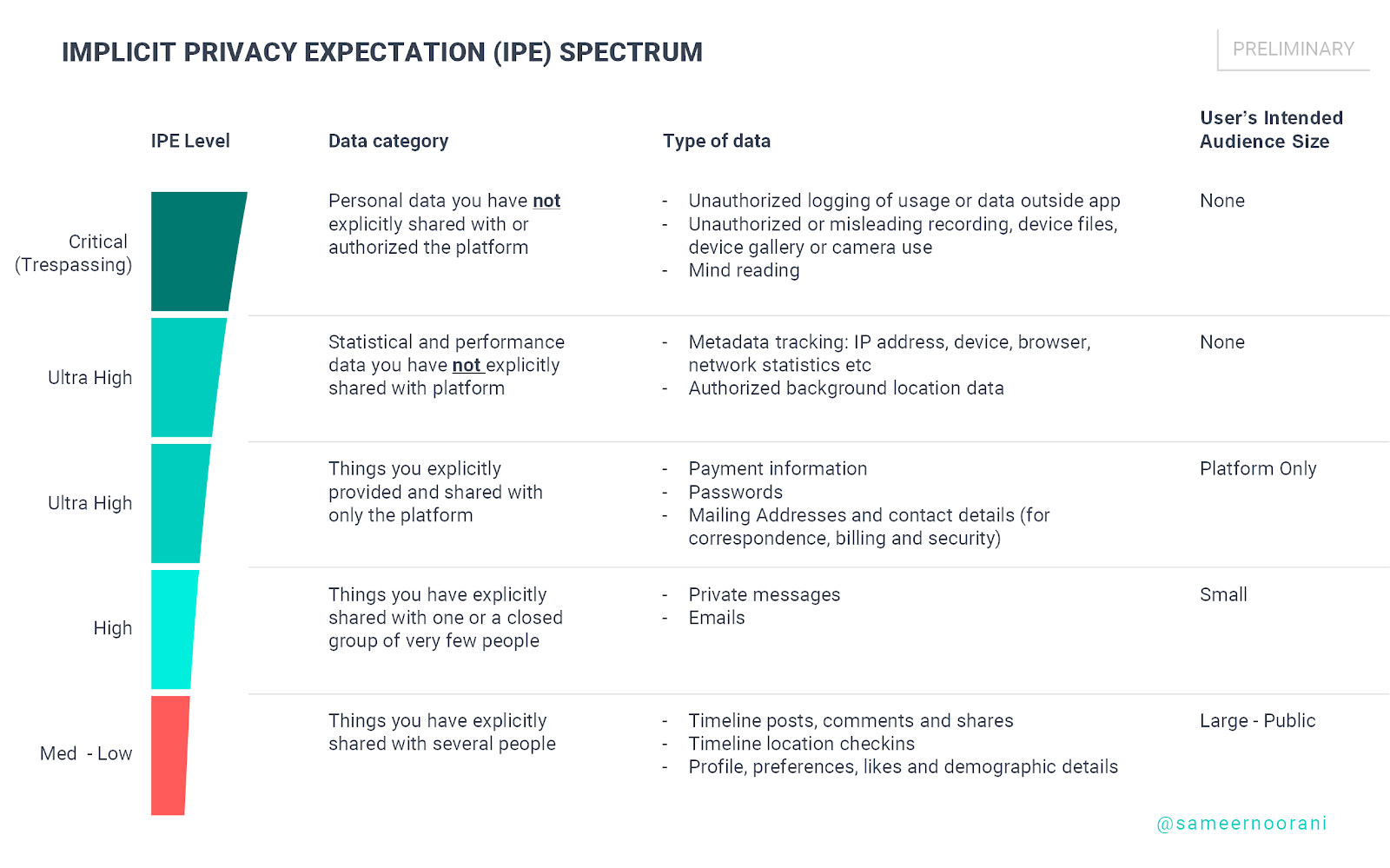
There needs to be a guiding principle on types of user data and the level to which a platform can utilize or analyze it.

The concept was completely alien and unintuitive to me at the time. And yet a short few years later wishing birthdays, sharing posts or writing a message to a friend in sight of a broader audience, whether to flaunt one’s friendship or to invite others to participate, became the new norm around the world. We tend to forget today that whereas services like chat messengers and email are varying degrees of private, things we write, post or share on social networks are varying degrees of public.

There needs to be a guiding principle on types of user data and the level to which a platform can utilize or analyze it. This level needs to be commensurate to the implicit privacy expectation based on where it is shared, the intended audience and the data’s purpose.

When Kim Kardashian shares a selfie on Instagram with her 109 million followers, it would unreasonable for her to be outraged if that photo finds its way into the hands of people outside of the platform. At a much smaller scale, when you share something with your social network of 500 friends and acquaintances, while it’s not technically public, you can’t reasonably expect it to be very private data.

It is very possible for anyone in that audience to further speak about, record or share your content with people outside your selected audience. Conversely, if you are having a private one-on-one chat with a person, your expectation and intent of privacy is a lot higher, despite the fact that it can still be shared on by that person.


To illustrate this framework, let’s take the example of Facebook’s most criticized error in the data harvesting scandal: allowing users to be able to grant access to their friends’ information in addition to their own. Essentially, it would have been the equivalent of any user manually collecting all the data that he had rights to view on Facebook, be it his own, his friends’ or public content, and passing it on to the third-party app or whomever else he wishes.

So while Facebook added fuel to the fire by making it systematically easier and more effortless for a user to collect all this data and pass it on with a simple click of one button, the fire still exists; data can still be shared outside intended audiences even without the API’s provision.

The objective is not to absolve platforms of the responsibility to keep its users data safe, but to reinforce the understanding to all users that social networks by design cannot be foolproof data-safes and to adjust social media user’s norms in addition to counter those risks.

It is important to isolate and view all the different issues under consideration here. We are at a pivotal juncture in history where tech companies, regulators and lawmakers are actively reviewing the acceptability of evolved social norms. Along with addressing serious threats of fake news and foreign intervention, more granular and grey-area questions like what data should be considered private, the obligations of companies in protection of that data even if the data owner consents, and the acceptable boundaries of data-driven influencing in business and political settings must be debated taking all aspects, good and bad, into consideration.

Anyway, time to share this on Facebook.

26 Apr 2018

Allegro.AI nabs $11M for a platform that helps businesses build computer vision-based services

Artificial intelligence and the application of it across nearly every aspect of our lives is shaping up to be one of the major step changes of our modern society. Today, a startup that wants to help other companies capitalise on AI’s advances is announcing funding and emerging from stealth mode.

Allegro.AI, which has built a deep learning platform that companies can use to build and train computer-vision-based technologies — from self-driving car systems through to security, medical and any other services that require a system to read and parse visual data — is today announcing that it has raised $11 million in funding, as it prepares for a full-scale launch of its commercial services later this year after running pilots and working with early users in a closed beta.

The round may not be huge by today’s startup standards, but the presence of strategic investors speaks to the interest that the startup has sparked and the gap in the market for what it is offering. It includes MizMaa Ventures — a Chinese fund that is focused on investing in Israeli startups, along with participation from Robert Bosch Venture Capital GmbH (RBVC), Samsung Catalyst Fund and Israeli fund Dynamic Loop Capital. Other investors (the $11 million actually covers more than one round) are not being disclosed.

Nir Bar-Lev, the CEO and cofounder (Moses Guttmann, another cofounder, is the company’s CTO), started Allegro.AI first as Seematics in 2016 after he left Google, where he had worked in various senior roles for over 10 years. It was partly that experience that led him to the idea that with the rise of AI, there would be an opportunity for companies that could build a platform to help other less AI-savvy companies build AI-based products.

“We’re addressing a gap in the industry,” he said in an interview. Although there are a number of services, for example Rekognition from Amazon’s AWS, which allow a developer to ping a database by way of an API to provide analytics and some identification of a video or image, these are relatively basic and couldn’t be used to build and “teach” full-scale navigation systems, for example.

“An ecosystem doesn’t exist for anything deep-learning based.” Every company that wants to build something would have to invest 80-90 percent of their total R&D resources on infrastructure, before getting to the many other apsects of building a product, he said, which might also include the hardware and applications themselves. “We’re providing this so that the companies don’t need to build it.”

Instead, the research scientists that will buy in the Allegro.AI platform — it’s not intended for non-technical users (not now at least) — can concentrate on overseeing projects and considering strategic applications and other aspects of the projects. He says that currently, its direct target customers are tech companies and others that rely heavily on tech, “but are not the Googles and Amazons of the world.”

Indeed, companies like Google, AWS, Microsoft, Apple and Facebook have all made major inroads into AI, and in one way or another each has a strong interest in enterprise services and may already be hosting a lot of data in their clouds. But Bar-Lev believes that companies ultimately will be wary to work with them on large-scale AI projects:

“A lot of the data that’s already on their cloud is data from before the AI revolution, before companies realized that the asset today is data,” he said. “If it’s there, it’s there and a lot of it is transactional and relational data.

“But what’s not there is all the signal-based data, all of the data coming from computer vision. That is not on these clouds. We haven’t spoken to a single automotive who is sharing that with these cloud providers. They are not even sharing it with their OEMs. I’ve worked at Google, and I know how companies are afraid of them. These companies are terrified of tech companies like Amazon and so on eating them up, so if they can now stop and control their assets they will do that.”

Customers have the option of working with Allegro either as a cloud or on-premise product, or a combination of the two, and this brings up the third reason that Allegro believes it has a strong opportunity. The quantity of data that is collected for image-based neural networks is massive, and in some regards it’s not practical to rely on cloud systems to process that. Allegro’s emphasis is on building computing at the edge to work with the data more efficiently, which is one of the reasons investors were also interested.

“AI and machine learning will transform the way we interact with all the devices in our lives, by enabling them to process what they’re seeing in real time,” said David Goldschmidt, VP and MD at Samsung Catalyst Fund, in a statement. “By advancing deep learning at the edge, Allegro.AI will help companies in a diverse range of fields—from robotics to mobility—develop devices that are more intelligent, robust, and responsive to their environment. We’re particularly excited about this investment because, like Samsung, Allegro.AI is committed not just to developing this foundational technology, but also to building the open, collaborative ecosystem that is necessary to bring it to consumers in a meaningful way.”

Allegro.AI is not the first company with hopes of providing AI and deep learning as a service to the enterprise world: Element.AI out of Canada is another startup that is being built on the premise that most companies know they will need to consider how to use AI in their businesses, but lack the in-house expertise or budget (or both) to do that. Until the wider field matures and AI know-how becomes something anyone can buy off-the-shelf, it’s going to present an interesting opportunity for the likes of Allegro and others to step in.


25 Apr 2018

China-based online education companies just launched an aggressive hiring spree in search of U.S. teachers

Teachers have long supplemented their incomes by tutoring. And there’s perhaps never been a better, or easier, time to do it than right now.  The reason: China-based online education companies are in an apparent race with each other to hire U.S. teachers who’d like to work from home this summer and, using their webcams, “teach cute kids” the English language — in the marketing parlance of one of those companies, Beijing-based VIPKid.

If you doubt that’s true, you haven’t been looking at the classifieds. Just today, five-year-old VIPKid — which reportedly raised $200 million in fresh funding last summer at a $1.5 billion valuation — listed openings for thousands of U.S. teachers, from Jacksonville Beach, Florida, to Saint Joseph, Missouri, to Carmel, Indiana.

Its jobs offensive comes just three days after seven-year-old, Beijing-based China Online Education Group, known as 51Talk, did precisely the same thing.

Both companies are growing quickly and, in the process, trying to outgun competitors. These include 14-year-old, Goldman Sachs-backed iTutorGroup, which operates out of Shanghai as VIPABC and boasts of its $1 billion valuation on its home page, and 15-year-old TAL Education Group, a holding company for a group of tutoring-related companies that went public in 2010 and now enjoys a roughly $17 billion market cap. (51Talk is also publicly traded, having IPO’d in 2016. Its market cap is currently $215 million.)

There’s seemingly plenty of demand for all. According to a recent report from the China-focused consultancy iResearch, online language lessons in China represented a $4.5 billion market opportunity in 2016 and is expected to grow to nearly $8 billion by next year.

VIPKID seems to be winning the war for media attention, however.

Back in January, Forbes named the company the best employer when it comes to work-from-home jobs (up from fifth place in 2017). Its founder, Cindy Mi, has also received glowing coverage in Bloomberg, the Financial Times, and Fast Company, among numerous other English-language outlets. (We also featured Mi in a fireside chat at our signature Disrupt event in San Francisco last fall.)

According to one of its job listings today, teachers are paid on average between $14 and $18 an hour and the openings are available to candidates who are eligible to work in the U.S. or Canada, have a bachelor’s degree in any field, and have at least one school year of traditional teaching, mentoring, or tutoring experience.

The company — which is backed by Sequoia Capital, Learn Capital, and an investment firm cofounded by Alibaba’s Jack Ma, among others — says it already works with more than 30,000 teachers. We’ll have to see how much those numbers change after this summer.

25 Apr 2018

How Microsoft helped imprison a man for ‘counterfeiting’ software it gives away for free

In a sickening concession to bad copyright law and Microsoft’s bottom line over basic technical truths and common sense, Eric Lundgren will spend 15 months in prison for selling discs that let people reinstall Windows on licensed machines. A federal appeals court this week upheld the sentence handed down in ignorance by a Florida district judge, for a crime the man never committed.

Now, to be clear, Lundgren did commit a crime, and admitted as much — but not the crime he was convicted for, the crime Microsoft alleges he did, the crime that carries a year-plus prison term. Here’s what happened.

In 2012 feds seized a shipment of discs, which they determined were counterfeit copies of Windows, heading to the U.S., where they were to be sold to retailers by Lundgren. U.S. Prosecutors, backed by Microsoft’s experts, put him on the hook for about $8.3 million — the retail price of Windows multiplied by the number of discs seized.

The only problem with that was that these weren’t counterfeit copies of Windows, and they were worth almost nothing. The confusion is understandable — here’s why.

When you buy a computer, baked into the cost of that computer is usually a license for the software on it — for instance, Windows. And included with that computer is often a disc that, should you have to reinstall that OS for whatever reason (virus infection, general slowdown), allows you to do so. This installation only works, of course, if you feed it your license key, which you’ll probably find on a sticker attached to your computer, its “Certificate of Authenticity.”

But what if you lose that disc? Fortunately, all those years Microsoft itself provided disc images, files that you could use to burn a new copy of the disc at no cost. Look, you can still do it, and you used to be able to get one without a license key. In fact that’s how many Windows installs were created — buy a license key directly from Microsoft or some reseller, then download and burn the install disc yourself.

Of course, if you don’t have a DVD burner (remember, this was a while back — these days you’d use a USB drive), you’d have to get one from a friend who has one, a licensed refurbisher, or your manufacturer (for instance, Dell or Lenovo) for a fee.
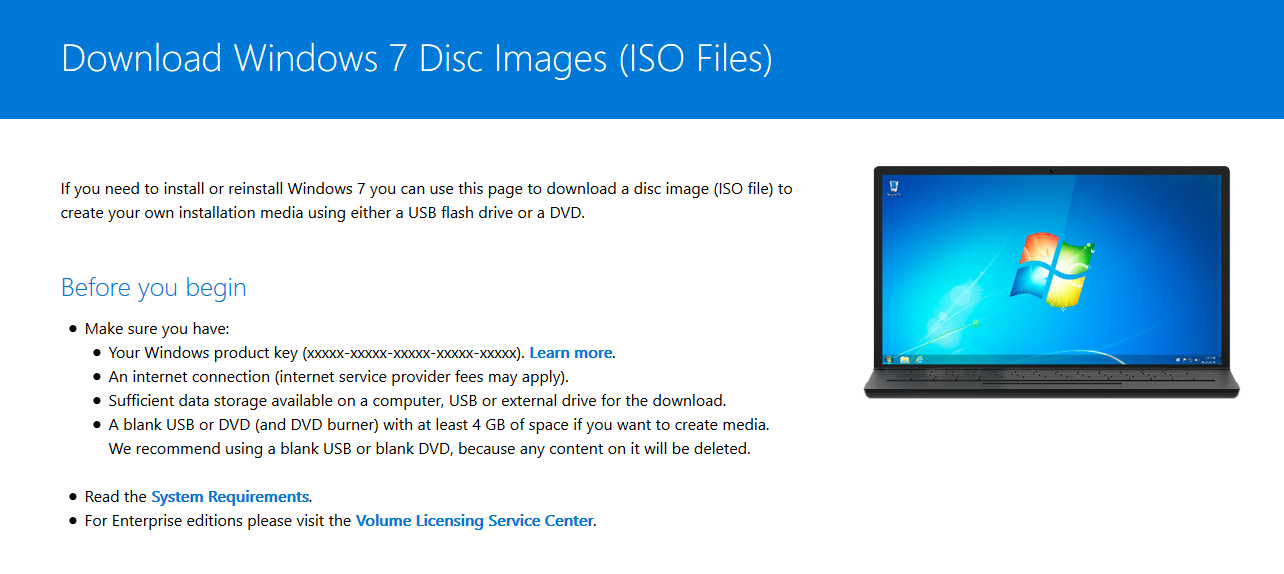
This option is still available, and very handy — I’ve used it many times.

What Lundgren did was have thousands of these recovery discs printed so that repair and refurbishing shops could sell them for cheap to anyone who can’t make their own. No need to go call Alienware customer service, just go to a computer store and grab a disc for a couple bucks.

Lundgren, by the way, is not some scammer looking to fleece a few people and make a quick buck. He has been a major figure on the e-waste scene, working to minimize the toxic wages of planned obsolescence and running a company of 100 to responsibly refurbish or recycle old computers and other devices.

His actual crime, which he pleaded guilty to, was counterfeiting the packaging to make the discs pass for Dell-branded ones.
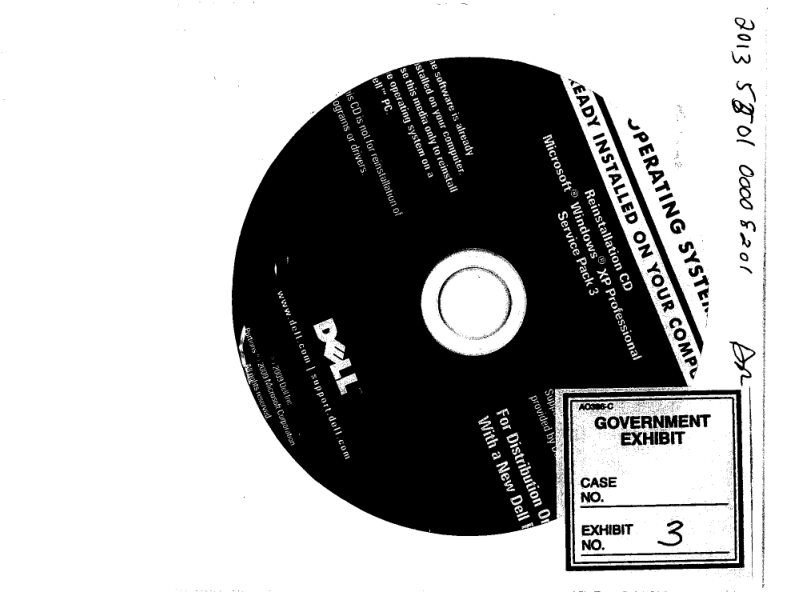
But the fundamental idea that this was counterfeit software, with all that implies, is simply wrong.

Software vs. license

The whole thing revolves around the fact that Microsoft — and every other software maker — doesn’t just plain sell software; they sell licenses to that software. Because software can easily be copied from computer to computer, piracy is easy if you make a program that anyone can just install. It’s more effective to distribute the software itself freely, but only unlock it for use with a special one-off code sold to the customer: a license, or product key.

When you buy a “copy” of Windows, you’re really buying a license to use Windows, not the bits and bytes that make up the OS. The company literally provided up to date disc images of Windows on its website! You could easily install it using those. But without a license key, the OS won’t work properly; it’ll nag you, remove functionality and may shut down entirely. No one would confuse this with a licensed copy of the OS.

This distinction between software and license is a fine one, but important. Not just for overarching discussions of copyright law and where it fails us as technology moves beyond the severely dated DMCA. Because in this case it’s the difference between a box of Windows recovery discs being worth millions of dollars, as prosecutors originally said they were, and being worth essentially nothing, which is what an expert witness and advocates countered.

More importantly, it’s the difference between someone getting 15 months in prison for a nonviolent crime harming no one and causing no actual financial loss, and getting a suitable punishment for counterfeiting labels.

A Microsoft representative told me, reasonably enough, that they want customers to be able to trust their software. So going after counterfeiters is a high priority. After all, if you buy a cheap, fake DVD of Windows on eBay and it turns out the disc has been pre-loaded with malware, that’s bad news for the consumer and hurts the Microsoft brand. Makes sense.

It said in an official statement:

We participate in cases like these because counterfeit software exposes our customers to malware and other forms of cybercrime. There are responsible ways to refurbish computers and save waste, but Mr. Lundgren intentionally deceived people about the software they were buying and put their security at risk.

First, it is worth mentioning that the court record is replete with tests showing these discs were perfectly normal copies of software that Microsoft provides for free. Prosecutors went through the entire install process several times and encountered nothing unusual — in fact, their arguments rely on the fact that these were perfect copies, not a compromised one. This may not affect Microsoft’s reasoning for pursuing the case, but it sure has a bearing on this one.

Lundgren deceived people that this was an official disc from Dell, certainly. That’s a crime and he admitted to it right off the bat. But from what I can tell, the discs were indistinguishable from Dell discs except for inconsistencies in the packaging. There’s nothing in the record to think otherwise. I was told Microsoft declined to look into whether the discs might have had malware because it would have no bearing on the case, which strikes me as ridiculous. It would be trivial to check the integrity and contents of a disc Microsoft itself provides the data for, and malware or the like would provide evidence of criminal intent by Lundgren or his supplier.

If on the other hand the discs were identical to those they are meant to imitate, we would expect to hear little about their content except that they are functional, which is what we see in the record.
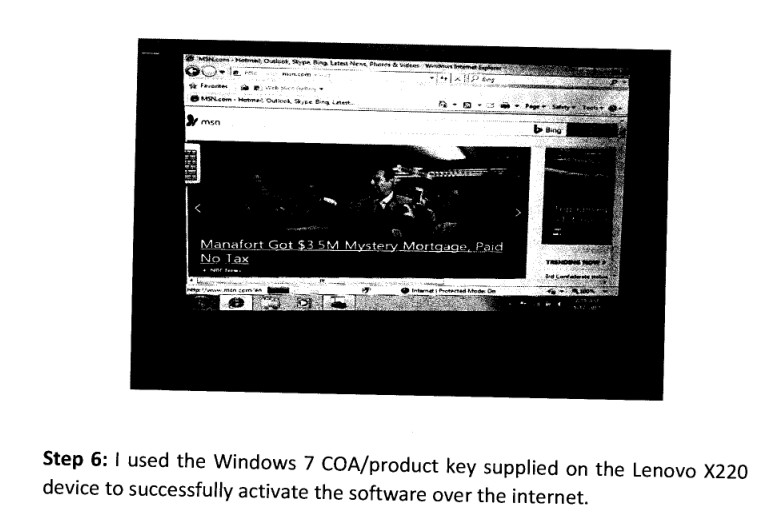
From the court records, the discs seized produced ordinary Windows installs when tested by multiple parties.

Furthermore: People weren’t buying software, let alone “counterfeit software.” The discs in question are at best “unauthorized” copies of software provided for free by Microsoft, not really a term that carries a lot of legal or even rhetorical weight. I could make a recovery disc, then make another for my friend who doesn’t have a DVD burner. Is that copy authorized or not? And how could it be unauthorized if it’s an image made available to users specifically for the purpose of burning recovery discs? How can it be counterfeit if it’s just a copy of that image? Furthermore, how can it be “pirated” if the business model requires the end user to purchase a license key to activate the product?

If the data on the disc is worth anything at all, why does Microsoft provide it for free? There was in fact no piracy because no license to use the software, which amounts to the entire value of the software, was ever sold.

What damage?

But how, then, could this freely available software produce damage in the millions, as first alleged, and later in the hundreds of thousands?

What Microsoft alleged, when it became clear that the data on the discs was worth precisely nothing without a license key, as evidenced by its own free distribution thereof, was that the discs Lundgren was selling were intended to short-circuit its official refurbishment program.

That’s the official registered refurbisher program where a company might buy old laptops, wipe them and contact Microsoft saying “Hey, give us 12 Windows 7 Home licenses,” which are then provided for a deep discount — $20-40 each, down from the full retail price of hundreds. It encourages reuse of perfectly good hardware and keeps costs down, both of which are solid goals.
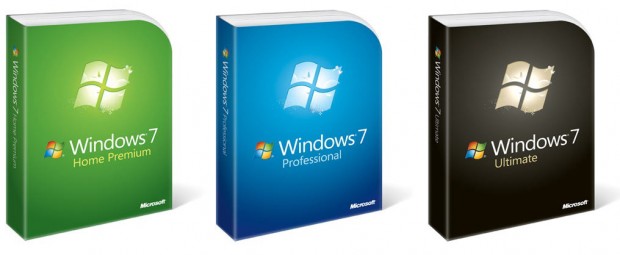
Every disc Lundgren sold to refurbishers, Microsoft argued, caused $20-40 (times .75, the profit ratio) of lost OS sales because it would be used in place of the official licensing process. This was the basis for the $700,000 figure used in part to determine the severity of his crime.

There are several things wrong with this statement, so I’m putting them in bullet points:

  • Lundgren was not necessarily selling these discs to refurbishers for use in refurbishing computers — the discs would be perfectly useful to any Dell owner who walked in and wanted a recovery disc for their own purposes. The government case rests on an assumption that was not demonstrated by any testimony or evidence.
  • The discs are not what Microsoft charges for. As already established, the disc and the data on it are provided for free. Anyone could download a copy and make their own, including refurbishers. Microsoft charges for a license to activate the software on the disc. The discs themselves are just an easy way to move data around. There’s no reason why refurbishers would not buy discs from Lundgren and order licenses from Microsoft.
  • Dell computers (and most computers from dealers) come with a Certificate of Authenticity with a corresponding Windows product key. So if intentions are to be considered, fundamentally these discs were intended for sale to and use by authorized, licensed users of the OS.
  • Furthermore, since many computers come with COAs, if the refurbishers decide to skip getting a new license use a given computer’s COA, that is not the fault of Lundgren, and could easily be accomplished with the free software Microsoft itself provides.
  • That process — using the COA instead of buying a new license — is not permitted by Microsoft and is murky copyright-wise. But in this case the defendants say it was admitted by U.S. prosecutors that the COA “belongs” to the hardware, not the first buyer. The alternative is that, for example, if I sold a computer to a friend with Windows installed, he would be required to buy a new copy of Windows to install over the first, which is absurd.
  • Naturally no actual damage was actually done. The damage is entirely theoretical and incorrect at that. A copy of Windows cannot be sold because it is freely provided; only a license key can be sold, and those sales are what Microsoft alleges were affected — but Lundgren neither had nor sold any license keys.

In fact an expert witness, Glenn Weadock, who had previously been involved in a 2001 government antitrust case against Microsoft, appeared in court to argue these very points.

Weadock was asked what the value of the discs is without a license or COA. “Zero or near zero,” he said. The value is a “convenience factor,” he said, in that someone can use a pre-made disc instead of burning their own or having the manufacturer provide it.

Real damage

This fact, a difference between selling a license that activates a piece of software and provides its real value, and the distribution of the software itself — again, provided for free to any asker — was completely ignored by the courts:

The government’s expert testified that the lowest amount Microsoft charges buyers in the relevant market—the small registered computer refurbisher market—was $25 per disc. Although the defense expert testified that discs containing the relevant Microsoft OS software had little or no value when unaccompanied by a product key or license, the district court explicitly stated that it did not find that testimony to be credible.

As I’ve already established, discs are free; $25 is the price of the license accompanying the disc. Again, a fine but very important distinction.

Weadock’s testimony and all arguments along these lines were disregarded by the judges, who decided that the “infringing item” “is or appears to be a reasonably informed purchaser to be, identical or substantially equivalent to the infringed item.”

This is fundamentally wrong.

The “infringing” item is a disc. The “infringed” item is a license. The ones confusing the two aren’t purchasers but the judges in this case, with Microsoft’s help.

“[Defendants] cannot claim that Microsoft suffered minimal pecuniary injury,” wrote the judges in the ruling affirming the previous court’s sentencing. “Microsoft lost the sale of its software as a direct consequence of the defendants’ actions.”

Microsoft does not sell discs. It sells licenses.

Lundgren did not sell licenses. He sold discs.

These are two different things with different values and different circumstances.

I don’t know how I can make this any more clear. Right now a man is going to prison for 15 months because these judges didn’t understand basic concepts of the modern software ecosystem. Fifteen months! In prison!

What would a reasonable punishment be for counterfeiting labels to put on software anyone can download for free? I couldn’t say. That would be for a court to decide. Possibly, based on Lundgren’s suggestion that if damages had to be calculated, that $4 per disc was more realistic, he would still face time. But instead the court has made an ignorant decision based on corporate misinformation that will deprive someone of more than a year of his life — not to mention all the time and money that has been spent explaining these things to deaf ears for the last few years.

Microsoft cannot claim that it was merely a victim or bystander here. It has worked with the FBI and prosecutors the whole time pursuing criminal charges for which the defendant could face years in prison. And as you can see, those charges are wildly overstated and produced a sentence far more serious than Lundgren’s actual crime warranted.

The company could at any point have changed its testimony to reflect the facts of the matter. It could have corrected the judges that the infringing and infringed items are strictly speaking completely different things, a fact it knows and understands, since it sells one for hundreds and gives the other away. It could have cautioned the prosecution that copyright law in this case produces a punishment completely out of proportion with the crime, or pursued a civil case on separate lines.

This case has been ongoing for years and Microsoft has supported it from start to finish; it has as much sentenced Lundgren to prison for a crime he didn’t commit as the fools of judges it convinced of its great “pecuniary loss.” I expect the company to push back against this idea, saying that it only had consumers’ best interests in mind, but the bad-faith arguments we have seen above, and which I have heard directly from Microsoft, seem to suggest it was in fact looking for a strong judgment at any cost to deter others.

If it was possible that Microsoft was not aware how bad the optics on this case are, they’ve been warned over and over as the case has worn on. Now that Lundgren is going to prison it seems reasonable to say that his imprisonment is as much a Microsoft product as the OS it accused him wrongly of pirating.


25 Apr 2018

Acorns launches retirement account product to expand beyond retail investing

Acorns, the mobile service that’s providing a gateway to investing in the stock market, has completed the master plan it set in motion months ago with the acquisition of Vault by finally launching a retirement account product today.

Called Acorns Later, the service is the first Acorns investment vehicle to get the same kind of tax advantages the swells get when they invest through products like Individual Retirement Accounts.

“Setting up a retirement account is confusing and, as a result, two out of three Americans aren’t saving for later in life,” said Noah Kerner, Acorns chief executive officer, in a statement. “Acorns Later removes friction from the decision making process, getting back to our central product philosophy: make big decisions small.”

Based on the same premise as the Acorns app, the Acorns Later feature will automatically recommend a retirement account and portfolio to customers.

The recommendations use an investor’s age, income and “other factors” to suggest one of three individual retirement accounts — either a traditional account, a Roth account (which charges you taxes up front, but not upon withdrawals that meet certain conditions) or an SEP (simplified employee pension plan).

Anyone can launch an account as long as they can put five dollars into it — then, like a regular Acorns account — customers set contributions to be withdrawn from an account daily, weekly or monthly.

“We joined the Acorns team to offer more Americans a simpler way to save,” said Randy Fernando, the founder and former chief executive of Vault and current head of investment products at Acorns, in a statement.

25 Apr 2018

Adtech company BuySellAds acquires Digg

It looks like Digg has found a new home: digital advertising company BuySellAds.

While neither company has put out an official announcement, BuySellAds CEO Todd Garland confirmed the acquisition to Fast Company, and a company spokesperson told me, “It’s true.”

Fast Company also reports that Digg’s technology team was not part of the deal.

Garland seems very aware that Digg readers may be skeptical about a company called BuySellAds, but he said, “Don’t pay attention to the name, people.” He also said, “Our plan with Digg is to not screw it up.”

The news aggregator was founded in 2004, then acquired by startup studio Betaworks in 2012. It took on additional funding from Gannett a couple of years ago.

Now it seems that last month’s shut down of Digg Reader was a sign that there were changes in the works.