Year: 2018

26 Apr 2018

Snapchat launches Spectacles V2, camera glasses you’ll actually wear

Photos, not just video. No yellow ring alerting people to the camera. Underwater-capable. Classier colors with lighter lenses. Prescription options. Faster syncing. And a much smaller charging case. Snapchat fixed the biggest pain points of its Spectacles camera sunglasses with V2, which launch today for $150. The company only sold 220,000 pairs of V1, with their limited functionality, tricky exports, and goofy style. But V2 is stylish, convenient, and useful enough to keep handy. They’re not revolutionary. They’re a wearable camera for everybody. 

You can check out our snazzy hands-on demo video below.

The new Spectacles go one sale today in the US, Canada, UK, and France, then in 13 more European countries on May 3rd. They’re only available on Snap’s app and site — no Amazon, pop-up stores or vending SnapBots. And V1 owners will get a firmware update that lets them take photos.

After two days of use, I think Spectacles v2 cross the threshold from clumsy novelty to creative tool accessible to the mainstream. And amidst user growth struggles, that’s what Snap needs right now. 

V1 Was To Get People Comfortable

What it doesn’t need is a privacy scandal, and that risk is the tradeoff Snap is making with its more discrete Spectacles design. They still display a little circle of white lights while recording, but without the permanent yellow ring on the corner you otherwise might not notice there’s a camera lens there. That could make people a little nervous and creeped out.

But the company’s VP of hardware Mark Randall tells me he thinks the true purpose of V1 was to get people comfortable wearing and being recorded by a face computer. It certainly wasn’t a consumer success, with less than half of owners using them after the first month. He said he feels pretty good about shipping 220,000 pairs. Yet Snapchat was roundly mocked for taking a $40 million write-off after making hundreds of thousands too many. Randall attributes that to having fragmented sales channels, which Snap is fixing by only selling V2 itself.

[gallery columns="4" type="slideshow" ids="1628988,1628989,1628987,1628990"]

Snap did learn that users wanted to take photos, get them in less flashy coral colors, bring Spectacles to the beach, pair them quicker with better resolution exports, and hear less wind noise when moving. And most importantly, they wanted something they didn’t feel weird wearing. So his team essentially scrapped the yellow warning ring, style, architecture, chipset, and electronics to build a better V2 from the ground up. The result rises high above its predecessor.

What’s Special About Spectacles V2

As soon as you slide them out of their tennis ball tube package, you’ll notice a higher build quality in Spectacles V2. The yellow case is about 1/3 smaller, so you could squeeze it in some pants pockets or easily throw it in a jacket or purse. The old version you basically required a backpack. The charging port has also been moved to the side so it doesn’t fall out so easily. Even with the better hardware, Spectacles are still supposed to get a week of normal use on a charge, plus carry four extra charges in the case.

The Spectacles themselves feel sleeker and less like chunky plastic. The box holding the hardware is much smaller, making them lighter overall. It’s easy to long-press for a photo or tap for 10-second video, with extra taps extending the clip up to 30 seconds.

Syncing to your phone always happens in HD now, and goes four times quicker than the old process that required you to sync standard definition (low quality) versions of videos first, then pick your favorites, then download them in HD.

Snapchat may have finally found a way to make Spectacles carryable and wearable enough that people use them as their default sunglasses. That could lead to way more content being produced from Spectacles, which in turn could make Snapchat more interesting at a time when it’s desperate to differentiate from Snapchat.
 

26 Apr 2018

Report: Chinese smartphone shipments drop 21% to reach lowest level since 2013

Analysts have long-warned of a growth crunch in China’s smartphone space, and it’s looking like that’s very much the case right now.

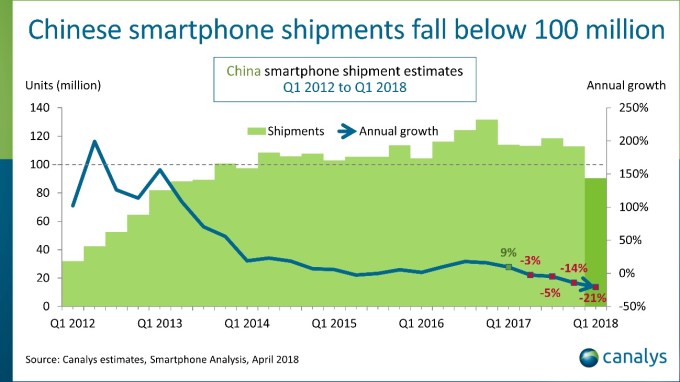
China’s smartphone growth has been the feel-good story for domestic OEMs who have clocked impressive figures as the billion-plus population has rushed online via mobile devices. However, the market reached saturation point in 2017 — when sales stopped growing for the first time — and the first quarter of this year is already showing savage results.

In a report released today, Canalys claimed that shipments across the industry fell by 21 percent year-on-year in Q1.

The total number of mobile devices shipped in China dropped below the 100 million market in a quarter for the first time since late 2013, the firm added.

“Eight of the top 10 smartphone vendors were hit by annual declines, with Gionee, Meizu and Samsung shrinking to less than half of their respective Q1 2017 numbers,” the report read.

Ouch.

Of the field, only Xiaomi the firm tipped for an IPO at a $100 billion valuation — was able to post positive momentum as its numbers grew by 37 percent to reach 12 million. That was enough to see it overtake Apple into fourth place, but Xiaomi numbers are still heavily reliant on its $150 Redmi range, which isn’t as lucrative as its higher-end products.

Huawei, Oppo and Vivo led the market. Somewhat incredibly, those three firms plus Xiaomi now account for a very dominant 73 percent of all shipments, which Canalys believes is bad for consumers and smartphone aficionados in China.

“The level of competition has forced every vendor to imitate the others’ product portfolios and go-to-market strategies,” analyst Mo Jia said in a statement. “While Huawei, Oppo, Vivo and Xiaomi must contend with a shrinking Chinese market, they can take comfort from the fact that it will continue to consolidate, and that their size will help them last longer than other smaller players.”

There might be a bright spark coming soon. Canalys anticipates growth in the second quarter as Oppo, Vivo and Huawei trot out new flagship devices. But China’s once-booming industry is now having to contend with the same issue as the U.S.: consumers don’t upgrade their phone as frequently as carriers would like.

26 Apr 2018

IFTTT raises $24M led by Salesforce to expand its platform to ‘connect everything’

IFTTT, a startup that was an early mover in API integrations by creating a platform for people to write easy scripts to connect different apps to each other (the name stands for “if this, then that”), is announcing another $24 million in funding to take its business deeper into areas like enterprise and IoT services.

This funding comes on the back of what CEO Linden Tibbets described in an interview as the company’s strongest-ever year in terms of revenue and growth (without disclosing any actual numbers; IFTTT has never been very transparent on this front, frustratingly).

IFTTT today has 14 million registered consumers (although it will not say how many are active), 75 million Applets since launch, and more than 5,000 active developers building services and more than 140,000 building Applets on the IFTTT Platform. Products from Google, Microsoft, Amazon, Twitter, BMW, Samsung, IBM, MyQ, and Verizon are among those touched by IFTTT scripts.

The round is notable for a couple of reasons. It’s the first funding announced by IFTTT in four years, a relatively large gap in the startup world. and it’s the first time that IFTTT has had strategic investors. The Series C was led by Salesforce, with participation also from IBM and the Chamberlain Group (best known for a variety of brands of automatic entry gates and garage door openers) — who all have services and Applets available on the platform — along with Fenox Venture Capital.

“They see IFTTT as an important business, ecosystem and partner in the industry,” said Tibbets of the strategics in this round. 

“IFTTT is at the forefront of establishing a more connected ecosystem for devices and services. It’s a prime example of the amazing innovation and commitment to customer success that we look for in our portfolio companies,” said John Somorjai, EVP of Corporate Development and Salesforce Ventures, Salesforce, in a statement.

(IFTTT’s longish list of previous investors have included Andreessen Horowitz, Betaworks, Greylock, NEA, Norwest, SV Angels and more.) The company has raised $63 million to date.

No valuation disclosed in this round, but for some context, IFTTT’s post-money valuation in August 2014 was around $210 million, according to PitchBook.

In 2010, IFTTT was one of the first startups to realise the opportunity in our fragmented tech world of linking up disparate apps — and later other services and devices — via their APIs, but a lot has evolved in the last eight years.

Companies like Google, Amazon and Apple have doubled down on their own interconnected platform plays, which include connected home products and both enterprise and consumer hubs that control different apps and services.

Meanwhile, on the enterprise IT end of the scale, you have services like Slack that have become funnels for calling in data from dozens of apps; and a number of companies that are also building bridges to connect up disparate apps and IoT services for businesses.

(Notably, new investor Salesforce acquired MuleSoft earlier this year for $6.5 billion, and invests in Workato, respectively already covering its bases in enterprise IoT and IT integrations and business intelligence integrations.)

Despite all the competition, IFTTT has grown as a long-tail play, by focusing on specific actions between apps and devices, some of which are created by users of its platform and some by the companies themselves, and often are not provided elsewhere either because companies have yet to integrate directly, or the action is perhaps too specific. (Example: this Applet lets you add any item on your Alexa to-do list to Facebook Messenger, by way of an IFTTT bot.)

“Building your own API platform and developer ecosystem is incredibly hard and expensive,” Tibbets said. “Business are forced to focus on just a small handful of integrations and platforms.”

This, plus the added benefit of getting exposure by being on a platform where many other services are being used, were two of the reasons why it’s picked up strategic investors.

“IBM and IFTTT are working together to realize the potential of today’s connected world. By bringing together IBM’s Watson IoT Platform and Watson Assistant Solutions with consumer- facing services, we can help clients to create powerful and open solutions for their users that work with everything in the Internet of Things,” said Bret Greenstein, VP, Watson Internet of Things, IBM, in a statement. “Our work together is an important step to enable true interoperability between devices as IoT becomes pervasive across business and society alike.”

The company has essentially thrived on the double tensions of ongoing fragmentation in the tech world (which is a good thing: we don’t want one company to control everything), and people’s desire to simplify their busy lives and wanting to use the technology they own to do that.

“Every single business, product and organization is becoming a service,” Tibbets said. “Getting all of these services to work together is a massive problem, opportunity and market. IFTTT is focused on defining and improving the relationship between businesses, their customers and the expanding universe of services that those end customers use.

Interestingly, we’ve had dozens of tips over the years about IFTTT, claiming potential sales of the company to the likes of Microsoft, Amazon and others. We were never able to get any corroboration for them from IFTTT or other sources — and whether or not they were completely accurate, an exit obviously never came to pass.

I resurfaced the rumors to see if I could get anywhere on them now, with a funding round off the ground, but got deflected once again. “We are focused on cementing IFTTT’s position as the leading, neutral platform for a more connected and compatible world,” Tibbets responded. “There is huge opportunity ahead for IFTTT and we’re excited to pursue it with all of our investors, users, customers and team.”


26 Apr 2018

Nintendo’s annual profit rockets by 500% after selling 15M Switch consoles

Nintendo has announced impressive financial results thanks to strong sales its Switch console, and a new CEO for its business.

Operating profit rose by a huge 505 percent to reach 178 billion yen ($1.6 billion) over the last financial year. Revenue was also up by an impressive 116 percent to hit 1.06 trillion yen ($9.7 billion) over the period as Nintendo sold 15 million Switch units, vastly out-performing the initial target of 10 million set last year. (The firm later updated its forecast to match the 15 million.)

On the games front, Super Mario Odyssey was the biggest seller at 10 million copies, followed by Mario Kart 8 Deluxe (nine million) and Splatoon 2 (six million.) The firm also revealed that it sold over five million of the SNES Classic Edition product, too.

Going forward, Nintendo is aiming to grow Switch sales to 20 million over the next year. Aside from continued games, it is banking on reaching new segments through Labo, its carboard-based product that literally brings games to life. The firm is already forecasting annual revenue of 1.2 trillion yen with an operating profit of 225 billion yen.

That period will see the firm helmed by Shuntaro Furukawa, an existing board member, who is stepping up into the president and CEO role to replace incumbent Tatsumi Kimishima. Kimishima, who is 68, stepped into the breach following the death of Satoru Iwata in 2015. Furukawa is far younger at 46. He joined the company in 1994, has worked in global marketing and was a board member with Pokemon Co.

26 Apr 2018

BMW is working with LiDAR company Innoviz to make self-driving cars

BMW has already made clear its intent to launch self-driving cars by 2021. Now, the automaker has decided on solid-state LiDAR (Light Detection and Ranging) sensors and computer vision tech from startup Innoviz to enable its Level 3 – 5 autonomous vehicles to “see” their surroundings. For clarity, level 3 involves highly-automated driving, level four is highly automated while level five is entirely autonomous, which means a human couldn’t intervene even if they wanted to.

LiDAR sensors, which use lasers to help self-driving cars figure out how to navigate, are usually quite bulky and constantly spinning on the roof of the car. The solid-state LiDAR sensor from Innoviz is much smaller and doesn’t spin. Next year, the InnovizOne will available as a built-in device beginning next year.

It’s not clear what LiDAR BMW was using in its previous testing (we’re asking), but BMW’s venture funding had previously invested in LiDAR company Blackmore Sensors and Analytics. Moving forward, the plan is to integrate Innoviz’s technologies into the Intel-Mobileye platform for the purposes of testing and mass production. BMW has already been working with Intel and Mobileeye around autonomous driving.

In addition to LiDAR sensors, Innoviz brings object detection (people, cars, trucks, bikes, lane markings), tracking, classification and other functionality to BMW. This partnership also includes collaboration with auto industry supplier Magna, which participated in a $65 million Series B round in Innoviz last September.

“Beyond that, our LiDAR technology can also apply to additional market applications in need of advanced sensing technology, such as mapping, fleets & robotaxis, security and surveillance, industrial automation, logistics and more, an Innoviz spokesperson said in a statement. “Right now our focus is on the automotive industry, but we haven’t ruled out other areas for future development.”

In March, Lyft announced a partnership with Magna to help get its self-driving tech into various automakers, as well as implement the ride-hailing service into future autonomous cars. So, let’s do some math here. (Lyft + Magna) + (Innoviz + Magna) + (BMW + Innoviz/Magna) could equal Lyft integration inside BMW autonomous cars and/or BMW launching a ride-hailing service using Lyft’s technology.

26 Apr 2018

The genomics-focused Illumina Accelerator backs five new companies

Illumina Accelerator, the genomics-focused startup accelerator backed by the publicly traded genetic sequencing pioneer Illumina Corp., has picked five startups for its seventh accelerator class, the company announced.

Wth technology addressing skin microbial therapeutics, fertility science, chronic disease alleviation, post traumatic stress disorder treatments, and services for the biopharmaceutical and clinical research industries; the startups selected by Illumina will have access to the company’s genomics and sequencing expertise, business coaching, lab and office space and an infusion of capital.

“At Illumina Accelerator, we provide entrepreneurs focused on breakthrough genomic sequencing applications key resources for success,” said Mostafa Ronaghi, Ph.D., Illumina’s Senior Vice President and Chief Technology Officer and co-founder of Illumina Accelerator, in a statement. “The selected companies receive advice and expertise to help guide strategies in business and financing, team building and more. Together, with our accomplished group of graduates, our newest investments are working to advance breakthrough applications in genomics, including therapeutics, diagnostics and direct-to-consumer applications.”

The companies in the program include:


  • DermBiont, Inc., a drug discovery and development company, developing skin microbial therapeutics.
  • MedAnswers, Inc., which is using big data and genetics to match would-be parents with a curated network of fertility experts and solutions to achieve healthier fertility outcomes, faster.
  • Mediphage Bioceuticals, Inc., based on research from the University of Waterloo, Ontario, Canada, this company is developing phage-based therapies to develop cures for chronic diseases.
  • TruGenomix Health, Inc., is a genomics company focused on advancing the treatment of post-traumatic stress disorder.
  • Unite Genomics, Inc., a data science spinout from Berkeley’s RISELab, uses machine learning for large-scale genomic analyses that can be applied in the biopharmaceutical and clinical research industries.


As an added perk for this seventh iteration of the program, accelerator companies also get access to Helix, the Illumina-affiliated genomics product marketplace that’s aiming to close out the year with roughly $300 million in total financing.

“Through our collaboration with Illumina Accelerator, we hope to provide innovative startups like MedAnswers access to Helix’s team of experts in bioinformatics, applied genomics, product development and consumer marketing to help transform their ideas into compelling consumer applications and services that make genomics relevant and accessible to all,” said Justin Kao, co-founder and Senior Vice President of Helix.

Companies selected for Illumina’s seed investment program, receive backing fro accredited investor through a convertible note and dollar-for-dollar matching funding through the company’s $40 million Illumina Accelerator Boost Capital, (if they raise between $1 million and $5 million of qualifying capital).

Applications for the accelerator’s eighth cohort are open now and are due by May 1.

26 Apr 2018

IBM introduces a blockchain to verify the jewelry supply chain

Every time I talk to someone about the viability of blockchain, I get challenged to show a real project beyond the obvious bitcoin use case. IBM has been working to build large enterprise projects blockchain and today they offered an irrefutable example that they have dubbed TrustChain, a blockchain that proves the provenance of jewelry by following the supply chain from mine to store.

As you might expect the TrustChain is built on IBM blockchain technology and includes a consortium of companies involved in every step of the supply chain: Asahi Refining, the precious metals refiner; Helzberg Diamonds, a U.S. jewelry retailer; LeachGarner, a precious metals supplier and The Richline Group, a global jewelry manufacturer. It even includes some third-party verification with UL Labs for the skeptical among you.

“What we are announcing and bringing forward has been in the works for some time. It’s the first end-to-end industry capability on blockchain that has its core in trust,” Jason Kelley, the GM of blockchain services at IBM told TechCrunch.

While there are trust mechanisms in place to ensure the authenticity of jewelry, they tend to be more piecemeal and this one is designed to be more comprehensive. One of the primary benefits of using blockchain in this instance is that it’s so much more efficient. Instead shuffling paper, the process becomes much more digital and reduces a lot (although not all) of the manual paper-pushing along the way.

Photo: IBM

Of course, just because it’s on the blockchain doesn’t mean there won’t be attempts to circumvent the system, but the TrustChain has a mechanism for participants to check the validity of each transaction, each step of the way. “If there is a dispute, instead of calling and following back through the process in a more manual way, you can click on a trusted chain, and you’re able to see what happened immediately. That reduces the number of steps in the process, and speeds up what has been a paper-laden and manual effort,” Kelley explained.

He fully recognizes the hype surrounding blockchain and that it’s the latest shiny tech thing, but he says if you set aside the name, the capability is really what’s important here. “Now we can share this [data] in a permissioned network and we can be sure it’s accurate,” he said.

The notion of the permissioned blockchain is an important one here. It means that you have to be allowed on the blockchain to participate, and everyone on the blockchain has to agree to let any members on. “That’s what exciting with TrustChain. Each point in the supply chain has bought into the consortium,” he said.

He acknowledges that errors could be introduced in any system, whether intentional or not, but he says the beauty of this system is that blockchain is a team sport and many, many eyeballs are acting as a check for each step along the way. If a problem is found, it can be fixed through the same level of consensus.

Blockchain network Photo: Zapp2Photo

Kelley says this level of trust is increasingly essential because consumers are demanding transparency in the jewelry they buy. They want to be sure the diamond or precious metal in the jewelry was not mined by exploited labor and in a sustainable way. Research has found consumers are willing to pay more for such proof.

By next year, you could be able to pull out your smart phone, scan a QR code on the diamond you want to by and see a visual of the entire supply chain right on your smartphone. Kelley such an interface is in the works for the consumer side.

The blockchain is clearly still in early days, and it can’t solve every problem, but systems like this could help prove that there are actual viable scalable use cases for it.

26 Apr 2018

Asia-based recruitment app GetLinks nabs investment led by Alibaba’s Hong Kong fund

GetLinks, a Thailand-based startup that offers a job finder app in six countries Southeast Asia and neighboring regions, has closed new funding led by Australia’s Seek group and Alibaba’s Hong Kong Entrepreneur fund.

The size of the investment was not disclosed. GetLinks previously raised $500,000 in 2016, and it later added $150,000 more to that round. GetLinks said Thailand’s SCG and a number of existing investors also took part in the round,

The deal seems highly strategic for the young company given those two lead investors. Publicly listed in Australia, Seek operates employment services in 19 countries, including popular Southeast Asia portals JobStreet and JobsDB. Its interest is centered around GetLink’s digital focus, which includes community events and a mobile app for job-seekers.

Alibaba started its Hong Kong fund, which has a total budget $130 million, in 2015. Its mandate is to support Hong Kong-based companies or ventures led by Hong Kong Chinese founders.

GetLinks doesn’t immediately seem spring to mind — its founder Djoann Fal is French and it was started in Thailand — but the company has an office (and entity) in Hong Kong, while co-founder and chairman Keenan Kwok is from Hong Kong.

The Alibaba fund — which is distinct from Alibaba Group and its e-commerce business — has typically invested in companies that can leverage its massive online retail footprint, but in GetLinks case the two companies are looking to pool their resources around the use of AI and machine learning in education.

GetLinks is planning to expand from recruitment into offering skills and talent training. That, plus is core business, are areas where Alibaba may help with its AI might. The Chinese firm launched a $15 billion initiative into emerging technology, including AI, last year and GetLinks could be one partner to help train its core AI tech and systems.

More generally, Alibaba is also working to build a footprint in Southeast Asia, and GetLinks fits into that focus. Alibaba owns e-commerce firm Lazada, has invested in Indonesia’s Tokopedia and — as we reported earlier this month — it is in talks to invest in Grab. In addition, its fintech affiliate Ant Financial has been busy striking deals across the region.

GetLinks claims to have 500,000 registered job seekers, with 3,000 companies on its platform.

26 Apr 2018

Snap to change how Snap Map operates in Europe ahead of GDPR

Snapchat is making changes to the information it collects about under-16s in Europe as it works to comply with an update to the EU’s data protection rules. The changes could see its location tracking Snap Map being disabled for younger teen users in the region.

The messaging app, which is most popular with teens, has faced criticism in Europe for how it processes and exposes the location of children on the Snap Map feature which launched last summer.

Following its launch some European schools wrote to parents warning them of safeguarding concerns over the feature. Police forces have also raised concerns about Snap Map.

The FT reports that the messaging app will stop gathering the location data of younger European teens. A spokesperson for the company told the newspaper it will generally no longer process any data that might require parental consent. Although the company also said Snapchat does not intent to put an outright bar on 13-year-olds signing up to its service.

The latter decision stands in contrast to a move by Facebook-owned WhatsApp, which earlier this week revealed it’s raising its minimum user age to 16 for European users, also as a GDPR compliance step — although WhatsApp did not detail any plans to actively enforce this new limit, i.e. beyond asking users to state they are over 16.

GDPR includes a new provision on children’s personal data, setting a 16-year-old age limit on kids’ ability to consent to their data being processed. Although Member States can choose to derogate from this (and some have) by writing a lower age limit into their laws.

The hard cap is set at 13-years-old — making that the defacto standard for children to be able to sign up to digital services.

The new privacy framework will apply in just over a month’s time.

In an FAQ on its website related to GDPR compliance and obtaining parental consent for users under the age of 16, Snap writes: “To the extent Snap relies on consent to process personal data of users between 13 and 16, we will make the reasonable efforts required to confirm that consent has been given by someone who holds parental responsibility while respecting the need to minimize further data collection.”

We’ve reached out to Snap to ask whether it will be entirely disabling Snap Map for under-16s in the region. It’s possible the company might try to come up with a compromise that obfuscates under-16s’ location on the map, although any such move would undermine the utility of the feature — and may not entirely assuage privacy concerns related to it either.

The level of detail on Snap Map has been flagged as a major privacy concern, because it can show the precise location of users (the location only updates when the app is open). It can even detail activities — such as showing a person is in a car or at an airport. Even Snapchat users colloquially refer to the feature as a tool to “stalk” their friends.

And while users do need to opt in to share their location, the Snap Map feature was actively pushed out as a new feature notification when it launched — meaning the company actively solicited opt-ins from users.

Once Snap Map has been enabled, there are controls which enable users to switch on a so-called ‘ghost mode’ — which removes their location-pinpointed avatar from the map. However some users have reported that subsequent updates to the app can disable this setting — rendering them visible again, and meaning they would need to notice that and revisit the setting to switch invisibility back on.

Users can also choose to share their location with a certain sub-set of friends, rather than with all their friends. However there is also a public version of Snap Map where Stories that users have shared publicly at a particular location can be viewed by anyone using the Internet, even if they’re not themselves a Snapchat user.

The social map feature was inspired by a similar offering made by French startup, Zenly . Snap later acquired the startup for between $250M and $350M — although Zenly’s own social map was left to run independently.

Zenly’s current privacy policy makes not mention of GDPR — citing only French DP law at this stage — and it’s not clear whether it will also be amending its data collection practices to comply with the regulation when it comes into force in a month’s time.

We’ve also reached out to the team with questions. The current minimum age for usage of its app is 13.

26 Apr 2018

Sign up today: 2 for 1 Innovator Passes to Disrupt Berlin 2018

You can’t think of the European startup scene without Berlin coming top-of-mind. It’s the urban center for all that’s tech in Europe and it’s why, like swallows to Capistrano, we’re returning to host Disrupt Berlin 2018 on November 29-30. It’s our sixth time in this vibrant, international hub, and we want you to join us at the best possible price.

We’re releasing a limited number of Innovator Passes at a special price: two for €695. If you want to take advantage of this great deal — because what budget-minded startup fan wouldn’t want to save money — sign up for our newsletter, and we’ll notify you when they’re available.

If you want to get your company, products and ideas in front of the European and international startup scene, Disrupt Berlin is the place to be. At last year’s event, we hosted 2,600 attendees and 416 Startup Alley exhibitors. Our CrunchMatch service — a platform that makes it simple for founders and investors to meet, greet and get down to business — generated 888 meetings. And 97 percent of participants said they’d use the CrunchMatch service again. Without a doubt, Disrupt Berlin is an event that drives opportunities.

You’ll experience two program-packed days that include Startup Battlefield, the renown startup pitch competition where the best pre-Series A startups compete for $50,000, bragging rights and a shocking amount of media coverage.

Don’t forget about Startup Alley located at the heart of the Alley Expo floor. That’s where you’ll find hundreds of early-stage startups showcasing their best tech and talent. If you’re looking for funding, connections, collaborators, inspiration or your next big investment, you’ll probably find more than you imagined in Startup Alley.

We’ve just barely scratched the surface on what you can expect at Disrupt Berlin. The conference takes place on November 29-30, 2018 at the Arena Berlin. Don’t procrastinate — take advantage of this limited-time offer: two Innovator Passes for €695. Sign up here, and we’ll let you know when they’re available. We can’t wait to see you there!

Our sponsors help make Disrupt happen. If you are interested in learning more about sponsorship opportunities, please contact our sponsorship team here.