Year: 2018

25 Apr 2018

India’s Jugnoo adopts a unique take on ride-hailing to help fill Singapore’s Uber void

Another contender is throwing its hat into the ring to replace Uber in Southeast Asia after India’s Jugnoo, a startup that specializes in offering autorickshaws on-demand in India, revealed it plans to enter Singapore.

Uber announced its exit from Southeast Asia last month in a deal that sees Grab buy its regional business, and since then a number of companies have stepped into the void. Those include $4 billion-valued heavyweight Go-Jek, which has held talks with top taxi operator ComfortDelGro, and newer names like Ryde and U.S.-based Arcade City, but Jugnoo is perhaps even less expected.

Away from the main stage fight between Ola and Uber in India, Jugnoo has quietly buckled down and built a business that founder and CEO Samar Singla told TechCrunch is profitable with around 10 percent of the country’s e-hailing volumes. Key to that, he said, has been a focus on more rural areas of the country and its B2B logistics service. Uber briefly ran a competing service in 2015, while Ola is pushing its rickshaw offerings towards electric vehicles.

Jugnoo plans to take a unique approach in Singapore, where it will launch a car-on-demand service that uses a “reverse-bidding” model. That’s a play on bidding systems — which incentivize passengers to offer a tip to land a driver for their requested journey — that instead lets drivers jostle to ‘win’ a passenger’s journey. So a user makes a request to go from A to B, and then picks the driver with the price — or perhaps car, or driver rating — that they prefer.

“Drivers will bid so we hope it will be beneficial to consumers,” Singla said in an interview, admitting that the system may need to be fine-tuned further down the line. “Singapore customers are open, educated and understanding of startup models.”

Jugnoo founder and CEO Samar Singla

The company was lured to Singapore as part of a government initiative to contact potential ride-hailing services post Uber-Grab . Jugnoo claims to have signed up over 100 drivers in the past two days, and it is aiming to grow that number to at least 500 before the service launches.

“If we say we will go and compete with Uber, Grab, Didi and others on their home turf and with their money, that would be quite stupid,” the Jugnoo CEO explained. “We think this could be a decent niche. Our goal is around 10 percent market share [and] to be a sustainable company.”

The opportunistic move will be Jugnoo’s first expansion outside of India. Singla is optimistic that it can figure out alternative ways to compete in other parts of the world, which could potentially include markets outside of Southeast Asia, in the future.

Jugnoo has taken $16 million from investors to date, according to Crunchbase. Its most recent raise was a $10 million Series B round that closed in 2016.

That’s small pennies for Grab, which raised a round of more than $2 billion led by SoftBank and Didi last year at a valuation of $6 billion. To date, the Singapore-based firm has pulled in over $4 billion in capital from investors.

25 Apr 2018

Twitter axed 142k spammy apps and 130M ‘low-quality’ Tweets in 1 week of Q1

Twitter is making good on its pledge to fight the persistent problems of spam, bots, harassment, and misinformation that have plagued the social platform for years. Today, in its generally positive Q1 earnings report, the company announced that changes that it has made related to TweetDeck and its API — two of the most common spam vectors on Twitter — in in the past quarter have translated into real numbers that point to overall improvements in quality on the service.

Specifically, according to figures published in the company’s letter to investors, 142,000 apps, accounting for 130 million Tweets, have had their API access revoked; and there are now 90 percent fewer accounts using TweetDeck to create junk Tweets.

To note, Twitter’s new changes took effect only on March 23, and the earnings report covers only activity for the three months ending March 30 — meaning these numbers are just covering a week of activity. In other words, the effect over the longer term will likely be significant.

The TweetDeck stat covering 90 percent fewer users using TweetDeck to create false information and automated engagement spam are both a result of changes to TweetDeck itself, as well as a new and more proactive approach that Twitter is taking.

In February, Twitter stopped allowing automating mass retweeting — or TweetDecking, as it’s been called by some — in which power users turned to TweetDeck to retweet posts across masses of accounts they managed, as well as across smaller user groups of people who managed masses of accounts, a technique that helps a Tweet go viral. Some weeks later it moved to suspend a number of accounts that were guilty of the practice.

Policies and enforcement around the company’s API have also been tightened up. The 142,000 applications that are no longer connected to the API were responsible for no less than 130 million “low-quality Tweets”. It’s a sizeable volume on its own, but — given the Twitter model — it’s even more impactful since they spurred a number of interactions and retweets outside those spam accounts, perpetuated by individuals. As with TweetDeck, the API changes were part of the larger overhaul Twitter made around automation and multiple accounts.

It’s an interesting turn for the company: given that the mass-action Tweeting ability has been so hugely misused, it’s a wonder why Twitter ever allowed it in the first place. It may have been one of those badly-conceived moments where Twitter thought it would help with traffic and activity on the site at a time when it needed to demonstrate growth, and perhaps just to bring more activity to the platform when it was smaller.

Beyond its own desire to be a force for good and not abuse, it’s also something that Twitter has been somewhat forced to address. Social media sites like Twitter and Facebook have proven to have a huge role in helping to disseminate information, but that spotlight has taken on a particularly pernicious hue in recent times. The rise of fake news and what role that might have played in the outcome of the EU referendum in the UK and the most recent presidential election in the US; and extreme cases of harassment online, are two of the uglier examples of where social sites might have an obligation to play a stronger role beyond that of simply being a conduit for information. Twitter taking better control of this is an important step, and perhaps one it would rather control itself.

In any case, this appears to be just the start of how Twitter hopes to raise the tone, and generally make its platform a safer and nicer place to be. “Our systems continue to identify and challenge millions of suspicious accounts globally per week as a result of our sustained investments in improving information quality on Twitter,” the company notes.

There are also some interesting plans in the pipeline. The company has been on a “health” kick of late, and has been looking to crowdsource suggestions for how to improve trust and safety, and reduce abuse and spam, on the platform. An RFP that it issued to stakeholders — and anyone interested in helping — has so far yielded 230 responses from “global institutions”, the company said. “We expect to have meaningful updates in the second quarter, and we’re committed to continuing to share our progress along the way.”

We are listening to the earnings webcast and will update with more related to this as we hear it.

25 Apr 2018

Aion launches first public blockchain network

If you believe blockchains will proliferate in the coming years, it stands to reason that you will need some sort of mechanism to move information between them, a network of blockchains with bridges and processes for sharing information between entities. That is exactly what The Aion Network is providing with a new blockchain network released today.

The company wants to be the underlying infrastructure for a network of blockchains in a similar way that TCP/IP drove the proliferation of the internet. To that end, the company, which originally began as a for-profit startup called Nuco, has decided to become a not-for-profit organization with the goal of setting up protocols for a set of interconnected blockchains. They now see their role as something akin to the Linux Foundation, helping third party companies build products and creating an ecosystem around their base technology.

Graphic: Aion Networks

“The core design of network we have been building is to connect various networks, and route data and transactions through a public network. We are launching that network today. It allows you to build bridges to other blockchain networks. That public network acts as relayer between blockchains,” Matthew Spoke, CEO and co-founder at Aion Networks told TechCrunch.

While there clearly could be security concerns with a public by-way for blockchain data moving between systems, Spoke says that can be minimized. Instead of transmitting a medical record between a hospital and insurance company, you send a proof that the person had an operation, which the insurance company can check against the coverage rules it has created for that individual and vice versa.

The idea behind this venture is to provide the underlying plumbing to encourage more highly scalable blockchain use cases. Spoke and his team once ran the blockchain practice at Deloitte before starting this venture, and they saw roadblocks to scaling first-hand. “When we were doing enterprise projects, our biggest realization was that the plumbing wasn’t sophisticated enough. The scaling wasn’t meeting specs that enterprise companies would need long term. Because of that, we were not seeing anyone moving beyond proof of concept projects. What we are doing is trying to mature the possible use cases,” he said.

In order to drive adoption, the company is introducing a token or cryptocurrency to be used to move data across the network and build in a level of trust. Spoke believes if the users have skin in the game in the form of tokens, that could create a higher level of trust on the system.

“Instead of paying for infrastructure, you are going to pay to be part of a common trusted protocol. It comes down to the mechanism of consensus and being incentivized to do business in an honest way,” Spoke said

This is probably not something that will get adopted widely overnight. Just because they have built it, they still require a level of utilization for it to really take off, and that will require more blockchain projects. “We still need a few years of pure focus on infrastructure to make sure we are getting these layers right. Every time you move data of any kind there are security vulnerabilities and we need to make sure there are good specs and comfort in using it,” he said.

25 Apr 2018

There’s an Echo Dot for kids now

This was nothing if not inevitable. Alexa’s steady home takeover just found its way into your kids’ rooms — and it’s doing so with a brightly colored case. Amazon just unveiled the Echo Dot Kids Edition — the first time the company’s popular smart speaker line has targeted children directly.

From a hardware perspective, there’s not really a lot different here. The Echo Dot Kids Edition is essentially a standard Echo Dot, with a color bumper to help it withstand your standard kid jostling and the same “two-year worry-free guarantee” the company introduced on its kids’ Fire Tablets. That means it’s covered for accidental and intentional breakage, should the little one take the thing apart out of curiosity.

At $80, it’s a $30 premium over the standard Dot. That price jump is largely due to the software included herein, making the device a bundle of sorts. It covers two years of FreeTime Unlimited— which includes a new premium version of the company’s smart assistant built for kids. That includes a bunch of child-friendly content, including 300 Audible books, an ad-free version of iHeartRadio Family and skills and content from the likes of Disney and National Geographic. Amazon’s also partnered with Disney and Nickelodeon on alarms, so kids can get woken up by the likes of Coco each morning.

Like the free version of FreeTime, it also includes a number of parental controls that can be adjusted directly from the Alexa app, similar to what the company has already rolled out on the tablet side of things. Parents can adjust time limits, filter out explicit content and review their kids’ Alexa activity from the new parental dashboard. The Dot also features the new intercom functionality rolled out from Alexa, but disables the ability to call Echos outside of the home network.

Beyond that, there aren’t any new privacy features baked into the hardware. There’s still that mute button, and parents can set a sleep mode that will disable the device from answering questions. But the microphone can’t be disabled by default, and even in sleep mode, the device is still listening for a wake word. Amazon stands by the same privacy features it’s rolled out on all of its products (encryption, etc.), but many parents will no doubt still be wary about putting an always-listening device into their kids’ room.

The Echo Dot Kids Edition is available for pre-order today. It starts shipping May 9.

25 Apr 2018

Alexa is going kid-friendly

In a briefing earlier this week, Amazon told TechCrunch that it was surprised by how Alexa has been embraced by families. But while the smart assistant isn’t exactly risqué (with a couple of notable exceptions), there are certainly things you don’t necessarily want your kid getting access to — shopping and explicit music among them.

With that in mind, the company is rolling out an update to the Alexa, designed specifically with concerned parents in mind. On May 9, the assistant is getting its very own version of FreeTime, the parental control program the company introduced for its Fire tablets. The offering is available in both free and premium tiers, the latter of which runs $3 a month for Prime members. If parents are already FreeTime Unlimited subscribers, however, they’ll get the new version for free.

The free version of FreeTime on Alexa (confusing, I know), gives parents device time limits, parental controls over skills and services and the ability to view their kids’ activity via a new parental dashboard in the app. This version of Alexa also maintains the new intercom functionality, but drops the ability to make phone calls outside of the home.

Alexa has also been trained to understand kid questions and speech patterns and has new answers targeted specifically at kids. You can, say, ask it to tell you a dinosaur joke, and it will be suitably groan-inducing.

The premium tier adds a bunch of kid-friendly content to the assistant. The list includes 300 Audible books, ad-free stations from iHeartRadio Family and premium skills and stories from Disney, National Geographic and Nickelodeon. That includes wake-up alarms featuring familiar Disney and Nickelodeon IP, like Coco.

A year of premium will also come bundled with the Echo Dot Kids Edition.

25 Apr 2018

Challenger bank Starling adds investment service Wealthify to its in-app marketplace

Starling, the U.K. challenger bank founded by Anne Boden, continues to execute on its “marketplace banking” vision, adding integration with Aviva-backed online investment service Wealthify.

Starling already has an existing partnership with digital investing service Wealthsimple — meaning that the Starling Marketplace is getting a little more competitive — along with mortgage broker Habito, travel insurance provider Kasko, and receipts & loyalty partner Flux.

However, the Wealthify integration goes a little deeper than most of the current partnerships and represents the next phase of the Starling Marketplace. Unlike PensionBee, for example, which only shares high level data with the Starling app (e.g. the size of your pension pot), Wealthify data-sharing is two-way, meaning that you can authorise Starling to share a limited set of your Starling data with Wealthify to make it a lot easier to sign up to the investment service.

“When a customer clicks ‘add’ from within Starling, new Wealthify users are then asked if they’d like to securely share Starling data with Wealthify (e.g. name, DOB, address, etc as well as account number and sort code for setting up the direct debit, if they want),” Starling’s Chief Platform Officer Megan Caywood explains. “And if they say yes then that auto-populates many of the fields in the Wealthify setup”.

Furthermore, Caywood says Starling is looking to advance each of it partnerships to get to this two-way integration, where Starling customers can more easily access products and services and manage them on an ongoing basis.

More broadly, the idea behind marketplace banking is that your bank will provide you with access to a choice of third-party money-related apps and services. The battle between banks and fintechs isn’t a zero sum game. Partnerships are being forged at a rapid pace, either formally or simply through open APIs mandated by Open Banking/PSD2 legislation.

Meanwhile, Starling isn’t the only challenger bank or fintech in the U.K./Europe building out a marketplace banking vision, in some form or another. To varying degrees, the likes of Monzo, Revolut, Tandem, Curve, and Cleo, are also exploring similar ideas with the end goal to become your financial control centre.

25 Apr 2018

Twitter beats expectations with $665M in revenue amid its turnaround hopes

It looks like Twitter, the oft-beleaguered social network that’s still worth more than Snap, will still hold that status for a little longer after delivering a stronger-than-expected quarter this morning.

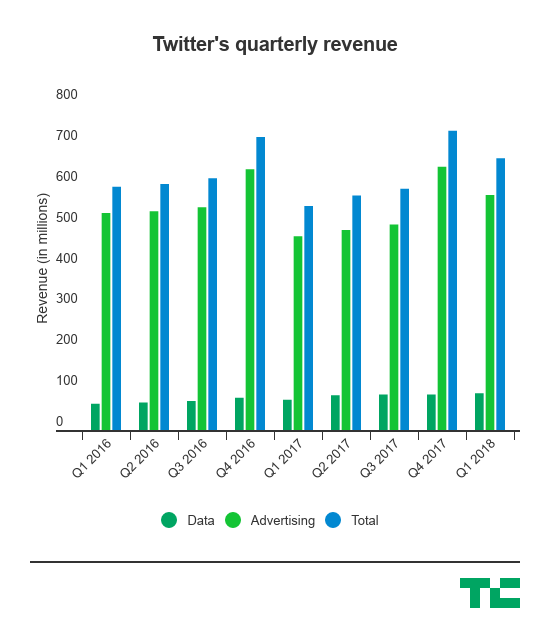
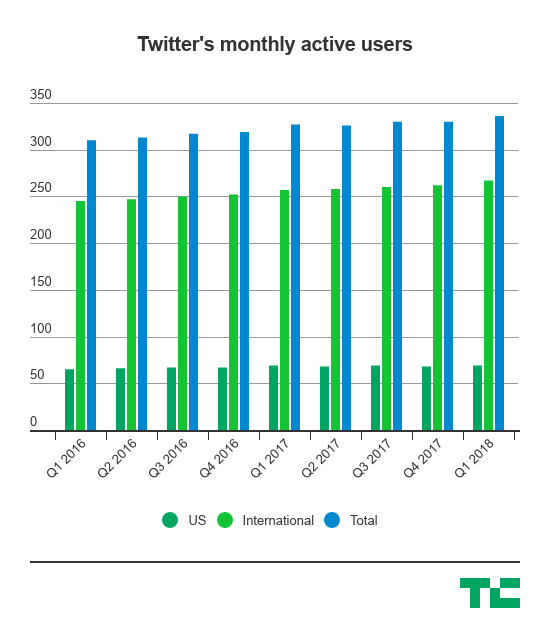
Twitter’s monthly active users barely grew — though it did, indeed, grow — by around 3% worldwide year-over-year, and is now at around 336 million monthly active users. That isn’t crazy growth or size in the scope of how large Facebook is, but it still means that Twitter isn’t losing those users. It’s going to be re-entering a critical time heading into another year of elections. All this is going to be critical to its story as it tries to sell a turnaround on Wall Street, where it at one point was worth more than double it is now.

The company beat out Wall Street’s expectations by delivering $655 million in revenue, leading to a small spike in the stock this morning by about 5%. Here’s the final scorecard:

  • Monthly active users: 336 million, up 3% year-over-year and compared to around 334 million expected
  • U.S. MAUs: 69 million, about flat year-over-year
  • International MAUs: 267 million, up 4% year-over-year
  • Q1 Revenue: $665 million, compared to $608 million Wall Street estimates and up 21% year-over-year
  • Q1 Earnings: 16 cents per share, compared to 12 cents per share estimates

While all of this looks pretty strong, Twitter had a pretty bumpy but somewhat positive 2017 on Wall Street toward the back end of the year. It’s been making significant moves to try to curb abuse and harassment and has actually been tweaking the product in some ways, even if they don’t particularly feel earth-shattering. Expanding the character count from 140 to 280 characters might not seem like a lot, but it does compress more information into that small space, and any bit of engagement helps Twitter in the long run sustain itself.

Late last year, Twitter passed Snap in market cap. While this is largely symbolic, it’s kind of a snapshot of the pressure both networks are under to show that advertisers are actually interested in a platform beyond Facebook. Both companies are pretty volatile and have to sell Wall Street on growth stories. Twitter has often been slammed for being difficult to use and having a lot of problems related to harassment and abuse, and it’s spent much of the last year trying to fix those problems.

(Interestingly, Twitter’s stock-based compensation expense — an expense that’s been hounding Twitter for some time — increasingly seems to be getting under control. It’s down to around $73 million in the first quarter, compared to $117 million in the first quarter last year.)

While it won’t be the size of Facebook, Twitter has to position itself as a unique spot where advertisers can reach an audience that is in a different kind of behavioral mode than they are on Facebook. Twitter has sought to specialize in a live feed of information, whether that’s trying to rejigger the timeline to surface up important information or investing more in video. That, theoretically, means that Twitter could sell itself as a platform with a higher level of engagement in certain activities — something that Snap has done in order to position itself in a positive way for Wall Street.

All this has given Twitter a way to show that while its revenue is not the scale of Facebook, it’s a different kind of revenue, and one that might have a lot of value for advertisers. If it can do that, and continue to scale up its user base over time and then move into significant news events like an elections cycle, it might be able to pick up more and more advertisers. There was a point when we were talking about how its advertising revenue had completely stalled and was headed into a tailspin, but it looks like it’s actually gotten that under control.

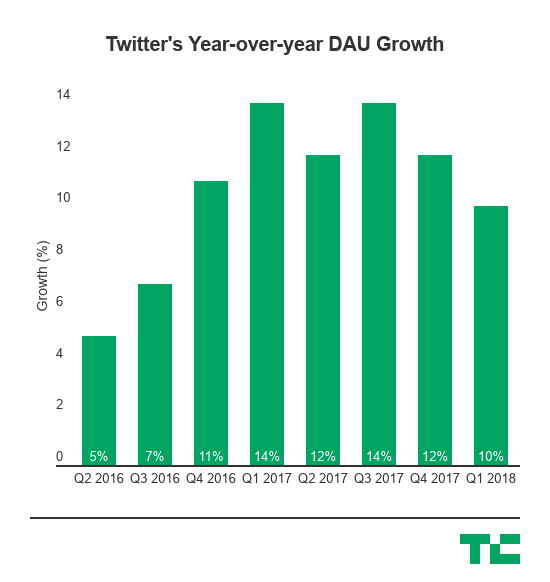
That’s also why Twitter loves to show this chart and talk about it on its quarterly earnings releases, which has only one of the two required axes in order to be a chart. The chart shows year-over-year daily active user growth, but the company doesn’t like to offer some kind of basis for how many of its users are actually super-active DAUs. But, nonetheless, here it is in all its glory:

25 Apr 2018

Xiaomi promises to give money back to customers if its profits get too high

Xiaomi, the Chinese smartphone maker tipped for a public listing this year, has made a unique pledge: if it makes too much money, it’ll give a chunk of its profits back to its customers.

Yes, that’s right.

The company said today it will forever limit the net profit margins after tax for smartphones, smart home devices and other hardware to just five percent. If it makes more money than planned over a calendar year, it plans to “distribute the excess amount by reasonable means to its users.”

It’s hard to know exactly what reasonable means Xiaomi is referring to, but here are some though.

Spoiler number one alert !! — most companies in mobile make a scant profit, if any at all, on hardware.

Firms like LG and Samsung rely on component divisions and other consumer brands to record the bulk of the revenue which makes them profitable. More broadly, the competitive market means there’s not much money to claim in selling phones. Apple is estimated to account for a whopping 87 percent of all smartphone profits despite just 18 percent market share.

Xiaomi Mi Mix 2 was widely-lauded when it launched last year

Spoiler number two alert !! — selling hardware with a low net profit has always been a component of Xiaomi’s strategy.

Indeed, former head of international Hugo Barra previously said it didn’t make money on hardware sales. That approach may have changed, but Xiaomi had never put a figure on its take-home margin before.

This pledge aligns itself neatly with the company’s core focus on providing cutting-edge tech, or as close to, at affordable prices. Much has been said over the years of the bang-for-buck of its $150 Redmi range, while countless comparisons of its higher-end Mi phones — which typically sell for $150-$300 — and flagship products from Apple and Samsung have graced the internet.

Xiaomi has said from the get-go that smartphones are just one part of its wider ecosystem — which includes Xiaomi-branded smart home and “lifestyle” devices from third-parties, and, crucially, services that link all the hardware together. Those include services such as online video, e-commerce, financial products and other digital services.

“From the beginning, we embarked on a relentless pursuit of innovation, quality, design, user experience and efficiency advances, to provide the best technology products and services at accessible prices. We hope that our products and services will help our users to achieve a better life,” CEO and co-founder Lei Jun said in the money statement that accompanies today’s announcement.

Xiaomi is widely tipped to go public this year in an IPO that could value its business as high as $100 billion, according to Bloomberg. Chinese media recently claimed that the company is planning a dual-IPO that would see it list both in Hong Kong and on Mainland China, as our sister site Technode explained.

Such a double-headed IPO would be unique but, as Xiaomi showed today, it has no intention of sticking to so-called convention.

25 Apr 2018

WhatsApp raises minimum age to 16 in Europe ahead of GDPR

Tech giants are busy updating their T&Cs ahead of the EU’s incoming data protection framework, GDPR. Which is why, for instance, Facebook-owned Instagram is suddenly offering a data download tool. You can thank European lawmakers for being able to take your data off that platform.

Facebook -owned WhatsApp is also making a pretty big change as a result of GDPR — noting in its FAQs that it’s raising the minimum age for users of the messaging platform to 16 across the “European Region“. This includes in both EU and non-EU countries (such as Switzerland), as well as the in-the-process-of-brexiting UK (which is set to leave the EU next year).

In the US, the minimum age for WhatsApp usage remains 13.

Where teens are concerned GDPR introduces a new provision concerning children’s personal data — setting a 16-year-old age limit on kids being able to consent to their data being processed — although it does allow some wiggle room for individual countries to write a lower age limit into their laws, setting a hard cap at 13-years-old.

WhatsApp isn’t bothering to try to vary the age gate depending on limits individual EU countries have set, though. Presumably to reduce the complexity of complying with the new rules.

But also likely because it’s confident WhatsApp-loving teens won’t have any trouble circumventing the new minimum age limit. And therefore that there’s no real risk to its business because teenagers will easily ignore the rules.

Certainly it’s unclear whether WhatsApp and its parent Facebook will do anything at all to enforce the age limit — beyond asking users to state they are at least 16 (and taking them at their word). So in practice, while on paper the 16-years-old minimum seems like a big deal, the change may do very little to protect teens from being data-mined by the ad giant.

We’ve asked WhatsApp whether it will cross-check users’ accounts with Facebook accounts and data holdings to try to verify a teen really is 16, for example, but nothing in its FAQ on the topic suggests it plans to carry out any active enforcement at all — instead it merely notes:

  • Creating an account with false information is a violation of our Terms
  • Registering an account on behalf of someone who is underage is also a violation of our Terms

Ergo, that does sound very much like a buck being passed. And it will likely be up to parents to try to actively enforce the limit — by reporting their own underage WhatApp-using kids to the company (which would then have to close the account). Clearly few parents would relish the prospect of doing that.

Yet Facebook does already share plenty of data between WhatsApp and its other companies for all sorts of self-serving, business-enhancing purposes — and even including, as it couches it, “to ensure safety and security”. So it’s hardly short of data to carry out some age checks of its own and proactively enforce the limit.

One curious difference is that Facebook’s approach to teen usage of WhatsApp is notably distinct to the one it’s taking with teens on its main social platform — also as it reworks the Facebook T&Cs ahead of GDPR.

Under the new terms there Facebook users between the ages of 13 and 15 will need to get parental permission to be targeted with ads or share sensitive info on Facebook.

But again, as my TC colleague Josh Constine pointed out, the parental consent system Facebook has concocted is laughably easy for teens to circumvent — merely requiring they select one of their Facebook friends or just enter an email address (which could literally be an alternative email address they themselves control). That entirely unverified entity is then asked to give ‘consent’ for their ‘child’ to share sensitive info. So, basically, a total joke.

As we’ve said before, Facebook’s approach to GDPR ‘compliance’ is at best described as ‘doing the minimum possible’. And data protection experts say legal challenges are inevitable.

Also in Europe Facebook has previously been forced via regulatory intervention to give up one portion of the data sharing between its platforms — specifically for ad targeting purposes. However its WhatsApp T&Cs also suggest it is confident it will find a way to circumvent that in future, as it writes it “will only do so when we reach an understanding with the Irish Data Protection Commissioner on a future mechanism to enable such use” — i.e. when, not if.

Last month it also signed an undertaking with the DPC on this related to GDPR compliance, so again appears to have some kind of regulatory-workaround ‘mechanism’ in the works.

25 Apr 2018

New Harry Potter game, launching today, lets players enroll in Hogwarts

In the first step of what could be an endless exploration of the wizarding world of Harry Potter, the Los Angeles mobile games studio Jam City  is releasing its Harry Potter: Hogwarts Mystery game on the App Store and Google Play.

Developed in partnership with Warner Bros., the game will launch under Warner Bros. Interactive Entertainment’s Portkey Games — a label dedicated to creating first-person gaming experiences for mobile devices and consoles based on J.K. Rowling’s Harry Potter series.

No one could accuse me of being a gamer, but as a fan of both the books and the movies, I was intrigued by the prospect that the Hogwarts Mystery game presents. The animation (from the demo I’d seen) is well done and the plot was compelling.

Set in the 1980s, the game follows the player as they develop a character, enroll in Hogwarts, select one of the school’s four houses and begin to navigate the world of Hogwarts. Players can create personalized characters and customize their avatars by learning magical skills and developing relationships with other students.

Certain choices in the game will change the trajectory of the story, and over time, the game developers envision expanding the world well-beyond Hogwarts to track characters as they navigate life in the Harry Potter universe.

But it all starts with Hogwarts School of Witchcraft and Wizardry and the mystery at the heart of game’s plot. The player’s avatar had an older sibling who attended Hogwarts but vanished mysteriously. Part of the narrative that propels the game will be investigating what happened, and why.

Within the game, players can expect to see some familiar faces (and hear some familiar voices). Dame Maggie Smith is reprising her role as Professor McGonagall and Michael Gambon is back voicing Professor Dumbledore. Other actors from the movies include Warwick Davis as Professor Flitwick, Gemma Jones as Madam Pomrey and Zoe Wanamaker as Madam Hooch .

“Our goal with Harry Potter: Hogwarts Mystery is to make players really feel for the first time like they’re attending Hogwarts,” said Chris DeWolfe, co-founder and CEO of Jam City, in a statement. “By including these iconic and incredibly talented actors in the game, we come one step closer to truly giving fans their own Hogwarts experience.”

Players will also meet original game characters like Penny, a popular Hufflepuff potions expert, Tulip, a rebellious Ravenclaw prankster, and Merula, a Slytherin with a dark past.

As for the gameplay itself, users can duel with characters, learn spells, and interact with students to gain different points that correspond to certain skills and attributes.

Mechanisms for interaction are similar to those developers have been using since Kim Kardashian: Hollywood, and some reviewers have wondered (rightly) whether the dream of a wizarding world that’s mostly open for exploration will be perverted by a cash grab.

The developers of the game seem to be just as excited as the players they want to attract, and will ideally acknowledge the not-so-fine line between commercial viability and opportunistically extortionate in-game economics.