Year: 2018

24 Apr 2018

Popular crypto wallet MEW hit by DNS attack that drained some users’ accounts

There is concern, tears and lost money in the world of crypto once again after MyEtherWallet (MEW), one of the most popular wallets on the internet, was hit by a DNS hack that saw some users lose their cryptocurrency.

MEW said in a statement that “a couple of Domain Name System registration servers were hijacked around 12PM UTC 24 April to redirect users to a phishing site.” Not all visitors to the site during the hijack were impacted, but MEW said that “a majority” of those who were had been using Google’s DNS.

“We are currently in the process of verifying which servers were targeted to help resolve this issue as soon possible,” the company added, confirming that it has since secured its website. The company recommends those who had used Google DNS to switch to Cloudflare’s.

Wikipedia, country-specific versions of Microsoft, Google and PayPal and even banks have been hit by similar attacks before.

An incident like this doesn’t compromise the site directly, but, in the case of MEW, it led some users of the service to insecure websites that aren’t MEW. From there, those who entered private key information without realizing they had been phished risked having their data snagged by the attackers on the other side. With that information, the attackers could gain access to their account and drain its contents. (Note: this is a very good reason why people are advised to never enter private keys manually, and why secure hardware is highly recommended.)

It’s hard to quantify the impact of an attack like this because MEW is such a well-used and trusted service, while MEW said it is still gathering information on exactly what happened.

Coindesk reports that $150,000, or 216 Ether, was taken, but the figure is likely higher. One fraud tracker identified two wallets (here and here) used in the attack, and they lead to what looks like a holding wallet (here) that collected over 520 Ether today. That would be around $365,000 at today’s price of $700 per ETH.

The actual amount taken could be higher still. The holding wallet leads to a larger wallet which has a balance of over $17 million in Ether and a constant stream of incoming transactions. That’s not to say that $17 million was stolen — that isn’t likely — but the attackers could be using other wallets which haven’t yet been tracked but eventually lead to this larger one.

Beyond using hardware like Trezor or Ledger, crypto wallet users — well, internet users in general — should check that the SSL of a website (shown to the left of the domain name in the browser bar) is secure when they are dealing with private information.

That’s the message that MEW gave to its community.

“Users, PLEASE ENSURE there is a green bar SSL certificate that says “MyEtherWallet Inc” before making any transactions. We advise users to run a local (offline) copy of the MEW (MyEtherWallet). We urge users to use hardware wallets to store their cryptocurrencies,” it said in a Reddit statement.

Those looking for an alternative to MEW could turn to MyCrypto, which was started in February by a former MEW co-founder and offers a similar service. Neither site holds users’ crypto or information, instead they allow the checking of accounts and enable transactions to be sent to the blockchain, after which they are ferried on to the intended recipient.

Disclosure: The author owns a small amount of cryptocurrency. Enough to gain an understanding, not enough to change a life.

24 Apr 2018

Bose acquires Andrew Mason’s walking tour startup, Detour

Groupon founder Andrew Mason’s audio tour startup Detour has been sold to Bose. The acquisition, which involves only the software and tour content – not the team – was quietly announced on Detour’s blog a few days ago, followed by an email to customers. Bose, initially, seems like an unlikely acquirer for an app designed to help people discover a city through narrated walking tours. But its interest in the product has to do with its upcoming AR platform, which involves audio experiences delivered through a pair of sensor-laden glasses.

Bose is now “actively looking for a partner to host the Detour content,” and make it available to its customers, including those on Bose AR.  The Detour app itself will soon shut down.

Mason says he may help Bose a bit in the process of finding that third party, but his focus is on his new company, Descript.

Detour had launched a few years ago, and was entirely self-funded by Mason. Its goal was to offer tourists and locals alike a way to discover a city’s hidden gems, like its off-the-beaten-track shops and alleys – things other tours would overlook. The service arrived to the public with tours in San Francisco starting in 2015, before later expanding to other markets, including international destinations, all available as in-app purchases.

The app, at the time of sale, had around 120 available tours.

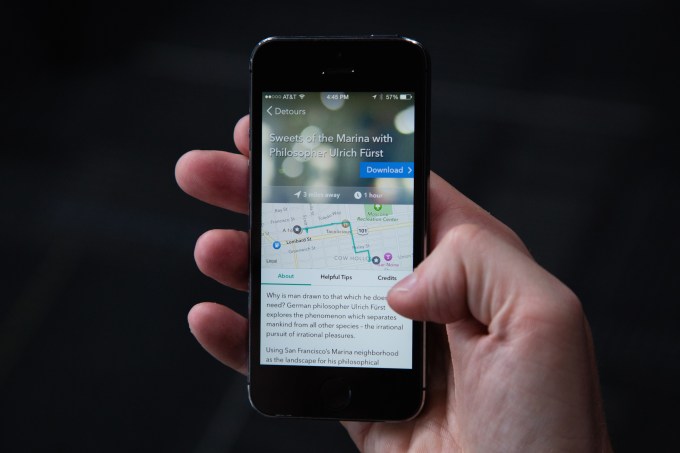
A tour of the Marina’s sweets shops in Detour, narrated by a German philosopher

As part of the creation of its tours, Detour had also developed some interesting technology – like a tool to transcribe audio that lets you edit the audio file by editing the written transcription, and a way to add music and sound to a narrative by adding it to the transcription.

This technology has now been spun off as a new startup, Descript. The Detour team, including Mason, have been working on Descript for around six months now. Descript, which aims to make editing sound files as easy as editing a Word document, launched in December with $5 million in funding from Andreessen Horowitz.

Given Mason’s current focus, it’s not surprising that Detour was shutting down. But it is a little surprising it found an acquirer.

The app was never able to gain a sizable following on the scale of other travel guides. (It had been ranking in the 400’s to 700’s in the App Store’s “Travel” category as of late – meaning, practically invisible.) However, its tours were unique and interesting and had been designed with features others at the time lacked – like location awareness or the ability to sync with multiple people in a group, for example.

The Detour app will remain available until May 31, 2018, and all tours will be free through then. Afterwards, the app will be removed from the App Store.

“Thank you to the producers, engineers, designers, and storytellers that made Detour what it is over the last four years. I’m excited to see where Bose takes it,” wrote Mason, on Detour’s blog.

Pitchbook claims Detour had raised funding, but Mason says that’s incorrect.

“Detour is self-funded (by me) and we never disclosed how much,” he says. But he did confirm that Mihir Shah, a friend, had invested a “some token number of thousands of dollars in the very beginning,” which is why the investment is listed on Shah’s LinkedIn.

Deal terms were not available, but it was likely a small exit.

It’s unclear when Detour would arrive on Bose AR, as Bose is still in the process of finding a third party to continue with Detour, and hasn’t yet shipped test builds of its AR glasses to developers.

24 Apr 2018

Instacart now suggests 5% tip default

Instacart has revamped its checkout process to make it easier for customers to leave better tips. Now, Instacart suggests a 5 percent default tip.

If someone wants to leave more, or less, there are still options to tip nothing at all, 10 percent, 15 percent, 20 percent and other amounts.

Instacart has had a rocky relationship over the years with its drivers and shoppers. In 2016, Instacart removed the option to tip in favor of guaranteeing higher delivery commissions. About a month later, following pressure from shoppers, the company reintroduced tipping.

“After announcing this change, we heard a lot of feedback from our shopper community,” the company said in a blog post at the time. “While our shoppers liked most of the changes, they did not like the fact that we were removing tips from our online platform. Taking that feedback into account, we have decided to continue to accept tips as part of this change.”

In addition to putting tips more front and center, Instacart also changed its service fee from a 10 percent waivable fee to a 5 percent fixed fee.

Just earlier this month, Instacart raised $150 million in funding, valuing the company at $4.35 billion.

24 Apr 2018

Instagram launches “Data Download” tool to let you leave

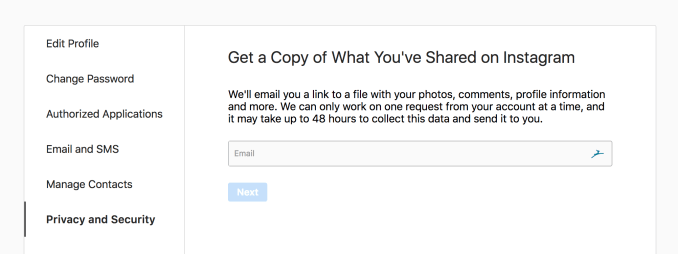
Two weeks ago TechCrunch called on Instagram to build an equivalent to Facebook’s “Download Your Information feature so if you wanted to leave for another photo sharing network, you could. The next day it announced this tool would be coming and now TechCrunch has spotted it rolling out to users. Instagram’s “Data Download” feature can be accessed here or through the app’s privacy settings. It lets users export their photos, videos, Stories, profile, info, comments, and messages, though it can take a few hours to days for your download to be ready.

An Instagram spokesperson now confirms to TechCrunch that “the Data Download tool is currently accessible to everyone on the web, but access via iOS and Android is still rolling out.” We’ll have more details on exactly what’s inside once my download is ready.

The tool’s launch is necessary for Instagram to comply with the data portability rule in European Union’s GDPR privacy law that goes into effect on May 25th. But it’s also a reasonable concession. Instagram has become the dominant image sharing social network with over 800 million users. It shouldn’t need to lock up users’ data in order to keep them around.

Instagram hasn’t been afraid to attack competitors and fight dirty. Most famously, it copied Snapchat’s Stories in August 2016, which now has over 300 million daily users — eclipsing the original. But it also cut off GIF-making app Phhhoto from its Find Friends feature, then swiftly cloned its core feature to launch Instagram Boomerang. Within a few years, Phhhoto had shut down its app.

If Instagram is going to ruthlessly clone and box out its competitors, it should also let users choose which they want to use. That’s tough if all your photos and videos are trapped inside another app. The tool could create a more level playing field for competition amongst photo apps.

It could also deter users from using sketchy third-party apps to scrape all their Instagram content. Since they typically require you to log in with your Instagram credentials, these put users at risk of being hacked or having their images used elsewhere without their consent. Considering Facebook launched its DYI tool in 2010, six years after the site launched, the fact that it took Instagram 8 years from launch to build this means it’s long overdue.

But with such strong network effect and its willingness to clone any popular potential rival, it may still take a miracle or a massive shift to a new computing platform for any app to dethrone Instagram.

24 Apr 2018

Whole Foods grocery delivery expands, now live in 10 markets

In February, Amazon announced it would begin to deliver from Whole Foods markets via its Prime Now service, which offers free, two-hour deliveries for purchases over $35 and even faster, one-hour delivery for an upcharge of $7.99. The service was initially available in only four markets – Austin, Cincinnati, Dallas and Virginia Beach, however. Today, Amazon is expanding Whole Foods deliveries to Denver, Sacramento, and San Diego.

The choice of Denver as one of the earlier markets to receive the option is interesting, given that the city has been a test market for Walmart’s online grocery efforts for years.

In fact, it was the first to offer a grocery pickup option back in 2014. Grocery pickup is now available at over 1,200 Walmart U.S. stores, and Walmart’s grocery delivery is expected to reach 100 markets by year-end. Walmart also announced today it’s now working with DoorDash as a delivery partner in Atlanta, which joins Walmart’s longtime partners on grocery delivery, Uber and Deliv. 

Though Walmart has been working in online grocery for years, Amazon is scaling up fast. Walmart says it will reach over 40 percent of U.S. households via its expansion this year, but it was only offering delivery in six markets as of March.

Amazon’s Whole Foods deliveries, with today’s news, is live in ten markets. This includes its other recent expansions to Atlanta, San Francisco, and L.A. If it continues to expand across Prime Now’s footprint, it would reach dozens of major metros nationwide.

As before, Prime Now shoppers can place their Whole Foods orders for delivery between 8 AM to 10 PM. The product selection includes thousands of fresh and organic produce, bakery, dairy, meat and seafood, floral and everyday staples.

In Sacramento and San Diego, Whole Foods can also deliver alcohol through Prime Now.

“We’ve been delighted with the customer response to free two-hour delivery through Prime Now, and we’re excited to bring the service to our customers in Denver, Sacramento and San Diego,” said Christina Minardi, Whole Foods Market Executive Vice President of Operations, in a statement. “Today’s announcement is another way that we are continuing to expand access to our high-quality products and locally-sourced favorites.”

Whole Foods is only one option for some of Prime Now’s markets, as the service also partners with other local stores like Sprouts, Fresh Thyme, New Season Market, and others. Amazon also operates AmazonFresh, a grocery delivery service available in parts of the U.S.

24 Apr 2018

Seattle’s new venture firm, Flying Fish, holds a first close on its targeted $80 million fund

The founding partners of the new Seattle-based venture firm Flying Fish  met as angel investors deploying capital in the talent-heavy, cash-light region around Amazon and Microsoft’s corporate headquarters.

“We’ve underperformed relative to the talent pool,” is how Heather Redman, one of the firm’s three founding partners describes the region.

Well, now Flying Fish has held a first close of $23 million on a targeted $80 million fund to bring some much needed institutional capital at the seed and Series A stage to a geography that’s seen a number of successful exits and a wealth of talented engineers crop up, but little in the way of regional investor talent to support it.

Seattle’s success extends beyond Microsoft’s Redmond, Wash. headquarters and Amazon’s downtown death star. There’re travel behemoths like Expedia, real estate riches pouring from Zillow and Redfin, titans of visualization and business intelligence software like Tableau, and up and coming success stories like Avalera.

All of those companies are bringing in talent from elsewhere to complement Seattle’s growing reputation as a hub for artificial intelligence and machine learning research and engineering talent thanks to programs at the University of Washington .

Joining Redman, a former executive at AtomShockwave, Inc., Getty Images, Inc., and PhotoDisc, Inc.; are two former Microsoft employees Geoff Harris, who served as General Manager for the Speech and Natural Language team, and Frank Chang. Harris and Chang met while working on natural language processing and machine learning for the gargantuan that Gates built before Chang absconded to Jeff Bezos’ Amazonian environs.

With its $28 million first close, Flying Fish is well on its way to joining a host of other investment firms that have launched or closed new investment funds in the Pacific Northwest since the beginning of the year. In all, at least $140 million in new capital has been committed to venture firms in the region like PSL Ventures, the venture capital firm started by development studio Pioneer Square Labs, and Founders Co-op, a longtime early stage investor on the Seattle scene.


“What we believe is that with the additional VC [firms] beginning to be formed here… that is going to increase the number of company starts geometrically,” says Redman. “The talent is here, the entrepreneurial spirit is here and the use is here… but [entrepreneurs] want to do it where there is the capital to support them.”

The firm is targeting around 25 investments for its $85 million first fund with a focus on machine learning, artificial intelligence and software services. Investments will range between $500,000 and $5 million, according to the firm’s partners.

Already, Flying Fish has put money to work in seven new deals.

  • Ad Lightning – Provides publishers a tool to manage bad ads on their sites
  • Otto Robotics – Robotic automation for the fast food industry. (still in stealth – no website)
  • MessageYes (Sold to Nordstrom) – Developers of an ecommerce chatbot over SMS, Facebook messenger etc.
  • Element Data – Developers of a decision engine that takes into account human emotion in the decision-making process
  • Tomorrow – Providing financial planning services such as wills, trusts and insurance 
  • Finn.ai – Pitching a financial services chatbot to engage with banks over Facebook messengers and other like platforms
  • Streem – Offering an augmented reality application connecting consumers with professionals in the home improvement and maintenance market
24 Apr 2018

Etleap scores $1.5 million seed to transform how we ingest data

Etleap is a play on words for a common set of data practices: extract, transform and load. The startup is trying to place these activities in a modern context, automating what they can and in general speeding up what has been a tedious and highly technical practice. Today, they announced a $1.5 million seed round.

Investors include First Round Capital, SV Angel, Liquid2, BoxGroup and other unnamed investors. The startup launched five years ago as a Y Combinator company. It spent a good 2.5 years building out the product says CEO and founder Christian Romming. They haven’t required additional funding up until now because they have been working with actual customers. Those include Okta, PagerDuty and Mode among others.

Romming started out at ad tech startup VigLink and while there he encounter a problem that was hard to solve. “Our analysts and scientists were frustrated. Integration of the data sources wasn’t always a priority and when something broke, they couldn’t get it fixed until a developer looked at it.” That lack of control slowed things down and made it hard to keep the data warehouse up-to-date.

He saw an opportunity in solving that problem and started Etleap. While there were (and continue to be) legacy solutions like Informatica, Talend and Microsoft SQL Server Integration Services, he said when he studied these at a deeply technical level, he found they required a great deal of help to implement. He wanted to simplify ETL as much as possible, putting data integration into the hands of much less technical end users, rather than relying on IT and consultants.

One of the problems with traditional ETL is that the data analysts who make use of the data tend to get involved very late after the tools have already been chosen and Romming says his company wants to change that. “They get to consume whatever IT has created for them. You end up with a bread line where analysts are at the mercy of IT to get their jobs done. That’s one of the things we are trying to solve. We don’t think there should be any engineering at all to set up ETL pipeline,” he said.

[gallery ids="1627465,1627466,1627467"]

Etleap is delivered as managed SaaS or you can run it within your company’s AWS accounts. Regardless of the method, it handles all of the managing, monitoring and operations for the customer.

Romming emphasizes that the product is really built for cloud data warehouses. For now, they are concentrating on the AWS ecosystem, but have plans to expand beyond that down the road. “We want help more enterprise companies make better use of their data, while modernizing data warehousing infrastructure and making use of cloud data warehouses,” he explained.

The company is currently has 15 employees, but Romming plans to at least double that in the next 12-18 months, mostly increasing the engineering team to help further build out the product and create more connectors.

24 Apr 2018

Catalyst brothers find capital success with $2.4m from True

Over the past few years, the old language of “customer support” has been supplanted by the new language of “customer success.” In the old model, companies would essentially disappear following the conclusion of a sale, merely handling customer problems when they arose. Now, companies are actively reaching out to customers, engaging them with education and training and monitoring them with analytics to ensure they have the best time with the product as possible.

What’s changing is the nature of product and services today: subscription. Customers no longer just make a single buying decision about a product, but instead must actively commit to using the product, or else they churn.

New York-based Catalyst, founded by brothers Edward and Kevin Chiu, wants to rebuild customer success from the ground up with an integrated software platform. They have received some capital success of their own, securing $2.4 million in venture capital from Phil Black of True Ventures with participation from Ludlow Ventures and Compound.

New York has had something of an increase in founder mafias, as TechCrunch reported this weekend. Catalyst is no exception to this trend, with the Chiu brothers both working at DigitalOcean, one of New York’s many high-flying enterprise startups. Edward Chiu was director of customer success at the company for a number of years, but had a unique background in sales and also in coding before starting.

Kevin Chiu was head of inside sales at DigitalOcean . “I brought my brother on to do sales at DigitalOcean,” Edward Chiu explains. “We always knew that we wanted to start a company together, but wanted to see if we would kill each other.” The two worked together, and lo and behold, they didn’t kill each other.

Edward Chiu wanted to match the product experience of using DigitalOcean with the experience of using its internal customer success tools. Nothing on the market fit. “Given that DigitalOcean was a very technical product,” Chiu explained, “we decided to build our own tool.” Chiu thought of customer success at DigitalOcean as its own product, and his team built up the platform to improve its functionality and scalability. “We just used the tool and we loved it,” he said, so we “started to show this tool to a bunch of other customer success leaders I am connected with.”

Other customer success leaders said they wanted the platform, and “after the 20th person told me that,” he and his brother spun out of DigitalOcean to go on their own. Unlike enterprise startups in New York a couple of years ago who often struggled to find any investors, Catalyst found cash quickly. “Two weeks in we had more offers than we knew what to do with,” Chiu explained. The two said they had originally targeted a fundraise of $750,000, but ended up at $2.4 million.

Catalyst is a platform that integrates between a number of other major SaaS services such as Salesforce, Zendesk, Mixpanel and others to create a unified dashboard for data around customer success. From there, customer success managers have a set of automated tools to handle engagement, such as customer segmentation and email campaigns.

A major challenge in the customer success world is that these managers often don’t have the skills required to do advanced data analytics, so they often rely on their friends in engineering to run scripts or perform database lookups. The hope is that Catalyst’s feature set is powerful enough that these sorts of ad-hoc tasks become a thing of the past. “Because we aggregate all this data, you can run queries,” Chiu explains.

Chiu says that Catalyst doesn’t just want to be a software platform, but rather a movement that pushes every company to think about how they can make their customers successful. “There are so many companies that are starting to understand that it is not something that you do once you raise a Series A, but something you do from day one,” Chiu said. “If you take care of your very first customer, they will constantly promote you and constantly promote your business.”

The company is based in Flatiron, and has eight employees.

24 Apr 2018

Uber’s first diversity report under new CEO shows slight progress

Under the leadership of Travis Kalanick, Uber was late to the game in producing its first diversity report. Now, under the leadership of new CEO Dara Khosrowshahi, things are starting to look a bit different at Uber.

Uber has not only brought on a chief diversity officer but also continues to make progress in terms of representation of black and brown people in leadership roles in the U.S., as well as the overall number of women in its workforce. But regarding black and brown people in tech leadership roles, Uber has none.

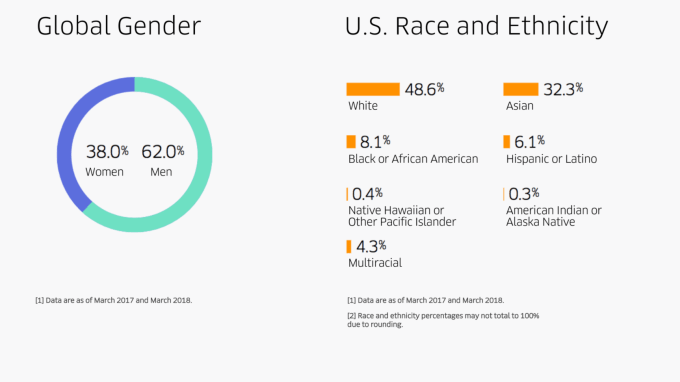
Here’s a quick overview of what Uber’s workforce looks like today:

Compared to last year, Uber has increased the percentage of women from 36.1 to 38 percent. While Uber’s black representation has gone down a bit, Latinx representation increased from 5.6 to 6.1 percent.

Uber’s data is based on an in-house survey, rather than an EEO-1 report. Instead, Uber pulled the gender and race numbers from Workday, where employees are able to self-identify. Uber says the gender data has about 99 percent participation while the race/ethnicity data represents more than 75 percent of the company.

Regarding lesbian, gay, bisexual, transgender and queer representation, Uber reported 15 percent of those who opted into that survey identified as such. In total, only a little over a third of Uber employees participated in the survey worldwide.

In perusing Uber’s December 2017 EEO-1 report, 13 percent of women at Uber are black, 9 percent are Latina and 5 percent are of two or more races in the U.S.

Uber has also created a workshop program called “Why Diversity Matters,” in order to educate employees about diversity and inclusion. To date, about 4,000 employees worldwide have participated in the workshop.

Additionally, Uber overhauled its recruiting and hiring process, and trained engineering interviewers on how to mitigate bias. Meanwhile, Uber also evaluated pay equity and has since “made changes to ensure aggregate race and gender pay equity across Uber,” Uber Chief People Officer Liane Hornsey wrote.

Citing legal reasons, Uber said it’s unable to disclose the exact amount just yet. It’s not clear exactly what those legal reasons entail, but it’s worth noting three Latina software engineers sued Uber in October, alleging they were compensated less because of their gender and race. Last month, Uber paid $10 million to settle the lawsuit.

24 Apr 2018

Meet the quantum blockchain that works like a time machine

A new – and theoretical – system for blockchain -based data storage could ensure that hackers will not be able to crack cryptocurrencies once the quantum era starts. The idea, proposed by researchers at the Victoria University of Wellington in New Zealand, would secure cryptocurrency futures for decades using a blockchain technology that is like a time machine.

You can check out their findings here.

To understand what’s going on here we have to define some terms. A blockchain stores every transaction in a system on what amounts to an immutable record of events. The work necessary for maintaining and confirming this immutable record is what is commonly known as mining . But this technology – which the paper’s co-author Del Rajan claims will make up “10 percent of global GDP… by 2027” – will become insecure in an era of quantum computers.

Therefore the solution is to store a blockchain in a quantum era requires a quantum blockchain using a series of entangled photons. Further, Spectrum writes: “Essentially, current records in a quantum blockchain are not merely linked to a record of the past, but rather a record in the past, one does that not exist anymore.”

Yeah, it’s weird.

From the paper intro:

Our method involves encoding the blockchain into a temporal GHZ (Greenberger–Horne–Zeilinger) state of photons that do not simultaneously coexist. It is shown that the entanglement in time, as opposed to an entanglement in space, provides the crucial quantum advantage. All the subcomponents of this system have already been shown to be experimentally realized. Perhaps more shockingly, our encoding procedure can be interpreted as non-classically influencing the past; hence this decentralized quantum blockchain can be viewed as a quantum networked time machine.

In short, the quantum blockchain is immutable because the photons that it contains do not exist at the current time but are still extant and readable. This means the entire blockchain is visible but cannot be “touched” and the only entry you would be able to try to tamper with is the most recent one. In fact, the researchers write, “In this spatial entanglement case, if an attacker tries to tamper with any photon, the full blockchain would be invalidated immediately.”

Is this possible? The researchers note that the technology already exists.

“Our novel methodology encodes a blockchain into these temporally entangled states, which can then be integrated into a quantum network for further useful operations. We will also show that entanglement in time, as opposed to entanglement in space, plays the pivotal role for the quantum benefit over a classical blockchain,” the authors write. “As discussed below, all the subsystems of this design have already been shown to be experimentally realized. Furthermore, if such a quantum blockchain were to be constructed, we will show that it could be viewed as a quantum networked time machine.”

Don’t worry about having to update your Bitcoin wallet, though. This process is still theoretical and not at all available to mere mortals. That said, it’s nice to know someone is looking out for our quantum future, however weird it may be.