Year: 2018

24 Apr 2018

Oracle acquires Grapeshot, a marketing tech startup that helps ensure ‘brand safety’

In the era of fake news and controversies over how brands’ advertising — via programmatic platforms — unwittingly ends up alongside content with which they’d rather not be associated, Oracle has made an acquisition to beef up its ability to help customers with these marketing challenges.

It has announced that it will acquire Grapeshot, a startup out of Cambridge, England, that has developed a platform to help ensure “brand safety”, along with solutions to help brands, agencies, publishers and ad platforms to match ads to more specific placements overall.

The startup will become a part of the Oracle Data Cloud, Oracle said, working specifically in the area of Audiences and Measurement, which already provides a number of other tools to marketers, such as data for custom segmented audiences.

The terms of the deal have not been disclosed but we are trying to find out. According to Pitchbook, Grapeshot’s last post-money valuation was around $59 million (£42 million) in May of 2017. The company has raised $22.4 million from investors that include IQ Capital Partners, Draper Esprit and Albion.

Grapeshot, via its Contextual Intelligence Platform, says it works with some 5,000 marketers globally, covering some 38 billion programmatic ad impressions. It’s been growing at a rate of over 100 percent year-over-year, it says. It looks like it will continue to work with existing customers, who will in turn become potential targets for the cross-selling of other Oracle services.

The rise of Grapeshot and its acquisition by Oracle speaks to a growing challenge in the area of adtech and corresponding marketing technology: while programmatic advertising has largely become the norm across the web, there are some unintended consequences from all that automation.

For one, it’s harder to specifically match ads to content in every case — and this might potentially become even more difficult with the rise of stronger data protection and increased scrutiny on how are data is used for ad targeting. One of Grapeshot’s services helps marketers solve this with technology that helps match ads not just to basic sites, but to keywords on pages.

But in the worst-case scenarios, brands are finding their ads running alongside content that is outright damaging to their images. In a recent scandal, advertisers were forced to freeze some ads on YouTube when they were found to be running alongside videos of kids with obscene comments from viewers.

Ideally both for the brands and YouTube, the ads would have never been there to begin with — and that is the kind of outcome that Grapeshot (and now Oracle) is going to be helping achieve.

There are, of course, a lot more controls in place now to try to prevent situations like this, and products aimed at generally making it easier to match ads to content. Search giant (and YouTube owner) Google, the world’s biggest online advertising company, earlier this year launched a new AdSense product that uses machine learning to “read” content on specific pages to understand the context before it serves an ad to it.

The interesting thing about Grapeshot is that it’s working a layer back before this. By not being tied to any specific ad platform, Oracle has the potential to play a strong hand as an unbiased helper to customers to achieve the best results.

Oracle has made a number of acquisitions to expand its digital marketing and advertising solutions business, to tap into the rise of social media and also to compete better against Salesforce. They have included Compendium, Moat, Involver, Vitrue, Netsuite, Market2Lead and many more.
24 Apr 2018

Oracle acquires Grapeshot, a marketing tech startup that helps ensure ‘brand safety’

In the era of fake news and controversies over how brands’ advertising — via programmatic platforms — unwittingly ends up alongside content with which they’d rather not be associated, Oracle has made an acquisition to beef up its ability to help customers with these marketing challenges.

It has announced that it will acquire Grapeshot, a startup out of Cambridge, England, that has developed a platform to help ensure “brand safety”, along with solutions to help brands, agencies, publishers and ad platforms to match ads to more specific placements overall.

The startup will become a part of the Oracle Data Cloud, Oracle said, working specifically in the area of Audiences and Measurement, which already provides a number of other tools to marketers, such as data for custom segmented audiences.

The terms of the deal have not been disclosed but we are trying to find out. According to Pitchbook, Grapeshot’s last post-money valuation was around $59 million (£42 million) in May of 2017. The company has raised $22.4 million from investors that include IQ Capital Partners, Draper Esprit and Albion.

Grapeshot, via its Contextual Intelligence Platform, says it works with some 5,000 marketers globally, covering some 38 billion programmatic ad impressions. It’s been growing at a rate of over 100 percent year-over-year, it says. It looks like it will continue to work with existing customers, who will in turn become potential targets for the cross-selling of other Oracle services.

The rise of Grapeshot and its acquisition by Oracle speaks to a growing challenge in the area of adtech and corresponding marketing technology: while programmatic advertising has largely become the norm across the web, there are some unintended consequences from all that automation.

For one, it’s harder to specifically match ads to content in every case — and this might potentially become even more difficult with the rise of stronger data protection and increased scrutiny on how are data is used for ad targeting. One of Grapeshot’s services helps marketers solve this with technology that helps match ads not just to basic sites, but to keywords on pages.

But in the worst-case scenarios, brands are finding their ads running alongside content that is outright damaging to their images. In a recent scandal, advertisers were forced to freeze some ads on YouTube when they were found to be running alongside videos of kids with obscene comments from viewers.

Ideally both for the brands and YouTube, the ads would have never been there to begin with — and that is the kind of outcome that Grapeshot (and now Oracle) is going to be helping achieve.

There are, of course, a lot more controls in place now to try to prevent situations like this, and products aimed at generally making it easier to match ads to content. Search giant (and YouTube owner) Google, the world’s biggest online advertising company, earlier this year launched a new AdSense product that uses machine learning to “read” content on specific pages to understand the context before it serves an ad to it.

The interesting thing about Grapeshot is that it’s working a layer back before this. By not being tied to any specific ad platform, Oracle has the potential to play a strong hand as an unbiased helper to customers to achieve the best results.

Oracle has made a number of acquisitions to expand its digital marketing and advertising solutions business, to tap into the rise of social media and also to compete better against Salesforce. They have included Compendium, Moat, Involver, Vitrue, Netsuite, Market2Lead and many more.
24 Apr 2018

Kidbox raises $15.3 million for its personalized children’s clothing box

Kidbox, a clothing-in-a-box startup aimed at a slightly younger crowd than StitchFix, has raised $15.3 million in Series B funding to expand and scale its business.

The round was led by Canvas Ventures, and includes participation from existing investors Firstime Ventures and HDS Capital, as well as new strategic partners Fred Langhammer, former CEO of The Estée Lauder Companies Inc., and The Gindi Family, owners of Century 21 department stores.

To date, Kidbox has raised $28 million.

The company was founded in October, 2015, then shipped its first box of clothing out of beta testing during the back-to-school shopping season the next year.

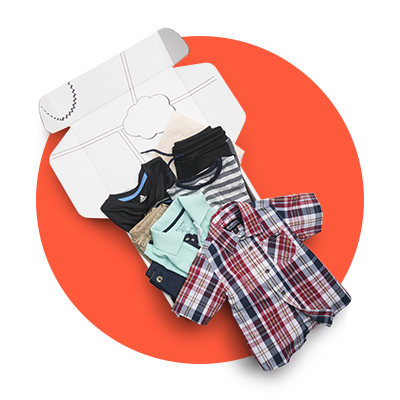
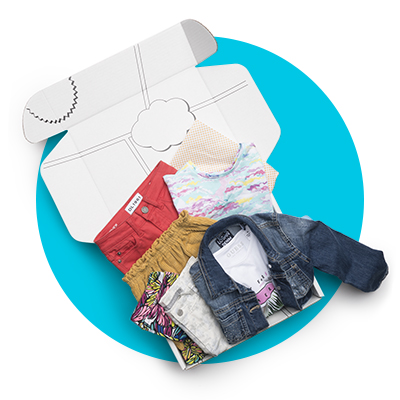
Similar to StitchFix, Kidbox also curates a selection of around half a dozen pieces of clothing and other accessories (but not shoes), which are based on a child’s “style profile” filled out online by mom or dad. The profile asks for the child’s age, sizes, and questions about the child’s clothing preferences – like what colors they like and don’t like, as well as other styles to avoid – like if you have a child who hates wearing dresses, for example, or one who has an aversion to the color orange.

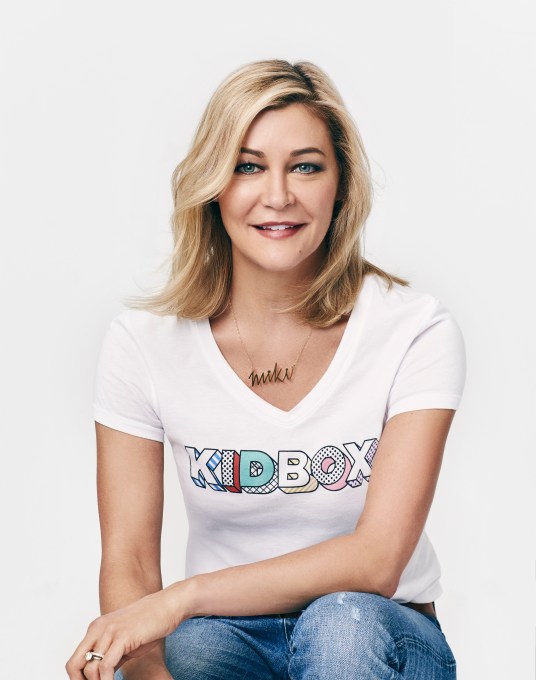
“Those answers feed into a proprietary algorithm – we’re very data science and tech focused,” explains Kidbox CEO Miki Berardelli. “That algorithm hits up against our product catalog at any given moment, and presents to our human styling team the perfect box for – just as an example, a size 7 sporty boy. And from there, the styling team looks at the box that’s been served up, the customer’s history, if they’re a repeat customer, the customer’s geography, and any notes [the customer] added to their account,” she says.

The box is then put together and shipped to the customer.

Berardelli previously worked at Ralph Lauren, Tory Burch, and was President of Digital Commerce for Chico’s (Chico’s, White House Black Market, and Soma). She joined Kidbox in September 2016, after meeting founder Haim Dabah while he was searching for Kidbox’s CEO.

“It resonated with me as a consumer, as an early adopter of all things digital, and as a multi-time operator of e-commerce businesses,” she says, of why she decided to join the startup.

Today, Kidbox’s boxes are sent out seasonally for spring, summer, back-to-school, fall and winter. However, unlike StitchFix, Kidbox isn’t a subscription service – you can skip boxes at any time, and you’re not charged a “styling fee” or any other add-on fees.

However, if you keep the full box, Kidbox donates a new outfit to a child in need through a partnership with Delivering Good, a nonprofit that allows customers to choose the charity to receive their clothing donation.

At launch, Kidbox carried around 30 kid’s brands. It’s since grown its assortment to over 100 brands for kids ages newborn through 14, including well-known names like Adidas, DKNY, 7 for All Mankind, Puma, Jessica Simpson, Reebok, Diesel, and others.

Kidbox launches its own private labels

With the next back-to-school box, Kidbox will insert its own brands into the mix. The company will be launching multiple private labels across all ages, and every box will get at least one own-label item. The brands will include everything from onesies for babies to graphic tees to denim to basics, and more. 

“We believe we’ve identified a void in the children’s apparel marketplace,” notes Berardelli. “The style sensibility of our exclusive brands will all have a unique personality, and a unique voice that’s akin to how our customers describe themselves. It’s all really based on customer feedback. Our customers tell us what they would love more of; and our merchandising team understands what they would like to be able to procure more of, in terms of rounding out our assortment,” she says.

On a personal note, a customer of both Kidbox and Rockets of Awesome, two of the leading kid box startups, what I appreciate about Kibox is the affordable price point – the whole box is under $100 – and its personal touches. Kidbox ships with crayons and a pencil-case for kids, and the box is designed for kids to color. It also includes a print edition of its editorial content, and sometimes, there’s a small toy included too.

Kidbox rival Rockets of Awesome is a little pricier, I’ve found, but has some unique pieces that make it worth checking out, as well.
With the new funding, Kidbox aims to further invest in its technology foundation, its data science teams, its own labels, its customer acquisition strategy and marketing.

The company doesn’t disclose how many customers it has or its revenues. Instead, it notes that the Kidbox “community” – which includes fluffy numbers like Facebook Page fans and people who signed up for emails – is over 1.2 million. So it’s hard to determine how many people are actually buying from Kidbox boxes.

Kidbox has potential in a market where brick-and-mortar retailers are closing their doors, and e-commerce apparel is on the upswing. But it – like others in the space – faces the looming threat posed by Amazon. The retailer has also just launched its clothing box service, Prime Wardrobe, which includes kids’ clothing.

“Kidbox is at the head of a trend that sees a world in which every person will have their own personalized storefront for literally anything — be it kids clothing, furniture, or weddings,” says Paul Hsiao, General Partner at Canvas Ventures, about the firm’s investment. Hsiao has also led investments in Zola and eporta while at Canvas, and in Houzz while at NEA.

“Kidbox is growing at atypically high multiples. I think it is because of their deep connection with their customers – the kids, the parents, and grandparents,” Hsiao continues. “The Kidbox Team is also remarkable at logistics. Sounds boring, but ecommerce is fundamentally a logistics business,” he adds.

Kidbox is currently a team of 35 based in New York.


24 Apr 2018

Kidbox raises $15.3 million for its personalized children’s clothing box

Kidbox, a clothing-in-a-box startup aimed at a slightly younger crowd than StitchFix, has raised $15.3 million in Series B funding to expand and scale its business.

The round was led by Canvas Ventures, and includes participation from existing investors Firstime Ventures and HDS Capital, as well as new strategic partners Fred Langhammer, former CEO of The Estée Lauder Companies Inc., and The Gindi Family, owners of Century 21 department stores.

To date, Kidbox has raised $28 million.

The company was founded in October, 2015, then shipped its first box of clothing out of beta testing during the back-to-school shopping season the next year.

Similar to StitchFix, Kidbox also curates a selection of around half a dozen pieces of clothing and other accessories (but not shoes), which are based on a child’s “style profile” filled out online by mom or dad. The profile asks for the child’s age, sizes, and questions about the child’s clothing preferences – like what colors they like and don’t like, as well as other styles to avoid – like if you have a child who hates wearing dresses, for example, or one who has an aversion to the color orange.

“Those answers feed into a proprietary algorithm – we’re very data science and tech focused,” explains Kidbox CEO Miki Berardelli. “That algorithm hits up against our product catalog at any given moment, and presents to our human styling team the perfect box for – just as an example, a size 7 sporty boy. And from there, the styling team looks at the box that’s been served up, the customer’s history, if they’re a repeat customer, the customer’s geography, and any notes [the customer] added to their account,” she says.

The box is then put together and shipped to the customer.

Berardelli previously worked at Ralph Lauren, Tory Burch, and was President of Digital Commerce for Chico’s (Chico’s, White House Black Market, and Soma). She joined Kidbox in September 2016, after meeting founder Haim Dabah while he was searching for Kidbox’s CEO.

“It resonated with me as a consumer, as an early adopter of all things digital, and as a multi-time operator of e-commerce businesses,” she says, of why she decided to join the startup.

Today, Kidbox’s boxes are sent out seasonally for spring, summer, back-to-school, fall and winter. However, unlike StitchFix, Kidbox isn’t a subscription service – you can skip boxes at any time, and you’re not charged a “styling fee” or any other add-on fees.

However, if you keep the full box, Kidbox donates a new outfit to a child in need through a partnership with Delivering Good, a nonprofit that allows customers to choose the charity to receive their clothing donation.

At launch, Kidbox carried around 30 kid’s brands. It’s since grown its assortment to over 100 brands for kids ages newborn through 14, including well-known names like Adidas, DKNY, 7 for All Mankind, Puma, Jessica Simpson, Reebok, Diesel, and others.

Kidbox launches its own private labels

With the next back-to-school box, Kidbox will insert its own brands into the mix. The company will be launching multiple private labels across all ages, and every box will get at least one own-label item. The brands will include everything from onesies for babies to graphic tees to denim to basics, and more. 

“We believe we’ve identified a void in the children’s apparel marketplace,” notes Berardelli. “The style sensibility of our exclusive brands will all have a unique personality, and a unique voice that’s akin to how our customers describe themselves. It’s all really based on customer feedback. Our customers tell us what they would love more of; and our merchandising team understands what they would like to be able to procure more of, in terms of rounding out our assortment,” she says.

On a personal note, a customer of both Kidbox and Rockets of Awesome, two of the leading kid box startups, what I appreciate about Kibox is the affordable price point – the whole box is under $100 – and its personal touches. Kidbox ships with crayons and a pencil-case for kids, and the box is designed for kids to color. It also includes a print edition of its editorial content, and sometimes, there’s a small toy included too.

Kidbox rival Rockets of Awesome is a little pricier, I’ve found, but has some unique pieces that make it worth checking out, as well.
With the new funding, Kidbox aims to further invest in its technology foundation, its data science teams, its own labels, its customer acquisition strategy and marketing.

The company doesn’t disclose how many customers it has or its revenues. Instead, it notes that the Kidbox “community” – which includes fluffy numbers like Facebook Page fans and people who signed up for emails – is over 1.2 million. So it’s hard to determine how many people are actually buying from Kidbox boxes.

Kidbox has potential in a market where brick-and-mortar retailers are closing their doors, and e-commerce apparel is on the upswing. But it – like others in the space – faces the looming threat posed by Amazon. The retailer has also just launched its clothing box service, Prime Wardrobe, which includes kids’ clothing.

“Kidbox is at the head of a trend that sees a world in which every person will have their own personalized storefront for literally anything — be it kids clothing, furniture, or weddings,” says Paul Hsiao, General Partner at Canvas Ventures, about the firm’s investment. Hsiao has also led investments in Zola and eporta while at Canvas, and in Houzz while at NEA.

“Kidbox is growing at atypically high multiples. I think it is because of their deep connection with their customers – the kids, the parents, and grandparents,” Hsiao continues. “The Kidbox Team is also remarkable at logistics. Sounds boring, but ecommerce is fundamentally a logistics business,” he adds.

Kidbox is currently a team of 35 based in New York.


24 Apr 2018

Spotify’s free tier is its main weapon in the fight against Apple Music

Rumors have been swirling around Spotify’s big event in Manhattan for weeks on end now. But we’ve known since the invites went out that the big show is about one thing, and one thing alone: free.

The feature has long been rumored to be a thorn in the side of record labels and artists, everywhere. After all, there’s no direct revenue generation — rather, the tier exists with the understanding that it’s Spotify’s best recruiting tool. Get roped in with the promise of music for nothing, and you’ll eventually pony up the $10 a month for the convenience of premium. It certainly appears to have worked thus far, as the company currently boasts 70 million paid subscribers to its 90 million free users.

That number keeps the company well above Apple Music’s 38 million. Of course, Apple’s been growing rapidly, helped out by music exclusives and the service’s deep integration the iTunes/iOS ecosystem. Apple’s plans to acquire Shazam will no doubt help push that even further, as the company uses the popular music identification app to push new subscribers.

What Apple doesn’t have going for it, however, is a free tier. It’s no surprise then, that Spotify is milking that feature for all its worth, further blurring the lines between premium and free.

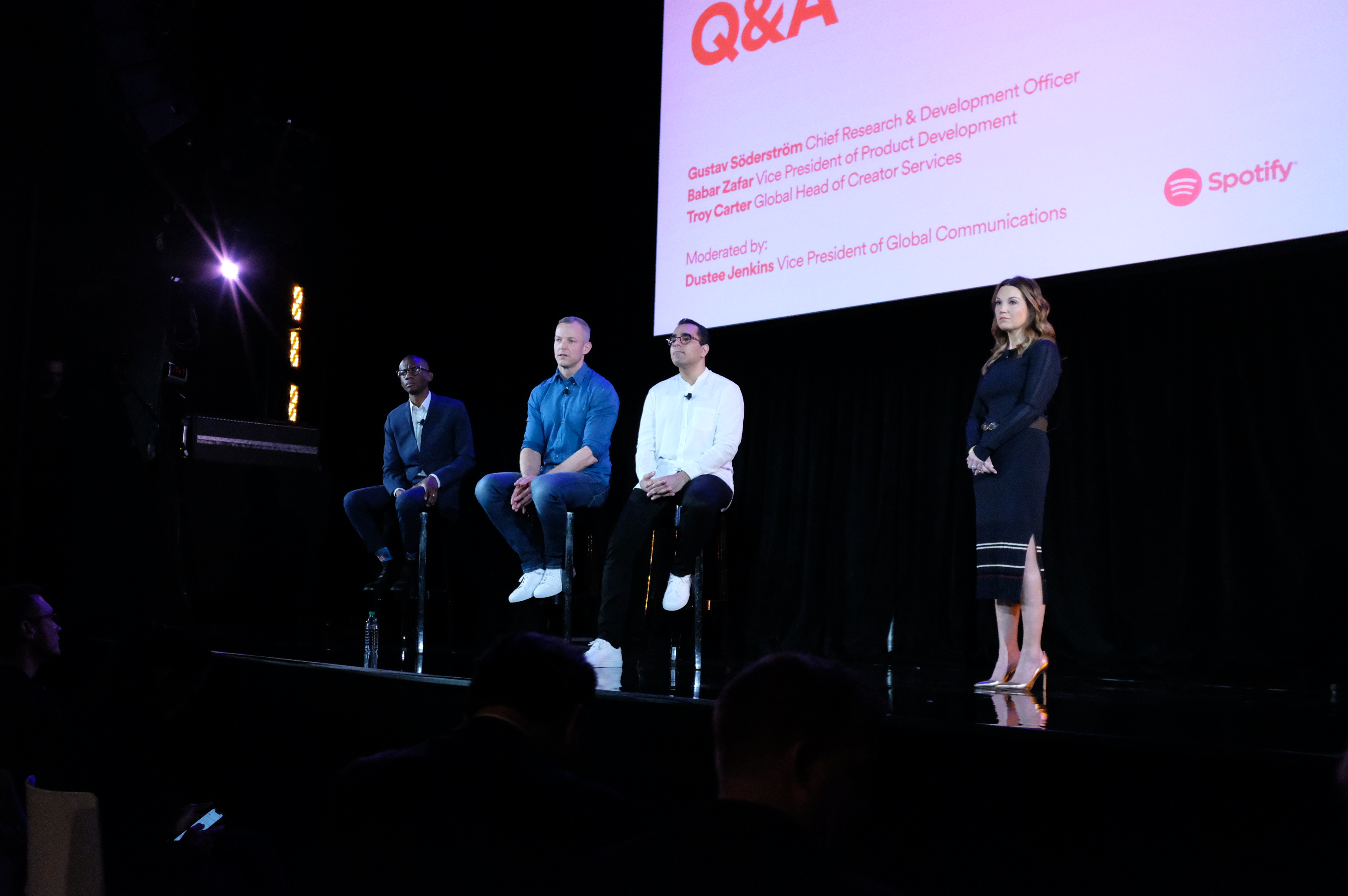
“You may ask why give this away for free?” Chief R&D Officer Gustav Söderström rhetorically asked the crowd at the Gramercy Theater this morning. “We know that it’s the only way we’re going to achieve our goal of getting billions of fans on the plan.”

That’s as much an acknowledged that free is the main thing Spotify has going for it in this fight as any I’ve heard thus far. It seems likely that the company had to pull some teeth behind the scenes in order to convince labels that an even better version of its free offering would still benefit them in the end. Thankfully for Spotify, however, the feature has been grandfather in — it’s been such an integral part of the Spotify experience since the beginning that it’s impossible to divorce it from the service’s overall value offering. 

Of course, while the company appears confident that beefing up its free service won’t cannibalize its free tier, labels will be watching the breakdown of free vs. premium with a very close eye. If growth stagnates for paid subscribers, Spotify will have a lot of angry royalty holders to contend with.

24 Apr 2018

Spotify beefs up its free tier

Today at the Gramercy Theater in NYC, Spotify’s Chief R&D Officer Gustav Söderström announced a brand new free version of the Spotify mobile app.

By leveraging their investment in machine learning, Spotify’s new free tier recommends music to users on the fly. That said, the free tier has always limited users to shuffle. With the new version, users can listen on-demand to whatever song they want, as many times as they want, as long as those songs appear on one of the 15 personalized discovery playlists like Daily Mix, Discover Weekly, Release Radar or Today’s Top Hits.

In total, that’s around 750 tracks (>40 hours of music) that Spotify is serving up to users for on-demand listening.

Spotify will also make recommendations in the free mobile version based on existing user-made playlists, from the songs on those playlists to the name of the playlist itself. The company is calling this “assisted playlisting,” which essentially means that each time you search for a song to add to a playlist, Spotify will make recommendations similar to it as well.

Finally, Spotify has built in a low-data mode (called data saver) that cuts data consumption by up to 75 percent. In the past, Spotify didn’t allow offline listening for free, meaning that users were somewhat tethered to wifi if they needed to conserve data.

With the new data consumption system, which caches music ahead of time to stream via 3G, users can actually listen to much more music with wireless data. Alongside utilizing 3G, Spotify is also optimizing the streaming itself as well as the app (including imagery and other UI elements) to save data and power.

All that said, advertisements will still run on the free tier of Spotify. Which is part of the company’s strategy not only for funding a free tier but for converting users to premium.

In 2014, Spotify introduced its free tier to mobile, letting users listen to their playlists on shuffle with ads. It was a huge part of Spotify’s free-tier growth. In fact, today Spotify has 90 million users on the free tier. And many of those convert to paid users — the company now has 70 million paid subscribers.

“If you’re on a date listening to music, you’re not going to want an ad to come on,” said Spotify’s Global Head of Creator Services Troy Carter.

The company has focused heavily on mobile since 2014, especially where it concerns the premium mobile player.

Spotify is built upon three tiers: ubiquity, personalization and freemium. Söderström explained that Spotify thinks of itself as the broadcast radio of the 90s, where discovery of great music was supported by ads and drove people to the record stores.

Spotify’s free tier represents broadcast radio for Spotify, and is a critical piece of Spotify’s overall strategy as paid services like Apple Music continue to grow.

24 Apr 2018

Spotify beefs up its free tier

Today at the Gramercy Theater in NYC, Spotify’s Chief R&D Officer Gustav Söderström announced a brand new free version of the Spotify mobile app.

By leveraging their investment in machine learning, Spotify’s new free tier recommends music to users on the fly. That said, the free tier has always limited users to shuffle. With the new version, users can listen on-demand to whatever song they want, as many times as they want, as long as those songs appear on one of the 15 personalized discovery playlists like Daily Mix, Discover Weekly, Release Radar or Today’s Top Hits.

In total, that’s around 750 tracks (>40 hours of music) that Spotify is serving up to users for on-demand listening.

Spotify will also make recommendations in the free mobile version based on existing user-made playlists, from the songs on those playlists to the name of the playlist itself. The company is calling this “assisted playlisting,” which essentially means that each time you search for a song to add to a playlist, Spotify will make recommendations similar to it as well.

Finally, Spotify has built in a low-data mode (called data saver) that cuts data consumption by up to 75 percent. In the past, Spotify didn’t allow offline listening for free, meaning that users were somewhat tethered to wifi if they needed to conserve data.

With the new data consumption system, which caches music ahead of time to stream via 3G, users can actually listen to much more music with wireless data. Alongside utilizing 3G, Spotify is also optimizing the streaming itself as well as the app (including imagery and other UI elements) to save data and power.

All that said, advertisements will still run on the free tier of Spotify. Which is part of the company’s strategy not only for funding a free tier but for converting users to premium.

In 2014, Spotify introduced its free tier to mobile, letting users listen to their playlists on shuffle with ads. It was a huge part of Spotify’s free-tier growth. In fact, today Spotify has 90 million users on the free tier. And many of those convert to paid users — the company now has 70 million paid subscribers.

“If you’re on a date listening to music, you’re not going to want an ad to come on,” said Spotify’s Global Head of Creator Services Troy Carter.

The company has focused heavily on mobile since 2014, especially where it concerns the premium mobile player.

Spotify is built upon three tiers: ubiquity, personalization and freemium. Söderström explained that Spotify thinks of itself as the broadcast radio of the 90s, where discovery of great music was supported by ads and drove people to the record stores.

Spotify’s free tier represents broadcast radio for Spotify, and is a critical piece of Spotify’s overall strategy as paid services like Apple Music continue to grow.

24 Apr 2018

Flipboard launches a new tech section

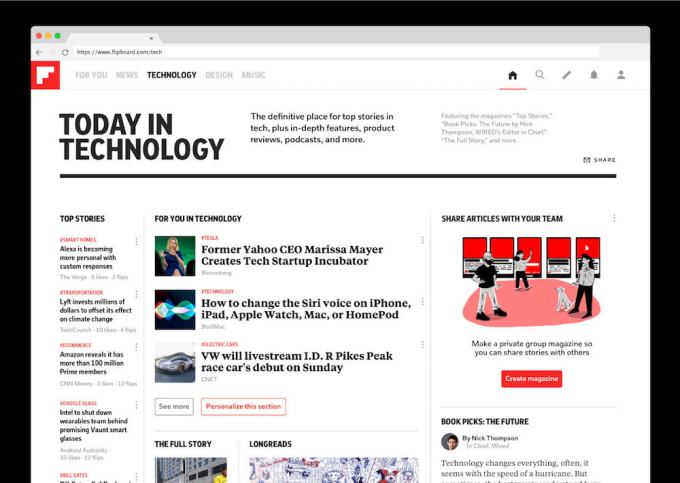
With recent changes, Flipboard has been placing a big emphasis on allowing readers to go deep on their interests. Now it’s adding even more features around one particular interest, in the Technology section of the Flipboard website and app.

“We want to make Flipboard definitive for tech insiders and enthusiasts,” said CEO Mike McCue .

This positions Flipboard as more of a direct competitor to a tech news aggregator like Techmeme, but with more curation from partners and from readers themselves.

The most immediately noticeable change is what the company describes as a “newspaper-like, high-density layout.” Basically, it moves away from the image-heavy look that Flipboard is known for, towards a layout that places a bigger emphasis on headlines and text, designed for quick scanning.

While McCue said the new look is “really meant for the desktop,” Flipboard has also created a version for the mobile web, and the app will also vary between a high-density and low-density layout depending on the stories. (If it seems strange for Flipboard to be prioritizing its web experience, remember that the company has also been shifting its focus away from its own native article formats towards the mobile web.)

Flipboard tech desktop

Regardless of which layout you’re seeing, the section will also have new content. Some of it will be curated by Flipboard publishers, with The Verge creating roundups for Gadgets News and Artificial Intelligence, the Wirecutter offering Deals of the Week and the team here at TechCrunch curating our latest Features.

“Flipboard has really become more of an ecosystem,” McCue said. “Publishers and curators are curating stories around all sorts of different topics. We want to provide access to that ecosystem on any platform, with or without the app.”

Teams can also create their own magazines, which are basically private collections of stories. So if you’re at a startup and want all of your colleagues to be up-to-date on the latest headlines about your industry and competitors, you can curate a magazine that’s only visible to them.

Flipboard will also be asking experts and influencers for book recommendations, starting with Wired Editor in Chief Nick Thompson’s roundup of “Five Books I’ve Recently Read About the Future.”

And all of this will be rounded up in a daily email, which will include the latest tech headlines as well as selections from any team magazine you contribute to. On Saturday, the newsletter will focus on those book recommendations, with links to buy the titles on Amazon.

McCue suggested that if all this new content is embraced by readers, we might see Flipboard start to pursue a similar strategy around other topics, with a focus on reaching professional readers. Next up: Advertising.

24 Apr 2018

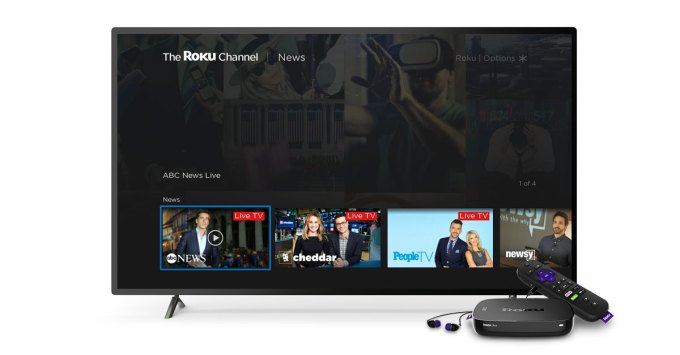
Roku’s adds news to its free channel, including the new streaming network ABC News Live

Last fall, Roku launched its own channel to provide its cord-cutting customers with access to free movies and TV shows in a single destination. Today, it’s adding live news to its channel, too.

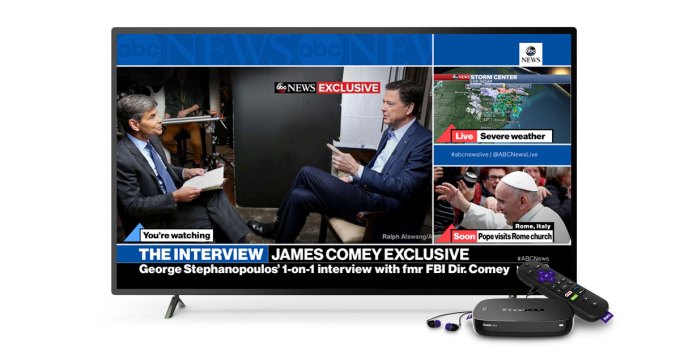
In partnership with ABC News and others, The Roku Channel will now feature live news streams and linear news programming, alongside its entertainment options.

ABC News will be the flagship partner for the launch, as Roku will be the exclusive over-the-top home for its new live and linear streaming network, ABC News Live. However, The Roku Channel will also include live and linear news from Cheddar, PeopleTV, and others.

Until now, The Roku Channel had offered a combination of free content aggregated across other partner channels, like FilmRise and Vidmark, plus content Roku itself licensed from studios like Lionsgate, MGM, Paramount, Sony Pictures Entertainment and Warner Brothers.

Since its launch, The Roku Channel has become one of the top 15 on Roku’s platform, and the number three ad-supported channel.

One of Roku’s goals in offering its own channels is to help users find content that would otherwise be distributed across a number of places on its platform. Roku had already done something similar with its “4K Spotlight” channel launched in 2015, as well as with the “Roku Recommends” channel’s curated selection, launched in 2011.

With The Roku Channel, the goal was to organize the best free content you could find on Roku. And with the addition of news, Roku is once again aggregating partners’ streams in one easy-to-find destination.

Of course The Roku Channel isn’t the only way to watch news on Roku – most major news organizations offer their own channel app.

But many of the news experiences available today are based on clips from the linear TV world, instead of a digital equivalent to the 24/7 news channels found on traditional cable television. That means that instead of being able to “flip on the news” as you can on TV, watching news on Roku has been more of a “choose your own adventure”-style experience of browsing clips to find something you wanted to view, explains Roku’s VP of Programming, Rob Holmes.

“We recognized that users are looking for easy ways to find high-quality content and to engage in a lean back experience,” he says, of bringing streaming news to Roku.

The channel will serve as the launch platform for ABC News Live, the news organization’s brand-new live streaming news service, designed for over-the-top viewing.

Roku and ABC had been in discussions about building out a live news experience for over a year – even before the company launched The Roku Channel, in fact. But with its arrival, it seemed like the best place to introduce the streaming news experience.

“Our ambition here is not to re-create cable, but to reinvent what a 24/7 news channel looks like for [the nonlinear audience],”says Colby Smith, VP of ABC News Digital. “We’ve spent the last three years or so really building up our live operation – experimenting with thousands of live streams and production formats. Of course, we consider ourselves expert live producers – ABC News has been around for many decades. But we’ve also analyzed mountains of data through that experimentation to really dive in and understand what works on each screen size,” he continues.

“And what we’ve learned more than anything in non-cable environments is that viewers want to be shown what’s happening in the world, not told what’s happening,” Smith says.

ABC’s live stream will focus on the most interesting thing that’s happening around the globe in that moment, he says. The content, however, may come from a number of sources – ABC News’ own boots-on-the-ground reporting; its domestic or international partners’ streams; or even social media streams cleared through places like Facebook or YouTube.

ABC News Live, like The Roku Channel itself, will be free and ad-supported, but Roku and ABC aren’t discussing the revenue share or how the ads are sold. (It’s a bit unclear, then, to what extent this is a new revenue stream for Roku itself, versus just another means to woo potential customers to the Roku platform.)

Roku is the only streaming platform to host ABC News Live outside of other ABC News properties, including its own Roku channel and the ABC News website and apps.

ABC says it partnered with Roku on the launch because it wanted to work with a distributor that understood the non-linear TV audience.

“There so many distributors that just want to re-create a TV Everywhere experience, or just want to plop in cable into a digital environment for cord cutters,” says Smith. “That’s not at the heart of what we believe in.”

The channel itself will offer some scheduled programming – including its own take on an hourly news update, in addition to the live stream. It may also cut to its post-White House press briefing coverage at times, and it may stream its Emmy-winning ABC News featured stories during breaks from live coverage.

In addition to ABC News Live, The Roku Channel will also integrate Cheddar’s linear news feed, which has also newly become available on Hulu and YouTube TV. And it will include the ad-supported pop culture and celebrity news network, PeopleTV, from People and Entertainment Weekly.

Roku OS 8.1

The Roku Channel will also get a slight makeover alongside the launch of news. It will now organize content into thematic “Collections,” and “Continue Watching.”

The updates will launch in May with the release of Roku OS 8.1, which will add multicast private listening through the Roku mobile app. That means up to four people on iOS and Android can listen to the TV through their headphones, instead of through the TV set itself.

24 Apr 2018

Delivery robotics company Marble raises $10 million, with plans to move beyond food

San Francisco-based robotics company Marble announced this morning that it’s just closed a $10 million Series A. The round, which involves the likes of Tencent, Lemnos, Crunchfund and Maven, brings the startup’s total funding to $15 million.

In press material tied to the announcement, Marble’s careful not to get hung up on the whole food delivery label that’s been hung on the company since its early days. Instead, Marble’s now referring to itself as “the last-mile logistics company,” a catchy title that points to its broader ambitions to help meet the growing expectations of e-commerce consumers.

“Two day [delivery] has become the norm of expectations,” Marble CEO Matthew Delaney told TechCrunch. “It’s the Amazon effect. Everyone is trying to figure out how to get things to meet the consumer demand of faster and cheaper. That move from next day to same day and sooner is the inevitable trend that is happening.”

This time last year, the company made headlines for cruising down the San Francisco sidewalks with a Yelp Eat24 logo, playing the role traditionally reserved for humans on bicycles and mopeds. The system’s on-board LIDAR sensor help it navigate around pedestrians and other potential hazards, with plans for on-board temperature control helping keep food hot or cold as it cruises toward its destination.

Even then the company touched upon broader ambitions, including groceries, prescriptions and package delivery. Now, it seems, the company is ready to expand those trials.

“It’s a lot more than just food delivery. It’s about rearchitecting the urban supply chain of the future, to open up these services that everyone can afford,” says Delaney, “and bring that next level conveyance to everyone. The at-home parent with six kids or the homebound, elderly or disabled. They don’t have this option. Nobody can afford these services.”

Of course, the company and its competition are going to have to work with regulators to see that future to fruition. Marble’s hometown has halted sidewalk trials out of the same concerns that recently found it putting the kibosh on the city’s recent scooter obsession.

“If we don’t value our society,” City Supervisor Norman Yee said at the time, “if we don’t value getting the chance to go the store without being run over by a robot[…]what is happening?”

Delaney says the company is exploring other avenues for testing, but remains hopeful that it will be able to use its own backyard. “We’ve had so many other states and cities reach out to us. We continue to remain optimistic about San Francisco. It’s our home town. We want to continue to work with the local government to move regulation forward. We want our home town to benefit from this, instead of being the one backwards place.”