Year: 2018

24 Apr 2018

Credit Karma expands its identity theft monitoring tool to include dark web data

Credit Karma is best known for being the only reason anyone is ever willing to peek at their credit score, but the company has other things it wants you to be less stressed out about too.

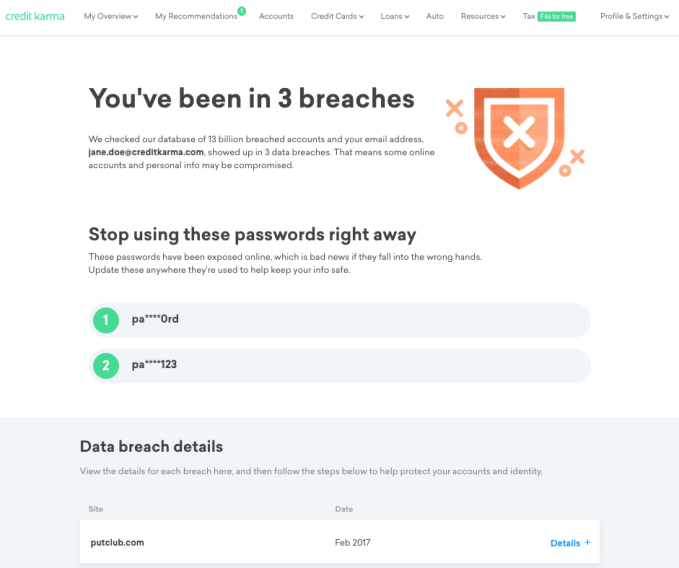
After introducing a free identity monitoring tool for its users late last year, Credit Karma is widening the scope of its fraud-fighting scans to include data from the dark web.

Credit Karma’s existing ID monitoring tool searches 4.5 billion public breaches for a user’s personal data, but the improved service will scour additional breaches culled from the dark web. Added up, the tool will now search through 13 billion data breaches.

By checking its own database of 80 million Credit Karma users against the information in both pools of data, the company can give users a head’s up when their info is compromised.

“The problem is pervasive and the data set that we have is relatively comprehensive,” Anish Acharya, Credit Karma’s vice president of data products, told TechCrunch. Credit Karma partnered with security firm SpyCloud for its databases.

As the company mixes in the new dark web data, affected Credit Karma users that pop up in its scans will receive an alert so they can find more contextual information through the free tool and lock down their accounts accordingly. Credit Karma users can even specifically view which of their passwords are no longer safe to use so that they know which passwords to change.

The company estimates that 65% of its users have experienced a data breach, whether they know it or not, so Credit Karma is well positioned to issue a wake up call about protecting identifying information online.

According to Acharya, the ID monitoring tool grew out of the same beliefs that inspired Credit Karma’s namesake product.

“It follows that same sort of philosophical point,” Acharya said. “This is really a set of information that consumers need to be empowered with.”

Much like its relatively stress-free credit score checks, Credit Karma wants to make its users less freaked out by the idea of identity theft — an unavoidable relatively of leading an online existence.

“The goal is actually decreasing fear and anxiety by empowering consumers,” Acharya said. “It’s a very scary conversation… it’s not a conversation you’re having with friends over a beer — [not] today at least.”

Credit Karma’s dark web monitoring service is available now to consumers through the company’s app (check ID Monitoring in the Settings menu) and through the Resources tab on the Credit Karma website.

24 Apr 2018

BuildingConnected lands $15 million for its service linking contractors and developers

BuildingConnected, which provides software linking contractors and developers has raised $15 million from a strategic investor — Brookfield Ventures, the new venture arm from real estate developer Brookfield Asset Management.

The new investment bumps the total raised by BuildingConnect to $53 million. Previous investors in the company include Crosslink Capital, Brick & Mortar Ventures, Freestyle Capital, Homebrew, Bee Partners, and Lightspeed Venture Partners.

“It is rare to have an investor also be a customer. We are excited to have Brookfield as a partner as we seek to expand our geographic footprint and develop new and innovative products for our expanding roster of customers,” said BuildingConnected CEO Dustin DeVan in a statement.

DeVan, a former engineer in the construction industry and his co-founder, Jesse Pederson, who worked in online marketing, both saw the need for a professional network that linked parties in the construction industry.

Over $80 billion of new construction projects are posted to the company’s platform where roughly 170,000 small business owners, general contractors, and subcontractors are now pitching their services.

Companies listing work on the platform include construction firms like Clark Construction, Mortenson, McCarthy, StructureTone, Shawmut, Turner Construction, and others.  And BuildingConnected counts owners and developers such as Brookfield, Panera Bread, UCSF, and Duke Realty as customers.

Brookfield isn’t only a BuildingConnect investor, it’s also a customer. Over 300 Brookfield projects have used the BuildingConnected marketplace for jobs ranging from $50,000 remodeling contracts to $900 million office towers.

24 Apr 2018

Enterprise firm Mitel to be acquired for $2B by Rackspace investor Searchlight

Mitel, the enterprise communications company that tried but failed to buy Polycom for $2 billion, is now being acquired for $2 billion itself. The company today announced that it has agreed to be acquired by Searchlight Capital Partners in an all-cash transaction of $2 billion, a deal that will also see the company going private.

The price is a decent jump on the company’s market cap of $1.57 billion when it closed trading on Nasdaq yesterday evening, with the $11.15 per-share-deal a 24 percent premium over the average price on the stock’s 90-day average.

Mitel said its board of directors has voted in favor of the deal and “will recommend that Mitel shareholders approve the arrangement”, although it also includes a 45-day “go-shop” period, “which permits Mitel’s Board of Directors and advisors to actively solicit, evaluate and potentially enter into negotiations with parties that make alternative acquisition proposals through June 7, 2018.” So there could be yet more developments in store.

Mitel is a legacy player in the world of enterprise communications — it’s now 45 years old — and it is perhaps known best for its IP telephony solutions, competing with the likes of Avaya and Cisco. Mitel says it counts 70 million businesses in 100 countries as customers.

But developments in the enterprise communications market — which has shifted to include things like BYO, mobile-first solutions; apps in the cloud; and massively integrated IT/comms stacks where companies are simplifying all products in single platforms (and sometimes single vendors like Microsoft), or are using upstart (and less expensive) services like Slack for all interactions, voice and text — have all served to disrupt Mitel’s business. So more recently, Mitel has been on a longer-term mission to reposition itself as a cloud-based, integrated SaaS company. As part of those efforts, last year it also acquired ShoreTel in a $430 million deal.

The deal is being described as a way to make that shift more efficiently, away from the scrutiny it might otherwise have as a publicly-listed company.

“Mitel has succeeded for 45 years because of persistent innovation and relentless focus on delivering shareholder value,” said Terry Matthews, Mitel cofounder and chairman, in a statement. “Our Board determined that this transaction, upon closing, will deliver immediate, significant and certain cash value to our shareholders. It also affirms the tremendous value and market leadership of Mitel. We believe this transaction will provide Mitel with additional flexibility as a private company to pursue the company’s move-to-the-cloud strategy.”

Notably, among Searchlight’s investments is a strategic stake in Rackspace, another legacy company that was taken private in recent years. It will be interesting to see how and if Searchlight looks to explore synergies in these holdings, given Mitel’s cloud strategy and Rackspace’s focus on managed cloud services.

“This transaction is an exciting next step in our multi-year transformation that has enabled Mitel to emerge as an industry leader in the largest markets in the world,” added Mitel CEO Rich McBee. “As a private company, and with the strategic and capital support of the Searchlight funds, we will have greater flexibility to manage the transition in our market, accelerate our strategy, and drive the next phase of success for our customers, partners, and employees.”

Mitel was in tech news several years ago for filing a patent infringement case against Facebook covering technology for calling up web pages in text-based communications (which you get if you type in a URL in a message or post); and its Internet telephony services. Facebook retaliated with patent suits of its own, and the two eventually settled out of court in 2013. Interestingly, although Mitel appeared to be tapping into patents back then that were not actively used in its mainstay PBX business, its more recent shift to the cloud and more integrated communications services across devices might just make those relevant once again.


24 Apr 2018

Bag Week is coming and we need your recommendations

Every year your faithful friends at TechCrunch spend an entire week looking at bags. Why? Because bags – often ignored but full of our important electronics – are the outward representations of our techie styles and we put far too little thought into where we keep our most prized possessions.

To that end we need your help. Do you have a favorite bag we should check out? Do you make a bag we should check out? Is there a bag we should avoid? We’ve created this form to gather bag and bag-related information. If you’re a manufacturer just add a link to your wares and we’ll be in touch. If you are a civilian and simply love a bag (or hate it) add as much info as you’d like and include a rating. We’ll pick a few brand new backs and some old standbys you recommend.

Considering we spend months carrying around our laptop and gear bags they deserve a closer look. That’s what Bag Week is about and we hope you can help us out with some recommendations. Our back and shoulders will thank you.

24 Apr 2018

DoorDash makes a big push into grocery delivery through a pilot program with Walmart

DoorDash is about to make a huge move into grocery delivery, but instead of going all out as a delivery service on its own, it’s instead going to be working behind the scenes to power delivery networks for larger companies — with Walmart as its first big partner.

While Instacart looks to control the end-to-end customer experience for grocery delivery, and Amazon is off doing Amazon-y things with its Whole Foods delivery system, DoorDash is hoping it can build a network that any company that needs some delivery network can tap without giving up its direct relationship with their customers. DoorDash is rolling out grocery delivery with Walmart in Atlanta in the first of what may be a major move to become a back-end platform for companies like Walmart, which want a delivery button on their website but don’t want to build the entire network themselves. By doing that, it offers DoorDash a potentially nice neutral niche as grocery delivery heats up.

“You can use the term white label, but our drivers still will often wear the DoorDash shirt and have the DoorDash bag,” DoorDash COO Christopher Payne said. “But if you go to Walmart.com, and order from Walmart in Atlanta, you’ll have no idea it’s from DoorDash. We’re very supportive of that scenario, that’s the DoorDash Drive scenario. We’re excited to build a business with them and provide this capability.”

Payne said he hopes this will be one of the first of a major expansion of that DoorDash Drive initiative to become a tool that businesses can start tapping for local delivery. And while DoorDash may partly be giving up that direct relationship with users, it can start getting a lot more data when it comes to deliveries. That data then helps it become more and more efficient, ensuring that it can get deliveries done in the best matter and attract more customers, leading to the need for more drivers, and so on.

DoorDash also basically started the whole last-mile delivery business on hard mode with restaurant delivery, Payne said. What DoorDash loses in that direct user experience is paid back in data, Payne says, and that’s more than valuable enough.

“It turns out restaurant delivery is probably one fo the hardest delivery use cases you have — you have to get a pizza somewhere in 20 or 30 minutes or it won’t be crisp, and you have to get an ice cream cone somewhere before it melts. Grocery delivery tends to be delivered earlier in the day, which is before dinner or before you go to work,” he said. “That works out perfectly for us, actually, because our drivers aren’t busy or are less busy than they would be otherwise. It’s a delivery window, as opposed to one that’s getting something to you at an exact moment and time. That’s actually much easier and less demanding than a real-time delivery.

It’s still a significant step beyond its core competency, which is restaurant delivery. But while that has the potential to be a big business, it’s also going to top out at some point. GrubHub, for example, has a market cap of nearly $9 billion — but Amazon, the backbone of how many consumers engage with physical goods through the Internet, is a $700 billion-plus company. If DoorDash is going to continue to grow, it has to start expanding into new lines of revenue, and figuring out how to take all the data and tools it’s built and bring them to new businesses is going to be critical.

Amazon changed the calculus of last-mile grocery delivery, and it pretty much did it overnight — or at least over the span of a few months, which is the equivalent of overnight for a $700 billion company. Amazon acquired Whole Foods, and all of its locations in major metropolitan areas, for $13.7 billion and very quickly began offering two-hour delivery for prime customers for Whole Foods. On top of that, the company quickly started offering a credit card with an absurdly good reward system that’s tied directly to Prime purchases and Whole Foods (assuming you stay within the Prime ecosystem).

That’s meant that larger companies find themselves trying to figure out how to make such an agile move, and do it as soon as possible. For Walmart, getting this partnership with DoorDash allows it to just add a small segment to its typical customer flow without having to build out a full-on logistics delivery system. The opportunity to expand that to other businesses is pretty natural, and that’s the theme behind the Drive platform, and in theory offers businesses a way to quickly ramp up a delivery network without having to hand off the customer relationship to DoorDash. That may, in the end, be much more palatable for businesses.

“One of the other advantages of partnering with a company like Walmart isn’t just that they’re a leading grocer in the US,” Payne said. “They’re in a lot of other lines of businesses. As they want to expand and deliver more to their customers, they have physical assets to do that, so it provides a nice solution for us to test other items in the future. I would say grocery delivery is very much in its early days, it’s roughly equivalent to where food delivery was four years ago. We’re all going to be learning together, and it also means there’s gonna be a lot of other competition as there is in food delivery. But we believe our merchant operational excellence and quality of delivery will set us apart, and that’ll be proven in time.”

24 Apr 2018

Despite IPO surge, Hong Kong investors aren’t tech savvy, warns Razer CEO

Xiaomi and Ant Financial are two of a cluster of major tech names being linked with IPOs in Hong Kong. But, despite a burst of upcoming tech listings and new measures that are tipped to encourage more, the country still has some way to go to match the U.S. as a destination for startup exits, according to one of its star graduates.

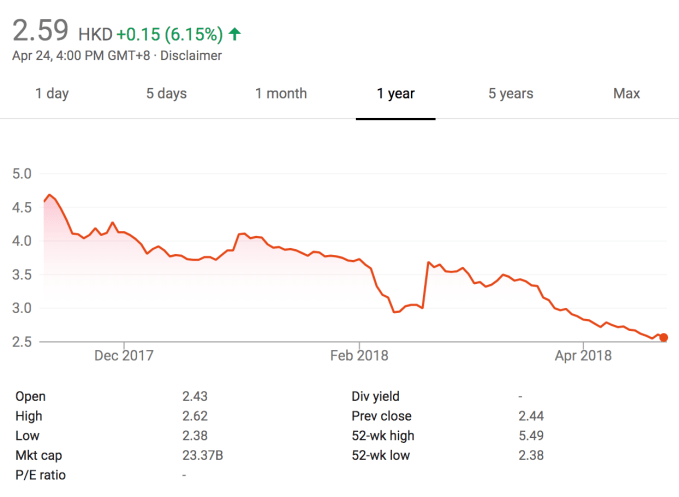
Gaming hardware firm Razer raised over $500 million when it went public on the HKSE last November, but its CEO Min-Liang Tan has warned that the country’s investor base needs education on how tech companies perform and develop.

“[Going public] was an exciting time for us, but [now] our focus is getting the Hong Kong investment public to be more educated on tech companies,” Tan told TechCrunch in an interview this week. “The U.S. [public markets] are probably more cognizant of tech companies.”

Razer, which is backed by Hong Kong’s richest man Li Ka-Ching among other investors, saw an 18 percent pop on IPO day, but its share price has steadily decreased since then. It is trading up six percent today — after the company bought $100 million-valued payment provider MOL yesterday — but its price of HK$2.59 is down on its initial list price of HK$3.88.

The company isn’t alone.

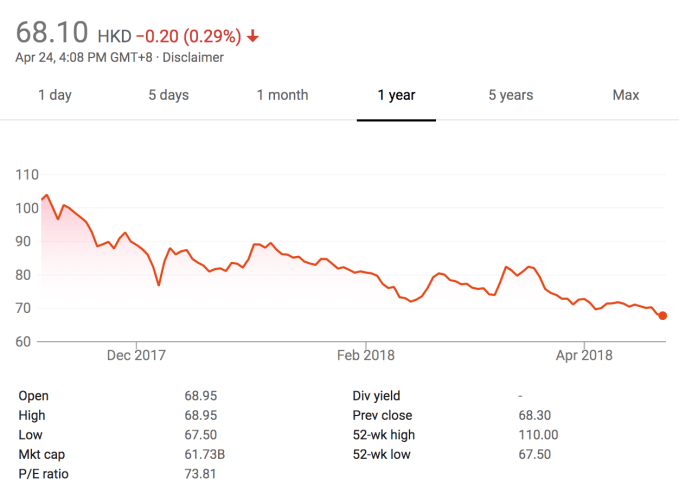
China Literature, the e-publishing unit of Tencent, is another lauded IPO darling that has struggled to find its feet since going public.

Its listing was the most profitable Hong Kong debut in a decade with shares leaping 86 percent in value on the first day of trading as China Literature raised $1 billion. But today the price of HK$68.10 is down substantially on a debut figure of HK$102.5.

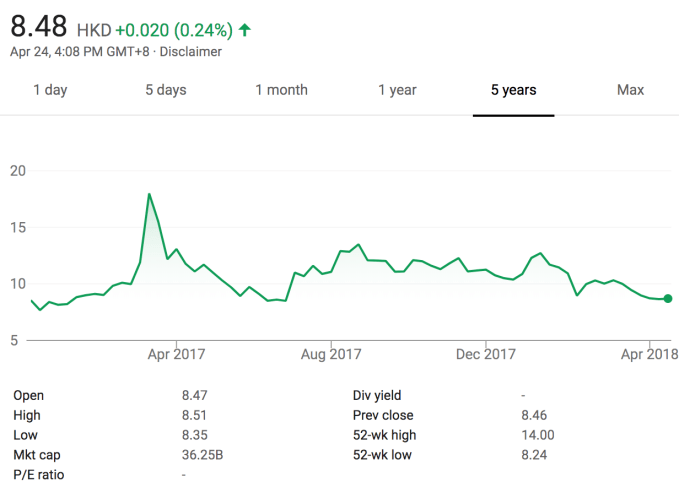
Going back further, shares of selfie app and smartphone-maker Meitu — which led the tech rally with an HKSE listing in late 2016 — have stayed flat.

The share price closed today at HK$8.48, down slightly on a HK$8.50 valuation at the close of trading on its December 15 2016 debut.

Those three stories should offer some caution to Ant Financial, the Alibaba fintech affiliate reported valued up to $150 billion by private investors, and Chinese smartphone star Xiaomi, which is reportedly close to listing in Hong Kong at a valuation that could reach $100 million.

We’ve written before that Hong Kong’s unique positioning bridging China and the international market gives it appeal as a crossway for Chinese brands to go international, and global firms to enter Mainland China. Added to that, there markets like India and Southeast Asia are incubating billion-dollar tech firms that will need destinations for exits perhaps beyond the scope of what the location options can offer. However, with facts like higher burn rates, iterative product development, large R&D budgets and varying business models, many tech companies don’t function like more traditional enterprises or industries.

In Razer’s case, the company sells gaming laptops and accessories for gamers such as specialist mice, keyboards, headsets and gaming pads. It recently branched out into mobile with its first smartphone and Tan teased the potential for other new product launches this year.

The challenge of educating investors is acuter for Razer than most tech companies since the company focuses on emerging industries such as gaming and e-sports. Case in point, that space is so nascent and under-the-radar that Razer had to commission its own surveys and research from third-parties ahead of its IPO to get market and competition data for its prospectus.

Still, Tan said things are going well for the business.

“We out-performed our expectations quite a bit in 2017 and there’s a lot of excitement around gaming and e-sports,” he told TechCrunch.

“The phone has done very well for us,” he added. “With games like PUBG and Fortnite coming to mobile, it’s probably the best timing ever for us to be first movers in this space. Now with virtual credits [from the MOL acquisition], we see a way to help games companies in various areas… we’re building an entire ecosystem for our games partners.”

Tan declined to comment when asked if Razer would consider additional listings in other markets, although he said there’s “a lot of interest in the work we do.”

24 Apr 2018

Belgium’s Cowboy raises $3M led by Index to launch a smarter e-bike

Cowboy, the startup that’s building a new, smarter electronic bicycle, quietly launched in its home country of Belgium this past week, whilst simultaneously disclosing it has raised $3 million in seed funding.

Notably, the round is led by Index Ventures. The London and San Francisco-based VC appears to be particularly bullish on electric-powered mobility, recently backing electric scooter startup Bird.

France’s Hardware Club, and Kima Ventures also participated in Cowboy’s seed round, along with individual investors Thibaud Elziere (eFounders), Bertrand Jelensperger (LaFourchette), Harold Mechelynck (Ogone), Frederic Potter (Netatmo) and Francis Nappez (BlaBlaCar).

Founded by Adrien Roose and Karim Slaoui, who both previously co-founded Take East Easy, an early Deliveroo competitor, and Tanguy Goretti, who was previously co-founder ride-sharing startup Djump, Cowboy has set out to build and sell a better designed e-bike that it claims addresses issues that have historically held back the category’s mass appeal. This includes a more elegant design than many existing models currently on the market, making the bike ‘smart’ by being connected to a mobile phone and ‘over the air’ through cellular and GPS networks, and better affordability than comparative offerings.

In a call last week, Roose gave me a brief run down of the Cowboy’s features and a little of the product’s back story, including how Index got interested. He says he first became aware of e-bikes (or “ped-elec” bikes that combine a manual pedal and electric motor) after being puzzled that they weren’t more widely used by Take Eat Easy’s bicycle couriers. Riders that did use an e-bike tended to be older, suggesting that current e-bikes didn’t appeal to a younger demographic.

After researching the market a lot deeper, Cowboy’s eventual founders also noticed that most e-bikes use entirely off the shelf components, which not only constrains differentiation, but also price, since most of the margin goes to parts suppliers and retailers. By designing a completely new e-bike, where the body and brain is bespoke — namely, the chassis/battery, and printed circuit board (PCB) — and where the product is sold direct online, the team believed there was an opportunity to re-define the e-bike category entirely.

The resulting Cowboy e-bike is pitched as a better ride, powered by “intuitive and automatic motor assistance”. This uses built-in sensor technology that measures speed and torque, and adjusts to pedalling style and force to deliver an added boost of motor-assisted speed at key moments e.g. when you start pedalling, when you accelerate, or go uphill.

In addition, the Cowboy it attempting to be more secure thanks to its connectivity. You unlock the bike via the Cowboy smart phone app, which also supports on-board navigation and a data dashboard that tracks speed and other useful stats.

It is also worth noting that this is definitely a vertical platform in the longer-run. That IoT-styled SIM card and GPS have been added to the e-bike for a reason. Initially it will be used for diagnostics and ‘find my bike’ in case of theft, but one can easily imagine other premium services being offered on top, such as bike insurance perhaps.
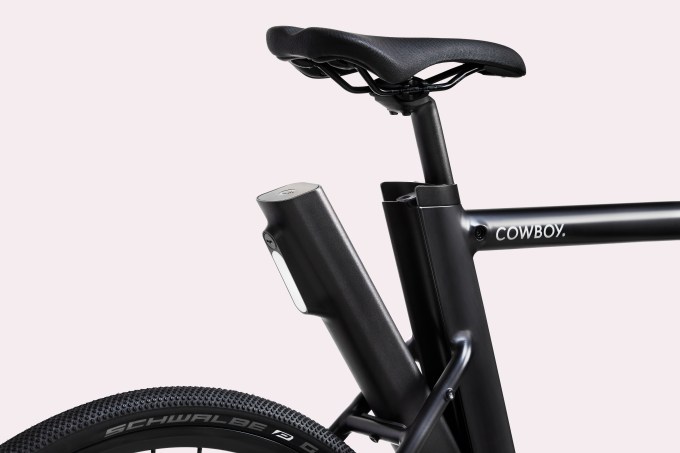
The battery is said to be good to go for around 50km, and takes 2.5 hours to fully charge. As part of the bespoke design, it is integrated into the frame under the saddle and is easily removable. The Cowboy claims to be one of the lightest urban electric bikes on the market, too (the bike and battery together weigh 16kg).

However, as with any product where it’s ultimately about the ride, you probably need to try a Cowboy before truly appreciating it — which, as a powered wheelchair user with limited muscle strength, I’m never going to be able to do. Instead, I’ll note that a pre-production model — which Roose admits still had many remaining issues to iron out — won the prestigious EuroBike trade fair in July 2017.

He also echoes this sentiment when I ask him to tell the story of how the Cowboy team first got the attention of Index Ventures. He says that the startup weren’t originally planning to raise a large seed round, having already got a commitment from Cowboy’s original backers for enough follow-on investment to do a production run and small launch in Belgium. However, knowing that hardware is, well, hard, and that costs can easily overshoot, the company was advised by Hardware Club (who he says has been instrumental in making Cowboy a reality) to find a larger VC backer to mitigate this risk. Index Partner Martin Mignot, who led the round, was immediately interested and then convinced after actually trying the e-bike, but Roose says that it took a lot more to persuade the rest of the Index team to back Cowboy when he subsequently pitched the startup over a video call.

Which brings us to Cowboy’s go-to-market strategy. If you really need to touch the device to truly appreciate it, how will the startup sell directly online? In Brussels, Roose says the startup is experimenting with recruiting product ambassadors — people who already have a Cowboy in their possession — who will be able to bring the device to a prospective buyer to try beforehand. This isn’t as scalable as a pure digital marketing effort, but is still likely a lot cheaper than selling to physical retailers, which in turn would push up the €1,790 price. Meanwhile, the company is only delivering to Belgium for now, but with capital in the bank it plans to launch more widely in Europe next year.


24 Apr 2018

Alibaba is bringing its smart assistant to cars from Daimler, Audi and Volvo

Alibaba is jumping behind the wheel after it announced that Daimler, Audi and Volvo will bring its voice assistant to their vehicles.

The assistant — Tmall Genie — is scheduled to go into cars “in the near future.” When it does, Alibaba said it will enable drivers to check fuel levels, mileage, battery levels and engine status use voice controls. Beyond diagnostics, it’ll also cover door windows, air conditioning and other settings.

Tmall Genie was launched last year when Alibaba unveiled a first smart speaker in the style of Amazon’s Echo products and Google Home, although the AI also connects to third-party hardware, too. The Chinese firm said it has sold over two million of its smart devices so far, and it is working on linking them with the car-based AI to allow users to check their vehicle from their home.

This week’s Genie auto launch is one of the first moves from Alibaba’s AI Lab institution, which was announced as part of a $15 billion push into artificial intelligence, machine learning, IOT, quantum computing and other emerging technologies last year.

24 Apr 2018

Uber to stop storing precise location pick-ups/drop-offs in driver logs

Uber is planning to tweak the historical pick-up and drop-off logs that drivers can see in order to slightly obscure the exact location, rather than planting an exact pin in it (as now). The idea is to provide a modicum more privacy for users while still providing drivers with what look set to be remain highly detailed trip logs.

The company told Gizmodo it will initially pilot the change with drivers, but intends the privacy-focused feature to become the default setting “in the coming months”.

Earlier this month Uber also announced a complete redesign of the drivers’ app — making changes it said had been informed by “months” of driver conversations and feedback. It says the pilot of location obfuscation will begin once all drivers have the new app.

The ride-hailing giant appears to be trying to find a compromise between rider safety concerns — there have been reports of Uber drivers stalking riders, for example — and drivers wanting to have precise logs so they can challenge fare disputes.

Location data is our most sensitive information, and we are doing everything we can do to protect privacy around it,” a spokesperson told us. “The new design provides enough information for drivers to identify past trips for customer support issues or earning disputes without granting them ongoing access to rider addresses.”

In the current version of the pilot — according to screenshots obtained by Gizmodo — the location of the pin has been expanded into a circle, so it’s indicating a shaded area a few meters around a pick-up or drop-off location.

According to Uber the design may still change, as is said it intends to gather driver feedback. We’ve asked if it’s also intending to gather rider feedback on the design.

Asked whether it’s making the change as part of an FTC settlement last year — which followed an investigation into data mishandling, privacy and security complaints dating back to 2014 and 2015 — an Uber spokesman told us: “Not specifically, but user expectations are shifting and we are working to build privacy into the DNA of our products.”

Earlier this month the company agreed to a revised settlement with the FTC, including agreeing that it may be subject to civil penalties if it fails to notify the FTC of future privacy breaches — likely in light of the 2016 data breach affecting 57 million riders and drivers which the company concealed until 2017.

An incoming update to European privacy rules (called GDPR) — which beefs up fines for violations and applies extraterritorially (including, for example, if an EU citizen is using the Uber app on a trip to the U.S.) — also tightens the screw on data protection, giving individuals expanded rights to control their personal information held by a company.

A precise location log would likely be considered personal data that Uber would have to provide to any users requesting their information under GDPR, for example.

Although it’s less clear whether the relatively small amount of obfuscation it’s toying with here would be enough to ensure the location logs are no longer judged as riders’ personal data under the regulation.

Last year the company also ended a controversial feature in which its app had tracked the location of users even after their trip had ended.

24 Apr 2018

Uber to stop storing precise location pick-ups/drop-offs in driver logs

Uber is planning to tweak the historical pick-up and drop-off logs that drivers can see in order to slightly obscure the exact location, rather than planting an exact pin in it (as now). The idea is to provide a modicum more privacy for users while still providing drivers with what look set to be remain highly detailed trip logs.

The company told Gizmodo it will initially pilot the change with drivers, but intends the privacy-focused feature to become the default setting “in the coming months”.

Earlier this month Uber also announced a complete redesign of the drivers’ app — making changes it said had been informed by “months” of driver conversations and feedback. It says the pilot of location obfuscation will begin once all drivers have the new app.

The ride-hailing giant appears to be trying to find a compromise between rider safety concerns — there have been reports of Uber drivers stalking riders, for example — and drivers wanting to have precise logs so they can challenge fare disputes.

Location data is our most sensitive information, and we are doing everything we can do to protect privacy around it,” a spokesperson told us. “The new design provides enough information for drivers to identify past trips for customer support issues or earning disputes without granting them ongoing access to rider addresses.”

In the current version of the pilot — according to screenshots obtained by Gizmodo — the location of the pin has been expanded into a circle, so it’s indicating a shaded area a few meters around a pick-up or drop-off location.

According to Uber the design may still change, as is said it intends to gather driver feedback. We’ve asked if it’s also intending to gather rider feedback on the design.

Asked whether it’s making the change as part of an FTC settlement last year — which followed an investigation into data mishandling, privacy and security complaints dating back to 2014 and 2015 — an Uber spokesman told us: “Not specifically, but user expectations are shifting and we are working to build privacy into the DNA of our products.”

Earlier this month the company agreed to a revised settlement with the FTC, including agreeing that it may be subject to civil penalties if it fails to notify the FTC of future privacy breaches — likely in light of the 2016 data breach affecting 57 million riders and drivers which the company concealed until 2017.

An incoming update to European privacy rules (called GDPR) — which beefs up fines for violations and applies extraterritorially (including, for example, if an EU citizen is using the Uber app on a trip to the U.S.) — also tightens the screw on data protection, giving individuals expanded rights to control their personal information held by a company.

A precise location log would likely be considered personal data that Uber would have to provide to any users requesting their information under GDPR, for example.

Although it’s less clear whether the relatively small amount of obfuscation it’s toying with here would be enough to ensure the location logs are no longer judged as riders’ personal data under the regulation.

Last year the company also ended a controversial feature in which its app had tracked the location of users even after their trip had ended.