Facebook has never before made public the guidelines its moderators use to decide whether to remove violence, spam, harassment, self-harm, terrorism, intellectual property theft, and hate speech from social network until now. The company hoped to avoid making it easy to game these rules, but that worry has been overridden by the public’s constant calls for clarity and protests about its decisions. Today Facebook published 25 pages of detailed criteria and examples for what is and isn’t allowed.
Facebook is effectively shifting where it will be criticized to the underlying policy instead of individual incidents of enforcement mistakes like when it took down posts of the newsworthy “Napalm Girl” historical photo because it contains child nudity before eventually restoring them. Some groups will surely find points to take issue with, but Facebook has made some significant improvements. Most notably, it no longer disqualifies minorities from shielding from hate speech because an unprotected characteristic like “children” is appended to a protected characteristic like “black”.
 Nothing is technically changing about Facebook’s policies. But previously, only leaks like a copy of an internal rulebook attained by the Guardian had given the outside world a look at when Facebook actually enforces those policies. These rules will be translated into over 40 languages for the public. Facebook currently has 7500 content reviewers, up 40% from a year ago.
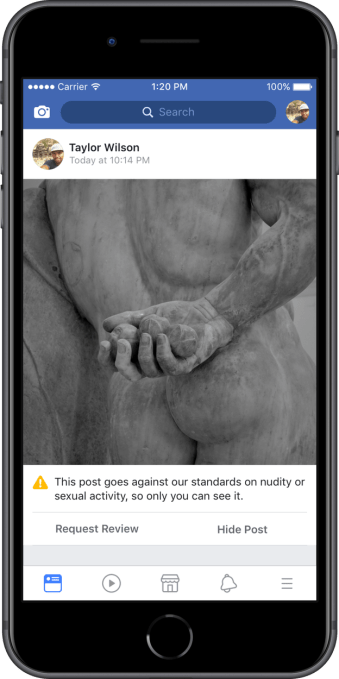
Facebook also plans to expand its content removal appeals process, It already let users request a review of a decision to remove their profile, Page, or Group. Now Facebook will notify users when their nudity, sexual activity, hate speech or graphic violence content is removed and let them hit a button to “Request Review”, which will usually happen within 24 hours. Finally, Facebook will hold Facebook Forums: Community Standards events in Germany, France, the UK, India, Singapore, and the US to give its biggest communities a closer look at how the social network’s policy works.
Facebook’s VP of Global Product Management Monika Bickert who has been coordinating the release of the guidelines since September told reporters at Facebook’s Menlo Park HQ last week that “There’s been a lot of research about how when institutions put their policies out there, people change their behavior, and that’s a good thing.” She admits there’s still the concern that terrorists or hate groups will get better at developing “workarounds” to evade Facebook’s moderators, “but the benefits of being more open about what’s happening behind the scenes outweighs that.”
Content moderator jobs at various social media companies including Facebook have been described as hellish in many exposes regarding what it’s like to fight the spread of child porn, beheading videos, racism for hours a day. Bickert says Facebook’s moderators get trained to deal with this and have access to counseling and 24/7 resources, including some on-site. They can request to not look at certain kinds of content they’re sensitive to. But Bickert didn’t say Facebook imposes an hourly limit on how much offensive moderators see per day like how YouTube recently implemented a four-hour limit.