Year: 2019

12 Nov 2019

Inspired Capital, founded by Alexa von Tobel and Penny Pritzker, just closed its debut fund with $200 million

Exactly 10 years ago, on stage at a TechCrunch event, Alexa von Tobel launched her startup, LearnVest, an online financial planning company that aimed to give people access to more affordable financial planning services.

Much has happened in subsequent years. LearnVest went on to raise roughly $70 million from investors, then to sell for a reported $250 million to the insurance giant Northwestern Mutual in 2015. Four days later, von Tobel had her first child, then she headed back to Northwestern where she ran LearnVest as a separate unit, became Northwestern’s chief innovation officer, and ultimately headed up its venture arm, Northwest Mutual Future Ventures.

Fast forward a bit, and one gathers von Tobel has no plans to slow down. Days after it was announced in January that she was leaving Northwestern, she filed paperwork with the SEC for a new fund with a $200 million target called Inspired Capital. In April came another baby, followed by some recruiting, fundraising, and investing, and today, von Tobel is officially taking the wraps off that debut fund — it hit its $200 million target — along with Inspired’s small but growing portfolio of investments and its full team.

As part of the big reveal, Inspired Capital, based in New York, is being spearheaded by both von Tobel and Penny Pritzker, a former U.S. Secretary of Commerce under former President Barack Obama and serial entrepreneur who currently serves on the boards of Microsoft and Harvard, among others.

Pritzker and von Tobel have known each other for years and became better acquainted when Pritzker selected von Tobel as one of 11 “ambassadors” for a global entrepreneurship initiative launched by the Obama administration.

Penny Pritzker

They are joined by Lucy Grayson Deland, who spent 11 years with the online correspondence platform Paperless Post — nearly eight of them as its COO — and Mark Batsiyan, who helped von Tobel run Northwest’s venture arm as a partner.

As for what Inspired represents, von Tobel pitches it as a more modern seed- and early-stage venture firm. What that means, in her telling: It’s heavily driven by women but does not plan to fund women expressly. It’s based in New York where it sees a capital vaccum, but it plans to invest nationally. It is also has an an advantage in that it spans generations, notes von Tobel, who suggests, correctly, that not a lot of other investment firms can say as much at their outset.

More, despite von Tobel’s experience in fintech and Pritzker’s in real estate especially, Inspired Capital has no plans to limit itself to any sector, von Tobel says. Inspired Capital is just as interested in consumer, media, healthcare and enterprise SaaS startups as money or property management, she stresses.

One of Inspired’s first checks went to Chief, a private women’s network that offers C-suite execs and vice presidents mentorship opportunities, career coaching sessions, and networking events. (Inspired co-led the company’s $22 million Series A round with General Catalyst this past summer.) Another is Umbrella, a kind of TaskRabbit that’s more expressly focused on the aging population.

Other deals include Kindur and Rho. Kindur is a platform that aims to help users choose annuities, as well as optimize their other investments and Social Security options. Rho, like Brex, is aiming to offering fast and flexible digital banking services to entrepreneurs.

Generally, says von Tobel, Inspired Capital will be writing checks that range from $500,000 on the low end, all the way up to $10 million for companies that are starting to gain real traction. In exchange, it will seek ownership in the “low single digits all the way to double digits, depending on where the company is,” she says.

As for how soon is too soon to approach the firm, von Tobel says that, unlike a lot of seed-stage firms, Inspired isn’t necessarily looking for traction as much as it is founders who are, well, inspiring.

Says von Tobel, “We’re definitely not afraid of partnering with an exceptional person before they have an idea.”


12 Nov 2019

Inspired Capital, founded by Alexa von Tobel and Penny Pritzker, just closed its debut fund with $200 million

Exactly 10 years ago, on stage at a TechCrunch event, Alexa von Tobel launched her startup, LearnVest, an online financial planning company that aimed to give people access to more affordable financial planning services.

Much has happened in subsequent years. LearnVest went on to raise roughly $70 million from investors, then to sell for a reported $250 million to the insurance giant Northwestern Mutual in 2015. Four days later, von Tobel had her first child, then she headed back to Northwestern where she ran LearnVest as a separate unit, became Northwestern’s chief innovation officer, and ultimately headed up its venture arm, Northwest Mutual Future Ventures.

Fast forward a bit, and one gathers von Tobel has no plans to slow down. Days after it was announced in January that she was leaving Northwestern, she filed paperwork with the SEC for a new fund with a $200 million target called Inspired Capital. In April came another baby, followed by some recruiting, fundraising, and investing, and today, von Tobel is officially taking the wraps off that debut fund — it hit its $200 million target — along with Inspired’s small but growing portfolio of investments and its full team.

As part of the big reveal, Inspired Capital, based in New York, is being spearheaded by both von Tobel and Penny Pritzker, a former U.S. Secretary of Commerce under former President Barack Obama and serial entrepreneur who currently serves on the boards of Microsoft and Harvard, among others.

Pritzker and von Tobel have known each other for years and became better acquainted when Pritzker selected von Tobel as one of 11 “ambassadors” for a global entrepreneurship initiative launched by the Obama administration.

Penny Pritzker

They are joined by Lucy Grayson Deland, who spent 11 years with the online correspondence platform Paperless Post — nearly eight of them as its COO — and Mark Batsiyan, who helped von Tobel run Northwest’s venture arm as a partner.

As for what Inspired represents, von Tobel pitches it as a more modern seed- and early-stage venture firm. What that means, in her telling: It’s heavily driven by women but does not plan to fund women expressly. It’s based in New York where it sees a capital vaccum, but it plans to invest nationally. It is also has an an advantage in that it spans generations, notes von Tobel, who suggests, correctly, that not a lot of other investment firms can say as much at their outset.

More, despite von Tobel’s experience in fintech and Pritzker’s in real estate especially, Inspired Capital has no plans to limit itself to any sector, von Tobel says. Inspired Capital is just as interested in consumer, media, healthcare and enterprise SaaS startups as money or property management, she stresses.

One of Inspired’s first checks went to Chief, a private women’s network that offers C-suite execs and vice presidents mentorship opportunities, career coaching sessions, and networking events. (Inspired co-led the company’s $22 million Series A round with General Catalyst this past summer.) Another is Umbrella, a kind of TaskRabbit that’s more expressly focused on the aging population.

Other deals include Kindur and Rho. Kindur is a platform that aims to help users choose annuities, as well as optimize their other investments and Social Security options. Rho, like Brex, is aiming to offering fast and flexible digital banking services to entrepreneurs.

Generally, says von Tobel, Inspired Capital will be writing checks that range from $500,000 on the low end, all the way up to $10 million for companies that are starting to gain real traction. In exchange, it will seek ownership in the “low single digits all the way to double digits, depending on where the company is,” she says.

As for how soon is too soon to approach the firm, von Tobel says that, unlike a lot of seed-stage firms, Inspired isn’t necessarily looking for traction as much as it is founders who are, well, inspiring.

Says von Tobel, “We’re definitely not afraid of partnering with an exceptional person before they have an idea.”

12 Nov 2019

Uploadcare raises $1.7M for its CDN platform

Uploadcare, a startup that aims to make using CDN platforms cheaper and easier for businesses, today announced that it has raised a $1.7 million seed round led by Runa Capital and Vendep Capital, with existing investors Vaizra Capital and LVL1 Group participating as well. Uploadcare promises to offer an end-to-end solution for businesses that automatically optimizes the files, images and videos of its clients and then delivers it over its CDN network or that of its partners.

Uploadcare founder and CEO Igor Debatur told me that the idea for the service started quite a few years ago, while he was running a web development agency. Gathering files in different formats and sizes and then making those available in a way that was secure and easily scalable, often turned out to be a challenge — and one that others in the industry faced as well. In the early days, Uploadcare was basically a file uploader for developers. Over time, Uploadcare added backend features, including the smart CDN that can modify content on the fly based on the client where it’s displayed.

For a while, the team developed Uploadcare as a side project, but by 2016, the project started getting traction and they decided to shut down the development agency and focus solely on building out a proper product. “We started to build out a team and right now, we have more than 1,000 paying customers from very different sizes, starting from SMB to large enterprises using the product,” said Debatur.

Having worked for clients, the team obviously knew how to build products, but it had to figure out sales and marketing on the fly. Unsurprisingly, a lot of today’s new funding will go to exactly that: building out a sales and marketing team. Debatur also argues that unlike some of its competitors, Uploadcare invests a lot in its own technology, though the company does partners with other CDN vendors as well, based on its users’ needs.

“The amount of data that’s created per day is rising at a breakneck rate,” said Dmitry Chikhachev, General Partner at Runa Capital . “With its robust infrastructure of delivery networks that span the globe, Uploadcare has quietly become a go-to solution for developers and engineers at some of the world’s largest companies. With differentiated technology and a strong leadership team, we believe that Uploadcare is well positioned to accelerate its growth and further solidify its leadership in the content delivery market.”

12 Nov 2019

Uploadcare raises $1.7M for its CDN platform

Uploadcare, a startup that aims to make using CDN platforms cheaper and easier for businesses, today announced that it has raised a $1.7 million seed round led by Runa Capital and Vendep Capital, with existing investors Vaizra Capital and LVL1 Group participating as well. Uploadcare promises to offer an end-to-end solution for businesses that automatically optimizes the files, images and videos of its clients and then delivers it over its CDN network or that of its partners.

Uploadcare founder and CEO Igor Debatur told me that the idea for the service started quite a few years ago, while he was running a web development agency. Gathering files in different formats and sizes and then making those available in a way that was secure and easily scalable, often turned out to be a challenge — and one that others in the industry faced as well. In the early days, Uploadcare was basically a file uploader for developers. Over time, Uploadcare added backend features, including the smart CDN that can modify content on the fly based on the client where it’s displayed.

For a while, the team developed Uploadcare as a side project, but by 2016, the project started getting traction and they decided to shut down the development agency and focus solely on building out a proper product. “We started to build out a team and right now, we have more than 1,000 paying customers from very different sizes, starting from SMB to large enterprises using the product,” said Debatur.

Having worked for clients, the team obviously knew how to build products, but it had to figure out sales and marketing on the fly. Unsurprisingly, a lot of today’s new funding will go to exactly that: building out a sales and marketing team. Debatur also argues that unlike some of its competitors, Uploadcare invests a lot in its own technology, though the company does partners with other CDN vendors as well, based on its users’ needs.

“The amount of data that’s created per day is rising at a breakneck rate,” said Dmitry Chikhachev, General Partner at Runa Capital . “With its robust infrastructure of delivery networks that span the globe, Uploadcare has quietly become a go-to solution for developers and engineers at some of the world’s largest companies. With differentiated technology and a strong leadership team, we believe that Uploadcare is well positioned to accelerate its growth and further solidify its leadership in the content delivery market.”

12 Nov 2019

Loop Returns picks up $10 million in Series A led by FirstMark Capital

Loop Returns, the startup that helps brands handle returns from online purchases, has today announced the close of a $10 million Series A funding round led by FirstMark Capital. Lerer Hippeau and Ridge Ventures also participated in the round.

Loop started when Jonathan Poma, a cofounder and COO and President, was working at an agency and consulting with a big Shopify brand on how to improve their system for returns and exchanges. After partnering with long-time friend Corbett Morgan Loop Returns was born.

Loop sits on top of Shopify to handle all of a brand’s returns. It first asks the customer if they’d like a different size in the item they bought, quickly managing an exchange. It then asks if the customer would prefer to exchange for a new item altogether, depositing the credit in that person’s account in real time so they can shop for something new immediately.

If an exchange isn’t in the cards, Loop will ask the customer if they’d prefer credit with this brand over a straight-up refund.

The goal, according to Poma and Morgan, is to turn the point of return into a moment where brands can create a life-loyal customer when handled quickly and properly.

The more we shop online, the more brands extend themselves financially, and returns are a big part of that. Returns account for 20 to 30 percent of ecommerce sales, which can become a terrible financial burden on a growing direct-to-consumer brand. And what’s more, the cost of acquiring those users in the first place also goes down the drain.

Loop Returns hopes to keep that customer in the fold by giving them post-purchase options that are more sticky and more lucrative for the brand than a refund.

The company thinks of it as Connection Infrastructure. Most brands already have a customer acquisition architecture, and Shopify and Amazon are ahead when it comes to the infrastructure around customer convenience. But the ties that bind customers to brands haven’t been optimized for the many D2C brands out there looking to make an impact.

“The big problem we’re trying to solve long term is connection infrastructure,” said Morgan. “Why does this brand matter? Why does it mean something to me? Why does the product matter? We want to enforce more mindfulness and meaning into buying.”

Of course, a more mindful shopper doesn’t yield as many returns. Poma and Morgan admit that the goal of their software is to minimize returns, the very reason for the software’s existence. After all, return volume is one of a handful of variables that help Loop Returns determine what it will charge its brand clients.

But the team is thinking about other layers of the connection infrastructure, with plans to launch a product in 2020 that also focuses on the connection point after purchase. Poma and Morgan believe, with an almost religious reverence, that the brands themselves will help lead shoppers and infrastructure providers to a better, more connected shopping experience.

“Brands are the torch bearers,” said Poma. “They will lead us to a more enlightened era of how we think about buying. Empowerment of the brand will lead us to a better consumerism.”

The cofounders stayed mum on any specific plans for the 2020 product, but did say they will use the funding to expand operations and further build out its current and future products.

Of course, Loop is playing in a crowded space. Not only are there other players thinking about post-purchase connection, but Shopify has itself built out tools to help with exchanges and returns, and even acquired Return Magic, a similar service, in the summer of 2018.

That said, Loop Returns believes that there is a long way to go as it builds the ‘connection infrastructure’ and that one clear path forward is actual personalization. With data from returns and exchanges, Loop Returns is relatively well positioned to take on personalization in a meaningful way.

For now, Loop Returns has more than 200 customers and has handled more than 2 million returns, working with brands like Brooklinen, AllBirds, PuraVida and more.

12 Nov 2019

Loop Returns picks up $10 million in Series A led by FirstMark Capital

Loop Returns, the startup that helps brands handle returns from online purchases, has today announced the close of a $10 million Series A funding round led by FirstMark Capital. Lerer Hippeau and Ridge Ventures also participated in the round.

Loop started when Jonathan Poma, a cofounder and COO and President, was working at an agency and consulting with a big Shopify brand on how to improve their system for returns and exchanges. After partnering with long-time friend Corbett Morgan Loop Returns was born.

Loop sits on top of Shopify to handle all of a brand’s returns. It first asks the customer if they’d like a different size in the item they bought, quickly managing an exchange. It then asks if the customer would prefer to exchange for a new item altogether, depositing the credit in that person’s account in real time so they can shop for something new immediately.

If an exchange isn’t in the cards, Loop will ask the customer if they’d prefer credit with this brand over a straight-up refund.

The goal, according to Poma and Morgan, is to turn the point of return into a moment where brands can create a life-loyal customer when handled quickly and properly.

The more we shop online, the more brands extend themselves financially, and returns are a big part of that. Returns account for 20 to 30 percent of ecommerce sales, which can become a terrible financial burden on a growing direct-to-consumer brand. And what’s more, the cost of acquiring those users in the first place also goes down the drain.

Loop Returns hopes to keep that customer in the fold by giving them post-purchase options that are more sticky and more lucrative for the brand than a refund.

The company thinks of it as Connection Infrastructure. Most brands already have a customer acquisition architecture, and Shopify and Amazon are ahead when it comes to the infrastructure around customer convenience. But the ties that bind customers to brands haven’t been optimized for the many D2C brands out there looking to make an impact.

“The big problem we’re trying to solve long term is connection infrastructure,” said Morgan. “Why does this brand matter? Why does it mean something to me? Why does the product matter? We want to enforce more mindfulness and meaning into buying.”

Of course, a more mindful shopper doesn’t yield as many returns. Poma and Morgan admit that the goal of their software is to minimize returns, the very reason for the software’s existence. After all, return volume is one of a handful of variables that help Loop Returns determine what it will charge its brand clients.

But the team is thinking about other layers of the connection infrastructure, with plans to launch a product in 2020 that also focuses on the connection point after purchase. Poma and Morgan believe, with an almost religious reverence, that the brands themselves will help lead shoppers and infrastructure providers to a better, more connected shopping experience.

“Brands are the torch bearers,” said Poma. “They will lead us to a more enlightened era of how we think about buying. Empowerment of the brand will lead us to a better consumerism.”

The cofounders stayed mum on any specific plans for the 2020 product, but did say they will use the funding to expand operations and further build out its current and future products.

Of course, Loop is playing in a crowded space. Not only are there other players thinking about post-purchase connection, but Shopify has itself built out tools to help with exchanges and returns, and even acquired Return Magic, a similar service, in the summer of 2018.

That said, Loop Returns believes that there is a long way to go as it builds the ‘connection infrastructure’ and that one clear path forward is actual personalization. With data from returns and exchanges, Loop Returns is relatively well positioned to take on personalization in a meaningful way.

For now, Loop Returns has more than 200 customers and has handled more than 2 million returns, working with brands like Brooklinen, AllBirds, PuraVida and more.

12 Nov 2019

Lawyers hate timekeeping. Ping raises $13M to fix it with AI

Counting billable time in six minute increments is the most annoying part of being a lawyer. It’s a distracting waste. It leads law firms to conservatively under-bill. And it leaves lawyers stuck manually filling out timesheets after a long day when they want to go home to their families.

Life is already short, as Ping CEO and co-founder Ryan Alshak knows too well. The former lawyer spent years caring for his mother as she battled a brain tumor before her passing. “One minute laughing with her was worth a million doing anything else” he tells me. “I became obsessed with the idea that we spend too much of our lives on things we have no need to do — especially at work.”

That’s motivated him as he’s built his startup Ping, which uses artificial intelligence to automatically track lawyers’ work and fill out timesheets for them. There’s a massive opportunity to eliminate a core cause of burnout, lift law firm revenue by around 10%, and give them fresh insights into labor allocation.

Ping co-founder and CEO Ryan Alshak. Image Credit: Margot Duane

That’s why today Ping is announcing a $13.2 million Series A led by Upfront Ventures, along with BoxGroup, First Round, Initialized, and Ulu Ventures. Adding to Ping’s quiet $3.7 million seed led by First Round last year, the startup will spend the cash to scale up enterprise distribution and become the new timekeeping standard.

I was a corporate litigator at Manatt Phelps down in LA and joke that I was voted the world’s worst timekeeper” Alshak tells me. “I could either get better at doing something I dreaded or I could try and build technology that did it for me.”

The promise of eliminating the hassle could make any lawyer who hears about Ping an advocate for the firm buying the startup’s software, like how Dropbox grew as workers demanded easier file sharing. “I’ve experienced first-hand the grind of filling out timesheets” writes Initialized partner and former attorney Alda Leu Dennis. “Ping takes away the drudgery of manual timekeeping and gives lawyers back all those precious hours.”

Traditionally, lawyers have to keep track of their time by themselves down to the tenth of an hour — reviewing documents for the Johnson case, preparing a motion to dismiss for the Lee case, a client phone call for Sriram case. There are timesheets built into legal software suites like MyCase, legal billing software like Timesolv, and one-off tools like Time Miner and iTimeKeep. They typically offer timers that lawyers can manually start and stop on different devices, with some providing tracking of scheduled appointments, call and text logging, and integration with billing systems.

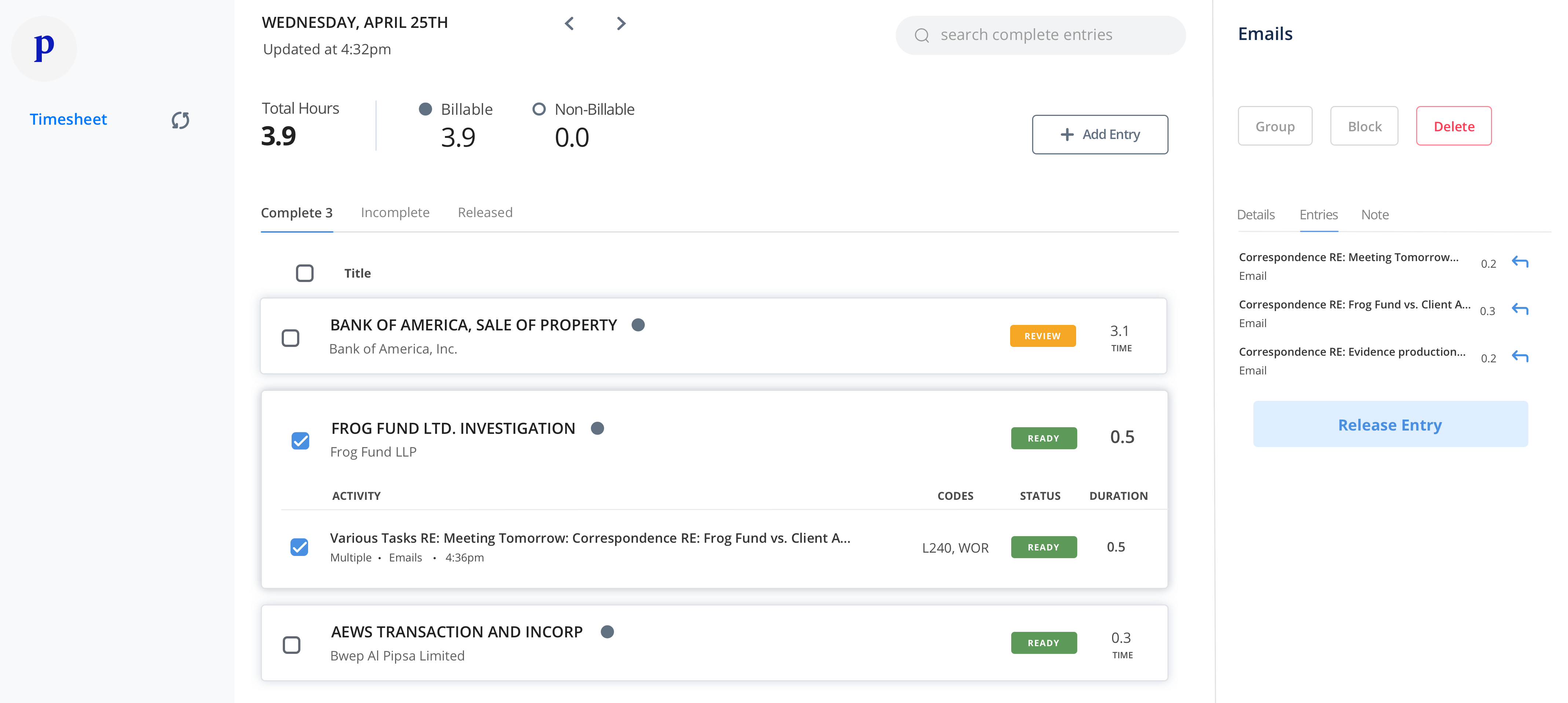
Ping goes a big step further. It uses AI and machine learning to figure out whether an activity is billable, for which client, a description of the activity, and its codification beyond just how long it lasted. Instead of merely filling in the minutes, it completes all the logs automatically with entries like “Writing up a deposition – Jenkins Case – 18 minutes”. Then it presents the timesheet to the user for review before the send it to billing.

The big challenge now for Alshak and the team he’s assembled is to grow up. They need to go from cat-in-sunglasses logo Ping to mature wordmark Ping.  “We have to graduate from being a startup to being an enterprise software company” the CEO tells meThat means learning to sell to C-suites and IT teams, rather than just build solid product. In the relationship-driven world of law, that’s a very different skill set. Ping will have to convince clients it’s worth switching to not just for the time savings and revenue boost, but for deep data on how they could run a more efficient firm.

Along the way, Ping has to avoid any embarrassing data breaches or concerns about how its scanning technology could violate attorney-client privilege. If it can win this lucrative first business in legal, it could barge into the consulting and accounting verticals next to grow truly huge.

With eager customers, a massive market, a weak status quo, and a driven founder, Ping just needs to avoid getting in over its heads with all its new cash. Spent well, the startup could leap ahead of the less tech-savvy competition.

Alshak seems determined to get it right. “We have an opportunity to build a company that gives people back their most valuable resource — time — to spend more time with their loved ones because they spent less time working” he tells me. “My mom will live forever because she taught me the value of time. I am deeply motivated to build something that lasts . . . and do so in her name.”

12 Nov 2019

Lawyers hate timekeeping. Ping raises $13M to fix it with AI

Counting billable time in six minute increments is the most annoying part of being a lawyer. It’s a distracting waste. It leads law firms to conservatively under-bill. And it leaves lawyers stuck manually filling out timesheets after a long day when they want to go home to their families.

Life is already short, as Ping CEO and co-founder Ryan Alshak knows too well. The former lawyer spent years caring for his mother as she battled a brain tumor before her passing. “One minute laughing with her was worth a million doing anything else” he tells me. “I became obsessed with the idea that we spend too much of our lives on things we have no need to do — especially at work.”

That’s motivated him as he’s built his startup Ping, which uses artificial intelligence to automatically track lawyers’ work and fill out timesheets for them. There’s a massive opportunity to eliminate a core cause of burnout, lift law firm revenue by around 10%, and give them fresh insights into labor allocation.

Ping co-founder and CEO Ryan Alshak. Image Credit: Margot Duane

That’s why today Ping is announcing a $13.2 million Series A led by Upfront Ventures, along with BoxGroup, First Round, Initialized, and Ulu Ventures. Adding to Ping’s quiet $3.7 million seed led by First Round last year, the startup will spend the cash to scale up enterprise distribution and become the new timekeeping standard.

I was a corporate litigator at Manatt Phelps down in LA and joke that I was voted the world’s worst timekeeper” Alshak tells me. “I could either get better at doing something I dreaded or I could try and build technology that did it for me.”

The promise of eliminating the hassle could make any lawyer who hears about Ping an advocate for the firm buying the startup’s software, like how Dropbox grew as workers demanded easier file sharing. “I’ve experienced first-hand the grind of filling out timesheets” writes Initialized partner and former attorney Alda Leu Dennis. “Ping takes away the drudgery of manual timekeeping and gives lawyers back all those precious hours.”

Traditionally, lawyers have to keep track of their time by themselves down to the tenth of an hour — reviewing documents for the Johnson case, preparing a motion to dismiss for the Lee case, a client phone call for Sriram case. There are timesheets built into legal software suites like MyCase, legal billing software like Timesolv, and one-off tools like Time Miner and iTimeKeep. They typically offer timers that lawyers can manually start and stop on different devices, with some providing tracking of scheduled appointments, call and text logging, and integration with billing systems.

Ping goes a big step further. It uses AI and machine learning to figure out whether an activity is billable, for which client, a description of the activity, and its codification beyond just how long it lasted. Instead of merely filling in the minutes, it completes all the logs automatically with entries like “Writing up a deposition – Jenkins Case – 18 minutes”. Then it presents the timesheet to the user for review before the send it to billing.

The big challenge now for Alshak and the team he’s assembled is to grow up. They need to go from cat-in-sunglasses logo Ping to mature wordmark Ping.  “We have to graduate from being a startup to being an enterprise software company” the CEO tells meThat means learning to sell to C-suites and IT teams, rather than just build solid product. In the relationship-driven world of law, that’s a very different skill set. Ping will have to convince clients it’s worth switching to not just for the time savings and revenue boost, but for deep data on how they could run a more efficient firm.

Along the way, Ping has to avoid any embarrassing data breaches or concerns about how its scanning technology could violate attorney-client privilege. If it can win this lucrative first business in legal, it could barge into the consulting and accounting verticals next to grow truly huge.

With eager customers, a massive market, a weak status quo, and a driven founder, Ping just needs to avoid getting in over its heads with all its new cash. Spent well, the startup could leap ahead of the less tech-savvy competition.

Alshak seems determined to get it right. “We have an opportunity to build a company that gives people back their most valuable resource — time — to spend more time with their loved ones because they spent less time working” he tells me. “My mom will live forever because she taught me the value of time. I am deeply motivated to build something that lasts . . . and do so in her name.”

12 Nov 2019

Lawyers hate timekeeping. Ping raises $13M to fix it with AI

Counting billable time in six minute increments is the most annoying part of being a lawyer. It’s a distracting waste. It leads law firms to conservatively under-bill. And it leaves lawyers stuck manually filling out timesheets after a long day when they want to go home to their families.

Life is already short, as Ping CEO and co-founder Ryan Alshak knows too well. The former lawyer spent years caring for his mother as she battled a brain tumor before her passing. “One minute laughing with her was worth a million doing anything else” he tells me. “I became obsessed with the idea that we spend too much of our lives on things we have no need to do — especially at work.”

That’s motivated him as he’s built his startup Ping, which uses artificial intelligence to automatically track lawyers’ work and fill out timesheets for them. There’s a massive opportunity to eliminate a core cause of burnout, lift law firm revenue by around 10%, and give them fresh insights into labor allocation.

Ping co-founder and CEO Ryan Alshak. Image Credit: Margot Duane

That’s why today Ping is announcing a $13.2 million Series A led by Upfront Ventures, along with BoxGroup, First Round, Initialized, and Ulu Ventures. Adding to Ping’s quiet $3.7 million seed led by First Round last year, the startup will spend the cash to scale up enterprise distribution and become the new timekeeping standard.

I was a corporate litigator at Manatt Phelps down in LA and joke that I was voted the world’s worst timekeeper” Alshak tells me. “I could either get better at doing something I dreaded or I could try and build technology that did it for me.”

The promise of eliminating the hassle could make any lawyer who hears about Ping an advocate for the firm buying the startup’s software, like how Dropbox grew as workers demanded easier file sharing. “I’ve experienced first-hand the grind of filling out timesheets” writes Initialized partner and former attorney Alda Leu Dennis. “Ping takes away the drudgery of manual timekeeping and gives lawyers back all those precious hours.”

Traditionally, lawyers have to keep track of their time by themselves down to the tenth of an hour — reviewing documents for the Johnson case, preparing a motion to dismiss for the Lee case, a client phone call for Sriram case. There are timesheets built into legal software suites like MyCase, legal billing software like Timesolv, and one-off tools like Time Miner and iTimeKeep. They typically offer timers that lawyers can manually start and stop on different devices, with some providing tracking of scheduled appointments, call and text logging, and integration with billing systems.

Ping goes a big step further. It uses AI and machine learning to figure out whether an activity is billable, for which client, a description of the activity, and its codification beyond just how long it lasted. Instead of merely filling in the minutes, it completes all the logs automatically with entries like “Writing up a deposition – Jenkins Case – 18 minutes”. Then it presents the timesheet to the user for review before the send it to billing.

The big challenge now for Alshak and the team he’s assembled is to grow up. They need to go from cat-in-sunglasses logo Ping to mature wordmark Ping.  “We have to graduate from being a startup to being an enterprise software company” the CEO tells meThat means learning to sell to C-suites and IT teams, rather than just build solid product. In the relationship-driven world of law, that’s a very different skill set. Ping will have to convince clients it’s worth switching to not just for the time savings and revenue boost, but for deep data on how they could run a more efficient firm.

Along the way, Ping has to avoid any embarrassing data breaches or concerns about how its scanning technology could violate attorney-client privilege. If it can win this lucrative first business in legal, it could barge into the consulting and accounting verticals next to grow truly huge.

With eager customers, a massive market, a weak status quo, and a driven founder, Ping just needs to avoid getting in over its heads with all its new cash. Spent well, the startup could leap ahead of the less tech-savvy competition.

Alshak seems determined to get it right. “We have an opportunity to build a company that gives people back their most valuable resource — time — to spend more time with their loved ones because they spent less time working” he tells me. “My mom will live forever because she taught me the value of time. I am deeply motivated to build something that lasts . . . and do so in her name.”

12 Nov 2019

Dutch court orders Facebook to ban celebrity crypto scam ads after another lawsuit

A Dutch court has ruled that Facebook can be required to use filter technologies to identify and pre-emptively take down fake ads linked to crypto currency scams that carry the image of a media personality, John de Mol, and other well known celebrities.

The Dutch celerity filed a lawsuit against Facebook in April over the misappropriation of his and other celebrities’ likeness to shill Bitcoin scams via fake ads run on its platform.

In an immediately enforceable preliminary judgement today the court has ordered Facebook to remove all offending ads within five days, and provide data on the accounts running them within a week.

Per the judgement, victims of the crypto scams had reported a total of €1.7 million (~$1.8M) in damages to the Dutch government at the time of the court summons.

The case is similar to a legal action instigated by UK consumer advice personality, Martin Lewis, last year, when he announced defamation proceedings against Facebook — also for misuse of his image in fake ads for crypto scams. Lewis withdrew the suit at the start of this year after Facebook agreed to apply new measures to tackle the problem: Namely a scam ads report button. It also agreed to provide funding to a UK consumer advice organization to set up a scam advice service.

In the de Mol case the lawsuit was allowed to run its course — resulting in today’s preliminary judgement against Facebook.

It’s not yet clear whether the company will appeal but in the wake of the ruling Facebook has said it will bring the scam ads report button to the Dutch market early next month.

In court, the platform giant sought to argue that it could not more proactively remove the Bitcoin scam ads containing celebrities’ images on the grounds that doing so would breach EU law against general monitoring conditions being placed on Internet platforms.

However the court rejected that argument, citing a recent ruling by Europe’s top court related to platform obligations to remove hate speech, also concluding that the specificity of the requested measures could not be classified as ‘general obligations of supervision’.

It also rejected arguments by Facebook’s lawyers that restricting the fake scam ads would be restricting the freedom of expression of a natural person, or the right to be freely informed — pointing out that the ‘expressions’ involved are aimed at commercial gain, as well as including fraudulent practices.

Facebook also sought to argue it is already doing all it can to identify and take down the fake scam ads — saying too that its screening processes are not perfect. But the court said there’s no requirement for 100% effectiveness for additional proactive measures to be ordered.

Its ruling further notes a striking reduction in fake scam ads using de Mol’s image since the lawsuit was announced

Facebook’s argument that it’s just a neutral platform was also rejected, with the court pointing out that its core business is advertising. It also took the view that requiring Facebook to apply technically complicated measures and extra effort, including in terms of manpower and costs, to more effectively remove offending scam ads is not unreasonable in this context.

The judgement orders Facebook to remove fake scam ads containing celebrity likenesses from Facebook and Instagram within five days of the order — with a penalty of €10k per day that Facebook fails to comply with the order, up to a maximum of €1M (~$1.1M).

The court order also requires that Facebook provides data to the affected celebrity on the accounts that had been misusing their likeness within seven days of the judgement, with a further penalty of €1k per day for failure to comply, up to a maximum of €100k.

Facebook has also been ordered to pay the case costs.

Responding to the judgement in a statement, a Facebook spokesperson told us:

We have just received the ruling and will now look at its implications. We will consider all legal actions, including appeal. Importantly, this ruling does not change our commitment to fighting these types of ads. We cannot stress enough that these types of ads have absolutely no place on Facebook and we remove them when we find them. We take this very seriously and will therefore make our scam ads reporting form available in the Netherlands in early December. This is an additional way to get feedback from people, which in turn helps train our machine learning models. It is in our interest to protect our users from fraudsters and when we find violators we will take action to stop their activity, up to and including taking legal action against them in court.

One legal expert describes the judgement as “pivotal“. Law professor Mireille Hildebrandt told us that it provides for as an alternative legal route for Facebook users to litigate and pursue collective enforcement of European personal data rights. Rather than suing for damages — which entails a high burden of proof.

Injunctions are faster and more effective, Hildebrandt added.

The judgement also raises questions around the burden of proof for demonstrating Facebook has removed scam ads with sufficient (increased) accuracy; and what specific additional measures it might deploy to improve its takedown rate.

Although the introduction of the ‘report scam ad button’ does provide one clear avenue for measuring takedown performance.

The button was finally rolled out to the UK market in July. And while Facebook has talked since the start of this year about ‘envisaging’ introducing it in other markets it hasn’t exactly been proactive in doing so — up til now, with this court order.