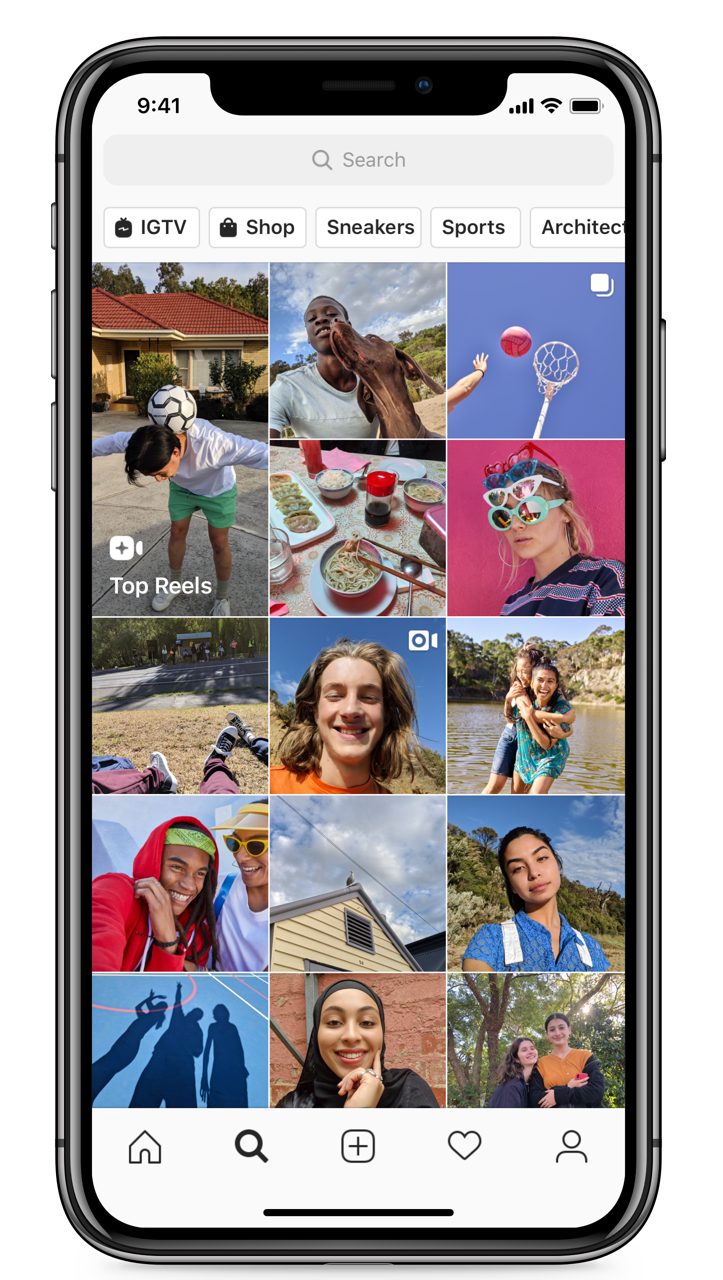
Instagram is launching a video-music remix feature to finally fight back against Chinese social rival TikTok. Instagram Reels lets you make 15-second video clips set to music and share them as Stories, with the potential to go viral on a new Top Reels section of Explore. Just like TikTok, users can soundtrack their Reels with a huge catalog of music, or borrow the audio from anyone’s else video to create a remix of their meme or joke.
Launching today limited to just Brazil where it’s called Cenas, Reels leverages all of Instagram’s most popular features to frankenstein together a remarkably coherent competitor to TikTok’s rich features and community of 1.5 billion monthly users including 122 million in the US according to Sensor Tower. Instead of trying to start from scratch like Facebook’s Lasso, Instagram could cross-promote Reels heavily to its own billion users.
But Instagram’s challenge will be retraining its populace to make premeditated, storyboarded social entertainment instead of just spontaneous, autobiographical social media like with Stories and feed posts.
“I think Musically before TikTok, and TikTok deserve a ton of credit for popularizing this format” admits Instagram director of product management Robby Stein. “No two products are exactly the same, and at the end of the day sharing video with music is a pretty univeral idea we think everyone might be interested in using. The focus has been on how to make this a unique format for us.”
Starting in Brazil before potentially rolling out elsewhere could help Instagram nail down its customization and onboarding strategy. Luckily, Brazil has a big Instagram population, a deeply musical culture, and a thriving creator community, says Stein.
It also isn’t completely obsessed with TikTok yet like fellow developing market India. As Facebook CEO Mark Zuckerberg said about trying to grow Lasso, “We’re trying to first see if we can get it to work in countries where TikTok is not already big.” Instagram used this internationalization strategy to make Stories a hit where Snapchat hadn’t expanded yet, and it worked surprisingly well.
Perhaps Instagram’s best shot at differentiation is through its social graph. While TikTok is primarily a feed broadcasting app, Instagram can work Reels into it’s Close Friends and Direct messaging features potentially opening a new class of creators — shy one who only want to share with people they trust not to make fun of them. A lot of this lipsyncing / dancing / humor skit content can be kinda cringey when people don’t get it just right.
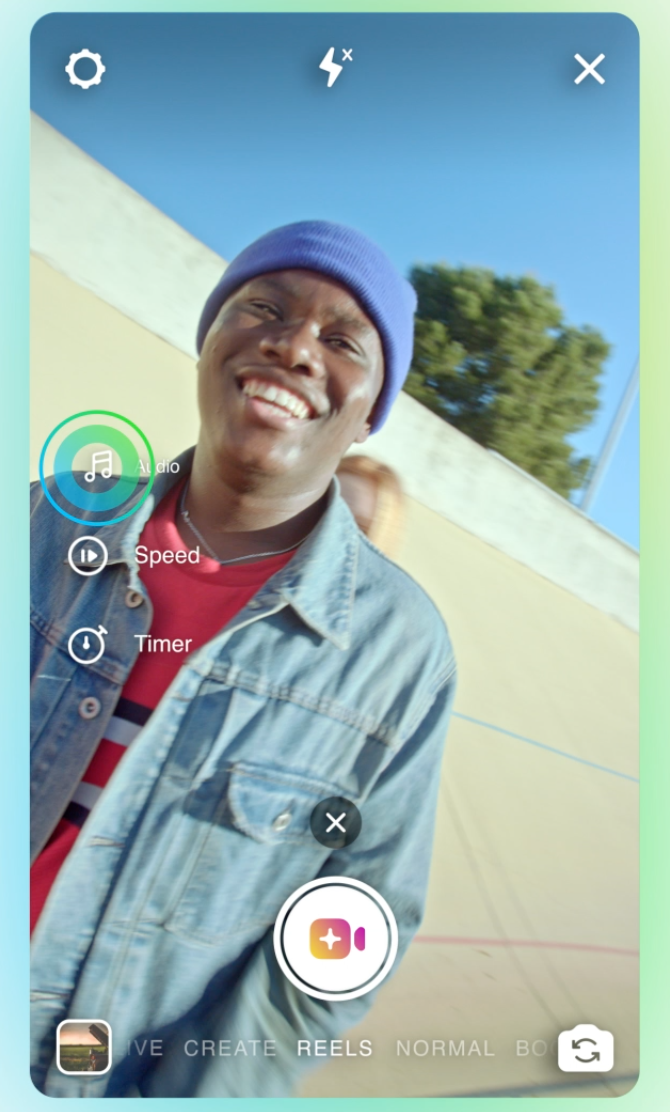
Here’s how Reels works. Users will find it in the Instagram Stories shutter modes tray next to Boomerang and Super-Zoom. They can either record with silence, borrow the audio of another video they find through hashtag search or Explore, or search Facebook’s enormous music collection secured from all the major labels and many indie publishers. Users pick the chunk to the song they want, and can then record or upload multiple video clips to fill out their Reel.
Once satisfied with their editing job, scene-by-scene captions, and ghost overlay-assisted transitions they can share a Reel to their Story, Close Friends, or message it to people. If shared publicly, it will also be eligible to appear in the Top Reels section of the Explore tab. Most cleverly, Instagram works around its own ephemerality by letting users add their Reels to their profile’s non-disappearing Highlights for a shot to show up on Explore even after their 24-hour story expires.
Instead of having to monetize later somehow, Instagram can immediately start making money from Reels since it already shows ads in Stories and the Explore tab.
Cloning TikTok isn’t just about the features, though Reels does a good job of copying the core ones while leaving out AR effects and transitions for now. But creating scripted content is totally new for most Instagram users, and could feel too showy or goofy for an app known for its seriousness. Instagram may have to lose its artful, cool vibe to embrace the silliness of tomorrow’s social entertainment.
Last week, we extended the early-bird pricing on passes to Disrupt Berlin 2019 until 15 November at11:59 p.m. (CEST). Consider it distinctly non-divine intervention from Expeditus, the patron saint of procrastinators (and speedy causes). The countdown continues, and you have just four days left to save serious dough — we’re talking up to €500 depending on the type of pass you purchase.
No matter what role you play in the startup world, you’ll find tremendous value at Disrupt Berlin. Add even more value — buy an early-bird pass to Disrupt Berlin before the early bird flies away for good on 15 November at11:59 p.m. (CEST).
Disrupt Berlin draws attendees from more than 50 countries across Europe and beyond, making it an international celebration of all things startup. This is the place to see the latest tech from innovative early-stage startups, and you’ll find hundreds of them exhibiting in Startup Alley. Don’t miss the Country Pavilions where you’ll find delegations from different countries showcasing the best of their up-and-coming startups.
You’ll also find TC Top Picks exhibiting in Startup Alley. Our editors selected up to five startups they feel represent the most interesting use of technology in the following categories: AI/Machine Learning, Biotech/Healthtech, Blockchain, Fintech, Mobility, Privacy/Security, Retail/E-commerce, Robotics/IoT/Hardware, CRM/Enterprise and Education. Come to meet, greet and network with the founders who earned the coveted Top Pick designation.
With so many exhibiting startups to see, not to mention all the founders, investors and technologists roaming around the Berlin Arena, how can you cut through the noise to find the people who align with your business goals and interests? Use CrunchMatch, our free business-matchmaking tool that slays the old needle-in-a-haystack approach to networking.
We’ll email all registered attendees when we launch CrunchMatch, and we’ll explain how to access the platform. You then create a professional profile outlining your role and the specific types of people and connections you want to make. CrunchMatch will find and suggest matches and — with your approval — suggest meetings, send out meeting requests and schedule appointments. Closing the deal? That’s up to you.
Beyond all the networking opportunities, you’ll have the chance to learn from and engage with tech and investing experts and icons. Hear from world-class speakers, attend smaller Q&A Sessions where you have the chance to get your pressing questions answered, watch the Startup Battlefield and don’t miss the Hackathon finalists pitch on the Extra Crunch Stage. Check out the Disrupt Berlin agenda.
Join us on 11-12 December for all the value and opportunity Disrupt Berlin 2019 offers. And remember, you have just four more days to grab all the value you can. Channel Saint Expeditus and beat the deadline. Buy your early-bird pass before 15 November at11:59 p.m. (CEST). We’ll see you in Berlin!
Is your company interested in sponsoring or exhibiting at Disrupt Berlin 2019? Contact our sponsorship sales team by filling out this form.
We started the competition with ten hardware startups vying to take home the Disrupt Hardware Battlefield cup at TechCrunch Shenzhen 2019. They all pitched their hearts out to our team of judges who deliberated at length and chose their 4 favorites who came back on day 2 of the event to pitch to a brand new set of judges.
After much deliberation from the judges, we’re pleased to announce the winner of Hardware Battlefield at TechCrunch Shenzhen 2019.
And the winner is…
Okra!
Okra Solar is a modular energy startup that’s aiming to bring power to homes in rural areas via a plug-and-play solution that energy companies can easily deploy. The solution uses distributed energy technology that can bring micro-grids to rural communities via interconnected systems of solar panels and batteries.
No one’s going to pay $380 for decent point-of-view video glasses and some trippy filters. But that’s kind of the point of Snapchat Spectacles 3. They’re merely a stepping stone towards true augmented reality eyewear — a public hardware beta for the Snap Lab R&D team that Apple and Facebook aren’t getting as they tinker in their bunkers.
Still, I hoped for something that could at least unlock the talents of forward-thinking video creators. Yet the unpredictable and uncontrollable AR effects sadly fail to make use of Spectacles‘ fashionable form factor in premium steel. The clunky software requires clips be uploaded for processing and then re-downloaded before you can apply the 10 starter effects like a rainbow landscape filter or a shimmering fantasy falcon. This all makes producing AR content a chore instead of a joy for something only briefly novel.
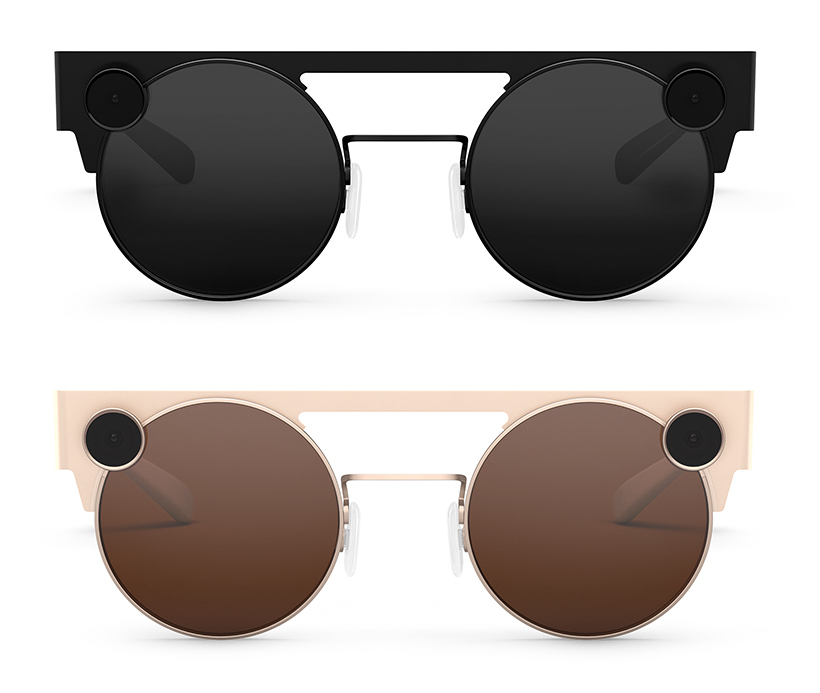
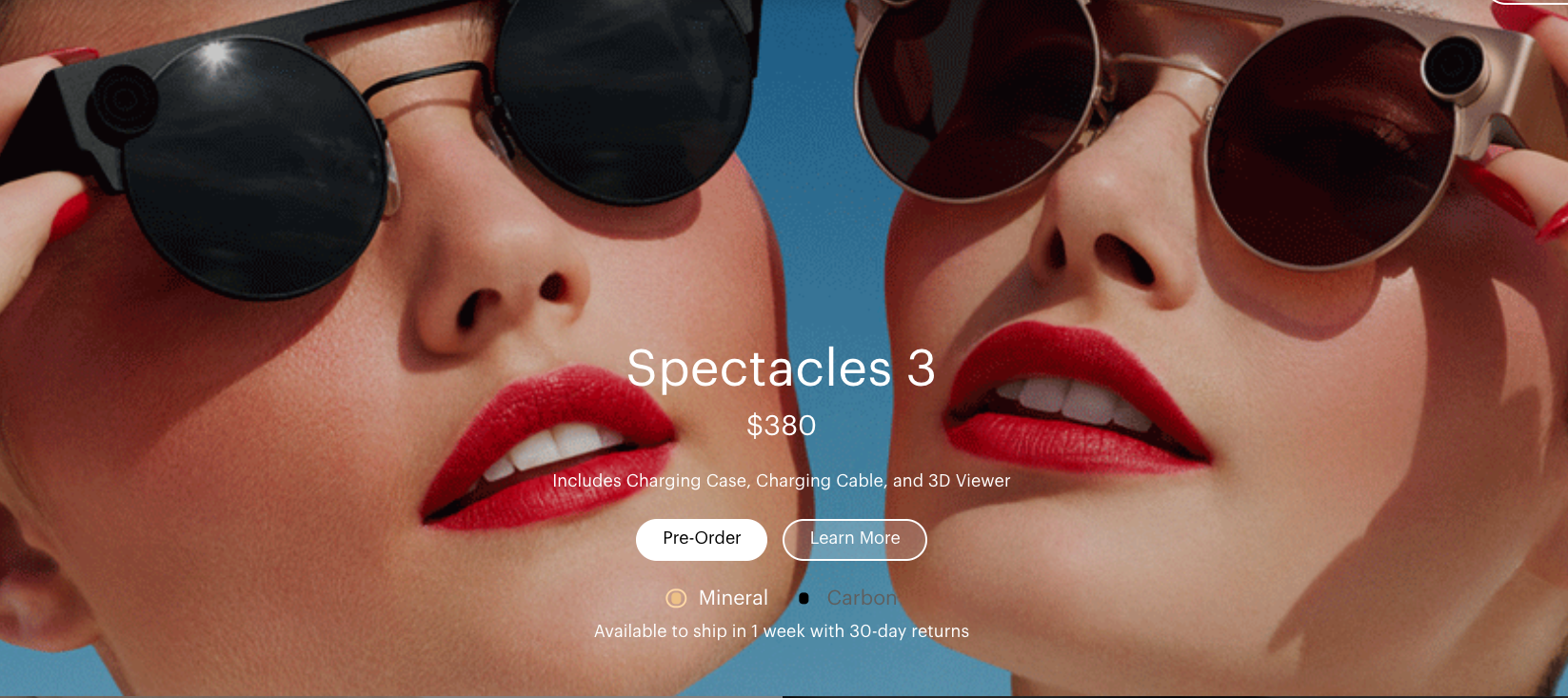
Spectacles 3 go on sale today for $380 in black ‘Carbon’ or rose gold-ish ‘Mineral’ color schemes on Spectacles.com, Neiman Marcus, and Ron Robinson in the UK, shipping in a week. Announced in August, they’re sunglasses with two stereoscopic lenses capable of capturing depth to produce “3D” photos, and videos you can add AR effects to on your phone. You also get a very nice folds-flat leather USB-C charging case that powers up the glasses four times, and a Google Cardboard-style VR viewer.
“Spectacles 3 is a limited production run. We’re not looking for massive sales here. We’re targeting people who are excited about these effects — creative storytellers” says Matt Hanover of the Snap Lab team.
Gen 1 featured a “toy-like design to get people used to wearing tech on their face”, while Gen 2 and 2.1 had a more subdued look abandoning the coral color schemes to push mainstream adoption. What Gen 3 can’t do is force a $40 million write-off due to poor sales, as V1 did after only shipping 220,000 with hundreds of thousands more gathering dust somewhere. Snap is already losing $227 million per quarter as it scrambles to break even.
So it seems with Spectacles 3 that Snap is gathering data and biding its time, trying to avoid burning too much cash until it can build a version that overlays effects atop a user’s view through the glasses. “We’re still able to get feedback from the customer and inform the future of Spectacles. That’s really the goal for us” Hanover confirms.
His CEO Evan Spiegel agrees, telling me on stage at TechCrunch Disrupt that it would be 10 years until we see augmented reality glasses worthy of mainstream consumer adoption. That’s a long time for an unprofitable company to spend competing to invest in R&D versus cash-rich companies like Facebook and Apple.
tl;dr
Spectacles could be worth the steep $380 if you’re a videographer for a living, perhaps making futuristic social media clips like Karen X Cheng, a creator Snap hired to demonstrate the device’s potential. They’re cool enough looking that you could wear them around Cannes or Coachella without people getting weirded out like they did with Google Glass. And as Snap’s Lens Studio lets anyone build 3D effects for Spectacles 3, perhaps we’ll see some filters and imaginary characters that are more than just a momentary gimmick.
But for those simply seeking first-person camera glasses, I’d still recommend the Spectacles 2 at $150 to $200 depending on style. The 3D features don’t carry the weight of paying double the price for Spec 3s. And at least the 2nd-gen Specs are waterproof, which make them great for ocean play with fun underwater shooting when you don’t want to risk losing or fizzling your phone.
“We’re testing the price point and the premium aesthetic to see if it lands with this demographic” Hanover says. But Snap’s Director Of Communications Liz Markman notes that “there isn’t this perfect one-to-one overlap with the core Snap users.”
The result is that Spectacles 3 are really more for Snap’s benefit than yours.
Slick Eyewear, Now Where’s The AR?
The Spectacles 3 software is disappointing, but you’ll be delighted when you open the box. Slick black packaging reveal sturdily built metal sunglasses with a luxury matte finish. As they magnetically dislodge from their charging case, you definitely get they sense you’re trying on something futuristic.
The style concurs, with a flat black bar at the top connecting the round lenses with a camera on both corners. Unlike the old Specs that sat right on your nose, feeling heavy at times, Spectacles 3 offers adjustable acetate non-slip nose tips to keep the weight off. All the tech is built discreetly into the hinges and temples without appearing too chunky.
Tap the button either arm, and LED light swooshes in a circle to let people know you’re recording a video for 10 seconds, with multiple presses growing that to up to 60. Tap and hold to shoot a photo, and the light blinks. There’s no obnoxious yellow rubber ring to shout “these are cameras”, and the defused LEDs are more subtle than Gen 2’s dots while remaining an obvious enough signal to passersby so they’re not creepy.
One charge powers up to 70 captures and transfers to your phone over a combined Bluetooth built-in Wifi connection. The 4 gigabyte storage holds up to 100 videos or 1200 photos, and Spectacles 3 even have GPS and GLOSNASS on-board. A 4-mic array picks up audio from others and your own voice, though they’re susceptible to windshear if you’re biking or running.
The magnetically-sealing folding leather USB-C charging case is my favorite part. I wish I could get an even flatter one without a battery in it for my other sunglasses. It’s a huge improvement on the unpocketable bulky triangular case of the previous versions.
A Toy Not Fun Enough For The Price
So far so good, right? But then it comes time to actually see and augment what you shot.
Pairing and syncing is much easier than Gen 1. The glasses forge a Bluetooth connection, then spawn a WiFi network for getting media to your phone faster.
If you just want to share to Snapchat, you’re in luck. Spectacles content posts to Stories or messages in its cool circular format that lets viewers tilt their phones around while always staying full-screen to reveal the edges of your shots. Otherwise, you still have to go through the chore of exporting from Snapchat to your camera roll. Spectacles can at least now export in a variety of croppings for better sharing on Instagram and elsewhere.
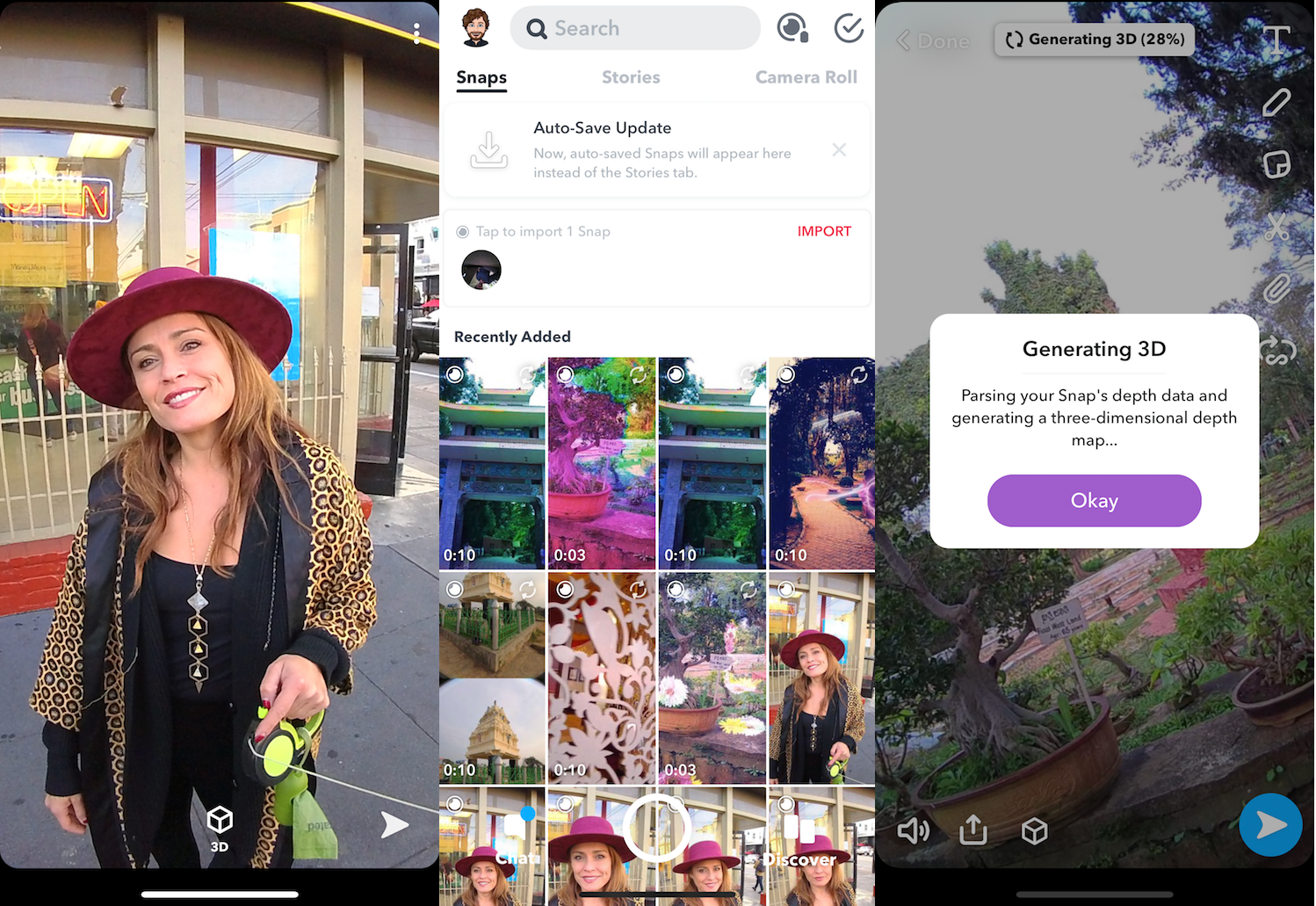
What’s new are the 3D photos and videos. They utilize the space between the stereoscopic cameras in the corners of Spectacles employ parallax to sense the depth of a scene. After tapping the 3D button on a photo, you can wiggle the perspective of the image around to almost see around the edges of what you’re looking at. Spectacles will automatically pan back and forth for you, and export 3D photos as short Boomerang-esque six-second videos.
Unfortunately, I found that I didn’t get much sense of depth from most of the 3D photos I shot or saw. It takes a very particular kind of three-dimensional object from the right angle in the right light to much sense of movement from the wiggle. Snapchat’s algorithms also had a bad habit of mistakenly assigning bits of the foreground and background to each other, breaking the illusion. Occasionally you’ll have someone’s ear or their hair left behind and disembodied by the 3D effect.
Don’t expect these to flood social media or convince prospective Spectacles buyers. The 3D selfies you can shoot on Snapchat for free look better anyways.
The biggest problem comes with the delay when playing with 3D videos. Snapchat has to do the depth processing on its servers, so you have to wait for your video to upload, get scanned, and be re-downloaded before you can apply the 3D AR filters. On WiFi that takes about 35 seconds per 10 second video, which is quite a bore. It takes forever over a mobile connection. That means you often won’t be able to apply the filters and see how they look until you’re home and unable to reshoot anything.
The filter set is also limited and haphazard. You can add a 3D bird or balloons around you, wander through golden snow or neon arcs, overlay flower projections or rainbow waves, or sprinkle on sparkles and light-bending blobs. While the bird is cute, and the rainbows and flowers are remarkably psychedelic, none of them are more than briefly entertaining.
The 3D objects often glitch through real pieces of scenery, and you can’t control them at all. No summoning the bird mid-video. My favorite trick, learned from Karen X Cheng, was to export unedited and filtered versions of a video and splice them together on my computer as scene in my demo video above. You can’t actually do that from within Snapchat.
Snap will have to build a lot cooler filters with interactivity if they’re going to compel creators to fork over $380 for Spectacles 3. It could hope to rely on its Lens Studio community platform, but so few developers or users will have the glasses that most will stick to making and using filters for phones.
Spectacles 3 are too expensive to be a toy, but don’t excel at being much more. Videography influencers might enjoy having a pair in their tool bag. But it’s hard to imagine anyone not sharing content professionally paying for the gadget.
Iteration vs Ideation
“We’re now pushing to elevate the technology and the design to master depth technically” Hanover tells me. “Holing ourselves up within an R&D center for years and years? That’s not our approach. It’s important to meet the customer where they are today and continue to iterate and get that feedback.”
But this iteration doesn’t feel like Snap meeting the customer where they are. That raises the question of whether Snapchat is really getting enough data out of the whole endeavor to justify publicly releasing Spectacles at all. The company will have to hope that testing short-term is worth thinking short-term, when it’s trying to win the long-term war in augmented reality eyewear.
No one’s going to pay $380 for decent point-of-view video glasses and some trippy filters. But that’s kind of the point of Snapchat Spectacles 3. They’re merely a stepping stone towards true augmented reality eyewear — a public hardware beta for the Snap Lab R&D team that Apple and Facebook aren’t getting as they tinker in their bunkers.
Still, I hoped for something that could at least unlock the talents of forward-thinking video creators. Yet the unpredictable and uncontrollable AR effects sadly fail to make use of Spectacles‘ fashionable form factor in premium steel. The clunky software requires clips be uploaded for processing and then re-downloaded before you can apply the 10 starter effects like a rainbow landscape filter or a shimmering fantasy falcon. This all makes producing AR content a chore instead of a joy for something only briefly novel.
Spectacles 3 go on sale today for $380 in black ‘Carbon’ or rose gold-ish ‘Mineral’ color schemes on Spectacles.com, Neiman Marcus, and Ron Robinson in the UK, shipping in a week. Announced in August, they’re sunglasses with two stereoscopic lenses capable of capturing depth to produce “3D” photos, and videos you can add AR effects to on your phone. You also get a very nice folds-flat leather USB-C charging case that powers up the glasses four times, and a Google Cardboard-style VR viewer.
“Spectacles 3 is a limited production run. We’re not looking for massive sales here. We’re targeting people who are excited about these effects — creative storytellers” says Matt Hanover of the Snap Lab team.
Gen 1 featured a “toy-like design to get people used to wearing tech on their face”, while Gen 2 and 2.1 had a more subdued look abandoning the coral color schemes to push mainstream adoption. What Gen 3 can’t do is force a $40 million write-off due to poor sales, as V1 did after only shipping 220,000 with hundreds of thousands more gathering dust somewhere. Snap is already losing $227 million per quarter as it scrambles to break even.
So it seems with Spectacles 3 that Snap is gathering data and biding its time, trying to avoid burning too much cash until it can build a version that overlays effects atop a user’s view through the glasses. “We’re still able to get feedback from the customer and inform the future of Spectacles. That’s really the goal for us” Hanover confirms.
His CEO Evan Spiegel agrees, telling me on stage at TechCrunch Disrupt that it would be 10 years until we see augmented reality glasses worthy of mainstream consumer adoption. That’s a long time for an unprofitable company to spend competing to invest in R&D versus cash-rich companies like Facebook and Apple.
tl;dr
Spectacles could be worth the steep $380 if you’re a videographer for a living, perhaps making futuristic social media clips like Karen X Cheng, a creator Snap hired to demonstrate the device’s potential. They’re cool enough looking that you could wear them around Cannes or Coachella without people getting weirded out like they did with Google Glass. And as Snap’s Lens Studio lets anyone build 3D effects for Spectacles 3, perhaps we’ll see some filters and imaginary characters that are more than just a momentary gimmick.
But for those simply seeking first-person camera glasses, I’d still recommend the Spectacles 2 at $150 to $200 depending on style. The 3D features don’t carry the weight of paying double the price for Spec 3s. And at least the 2nd-gen Specs are waterproof, which make them great for ocean play with fun underwater shooting when you don’t want to risk losing or fizzling your phone.
“We’re testing the price point and the premium aesthetic to see if it lands with this demographic” Hanover says. But Snap’s Director Of Communications Liz Markman notes that “there isn’t this perfect one-to-one overlap with the core Snap users.”
The result is that Spectacles 3 are really more for Snap’s benefit than yours.
Slick Eyewear, Now Where’s The AR?
The Spectacles 3 software is disappointing, but you’ll be delighted when you open the box. Slick black packaging reveal sturdily built metal sunglasses with a luxury matte finish. As they magnetically dislodge from their charging case, you definitely get they sense you’re trying on something futuristic.
The style concurs, with a flat black bar at the top connecting the round lenses with a camera on both corners. Unlike the old Specs that sat right on your nose, feeling heavy at times, Spectacles 3 offers adjustable acetate non-slip nose tips to keep the weight off. All the tech is built discreetly into the hinges and temples without appearing too chunky.
Tap the button either arm, and LED light swooshes in a circle to let people know you’re recording a video for 10 seconds, with multiple presses growing that to up to 60. Tap and hold to shoot a photo, and the light blinks. There’s no obnoxious yellow rubber ring to shout “these are cameras”, and the defused LEDs are more subtle than Gen 2’s dots while remaining an obvious enough signal to passersby so they’re not creepy.
One charge powers up to 70 captures and transfers to your phone over a combined Bluetooth built-in Wifi connection. The 4 gigabyte storage holds up to 100 videos or 1200 photos, and Spectacles 3 even have GPS and GLOSNASS on-board. A 4-mic array picks up audio from others and your own voice, though they’re susceptible to windshear if you’re biking or running.
The magnetically-sealing folding leather USB-C charging case is my favorite part. I wish I could get an even flatter one without a battery in it for my other sunglasses. It’s a huge improvement on the unpocketable bulky triangular case of the previous versions.
A Toy Not Fun Enough For The Price
So far so good, right? But then it comes time to actually see and augment what you shot.
Pairing and syncing is much easier than Gen 1. The glasses forge a Bluetooth connection, then spawn a WiFi network for getting media to your phone faster.
If you just want to share to Snapchat, you’re in luck. Spectacles content posts to Stories or messages in its cool circular format that lets viewers tilt their phones around while always staying full-screen to reveal the edges of your shots. Otherwise, you still have to go through the chore of exporting from Snapchat to your camera roll. Spectacles can at least now export in a variety of croppings for better sharing on Instagram and elsewhere.
What’s new are the 3D photos and videos. They utilize the space between the stereoscopic cameras in the corners of Spectacles employ parallax to sense the depth of a scene. After tapping the 3D button on a photo, you can wiggle the perspective of the image around to almost see around the edges of what you’re looking at. Spectacles will automatically pan back and forth for you, and export 3D photos as short Boomerang-esque six-second videos.
Unfortunately, I found that I didn’t get much sense of depth from most of the 3D photos I shot or saw. It takes a very particular kind of three-dimensional object from the right angle in the right light to much sense of movement from the wiggle. Snapchat’s algorithms also had a bad habit of mistakenly assigning bits of the foreground and background to each other, breaking the illusion. Occasionally you’ll have someone’s ear or their hair left behind and disembodied by the 3D effect.
Don’t expect these to flood social media or convince prospective Spectacles buyers. The 3D selfies you can shoot on Snapchat for free look better anyways.
The biggest problem comes with the delay when playing with 3D videos. Snapchat has to do the depth processing on its servers, so you have to wait for your video to upload, get scanned, and be re-downloaded before you can apply the 3D AR filters. On WiFi that takes about 35 seconds per 10 second video, which is quite a bore. It takes forever over a mobile connection. That means you often won’t be able to apply the filters and see how they look until you’re home and unable to reshoot anything.
The filter set is also limited and haphazard. You can add a 3D bird or balloons around you, wander through golden snow or neon arcs, overlay flower projections or rainbow waves, or sprinkle on sparkles and light-bending blobs. While the bird is cute, and the rainbows and flowers are remarkably psychedelic, none of them are more than briefly entertaining.
The 3D objects often glitch through real pieces of scenery, and you can’t control them at all. No summoning the bird mid-video. My favorite trick, learned from Karen X Cheng, was to export unedited and filtered versions of a video and splice them together on my computer as scene in my demo video above. You can’t actually do that from within Snapchat.
Snap will have to build a lot cooler filters with interactivity if they’re going to compel creators to fork over $380 for Spectacles 3. It could hope to rely on its Lens Studio community platform, but so few developers or users will have the glasses that most will stick to making and using filters for phones.
Spectacles 3 are too expensive to be a toy, but don’t excel at being much more. Videography influencers might enjoy having a pair in their tool bag. But it’s hard to imagine anyone not sharing content professionally paying for the gadget.
Iteration vs Ideation
“We’re now pushing to elevate the technology and the design to master depth technically” Hanover tells me. “Holing ourselves up within an R&D center for years and years? That’s not our approach. It’s important to meet the customer where they are today and continue to iterate and get that feedback.”
But this iteration doesn’t feel like Snap meeting the customer where they are. That raises the question of whether Snapchat is really getting enough data out of the whole endeavor to justify publicly releasing Spectacles at all. The company will have to hope that testing short-term is worth thinking short-term, when it’s trying to win the long-term war in augmented reality eyewear.
No one’s going to pay $380 for decent point-of-view video glasses and some trippy filters. But that’s kind of the point of Snapchat Spectacles 3. They’re merely a stepping stone towards true augmented reality eyewear — a public hardware beta for the Snap Lab R&D team that Apple and Facebook aren’t getting as they tinker in their bunkers.
Still, I hoped for something that could at least unlock the talents of forward-thinking video creators. Yet the unpredictable and uncontrollable AR effects sadly fail to make use of Spectacles‘ fashionable form factor in premium steel. The clunky software requires clips be uploaded for processing and then re-downloaded before you can apply the 10 starter effects like a rainbow landscape filter or a shimmering fantasy falcon. This all makes producing AR content a chore instead of a joy for something only briefly novel.
Spectacles 3 go on sale today for $380 in black ‘Carbon’ or rose gold-ish ‘Mineral’ color schemes on Spectacles.com, Neiman Marcus, and Ron Robinson in the UK, shipping in a week. Announced in August, they’re sunglasses with two stereoscopic lenses capable of capturing depth to produce “3D” photos, and videos you can add AR effects to on your phone. You also get a very nice folds-flat leather USB-C charging case that powers up the glasses four times, and a Google Cardboard-style VR viewer.
“Spectacles 3 is a limited production run. We’re not looking for massive sales here. We’re targeting people who are excited about these effects — creative storytellers” says Matt Hanover of the Snap Lab team.
Gen 1 featured a “toy-like design to get people used to wearing tech on their face”, while Gen 2 and 2.1 had a more subdued look abandoning the coral color schemes to push mainstream adoption. What Gen 3 can’t do is force a $40 million write-off due to poor sales, as V1 did after only shipping 220,000 with hundreds of thousands more gathering dust somewhere. Snap is already losing $227 million per quarter as it scrambles to break even.
So it seems with Spectacles 3 that Snap is gathering data and biding its time, trying to avoid burning too much cash until it can build a version that overlays effects atop a user’s view through the glasses. “We’re still able to get feedback from the customer and inform the future of Spectacles. That’s really the goal for us” Hanover confirms.
His CEO Evan Spiegel agrees, telling me on stage at TechCrunch Disrupt that it would be 10 years until we see augmented reality glasses worthy of mainstream consumer adoption. That’s a long time for an unprofitable company to spend competing to invest in R&D versus cash-rich companies like Facebook and Apple.
tl;dr
Spectacles could be worth the steep $380 if you’re a videographer for a living, perhaps making futuristic social media clips like Karen X Cheng, a creator Snap hired to demonstrate the device’s potential. They’re cool enough looking that you could wear them around Cannes or Coachella without people getting weirded out like they did with Google Glass. And as Snap’s Lens Studio lets anyone build 3D effects for Spectacles 3, perhaps we’ll see some filters and imaginary characters that are more than just a momentary gimmick.
But for those simply seeking first-person camera glasses, I’d still recommend the Spectacles 2 at $150 to $200 depending on style. The 3D features don’t carry the weight of paying double the price for Spec 3s. And at least the 2nd-gen Specs are waterproof, which make them great for ocean play with fun underwater shooting when you don’t want to risk losing or fizzling your phone.
“We’re testing the price point and the premium aesthetic to see if it lands with this demographic” Hanover says. But Snap’s Director Of Communications Liz Markman notes that “there isn’t this perfect one-to-one overlap with the core Snap users.”
The result is that Spectacles 3 are really more for Snap’s benefit than yours.
Slick Eyewear, Now Where’s The AR?
The Spectacles 3 software is disappointing, but you’ll be delighted when you open the box. Slick black packaging reveal sturdily built metal sunglasses with a luxury matte finish. As they magnetically dislodge from their charging case, you definitely get they sense you’re trying on something futuristic.
The style concurs, with a flat black bar at the top connecting the round lenses with a camera on both corners. Unlike the old Specs that sat right on your nose, feeling heavy at times, Spectacles 3 offers adjustable acetate non-slip nose tips to keep the weight off. All the tech is built discreetly into the hinges and temples without appearing too chunky.
Tap the button either arm, and LED light swooshes in a circle to let people know you’re recording a video for 10 seconds, with multiple presses growing that to up to 60. Tap and hold to shoot a photo, and the light blinks. There’s no obnoxious yellow rubber ring to shout “these are cameras”, and the defused LEDs are more subtle than Gen 2’s dots while remaining an obvious enough signal to passersby so they’re not creepy.
One charge powers up to 70 captures and transfers to your phone over a combined Bluetooth built-in Wifi connection. The 4 gigabyte storage holds up to 100 videos or 1200 photos, and Spectacles 3 even have GPS and GLOSNASS on-board. A 4-mic array picks up audio from others and your own voice, though they’re susceptible to windshear if you’re biking or running.
The magnetically-sealing folding leather USB-C charging case is my favorite part. I wish I could get an even flatter one without a battery in it for my other sunglasses. It’s a huge improvement on the unpocketable bulky triangular case of the previous versions.
A Toy Not Fun Enough For The Price
So far so good, right? But then it comes time to actually see and augment what you shot.
Pairing and syncing is much easier than Gen 1. The glasses forge a Bluetooth connection, then spawn a WiFi network for getting media to your phone faster.
If you just want to share to Snapchat, you’re in luck. Spectacles content posts to Stories or messages in its cool circular format that lets viewers tilt their phones around while always staying full-screen to reveal the edges of your shots. Otherwise, you still have to go through the chore of exporting from Snapchat to your camera roll. Spectacles can at least now export in a variety of croppings for better sharing on Instagram and elsewhere.
What’s new are the 3D photos and videos. They utilize the space between the stereoscopic cameras in the corners of Spectacles employ parallax to sense the depth of a scene. After tapping the 3D button on a photo, you can wiggle the perspective of the image around to almost see around the edges of what you’re looking at. Spectacles will automatically pan back and forth for you, and export 3D photos as short Boomerang-esque six-second videos.
Unfortunately, I found that I didn’t get much sense of depth from most of the 3D photos I shot or saw. It takes a very particular kind of three-dimensional object from the right angle in the right light to much sense of movement from the wiggle. Snapchat’s algorithms also had a bad habit of mistakenly assigning bits of the foreground and background to each other, breaking the illusion. Occasionally you’ll have someone’s ear or their hair left behind and disembodied by the 3D effect.
Don’t expect these to flood social media or convince prospective Spectacles buyers. The 3D selfies you can shoot on Snapchat for free look better anyways.
The biggest problem comes with the delay when playing with 3D videos. Snapchat has to do the depth processing on its servers, so you have to wait for your video to upload, get scanned, and be re-downloaded before you can apply the 3D AR filters. On WiFi that takes about 35 seconds per 10 second video, which is quite a bore. It takes forever over a mobile connection. That means you often won’t be able to apply the filters and see how they look until you’re home and unable to reshoot anything.
The filter set is also limited and haphazard. You can add a 3D bird or balloons around you, wander through golden snow or neon arcs, overlay flower projections or rainbow waves, or sprinkle on sparkles and light-bending blobs. While the bird is cute, and the rainbows and flowers are remarkably psychedelic, none of them are more than briefly entertaining.
The 3D objects often glitch through real pieces of scenery, and you can’t control them at all. No summoning the bird mid-video. My favorite trick, learned from Karen X Cheng, was to export unedited and filtered versions of a video and splice them together on my computer as scene in my demo video above. You can’t actually do that from within Snapchat.
Snap will have to build a lot cooler filters with interactivity if they’re going to compel creators to fork over $380 for Spectacles 3. It could hope to rely on its Lens Studio community platform, but so few developers or users will have the glasses that most will stick to making and using filters for phones.
Spectacles 3 are too expensive to be a toy, but don’t excel at being much more. Videography influencers might enjoy having a pair in their tool bag. But it’s hard to imagine anyone not sharing content professionally paying for the gadget.
Iteration vs Ideation
“We’re now pushing to elevate the technology and the design to master depth technically” Hanover tells me. “Holing ourselves up within an R&D center for years and years? That’s not our approach. It’s important to meet the customer where they are today and continue to iterate and get that feedback.”
But this iteration doesn’t feel like Snap meeting the customer where they are. That raises the question of whether Snapchat is really getting enough data out of the whole endeavor to justify publicly releasing Spectacles at all. The company will have to hope that testing short-term is worth thinking short-term, when it’s trying to win the long-term war in augmented reality eyewear.
Meet PacketAI, a French startup that wants to alert you when there’s something wrong with your app or service. The company uses machine learning to parse raw event data and find out if there’s anything wrong.
PacketAI can intercept incidents at many different levels. For instance, the service can tell you if your users can’t write something on your database or if there’s something wrong with your compute layer.
PacketAI doesn’t try to reinvent the wheel. The startup is well aware that there are many monitoring tools our there — Datadog, Splunk and Dynatrace for instance.
“Those tools are primarily designed for humans so that they can understand information delivered by machines,” co-founder and CEO Hardik Thakkar told me.
PacketAI integrates directly with the APIs of Datadog, Splunk or Dynatrace to analyze raw event data in real time. Instead of scrolling through thousands of lines, you can get an alert that tells you that bank transfers take a a lot more time than usual to go through for instance.
Eventually, you should be able to repair your problem much more quickly, which could potentially improve your revenue.
For now, the startup creates a machine learning model for each client. But the plan is to create a model for each vertical as soon as you have four or five companies in the same space using PacketAI. You could imagine a model for banking companies, a model for telecom companies, etc.
The startup already raised $2.3 million (€2.1 million) from Aster Capital, BNP Paribas Developpement, Entrepreneur First and SGPA.
PacketAI is already working with some clients on the first implementations of its product. The service will be available to anyone in early 2020. Pricing varies depending on the number of nodes (any physical or virtual network element) you want to monitor using PacketAI.
Meet PacketAI, a French startup that wants to alert you when there’s something wrong with your app or service. The company uses machine learning to parse raw event data and find out if there’s anything wrong.
PacketAI can intercept incidents at many different levels. For instance, the service can tell you if your users can’t write something on your database or if there’s something wrong with your compute layer.
PacketAI doesn’t try to reinvent the wheel. The startup is well aware that there are many monitoring tools our there — Datadog, Splunk and Dynatrace for instance.
“Those tools are primarily designed for humans so that they can understand information delivered by machines,” co-founder and CEO Hardik Thakkar told me.
PacketAI integrates directly with the APIs of Datadog, Splunk or Dynatrace to analyze raw event data in real time. Instead of scrolling through thousands of lines, you can get an alert that tells you that bank transfers take a a lot more time than usual to go through for instance.
Eventually, you should be able to repair your problem much more quickly, which could potentially improve your revenue.
For now, the startup creates a machine learning model for each client. But the plan is to create a model for each vertical as soon as you have four or five companies in the same space using PacketAI. You could imagine a model for banking companies, a model for telecom companies, etc.
The startup already raised $2.3 million (€2.1 million) from Aster Capital, BNP Paribas Developpement, Entrepreneur First and SGPA.
PacketAI is already working with some clients on the first implementations of its product. The service will be available to anyone in early 2020. Pricing varies depending on the number of nodes (any physical or virtual network element) you want to monitor using PacketAI.
Can we get a fanfare of trumpets, please? The time has come to introduce you to our TC Top Picks for Disrupt Berlin 2019. The ingenuity and creativity reflected in the international startup community can’t be overstated, and narrowing the field from the hundreds of applications we received was no easy task.
The program showcases outstanding early-stage startups across these categories: AI/Machine Learning, Biotech/Healthtech, Blockchain, Fintech, Mobility, Privacy/Security, Retail/E-commerce, Robotics/IoT/Hardware, CRM/Enterprise and Education.
Challenging as it was, TechCrunch editors had a (wicked fun) job to do — select up to five early-stage startups they felt represent the best of their specific tech category. This remarkable cadre of early-stage startups knocked our proverbial socks off. Cold toes notwithstanding, we think you’ll be equally impressed.
Founders who earn the TC Top Picks designation receive a free Startup Alley Exhibitor Package, one full day of exhibiting, three free Founder passes, intense investor and media interest and VIP treatment — including an interview on the Showcase Stage with a TechCrunch editor. And we promote that video across our social media platforms.
Alright, it’s time for the big reveal. Congratulations to the TC Top Picks for Disrupt Berlin 2019!
Artificial Intelligence + Machine Learning
Apostera: An automotive company offering a set of innovative products world-wide.
CYANITE: Music analysis tool — the interface between the music industry, data science and software engineering.
Prodsight: Helps companies make data-driven product development decisions.
Stormly: An AI-powered platform that works as a data consultant.
Timekettle Technologies: Committed to building a global brand of AI translator so immersive that it disappears into the experience.
Biotech + Healthtech
Glazomer: An affordable Hi-End Eye Tracking system for professional academic and clinical research.
Healthy Quit: Digital health company and a pharmacy that provides vaping and smoking cessation by utilizing an artificial intelligent treatment algorithm and medications to help patients quit.
mettleAI: Leveraging ML/AI to predict substance abuse relapse before it happens.
Thryve: We power the individualization of health care by providing the API needed by health services to access health data from more than 100 wearables.
Volta Medical: Aims at developing a wide range of intelligent software solutions designed to guide cardiologists during interventional procedures.
Anytype: An operating system for the new internet.
etoshi: The all-in-one crypto platform: trading, wallets and taxes under one roof!
SIMBA Chain: A cloud-based, smart-contract-as-a-service (SCaaS) platform, enabling users across a variety of skill sets to implement dapps (decentralized applications).
CRM + Enterprise
Cumul.io: A cloud analytics platform for business experts & SaaS companies to integrate intuitive yet powerful data visualization into their daily lives.
cux.io: Your one-stop shop for understanding your users’ experiences online.
Radicalbit: Event stream processing self-service platform. One platform for data engineering, data ops & MLOps on top of Kafka.
Stack: Internet launchpad, increasing the efficiency of working with the web for the average internet users by allowing simultaneous use of multiple web-apps within a neatly organized working environment.
Usercentrics: A CMP that helps enterprise customers obtain, manage and document the user consent, with all different aspects of consent storage, consent API’s, consent in ad tech.
Fintech
ChromaWay: Blockchain “2.0” platform that enables smart contracts and digital assets for financial applications and non-financial applications.
CurioInvest: A technology platform that lets anyone invest directly in rare alternative assets.
Raison: A platform for operations with investments and personal finance.
TXC Markets: Peer to peer fintech trading technologies and marketplaces for illiquid and alternative assets.
Mobility + Transportation
DUCKT: The world’s first universal electrical scooter charging station. Better operations, better experience for people & the city.
MachineMax: Used to track utilisation, idling, fuel and geolocation for any machine.
TRAXIT: Tracking multi service company changing the way we track our belongings, starting from Aviation vertical.
Privacy + Security
Nect: Delivers the self-service future of identity verification as a service — easy to use and with military-grade security.
o.vision: Develops facial identification solutions for integration within smart office frameworks and commercial bank security systems.
Sypher Solutions: Software platform that simplifies analysis and helps prevent mistakes when documenting and maintaining GDPR compliance.
Wire: The most secure collaboration platform, transforming the way business’ communicate in the same way and speed that our founders disrupted telephony with Skype.
Retail + E-commerce
combyne: A social tool for combining clothing. Our vision is to digitize the usage of fashion.
Fashwire: A global data-driven marketplace with 200+ fashion designers from 25+ countries.
Squareshot: We help consumer, fashion and dnvb brands streamline content production and create beautiful product shots to maximize their online sales.
Robotics + Hardware + IoT
Aether Biomedical: A rehabilitation robotics startup focused on building bionic limbs for upper limb amputees.
Domotron: The most advanced smart home that adapts to your lifestyle. To make your life easier.
Infocode: Smart building solution company that provides smart waste bin for office and public spaces.
RoboChef: World’s first fully automated robotic kitchen cooking 500+ recipes with ZERO manual effort powered by IoT, Robotics & AI.
Disrupt Berlin 2019 takes place on 11-12 December. Buy your pass today and be sure to swing by Startup Alley to meet and greet the TC Top Picks. One more thing. It’s not too late to buy a Startup Alley Exhibitor Package and strut your stuff alongside hundreds of companies and sponsors. All exhibiting startups have a shot at winning the Wild Card to compete for $50,000 in our famous pitch competition, Startup Battlefield. What have you got to lose? Nuthin!
Angular Ventures, the early-stage enterprise and “deep tech”-focused VC firm founded by former DFJ Esprit partner Gil Dibner, is announcing the closing of its debut fund at $41 million.
Targeting startups in Europe and Israel, Angular Ventures has been operating in so-called “stealth mode” for almost two years, seeing its portfolio grow to 12 companies. The VC typically invests between $250,000 and $1.5 million, from writing a startup’s first cheque to Series A. It says it aims to do five-seven new investments per year.
Companies backed by Angular include “service intelligence” startup Aquant.io, HR workplace misconduct platform Vault, nano-tech security technology provider Dust Identity (also backed by Kleiner Perkins) and food supply chain optimization company Trellis.
Notably, Dibner is Angular Ventures’ sole general partner. Prior to founding Angular Ventures, he was most recently running an angel syndicate on AngelList, although his venture career goes back much further.
Prior to leading the syndicate, Dibner was a partner at London-based venture capital firm DFJ Esprit, which he departed in March 2015. Before that he was a principal at Index Ventures, also in London, and had earlier spells at Israeli VCs Gemini Israel Ventures and Genesis Partners, both in Tel Aviv.
Dibner says he wanted to “re-imagine” early-seed venture capital in Europe and Israel by building what he describes as a sector-focused firm, and removing geographical boundaries by investing in both Europe and Israel, and establishing a U.S. presence to support portfolio startups with global expansion.
Whether or not you think that is particularly unique, you’re mileage may vary, but there is no doubt Dibner has a decent investment track record in the enterprise space and beyond, either way.
Throughout his career to date, Dibner says he has backed 40 companies. Breaking this down further: 28 have raised capital from U.S.-based VC firms or exited to U.S.-based acquirers. In fact, he’s seen eight exits overall, and two of Dibner’s investments — JFrog and SiSense — have reached “unicorn” status, i.e. a valuation of $1 billion or more.
Despite his track record, Dibner says it took four years to finally close this fund, which has given him even more empathy for founders during fundraising.
“It took nearly four years to get from concept to a first close, and although we were ultimately significantly oversubscribed, I had to hear a lot of ‘nos’ to get this done,” he tells TechCrunch. “There are a lot of differences between raising a fund and raising money for a company, but experience has given me even more empathy with founders who are often enduring very difficult fundraising pathways. The most ambitious ideas usually have the most difficult fundraising.”
It is also probably worth noting that all of Angular’s LPs are private/commercial — in other words, no taxpayer money is at stake here, unlike a plethora of European VC funds. And whilst Dibner is the sole GP, he says he’s working with a team of advisors helping to source deals, provide due diligence and support portfolio companies.
They include: Fred Simon, founder of JFrog; Eldad Farkash, founder of SiSense and Firebolt, an Angular portfolio company; Guy Poreh, former EVP New Media at BBDO, who led Wix’s U.S. market launch and founded Playground; Jerry Dischler, who leads product for Google search and YouTube search; and Phil Wickham, who founded Sozo Ventures and is the chairman of the Kauffman Fellows Program.

 But Instagram’s challenge will be retraining its populace to make premeditated, storyboarded social entertainment instead of just spontaneous, autobiographical social media like with Stories and feed posts.