
Year: 2019

05 Nov 2019

Pigeon, a ‘Waze for public transit’ from Google’s Area 120, expands across the U.S.

Crowdsourced transit app Pigeon, developed within Google’s Area 120 lab for experimental projects, is today rolling out to five new cities across the U.S., in addition to New York — including Boston, Chicago, Los Angeles, San Francisco, and Washington D.C. Unlike traditional transit apps that rely on schedules and updates from a local transit authority, Pigeon takes more of a Waze-like approach where commuters help one another by reporting delays, crowds, and other issues.

The result is a transit app that can better inform users about unexpected incidents, as well as real-time crowds and offer more context about delays. The app will also send out alerts to users about things like power outages or major service changes, in addition to personalized alerts sent before commuters leave their home or office so they can plan around the delays, reroutes or weather-related incidents.

While the app’s goal is to offer better transit information to riders, it’s also working to develop a community within Pigeon.

Similar to Waze where users establish profiles and communicate with friends, Pigeon offers a social component. Users can post not only about delays, but also other transit happenings with both comments and images. These reports are then shared along a rider’s route in an activity feed.

For example, users may post about dirty or unsafe conditions, crowds, or escalator outages, then share a photo along with that information. But some of the posts may be more positive — like those applauding a local entertainer or noting a cute dog.

If anything, Pigeon could encourage more of these kinds of social posts as its users, unlike on Waze, aren’t stuck behind the wheel and only able to quickly tap a button to share a report with the crowd.

However, even users who don’t want to contribute directly can benefit from the app’s push notifications about unexpected delays and incidents.

The app was developed internally at Google, through its in-house incubator Area 120, and launched to New York users in September 2018. (TechCrunch actually spotted it go live in May 2018, but Google wasn’t sharing much information at the time.)

Since then, Pigeon has helped its early adopters across hundreds of thousands of transit trips each month, the company says. It’s also releasing an NYC Subway Insights Report detailing some of those learnings — like which lines had the most rush-hour delays or most crowds, which station was reported to be the hottest in the summer, and more.

Google’s app isn’t alone in tackling public transit from a new angle. Startups like Transit, Moovit, Citymapper, and others are also participating in this space — sometimes with their own crowdsourced components.

Today, Pigeon is live on iOS in these half-dozen U.S. cities and supports transit information for subway, bus, rail, ferry and cable car.

Android users can sign up for the waitlist to be alerted as to when Pigeon becomes available.
05 Nov 2019

Pigeon, a ‘Waze for public transit’ from Google’s Area 120, expands across the U.S.

Crowdsourced transit app Pigeon, developed within Google’s Area 120 lab for experimental projects, is today rolling out to five new cities across the U.S., in addition to New York — including Boston, Chicago, Los Angeles, San Francisco, and Washington D.C. Unlike traditional transit apps that rely on schedules and updates from a local transit authority, Pigeon takes more of a Waze-like approach where commuters help one another by reporting delays, crowds, and other issues.

The result is a transit app that can better inform users about unexpected incidents, as well as real-time crowds and offer more context about delays. The app will also send out alerts to users about things like power outages or major service changes, in addition to personalized alerts sent before commuters leave their home or office so they can plan around the delays, reroutes or weather-related incidents.

While the app’s goal is to offer better transit information to riders, it’s also working to develop a community within Pigeon.

Similar to Waze where users establish profiles and communicate with friends, Pigeon offers a social component. Users can post not only about delays, but also other transit happenings with both comments and images. These reports are then shared along a rider’s route in an activity feed.

For example, users may post about dirty or unsafe conditions, crowds, or escalator outages, then share a photo along with that information. But some of the posts may be more positive — like those applauding a local entertainer or noting a cute dog.

If anything, Pigeon could encourage more of these kinds of social posts as its users, unlike on Waze, aren’t stuck behind the wheel and only able to quickly tap a button to share a report with the crowd.

However, even users who don’t want to contribute directly can benefit from the app’s push notifications about unexpected delays and incidents.

The app was developed internally at Google, through its in-house incubator Area 120, and launched to New York users in September 2018. (TechCrunch actually spotted it go live in May 2018, but Google wasn’t sharing much information at the time.)

Since then, Pigeon has helped its early adopters across hundreds of thousands of transit trips each month, the company says. It’s also releasing an NYC Subway Insights Report detailing some of those learnings — like which lines had the most rush-hour delays or most crowds, which station was reported to be the hottest in the summer, and more.

Google’s app isn’t alone in tackling public transit from a new angle. Startups like Transit, Moovit, Citymapper, and others are also participating in this space — sometimes with their own crowdsourced components.

Today, Pigeon is live on iOS in these half-dozen U.S. cities and supports transit information for subway, bus, rail, ferry and cable car.

Android users can sign up for the waitlist to be alerted as to when Pigeon becomes available.

05 Nov 2019

Friended is a new social network that wants to get real

Though the social media landscape is dominated by a few major players, consumers still seem to want something new and different. Just look at TikTok.

Today, a new social app is launching called Friended, which is taking an altogether different strategy when it comes to connecting people online. Friended was started by Thumb cofounder and CEO Dan Kurani, Friended wants to give users a deeper and more meaningful connection to one another, which the company believes they crave.

On Friended, users can post to the community about what they’re thinking or feeling. But rather than catalyze a ‘town hall’-style group conversation, members of the community can respond privately to that post, offering their insights, anecdotes, or advice.

The idea is to give people a chance to share how they really feel in a vulnerable, one-to-one setting. In playing around with the app, I had conversations with people about how to make friends in NYC and why it sometimes feel like others don’t care about us as much as we care about them.

Anyone can respond to a thread, and comments on threads can be liked by the poster or respondent, but from the moment a response comes through, that conversation is one-on-one and private.

“People feel more lonely now than ever before,” said Kurani. “Part of the blame is the social media algorithms that only promote people’s highlights for more ad impressions. It’s isolating to see everyone’s happy moments, and, then get silence when you share something vulnerable. But, it’s also just plain hard to open up and share your feelings because of the pressure to be perfect.”

Because Friended wants to be a place where you always have someone to talk to, the company has eliminated ads as a possible revenue stream. Instead, the company is working to implement a premium tier.

Right now, users can only post a conversation starter every eight hours. The premium tier, which costs $4.99/week, allows users to post as frequently as they want, and also includes a few other premium features like the ability to talk to people in your location.

Friended has raised a $500K seed round from investors such as Jonah Goodhart, Dr. Lara Otte, Jared Fliesler, and Bobby Goodlatte. Though the company won’t disclose monthly active user numbers, it did say that it has 500,000 registered users with an average of 11 sessions per day per active user during its beta. More than 2.5 million messages were sent last month.

05 Nov 2019

Friended is a new social network that wants to get real

Though the social media landscape is dominated by a few major players, consumers still seem to want something new and different. Just look at TikTok.

Today, a new social app is launching called Friended, which is taking an altogether different strategy when it comes to connecting people online. Friended was started by Thumb cofounder and CEO Dan Kurani, Friended wants to give users a deeper and more meaningful connection to one another, which the company believes they crave.

On Friended, users can post to the community about what they’re thinking or feeling. But rather than catalyze a ‘town hall’-style group conversation, members of the community can respond privately to that post, offering their insights, anecdotes, or advice.

The idea is to give people a chance to share how they really feel in a vulnerable, one-to-one setting. In playing around with the app, I had conversations with people about how to make friends in NYC and why it sometimes feel like others don’t care about us as much as we care about them.

Anyone can respond to a thread, and comments on threads can be liked by the poster or respondent, but from the moment a response comes through, that conversation is one-on-one and private.

“People feel more lonely now than ever before,” said Kurani. “Part of the blame is the social media algorithms that only promote people’s highlights for more ad impressions. It’s isolating to see everyone’s happy moments, and, then get silence when you share something vulnerable. But, it’s also just plain hard to open up and share your feelings because of the pressure to be perfect.”

Because Friended wants to be a place where you always have someone to talk to, the company has eliminated ads as a possible revenue stream. Instead, the company is working to implement a premium tier.

Right now, users can only post a conversation starter every eight hours. The premium tier, which costs $4.99/week, allows users to post as frequently as they want, and also includes a few other premium features like the ability to talk to people in your location.

Friended has raised a $500K seed round from investors such as Jonah Goodhart, Dr. Lara Otte, Jared Fliesler, and Bobby Goodlatte. Though the company won’t disclose monthly active user numbers, it did say that it has 500,000 registered users with an average of 11 sessions per day per active user during its beta. More than 2.5 million messages were sent last month.

05 Nov 2019

Segwey-Ninebot now has an electric dirt bike

Segway-Ninebot introduced Tuesday an electric dirt bike that marks the company’s expansion into the powersports market.

The Chinese scooter company launched two versions of its new “Dirt eBike” at the automotive specialty products show SEMA in Las Vegas.

Segwey’s first foray into powersports products combines aspects of a mountain bike with the get-up-and-go of a dirt bike. And it’s all electric.

These days, Segwey is known for its micromobility products, namely scooters. For instance, Segwey unveiled in January the Model Max scooter, a more robust product designed to help shared scooter services like Bird and Lime reduce operating and maintenance costs.

But Segwey is aiming to do more than supply scooters. The company wants to offer a range of mobility devices that combine software, robotics, and its patent-protected Segway self-balancing technology. The debut of the Dirt eBike follows the introduction of three other hybrid off-road products, including an ATV all in an effort to build out its new SegwayPowersports business unit.

The Dirt eBike falls under Segway’s line of personal products, including other micromobility solutions such as the Ninebot Kickscooter and Ninebot GoKart Kit, according to the company.

“Our core focus is to create innovative transportation solutions that will help people move around their
communities — including solutions for the urban dweller and outdoor adventurer,” said Julie Tang,
marketing director at Segway. “The popularity of electric vehicles has made its way to the biking
segment and we are proud to meet the growing eco-conscious consumer demands by introducing Segway Dirt eBike, our first product focused solely on the outdoor consumer who wants a rugged and
high performance dirt biking experience.”

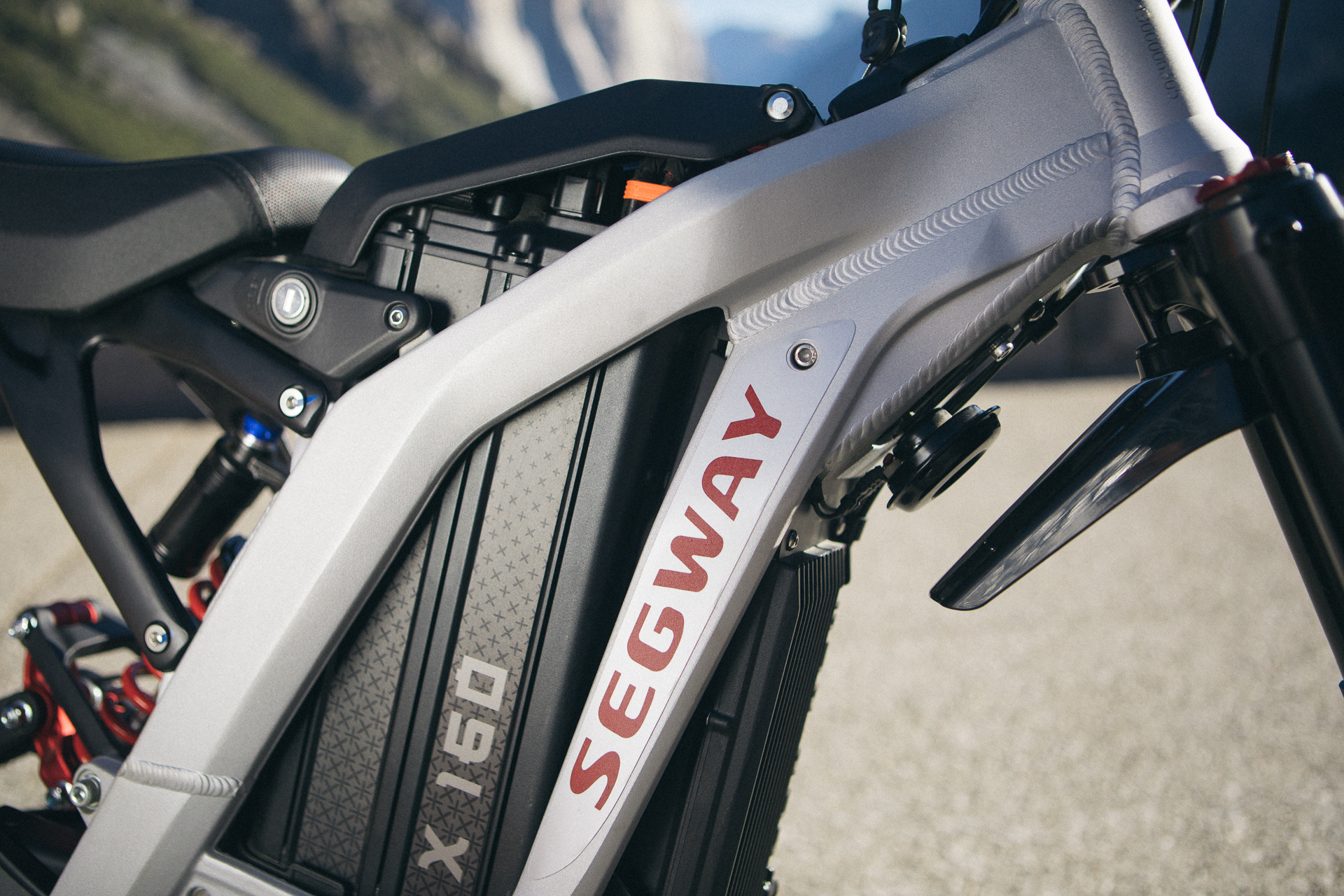
The Dirt eBike will come in two versions, the X160 and X260. The X260 will be, as you might assume, is the beefier, heavier, longer range and more capable bike. It will also be more expensive, coming in at about $4,500.

The X260 weighs 121 pounds with the battery. While the X160, which costs $3,000, is about 105 pounds.

The X260 comes with a headlight, can hit a top speed of 46.6 miles per hour and handle steeper slopes of up to 45 degrees.

Both versions have swappable batteries. The X260 has an estimated battery range of 74.6 miles on a single charge, while the X160 has 40.4-mile range.

The product will be available for consumers will be in the first quarter of 2020, the company said.

05 Nov 2019

Segwey-Ninebot now has an electric dirt bike

Segway-Ninebot introduced Tuesday an electric dirt bike that marks the company’s expansion into the powersports market.

The Chinese scooter company launched two versions of its new “Dirt eBike” at the automotive specialty products show SEMA in Las Vegas.

Segwey’s first foray into powersports products combines aspects of a mountain bike with the get-up-and-go of a dirt bike. And it’s all electric.

These days, Segwey is known for its micromobility products, namely scooters. For instance, Segwey unveiled in January the Model Max scooter, a more robust product designed to help shared scooter services like Bird and Lime reduce operating and maintenance costs.

But Segwey is aiming to do more than supply scooters. The company wants to offer a range of mobility devices that combine software, robotics, and its patent-protected Segway self-balancing technology. The debut of the Dirt eBike follows the introduction of three other hybrid off-road products, including an ATV all in an effort to build out its new SegwayPowersports business unit.

The Dirt eBike falls under Segway’s line of personal products, including other micromobility solutions such as the Ninebot Kickscooter and Ninebot GoKart Kit, according to the company.

“Our core focus is to create innovative transportation solutions that will help people move around their
communities — including solutions for the urban dweller and outdoor adventurer,” said Julie Tang,
marketing director at Segway. “The popularity of electric vehicles has made its way to the biking
segment and we are proud to meet the growing eco-conscious consumer demands by introducing Segway Dirt eBike, our first product focused solely on the outdoor consumer who wants a rugged and
high performance dirt biking experience.”

The Dirt eBike will come in two versions, the X160 and X260. The X260 will be, as you might assume, is the beefier, heavier, longer range and more capable bike. It will also be more expensive, coming in at about $4,500.

The X260 weighs 121 pounds with the battery. While the X160, which costs $3,000, is about 105 pounds.

The X260 comes with a headlight, can hit a top speed of 46.6 miles per hour and handle steeper slopes of up to 45 degrees.

Both versions have swappable batteries. The X260 has an estimated battery range of 74.6 miles on a single charge, while the X160 has 40.4-mile range.

The product will be available for consumers will be in the first quarter of 2020, the company said.

05 Nov 2019

Learn how to raise your Series A at Disrupt Berlin

There are more seed funds than ever helping business get off the ground but the Series A financing continues to be one of the toughest deals to close.

Not only will we welcome early-stage investors to teach entrepreneurs how to raise their first round of venture capital, we will have a group of investors intimately familiar with the Series A on deck at TechCrunch Disrupt Berlin this December to offer their best tips and tricks.

Joining us on stage is Blossom Capital partner Louise Samet and Penta founder Jessica Holzbach.

Samet, for her part, joined Blossom Capital, a new European venture capital fund focused on leading Series A investments, earlier this year. Based in Stockholm, Samet’s career includes years of angel investig with standout bets including LendingHome, Bloomcredit and Stravito. Blossom portfolio companies include Duffel, Frontify, Fat Llama, Sqreen and Checkout.com. Before Blossom, Samet was the director of technical sales at Klarna, a high profile European fintech startup.

Finally, Holzbach, who leads the digital only banking platform for SMEs, Penta, has spent her career founding startups and working as a management consultant, supervising various CRM projects for financial institutions and insurance companies. Penta, where she is currently CCO, has raised millions in venture capital funding, including a €7 million Series A last year. She can speak to the process of securing funding and the challenges she faced as a founder.

Join us at Disrupt Berlin, running December 11 and December 12, to hear more from these experts on how to secure one of the most influential funding rounds in a company’s lifespan. Tickets to the show are available here!

05 Nov 2019

Learn how to raise your Series A at Disrupt Berlin

There are more seed funds than ever helping business get off the ground but the Series A financing continues to be one of the toughest deals to close.

Not only will we welcome early-stage investors to teach entrepreneurs how to raise their first round of venture capital, we will have a group of investors intimately familiar with the Series A on deck at TechCrunch Disrupt Berlin this December to offer their best tips and tricks.

Joining us on stage is Blossom Capital partner Louise Samet and Penta founder Jessica Holzbach.

Samet, for her part, joined Blossom Capital, a new European venture capital fund focused on leading Series A investments, earlier this year. Based in Stockholm, Samet’s career includes years of angel investig with standout bets including LendingHome, Bloomcredit and Stravito. Blossom portfolio companies include Duffel, Frontify, Fat Llama, Sqreen and Checkout.com. Before Blossom, Samet was the director of technical sales at Klarna, a high profile European fintech startup.

Finally, Holzbach, who leads the digital only banking platform for SMEs, Penta, has spent her career founding startups and working as a management consultant, supervising various CRM projects for financial institutions and insurance companies. Penta, where she is currently CCO, has raised millions in venture capital funding, including a €7 million Series A last year. She can speak to the process of securing funding and the challenges she faced as a founder.

Join us at Disrupt Berlin, running December 11 and December 12, to hear more from these experts on how to secure one of the most influential funding rounds in a company’s lifespan. Tickets to the show are available here!

05 Nov 2019

Learn how to raise your Series A at Disrupt Berlin

There are more seed funds than ever helping business get off the ground but the Series A financing continues to be one of the toughest deals to close.

Not only will we welcome early-stage investors to teach entrepreneurs how to raise their first round of venture capital, we will have a group of investors intimately familiar with the Series A on deck at TechCrunch Disrupt Berlin this December to offer their best tips and tricks.

Joining us on stage is Blossom Capital partner Louise Samet and Penta founder Jessica Holzbach.

Samet, for her part, joined Blossom Capital, a new European venture capital fund focused on leading Series A investments, earlier this year. Based in Stockholm, Samet’s career includes years of angel investig with standout bets including LendingHome, Bloomcredit and Stravito. Blossom portfolio companies include Duffel, Frontify, Fat Llama, Sqreen and Checkout.com. Before Blossom, Samet was the director of technical sales at Klarna, a high profile European fintech startup.

Finally, Holzbach, who leads the digital only banking platform for SMEs, Penta, has spent her career founding startups and working as a management consultant, supervising various CRM projects for financial institutions and insurance companies. Penta, where she is currently CCO, has raised millions in venture capital funding, including a €7 million Series A last year. She can speak to the process of securing funding and the challenges she faced as a founder.

Join us at Disrupt Berlin, running December 11 and December 12, to hear more from these experts on how to secure one of the most influential funding rounds in a company’s lifespan. Tickets to the show are available here!

05 Nov 2019

Coda Biotherapeutics is developing a cure for pain

If the researchers, executives and investors behind Coda Biotherapeutics have their way, one day soon there really could be a cure for pain.

Co-founded by researchers Joseph Glorioso, from the University of Pittsburgh’s microbiology and molecular genetics department; and Dr. Nicholas Boulis, the founder of Emory’s Gene and Cell Therapy for Neurorestoration Laboratory; Coda uses gene therapies to treat neurological diseases starting with severe pain and epilepsy.

America is a country in pain. There are over 19 million Americans who live with chronic neuropathic pain, according to Coda’s own statistics. And over the past twenty years the doctors treating those Americans and the drug companies developing therapies for them have managed to turn their treatment into a new epidemic — opioid addiction.

In 2017, 47,600 Americans died from opioid-involved overdoses, according to the Centers for Disease Control. Of those deaths, about 60% involved synthetic opioids.

“The incentives were there for people to prescribe more and more, particularly when they had already been convinced it was the right thing to do — the compassionate thing to do,” Keith Humphreys, a psychiatrist at Stanford University and a former White House drug-policy adviser, told the journal Nature.

As the pain epidemic and attendant opioid crisis began to skyrocket several companies have been racing to find alternatives to the drug treatments that were now killing Americans by the thousands. Other approaches like electrical nerve stimulation can carry risks, and invasive surgeries are an unappealing last resort, according to Coda’s chief executive.

Coda’s experimental treatment is based on a science called chemogenetics, which uses a harmless virus to create new receptors in the sensory neurons that provide signals to the brain about physical stimuli. Those receptors can be unlocked by small molecule drugs, which would instruct the sensory neurons to stop firing, thereby cutting off the signals of pain to the brain.

Coda’s virus on a neural cell (Image courtesy of Coda Biotherapeutics)

The idea behind chemogenetics is to engineer a receptor that when you put it in with a… gene therapy… it does nothing. We’ve engineered it so that it is no longer responsive,” says Michael Narachi, the president and chief executive officer at Coda. “Most of these receptors are naturally opened or closed by acetylcholine… We’ve engineered these receptors so that  they’re no longer responsive to acetylcholine, but they are responsive to a man-made drug.”

The company then draws from a portfolio of receptor small-molecule drug pairs that were developed and tested for their pharmacological and toxicological effects, but discarded because of a lack of efficacy, to create new therapies with receptors tailored to respond to those drugs.

“What we’ve done is flipped the whole paradigm on its head. We’re making the lock that can work with these keys,” says Narachi. 

So far, the company has raised $34 million as investors including Versant Ventures, MPM Capital and Astellas Venture Management have doubled down on their initial $19 million commitment to the new drug developer. 

“Since coming out of stealth mode last September, the CODA team has made tremendous progress in developing its gene therapy program that is tunable, durable and highly selective, which allows for better efficacy and safety with fewer off-target effects,” said Tom Woiwode, Ph.D., managing director at Versant Ventures and CODA Chairman, in a statement. “CODA’s platform holds great promise to significantly transform how we treat challenging conditions and disorders for which new therapeutic options are greatly needed.” 

Pain isn’t the only condition that Coda hopes to treat. The company is also working on therapies that can reduce the severity of epilepsy for the nearly 3.4 million people in the U.S. who have the condition. While the company can’t treat all kinds of epilepsy, Coda says that it could address focal epilepsy, which represents 60% of all manifestations of the condition, and is linked to a specific region of the brain.

By engineering neurotransmitter receptors that are activated by medicines that can be taken orally, Coda thinks it can control the activity of neurons responsible for both chronic pain and focal epilepsy.

The next step for the company — and part of the use of proceeds from its new $15 million cash infusion — will . be to proceed with early animal trials. These clinical trials will be followed by human trials.

“This is a research platform,” says Narachi. “We have this portfolio of engineered receptors and we’re testing them in cells. The next step is to go into human clinical trials.”