Year: 2019

04 Nov 2019

Facebook’s new branding distinguishes app from acquisitions

Facebook wants more people to know it owns Instagram, WhatsApp, and Oculus while still maintaining an identity for its main app. So today Facebook launched a new capitalization and typography format for its company name, using all capital letters and a shifting color scheme that highlights Instagram’s purple gradient and WhatsApp’s green tint.

“Over the coming weeks, we will start using the new brand within our products and marketing materials, including a new company website” Facebook writes. For example, the “from FACEBOOK” branding will appear at the bottom of the Instagram login screen and settings menu.

04 Nov 2019

TC Sessions: Mobility Returns In 2020

TC Sessions: Mobility is returning for a second year on May 14 in San Jose — a day-long event brimming with the best and brightest engineers, policymakers, investors, entrepreneurs and innovators, all of whom are vying to be a part of this new age of transportation.

Companies are racing to deploy autonomous vehicles and flying cars, scale their scooter operations and adjust to headwinds in the vehicle subscription and car-sharing businesses. At the center of the mobility maelstrom is TechCrunch. 

TechCrunch held its inaugural TC Sessions: Mobility event in summer 2019 with a mission to do more than highlight the next new thing. We aimed to dig into the how and why, the cost and impact to cities, people and companies, as well as the numerous challenges that lie along the way, from technological and regulatory to capital and consumer pressures.

We met our goal and now we’re back to push further with TC Sessions: Mobility 2020.

Attendees of TC Sessions: Mobility can expect interviews with founders, investors and inventors, demos of the latest tech, breakout sessions, dozens of startup exhibits and opportunities to network and recruit.

If you’re wondering what to expect, take a look at some of the speakers we had on stage at the first event:

  • Amnon Shashua, Mobileye, Co-Founder, President and CEO
  • Dmitri Dolgov, Waymo, CTO
  • Summer Craze Fowler, Argo AI, Chief Security Officer
  • Katie DeWitt, Scoot, VP of Product
  • Karl Iagnemma, Aptiv, President
  • Seleta Reynolds, Head of the Los Angeles Department of Transportation
  • Caroline Samponaro, Lyft, Head of Micromobility Policy
  • Ted Serbinski, Techstars, Founder and Managing Director Of The Mobility Program
  • Ken Washington, Ford, CTO
  • Sarah Smith, Bain Capital Ventures, Partner
  • Dave Ferguson, Nuro, Co-Founder and President
  • Michael Granoff, Maniv Mobility, Founder and Managing Partner
  • Jesse Levinson, Zoox, CTO and Co-Founder

TechCrunch will announce in the coming weeks and months the participants of TechCrunch Mobility’s fireside chats, panels and workshops.

Tickets are on sale now

Early-Bird Tickets are available now for $250— that’s $100 savings before prices go up. Students can book a ticket for just $50. Book your tickets today.

Speaker Applications

We’re always looking for speakers for our events. Apply here.

Sponsorship Opportunities

Fill out this form and someone from our sales team will get right back to you about sponsorship opportunities for this event.

04 Nov 2019

TikTok expands its influence to third-party apps with new developer program

TikTok is looking to expand its influence by integrating with popular third-party video creation and editing apps. The company today announced a new TikTok for Developers program which will introduce tools for third-party app developers, including those that allow them to access TikTok’s creative offerings as well as push content from their apps to TikTok directly. The first of these tools is the new Share to TikTok SDK, which will let users edit videos in other apps then publish them from that app to TikTok.

One of the key launch partners for the new SDK is Adobe Premiere Rush, Adobe’s mobile app for video editing. With the new TikTok integration, Premiere Rush users can access video editing features like aspect ratio switching, transitions, color filters, timelapse and slo-mo, audio control and more, then share instantly to TikTok and other video destinations.

In addition to Adobe, the apps supporting the Share to TikTok SDK at launch also include looping video creator Plotaverse, AR app Fuse.it, gaming highlights recorder Medal, Momento GIF Maker, PicsArt, and Enlight Videoleop.

For some of the smaller, single-purpose apps being able to become a useful tool for the creator community can have an outsized impact on their growth and revenues. For example, Facetune’s maker Lightricks has built a profitable business across its suite of photo and video editing apps, including Enlight Videoleap, and has now raised a total of $205 million.

In addition to built-in sharing features, apps that integrate with the new TikTok SDK will also gain access to a wider selection of creative tools, says TikTok.

But the apps will benefit in another way, too — when creators share their videos, they’ll include the specified partner hashtag along with the content. This will help to give the app the ability to gain exposure among even more TikTok users.

“This new Share to TikTok feature enriches the content available on TikTok, diversifies the types of videos users can discover, and offers more editing choices for users to explore in addition to TikTok’s built-in creative tools,” explained TikTok, in an announcement. “Most importantly, it gives users multiple avenues to create new original, high-quality content using platforms with exciting creative tools,” the company said.

The TikTok for Developers program also includes tools to embed videos on the web, and offers developer documentation, demos, and more. The program’s terms of service restricts developers from collecting users’ personal data or other nefarious activity, and threatens developers’ access could be removed if terms are violated.

TikTok didn’t say what other plans its has in store for the developers program, only that it will continue to expand access to its own creative tools further across the wider app ecosystem.

04 Nov 2019

Robocorp announces $5.6M seed to bring open source option to RPA

Robotic Process Automation (RPA) has been a hot commodity in recent years as it helps automate tedious manual workflows inside large organizations. Robocorp, a San Francisco startup, wants to bring open source and RPA together. Today it announced a $5.6 million seed investment.

Benchmark led the round with participation from Slow Ventures, firstminute Capital, Bret Taylor, president and chief product officer at Salesforce and Docker CEO Rob Bearden. In addition, Benchmark’s Peter Fenton will be joining the company’s board.

Robocorp co-founder and CEO Antti Karjalainen has been around open source projects for years, and he saw an enterprise software category that was lacking in open source options. “We actually have a unique angle on RPA, where we are introducing open source and cloud native technology into the market and focusing on developer-led technologies,” Karjalainen said.

He sees a market that’s top-down and focused on heavy sales cycles. He wants to bring the focus back to the developers who will be using the tools. “We are all about removing friction from developers. So, we are focused on giving developers tools that they like to use, and want to use for RPA, and doing it in an open source model where the tools themselves are free to use,” he said.

The company is built on the open source Robot Framework project, which was originally developed as an open source software testing environment, but he sees RPA having a lot in common with testing, and his team has been able to take the project and apply it to RPA.

If you’re wondering how the company will make money they are offering a cloud service to reduce the complexity even further of using the open source tools, and that includes the kinds of features enterprises tend to demand from these projects like security, identity and access management, and so forth.

Benchmark’s Peter Fenton, who has worked for several successful open source startups including JBoss, SpringSource and Elastic, sees RPA as an area that’s ripe for developer-focused open source option. “We’re living in the era of the developer, where cloud-native and open source provide the freedom to innovate without constraint. Robocorp’s RPA approach provides developers the cloud native, open source tools to bring RPA into their organizations without the burdensome constraints of existing offerings,” Fenton said.

The company intends to use the money to add new employees and continue scaling the cloud product, while working to build the underlying open source community.

While UIPath, a fast growing startup with a hefty $7.1 billion valuation recently announced it was laying off 400 people, Gartner published a study in June showing that RPA is the fastest growing enterprise software category.

04 Nov 2019

Where tech companies should look to expand

Brutally expensive housing markets, fierce competition over a shrinking talent pool and unbearably long commutes: these are some of the challenges plaguing typical tech hubs like the San Francisco Bay Area, Seattle, Los Angeles and Boston.

While some of these areas continue to have the gravitational pull that draws venture capital funding and tech talent, downside factors including high costs and difficulty retaining talent deter smaller tech companies from locating in these markets. Not only are smaller tech companies shying away from a crowded tech scene, but larger tech companies that have outgrown their headquarters are shifting their gaze to markets that have previously flown under their radar. 

At Zillow, we analyzed data to determine the best markets that provide fertile environments for startups or tech companies looking to put down stakes for their next office. In additional to tapping the U.S. Census and Bureau of Labor Statistics, we leveraged our own data products at Zillow, partnered with Ookla for internet insights based on Speedtest data as well as LinkedIn for the availability of tech skills based on their skills gap data. The analysis focuses on factors that would entice skilled workers and therefore present strong opportunities for tech companies looking for talent outside the usual tech orbits. 

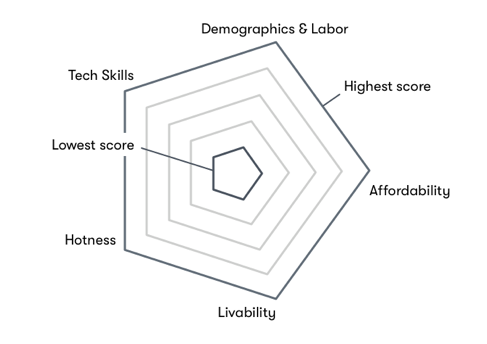
We zeroed in on five categories that determine how ripe markets are for tech growth: 1) demographics and labor market dynamics — factors that indicate a robust economy; 2) tech skills — factors that indicate the market has ready or potential talent; 3) market “hotness” — factors that indicate that the market has the potential to attract people; 4) housing affordability — factors that indicate how affordable housing is; and 5) livability — factors that indicate the appeal of living in that market.

five categories that determine how ripe markets are for tech growth

Five categories that determine how ripe markets are for tech growth.

Topping the list of markets that may beckon to startups are those smack in the middle of Silicon Prairie. Rounding out the top 10 are markets in the Midwest and the South that have the ability to draw talent and the tech companies looking to hire them. What’s more, the traditional tech hubs occupied the bottom of the rankings because of eroding affordability and quality of life.

“Rising costs of living and soaring housing prices in many major U.S. cities means that employers need to build pay structures that allow their employees to live and work in the same city. And if they don’t, they may end up paying the price,” said Jenny Ying, Data Scientist, Economic Graph at LinkedIn. “Our data shows that many people will choose to leave the area altogether in search of a better quality of life, a trend we already see starting to manifest in many of the country’s biggest tech hubs; New York, Los Angeles, the San Francisco Bay Area and Seattle have the lowest tech skills scores on the list, driven by demand for this talent outpacing available supply.”

Affordable markets

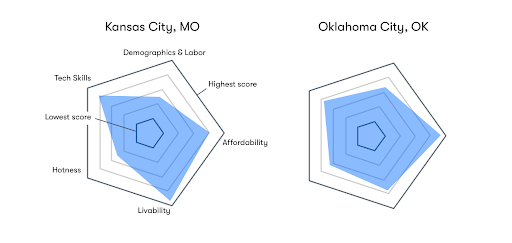
Oklahoma City and Kansas City lead the list of markets where tech companies should consider locating. These cities rank high in affordability — where typical income earners are spending a relatively smaller share of their income on housing, livability (Kansas City tops the list in this category) and the availability of tech skills. 

Oklahoma City and Kansas City lead the list of markets where tech companies should consider locating.

Oklahoma City and Kansas City lead the list of markets where tech companies should consider locating.

Hot markets

04 Nov 2019

Founder of language learning platform Babbel steps down as co-CEO to focus on board role

Babbel, the popular Berlin-based language learning service, today announced that its founder and current co-CEO Markus Witte is stepping down from his CEO role but that he will remain the executive chairman of the company’s board. The company’s current co-CEO Arne Schepker will become Babbel’s sole CEO.

In addition to these leadership changes, the company also today announced that it has appointed Katherine Melchior Ray, who held previous executive positions with luxury consumer brands like Japan’s Shiseido, Hyatt Hotels, Tommy Hilfiger, Gucci and Louis Vuitton, as its new Chief Marketing Officer.

All of these changes come as Babbel ends as Babbel hits 100 million Euro in revenue for its 2018 financial year.

As Witte and Schepker told me in an interview ahead of today’s official announcement, there were a few reasons why the team decided that this would be the best way forward. And while it’s unusual for U.S. founders to step back from their CEO role, especially as a company is hitting a new growth phase, Witter argues that going forward, being the chairman of the board will put him in the best position to ensure the company’s future going forward.

“Being CEO and chairman of the board has pros and cons,” Witte told me. “To say that the founder and chairman are one and the same person, that’s the West Coast model — and every now and then, that has its advantages. But it’s not what people would consider good governance in Europe and at times, it makes things harder because it creates a conflict of interest in board meetings.”

Those conflicts, Witte argues, made him less effective in the chairman role and in addition, he believes that Babbel has now reached a point where chairman and CEO just can’t be the same person anymore. And so he decided that if he had to choose, he’d stay as chairman of the board because that’s the role where he can ensure that Babbel remains true to its mission.

He also admitted that as the company grew, the workload became a bit too much. “CEOs like to overestimate themselves and I’m no exception,” said Witte. “But you get to the point where you have to say: I can’t fill all of these roles anymore.”

With Schepker, Babbel had brought on an outsider as CMO a few years ago who proved himself in the co-CEO role and was, in Witte’s view, ready for the CEO role, making his decision easier.

Schepker tells me that the company doesn’t plan to change its overall strategy going forward. “We have a clear strategy and we plan to implement that even faster — but that’s independent of these leadership change,” he told me. “The focus is on how we can create more value for our customers, our learners, by looking at how we can better guide them through their personal learning journey. The problem that most learners face is that, unless they studied it in college, they never learned how to effectively learn a new language.”

In practical terms, this means that Babbel will look at expanding the range of language learning opportunities for its users to better guide them through their learning experience (and for longer).

04 Nov 2019

Apple commits $2.5 billion to address California’s housing crisis and homelessness issues

Apple announced this morning a significant $2.5 billion commitment towards easing the California housing availability and affordability crisis. The investment includes a $1 billion commitment to an affordable housing investment fund, $1 billion towards a first-time homebuyer mortgage assistance fund, and $300 million in Apple-owned land which will be made available for affordable housing.

Another $200 million will go to support new, lower-income housing in the Bay Area including by way of a $150 million Bay Area housing fund, with partners like Housing Trust Silicon Valley. This will consist of long-term forgivable loans and grants. Another $50 million will be directed towards vulnerable populations, specifically to address homelessness in the Silicon Valley area.

Apple says it will also look into similar efforts across both Northern and Southern California that are designed to prevent homelessness.

The company says the full commitment in the state — which is being done in parntership with Governor Gavin Newsom, the state of California, and community-based organizations — will take approximately two years to be fully utilized, and will depend on the availability of projects. The capital returned to Apple will also be reinvested in future projects over the next five years.

The investment comes at a time when the housing crunch in Calfornia has forced people from their homes, Apple explained in its announcement.

“Community members like teachers, firefighters, first responders and service workers are increasingly having to make the difficult choice to leave behind the community they have long called home. Nearly 30,000 people left San Francisco between April and June of this year1 and homeownership in the Bay Area is at a seven-year low,” Apple said.

The housing crisis didn’t develop overnight, nor is the tech industry’s growth the only reason there’s now an issue.

Like most complexities, the crisis arose from a combination of factors including also the area’s local laws, zoning regulations, protests against building vertically, NIMBY-ism, rental control’s impact on the market, the restricted housing supply and much more.  But tech has played a big role here, having led to a disparity between the wealthy tech workers and everyone else as well as contributing to rapid population growth that’s outpaced the growth in the housing supply.

Today, many area residents can’t afford to live in the cities where they work, commuting an hour or more from more affordable neighborhoods.

“Before the world knew the name Silicon Valley, and long before we carried technology in our pockets, Apple called this region home, and we feel a profound civic responsibility to ensure it remains a vibrant place where people can live, have a family and contribute to the community,” said Tim Cook, Apple’s CEO, in a statement. “Affordable housing means stability and dignity, opportunity and pride. When these things fall out of reach for too many, we know the course we are on is unsustainable, and Apple is committed to being part of the solution.”

Apple isn’t the first tech giant to make a contribution in an attempt to address the housing crisis. Facebook last month announced $1 billion to tackle affordable housing in California and elsewhere. Google earlier this year also announced a $1 billion investment aimed at easing the Bay Area housing crisis. Elsewhere, Microsoft committed $500 million for an affordable housing fund in the Seattle area.

The fact that the tech giants have to step in to address the problems — which do, in fact, impact their own businesses as they need to be able to hire more than the just high-paid engineers — is concerning. While some would applaud the sizable investments as proof of tech’s ability to be a good neighbor to their local communities, others would say we should just be taxing these companies more so the money is available to solve the problems upfront — instead of it going into loans that actually earn these companies more. Nor should they be invested into million- or billion-dollar programs that give these tech companies an incredible amount of influence in local politics.

But it could also be that crisis has gotten so out of control, it can no longer be solved at the local level.

“This unparalleled financial commitment to affordable housing, and the innovative strategies at the heart of this initiative, are proof that Apple is serious about solving this issue. I hope other companies follow their lead,” said Newsom. “The sky-high cost of housing — both for homeowners and renters — is the defining quality-of-life concern for millions of families across this state, one that can only be fixed by building more housing. This partnership with Apple will allow the state of California to do just that.”


04 Nov 2019

New York’s ERA invests in esports org Gen.G

Esports are the wild wild West right now. There’s clearly a huge potential for the industry to become incredibly lucrative, but everything from the infrastructure of competition to the overall culture isn’t quite ready for prime time.

This introduces a huge opportunity for the tech world to get in on the action. We’ve seen traditional VC money start to sniff around esports in ways big and small. Bessemer Venture Partners has invested in Team SoloMid, while Sequoia has invested in 100 Thieves.

Today, Gen.G has announced that it has accepted investment from the Entrepreneurs Roundtable Accelerator, a longstanding New York City-based accelerator program.

Gen.G started as KSV (Korea plus Silicon Valley) in mid-2017 with a debut in the Overwatch League. In 2018, after expanding to other games including Heroes of the Storm, PUBG and League of Legends, KSV eSports rebranded to Generation Gaming (Gen.G) and launched a Clash Royale esports team.

At the end of 2018, Gen.G made yet another huge move. They lured Chris Park from his position as executive vice president in charge of product and marketing at Major League Baseball to join Gen.G as CEO.

Since, Park has been thinking about the long-term opportunities for the esports org and the industry as a whole. He secured $46 million in funding from Los Angeles Clippers minority owner Dennis Wong, Will Smith’s Dreamers Fund, NEA, Battery Ventures, Canaan Partners, SVB Capital and Stanford University, among others.

He signed a partnership with dating app Bumble to create Team Bumble, an all-female professional Fortnite squad.

Gender inclusion is one of the biggest misses in the esports world right now. Data shows that 46 percent of gamers are female (ESA) and that nearly one in four esports viewers are female (Nielsen). Despite no physical differentiators between men and women, women are severely underrepresented in the esports world.

Not one female competed in the Fortnite World Cup in 2018, despite the fact that qualifiers were completely open to any player. A big reason for the disparity here is that the gaming community isn’t generally a safe environment for female gamers, in big and small ways. Many female gamers experience abuse while playing games, like this streamer, and it’s gotten bad enough to push a small percentage of female gamers away from playing entirely.

But exclusion comes in many forms. Ninja announced in August 2018 that he won’t be streaming with female gamers, which you can read about here.

Beyond general principles about equality, the female gamer is a lucrative demographic that has yet to be properly tapped by any particular esports org, publisher, or otherwise. Gen.G is now ahead in the race to acquire female gamers as fans, customers and future talent.

Another forward-thinking move by Gen.G is its recent partnership with the University of Kentucky to help create and manage its esports program. We’ve seen startups like PlayVS look to build out the infrastructure and connective tissue that will eventually bind education and professional sports, as has been the case with traditional sports for generations. Gen.G is now tackling that ever-important bridge from academia to professional life by looking at universities.

The funding from ERA, the amount of which has not been disclosed, not only allows Gen.G to grow its foothold on the East Coast. It also gives the esports org a strategic partnership with ERA, which invests in super early stage tech startups. As more founders tackle the mounting challenges in esports, Gen.G is now in a prime position to watch over those deals closely and potentially tap into some of the solutions and services sure to sprout up in the next five to ten years.

“We are focused on ways to make it easier for people in the gaming community to connect,” said Chris Park, hinting at some of the technology that Gen.G is interested in. “My hope is that over time, platforms as well as teams treat fans and athletes as more than just users, and more like collaborators and partners.”

04 Nov 2019

Adobe is bringing Illustrator to the iPad in 2020

Adobe will be bringing another of its desktop-class imaging and graphics apps to the iPad: Illustrator, which is set for a launch win 2020, the company announced today at its annual MAX conference. Last year, Adobe announced a similar plan to deliver Photoshop for iPad, and that app launched on the App Store early on Monday.

Illustrator for iPad is still in “early” development, the company said, so we don’t know exactly what it’ll look like relative to the desktop version. But it will focus on making the most of touch and Apple Pencil-based input, which are uniquely available to the iPad. As with Photoshop, documents created on one platform will be available in full fidelity to edit on any others via Creative Cloud storage.

The app will be available in a limited private beta beginning immediately, but the group of those with access will remain very tight until Adobe has managed to get further along in the development process. You can sign up now to register interest, however, and maybe you’ll gain access sometime earlier than official launch to help with the beta and building process.

Adobe says it’s already been in touch with “thousands of designers” to understand how best to build them a version of Illustrator that works best for how they use tablets in their work. If the Photoshop for iPad release process is any measure, at launch next year Illustrator won’t offer feature parity, but it’s a starting point for turning the iPad into a true one-stop shop for creative pros who favor an Adobe working environment.

04 Nov 2019

Boeing’s Starliner crew spacecraft launch pad abort test is a success

NASA’s commercial crew partner Boeing has achieved a key milestone on the way to actually flying astronauts aboard its CST-100 Starliner: Demonstrating that its launch pad abort system works as designed, which is a key safety system that NASA requires to be in place before the aerospace company can put astronauts inside the Starliner.

The Starliner’s demonstration mission involved starting from a standing position designed to simulate how it would be set up on top of the ULA Atlas 5 rocket during an actual crewed launch. It then activated its abort engines, which helped push the Starliner and its service module to a safe distance away from the launcher rocket. One issue is that only two out of three parachutes deployed, which will have to be investigated, but the actual fault tolerance defined by NASA here allows and anticipates that as a possibility.

The need for this system is described as a very ‘unlikely’ scenario by Boeing and NASA, but the agency and its partners are emphasizing safety as they develop both Boeing’s and SpaceX’s new crew transportation spacecrafts.

There’s an anthropomorphic test dummy on board, loaded with sensors that will provide Boeing and NASA with all the data they need about what the abort system impact would be on an actual human sitting in that Starliner, were this an actual incident with astronauts involved. That will provide further data about how people would’ve experienced the abort, which will be key information in addition to finding out why that third parachute didn’t fire.

In December, Boeing plans to launch its first uncrewed Starliner to the ISS for the next step ahead of launching with people on board. That remains on track based on an initial interpretation of these results.