Year: 2019

02 Nov 2019

This Week in Apps: iOS 13 complaints, Q3 trends, App Store ratings bug

Welcome back to This Week in Apps — the easiest way to keep up with everything that happened in the world of apps over the past week — from the breaking news to the trends and all the other information an industry watcher needs to know.

The app industry is as hot as ever, with 194 billion downloads in 2018 and more than $100 billion in consumer spending. People spend 90% of their mobile time in apps and more time using their mobile devices than watching TV. In other words, apps aren’t just a way to waste idle hours — they’re big business, and one that often seems to change overnight.

In this Extra Crunch series, we help you to keep up with the latest news from the world of apps.

This week, we’re looking at that one iOS 13 bug everyone is complaining about, App Store Q3 trends, plus the latest revenue numbers announced by Apple and Google during quarterly earnings. We’ve also found a new product for figuring out what may have caused spikes or changes in an app’s history, and we’re tracking new information about Microsoft’s Xbox Console to mobile streaming service as well as Google’s Motion Sense.

And more!

To get this information, subscribe to Extra Crunch.

Headlines

Everyone is complaining about iOS 13 killing background apps

Apple released iOS 13.2 with Deep Fusion this week. The release also included new emoji, Siri recording opt-out, bug fixes and security improvements. But it didn’t solve the background app bug.

As a result, developers are angry and users are frustrated. A number of iOS 13 users are complaining about iOS 13’s aggressiveness in killing background apps and tasks, which is attributed to poor RAM management. This particularly affects apps like Safari, YouTube, Overcast and others. Users have lost Safari tabs, emails they were composing, or the video they were watching just after switching away for a minute.

The complaints are all over Twitter, Reddit, and Apple’s own forums. A MacRumors post about this has over 400 comments.

This has been a problem since the betas, but people were hoping they’d be addressed by the public releases. Apple hasn’t clarified what’s at fault here, but there’s speculation about the impact of the memory-intensive camera system.

As TechCrunch editor Matthew Panzarino put it, it “feels like I’m back on iOS 3.”

Developer Nick Heer of Pixel Envy says the bug isn’t catastrophic, but “it absolutely should be the highest of priorities to fix it. It’s embarrassing that all of the hard work put into making animations and app launching feel smooth is squandered by mismanaged multitasking,” he says.

Radar filed.

Consumers spent more than $500M on photo/video apps in Q3

Outside of mobile games, entertainment and streaming apps are also pulling in the big money. But there’s another category benefiting from the shift to the subscription model: photo and video apps. In this category, you’ll find apps that promise to touch up photos, add filters that can make or break Instagram careers, as well as the video giants like YouTube and TikTok.

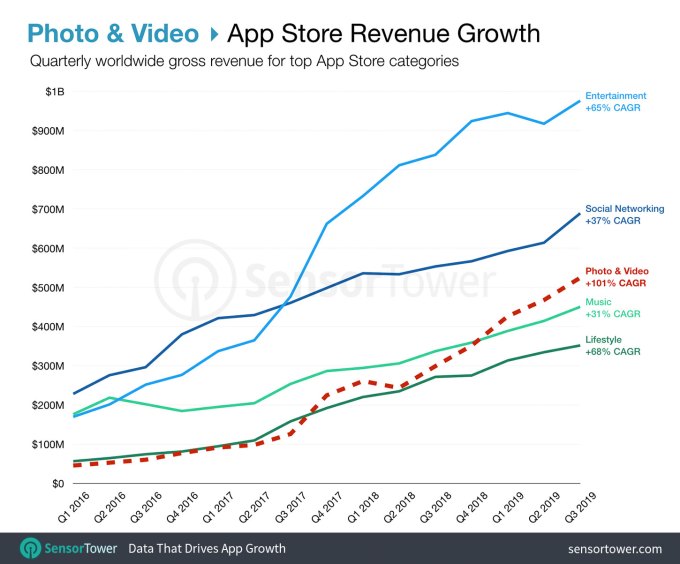
photo and video app store revenue growth q3 2019

In Q3, the category grossed more than $500 million, up a whopping 75% year-over-year, says Sensor Tower. It’s also seeing an annual growth rate of 101% since 2016. Much of this is attributable to YouTube, which alone was responsible for 30% of the category’s revenue in Q3. (Just wait until TikTok takes in-app monetization seriously, though.)

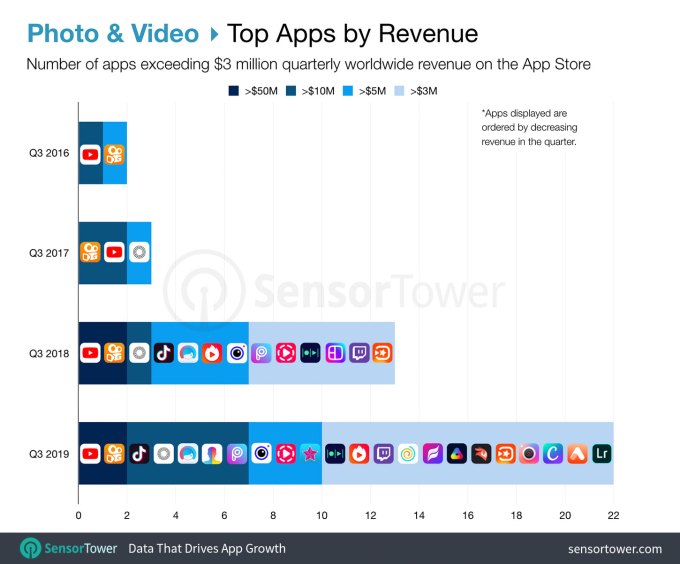
top apps photo and video app store revenue q3 2019

But now, it’s not just the top apps that are growing. In Q3, 22 apps exceeded $3 million in gross user spend, compared to just 2 in Q3 2016. And 7 apps had more than $10 million in revenue, including TikTok, VSCO, Facetune 2, FaceApp, and PicsArt.

02 Nov 2019

Startups Weekly: Understanding Uber’s latest fintech play

Hello and welcome back to Startups Weekly, a weekend newsletter that dives into the week’s noteworthy startups and venture capital news. Before I jump into today’s topic, let’s catch up a bit. Last week, I wrote about how SoftBank is screwing up. Before that, I noted All Raise’s expansion, Uber the TV show and the unicorn from down under.

Remember, you can send me tips, suggestions and feedback to kate.clark@techcrunch.com or on Twitter @KateClarkTweets. If you don’t subscribe to Startups Weekly yet, you can do that here.


Uber Head of Payments Peter Hazlehurst addresses the audience during an Uber products launch event in San Francisco, California, on September 26, 2019. (Photo by Philip Pacheco / AFP) (Photo credit should read PHILIP PACHECO/AFP/Getty Images)

The sheer number of startup players moving into banking services is staggering,” writes my Crunchbase News friends in a piece titled “Why Is Every Startup A Bank These Days.”

I’ve been asking myself the same question this year, as financial services business like Brex, Chime, Robinhood, Wealthfront, Betterment and more raise big rounds to build upstart digital banks. North of $13 billion venture capital dollars have been invested in U.S. fintech companies so far in 2019, up from $12 billion invested in 2018.

This week, one of the largest companies to ever emerge from the Silicon Valley tech ecosystem, Uber, introduced its team focused on developing new financial products and technologies. In a vacuum, a multibillion-dollar public company with more than 22,000 employees launching one new team is not big news. Considering investment and innovation in fintech this year, Uber’s now well-documented struggles to reach profitability and the company’s hiring efforts in New York, a hotbed for financial aficionados, the “Uber Money” team could indicate much larger fintech ambitions for the ride-hailing giant.

As it stands, the Uber Money team will be focused on developing real-time earnings for drivers accessed through the Uber debit account and debit card, which will itself see new features, like 3% or more cash back on gas. Uber Wallet, a digital wallet where drivers can more easily track their earnings, will launch in the coming weeks too, writes Peter Hazlehurst, the head of Uber Money.

This is hardly Uber’s first major foray into financial services. The company’s greatest feature has always been its frictionless payments capabilities that encourage riders and eaters to make purchases without thinking. Uber’s even launched its own consumer credit card to get riders cash back on rides. It’s no secret the company has larger goals in the fintech sphere, and with 100 million “monthly active platform consumers” via Uber, Uber Eats and more, a dedicated path toward new and better financial products may not only lead to happier, more loyal drivers but a company that’s actually, one day, able to post a profit.


VC deals


Meet me in Berlin

The TechCrunch team is heading to Berlin again this year for our annual event, TechCrunch Disrupt Berlin, which brings together entrepreneurs and investors from across the globe. We announced the agenda this week, with leading founders including Away’s Jen Rubio and UiPath’s Daniel Dines. Take a look at the full agenda.

I will be there to interview a bunch of venture capitalists, who will give tips on how to raise your first euros. Buy tickets to the event here.


Listen to Equity

This week on Equity, I was in studio while Alex was remote. We talked about a number of companies and deals, including a new startup taking on Slack, Wag’s woes and a small upstart disrupting the $8 billion nail services industry. Listen to the episode here.

Equity drops every Friday at 6:00 am PT, so subscribe to us on iTunesOvercast and all the casts.

02 Nov 2019

Amazon now sells movie tickets in India

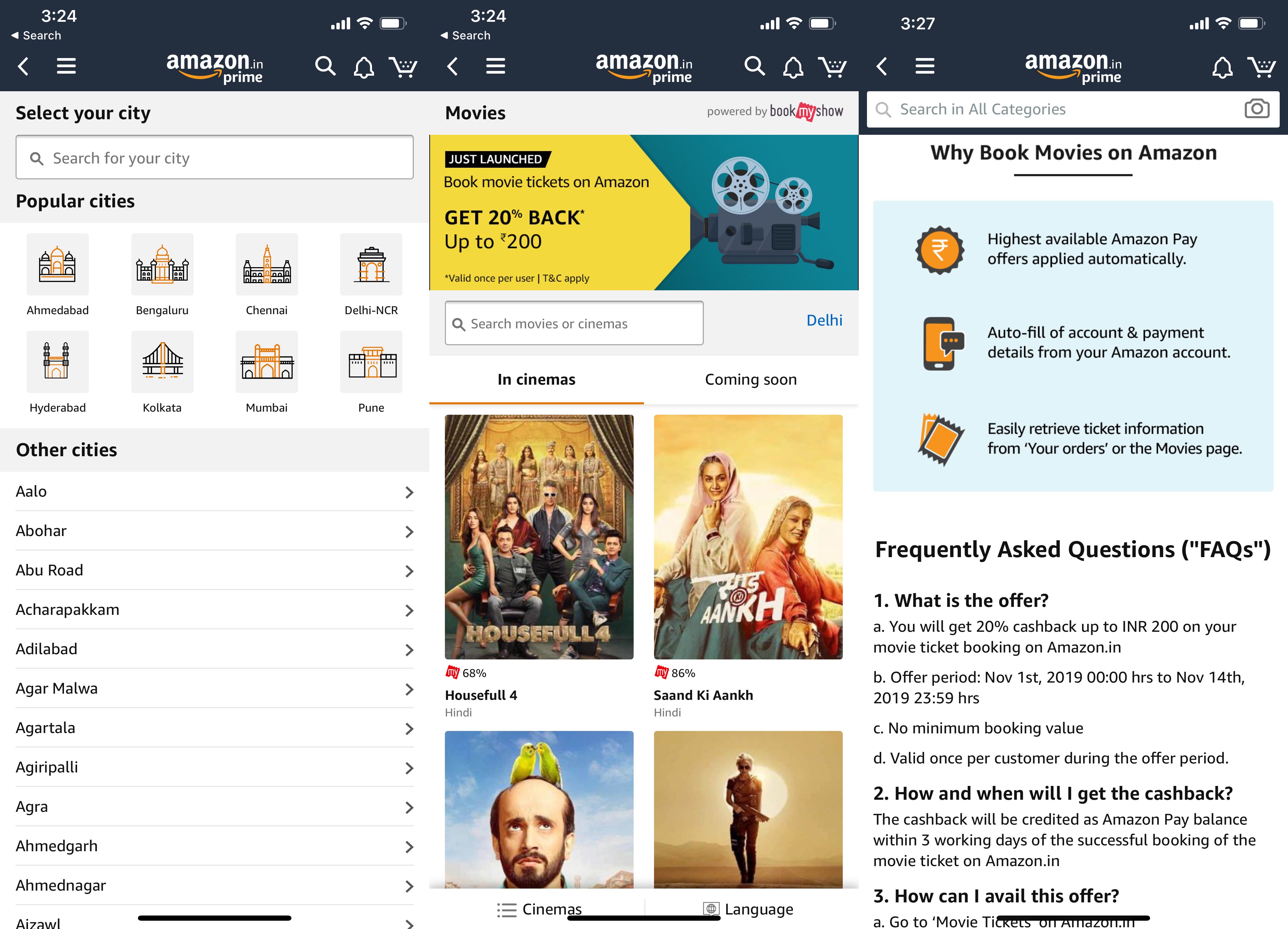
Amazon has set its eye on the next business it wants to disrupt in India: online movie tickets. The e-commerce giant said Saturday it has partnered with online movie ticketing giant BookMyShow to offer booking option on its shopping site and app.

The move comes months after the e-commerce giant began offering flight ticketing option in the country as it races to turn its payments service Amazon Pay into a “super app” — a strategy increasingly employed by players in emerging markets such as India.

Starting today, Amazon users in India can book their movie tickets from the “movie tickets” category under “shop by category” or the Amazon Pay tab, the e-commerce firm said. BookMyShow, which leads the online movie ticketing market, is the exclusive partner for this new offering, the two said.

Neither of the parties disclosed the financial arrangements of the deal, but BookMyShow is likely paying Amazon a fee for tapping “millions” of customers the e-commerce giant has amassed in the country.

Amazon said its credit card users in India will get a 2% cashback on each movie ticket purchase. On its app, the company adds until November 14. it will also offer cashback of up to Rs 200 on each ticket purchase.

For its flight ticketing service, Amazon India partnered with Cleartrip . Balu Ramachandran, SVP at Cleartrip, told TechCrunch in an interview earlier that the company was paying a promotional fee to Amazon, but declined to offer specifics.

An Amazon India spokesperson declined to comment on the financial arrangements.

BookMyShow, which employs 1,400 employees, sells about 15 million tickets each month. The service, which has a presence in over 650 towns and cities, today counts heavily-backed Paytm as one of its biggest rivals. Paytm, which entered the movie ticketing business three years ago, has been able to eat some of BookMyShow’s market share by offering cashback on each ticket purchase.

The media and entertainment business in India is worth $23.9 billion, a report from EY-FICCI said in March this year, which noted that consumer spendings on the web is increasingly growing. More than 50% of all tickets sold by the top four multiplex chains in the country have occurred on the web.

Ashish Hemrajani, founder and CEO of BookMyShow, said through the partnership the company will be able to access Amazon India’s “deep penetration across tier 2 and tier 3 cities.”

Mahendra Nerurkar, Director of Amazon Pay, said today’s partnership shows Amazon’s commitment to “simplify the lives of our customers in every possible way — as they shop, pay bills, or seek other services.”

Last month, Amazon introduced a new feature that allows Amazon Pay users to pay their mobile, internet, and utility bills. This is the first time Amazon is offering these functionalities in any market (it plans to bring this to the U.S. in coming months).

Amazon has been quietly expanding its payments offering, built on top of UPI payments infrastructure, in the country. Unlike its global rivals Google and Walmart that offer standalone apps for their payment services and also focus on transactions among customers, Amazon has kept Pay integrated with its e-commerce offering and focused on consumer-to-business transactions.

The company maintains tie-ups with several popular Indian online services and frequently offers cashback to incentivize users to pick Amazon Pay over other solutions. Earlier this week, Amazon pumped about $634 million into its India business.

01 Nov 2019

Los Angeles-based BuildOps, subcontracting software for real estate, raises $5.8 million

Software development companies tackling services for niche industries, like commercial real estate subcontracting, continue to find Los Angeles to be fertile ground for development.

The latest company to raise funding from a clutch of investors is BuildOps, which raised $5.8 million in seed financing from some big names in the Los Angeles tech ecosystem.

Led by Fika Ventures, with additional investments from MetaProp VC, Global Founders Capital, CrossCut Ventures, TenOneTen, IGSB, 1984 Ventures, L2 Ventures, GroundUp, NBA all-star Metta World Peace, Oberndorf Enterprises, Wolfson Group, and scouts from Sequoia Capital, the new financing will be used to support the company’s continued growth.

BuildOps sells software that integrates scheduling, dispatching, inventory management, contracts, workflow and accounting into a single software package for commercial real estate contractors with staff ranging from a few dozen to several hundred employees.

Software for the service industry is nothing new for Los Angeles entrepreneurs. The unicorn ServiceTitan hails from the greater Los Angeles area and a number of other software as a service businesses are calling the greater Los Angeles area home.

It’s hard to argue with the size of the commercial construction market. Over the past three years commercial construction spending grew from $626 billion to $807 billion, according to data provided by the company. And while most large vendors — architects, general contractors and property management companies have some project management software, the fragmented group of subcontractors that provide services to those customers has remained resistant to adopting new technologies, the company said.

Co-founded by former ServiceTitan devel

oper Neeraj Mittal; Microsoft, Nextag, Swurv, and Fundly former executive Steve Chew; and Alok Chanani, who previously founded a commercial real estate company and was a former commander of a transportation unit of the Army in Iraq.

“At BuildOps, we are on a mission to bring a true all-in-one solution on the latest technology to the people who keep America’s hospitals, power plants, and commercial real estate running. We are privileged to be working closely with some of the country’s top commercial contractors,” said Chanani.

That sentiment is echoed by Liquid 2 Ventures managing partner and former National Football League superstar, Joe Montana .

“Liquid 2 Ventures has an investment thesis in supporting America’s working class and I just love the idea of making their lives far easier and better. You have one solution that does it all and talks seamlessly to every single part of their business from parts to ordering to inventory and more,” said Montana in a statement. “There are very few world-class technology solutions for commercial subcontractors like this and we believe in the founders.”

01 Nov 2019

This startup is making customized sexual harassment training that it says employees won’t hate (or forget)

If you work for someone else, you know the drill: in comes that annual email reminding you that it’s time for unconscious bias or sexual harassment training, and if you could please finish up this mandatory module by this date, that would be terrific.

The email — not to mention the programming itself — is straight out of “Office Space.” Little surprise that when Anne Solmssen, a Harvard-trained computer scientist, happened to call a friend recently who was clicking through his own company-sponsored training program, his answer to how it was going was, “It’s more interesting when I have baseball on.”

Solmssen has some other ideas about how to make sexual harassment training far more interesting and less “cringe-worthy.” Indeed, she recently joined forces with Roxanne Petraeus, another Harvard grad, to create Ethena, a software-as-a-service startup that’s promising customizable training delivered in bite-size segments that caters to individuals based on how much they already know about sexual harassment in the workplace. The software will also be sector specific when it’s released more widely in the first quarter of next year.

The company first came together this past summer, led by Petraeus, who joined the U.S. Reserve Officers’ Training Corps to help defray the cost of her Ivy league education and wound up spending seven years in the U.S. Army, including as a civil affairs officer, before cofounding an online meals marketplace, then spending a year with McKinsey & Co. to get a better handle on how businesses are run.

Petraeus says that across her experience, and particularly in the Army, she had “great leaders who were super thoughtful” about sexual harassment training, “who cared about their [reports’] development goals and what was happening in their personal lives, and brought out the best in their people, rather than making them feel less than or marginalized.”

Still, she was aware that from an institutional standpoint, most harassment training is not thoughtful, that it’s a matter of checking boxes on an annual basis to ensure compliance with different state laws, depending on where an organization is headquartered. She marveled that so much of the content employees are being forced to consume seems “designed for a 1980s law firm.”

Solmssen was meanwhile working for a venture-backed public safety software company, Mark43. She was getting along just fine, too, but when a friend put the two in touch on the hunch that their engineering talent and vision could amount to something, that instinct proved right.

“I’d been working for Mark43 for four years, and I wasn’t particularly interested in starting a business,” Solmssen says. “But I fell in love with Roxanne and this idea, and I came to this thinking that someone needs to make [this training process] better. We’re still using the tools and technologies that we’ve had since 1997.”

So how is what they’re building different than what’s currently available? In lots of ways, seemingly. For starters, Ethena doesn’t want to employees to “knock it out all at once” in an hour or two of training at the end of each year. Instead, it’s creating what it calls monthly “nudges” that deliver relevant studies and questions on a monthly basis — information that can then be used in an all-hands meeting, for example, helping to reinforce its goals.

It’s also focused on sending content and questions to people that’s iterative and that evolves based on how an individual responds. A new hire might answer very differently than a sponsor of other women within an organization, for example. It’s a stark contrast to to the black-and-white scenarios that every employee is typically presented. (Think: “Judy and Brian go to a bar after work.”)

These subtleties are a significant development, argues Petraeus, because “traditional training implicitly tells employees that going to spending time together outside of work is bad for mentorship. It’s why you hear things like, ‘I just hired my first female analyst; can I get into an Uber with her when we’re traveling?'” Turning every mixed-gender occasion into a potential minefield is “not the message we should be conveying.”

Yet it’s a message that’s being absorbed.  According to a survey conducted earlier this year by LeanIn.Org and SurveyMonkey, 60% of managers who are men are now uncomfortable participating in a common work activity with a woman, such as mentoring, working alone, or socializing together. That’s a 32% jump from a year ago.  According to that same survey, senior-level men are now 12 times more hesitant to have one-on-one meetings with junior women, 9 times more hesitant to travel together and 6 times more hesitant to have work dinners together.

Even the U.S. Equal Employment Opportunity Commission thinks sexual harassment training has gone wrong somewhere, noting that it hasn’t worked as a prevention tool in part because it’s been too focused on simply avoiding legal liability. Indeed, a few years ago, a task force studying harassment in the workplace on behalf of the EEOC concluded that “effective training cannot occur in a vacuum – it must be part of a holistic culture of non-harassment that starts at the top.” Similarly, it added, “one size does not fit all: training is most effective when tailored to the specific workforce and workplace and different cohorts of employees.”

Toward that end, and with compliance in mind, Ethena is also modernizing the content it delivers, including as it pertains to dating at work, which definitely happens; and inclusivity around pregnant colleagues, who are often subtly marginalized; and transgender colleagues, who can also find themselves feeling either misunderstood or overlooked by current sexual harassment training materials.

There’s also a heavy focus on analytics. If 60 percent of employees don’t know about a company’s policies around office dating, for example, or employees in an outfit’s marketing department appear to know less about an organization’s values than other departments, it will flag these things so managers can take preventative action. (“Say there’s a new manager in the L.A. office where employees seem to be answering less consistently,” suggests Solmssen. “We can provide additional training to get that person up to speed.”)

For Petraeus — who is the daughter-in-law of retired general and former CIA director David Petraeus — the overarching goal is to kill off mandatory yearly training where the takeaway for many employees, the fundamental standard, is, “Can I go to jail for this comment?”

It’s too soon to say if Ethena will be successful. It’s only halfway through a pilot training program at the moment. But Solmssen and Petraeus are strong pitchmen, and they say their software will be available beginning in the first quarter of next year for $4 per employee per month, which is on a par with other e-learning programs.

The startup has also won the support of early backers who’ve already given the months-old outfit $850,000 to start hiring. Among those investors: Neo (a venture fund started last year by serial entrepreneur Ali Partovi), Village Global, and Jane VC, which is a fund focused on women-led startups.

Numerous angel investors have also written Ethena a check, including Reshma Saujani, who is the founder of the organization Girls Who Code, and a handful of military veterans.

As for the last, “they’re not a group that’s typically represented in startup ventures,” observes Petraeus, “but in terms of leadership and thinking about how to get a diverse team oriented around the same goal,” they’re hard to match, she adds.


01 Nov 2019

Reaction Engines’ Mach 5 engine is just the tip of the new aerospace boom

Imagine a hypersonic passenger aircraft that would cut the journey time between London and New York to around two hours. At Mach 5, or five times the speed of sound, the aircraft would complete a trip across the Atlantic in around 120 minutes. Mach 5 is more than twice as fast as the cruising speed of Concorde and over 50% faster than the SR-71 Blackbird – the world’s fastest jet-engine powered aircraft. A flight across the Pacific would take roughly three hours. Flight times from London to Sydney could be 80% shorter. Who needs Elon Musk?

Reaching these speeds would require an aircraft engine that has never previously existed. But last week, the world got a glimpse of a new future via a project which has been germinating for 30 years.

Reaction Engines was founded in 1989 by three propulsion engineers from Rolls Royce: Alan Bond, Richard Varvill and John Scott Scott. Their idea was that in order for an engine to reach hypersonic speeds, the air going into it would have to be rapidly cooled, otherwise the engine would melt. Reaction’s breakthrough was inventing a “precooler” or heat exchanger which can take the air down to minus 150 degrees centigrade in less than a 20th of a second.

These ultra-lightweight “heat exchangers” would enable aircraft to fly over five times the speed of sound in the atmosphere. Thus the SABRE – Synergetic Air-Breathing Rocket Engine – was born. The Sabre engine “breathes” air to make 20 per cent of the journey to orbit, before switching to rocket mode to complete the trip.

Last week, Reaction Engines passed a significant milestone. It successfully tested its innovative precooler at airflow temperature conditions representing Mach 5.

The ground-based test at the Colorado Air and Space Port in the US, saw the precooler successfully operate at temperatures of 420ᵒC (~788ᵒF) – matching the thermal conditions corresponding to Mach 3.3 flight.

Reaction Engines

But this technology wouldn’t just be applicable to hypersonic flight. The precooler technology, developed by Reaction Engines, would significantly enhance the performance of existing jet engine technology, along with applications in automotive, aerospace, energy and industrial processes. Reaction Engines has attracted development funding from the British government, the U.S. Defense Advanced Research Projects Agency (DARPA) and the European Space Agency. It’s also raised over £100m from public and private sources and has secured investment from BAE Systems, Rolls-Royce and Boeing’s venture capital arm HorizonX. Reaction is expected to start building and testing a demonstrator engine next year.

The success of Reaction Engines to date is a sign that the ‘AerospaceTech’ sector is now booming. It is most certainly not alone.

Last month, Boeing and the UK government launched a £2m accelerator program to look for new innovations in this area. Boeing’s HorizonX is backing the initiative.

01 Nov 2019

Backed by Will Smith and FabFitFun, OurPlace brings cookware and dinnerware direct to consumers

The husband and wife co-founders behind the direct-to-consumer cookware and dinnerware startup retailer OurPlace are big believers in the notion that the doorway to inclusive communities opens through the kitchen. 

Amir Tehrani, the company’s co-founder and chief executive spent, his life in the cookware and kitchen business, while his wife, Shiza Tehrani, is the co-founder of the Malala Fund, supporting educational initiatives for young women around the world, and Now Ventures, an impact seed investment fund based in Los Angeles.

The Los Angeles-based company is taking Shiza’s belief in social missions and the power of entrepreneurialism to transform communities, and Amir’s knowledge of the multibillion-dollar cookware and dinnerware business, to create a consumer-focused business that celebrates the culture surrounding cooking and uses it as a way to educate and inform — all while selling high-end pots, pans, plates and glasses to an audience of socially conscious consumers.

The project has received its initial capital from some pretty high-end backers. So far, the company has raised $2.35 million in financing from investors, including the venture arm of Los Angeles’ startup retail giant, FabFitFun and Will Smith’s Dreamers VC.

Two of the new products available from startup direct to consumer cookware and dinnerware brand OurPlace

The company’s initial line of dinnerware and cookware is manufactured in China and its glassware is manufactured in Thailand.

But the two executives have plans to source its future collections from artisans living in emerging markets around the world. “Our next collection is sourced from Oaxaca,” says Tehrani. “The Oaxaca line… it’s artisans making things out of their home. They’re making everything by hand and there’s no sophisticated machinery to speak of.”

The challenge, says Amir Tehrani, is to help these artisans begin producing products at scale, while staying true to the artisanal nature of the products.

Ultimately, the idea is to educate and inform consumers about the cultural context behind the products they buy, according to the company’s two founders.

There’s also a financial incentive to launch a direct-to-consumer brand, the founders say. It’s an industry that has yet to be disrupted by the technological innovations that have reshaped so many other retail markets, they say… and one that’s equally as large as the mattress industry.

By 2021, the cookware and dinnerware market is projected to be $12.7 billion, according to a study by Freedonia Focus Reports. By comparison, mattresses are about a $14 billion market in the U.S.

And it’s a market that Amir Tehrani knows well. His grandfather founded TableTops Unlimited, one of the largest white-label suppliers of kitchenware, cookware and dinnerware in the U.S. That experience is what brought investors like FabFitFun to the table.

“They understand our capabilities around the family business and they want to help bring it to their community as well,” says Amir Tehrani. “Aside from what they were already doing around fashion and cosmetics the largest opportunity they weren’t already doing was around cookware.”

01 Nov 2019

Waymo’s UX challenge: getting people to enjoy the ride

Google has been working on autonomous vehicles — one of the biggest challenges in AI — for more than a decade, but it’s learning that the hardest part might just be getting people to enjoy the ride.

“This is an experience that you can’t really learn from someone else,” Waymo’s Director of Product Saswat Panigrahi told TechCrunch, while explaining the work he oversees on user experience (UX) development. “This is truly new.”

The sheer novelty of designing a UX for driverless mobility has drawn Waymo away from hard science-based technologies where tech giants often feel most comfortable. In the place of data, sensor and neural net development, Waymo finds its driverless development gated by painstaking research into human factors and behavioral psychology. Despite making critical decisions to avoid delving into the mysteries of human behavior and interactions, Waymo is finding that such research is an unavoidable challenge on the road to driverless mobility.

“User research has always been a big part of the development process,” said Ryan Powell, the company’s head of UX Research and Design.

In 2012, when the Google Self-Driving Car program was “dogfooding” a highway-only driver assistance system called “AutoPilot,” its in-car cameras found that employees were over-relying on the limited automation in dangerous ways. As a result of videos showing Googlers putting on makeup, using multiple devices and even falling asleep while using the system that they’d been told required constant observation, the decision was made to cancel AutoPilot product plans and focus on fully autonomous driving. “That was a big moment for the user research team because we had a big impact on the work that we were doing at Waymo in terms of making that commitment to Level 4 autonomy,” Powell recalls.

01 Nov 2019

After signing a big food additive deal, cell-based protein company Geltor is looking for at least $50M

After inking what sources said was a nine-figure deal with the the world’s leading supplier of collagen proteins, Gelita, the cell-based collagen maker Geltor is in the market for at least $50 million in new funding, TechCrunch has learned.

According to people with knowledge of the company’s plans, the new funding could range from $50 million to as much as $100 million.

The money would be used to scale up the company’s collagen manufacturing capacity as it preps for the longterm Gelita contract.

Geltor is one of a slew of companies developing technologies to culture proteins at scale as a way to supplement and ultimately replace animal-based proteins in manufacturing.

While other companies pursue meat replacements using cultured products, Geltor is focused on another aspect of the supply chain. The collagen and gelatin additives that are typically made from the waste materials left over from the meat industry.

Traditionally, gelatin is made by boiling skin, cartilage, and bones from animals. The material finds its way into any number of cosmetics and foodstuffs thanks to its ability to act as a thickening agent.

The markets for collagen and gelatin are worth a combined $9 billion dollars, which is a pretty sizable market for Geltor to tackle.

Just as importantly, should the meat replacement industry take off, then replacements will need to be found for the secondary markets that had been supplied by the waste streams for traditional meat processing.

Geltor already sells an animal-free collagen under the “Collume” brand as a marine collagen and “HumaColl21”, which is a human collagen. Both products are used in the skincare market.

The agreement with Gelita marks the company’s first move into food and beverage additives.

“Gelita’s decision to invest in biodesign technologies is a prime example of our commitment to innovation and satisfying market needs,” said Hans-Ulrich Frech, Gelita’s Global Vice President of Business Unit Collagen Peptides in a statement last month. “This addition to GELITA’s collagen portfolio will complement the already robust portfolio of scientifically substantiated Bioactive Collagen Peptides®, which are key ingredients in foods and nutritional supplements for their protein content and physiological benefits.”

Meanwhile, for Geltor, the deal further proves out the company’s thesis that protein manufacturing can be a big business outside of the meat market that attracted players like Memphis Meats, Future Meat Technologies, and other companies developing cell culture replacements for traditional animal husbandry.

“This pact further solidifies our view that we have entered a new era in how proteins are being utilized to improve products that consumers around the world use every day,” said Alexander Lorestani, the chief executive of Geltor in a statement. “Today, the market is ready and eager for premium offerings of protein ingredients, and this is the need that Geltor is serving.”


01 Nov 2019

Can a combined Google/Fitbit take on the Apple Watch?

In January 2014, Google announced plans to acquire Nest for $3.2 billion; the acquisition was completed the following day, but since then, Nest’s integration has been a controlled burn. Initially, the company existed as a subsidiary of the newly-formed Alphabet Inc., but in early 2018, Google tightened its grip and integrated it directly into its hardware division.

Over the next year and a half, Nest became the face and name of Google’s smart home offering, a division that’s grown quickly as Google Home/Google Nest has become one of the top two players in the U.S. smart home category, rivaled only by Amazon’s Alexa/Echo offerings.

All the while, wearables have been an also-ran: Google has clearly had an interest in the category, launching Android Wear in 2014. The company partnered with some of consumer hardware’s biggest names, including Motorola, Asus, Sony, Huawei and LG, but to little fanfare. A year ahead the release of Android Wear (now Wear OS), Apple brought its own smartwatch to market, effectively leaving the competition in the dust.

The Apple Watch would soon eclipse the rest of the wearable industry; numbers from Canalys in August 2019 show Apple at 37.9 percent of the total North American wearable band market. Fossil, the only Wear OS partner to crack the top five, is in a distant fifth, with 4.1%.

Samsung and Garmin have found success with their own offerings, but both are far behind Fitbit at second place. Founded in 2007, Fitbit would eventually become synonymous with fitness trackers. A humble startup when it showcased its first product (an eponymous 3D pedometer) on stage at our TC50 event in 2008, Fitbit’s rise has been an unqualified success.

Fitbit predicted and eventually came to define the wearable zeitgeist, finding itself at the forefront of the next big wave in consumer electronics after the smartphone. As the mobile category has plateaued, wearables continue to grow at an impressive pace. Let’s take a moment to appreciate what has been an impressive run.

The last few years, however, have been far rockier as Fitbit stumbled and sputtered. By CEO James Park’s own admission, the company failed to embrace smartwatches quickly and fully enough, and as it has so many times in the past, Apple entered and dominated the space, leaving Fitbit reeling with an uncertain future.