Year: 2019

01 Nov 2019

Forecast raises $5.5M for its ‘AI-powered’ project management software

Forecast, a Denmark-based startup that has developed “AI-powered” project management software, has raised $5.5 million in new funding.

The round is led by Crane Venture Partners, with participation from existing backers SEED Capital and Heartcore. Forecast has raised $10 million in total funding to date.

Founded in late 2016, Forecast describes itself as an AI-powered project management solution that automates manual project management tasks, and brings extra visibility and predictive capabilities to to project management. The idea is to help increase collaboration across teams with a better workflow and to improve planning.

Forecast claims that by using its project management software, customers reduce their administrative tasks by 20-40% and gain much better insights into “project risk, resource management and more”.

“Work is going more project-based… leading to an increased need for project management skills and expertise,” Forecast co-founder and CEO Dennis Kayser tells TechCrunch. “Plus, projects are getting more complex. Project management depends on many manual, ongoing updates to stay on time, on budget and on track. That’s why 66% of all projects fail due to human error”.

In addition, as projects become more complex and the data associated with a project increases exponentially, Kayser says the problem is getting worse, which, of course, is where machine intelligence can help. “We don’t learn from our mistakes because no one can keep track of every influencing factor to make crucial adjustments,” he adds.

To tackle this, Forecast uses AI to help keep projects on track and make project management more efficient. The software integrates with existing tools — such as Trello, Slack, Gdrive, Githum and Salesforce — and uses these various external data-points as key indicators for how well a project is running.

“[It pulls in] data from disparate systems and synthesizes it into something human-readable with powerful AI,” explains Kayser. “Everyone on your team can continue to use the tool they prefer without sacrificing dead-simple scheduling, reporting and collaboration for project managers and senior executives. With better insights and tools, project managers can be more efficient and gain insights from increasingly complex projects”.

The use of AI is proactive, too. This includes matching the best person and role to the task, automation of time registration, forecasting the size and duration of tasks, and being alerted before a project is in trouble.

With regards to target customer, Kayser says that Forecast is focused on helping IT & services, marketing, and computer software development companies that “rely on capacity being predictable and project delivery being successful”.

Forecast currently has “hundreds of customers” in over 40 countries. The software has helped customers manage more than 40,000 projects with more than 1,000,000 tasks created.
01 Nov 2019

Altria writes down $4.5 billion from its investment in Juul

Facing increasing scrutiny from international and domestic regulators, the Altria Group has decided to write down its investment into the e-cigarette company JUUL by $4.5 billion.

That’s roughly one-third of the $12.8 billion that the tobacco giant had invested into JUUL a little less than one year ago.

What a difference a year has made.

JUUL, which has become synonymous with the vaping phenomenon that has swept the U.S., was once hailed as being at the forefront of a wave of companies that were making smoking obsolete and nicotine consumption safer for consumers.

The company began running into problems as its popularity increased exponentially (in part by allegedly turning to some of the same tactics big tobacco used to target underage consumers).

As the complaints began to roll in, and as JUUL was held responsible for an explosion in the use of tobacco products among underage Americans, the regulatory scrutiny also began to increase.

First the company was compelled to limit its sale of flavored tobacco products. Now it may be forced to pull all of its flavored products outright.

None of the company’s troubles have been helped by the wave of vaping related illnesses that have swept through the U.S. causing several deaths in users across multiple states.

Indeed, a new lawsuit against the company (filed two days ago) alleges that JUUL knowingly sold contaminated pods despite warnings from at least one employee.

First reported by BuzzFeed, the lawsuit was brought by Siddharth Breja, a former senior vice president of global finance at Juul from May 2018 to March 2019.

Breja alleges he was fired for complaining about the charge — a claim that a spokesperson for JUUL called “baseless”.

“[Breja] was terminated in March 2019 because he failed to demonstrate the leadership qualities needed in his role,”a spokesperson for JUUL wrote in an email. “The allegations concerning safety issues with Juul products are equally meritless, and we already investigated the underlying manufacturing issue and determined the product met all applicable specifications.”

The write down by Altria follows an announcement from JUUL that it intends to lay off around 500 people — or roughly 10% of its workforce.

01 Nov 2019

Japanese instant-credit provider Paidy raises $143 million from investors including PayPal Ventures

Paidy, a Japanese financial tech startup that provides instant credit to consumers in Japan, announced today that it has raised a total of $143 million in new financing. This includes a $83 million Series C extension from investors including PayPal Ventures and debt financing of $60 million. The funding will be used to advance Paidy’s goals of signing large-scale merchants, offering new financial services and growing its user base to 11 million accounts by the end of 2020.

In addition to PayPal Ventures, investors in the Series C extension also include Soros Capital Management, JS Capital Management and Tybourne Capital Management, along with another undisclosed investor. The debt financing is from Goldman Sachs Japan, Mizuho Bank, Sumitomo Mitsui Banking Corporation and Sumitomo Mitsui Trust Bank. Earlier this month, Paidy and Goldman Sachs Japan established a warehouse facility valued at $52 million. Paidy also established credit facility worth $8 million with the three banks.

This is the largest investment to date in the Japanese financial tech industry, according to data cited by Paidy and brings the total investment the company has raised so far to $163 million. A representative for the startup says it decided to extend its Series C instead of moving onto a D round to preserve the equity ratio for existing investors and issue the same preferred shares as its previous funding rounds.

Launched in 2014, Paidy was created because many Japanese consumers don’t use credit cards for e-commerce purchases, even though the credit card penetration rate there is relatively high. Instead, many prefer to pay cash on delivery or at convenience stores and other pickup locations. While this makes online shopping easier for consumers, it presents several challenges for sellers, because they need to cover the cost of merchandise that hasn’t been paid for yet or deal with uncompleted deliveries.

Paidy’s solution is to make it possible for people to pay for merchandise online without needing to create an account first or use their credit cards. If a seller offers Paidy as a payment method, customers can check out by entering their mobile phone numbers and email addresses, which are then authenticated with code sent through SMS or voice. Paidy covers the cost of the items and bills customers monthly. Paidy uses proprietary machine learning models to score the creditworthiness of users, and says its service can help reduce incomplete transactions (or items that buyers ultimately don’t pick up and pay for), increase conversion rates, average order values and repeat purchases.

31 Oct 2019

How you react when your systems fail may define your business

Just around 9:45 a.m. Pacific Time on February 28, 2017, websites like Slack, Business Insider, Quora and other well-known destinations became inaccessible. For millions of people, the internet itself seemed broken.

It turned out that Amazon Web Services was having a massive outage involving S3 storage in its Northern Virginia datacenter, a problem that created a cascading impact and culminated in an outage that lasted four agonizing hours.

Amazon eventually figured it out, but you can only imagine how stressful it might have been for the technical teams who spent hours tracking down the cause of the outage so they could restore service. A few days later, the company issued a public post-mortem explaining what went wrong and which steps they had taken to make sure that particular problem didn’t happen again. Most companies try to anticipate these types of situations and take steps to keep them from ever happening. In fact, Netflix came up with the notion of chaos engineering, where systems are tested weaknesses before they turn into outages.

Unfortunately, no tool can anticipate every outcome.

It’s highly likely that your company will encounter a problem of immense proportions like the one that Amazon faced in 2017. It’s what every startup founder and Fortune 500 CEO worries about — or at least they should. What will define you as an organization, and how your customers will perceive you moving forward, will be how you handle it and what you learn.

We spoke to a group of highly-trained disaster experts to learn more about preventing these types of moments from having a profoundly negative impact on your business.

It’s always about your customers

Reliability and uptime are so essential to today’s digital businesses that enterprise companies developed a new role, the Site Reliability Engineer (SRE), to keep their IT assets up and running.

Tammy Butow, principal SRE at Gremlin, a startup that makes chaos engineering tools, says the primary role of the SRE is keeping customers happy. If the site is up and running, that’s generally the key to happiness. “SRE is generally more focused on the customer impact, especially in terms of availability, uptime and data loss,” she says.

Companies measure uptime according to the so-called “five nines,” or 99.999 percent availability, but software engineer Nora Jones, who most recently led Chaos Engineering and Human Factors at Slack, says there is often too much of an emphasis on this number. According to Jones, the focus should be on the customer and the impact that availability has on their perception of you as a company and your business’s bottom line.

“It’s money at the end of the day, but also over time, user sentiment can change [if your site is having issues],” she says. “How are they thinking about you, the way they talk about your product when they’re talking to their friends, when they’re talking to their family members. The nines don’t capture any of that.”

Robert Ross, founder and CEO at FireHydrant, an SRE as a Service platform, says it may be time to rethink the idea of the nines. “Maybe we need to change that term. Maybe we can popularize something like ‘happiness level objectives’ or ‘happiness level agreements.’ That way, the focus is on our products.”

When things go wrong

Companies go to great lengths to prevent disasters to avoid disappointing their customers and usually have contingencies for their contingencies, but sometimes, no matter how well they plan, crises can spin out of control. When that happens, SREs need to execute, which takes planning, too; knowing what to do when the going gets tough.

31 Oct 2019

This tactile display lets visually impaired users feel on-screen 3D shapes

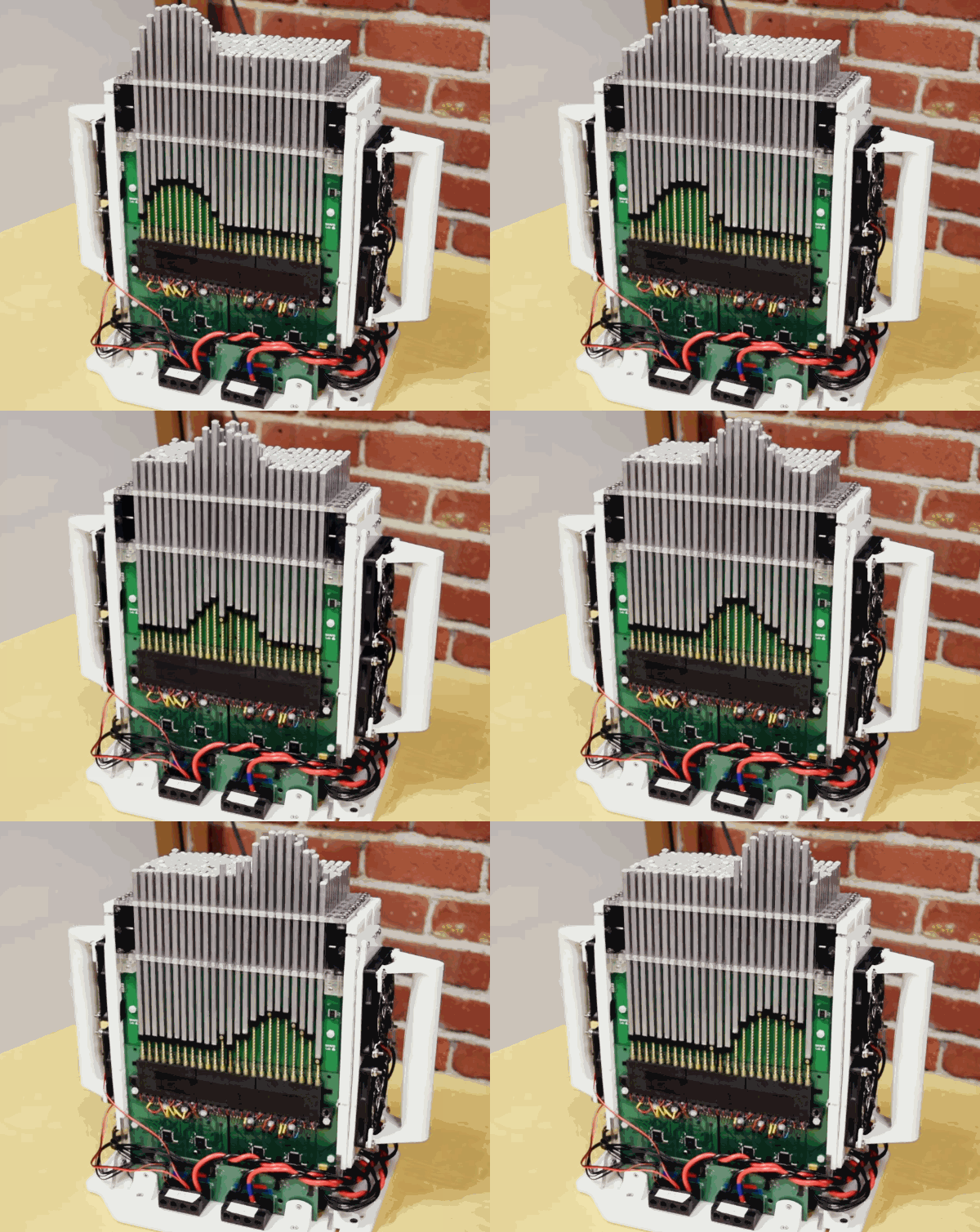
Using a computer and modern software can be a chore to begin with for the visually impaired, but fundamentally visual tasks like 3D design are even harder. This Stanford team is working on a way to display 3D information, like in a CAD or modeling program, using a “2.5D” display made up of pins that can be raised or lowered as sort of tactile pixels. Taxels!

The research project, a collaboration between graduate student Alexa Siu, Joshua Miele, and lab head Sean Follmer, is intended to explore avenues by which blind and visually impaired people can accomplish visual tasks without the aid of a sighted helper. It was presented this week at SIGACCESS.

tactile display2The device is essentially a 12×24 array of thin columns with rounded tops that can be individually told to rise anywhere from a fraction of an inch to several inches above the plane, taking the shape of 3D objects quick enough to amount to real time.
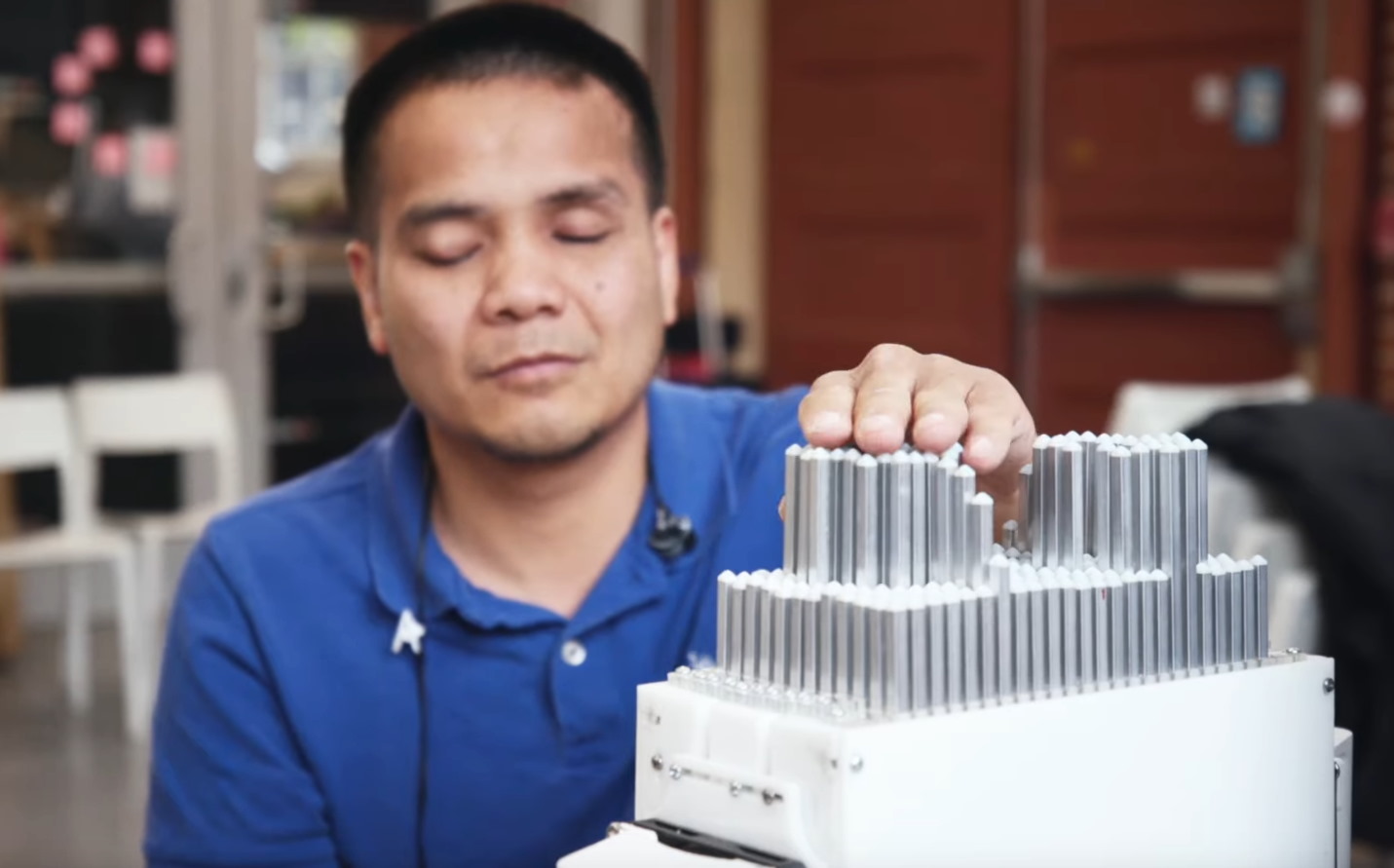


“It opens up the possibility of blind people being, not just consumers of the benefits of fabrication technology, but agents in it, creating our own tools from 3D modeling environments that we would want or need – and having some hope of doing it in a timely manner,” explained Miele, who is himself blind, in a Stanford news release.

Siu calls the device “2.5D,” since of course it can’t show the entire object floating in midair. But it’s an easy way for someone who can’t see the screen to understand the shape it’s displaying. The resolution is limited, sure, but that’s a shortcoming shared by all tactile displays — which it should be noted are extremely rare to begin with and often very expensive.

The field is moving forward, but too slowly for some, like this crew and the parents behind the BecDot, an inexpensive Braille display for kids. And other tactile displays are being pursued as possibilities for interactions in virtual environments.

Getting an intuitive understanding of a 3D object, whether one is designing or just viewing it, usually means rotating and shifting it — something that’s difficult to express in non-visual ways. But a real-time tactile display like this one can change the shape it’s showing quickly and smoothly, allowing more complex shapes like moving cross-sections to be expressed as well.

tac

Joshua Miele demonstrates the device.

The device is far from becoming a commercial project, though as you can see in the images (and the video below), it’s very much a working prototype and a fairly polished one at that. The team plans on reducing the size of the pins, which would of course increase the resolution of the display. Interestingly another grad student in the same lab is working on that very thing, albeit at rather an earlier stage.

The Shape Lab at Stanford is working on a number of projects along these lines — you can keep up with their work at the lab’s website.

31 Oct 2019

8th Wall’s new Cloud Editor helps customers quickly build mobile AR experiences

The world of phone-based AR has involved a lot of promises, but the future that’s developed has so far been more iterative and less platform shift-y. For startups exclusively focused on mobile AR, there’s been some soul-searching to find ways to bring more lightweight experiences to life that don’t require as much friction or commitment from users.

8th Wall is a team focused on building developer tools for mobile AR experiences. The startup has raised over $10 million to usher developers into the augmented world.

The company announced this week that they’ve built a one-stop shop authoring platform that will help its customers create and ship AR experiences that will be hosted by 8th Wall . It’s a step forward in what they’ve been trying to build and a further sign that marketing activations are probably the most buoyant money-makers in the rather flat phone-based AR space at the moment.

The editor supports popular immersive web frameworks like A-Frame, three.js and Babylon.js. It’s a development platform, but while game engine tools like Unity have features focused on heavy rendering, 8th Wall is more interested in “very fast, lightweight projects that can be built up to any scale,” the startup’s CEO Erik Murphy tells TechCrunch.

8th Wall’s initial sell was an augmented reality platform akin to ARKit and ARCore that allowed to developers to build content that supported a wider breadth of smartphones. Today, 8th Wall’s team of 14 is focused on a technology called WebAR that allows mobile phones to call-up web experiences inside the browser.

The main sell of WebAR is the same appeal of web apps; users don’t need to download anything and they can access the experience with just a link. This is great for branded marketing interactions where expecting users to download an app is pretty laughable, moving this process to the web with a link or a QR code makes life much easier.

The startup’s cloud-based authoring and hosting platform is available now for its agency and
business users.

31 Oct 2019

Small satellite startup Kepler opens sign-ups for its IoT developer kits

Kepler Communications, the Toronto-based startup that’s focused on developing and deploying shoebox-sized satellites to provide telecommunications services, is opening up registration for those interested in getting their first developer kits. These developer kits, designed to help potential commercial customers take advantage of its Internet of Things (IoT) narrowband connectivity deploying next year, will then be made available to purchase for elect partners next year.

This kind of early access is designed to give companies interested in using the kind of connectivity Kepler intends on providing a head start on testing and integration. Kepler‘s service is designed to provide global coverage using a single network for IoT operators, at low costs relative to the market, for applications including tracking shipping containers, railway networks, livestock and crops and much more. Kepler says that its IoT network, which will be made up of nanosatellites designed specifically for this purpose it plans to launch throughout next year and beyond, is aimed at industries where you don’t need high-bandwidth, as you would for say HD consumer video streaming, but where coverage across large, often remote areas on a consistent basis is key.

IoT connectivity provided by constellations of orbital satellites is an increasing are of focus and investment, as large industries look to modernize their monitoring and tracking operations. Startup Swarm got permission from the FCC to launch its 150-small satellite constellation earlierr this month, for instance, to establish a service to address similar needs.

Kepler, founded in 2015, has raised over $20 million in funding so far, and has launched two small satellites thus far, including one in January and one in November of 2018. The company announced a contract with ISK and GK Launch Services to deploy two more sometime in the middle of next year aboard a Soyuz rocket.

31 Oct 2019

Facebook sues OnlineNIC for domain name fraud associated with malicious activity

Facebook today announced it has filed suit in California against a domain registrar OnlineNIC and its proxy service ID Shield for registering domain names that pretend to be associated with Facebook, like www-facebook-login.com or facebook-mails.com, for example. Facebook says these domains are intentionally designed to mislead and confuse end users, who believe they’re interacting with Facebook.

These fake domains are also often associated with malicious activity, like phishing.

While some who register such domains hope to eventually sell them back to Facebook at a marked up price, earning a profit, others have worse intentions. And with the launch of Facebook’s own cryptocurrency, Libra, a number of new domain cybersquatters have emerged. Facebook was recently able to take down some of these, like facebooktoken.org and ico-facebook.org, one of which had already started collecting personal information from visitors by falsely touting a Facebook ICO.

Facebooks’ new lawsuit, however, focuses specifically on OnlineNIC, which Facebook says has a history of allowing cybersquatters to register domains with its privacy/proxy service, ID Shield. The suit alleges that the registered domains, like hackingfacebook.net, are being used for malicious activity, including “phishing and hosting websites that purported to sell hacking tools.”

The suit also references some 20 other domain names that are confusingly similar to Facebook and Instagram trademarks, it says.

Screen Shot 2019 10 31 at 1.27.38 PM

OnlineNIC has been sued before for allowing this sort of activity, including by Verizon, Yahoo, Microsoft, and others. In the case of Verizon (disclosure: TechCrunch parent), OnlineNIC was found liable for registering over 600 domain names similar to Verizon’s trademark, and the courts awarded $33.15 million in damages as a result, Facebook’s filing states.

Facebook is asking for a permanent injunction against OnlineNIC’s activity as well as damages.

The company says it took this issue to the courts because OnlineNIC has not been responsive to its concerns. Facebook today proactively reports instances of abuse with domain name registrars and their privacy/proxy services, and often works with them to take down malicious domains. But the issue is widespread — there are tens of millions of domain names registered through these services today. Some of these businesses are not reputable, however. Some, like OnlineNIC, will not investigate or even respond to Facebook’s abuse reports.

The news of the lawsuit was previously reported by Cnet and other domain name news sources, based on courthouse filings.

Attorney David J. Steele, who previously won the $33 million judgement for Verizon, is representing Facebook in the case.

“By mentioning our apps and services in the domain names, OnlineNIC and ID Shield intended to make them appear legitimate and confuse people. This activity is known as cybersquatting and OnlineNIC has a history of this behavior,” writes Facebook, in an announcement. “This lawsuit is one more step in our ongoing efforts to protect people’s safety and privacy,” it says.

OnlineNIC has been asked for comment and we’ll update if it responds.

31 Oct 2019

Supercross’s anticipated EV class not ready for primetime in 2020

Motorcycle racing series Supercross isn’t quite ready to add an EV class.

The sport — where riders race high-performance machines on jump-filled stadium tracks — currently fields only gas-powered two-wheelers.

Supercross was poised to launch an all electric class this month, by converting its junior program to a new e-moto manufactured by KTM — Supercross Director of Operations Dave Prater told TechCrunch in April.

“We haven’t one-hundred-percented it yet, but it’s fairly close and we’re…going to race that electric KTM in October,” he said.

That won’t likely happen for the upcoming 2020 season, but input from Supercross and KTM indicates the launch of a junior EV class could be imminent.

On why it didn’t kick-off in October, “That would be a KTM question,” Prater told TechCrunch on a call this week.

“As a company we’re embracing EV racing. At the moment, we’re beholden to the OEM’s and how quickly they want to introduce it into the mix,” he added.

The first-mover OEM could still be KTM and the first electric class the juniors.

“The KTM Junior racing in Supercross is an incredible experience for a small group of kids and their parents. At some point we might start using the SX-E5,” KTM’s Group Marketing Manager for North America Tom Moen told TechCrunch in an email.

“We can’t have them racing something that is not readily available,” he added.

KTM SX E 5 2020KTM’s SX-E5 launched in the U.S. this month, but won’t be available in dealerships until late November, according to Moen.

So for now, there appears to be a timing gap between Supercross and KTM.

Another area to watch for the introduction of e-moto competition — according to Moen — is outdoor dirt series Motocross, the rules of which (like Supercross) are governed by the American Motorcyclist Association (AMA).

“The AMA…is working on classes for the AMA Loretta Lynn’s championships for 2020, which is the national amateur MX series, the finals happen late summer, this is much more important racing wise,” Moen said.

TechCrunch has an inquiry into AMA for confirmation and will update accordingly.

One hurdle to entering electric motorcycles in AMA gas racing is how to classify battery powered two-wheelers compared to internal combustion engines that the AMA classes based on displacement, AMA off-road racing manager Erek Kudla explained to TechCrunch in April.

The other potentially larger hurdle (as Supercross’s Dave Prater alluded to) is the lack of an OEM produced competition e-moto capable of racing at or near the specs of the high-performance gas machines that run in Supercross and Motocross.

California based EV startup Alta Motors had come the closest toward creating an e-moto toward that endeavor, but went bankrupt before getting there.

In addition to its junior SX-E5, KTM debuted its Freeride E-XC adult off-road e-motorcycle in the U.S. in 2018, but KTM didn’t indicate if this was the bike it was planning to reconfigure for motocross.

For the moment, it looks like seven to eight-year-olds racing KTM’s SX-E5 in Supercross could be the nearest bet for EV motorcycle competition.

And Supercross creating an all EV junior class has a spot of relevance in the overall transformation of global mobility — namely the conversion of the motorcycle industry to electric.

Factors such as declining sales among young people and competitive pressure from EV startups are pushing the big names toward E offerings. Harley Davidson launched its first e-moto, the $29K  LiveWire, this year as part of a full EV pivot.

Zero Motorcycles is challenging HD with its new $19K SR/F.  And rumors have floated on Ducati developing an e-moto, after the Italian company debuted two e-bicycles.

Harley and e-moto companies such as Zero have spoken of the importance of early adopters to embrace e-motorcycles. Harley made moves this year to reach the earliest of early adopters when it acquired kids e-bicycle company StaCyc.

Launching one of motorcycle racing’s first all electric classes with juniors and pairing it to Supercross’s stadium venues could become more than an EV gateway for OEM KTM.

It could actually start young riders on e-motos before they’ve ever ridden gas and keep them running on voltage into teen and adult years.

For the motorcycle industry at large, that means creating a future EV market vs. trying convert one with preferences set in fossil-fuel the past.


31 Oct 2019

Sidewalk Labs (Alphabet’s grand experiment in smart cities) will move forward with Toronto project

In the two years since Sidewalk Labs pitched its vision for a grand smart city development — encompassing an entire neighborhood on the Toronto waterfront — the project has been beset by controversy and criticism on all sides.

On one hand, the 12-acre project in Toronto’s Quayside district promised to be a proving ground for the latest thinking in sustainable design and technology integration into urban planning led by a subsidiary of one of the world’s most innovative technology companies. On the other, that same technology company has been instrumental in the development of a corporate, technologically enabled, panopticon that has an almost total view into our digital (and physical) lives through its search and mapping technology.

Giving that company the potential for unfettered access to the built environment in which Toronto citizens would move seemed like a step too far for many privacy advocates in the city and around the world.

The public outcry had gotten so loud that the project seemed to be in jeopardy. That, in turn, likely would be an existential challenge to Sidewalk Labs, since the company’s work in Toronto was to be the early crown jewel proving out its ability to integrate technology into the built environment in a way that would benefit populations, the company argued.

Now, the project will move forward. Sidewalk and Waterfront Toronto (the regulatory body overseeing the project) have come to an agreement that will limit the scope of the Sidewalk development and make the company work more closely with oversight agencies on the construction of the 12-acre parcel abutting Toronto’s parliamentary building.

We are encouraged by today’s decision by the Waterfront Toronto board and are pleased to have reached alignment on critical issues with Waterfront Toronto. We want to be a partner with Waterfront Toronto and governments to build an innovative and inclusive neighborhood,” said Sidewalk Labs chief executive officer, Dan Doctoroff, in a statement.

Sidewalk is making some significant concessions to move forward. Under the initial plan that the company had submitted in June, it attempted to expand the scope of its development efforts beyond the initial 12-acres it had been bidding for. The company also wanted to be the lead developer of the land.

Instead, Sidewalk is acceding to the Waterfront Toronto counter-offer that it restrict its development to the 12-acre “beta site” initially carved out by the city. The company will also agree to work with Waterfront Toronto, which will lead a public procurement process for a developer to partner with Sidewalk Labs. Finally, Sidewalk Labs will also no longer lead the efforts to design and implement infrastructure. That’s now going to be handled by Waterfront Toronto.

“After two years in Toronto and engaging and planning with over 21,000 Toronto residents, we are looking forward to the next round of public consultations, entering the evaluation process, and continuing to develop a plan to build the most innovative neighborhood in the world. We are working to demonstrate an inclusive neighbourhood here in Toronto where we can shorten commute times, make housing more affordable, create new jobs, and set a new standard for a healthier planet.

One of the sticking points that the agreement between Sidewalk and the city doesn’t address is what’s going to be done with all of the data that the company will doubtless be collecting about the residents and visitors to this new intentional community.

Data privacy was one of the biggest concerns about the project. Indeed, at one point Sidewalk Labs proposed setting up an independent trust that would analyze and approve data collection in Quayside. The conflict between Sidewalk and its consultants drove one expert, Dr. Ann Cavoukian to step away from the work she was doing. Cavoukian wanted the data collection to be anonymized before it would be collected by any entity, and Sidewalk Labs was not willing to make that commitment on behalf of third parties.

Even with concerns over data collection, the experiment in urban planning has merit. Integrating technology to improve efficiencies in construction, energy generation, energy efficiency, traffic management and telecommunications could create a roadmap that other developments could follow. That’s a good thing. But those advancements should not come at the cost of an even greater erosion of personal privacy.

Ensuring that Sidewalk Labs can thread that needle in Toronto could actually improve the company’s chances to create a quilt of technologically advanced communities around the world.